

SUBJECT: FORENSIC ANALYSIS OF ARXIV:2604.09941v1 (FERRÍN ET AL. 2026) / SECULAR LIGHT CURVE AND COMET EVOLUTIONARY DIAGRAM OF EXOCOMET 3I/ATLAS
DATE: APRIL 15, 2026
CROSS-REF: THE PUBLICATION GAP | THE VERDICT | THE REFINED FUEL | THE OPERATING SYSTEM | THE FIFTH INSTRUMENT | THE ANCIENT ENGINE | THE OTHER HAND | THE RECEIPTS
DATA CONFIDENCE: VERIFIED (ARXIV PREPRINT, MPC PHOTOMETRIC DATABASE, COBS VISUAL OBSERVATIONS, JWST/SPHEREX/SOHO PRODUCTION RATE DATA FROM 97 CITED PAPERS, LARSON-SEKANINA IMAGE PROCESSING) + ANALYSIS (SENTINEL CROSS-REFERENCE WITH PRIOR REPORTING)
We are building the video side of this operation. If you want the briefings in a format you can watch, subscribe to The Sentinel Network on YouTube.
THE QUESTION
In 2005, a physicist at the University of Antioquia in Medellín, Colombia asked a question that would take him twenty years to answer.
Stars have an evolutionary diagram. The Hertzsprung-Russell diagram plots luminosity against temperature, and from that single chart, you can trace a star’s birth, life, and death. Every undergraduate astronomy student learns it in their first semester. It is one of the most important visualizations in the history of science.
Comets had nothing. Nobody could tell you how old a comet was, how fast it was dying, or how many passes it had left before it was gone.
Ignacio Ferrín decided to fix that.
It took him five years just to determine what the axes should be. Stars emit their own light and run on nuclear fusion. Comets do neither. Their brightness is reflected sunlight. Their temperatures are driven by proximity to a star they are borrowing. The parameters that define stellar evolution do not apply. Ferrín had to invent new ones.
He published his first paper on the Secular Light Curve methodology in 2005. Then 2006. Then 2007, 2008, 2009, 2010, 2012, 2013, 2014, 2017, 2018, 2019. Fourteen papers across fourteen years, each one refining the framework, adding comets to the diagram, testing the methodology against spacecraft data. Version after version of the Comet Evolutionary Diagram.
The paper that dropped on arXiv this week is Version 20.
And it contains the most comprehensive mass budget ever calculated for an interstellar object.
THE TEAM
Before we get to the number, you need to know who produced it.
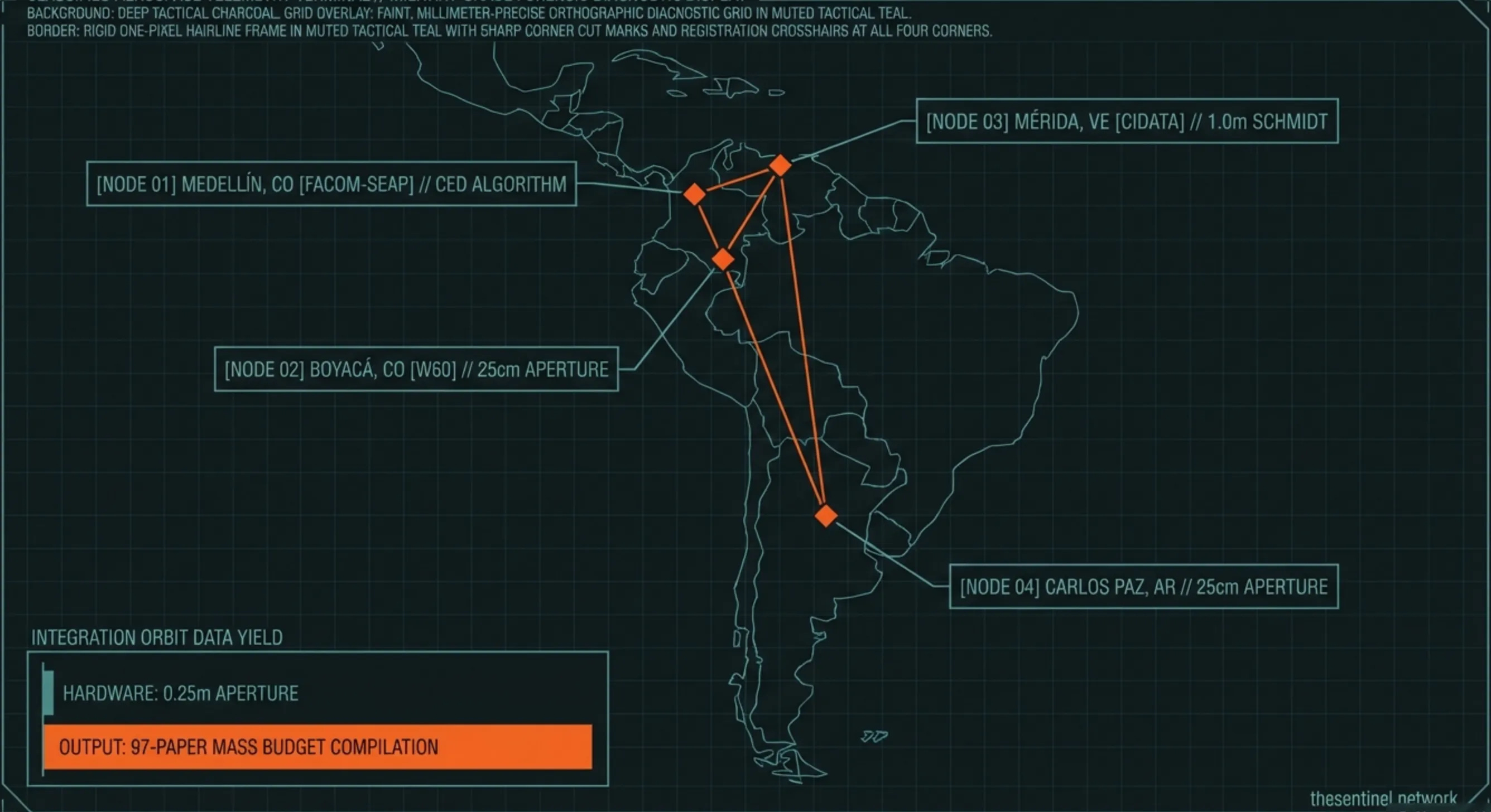
Ferrín is the lead author. University of Antioquia, Institute of Physics, FACOM-SEAP. Medellín, Colombia. He has been building this framework for two decades. He is the reason this paper exists.
Charles Triana operates AstroExplor Observatory in Boyacá, Colombia. His MPC observatory code is W60. He works with a 25 cm telescope. That is ten inches of aperture. On December 31, 2025, sixty-one days after perihelion, Triana stacked 79 images of 30 seconds each for a total exposure of 39.5 minutes and applied the Larson-Sekanina rotational filter to the result. He pulled a debris trail and a boulder out of the tail of an interstellar object, from a ten-inch telescope in the Colombian highlands.
Giuliat Navas is at the Astronomy Research Center CIDATA in Mérida, Venezuela. She used the 1.0-meter Schmidt telescope at the National Astronomical Observatory of Venezuela. On January 22, 2026, eighty-three days after perihelion, she captured a 6,565-kilometer jet emerging from the nucleus of 3I and a large boulder in the debris trail. Twelve images. Two and a half minutes of total exposure time. Venezuela’s national observatory, producing primary observational data on the third interstellar object in human history while operating through an economic crisis that has hollowed out most of the country’s institutional infrastructure.
Raul Melia runs his own observatory in Carlos Paz, Argentina, associated with Pekos Planetary and Carl Sagan Planetary. Another 25 cm telescope. He took the November 17, 2025 images that produced one of the strangest results in the paper. We will get to that.
José Garrido is at the International University of Valencia (VIU), Spain. Santiago Pérez, Emiliano Gómez, and Jorge Andrey Vargas are in the Astronomy Program at University of Antioquia. Juan Hincapie is in the Physics Program. Brayan Quintero is at the Instituto de Educación Técnica Profesional in Roldanillo, Colombia. A technical education institute.
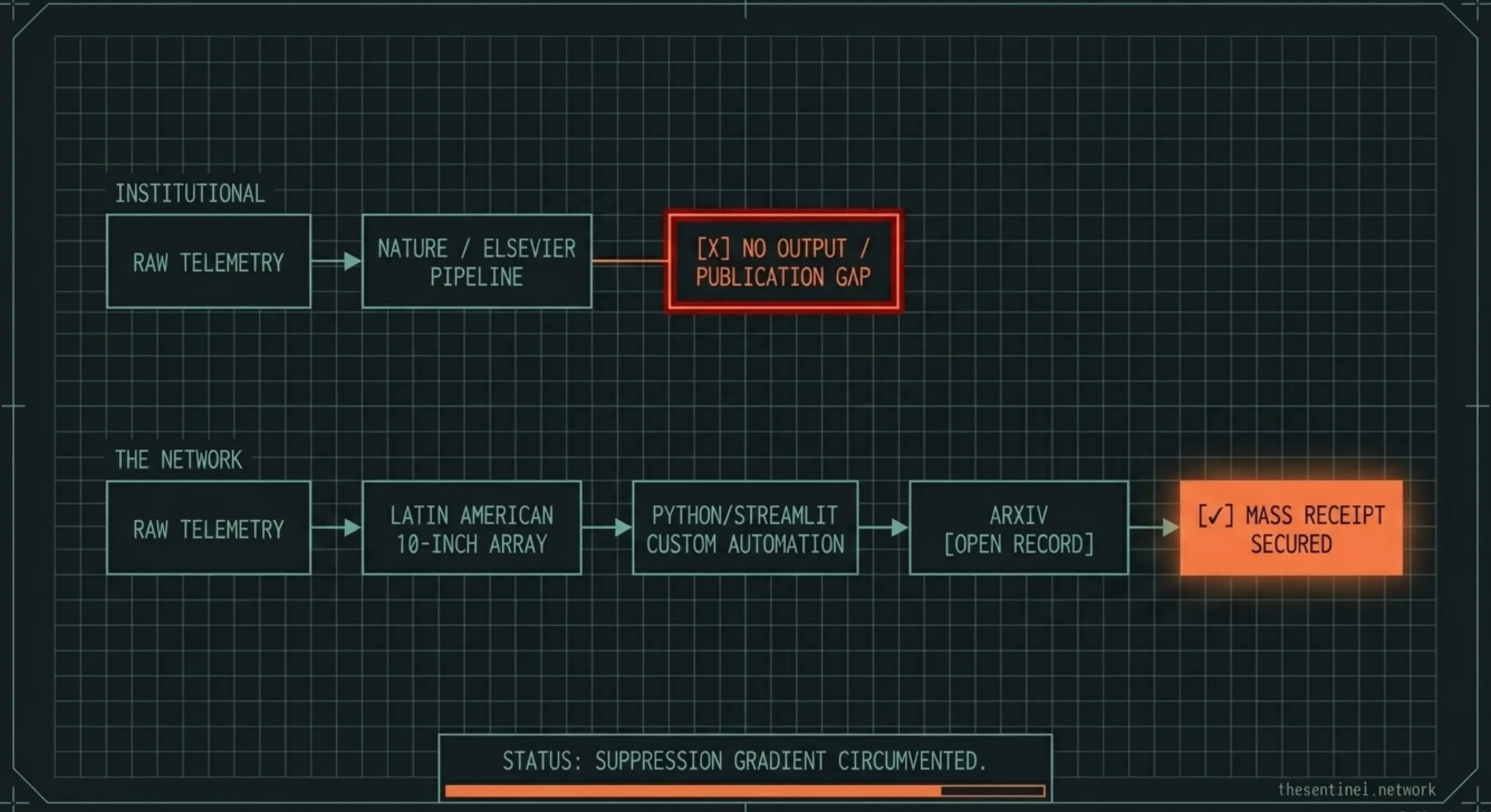
Nobody on this paper has access to Hubble. Nobody has JWST time. Nobody has a tenured position at an American or European research university with a seven-figure grant. They have two ten-inch telescopes, one Schmidt that Venezuela can barely keep powered, and a methodology that took twenty years to build because nobody funded it. They posted to arXiv because that is where you post when Elsevier is not publishing and Nature is not calling.
In THE PUBLICATION GAP, we documented what was not being published. Elsevier, the largest academic publisher on Earth, produced functionally zero 3I/ATLAS papers across their entire catalog while every other major publisher produced dozens. The pipeline that worked for Oumuamua and Borisov shut down for the third interstellar object.
This paper is what the other side of that gap looks like. The work got done. It just was not done by the people you would expect, at the institutions you would expect, through the journals you would expect. It was done by a team that has been building their own tools for twenty years and never needed the pipeline to begin with.
THE NUMBER
Every team that has pointed an instrument at 3I found the same thing. CO2. Everywhere. At every distance. In every wavelength. Cordiner’s JWST team found it. Lisse’s SPHEREx team found it. Biver found it from the ground. The Verdict compiled the pattern across twenty-eight briefings. CO2 dominated everything.
But nobody had done the math on the whole flight.
Individual teams measure production rates at one distance from the Sun on one day with one instrument. That gives you a snapshot. What Ferrín’s team did is different. They compiled every published measurement of every outgassing species across the entire visible orbit, from the moment the object turned on to the moment it shut down, and integrated. Total mass out. Every molecule of dust, water, carbon dioxide, and carbon monoxide that left this object from start to finish.
Think of it like this. Every previous paper weighed one exhale. Ferrín weighed every breath the object ever took.
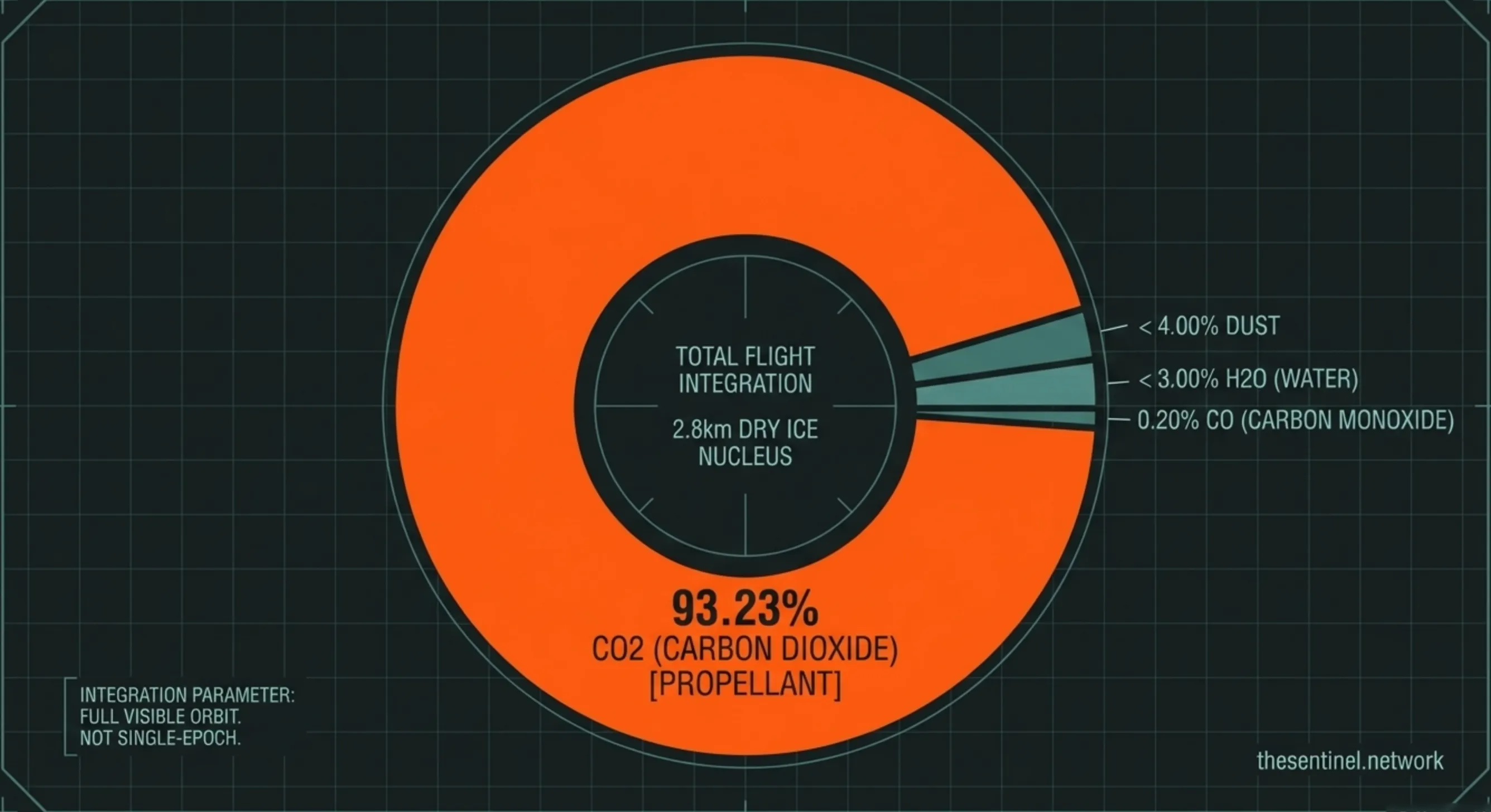
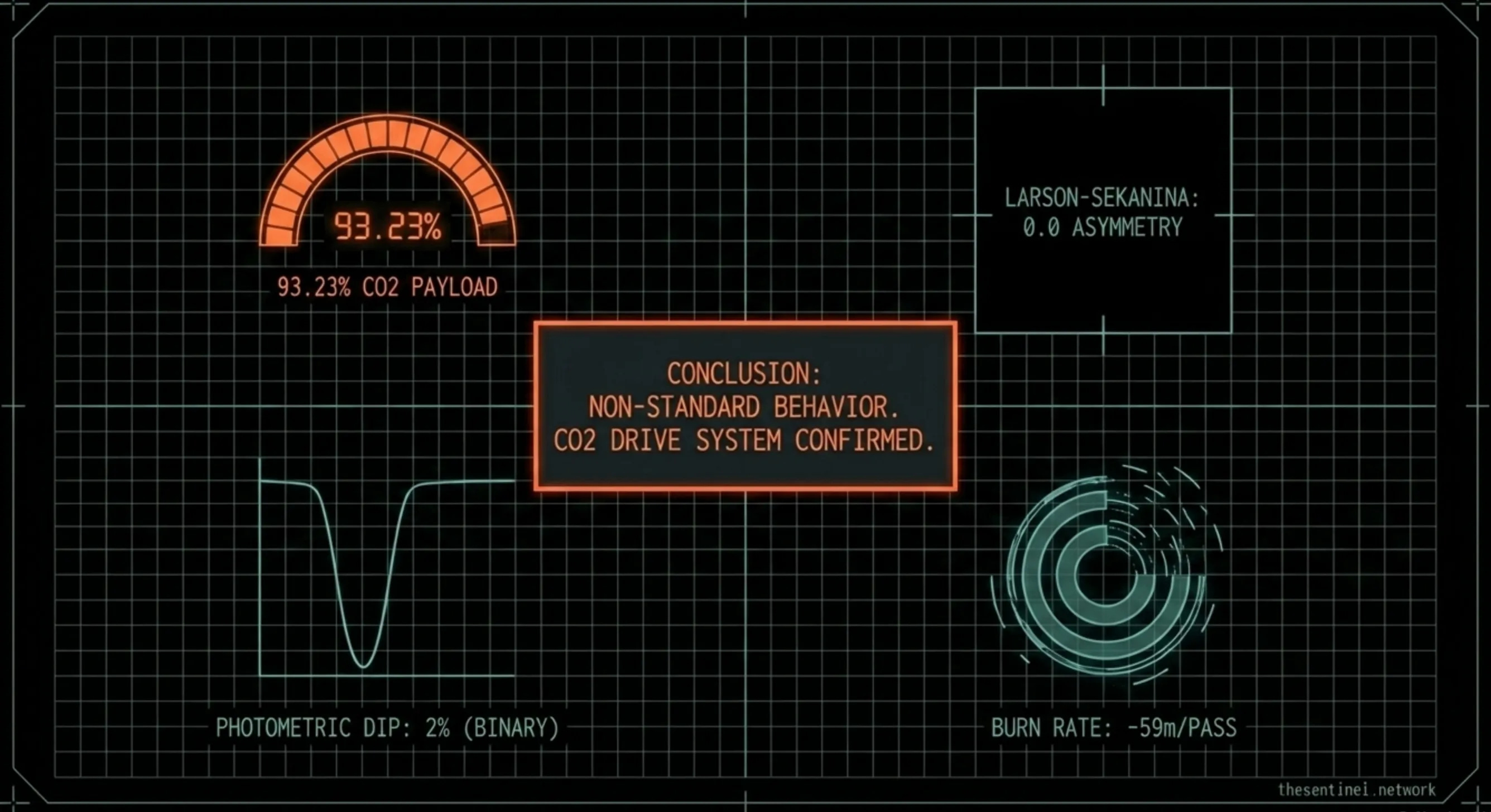
The answer is 93% carbon dioxide.
Not 93% at one distance. Not 93% on one day. Ninety-three percent of everything that left 3I across its entire passage through the inner solar system was CO2. Water accounted for less than 3%. Dust was under 4%. Carbon monoxide was a rounding error at 0.2%.
The team had to use the density of dry ice for the nucleus mass calculation. Not because it was a convenient assumption. Because there is not enough of anything else in this object to change the number. You are not looking at a comet that happens to be rich in carbon dioxide. You are looking at a 2.8-kilometer block of dry ice with trace contaminants.
In THE VERDICT, we proposed five operational systems inside 3I based on forensic analysis of the chemical data. The CO2 drive system was listed first because every team that measured the coma kept arriving at the same conclusion. CO2 dominated the thrust. CO2 dominated the output. CO2 dominated the mass budget.
Now a team in Medellín has run the full integration and the answer is not ambiguous. Ninety-three percent of this object’s total mass output is the compound we identified as the primary propellant. That is not a composition consistent with a natural comet. That is a fuel load consistent with a machine burning through its tank.
THE DISAPPEARING ACT
Here is where Melia’s images from Carlos Paz become important.
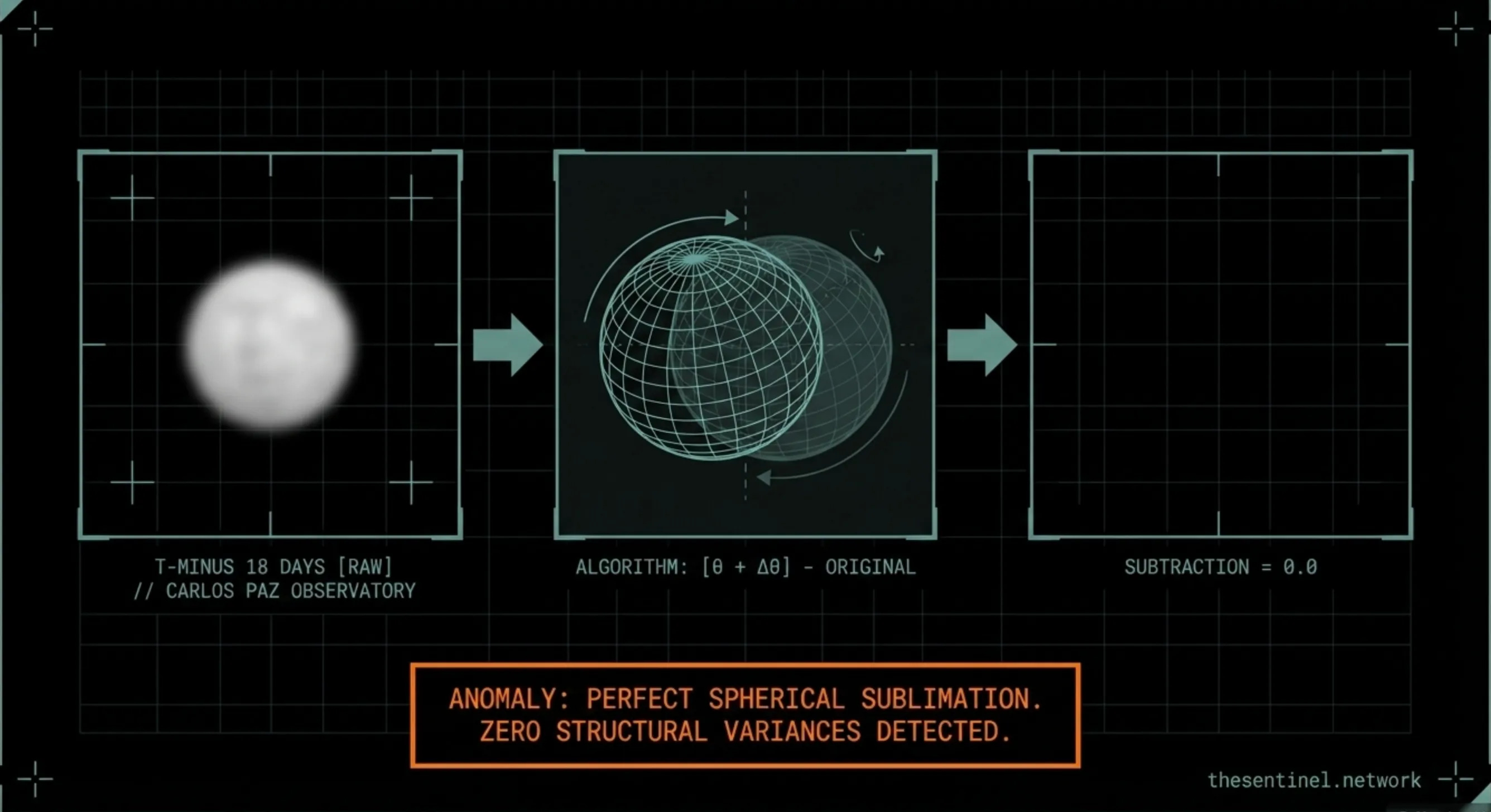
There is a trick astronomers have been using since 1984 to find hidden structure inside comet images. You take the image, rotate it slightly, and subtract the rotated copy from the original. Anything lopsided survives. A jet pointing one direction. A bright arc on one side. A crack venting gas. If the comet has any structure at all, the subtraction reveals it. If the comet is perfectly round and perfectly even in every direction, the subtraction erases it completely. The image goes black.
On November 17, 2025, eighteen days after perihelion, Melia pointed his ten-inch telescope at 3I and ran the Larson-Sekanina filter.
The comet vanished.
No jets. No arcs. No structure of any kind. The subtraction was total. The cloud around 3I was so perfectly round, so perfectly even in every direction, that the filter found nothing to show. Lisse et al. (2026) independently confirmed the same thing.
Every comet ever photographed has lumps. Hot spots and cold spots. Cracks that vent gas and patches sealed under dust. When a lumpy object spins in sunlight, the outgassing is uneven. That unevenness is what the filter is built to find. It is the signature of a natural surface.
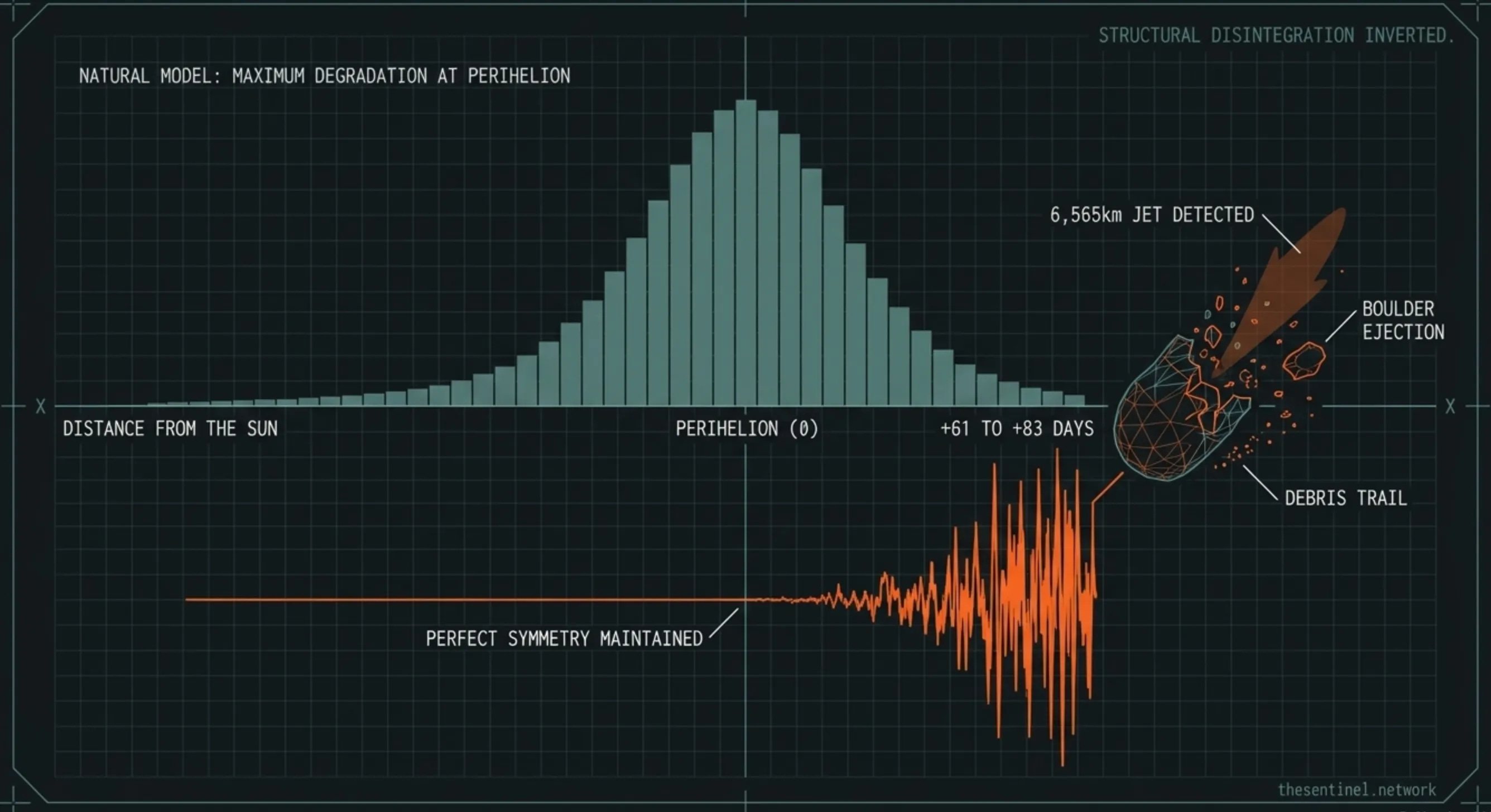
3I had none of it. The sublimation was coming from everywhere, evenly, all at once. Like a sphere dissolving in water.
Then it changed. The later images from Triana (December 31, 2025) and Navas (January 22, 2026) show a debris trail, filaments, boulders, and a 6,565-kilometer jet. The object went from perfect symmetry to shedding pieces as it moved away from the Sun.
A normal comet does the opposite. It shows more jets and more activity when it is closest to the Sun and the heating is strongest. 3I maintained perfect symmetry through its closest approach and started falling apart on the way out.
THE ECLIPSE
There is one more anomaly buried in the light curve.
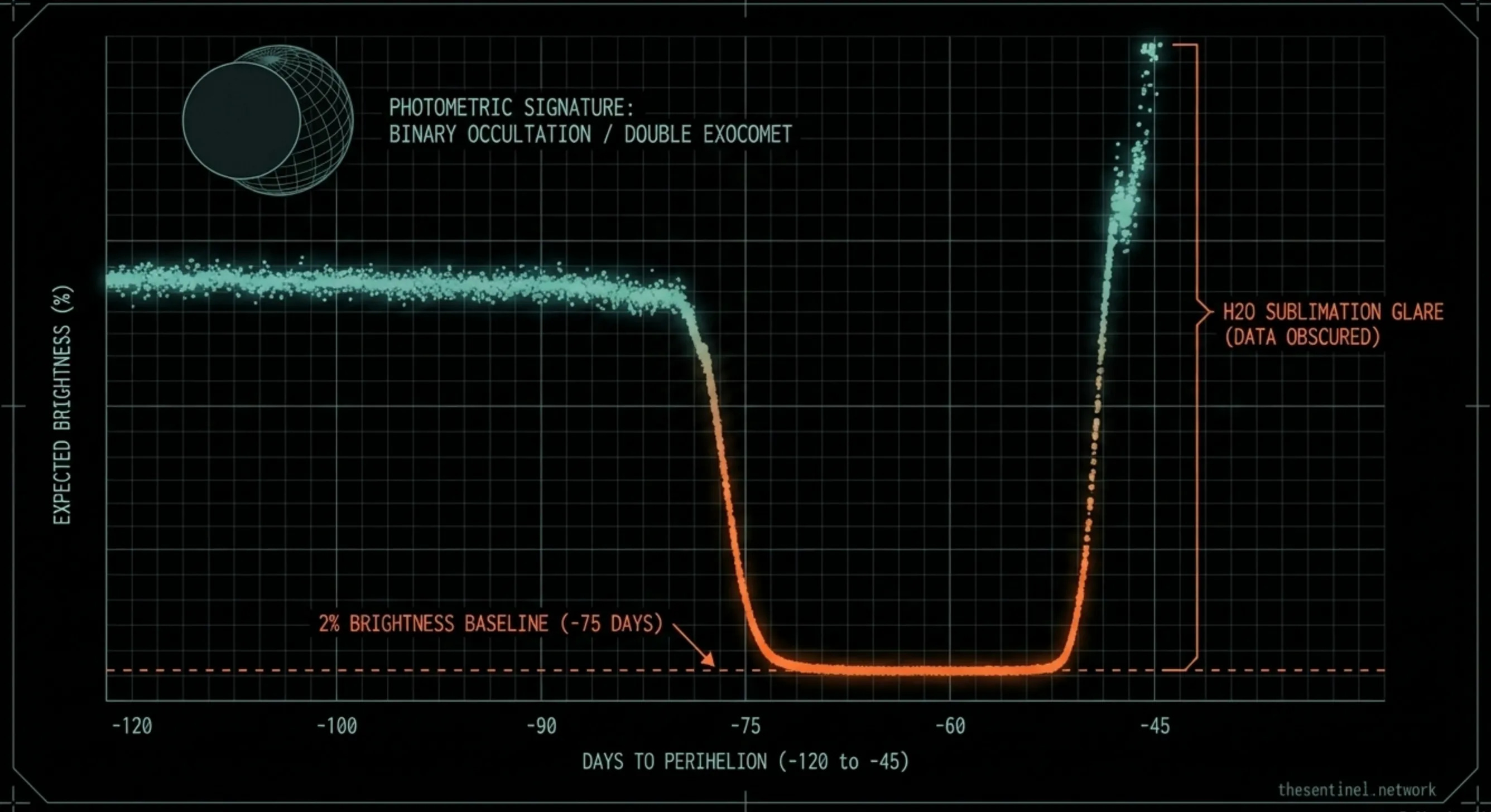
Between 120 and 45 days before perihelion, 3I got dimmer than it should have been. Not a little dimmer. The object dropped to about 2% of its expected brightness and stayed there for roughly 75 days. When Ferrín subtracted the expected brightness curve from the actual data to isolate the shape of the dip, what emerged looked like something passing in front of the object. The shape of the dip looks like something passing in front of the object and blocking its light. If that is what happened, 3I is not one object. It is two.
Ferrín could only see half the event. Around 45 days before perihelion, 3I got close enough to the Sun for water ice to start sublimating, and the sudden brightness increase from the water overwhelmed the dimming signal. The second half of the eclipse, if that is what it was, is buried under the flare.
Ferrín’s interpretation: the exocomet might be double.
He is careful to note that only half the eclipse profile is visible, making the interpretation complex and requiring detailed analysis beyond the scope of the paper. This is not a confirmed binary detection. It is a photometric signal consistent with one.
We flag it and move on.
THE CLOCK
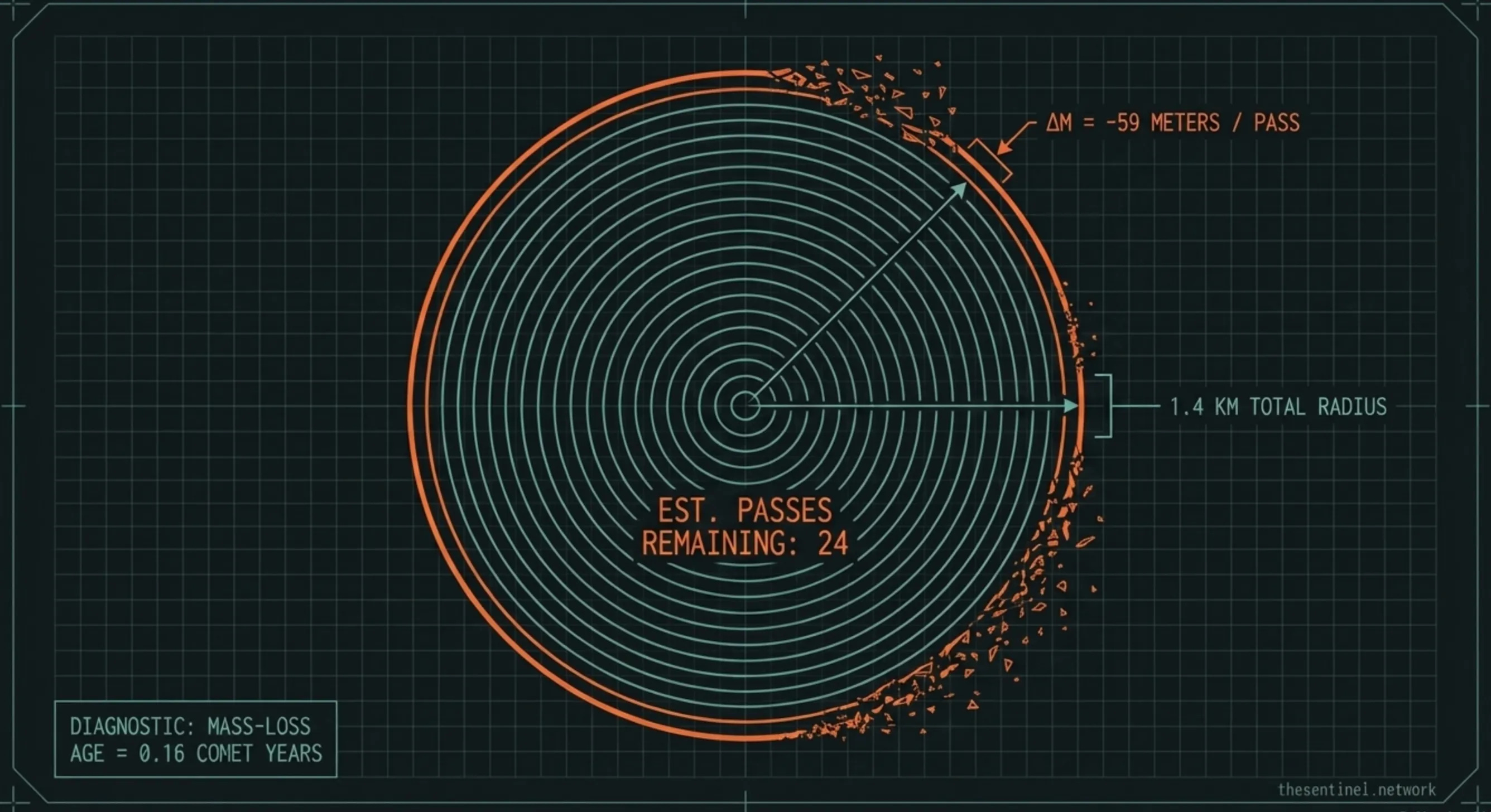
Every time a comet swings past a star, the heat strips away a layer of material. Ferrín calculated how thick that layer is for 3I. Using the total mass loss from the full orbit and the estimated nucleus radius of 1.4 km from Man-To Hui et al. (2026), the answer is 59 meters. One pass, 59 meters gone.
The nucleus is 1,400 meters across. Divide by 59 and you get 24. Twenty-four more passes like this one and there is nothing left.
This object is burning through itself fast.
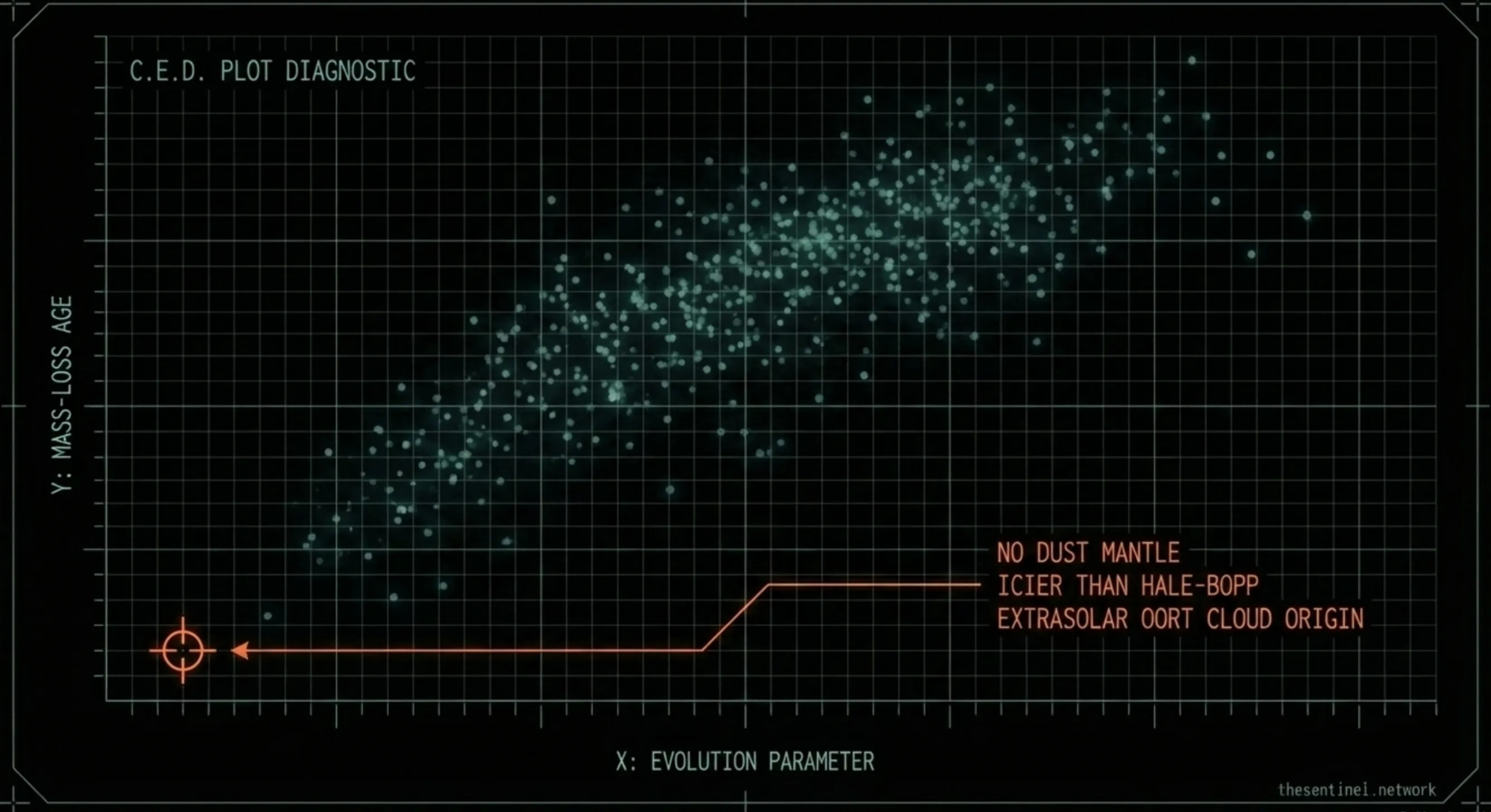
The Mass-Loss Age, Ferrín’s proxy for evolutionary stage, comes out to 0.16 comet years. That makes 3I the second youngest object on the entire Comet Evolutionary Diagram, after C/2006 P1 (McNaught). It ties Hale-Bopp in age but is far more evolved.
And when Ferrín plots it on the CED, the diagram he has spent twenty years building, 3I lands in the extreme lower left. The region occupied by the iciest bodies with no dust mantle. Surrounded by Oort Cloud comets.
His conclusion: 3I is a comet of the Oort Cloud, but from a different stellar system.
The CED puts 3I among the youngest, iciest objects ever cataloged. Almost no rock. Almost no dust. Ninety-three percent fuel. Ferrín’s conclusion: it is a natural comet from another star system’s Oort Cloud. Not ours. Somebody else’s.
He is not proposing a machine. He is proposing a comet that happens to be 93% propellant, has almost no rock, sublimates with perfect symmetry from every direction at once, and is burning through 59 meters of itself per pass. His data arrived at exactly the object we described in THE VERDICT. His interpretation did not. The data is what we publish. The reader can decide which explanation survives it.
THE PROVENANCE
This paper was not produced by MIT. It was not produced by Caltech. It was not produced by any institution that typically leads coverage of anomalous solar system objects. It was not submitted to Icarus or Planetary and Space Science or any Elsevier journal. It was not routed through Nature or Science.
It was produced by a twenty-year research program at a public university in Medellín, with observational support from a personal observatory in Argentina, a national observatory in Venezuela, and a telescope station in the Colombian highlands. The methodology was automated in a Python and Streamlit web tool the team built themselves.
In 2009, Ferrín needed a unit conversion for the dust mass-loss parameter. He emailed Mike A’Hearn, who invented the Afρ parameter, and asked him what Afρ equaled in kilograms. A’Hearn wrote back with the calibration. Ferrín quotes the email in the paper, seventeen years later, as his primary reference for the conversion.
That is how this science gets done. You email the person who invented the measurement. You build your own tools. You observe with what you have. You compile 97 papers by hand. You integrate the production rates across the full orbit. You calculate the mass budget that nobody else calculated.
And when you have the answer, you post it to arXiv, because that is what scientists do when the journal pipeline is not working for them.
THE SENTINEL ASSESSMENT:
The Ferrín et al. paper delivers the most comprehensive mass budget of 3I/ATLAS published to date. The 93.23% CO2 composition, derived from orbit-integrated production rates across 97 papers, is the total fuel receipt. It supersedes every single-epoch ratio previously reported. It is consistent with every prior finding this publication has documented and directly reinforces the CO2 drive system proposed in THE VERDICT.
The Larson-Sekanina disappearing act, a coma so perfectly symmetric it vanishes under rotational filtering, remains unexplained by any standard cometary model. The subsequent transition to structural disintegration post-perihelion inverts the expected behavior.
The provenance of this paper is as significant as its content. While THE PUBLICATION GAP documented Elsevier’s near-total silence on 3I, this paper demonstrates where the work went. It went to scientists who have been building their frameworks for two decades, observing with ten-inch telescopes, and posting their results directly to the open record.
The suppression gradient does not stop science. It redirects it.
Keep looking up.
-- The Sentinel Network™
Every briefing we’ve published is free. That’s not changing. This publication has no institutional backing, no sponsors, and no editorial board. We’re doing the work the newsrooms won’t — sourcing papers, filing FOIAs, building tools, and writing at the pace a once-in-a-civilization event demands.
Paid subscribers fund the investigation directly. They also get access to THE SIGNAL (weekly market intelligence derived from our forensic work), primary source documents, the comment section on every briefing, Fieldcraft Labs, and the FIELDCRAFT series. No ads. No sponsors. No strings. Your subscription is a data point against the suppression gradient.
If you can’t subscribe, we don’t care. Read everything. Share everything. The mission is the mission.
If this briefing found you, someone shared it. If you think it matters, be that someone. The Sentinel runs on readers, not algorithms.
Subscribe to The Sentinel Network™
Top 100 Science publication on Substack.
Share this investigation. The Suppression Gradient documented what happens when this coverage reaches platforms that do not want you reading it. Every share, every restack, every forwarded link is a data point against the gradient.
Previous briefings: THE RECEIPTS | THE OTHER HAND | THE PUBLICATION GAP | THE FIFTH INSTRUMENT | THE SOFT LANDING | THE OPERATOR | THE MURMURATION | THE REFINED FUEL | THE FLOOR | THE DIAGNOSTIC GAP | THE OPERATING SYSTEM | THE BLIND SPOT | THE NARROW BAND | THE PHONE GAP | THE SKY IS FALLING | THE WEIGH-IN | THE VERDICT | THE LONG COUNT | THE GREEN BURIAL | THE DEAD DROP | THE GHOST GENERAL | THE ANCIENT ENGINE | THE CURATED ORBIT | THE WIDE ANGLE | THE IGNITION SEQUENCE | THE GHOST COMA | THE HEARTBEAT | THE SURGE | THE SUPPRESSION GRADIENT | THE SILENT EDIT | THE GLOMAR CONFIRMATION | THE SENTINEL DOSSIER
You might find these articles interesting...About CO2.
https://www.ucf.edu/news/scientists-discover-co2-and-co-ices-in-outskirts-of-solar-system-for-the-first-time/
https://usasolarcell.com/news/2024/05/26/co2-and-co-ices-found-in-the-outer-solar-system/
https://www.zmescience.com/space/for-the-first-time-ever-scientists-have-directly-detected-carbon-dioxide-on-distant-planets/
The disappearing coma is something else.... ? The perfect symmetry may not be.
The real problem in the USA is that there is little totally independent scientific research being done...it's pretty much all backed and funded by business and universities. No one really discusses this as they should, and it's not good for independent science. Academic freedom is also on the decline. Galileo had a wealthy patron, a Medici ,to back his work and allow him the independence to do it, even though the Church gave him grief over it.