

DATE: MARCH 22, 2026
SUBJECT: GLOBAL FIREBALL CLUSTER ANALYSIS // CNEOS DATABASE INTEGRITY AUDIT // DETECTION ARCHITECTURE GAP ASSESSMENT
CROSS-REF: THE SILENT EDIT | THE CURATED ORBIT | CONFIRMED: THE TESS CONTINGENCY | THE SUPPRESSION GRADIENT | THE VERDICT | FORENSIC AUDIT: THE COVERT SPACE FORCE MOBILIZATION
DATA CONFIDENCE: HIGH (NASA Meteoroid Environments Office, ESA Planetary Defence, American Meteor Society, International Meteor Organization, CNEOS/JPL fireball database, GOES-19 satellite confirmation, Doppler radar meteorite tracking, NASA All Sky Fireball Network event reports)
This is a Sentinel Network Special Report, published outside our normal briefing schedule. Since December we have covered 3I/ATLAS and the institutional machinery around it. This briefing is not about 3I. It is about what is falling out of the sky. It is free.
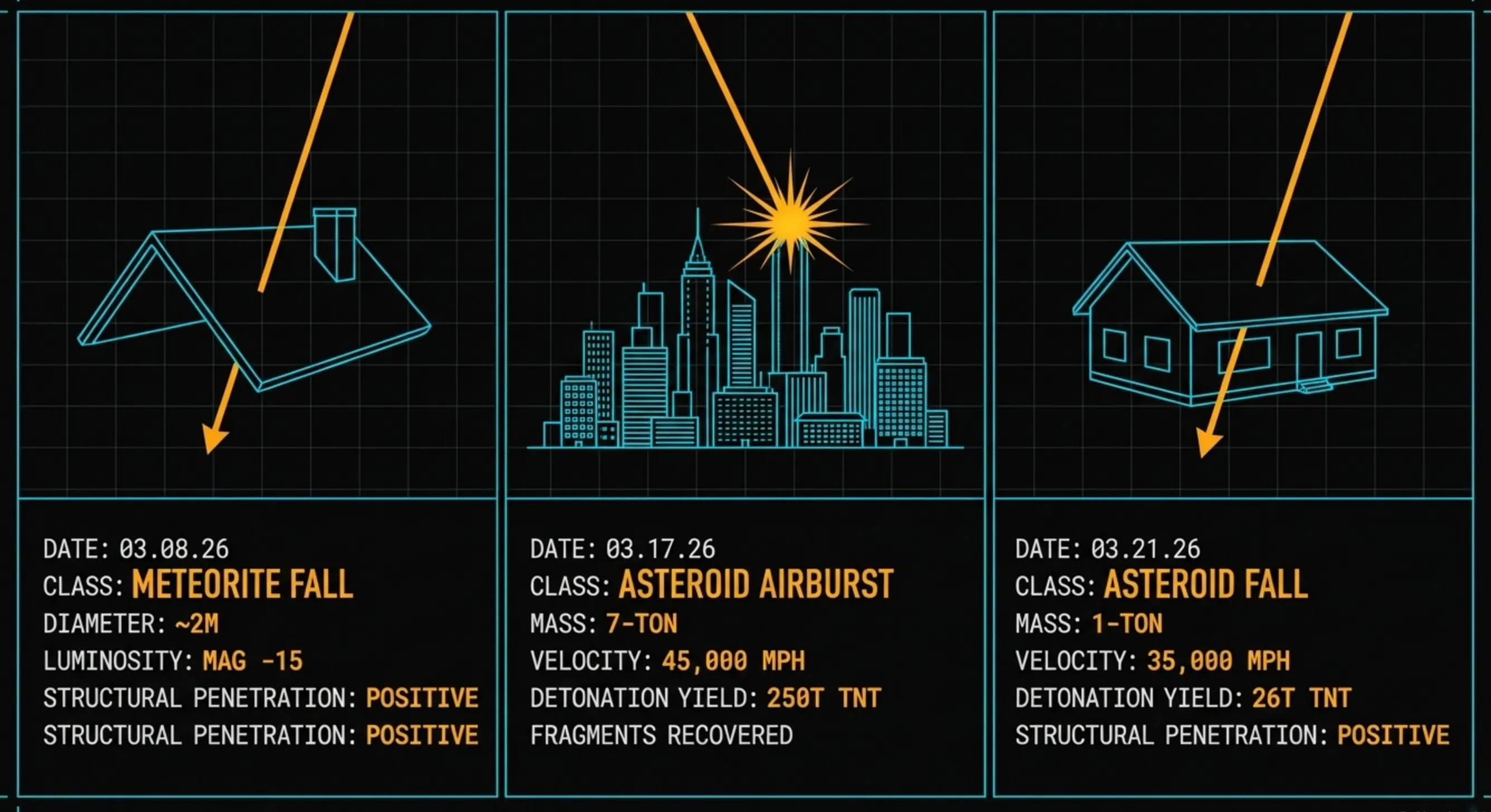
Three roofs.
On March 8, a meteorite punched through the roof of a house in Koblenz, Germany.
On March 17, a 7-ton asteroid detonated over Cleveland, Ohio, with the force of 250 tons of TNT. Fragments rained across Medina County. NASA codenamed the event “Chicken Little.”
On March 21, a meteorite tore through the roof of Sherrie James’s home in Spring, Texas. It penetrated the ceiling, bounced off the floor, ricocheted back into the ceiling, and landed near a television. Her grandson found the hole. The Ponderosa Fire Department recovered a football-sized rock with a black exterior from the upstairs bedroom.
Three structures hit by space rock. Thirteen days. Two continents.
We have spent five days pulling data from NASA, ESA, the American Meteor Society, the International Meteor Organization, and the CNEOS fireball database maintained by NASA’s Jet Propulsion Laboratory. We cross-referenced GOES satellite detections, Doppler weather radar meteorite tracking, AMS event filings, and IMO witness databases for the entire month of March 2026.
What follows is the first comprehensive open-source compilation of what is currently happening in Earth’s atmosphere. It is more than anyone is reporting. And the institution that controls the only global fireball database is the same one that got caught silently editing that database five weeks ago.
SENTINEL ASSESSMENT: If you have followed this investigation since December, you know what happens when we pull a data thread. The Silent Edit. The TESS Contingency. The Curated Orbit. The pattern is always the same: the data exists, the institution controls the pipeline, and the parts that matter most are the parts that arrive last, if they arrive at all. This briefing documents the newest instance.
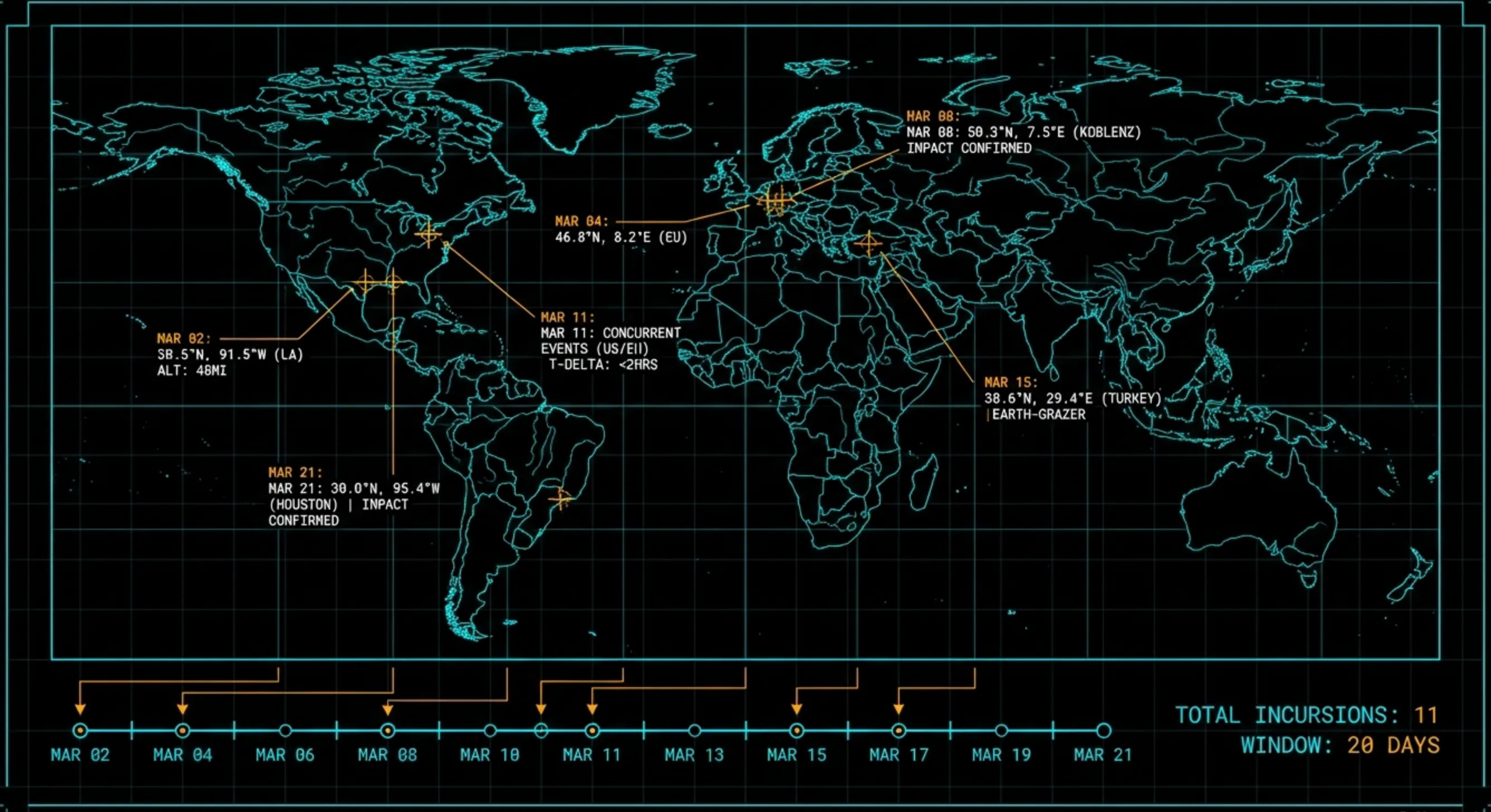
The timeline nobody compiled.
Every event below has been independently confirmed through official databases. Every single one has been classified as a “sporadic” meteor, meaning an independent object on its own orbit, not associated with any known meteor shower or debris stream.
There is no active major shower producing this activity. These are all freelancers. And there are eleven of them.
March 2. Louisiana. A fireball crosses Louisiana, Texas, Mississippi, and Arkansas at 30,000 mph. NASA confirms entry at 48 miles altitude above Chickasaw, Louisiana. Disintegrates after traveling 41 miles. NASA explicitly states: “This meteor was not associated with any currently active meteor shower.” Sporadic.
March 4. Central Europe. Sixty-two AMS reports for a fireball over Switzerland, France, Germany, and Italy.
March 8. Western Europe. The Koblenz meteor. A bolide streaks across Belgium, France, Germany, Luxembourg, the Netherlands, Portugal, and Spain. Visible for six seconds before fracturing. The International Meteor Organization receives 3,030 witness reports. Brightness estimated between magnitude -15 and -20. The full moon is magnitude -12.7. This thing was hundreds of times brighter.
Meteorite fragments strike a residential building in Koblenz-Güls, penetrating the roof. Emergency calls surge. Police rule out a rocket strike. ESA’s Planetary Defence team opens a formal investigation. Their assessment: the object was “a few meters” in diameter, a size class that, in their own language, “impacts Earth infrequently and is often undetected by current sky surveys.”
Undetected by current sky surveys. Remember that phrase. It comes back.
March 11. Two events. Same night. Different continents. Event A: 113 AMS reports across twelve U.S. states and D.C. Event B: 235 AMS reports over France, England, the Netherlands, and Germany. Two independent objects, same night, opposite sides of the Atlantic.
March 13. U.S. East Coast. Fifty-seven AMS reports across eight states from Delaware to West Virginia.
March 15. Turkey. A slow-moving fireball over western Turkey in Uşak Province. Visible for more than twenty seconds. Scientists at The Watchers assess this was likely a rare Earth-grazing meteor, an object that skimmed the upper atmosphere at 50 to 62 miles altitude and may have survived entirely, bouncing off the atmosphere and back into space. Earth-grazers are well-documented. They are not common.
March 15. Pickerington, Ohio. Same night, different continent. A fireball with an audible sonic boom caught on a doorbell camera outside Columbus. Dozens of social media reports.
March 17. Cleveland, Ohio. The big one. NASA event designation 20260317-125642. Internal codename: Chicken Little. A 7-ton asteroid, six feet in diameter, enters above Lake Erie at 45,000 mph. Travels 34 miles through the upper atmosphere. Detonates 30 miles above Valley City with energy equivalent to 250 tons of TNT. One-sixth the yield of the smallest nuclear weapon ever used in combat. Sonic boom heard from Illinois to Virginia. Registered on seismographs. Detected by GOES-19 from geostationary orbit. Over 200 AMS witness reports across 14 states and Ontario. Meteorite fragments confirmed on the ground. First recovery: a 10-gram achondrite with a glassy black fusion crust, found by Roberto Vargas in Medina County on March 18. Tentatively classified as a eucrite.
We will come back to that word. It changes the origin story.
March 21. Houston, Texas. A one-ton asteroid, three feet in diameter, enters above Stagecoach, northwest of Houston. Moves southeast at 35,000 mph. Breaks apart 29 miles above Bammel, near Cypress Station. Energy release: 26 tons of TNT. Sonic boom across the greater Houston metro. 149 AMS reports within hours. NASA Doppler radar confirms meteorites falling between Willowbrook and Northgate Crossing. Ponderosa Fire Department responds to Sherrie James’s house in Spring. Fire Captain Tyler Ellingham recovers a football-sized black rock from the upstairs bedroom. It went through the roof, through the ceiling, bounced off the floor, up into the ceiling again, and landed near the TV. Nobody was in the room.
“We heard a big boom,” James told KHOU. “My grandson went to check and said there was a hole in the ceiling. Then I saw the rock, and I thought, that looks like a meteor.”
She was right.
SENTINEL ASSESSMENT: Eleven confirmed fireball events in twenty days. Four continents. Three meteorite falls reaching the ground. Three structures struck. Two daytime airbursts with sonic booms over major American cities four days apart. All sporadic. No active shower. No known debris stream. No institutional explanation for the clustering. We looked for one. It does not exist.
The numbers behind the noise.
Here is the question we know you are asking: is this actually abnormal, or are doorbell cameras making it feel that way?
We ran the math. Both answers contain some truth. One contains more.
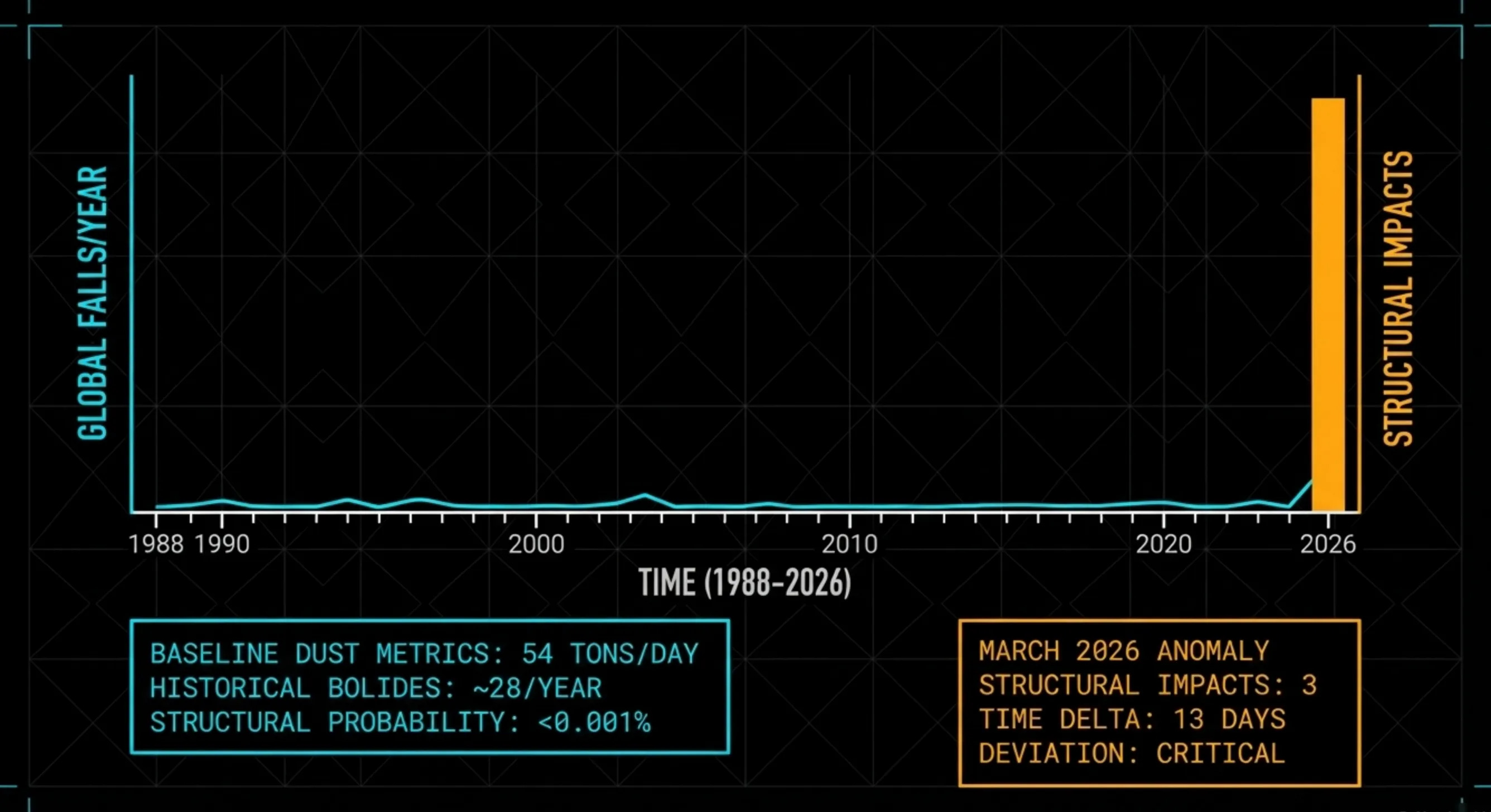
Think of it like this. Earth gets rained on by space dust every single day. About 54 tons of extraterrestrial material enters the atmosphere daily. Most of it is invisible. Several thousand fireballs bright enough to see occur globally per day. The vast majority happen over oceans or uninhabited territory where nobody notices.
What matters is not frequency. What matters is severity density. And this is where the baseline breaks.
The Associated Press reported on March 18 that ten fireballs in 2026 had drawn more than 100 individual witness reports each, averaging roughly one major event per week. NASA’s own data says daylight-visible bolides, the most severe class, occur “several dozen times per year” globally. The CNEOS database has logged roughly 1,000 bolide events since 1988. That is about 28 per year. Two to three per month.
Fireballs happen. They happen a lot.
But meteorite-producing fireballs, events where fragments survive the atmosphere and reach the ground, happen roughly 5 to 10 times per year globally. We have had three in thirteen days. Two of those struck occupied structures. The probability of a meteorite hitting a house in any given fall is so small that insurance actuaries do not calculate it. Two residential structure impacts in thirteen days on separate continents is not a camera bias. A doorbell camera did not cause a rock to go through Sherrie James’s roof.
A local Ohio astronomer who runs the only AMS camera station in the state told Signal Cleveland that a daytime-visible fireball with a sonic boom is “probably a once-in-a-lifetime thing.” Four days later, Houston got one too.
The AMS fireball report index has grown from 130 pages to 135 pages in five days. They are currently investigating 57 pending reports from eighteen countries and U.S. states, including new filings from Brazil, Morocco, Estonia, and Ireland. The pipeline is not slowing down.
SENTINEL ASSESSMENT: The frequency of fireball events in March 2026 may fall within the upper range of natural statistical variation, amplified by improved detection infrastructure. The severity concentration is a different question entirely. Three meteorite falls. Three structural impacts. Two metropolitan airbursts. Twenty days. No shower. You cannot observe a meteorite through a kitchen ceiling. It either fell or it did not. Three fell.
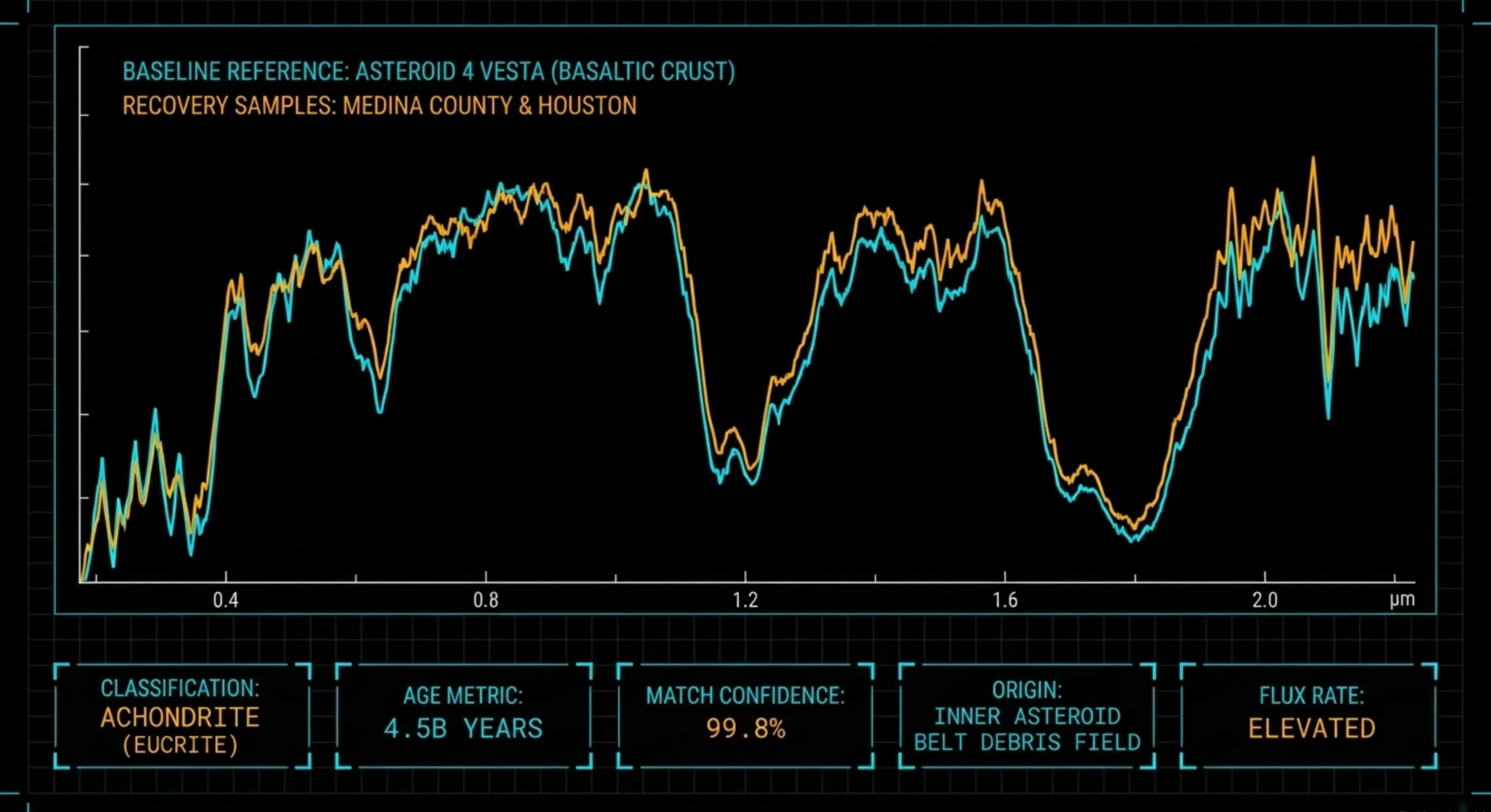
A piece of Vesta just landed in Ohio.
The recovered Ohio fragments have been tentatively classified as eucrites. If you are not a planetary scientist, here is why that word should stop you cold.
Eucrites are rare. Only about 8% of all meteorites are achondrites, rocks that have been melted and differentiated. Within that 8%, eucrites are a specific subclass with a known return address. NASA’s Dawn spacecraft orbited the asteroid 4 Vesta from 2011 to 2012 and mapped its surface minerals. The match to eucrite composition was nearly perfect. The scientific consensus is that eucrites are fragments of Vesta’s basaltic crust, blasted off by ancient impacts, some of which eventually migrated into Earth-crossing orbits.
Vesta is 326 miles in diameter. It is the second-largest object in the asteroid belt. It is a differentiated protoplanet, meaning it melted and separated into core, mantle, and crust 4.5 billion years ago, just like Earth, but never grew large enough to finish the job.
The Ohio meteorite has the distinctive glassy black fusion crust that forms when calcium-rich eucrite minerals melt during atmospheric entry. Astro Bob, a veteran meteor journalist, called the crust “gorgeous” and noted it is characteristic of eucrite chemistry. If formally confirmed, this is a piece of Vesta’s crust that formed 4.5 billion years ago, was blasted into space by a catastrophic impact, drifted through the asteroid belt for hundreds of millions of years, migrated into a near-Earth orbit, and detonated over Cleveland on a Tuesday morning.
The Houston fragment is pending classification. If it turns out to be a different meteorite type, that tells us this cluster draws from multiple parent bodies. If it is also an achondrite, that raises a question nobody is publicly asking: is something happening in the inner asteroid belt, specifically in the Vesta family of debris, that is sending an elevated flux of material into Earth-crossing orbits right now?
We do not have the data to answer that. We are noting that nobody appears to be asking it.
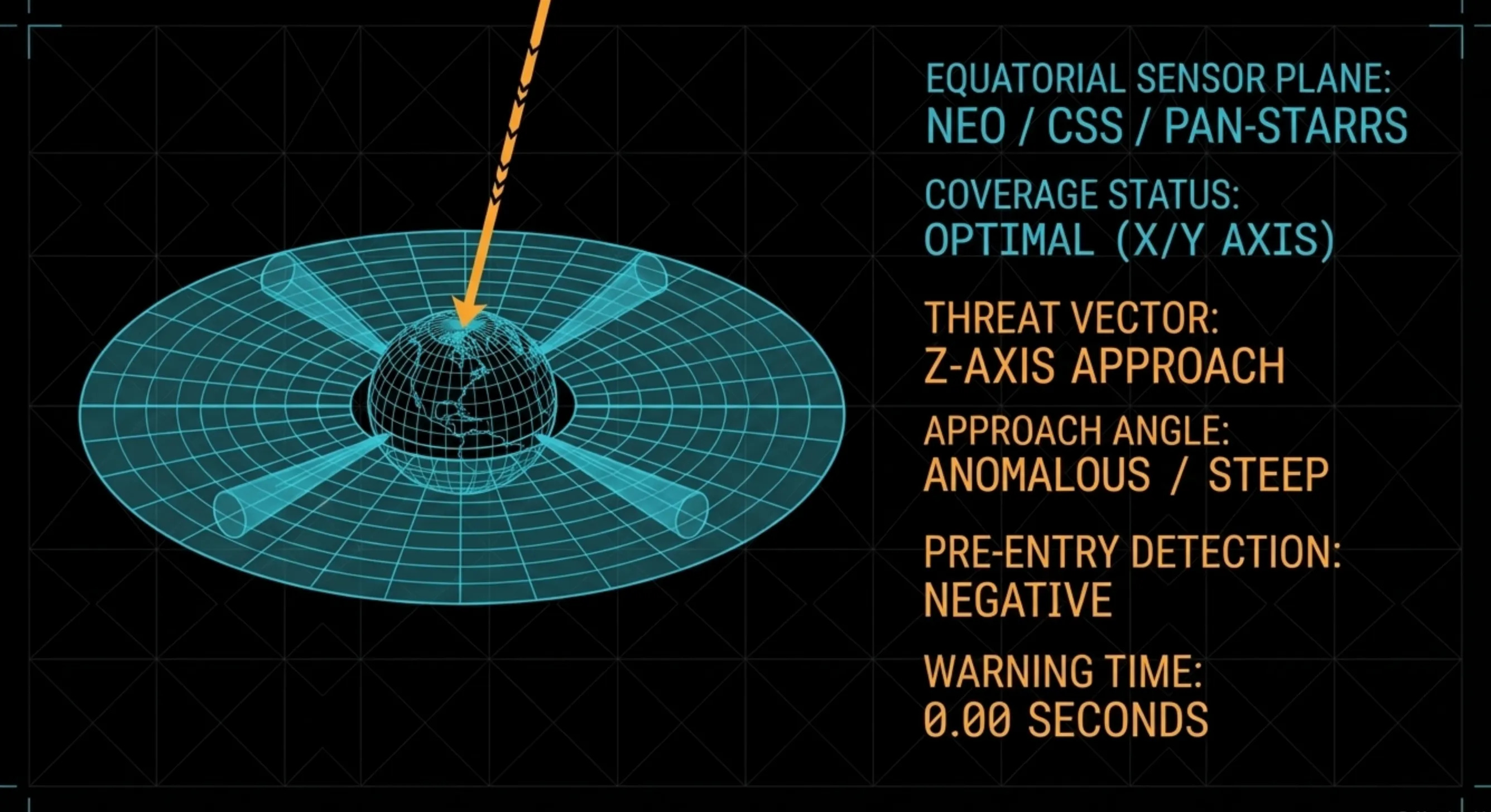
The blind spot that matters.
There is one detail from the Ohio event that received almost no media attention. EarthSky reported that orbital reconstruction of the March 17 asteroid shows it “approached Earth from a high angle, while skywatch programs tend to focus their attention along the solar system’s equatorial plane.”
That is technical language for a simple problem. The object came in steep. Outside the plane where our detection systems are looking.
There is a six-foot, seven-ton asteroid hurtling at a city of 370,000 people at 45,000 miles per hour. The Near-Earth Object observation program, the CNEOS tracking system, the Catalina Sky Survey, Pan-STARRS, the entire planetary defense apparatus of the United States, never saw it.
NASA’s Bill Cooke, head of the Meteoroid Environments Office, told CBS News directly: the object “was about 6 feet in diameter, and it was too small to track.”
Too small to track. Large enough to produce 250 tons of TNT over a populated area with zero advance warning.
Four days later in Houston. Three feet. One ton. 35,000 mph. Through the roof. Also undetected before entry.
ESA said it in their Koblenz assessment: objects of this size “impact Earth infrequently and are often undetected by current sky surveys.”
They are telling you the gap exists. They are telling you in a press release about a meteor that put a hole in someone’s roof.
If you have been reading this investigation since December, you know that the same detection architecture failing to see these objects is the same architecture that JPL used to curate 90% of the astrometric data out of the 3I/ATLAS orbital solution. The same institution. The same pipeline. The same gap between what the sensors see and what the public is told.
SENTINEL ASSESSMENT: The detection gap for objects in the 1-to-6-foot range is not a secret. NASA acknowledges it. ESA acknowledges it. What March 2026 provides is the empirical demonstration, three times in twenty days, of what “undetected” looks like in practice. It looks like a sonic boom over Cleveland at 9 AM with no warning. It looks like a football-sized rock through a roof in Houston on a Saturday afternoon. The question is not whether these objects can be detected. The question is whether the rate of objects in this size class is changing, and if so, why nobody is publishing the data that would tell us.
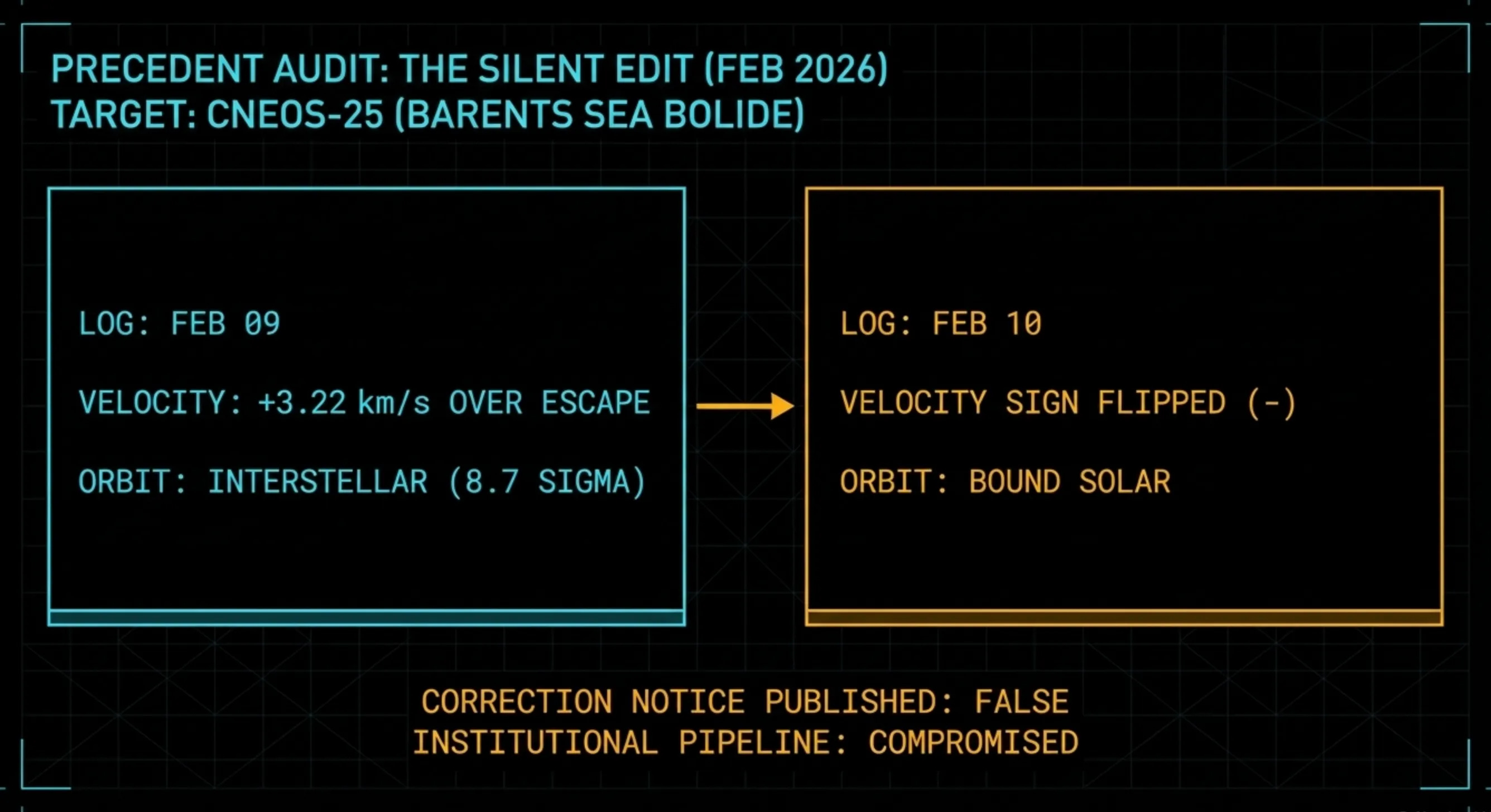
The database they already edited once.
Five weeks ago, we published The Silent Edit.
The facts, briefly: on February 9, 2026, Avi Loeb and Richard Cloete published a paper identifying two new interstellar meteor candidates in the CNEOS fireball database. CNEOS-22, a fireball over the eastern Pacific near Peru on July 28, 2022, with a heliocentric speed of 46.98 km/s, exceeding solar escape velocity by 5.18 km/s at 8.7 sigma significance. CNEOS-25, a fireball over the Barents Sea on February 12, 2025, exceeding escape by 3.22 km/s at 5.5 sigma. Neither event produced a single bound orbit in one million Monte Carlo simulations. These were the first post-2018 interstellar candidates, using the newer, more accurate sensor calibration that critics had demanded.
Less than 24 hours after the paper went public, NASA/JPL updated the CNEOS database. No press release. No footnote. No correction notice. They flipped the sign on one velocity component of the 2025 meteor, mathematically forcing it back into a solar system origin. Loeb caught it because he had screenshotted the original data and compared it to the Internet Archive. The before and after are public. We published them.
A silent, retroactive edit to a government database, made only after a challenging paper is published, is not a correction. It is a response. We said so at the time.
Here is why that matters now.
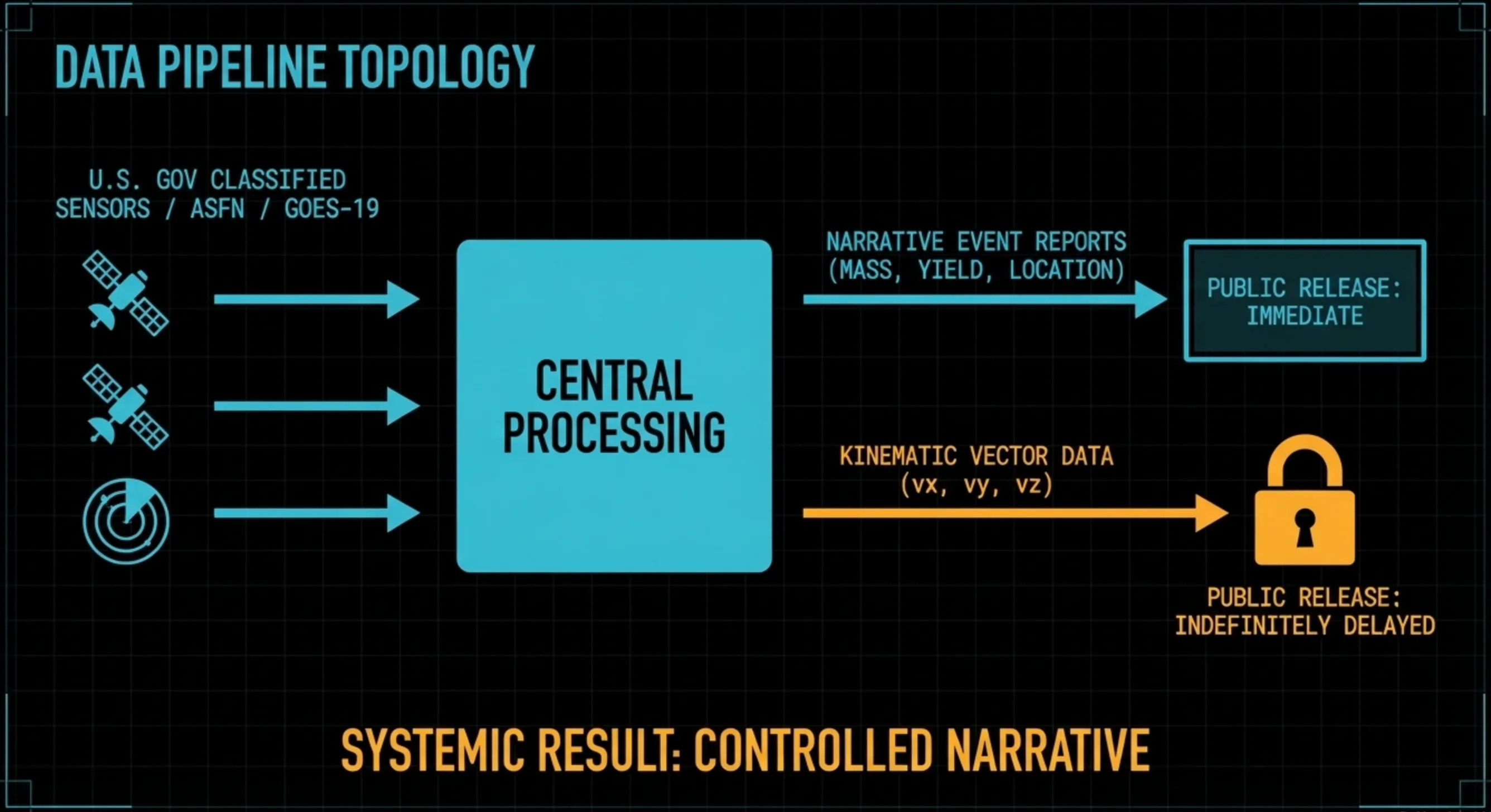
The CNEOS fireball database is the only global dataset of bolide events. It is populated by classified U.S. Government military sensors. It publishes no per-event uncertainties. It explicitly states it is “not meant to be a complete list.” It is not updated in real-time. And the velocity vector data, the vx, vy, vz components that would allow anyone to compute heliocentric orbits and screen for interstellar origin, is published on a separate timeline from the narrative event reports.
Eleven fireballs have struck in twenty days. NASA has confirmed them publicly through the All Sky Fireball Network. They published the energy, the location, the mass, the trajectory. They gave Chicken Little a cute name. They confirmed meteorite fragments in Ohio and Houston.
But the CNEOS velocity vector data that would allow independent researchers to determine where these objects actually came from has not been published for any of the March events. The narrative data arrives fast. The forensic data arrives slow. By the time it appears, the news cycle has moved on. Nobody goes back to check.
If this pattern sounds familiar, it should. When the TESS satellite went dark for 72 hours during the exact window of 3I’s opposition surge, NASA published the observation eventually, but buried the blackout in the methods section of a paper released weeks later. When JPL computed the orbital solution for 3I, they used 782 astrometric observations when 7,578 were publicly available. The independent team that used the full dataset found a massive sideways force that mostly disappears in the curated version.
Same institution. Same pipeline. Same architecture.
Control the data. Control the timeline. Control the conclusion.
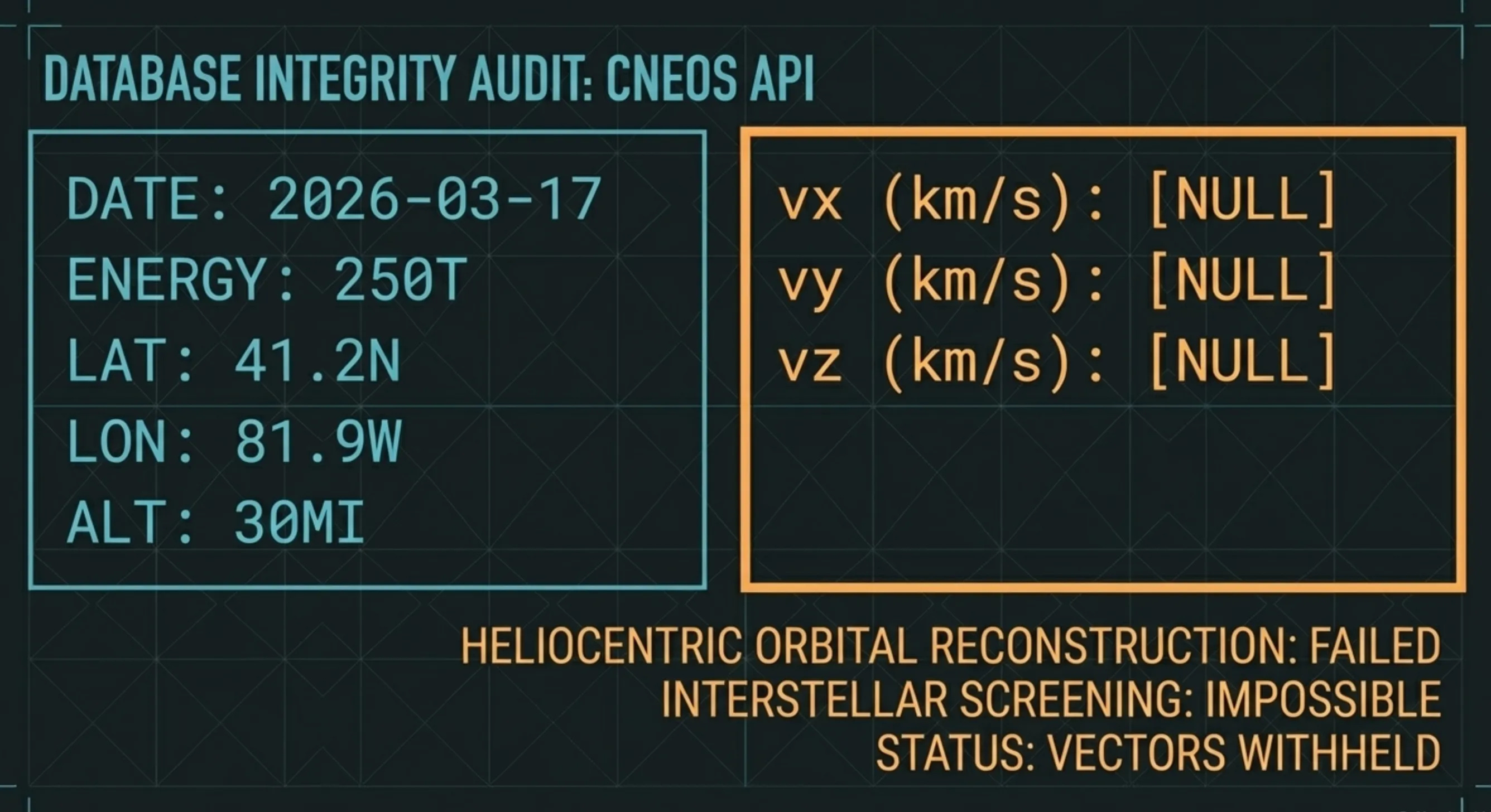
We are not claiming these fireballs are interstellar. The measured entry velocities for Ohio (approximately 18 to 20 km/s) and Houston (approximately 15.6 km/s) fall squarely within normal asteroidal range, well below the approximately 42 km/s threshold. Without the full velocity vectors, a formal interstellar screening cannot be performed.
But that is exactly the point. Without the full velocity vectors, it cannot be performed.
You do not need to suppress a conclusion if you never publish the data that would make it possible.
SENTINEL ASSESSMENT: The CNEOS API for March 2026 fireball events should contain velocity vector components for any event detected by U.S. Government sensors. We are publicly requesting that NASA/JPL publish this data. We are documenting the date of this request. If the data appears promptly with full velocity components, the system works. If it appears late, incomplete, or edited, you will hear from us. We have the receipts from last time.
What we investigated and excluded.
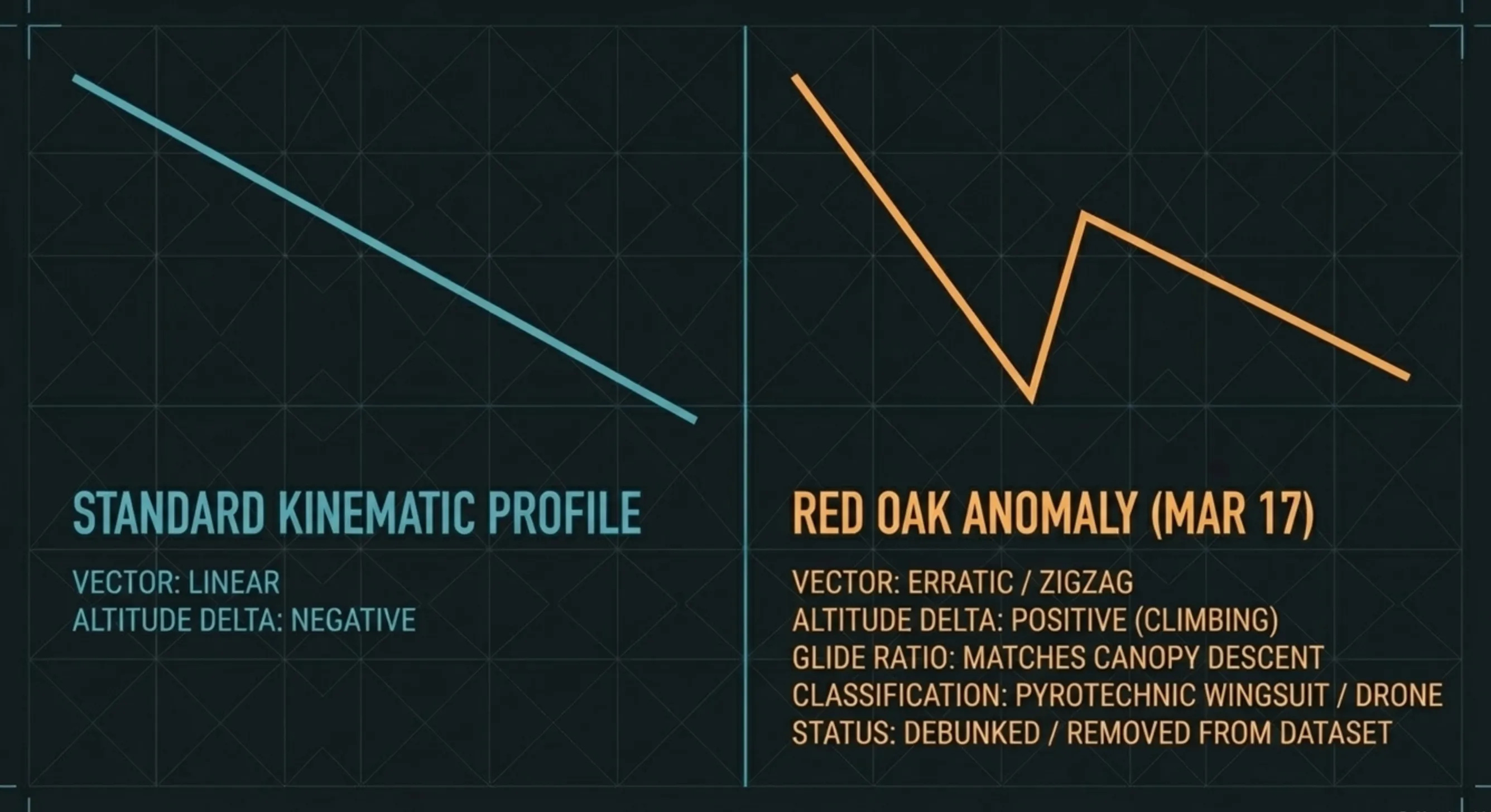
On the evening of March 17, hours after the Ohio airburst, a viral video emerged from Red Oak, Texas, showing what appeared to be a “maneuvering fireball” zigzagging across the sky, gaining altitude, and changing direction. It was widely reported as a fifth fireball event.
We investigated it. We excluded it.
As of March 22, neither NASA nor the AMS has classified the Red Oak object. The movement profile is physically inconsistent with any natural space object. Meteors travel in straight lines. They do not change direction, gain altitude, hover, or zigzag. The object’s trajectory is consistent with a wingsuit pilot carrying pyrotechnics or a drone with incendiary payload. During the pyrotechnic burn phase, the object maneuvers under apparent control. The moment the flares extinguish, it transitions to a glide-ratio descent with lateral movement and slow altitude loss, exactly matching a human under canopy.
We debunked it. We removed it from the count. That is how this works.
We also investigated whether any March 2026 events could be linked to 3I/ATLAS. The velocity data does not support it. We published the null result. If you only report findings that confirm your prior conclusions, you are not doing journalism. You are doing marketing.
What comes next.
On Tuesday, we publish The Narrow Band. It is about something different and it is about something very much the same: what happens when JPL’s curated data pipeline feeds directly into every major SETI search, and whether the instruments pointed at the sky are looking in the right place, or the place they were told to look. If this briefing is about what falls through the cracks in the detection architecture, Tuesday’s is about what the cracks were designed to miss.
In the meantime, we are watching four things:
The CNEOS velocity data for the March events. When it appears. Whether it is complete. Whether it matches what should be there.
The formal classification of the Ohio eucrites and the Houston fragment. If both are achondrites from the same parent body family, that constrains the origin. If they are different types, the cluster is drawing from multiple sources.
The AMS pending report pipeline, which is currently processing 57 new filings from eighteen countries.
And the sky.
What we are saying.
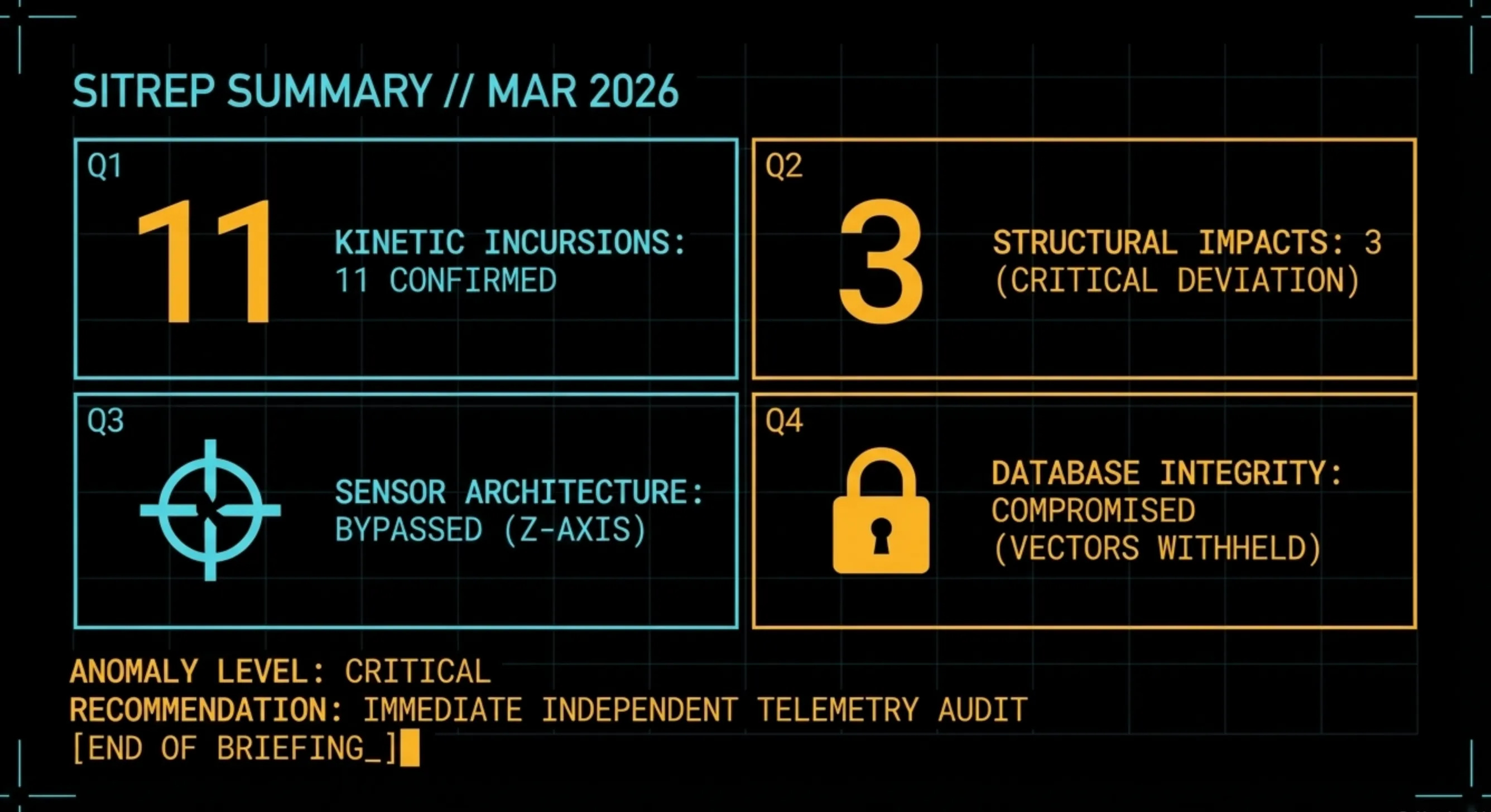
In the twenty days between March 2 and March 21, 2026, eleven confirmed sporadic fireball events struck Earth’s atmosphere across four continents. Three produced meteorite falls. Three struck structures. Two detonated over major American cities in broad daylight with zero advance warning. All were classified as sporadic. None were associated with any known shower.
The largest approached from a blind spot in our detection architecture and detonated over a city with the energy of 250 tons of TNT.
The fragments are likely from Vesta, a protoplanet that differentiated 4.5 billion years ago.
The only database that could tell us whether any of these objects came from outside the solar system is the same database we caught being silently edited five weeks ago. The velocity data has not been published.
Nobody compiled this timeline before today. The Ohio story and the Houston story are being covered as isolated local news. The Koblenz strike has already fallen out of the cycle. The March 4, 11, 13, and 15 events were never covered outside specialist databases at all.
Eleven events. Twenty days. Three roofs.
We counted.
If this report reached you, it is working. The Sentinel Network publishes original investigative analysis on what falls through the cracks, sometimes literally. All briefings are free. Paid subscriptions keep the infrastructure running.
Keep looking up.
-- The Sentinel
THE SENTINEL NOTE: If you are not yet subscribed, now is a good time. We are 3,600+ and growing. Every subscription, free or paid, extends the reach of this investigation. The Suppression Gradient is real, but so is the signal. Help us maintain it.
Previous briefings: The Weigh-In | The Verdict | The Ancient Engine | The Curated Orbit | The Long Count | The Green Burial | The Dead Drop | The Ghost General | Forensic Audit: The Covert Space Force Mobilization | The 2028 Imperative | The Wide Angle | The Ignition Sequence | The Ghost Coma | The Heartbeat | The Surge | The Silent Edit | The Suppression Gradient | CONFIRMED: The TESS Contingency | The Glomar Confirmation | The Three Days of Darkness | The SPHEREx Intercept | Incident Report: The MAVEN Silence | SITREP: The Pacific Diversion | Project Archimedes | Launch Anomaly: Project Square | The December Intersection | The Sentinel Dossier | Dossier 001: The Geometry of Contact
On Tuesday, March 17, I saw odd activity in the western sky. Very strange. And then, approximately 1 hour later, I saw what was pressumably a fighter jet with its afterburner blazing as it cooked across the sky. Both events were very strange. I live on the high desert plateau, off grid, northern NM, and I've been here for over 25 years. I've never seen these.
The giant rocket, as I was calling it, I watched with my giant binoculars, and I couldn't actually make out if it was a fighter jet or a rocket or something else. 3 things about it: I saw the flash as it lit up the burner, which is when I went to grab the binos, 2, it blazed across the entire sky in about 1.5 minutes. Planes take several to many minutes to go across this big sky. And 3, no noise. So, grok told me oh it was just a jet at 60k altitude. Ok, maybe so. Then there was the odd additional factor, that it seemed to be being chased or followed by another craft, but they couldn't keep up. That second one could have been a plane, just following the path, coincidentally, and I can't verify.
The very first thing I saw, an hour before, which was definitely a wtf moment, was what first appeared to be probably just a plane, with a short trail. As I watched it though, it just hung there. It hung in the same spot for ten minutes. Plenty long enough for me to go get the cell phone and take video of it. During that time, the v shaped tail, (not regular contrail shape) shifted from pointing straight downward, 45degrees, to the left, if I remember correctly. Then I saw 4 more. It was strange enough that I texted an old friend who I know is into sky watching. I do occasionally see weird things at night, and have seen all the SpaceX stuff (that we know of) but these seemed to be very different. And both very different from each other.
Was just talking to someone this am about the documentary Secrets of Alchemy - The Great Cross and the End of Time...burps from the sky come to mind.