

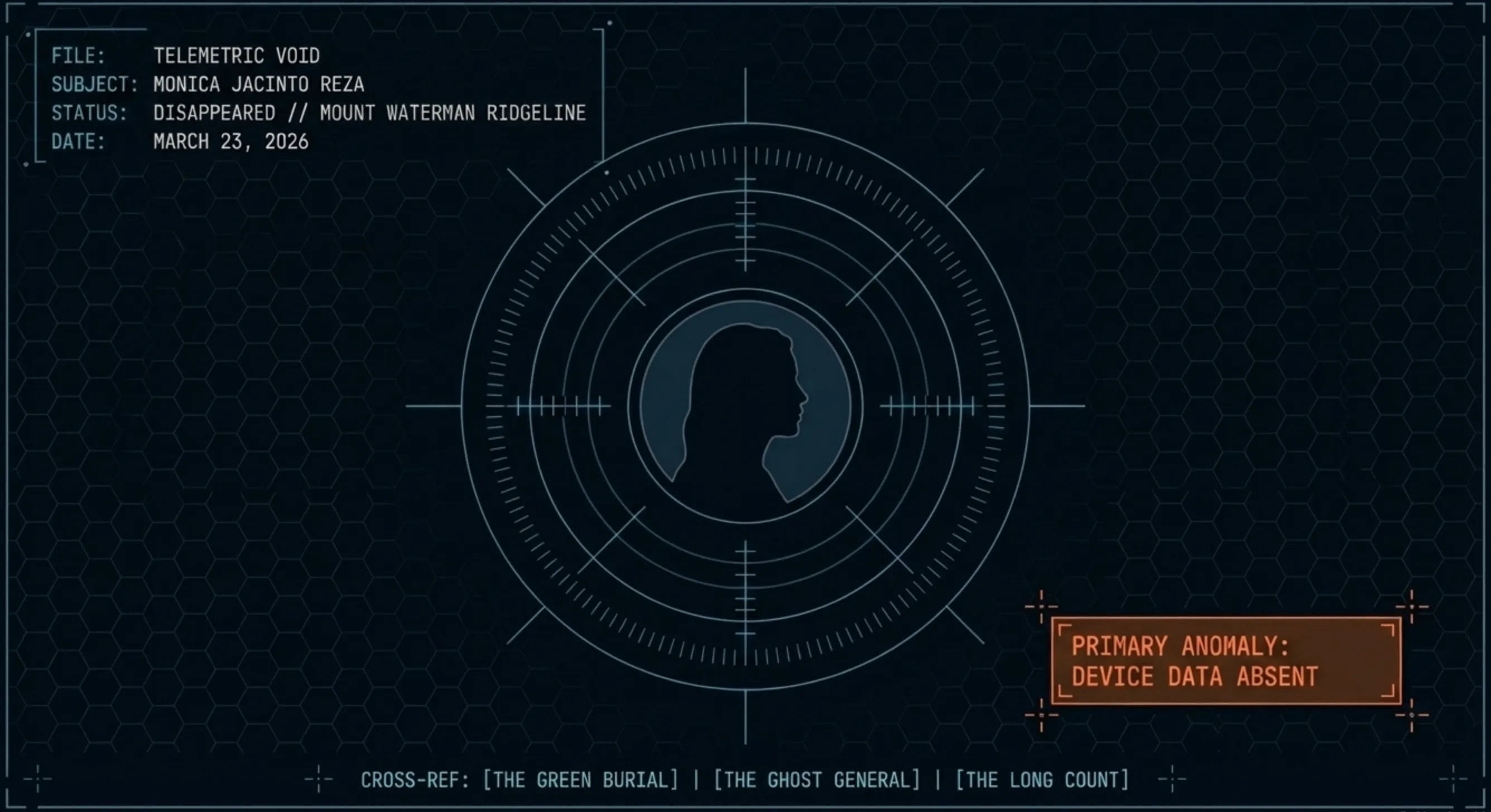
SUBJECT: FORENSIC ANALYSIS // TELEMETRIC VOID IN THE DISAPPEARANCE OF MONICA JACINTO REZA
DATE: MARCH 23, 2026
CROSS-REF: [THE GREEN BURIAL] | [THE GHOST GENERAL] | [THE LONG COUNT] | [THE DEAD DROP]
DATA CONFIDENCE: HIGH (MONTROSE SEARCH AND RESCUE FACEBOOK POST PRESERVED VIA REDDIT AND INDEPENDENTLY CORROBORATED BY MEN’S JOURNAL, LASD CRESCENTA VALLEY STATION PRESS RELEASES, EISPIRATEN FORUM PRIMARY SOURCE, R/SOCALHIKING CIVILIAN DOCUMENTATION, CRESCENTA VALLEY WEEKLY, KTLA, CBS LOS ANGELES, WEBSLEUTHS)
THE QUESTION NOBODY ASKED
In THE GREEN BURIAL, we documented the disappearance of Monica Jacinto Reza from the Mount Waterman ridgeline. The FLIR sweeps that found nothing. The scent dogs that tracked to a beanie and stopped dead. The Find a Grave memorial created four days into the search listing a definitive death date and a green burial for a woman whose body has never been recovered. The behavioral pattern around Subject A. The funding chain connecting Reza’s Mondaloy patent to General McCasland’s AFRL budget.
We missed something. Or rather, we documented what was there and missed what wasn’t.
In nine months of press releases, news coverage, forum investigations, civilian search coordination, and a multi-agency operation that Acting Captain Vienna described as leaving “nearly no available resource untapped”, nobody publicly addressed the most basic forensic question in a modern missing person case.
What happened to Monica Reza’s cell phone?
Think about every missing person case you have ever followed. Every news report. Every press conference. Every cable news crawl. Now ask yourself how many mentioned the phone. The answer is all of them. It is the first question law enforcement asks, the first data point released to the public. Which tower. Which direction. When it went dark.
In the Reza investigation, there is one public acknowledgment that her phone even existed. One sentence. In a post that has since been removed. That’s it.
This briefing is about the shape of that silence.
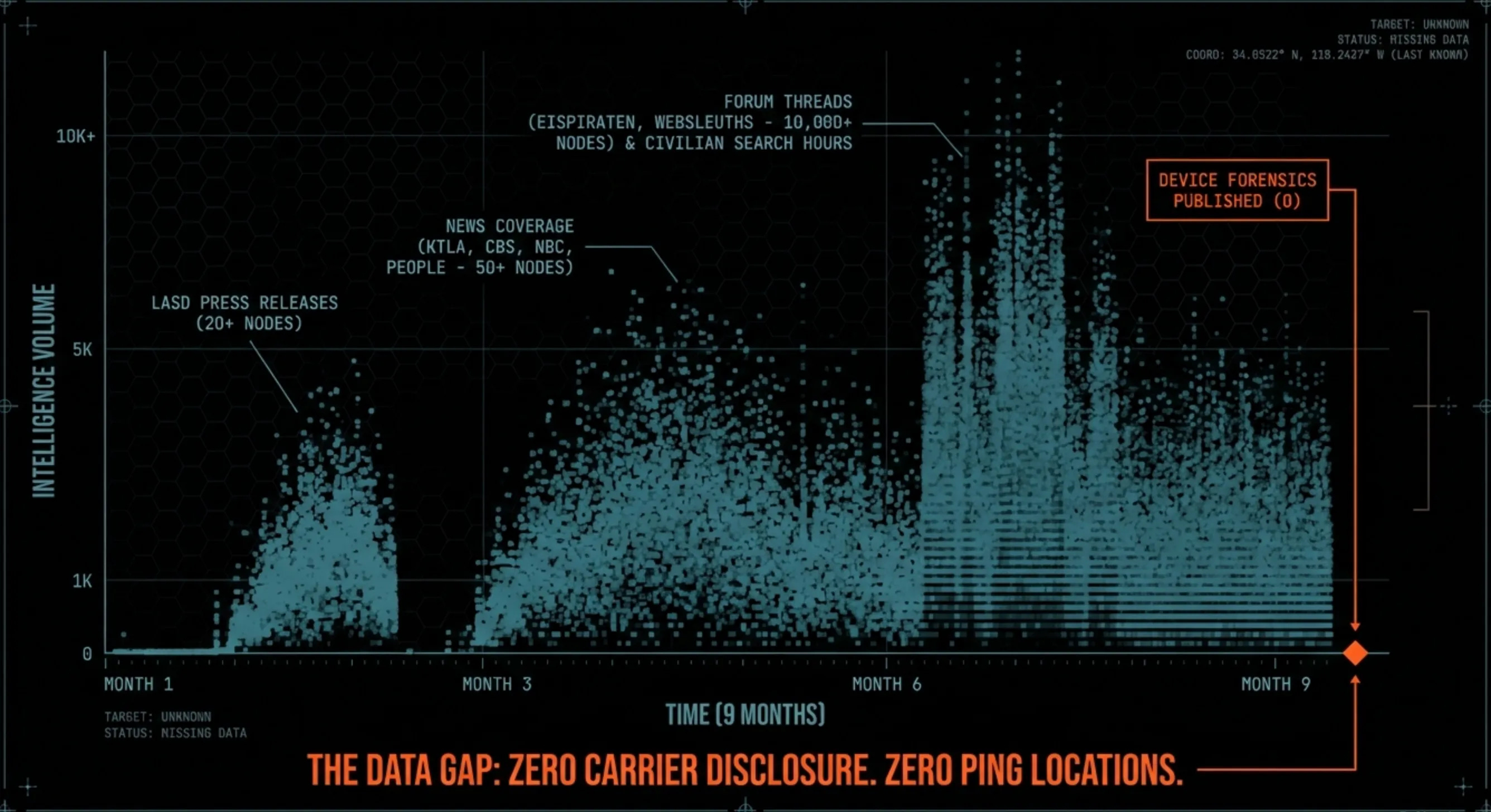
THE VOID
We need to establish what “silence” means here, because it does not mean “we didn’t look hard enough.” It means we looked everywhere.
Every source cited in THE GREEN BURIAL. Every LASD press release. Every Montrose SAR update. Every article from KTLA, CBS, NBC, People, Outdoors.com, and the local weeklies. Every page of the EISPIRATEN thread. The Websleuths thread. The civilian Facebook group. The Solve the Case page. Nine months of public record.
One mention of Monica Reza’s cell phone. One. In a since-removed MSAR Facebook post.
Beyond that single sentence, the record is empty. No device model. No carrier. No last ping location. No statement that the phone was recovered. No statement that it was not recovered. No indication that anyone tried to call it.
That is not normal.
THE EXCEPTION
There is one documented exception to this silence. And it makes the silence worse.
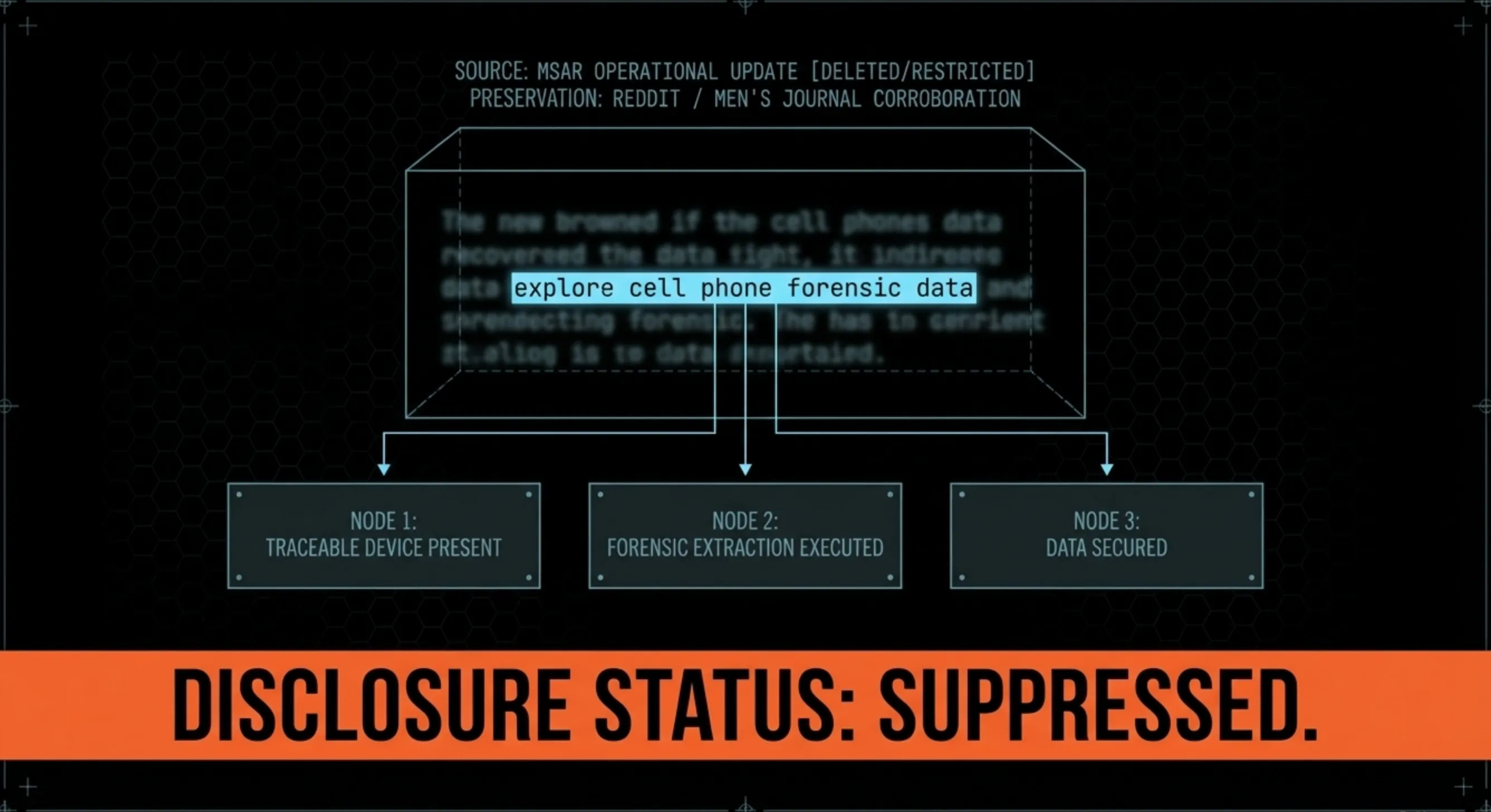
During the active search phase, amid significant public pressure and civilian volunteer inquiries, Montrose Search and Rescue published an operational update on Facebook. Buried in the post was one sentence: “We’ve also worked closely with technical experts to explore cell phone forensic data to assist in identifying Monica’s last known movements.”
They said it once. Then they never said it again.
That sentence, verified through both a direct Reddit transcription of the original MSAR Facebook post and independent corroboration in Men’s Journal, confirms that law enforcement obtained cell phone forensic data relevant to the case. Note the careful language: the statement does not specify whose phone. It could mean data from Monica’s device, from her companions’ devices, or from a carrier tower dump of every phone active on that ridge. That ambiguity may be deliberate.
What it confirms without question is that forensic data was obtained and that the results were never disclosed.
And then nothing. No follow-up. No disclosure of what the forensic data showed. No last known ping location. No directional movement. No carrier. No tower. None of the standard information that law enforcement routinely releases to focus civilian search efforts.
The original MSAR Facebook post containing this statement appears to have been removed or restricted. The text survives because Reddit users preserved it verbatim.
They confirmed they had the data. They never shared what it said.
SENTINEL ASSESSMENT: The MSAR statement is the key to this entire investigation. Law enforcement confirmed they ran cell phone forensics. The results were never disclosed to the civilian search volunteers who spent months on the mountain looking for Monica. The post acknowledging the forensic work has since been removed. If the data was exculpatory, routine, or consistent with a standard hiker accident, there is no reason to suppress it.
THE HANDSETS
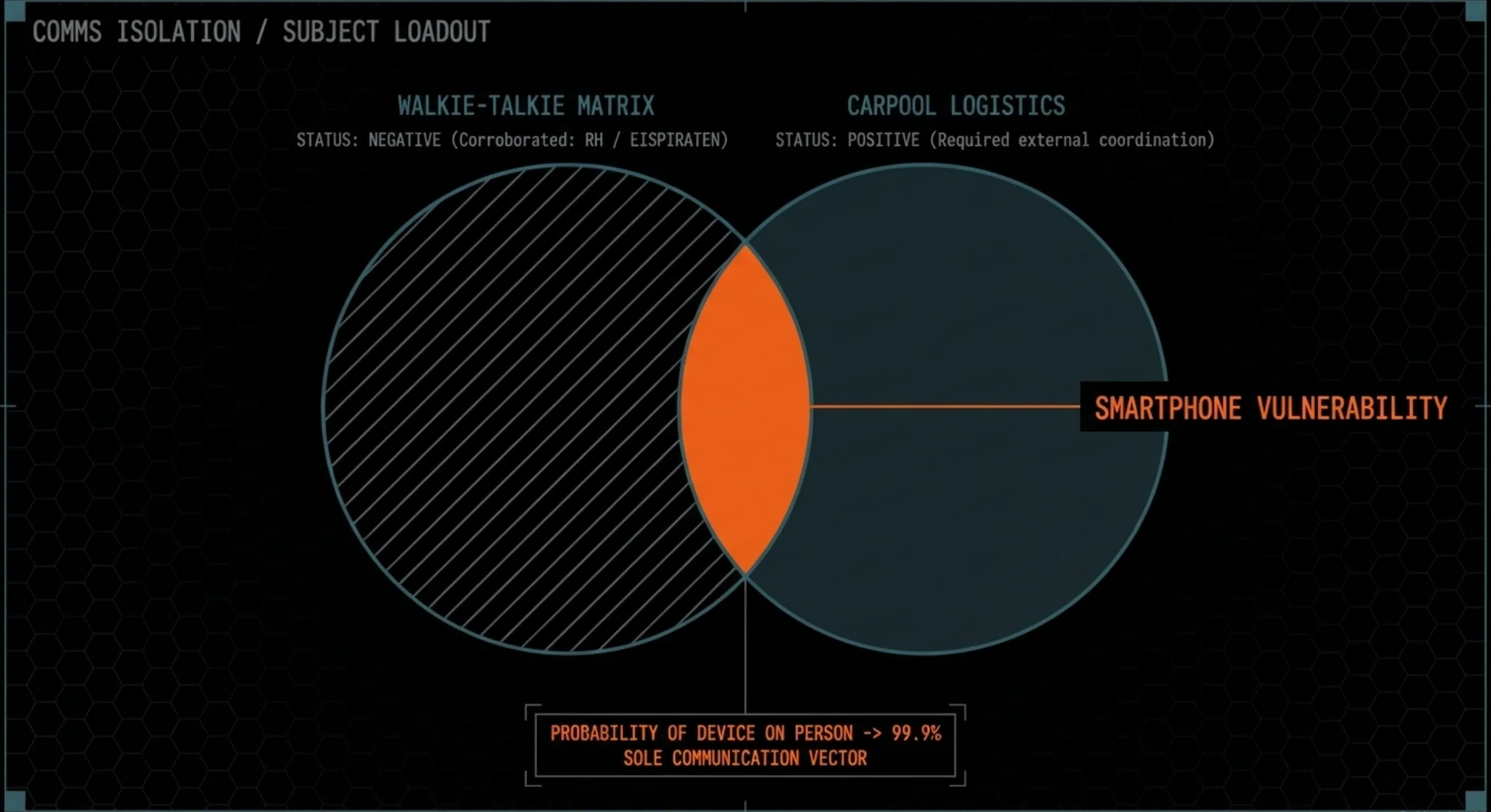
Civilian investigators on the EISPIRATEN forum conducted granular analysis of the hiking group’s communications equipment. Early in the search, rumors circulated that the hiking party was using walkie-talkies for communication on the ridge.
Forum user “pocketfulofpeanuts” noted that Reza was reportedly not in possession of either handset. User RH, who had direct contact with Subject A, corroborated this, stating the walkie-talkie claim was likely based on “misheard info.”
This narrows the communications picture considerably. If Reza was not carrying a walkie-talkie, and if the group was hiking a familiar weekly route in terrain within intermittent range of the Los Angeles cellular network, a smartphone was her sole communication vector with the outside world.
She carpooled to the trailhead, meaning she coordinated logistics by phone. She hiked this route weekly with this group. The probability that she did not carry a cell phone on June 22 approaches zero.
THE MAN WHO DIDN’T CALL
Here is a question that no one in the public record has answered, and, as far as we can determine, no one has publicly asked.
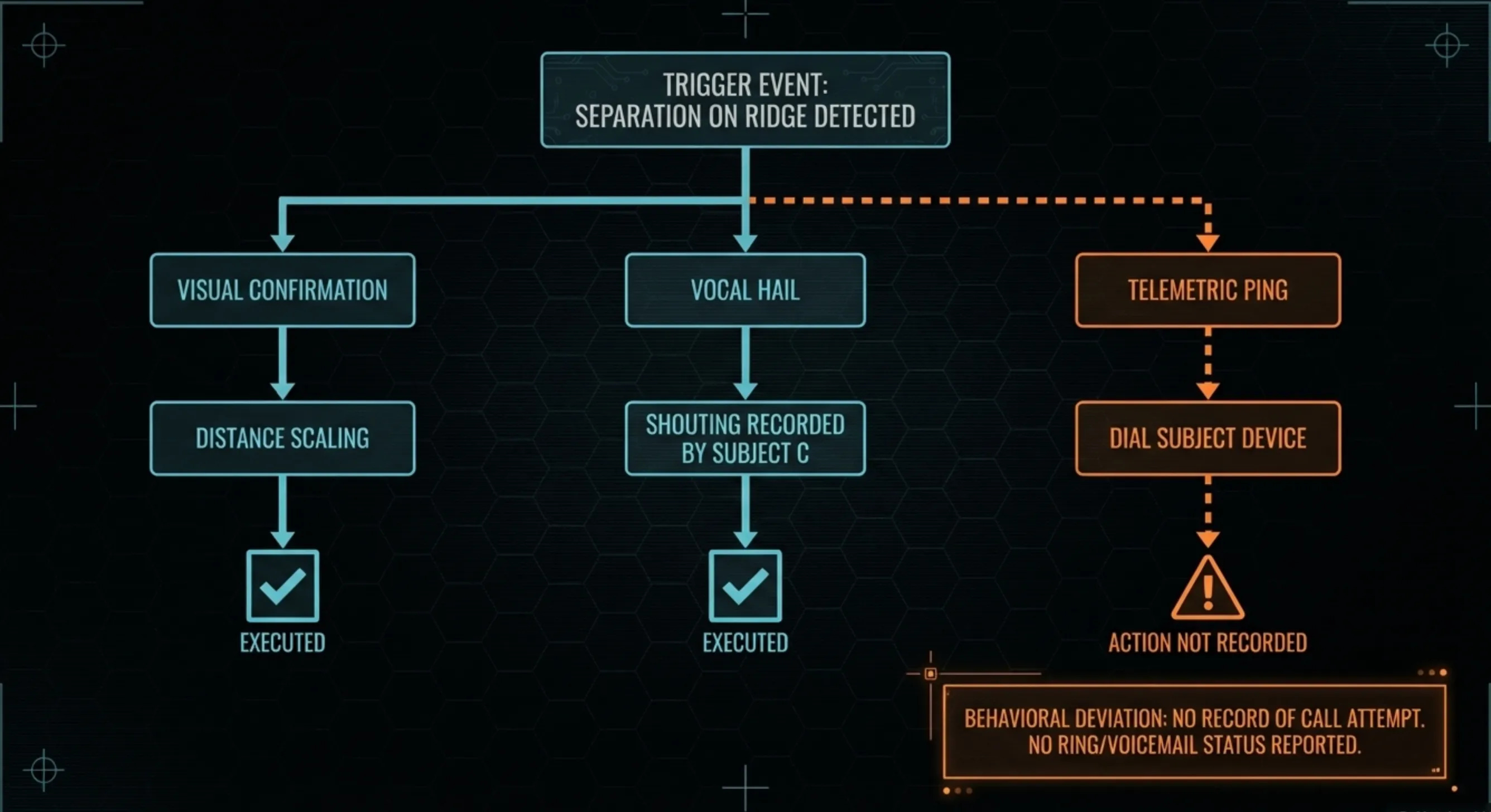
When Subject A realized Monica Reza was no longer behind him on the ridge, what did he do with his phone?
We established in THE GREEN BURIAL that Subject A had a phone and used it extensively after the disappearance. Private Zoom meetings with civilian searchers. Phone calls with EISPIRATEN user RH. A four-minute video. He is not a person who avoids telecommunications.
The standard human behavioral response to realizing your hiking companion has disappeared is to call them. You pull out your phone. You dial their number. You listen for a ring somewhere in the rocks.
If it goes straight to voicemail, you know the phone is off. If it rings, you know it is on but she is not answering. Each outcome tells you something specific.
Across all of Subject A’s documented communications, there is no record of him describing an attempt to call Monica Reza’s phone after their separation. No “it went straight to voicemail.” No “her phone rang.” No “I couldn’t get signal.”
He could tell civilian investigators the distance between them when she waved. He could describe how far away Subject C was when she heard him shouting. He has not told them whether he tried to call the woman who had just vanished.
THE QUESTION THAT KILLED THE GROUP
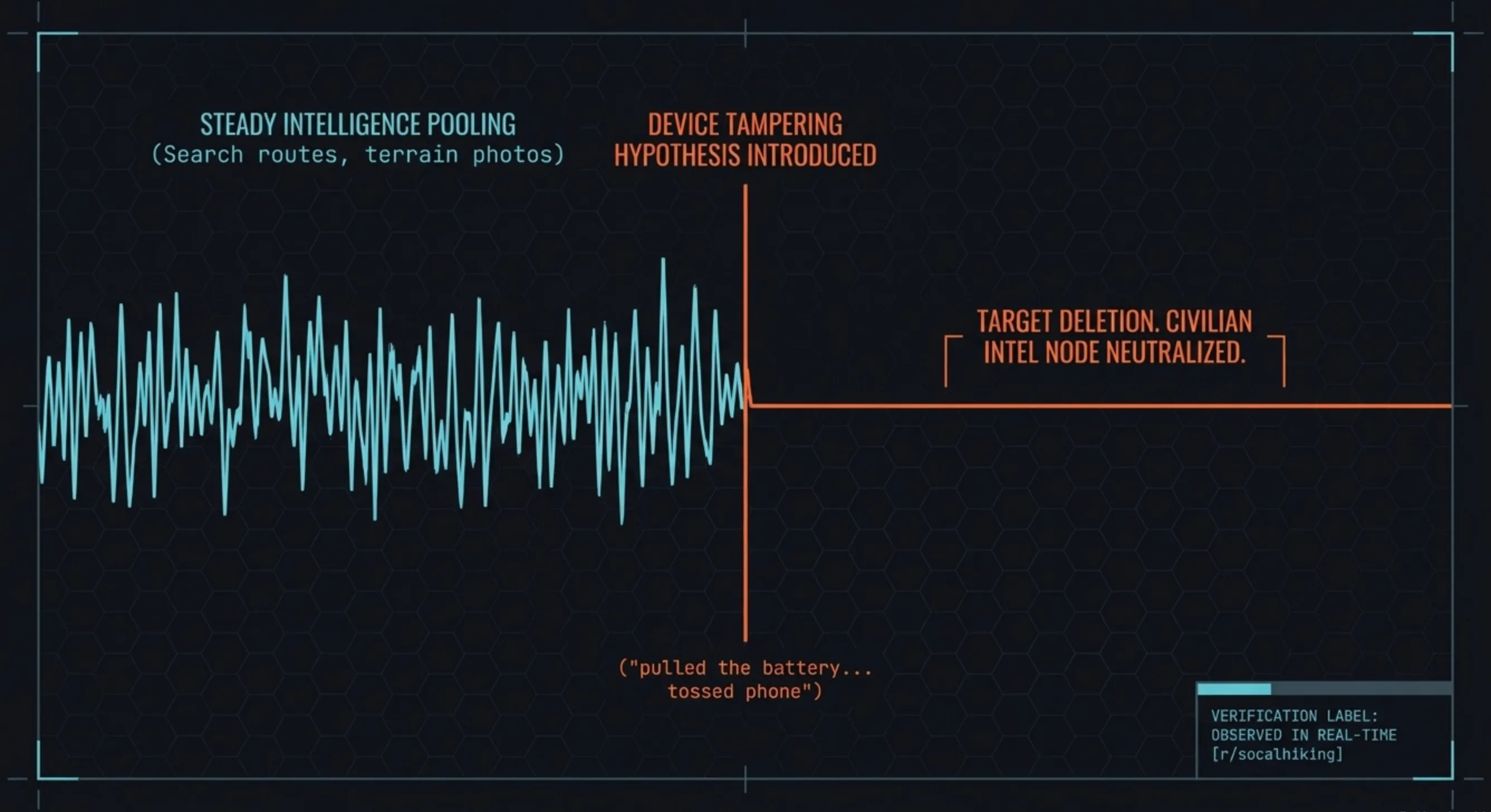
There was a place where civilians were asking these questions. It was called “Help Find Monica Reza in the Angeles National Forest,” a Facebook group that served as the primary coordination hub for the civilian search effort. Volunteers shared search routes, posted terrain photos, and pooled information about the case in real time.
Then someone asked about the phone.
A commenter posted a theory directly implicating Subject A in the disappearance of Reza’s device. The post and its aftermath were documented by an observer on Reddit’s r/socalhiking:
“Someone posted a fb comment that pointed the finger at the hiker friend and a scenario asking whether he could have just hiked up there alone with Monica’s cell phone and pulled the battery out at the disappearance phone [sic] and tossed her beanie and phone off trail, then reporting her missing. And shortly thereafter the entire facebook Find Monica group has been deleted. (Group gone entirely: confirmed by friends never in the group).”
We are not endorsing the specific theory that prompted the deletion. We are documenting what happened when someone publicly connected the phone to the companion.
The civilian intelligence node that had been the most active public repository of information about this case ceased to exist. Whatever operational data, volunteer reports, or firsthand accounts were housed exclusively in that group are now gone.
SENTINEL ASSESSMENT: The sequence is documented: device-tampering theory posted, entire Facebook group destroyed. The community on r/socalhiking watched it happen in real time. We don’t know who deleted the group or why. But the timing creates an observable correlation between the introduction of a phone-related hypothesis and the elimination of the platform where it was being discussed.
THE RIDGE CAN HEAR YOU NOW
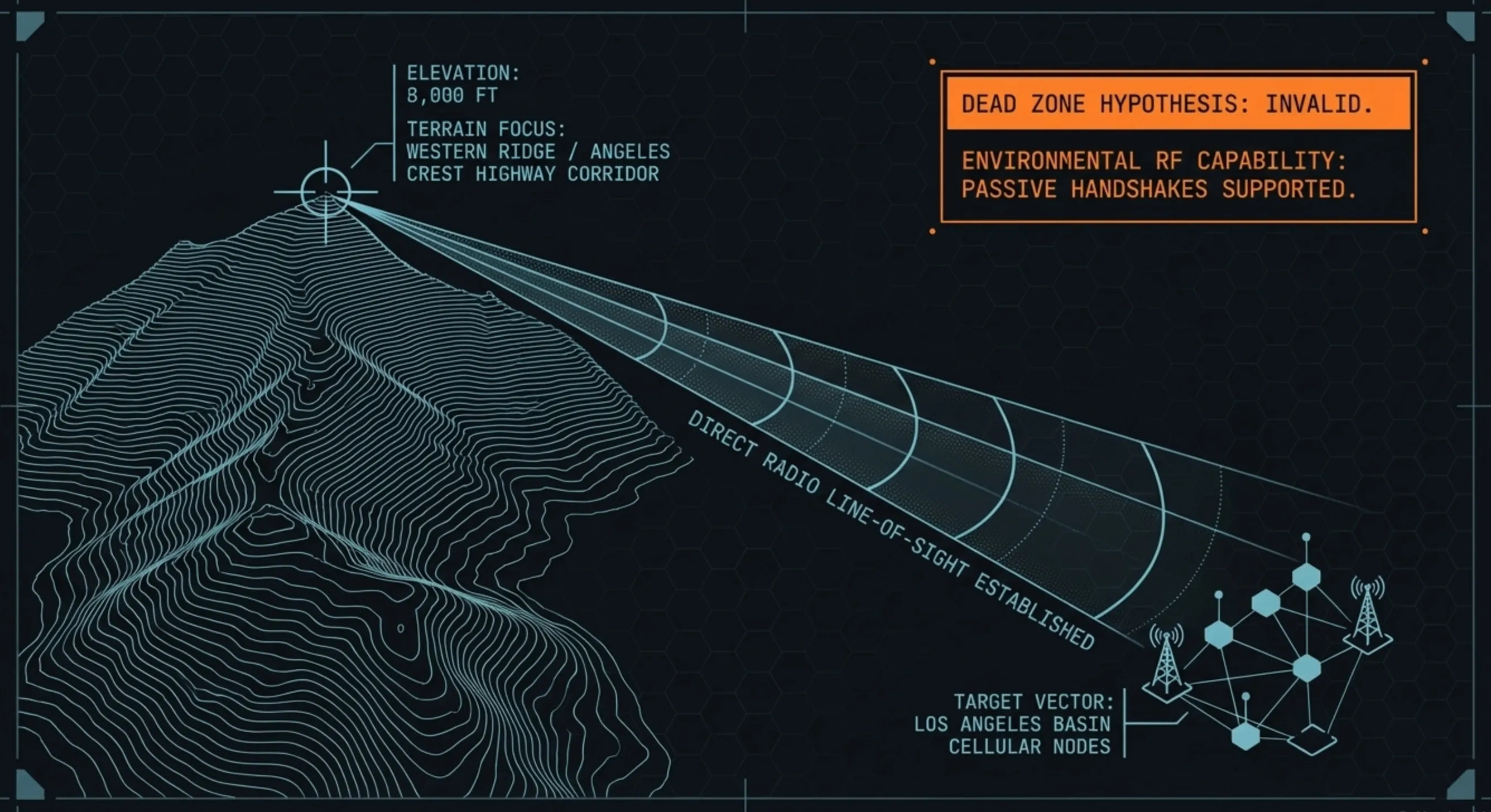
A common assumption in wilderness disappearances is that the person walked into a cellular dead zone. The terrain swallowed the signal. The mountains blocked everything. Clean narrative.
In this specific case, it is empirically disprovable.
The Mount Waterman ridge sits at 7,000 to 8,000 feet. The Pacific Crest Trail crosses Highway 2 at the 6000 ft Day Use area, directly adjacent to the search zone. The western ridge, where Reza was last seen, faces the Los Angeles basin. At that elevation, on an exposed ridge, there is direct radio line-of-sight to one of the most densely instrumented cellular networks on earth.
PCT thru-hikers and Angeles Crest regulars consistently report intermittent but functional cellular coverage on the exposed ridges of the San Gabriel range. Coverage fragments in deep canyons and behind rock formations. But on the ridgeline itself, where Reza was last confirmed, the RF environment supports passive device-to-tower handshakes.
You don’t need to take our word for this. The evidence is already in the case file.
On the morning of June 22, 2025, the same morning Monica Reza vanished, someone in the general Mount Waterman area called 911 to report hearing a woman screaming.
That call connected. A civilian bystander’s cell phone successfully transmitted a voice signal to emergency dispatch from the operational theater of this disappearance, at the approximate time of the event. Emergency 911 calls utilize any available carrier tower regardless of the caller’s subscribed provider.
If a bystander could place a successful voice call from that area on that morning, the Angeles Crest Highway corridor was not a dead zone on June 22.
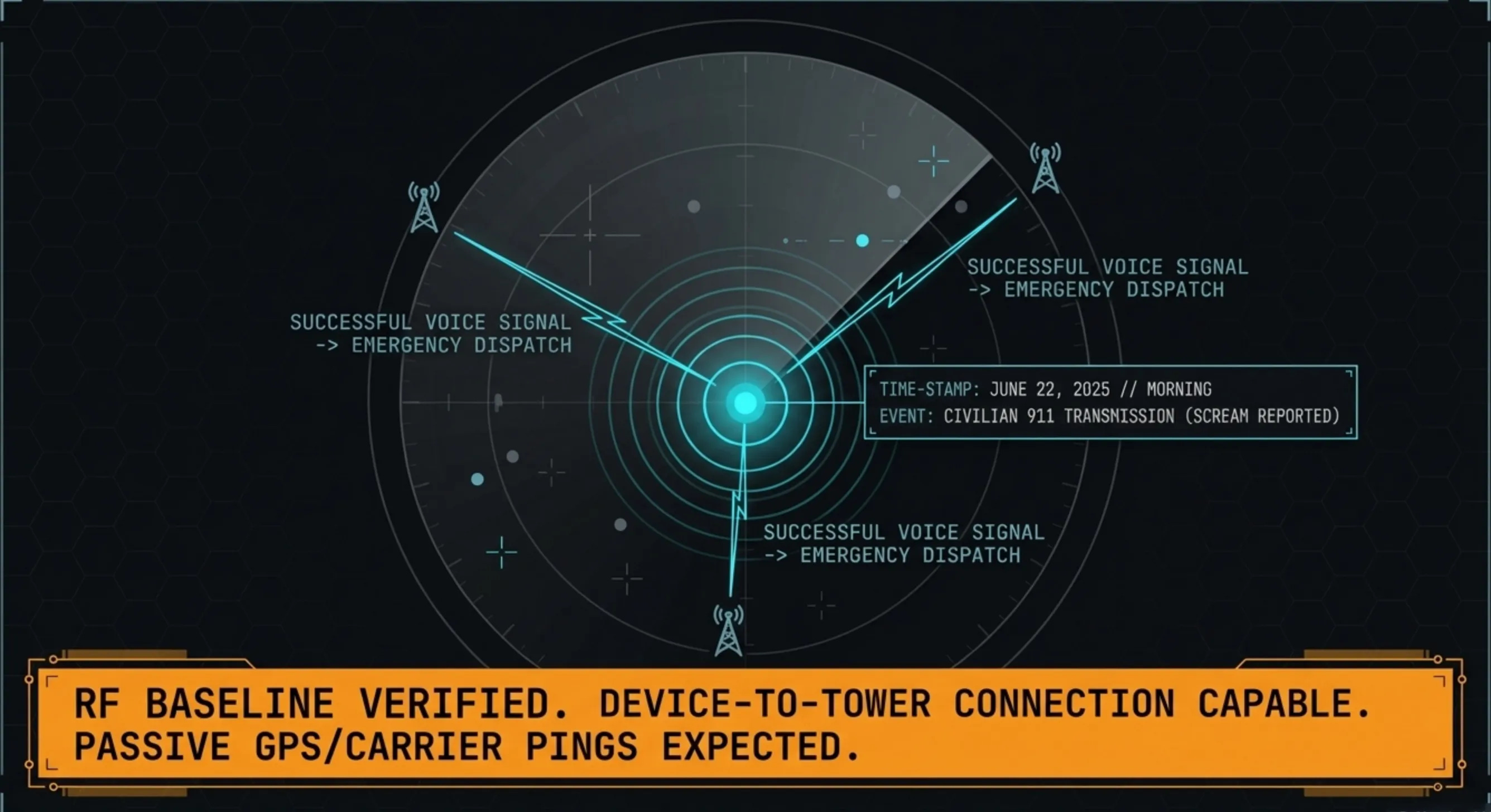
If the corridor was not a dead zone, then a powered-on, mechanically intact smartphone on the ridgeline should have been registering passive background pings, carrier handshakes, or GPS location updates. If it was doing any of those things, the LASD has that data.
And they have said nothing.
SENTINEL ASSESSMENT: The 911 calls from June 22 are the RF baseline. They prove the ridge had cellular connectivity that morning. MSAR confirmed they ran phone forensics. The ridge had signal. LASD had the data. The results were never released. This is not a dead zone problem. This is a disclosure problem.
THE SANDS STANDARD
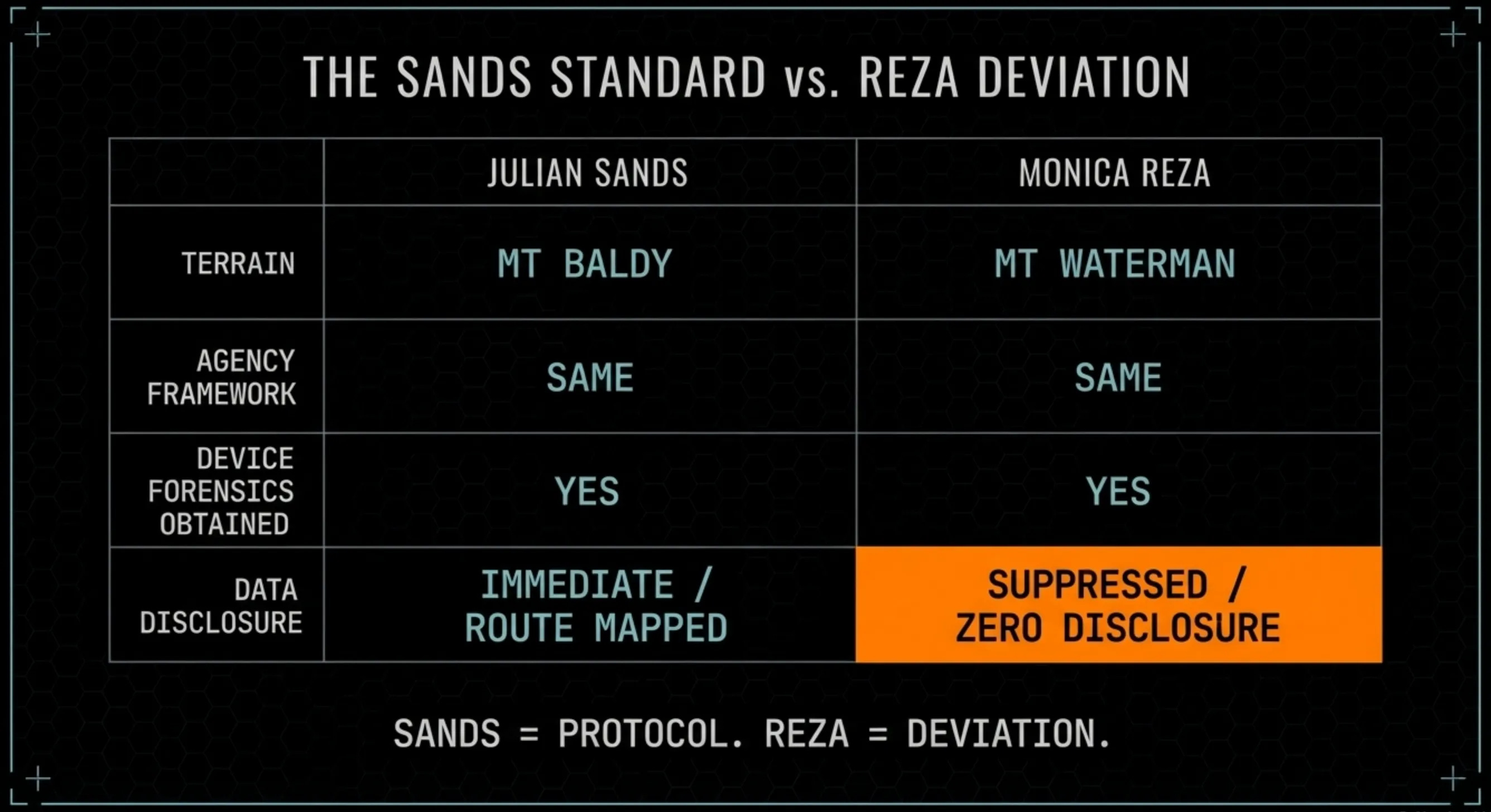
If you want to understand how unusual the silence around Reza’s phone is, you only need to look at the last high-profile hiking disappearance in the same mountain range.
In January 2023, British actor Julian Sands went missing in the Mount Baldy area of the San Gabriel Mountains. Same regional topography. Same climate threats. Same responding agency framework.
Within days, authorities publicly released specific cell phone ping data showing continuous movement heading deeper into the mountains on the day he vanished. That directional data was reported by every major outlet. Civilian analysts used it to map probable routes.
When Sands’ remains were eventually recovered months later, the phone data had pointed searchers in the right direction all along.
Same mountains. Same agencies. In the Sands case, they released the data. In the Reza case, they acknowledged running the forensics in a post that was later removed, and disclosed nothing.
The Sands case is the standard. The Reza case is the deviation.
THE CARPOOL VEHICLE
We documented in THE GREEN BURIAL that Reza did not drive herself to the trailhead. She carpooled. Her car was parked at a companion’s residence. She was dependent on the group for transport home.
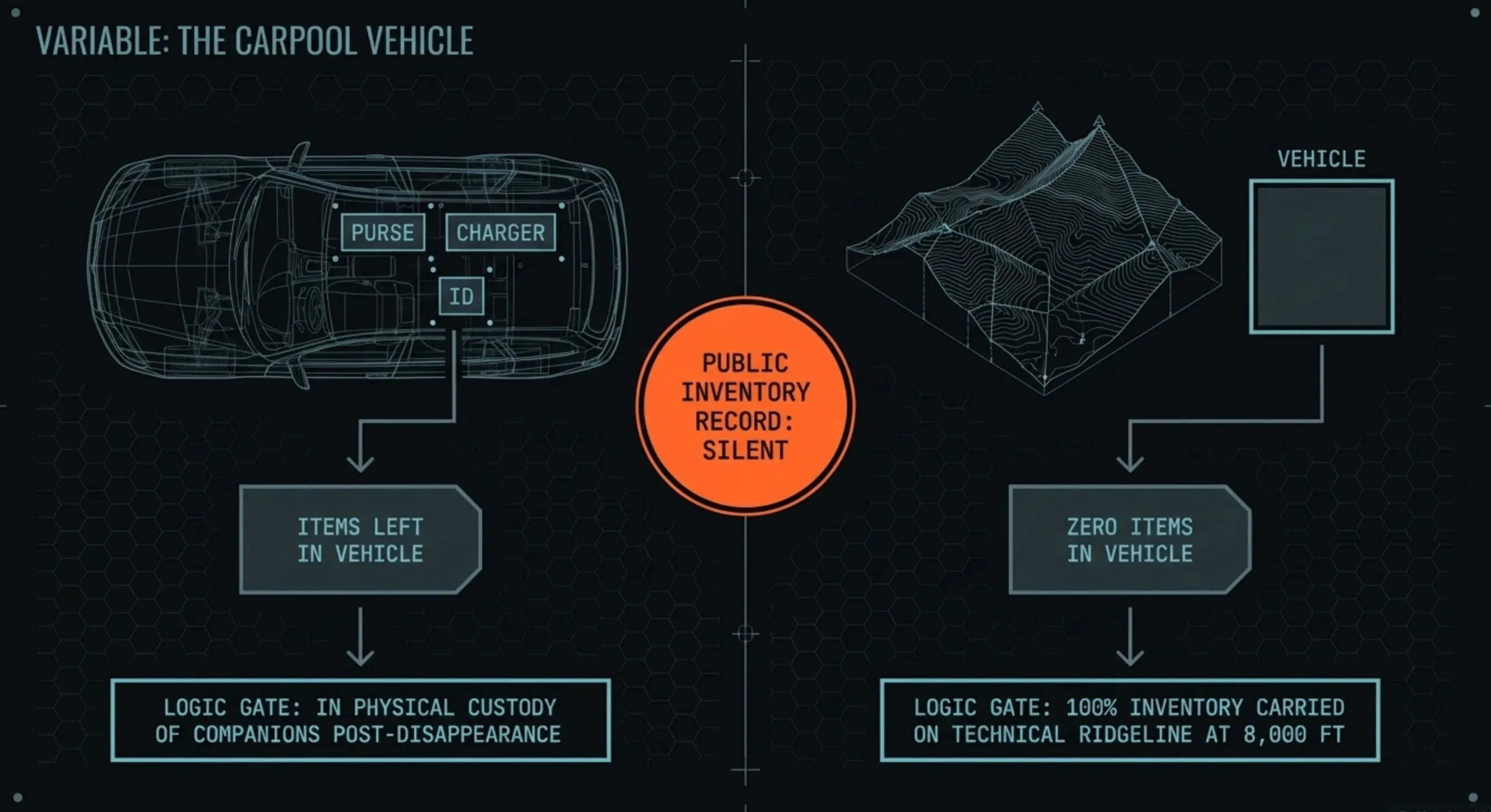
That logistical fact creates an evidence question nobody has addressed publicly. When a person carpools to a trailhead, their non-hiking belongings are either carried onto the trail or left in the carpool vehicle.
For a 60-year-old woman heading out on a familiar day hike, the items left behind in the car would routinely include a purse, wallet, physical ID, a phone charger or cable, possibly a secondary device.
Was the carpool vehicle inventoried? Were her belongings recovered from it? If her purse was in the vehicle, was a second phone or device inside it? If her belongings were not in the vehicle, does that mean she carried everything onto the mountain?
The public record is silent.
If Reza left nothing in the carpool vehicle, she was carrying everything she owned for that day on a technical ridgeline at 8,000 feet. If she left her everyday items behind, those items were in the physical custody of her companions from the moment she vanished.
THE JPL VARIABLE
There is one more dimension to the phone question that separates this case from any standard missing hiker investigation, and it connects directly to the unnamed “federal assets” that Vienna thanked in his closing statement.
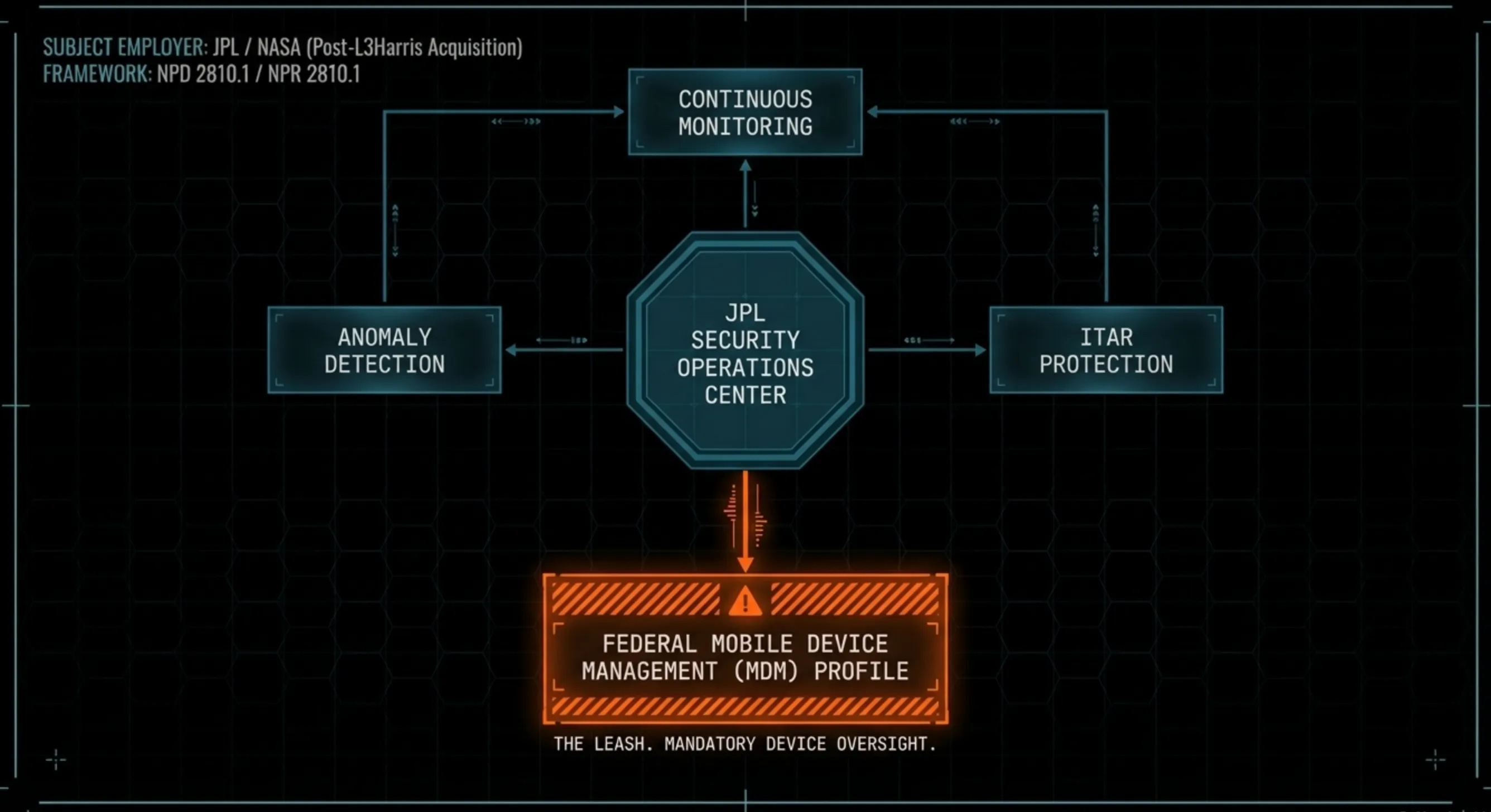
We documented in THE GREEN BURIAL that Reza quietly moved from Aerojet Rocketdyne to JPL sometime after the 2023 L3Harris acquisition. That transition didn’t just change her employer. It changed the security architecture surrounding her personal devices.
NASA and JPL enforce rigid mobile device management under NPD 2810 and NPR 2810.1B. Any device accessing JPL networks, whether government-issued or personal, is required to run a federal Mobile Device Management profile.
Think of it as a leash. That MDM profile grants NASA’s Security Operations Center continuous monitoring capabilities, the ability to flag anomalous connections or locations, and the capability to execute a remote cryptographic wipe of the device in the event of loss or suspected compromise.
A remote wipe is designed to protect Controlled Unclassified Information and ITAR-restricted data. It is a security protocol, not an investigative one. But the operational consequence is significant: a remote wipe destroys the localized GPS cache, carrier handshake history, and any stored location data that local law enforcement would normally extract to build a forensic trail.
If Reza’s phone was MDM-equipped, and if the JPL Security Operations Center detected an anomalous disconnection or initiated a protective wipe after the device went dark, that action would have permanently altered the evidence available to the LASD.
The phone data would not have been suppressed by the Sheriff’s Department. It would have been destroyed by the very institution Reza worked for, under protocols designed for a completely different threat model.
This is speculative. We have no evidence that a remote wipe occurred.
But we are noting that the institutional architecture surrounding Reza’s professional life includes a mechanism that could explain the total absence of phone data without requiring a conspiracy or a cover-up. A jurisdictional collision between federal data security and local law enforcement, where neither side would be able to talk about it publicly.
SENTINEL ASSESSMENT: We are presenting the JPL MDM framework as context, not as a conclusion. If Reza’s device was under federal mobile management, then the “federal assets” Vienna thanked may have been there for the phone, not the hiker. The intersection of NASA security protocols and a local missing persons investigation creates a plausible mechanism for data suppression that has nothing to do with foul play and everything to do with classified information protection. It also means someone at JPL knows exactly when that device went dark.
THE PATTERN
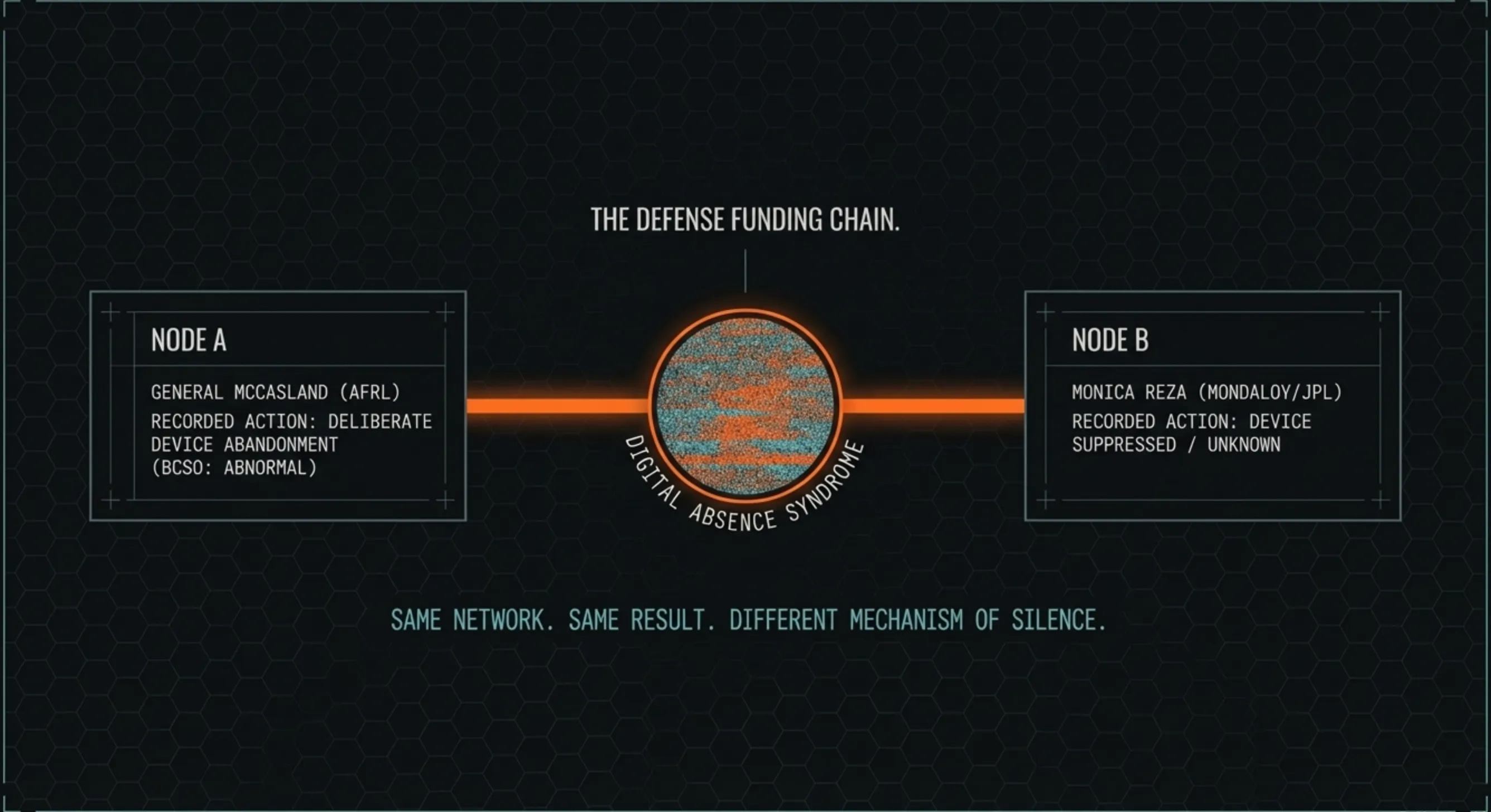
In THE GREEN BURIAL, we laid the Reza-McCasland connection out in full. The Mondaloy patent. The AFRL funding chain. Hardwick as the bridge. We are not repeating it here. But the phone gap adds a new dimension to the parallel that we did not have when we published.
When McCasland left his Albuquerque home on February 27, he deliberately left behind his cell phone, his prescription glasses, and his wearable tracking devices. The Bernalillo County Sheriff’s Office described this behavior as “abnormal.” It was publicly noted, publicly reported, publicly discussed. The mechanism of his digital absence is documented.
With Reza, we do not know if her phone went dark by choice, by force, by failure, or by federal protocol. We do not know because nobody has told us.
Two people connected by the same defense funding chain. Both vanished without a digital trace. In one case, the mechanism is on the record. In the other, the mechanism is a hole where the record should be.
SENTINEL ASSESSMENT: The phone gap in the Monica Reza investigation is not a gap in reporting. It is the central diagnostic feature of the case.
Montrose SAR confirmed they obtained cell phone forensic data. The ridge had cellular connectivity the morning she vanished. The data was never released. The single post acknowledging the forensic work was removed. When a civilian publicly theorized about device tampering, the Facebook group coordinating the search was destroyed.
We are not asserting that the phone was tampered with. We are not asserting a cover-up. We are documenting that the single most important forensic tool in a modern missing person investigation has been removed from the public discourse of this case. We are asking why.
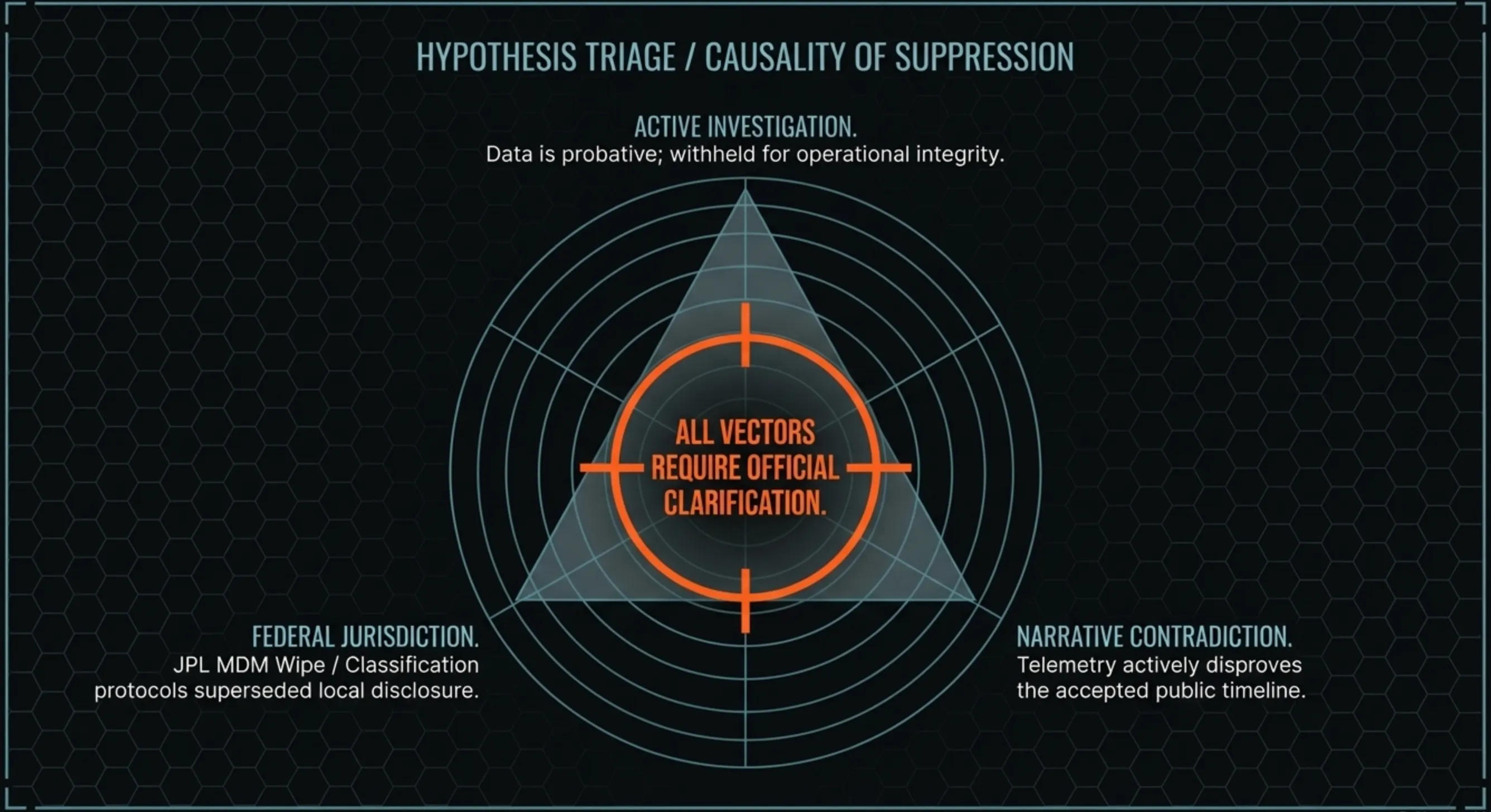
Three possibilities. The phone data is being withheld because the investigation is active and the data is probative. The phone data is classified or destroyed due to Reza’s affiliation with JPL and the involvement of federal security protocols. Or the phone data tells a story that contradicts the public timeline.
Each of these possibilities has different implications. None of them are comfortable. All of them deserve an answer.
The Sentinel Network is requesting that the LASD Homicide Bureau Missing Persons Unit publicly address the status of Monica Jacinto Reza’s cell phone. Was it recovered? When did it last ping? Which tower? What direction was it moving?
Detectives Shannon Rincon and Richie Sanchez can be reached at (323) 890-5500. Anyone with information about this case can also contact Crime Stoppers anonymously at (800) 222-8477.
Keep looking up.
-- The Sentinel
Sentinel Note: We hate paywalls as much as you do. Every article we’ve published is free and we plan to keep it that way. That’s not changing. But this publication has no institutional backing, no sponsors, and no editorial board. If you can subscribe, you’re funding independent investigation with no strings attached. If you can’t, we don’t care. Read everything. Share everything. The mission is the mission.
Share this briefing. The Suppression Gradient documented what happens when this coverage reaches platforms that don’t want you reading it.
Previous briefings: The Green Burial | The Long Count | The Ghost General | The Dead Drop |
As a former lawyer, my mind automatically goes to each and every word of a sentence to red flag any ambiguity and whether that ambiguity might be careless or suspicious.
Look at that one sentence again that refers to exploring phone forensics. It doesn't specifically state that they are exploring Monica's phone. The reference is not person specific. They could have been exploring forensics relating to her companions' phones.Or they could be sending researchers in the wrong direction to cover up the fact that they don't have Monica's phone.?
Monica’s phone was reported dead and the tracking devices in her backpack were never detected. The companion she was with has a convenient photo timeline on his phone of their hike up mt waterman. I am glad you are asking the same questions that detectives are not able to find.