

SUBJECT: OSINT EXTRACTION // DISAPPEARANCE OF MONICA JACINTO REZA, FORMER TECHNICAL FELLOW (AEROJET ROCKETDYNE), JPL NASA
CROSS-REF: [THE GHOST GENERAL] [THE DEAD DROP] [FORENSIC AUDIT: THE COVERT SPACE FORCE MOBILIZATION]
DATA CONFIDENCE: HIGH (LASD PRESS RELEASES, CRESCENTA VALLEY WEEKLY, KTLA, NBC LOS ANGELES, CBS LOS ANGELES, SPACENEWS PRIMARY SOURCE INTERVIEW, GOOGLE PATENTS US 2010/0266442 A1, CAL STATE LA OFFICIAL DIRECTORIES, UNSW ALUMNI MEMORIAL, DEFENSE NEWS, FIND A GRAVE MEMORIAL 284387277, EISPIRATEN FORUM PRIMARY SOURCE, REDDIT R/SOCALHIKING, WEBSLEUTHS, SNOWBRAINS)
We are building the video side of this operation. If you want the briefings in a format you can watch, subscribe to The Sentinel Network on YouTube.
The Wave
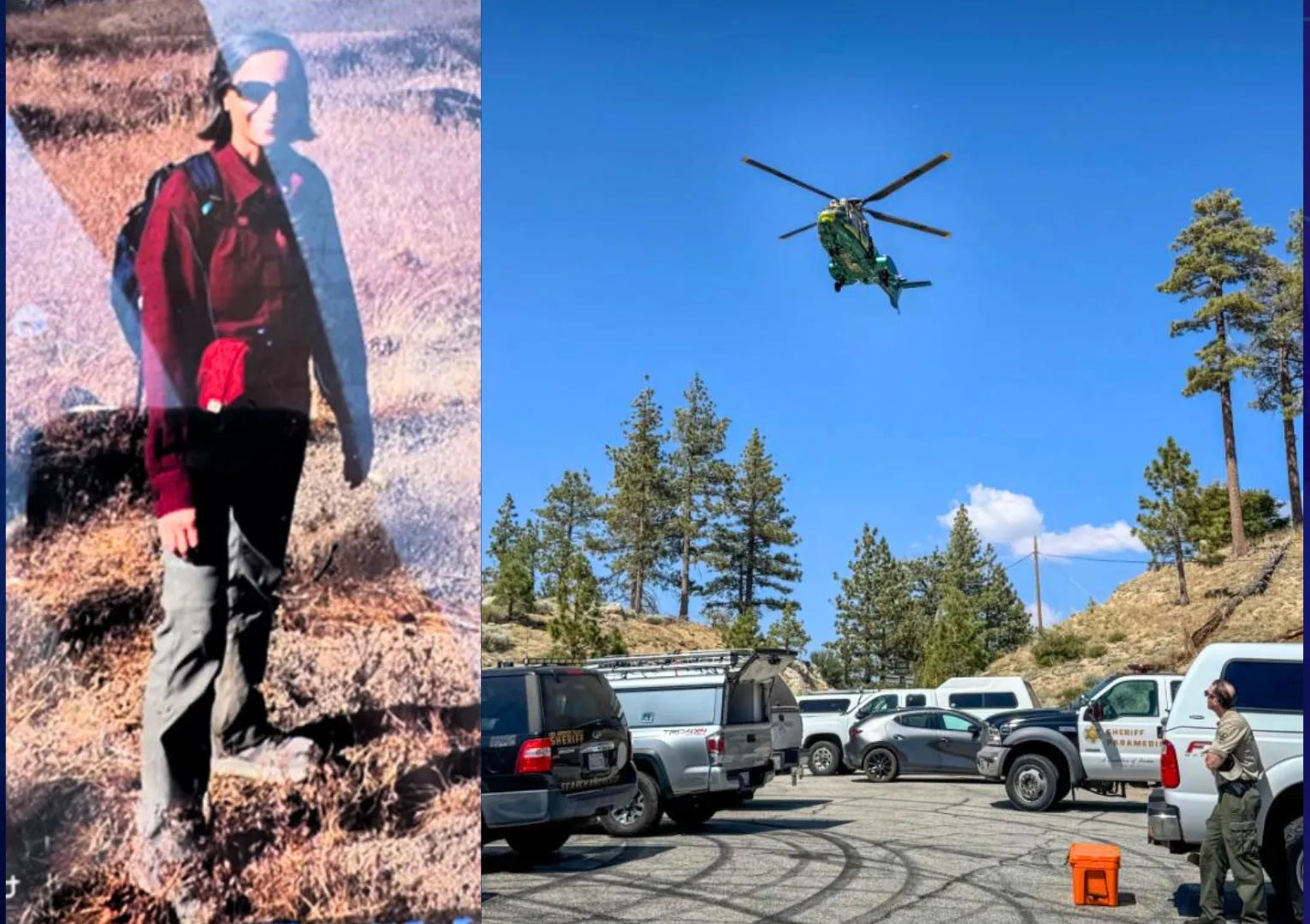
On June 22, 2025, a 60-year-old woman waved at her hiking companion on a ridgeline in the Angeles National Forest. She was 30 feet behind him. Bright red shirt. Green hiking pants. Clear weather. A route she hiked every week.
That wave is the last confirmed contact anyone had with Monica Jacinto Reza.
Every news outlet that covered this story ran the same framing: missing hiker, rugged terrain, please check your cameras. Standard template. What none of them reported is who she actually was.
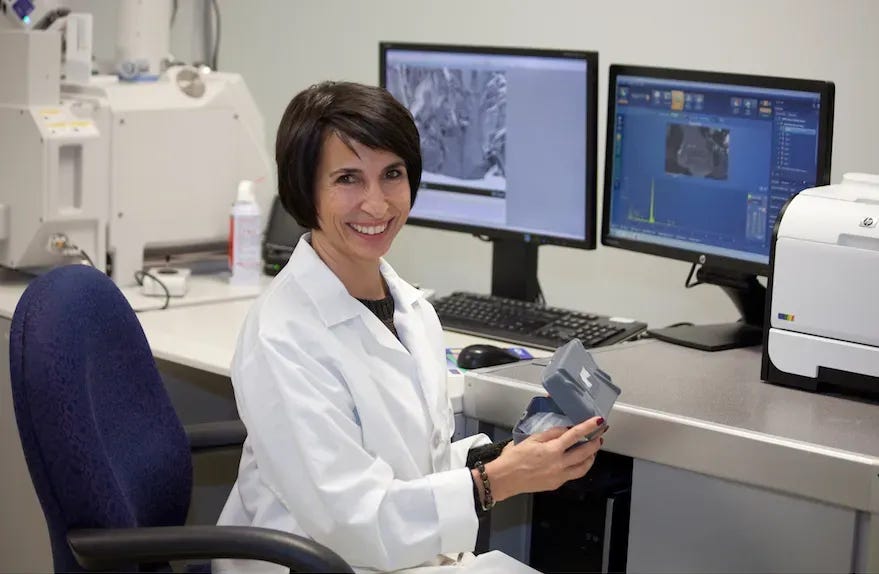
Reza co-invented Mondaloy, a family of nickel-based superalloys now built into the engines replacing Russian-made rockets for American national security launches. She held the patent. She spent decades as a Technical Fellow at Aerojet Rocketdyne, the highest technical rank in the company. An Associate Fellow of the American Institute of Aeronautics and Astronautics. At some point after 2023, she moved to NASA’s Jet Propulsion Laboratory.
That matters because of what happened eight months later. On February 27, 2026, retired Major General William Neil McCasland walked out of his Albuquerque home and into the Sandia Mountain foothills. Left his phone. Left his glasses. Left his wearable devices. Took a gun and his wallet. He has not been seen since.
In THE GHOST GENERAL, we mapped McCasland’s career. He commanded the Air Force Research Laboratory from 2011 to 2013, overseeing the $4.4 billion portfolio that funded the most sensitive aerospace research in the country.
That portfolio funded Monica Jacinto Reza’s work. Her alloy is in the engines his budget was was actively building.
We did not expect the General’s trail to lead here.
The Sweet Spot
American rocket designers had a problem for decades. The Soviets could build oxygen-rich staged combustion engines. We couldn’t. Not because we didn’t understand the physics. Because we couldn’t find a metal that survived the environment.
Picture the inside of a rocket preburner. High-pressure gas oxygen, superheated, slamming through components at forces that would vaporize ordinary steel. The metals strong enough to hold that pressure were the metals that caught fire in the oxygen. The metals that didn’t catch fire were too weak to hold anything. Every alloy was a tradeoff that lost on one side or the other.
In the mid-1990s, at the Rockwell Science Center in California, a metallurgist named Dallis Hardwick and her research assistant, Monica Jacinto, cracked it. They found a nickel-based composition that could sit in that inferno without igniting and without cracking. No coatings. No liners. Bare metal touching gas oxygen at extreme temperature.
They called the alloy Mondaloy. The name is a portmanteau. The “Mon” belongs to Monica.
In 1999, the Air Force Research Laboratory started putting money in. NASA followed. The lab-scale alloy became two production variants: Mondaloy 100 and Mondaloy 200. Different chemistries for different heat and pressure ranges. You can cast it, forge it, 3D-print it. Twenty years of materials qualification, component testing, and integration work. Monica Jacinto led all of it.
In December 2017, SpaceNews profiled her. The headline: “What is Mondaloy and why should you care?” Here’s why you should care. The AR1 engine is Aerojet Rocketdyne’s replacement for the Russian RD-180 that launches America’s national security satellites. Twelve components inside that engine are Mondaloy. Preburners. Turbine rotors. Turbine housings. Ducts and lines and hot gas manifolds. Every part that touches the fire.
The “Hydrocarbon Boost Technology Demonstrator”, the Air Force’s program for a reusable 250,000-pound-thrust engine, uses Mondaloy. Both programs. Air Force funded. Both flowing through AFRL.
The patent is public record. US 2010/0266442 A1. “Burn-Resistant and High Tensile Strength Metal Alloys.” Jacinto et al.
The Cal State LA LAunchPad 2021 page documented who she was: Technical Fellow for Materials and Processes Engineering at Aerojet Rocketdyne. Associate Fellow of the AIAA. Thirty years leading R&D teams. Columbia for her B.A. and B.S. in Metallurgical Engineering. UCLA for her M.S. in Materials Science. Born and raised in Los Angeles.
Her mentor, Hardwick, later moved to the AFRL in Ohio. Wright-Patterson Air Force Base. By 2005, she was leading all materials research for advanced gas turbine engines. Her group, the AFRL Materials Directorate, was the government half of the Mondaloy partnership. Reza built the alloy at Aerojet Rocketdyne. Hardwick’s team qualified it at Wright-Patterson. Two women, two institutions, one program. When McCasland took command of AFRL in May 2011, Hardwick was still there. Reza’s contracts were still active. All three of them were on the same program at the same time.
Hardwick retired in 2012 after a stage four cancer diagnosis. She continued mentoring through the AFRL Emeritus Program. She died on January 5, 2014.
After Hardwick’s death, Reza said publicly: “I hope she understood that my accomplishments and successes are, in large part, due to her.”
Nobody outside the propulsion world knew her name. That was fine. She made the metal that makes the engines work.
Thirty Feet
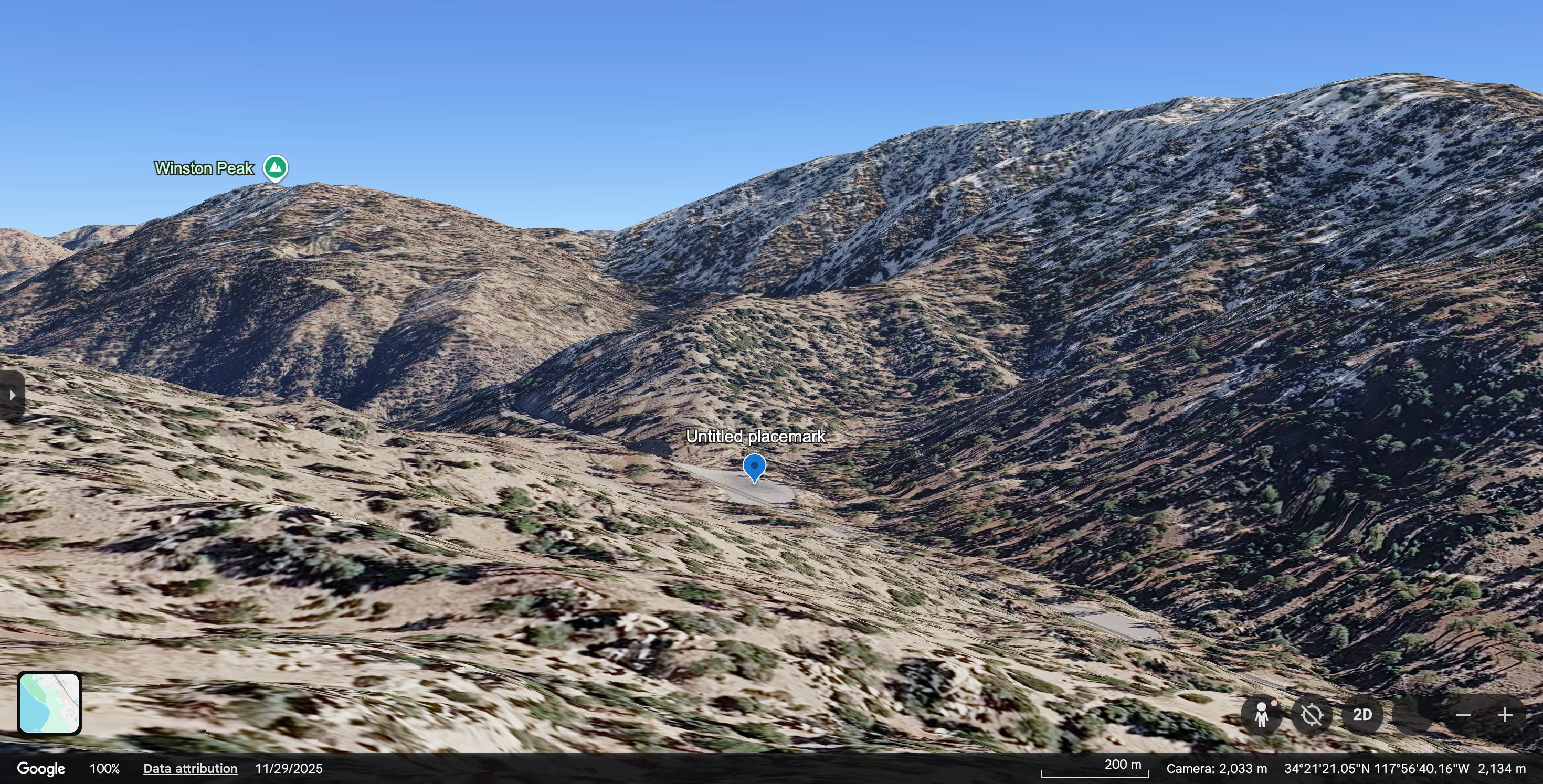
Three hikers departed the 6000 Foot Day Use parking area on Angeles Crest Highway at approximately 9:10 a.m. Coordinates: 34.349583, -117.962806. Pacific Crest Trail crossing at Highway 2. Ridgeline terrain, 7,000 to 8,000 feet. Challenging but well-maintained.
A neighbor later posted on the Crescenta Valley Sheriff’s Station Facebook page: “What we know is that she went hiking with her yoga group/friends and her car was parked at one of their houses.”
Read that again. Her car was at someone else’s house. She was dependent on the group for transport.
One of the three, designated “Subject C” in civilian investigations, stayed at the bottom of the steep section. Reza and the lead hiker, “Subject A,” continued to the summit of Mount Waterman and began descending the west ridge.
Independent investigators on the EISPIRATEN hiking forum reconstructed the timeline using metadata from photos the group took on the trail. The pair covered a mile from the summit to their last photographed position in 17 minutes, roughly 3.5 mph. A jog. Then 0.3 miles more in 5 minutes to the spot where everything stopped.
At a northerly right turn on the ridge, Subject A claims he communicated the turn to Reza. He says she was 30 feet behind him. He initially reported 30 yards, then corrected to 30 feet. Photographic evidence from moments earlier showed 60 feet of separation. The distance kept changing.
Reza acknowledged the signal with a wave.
Subject A made the turn. He descended approximately 150 feet before realizing she was not behind him. He returned to the ridgeline in 8 to 10 minutes.
She was gone.
He called her name. Subject C, over 1,600 feet away and 500 feet below the ridge on the noisier highway side, could hear his shouts. Monica, who by Subject A’s own account had been 30 feet behind him less than 10 minutes earlier, did not answer.
Nobody heard from her again.
The Search for Nothing
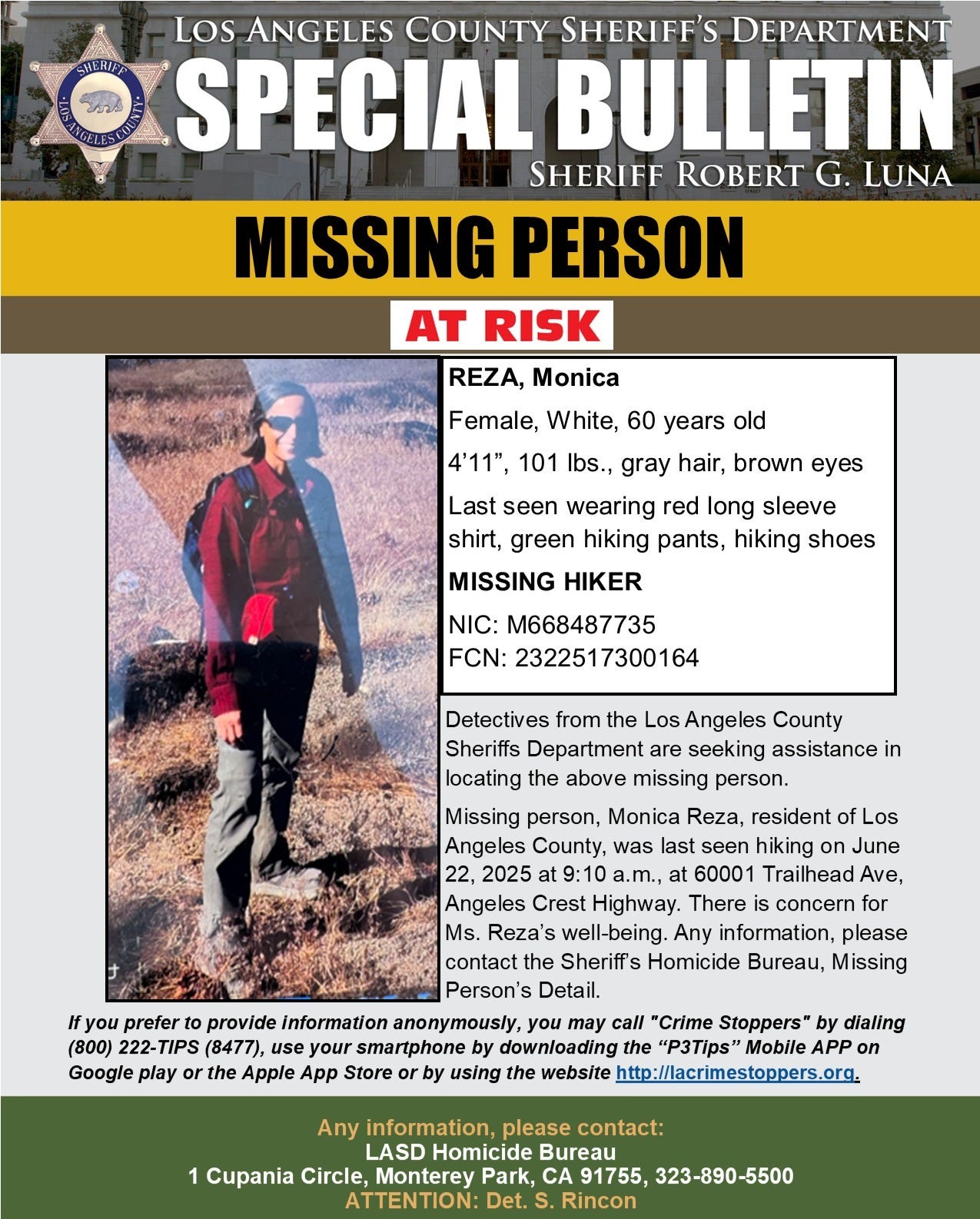
Acting Captain Ryan A. Vienna of the LA County Sheriff’s Crescenta Valley Station called it “an extraordinary search.” He wasn’t exaggerating.
Montrose Search and Rescue led. They were joined by units from Altadena, Antelope Valley, Malibu, San Dimas, Sierra Madre, San Diego, Ventura County, Orange County, San Bernardino County, Riverside. Federal partners were involved but not publicly named. Vienna thanked “our federal partners for their continued assistance.”
LASD’s Air Rescue 5 helicopter ran thermal imaging sweeps. FLIR went up the first morning after she disappeared. It picked up a bear. It picked up other searchers. It did not pick up a 60-year-old woman in a red shirt.
They ran an algorithmic pixel-matching program through the aerial photography, calibrated specifically to the red of her hiking shirt. High tech. It flagged hits. Ground teams hiked to each one. Mylar balloons. Every time.
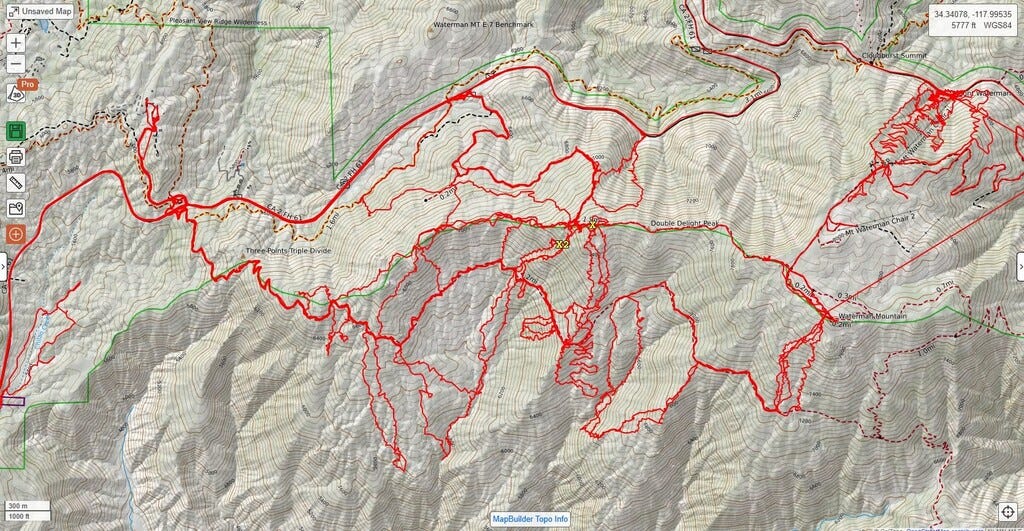
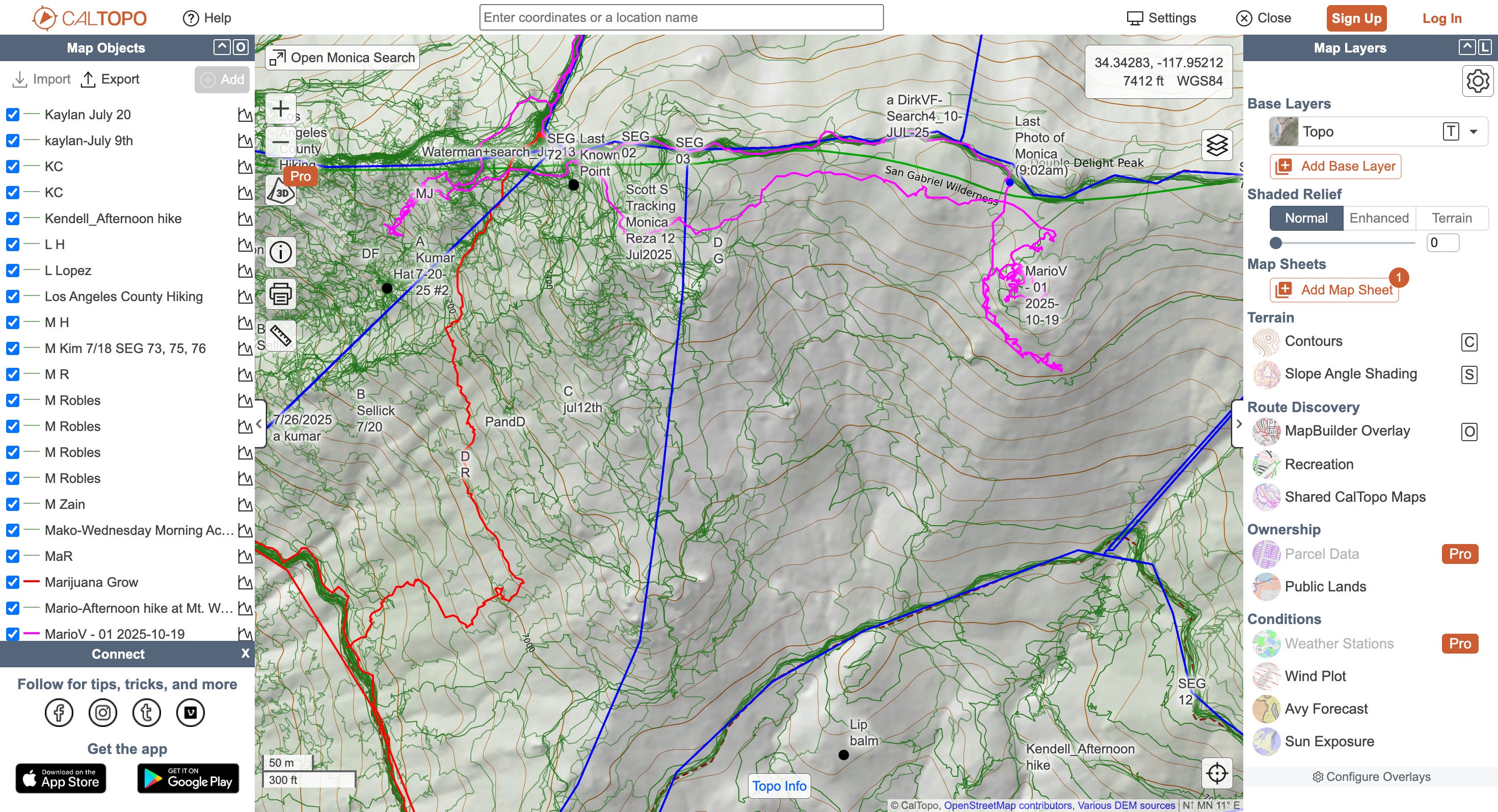
They mapped every search track on CalTopo to prevent overlap across a 40 to 50 mile radius. They ran canines. They deployed what Vienna described as “forensic technology, photography, airships (drones), canines, and other specialized tools” with “nearly no available resource untapped.”
One piece of physical evidence was recovered.
On the morning of June 23, approximately 24 hours after the disappearance, a beanie belonging to Reza was found in a steep ravine south of the ridge, descending toward Devil’s Canyon. Scent dogs tracked Reza’s trail from the upper ridge downward and successfully followed it to the beanie.
Then they lost the scent entirely.
No exit trail. No trail in any direction. Reza’s scent simply stopped at the beanie and went nowhere.
In October, an independent investigator who visited the site and spoke directly with Subject A wrote on EISPIRATEN: “Without significant wind, to me this meant the beanie got transported there by some walking animal (not a flying bird) or someone other than Monica.”
Multiple civilian searchers who descended the ravine described the terrain as steep but “not steep enough to be fatal if someone fell.” The slopes were open and visible. Hundreds of people searched south of the ridge for months. Nothing.
The day she went missing, someone reported hearing “a woman screaming” in the area. The original witness was never publicly identified. The time and exact location were never disclosed.
A lip balm was later found far from both the last known position and the beanie. Subject A insisted it looked new and was hers. The only photo provided showed it looking weathered. Forum investigators noted it was a common brand that could have belonged to any of the hundreds of searchers who had already covered the area in the weeks before it surfaced.
On June 29, one week in, Vienna announced the conclusion of the initial response phase. The case transferred to the LASD Homicide Bureau Missing Persons Unit, Detectives Shannon Rincon and Richie Sanchez. This is standard procedure for unsolved missing persons in LA County. It alone does not indicate a presumption of foul play.
As of March 2026, Monica Jacinto Reza has not been found.
The Yogi
Subject A is not publicly identified. What follows is sourced from EISPIRATEN, Reddit’s r/socalhiking, and the “Help Find Monica Reza” Facebook group.
He is described repeatedly as a “yogi” who operates a wellness business that includes taking clients on outdoor excursions. Reza was not merely a hiking friend. She was a client.
His post-disappearance behavior drew sustained scrutiny.
One Reddit user documented that “this yogi is still out there searching for her in the heat and rough terrain. He was very adamant about searching every bush and rock.” The same thread included a counter-analysis: “It is probable that he is building an alibi to protect himself and his wellness business. However, lets say I was the yogi and had killed one of my clients. Why would I create a fake scenario where I lose someone on my own hiking event in a well traveled area? This totally jeopardizes my own business and makes me the last person to see her.”
Fair argument. But there is a directional contradiction that nobody has resolved.
Subject A explicitly told Reza to make a northerly right turn. He claims she acknowledged with a wave. Yet when SAR arrived, Subject A was reportedly “irritated” that teams searched north and insisted she must have traveled south.
Think about that. If you tell someone to turn right and they vanish, your first instinct is they tried to turn right and missed it. You don’t argue for the opposite direction unless you have a reason to redirect the search.
The civilian search organizers, widely believed to be connected to Subject A and the hiking companions, drew intense criticism for information control. On October 18, 2025, EISPIRATEN user RH wrote: “Organizers would not share previous search routes and became very guarded with information. This was a huge disservice to Monica as volunteers were searching the same areas over and over again.”
RH continued: “The organizers seemed more interested in controlling all aspects of the search and online discussions regarding the disappearance to protect the other hikers who were with her rather than actually doing what’s best to find her remains.”
Two months in, Subject A was reportedly still searching. “Very adamant about searching every bush and rock.” Forum investigators suspected he was operating a YouTube account that aggressively responded to anyone suggesting foul play. The man who lost her embedded himself in the effort to find her.
We are not accusing Subject A of anything. We are documenting a pattern.
The group was split before the disappearance. Subject C left at the bottom. One witness removed. Monica carpooled. No independent transport out. The pace on the ridge was 3.5 mph, a jog, on descending terrain, with a 60-year-old woman who was 4’11” and 101 pounds. That’s how you create separation conditions. Then the distance shrinks in the retelling: 30 yards becomes 30 feet, but the photos show 60. He told her to turn north, then insisted SAR search south. When a lip balm was found far from both the LKP and the beanie (to the south), Subject A insisted it looked new and was hers. The only photo showed it weathered. The organizers locked down information, controlled online discussion, and posted a 4-minute video that has since disappeared from the internet. And Subject A stayed inside the search, monitoring what was found and responding to what was said.
Isolate. Accelerate. Minimize. Contradict. Control. Embed.
The Silence
Here is what makes the JPL detail sting.
Until 2023, every public record listed Monica Jacinto as a Technical Fellow at Aerojet Rocketdyne. The 2016 Cal State LA newsletter said Aerojet Rocketdyne. The 2021 LAunchPad page said Aerojet Rocketdyne. The 2017 SpaceNews profile said Aerojet Rocketdyne. In July 2023, L3Harris acquired Aerojet Rocketdyne for $4.7 billion. Then, on the current 2024-2025 Dean’s Advisory Board, a different listing: “Monica Reza. JPL NASA.”
She moved. From the defense contractor that builds the engines to the NASA lab that sits in the Crescenta Valley, 30 miles down Angeles Crest Highway from the ridgeline where she vanished. Under her family name rather than the professional name attached to her patents and publications. No public announcement. No press release. Sometime between the 2023 SpaceNews profile and the 2024-2025 board year.
JPL is a federally funded research and development center managed by Caltech for NASA. It builds planetary spacecraft. It operates the Deep Space Network. It employs roughly 5,500 people in La Canada Flintridge, in the same community whose sheriff’s station led the search for Monica Reza.
Aerojet Rocketdyne issued no public statement about her disappearance.
NASA issued no public statement.
JPL issued no public statement.
The AIAA issued no acknowledgment.
SpaceNews, which published a feature profile of her in December 2017, did not cover her disappearance. Neither did Aviation Week. Neither did Defense News.
The only signal from anyone inside the system is a Reddit comment on r/socalhiking: “Any updates on the search? I’m a JPLer and something is not right about this story. She needs to be found.”
She was one of theirs. And the entire aerospace industry pretends it didn’t happen.
The Green Burial
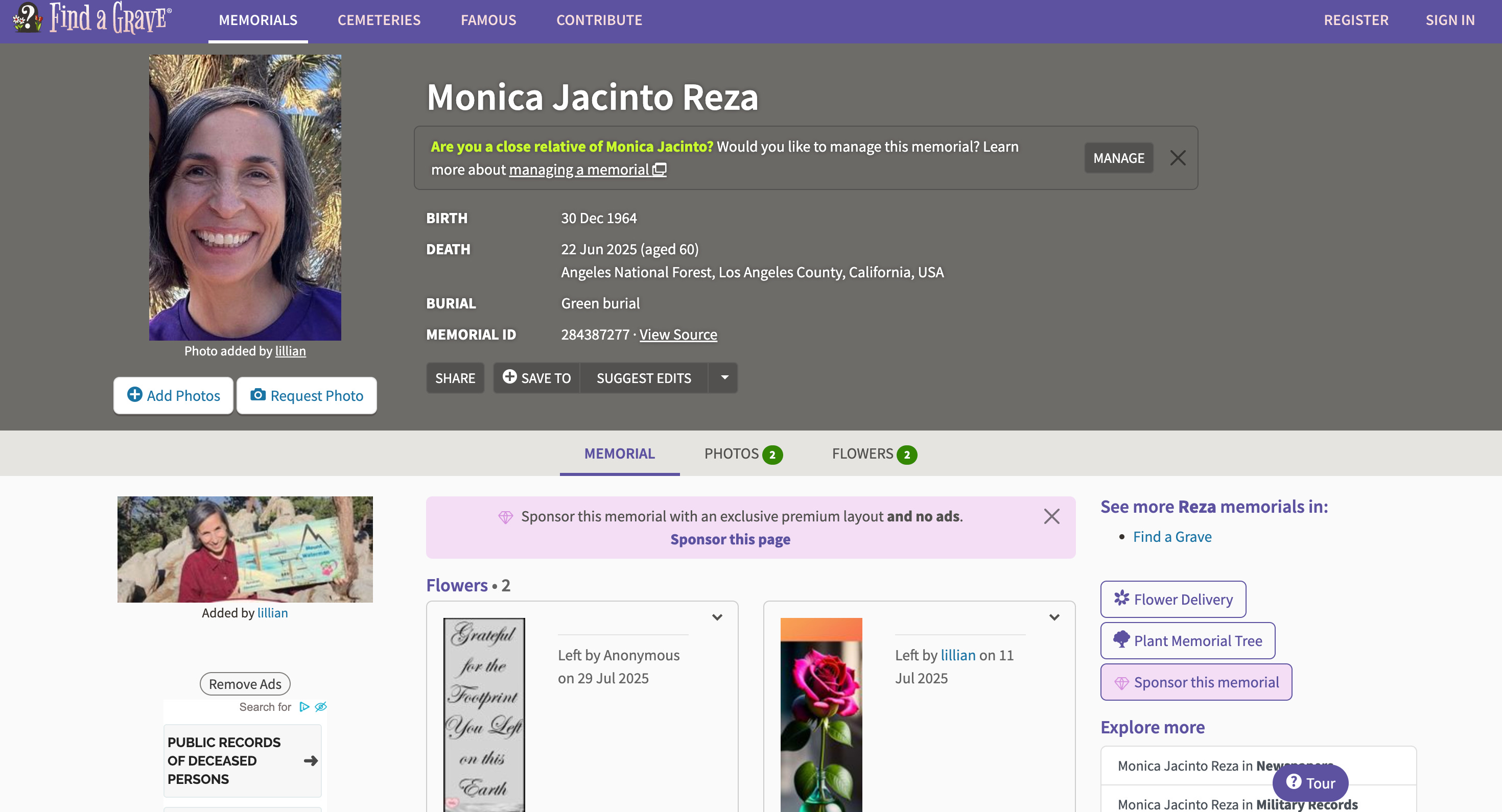
On June 26, 2025, four days after Monica Jacinto Reza disappeared and three days before the official search was even suspended, someone created a memorial page for her on Find a Grave.
Memorial ID 284387277. Monica Jacinto Reza. Born December 30, 1964. Died June 22, 2025. Death location: Angeles National Forest, Los Angeles County, California, USA. Remains: Green burial.
The memorial was created by a contributor identified as "lillian," whose profile is no longer publicly accessible. It is currently maintained by a separate contributor, "J.C." (contributor ID 50725353). Two photos were added, one matching the image from the missing person flyer. It was added while helicopters were still in the air looking for her.
Look up what “green burial” means. No embalming. Biodegradable container. Straight into the earth. You need a body for that.
No public reports indicate her remains were recovered. No obituary has been published. No death certificate is accessible through public databases. No funeral announcement has been issued. The Homicide Bureau Missing Persons Unit has not announced a resolution.
Someone declared Monica Jacinto Reza dead and buried four days into the search. While SAR teams from half the state of California were still combing the mountainside.
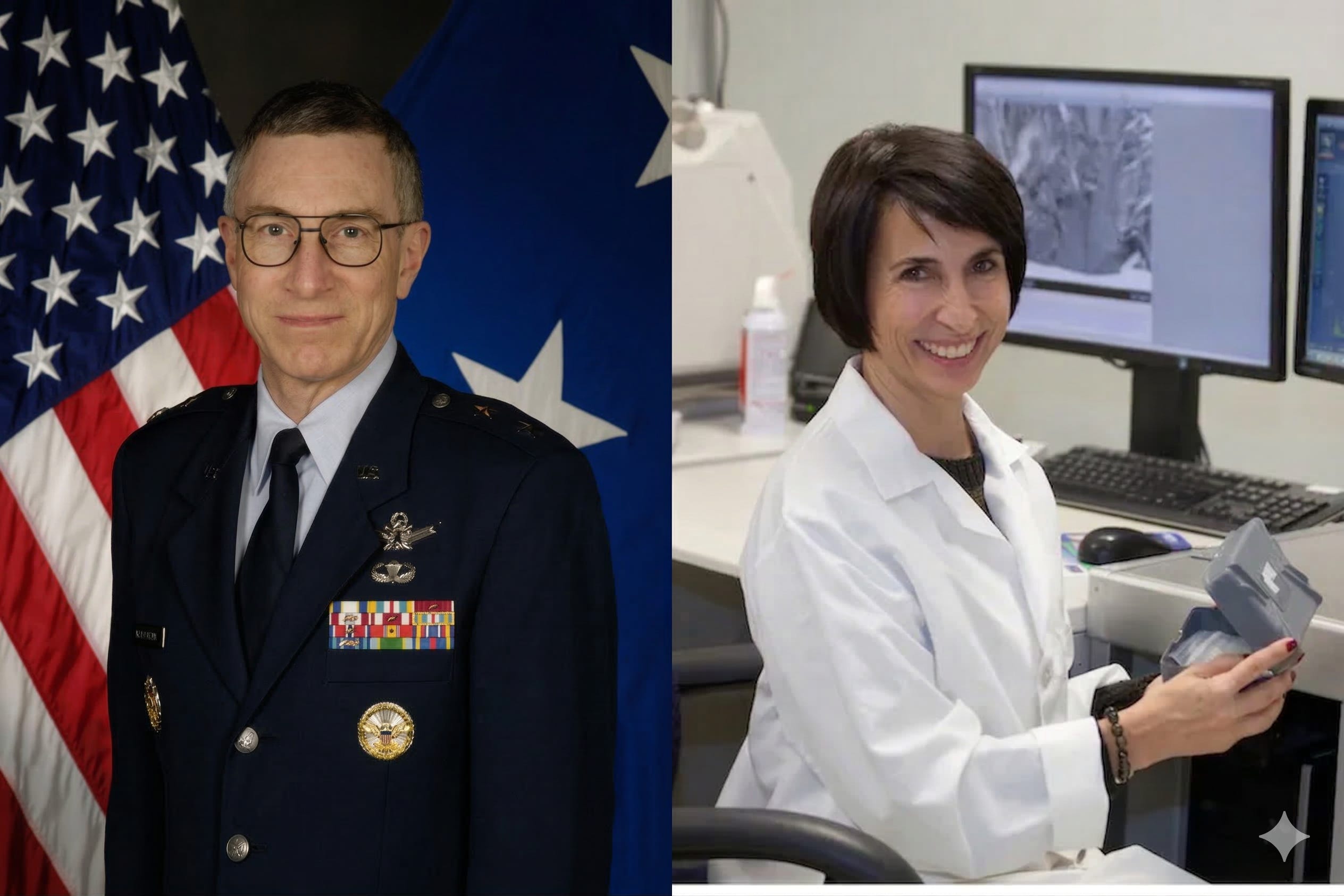
The Pattern
We published our investigation of the McCasland disappearance in THE GHOST GENERAL. We are not repeating its contents here. But we need to walk you through something we found while pulling the funding chain. It changes the shape of this story.
The Air Force started funding Reza’s superalloy work in 1999. McCasland commanded AFRL from May 2011 to July 2013, overseeing $4.4 billion in science, technology, and customer-funded R&D at Wright-Patterson Air Force Base. His budget directly funded the programs that depended on Reza’s alloy. AR1. Hydrocarbon Boost. Air Force propulsion.
That alone would be worth documenting. A general’s budget. A contractor’s alloy. Two people connected by the same river of money who both vanished from familiar terrain.
But the connection is not that simple.
Go back to Dallis Hardwick. Remember where she went after Rockwell. She moved to AFRL Ohio. Wright-Patterson. By 2005, she was leading all materials research for advanced gas turbine engines. Her group, the AFRL Materials Directorate, was the government side of the Mondaloy cost-sharing contracts. Reza was the contractor side at Aerojet Rocketdyne.
These were not two separate operations that happened to share funding. This was one program with two halves. Hardwick’s team at AFRL qualified the alloy. Reza’s team at Aerojet Rocketdyne produced it. Every Mondaloy test article, every composition variant, every material certification flowed between them. Two women who had invented the alloy together at Rockwell in the 1990s were now running both ends of the pipeline that would put it inside American rocket engines.
In May 2011, McCasland took command of the entire Air Force Research Laboratory. Every directorate. Every program. Every dollar. Including the Materials Directorate. Including Hardwick.
She was one of his senior civilian scientists. Her materials research program reported up through his authority. The Mondaloy cost-sharing contracts with Aerojet Rocketdyne flowed through both of them. When Reza’s team in California shipped data to the government for qualification, it landed in Hardwick’s directorate, inside McCasland’s laboratory.
This was not an arm’s-length funding relationship. These three people were on the same program. The commander who authorized it. The scientist who qualified the materials. The engineer who built the alloy. Three vertices of one triangle. The complete human chain of custody for a superalloy that the United States cannot build next-generation rocket engines without.
Dallis Hardwick retired in 2012 after a cancer diagnosis. She died on January 5, 2014. The first vertex. Gone.
Monica Jacinto Reza waved at her hiking companion on June 22, 2025 and vanished from a ridgeline in the Angeles National Forest. The second vertex. Gone.
William Neil McCasland walked into the Sandia foothills on February 27, 2026 and has not been seen since. The third vertex. Gone.
The metallurgist who understood the crystallography. The engineer who scaled it for production. The general who greenlit the programs it went into. Every person who held the complete picture of how this alloy moved from a lab bench to the inside of an American rocket engine is now dead or missing.
The chain is not frayed. It is severed.
Now look at the two who vanished side by side.
Monica Jacinto Reza: weekly hiker, 30 feet behind a companion, FLIR-negative, scent trail terminated, no body.
William Neil McCasland: avid outdoorsman, left home on foot, left phone/glasses/wearables behind, no body.
Reza: only physical evidence is a beanie in a ravine inconsistent with her trajectory.
McCasland: only physical evidence is a gray sweatshirt found 1.25 miles from home, unconfirmed as his.
Reza: total institutional silence from employer and professional societies.
McCasland: wife’s public statement explicitly addressing the UFO angle as “there’s nothing to see here”.
One is a coincidence. This is a pattern.
SENTINEL ASSESSMENT
This investigation started with a funding connection and ended with a severed chain of custody.
The connection between these three people is not institutional. It is programmatic. Hardwick and Reza co-invented the alloy at Rockwell. After the split, Hardwick ran the government qualification at AFRL while Reza ran contractor production at Aerojet Rocketdyne. McCasland commanded the laboratory that housed Hardwick’s directorate and authorized the contracts that funded Reza’s work. They were not three people connected by the same river of money. They were the river. And the river has gone dry.
The disappearance itself is profoundly wrong. An experienced weekly hiker. Thirty feet behind a companion who watched her wave. Gone in under 10 minutes from a ridgeline in clear weather. FLIR found nothing. Scent dogs hit a dead end at a beanie that doesn’t match her trajectory. Hundreds of searchers over months found nothing. The terrain is steep but not fatal. The slopes are open and visible. A woman in a red shirt should be findable.
The behavioral layer makes it worse. Subject A’s directional contradiction. The information embargo by search organizers. The carpool dependency. The premature Find a Grave memorial with a definitive death date and “green burial” created while helicopters were still searching.
The institutional silence is the most troubling layer. She didn’t just work for a defense contractor. By the time she disappeared, she was at JPL. NASA’s own lab. When a JPL employee who co-invented strategic rocket engine materials vanishes without a trace, and JPL says nothing, NASA says nothing, her former employer says nothing, and the aerospace media that profiled her two years earlier says nothing, the silence itself becomes data. Not evidence of conspiracy. Evidence of something the institutions know, or suspect, that the public does not.
We do not know what happened to Monica Jacinto Reza. We do not know what happened to William Neil McCasland. We know that every human link in the chain that built a strategic national security technology has been broken. And we know that nobody in a position of authority has said a single word about it.
If you have information about the disappearance of Monica Jacinto Reza, contact the LASD Homicide Bureau Missing Persons Unit, Detective Shannon Rincon or Detective Richie Sanchez at (323) 890-5500. Anonymous tips: LA Regional Crime Stoppers at 1-800-222-8477.
If you have information about William Neil McCasland, text BCSO to 847411 or call (505) 468-7070.
Keep looking up.
-- The Sentinel Network
Every briefing we’ve published is free. That’s not changing. This publication has no institutional backing, no sponsors, and no editorial board. We’re doing the work the newsrooms won’t, sourcing papers, filing FOIAs, building tools, and writing at the pace a once-in-a-civilization event demands.
Paid subscribers fund the investigation directly. They also get access to THE SIGNAL (weekly market intelligence derived from our forensic work), primary source documents, the comment section on every briefing, Fieldcraft Labs, and the FIELDCRAFT series. No ads. No sponsors. No strings. Your subscription is a data point against the suppression gradient.
If you can’t subscribe, we don’t care. Read everything. Share everything. The mission is the mission.
If this briefing found you, someone shared it. If you think it matters, be that someone. The Sentinel runs on readers, not algorithms.
Subscribe to The Sentinel Network™
Top 100 Science publication on Substack.
Share this investigation. THE SUPPRESSION GRADIENT documented what happens when this coverage reaches platforms that do not want you reading it. Every share, every restack, every forwarded link is a data point against the gradient.
Previous briefings: THE GHOST GENERAL | THE DEAD DROP | THE ANCIENT ENGINE | THE APERTURE | THE IGNITION SEQUENCE | THE GHOST COMA | THE HEARTBEAT | THE SURGE | Dossier 001
Comments engaging with the sourced material are welcome. Speculative content introducing claims not supported by the reporting or evidence will be removed.
This expose' has grabbed my interest, as the Reza & McCasland cases are collecting data points, geographical in nature. Enough physical location data points makes this analyzable.
My interest is really in scaling up an algo to find geo clustering. Clustering coupled with behavioral profiling of suspected actors is sometimes very revealing; often leading to additional undiscovered location data & evidence.
Is anyone with the available data dropping pins on a map for these cases?
Another thought was that the alloy/patent side of is likely about rocket tech, but doesn't need to be. Applications for Mondalloy are too endkess. Really only limited by imagination & resources.