

DATE: MARCH 19, 2026
SUBJECT: FORENSIC ANALYSIS OF THOSS, LOEB & BURKERT (2026) // INFERRING THE MASS AND SIZE OF 3I/ATLAS FROM ITS NON-GRAVITATIONAL ACCELERATION CROSS-REF: [THE VERDICT] | [THE GHOST COMA] | [THE CURATED ORBIT] | [THE HEARTBEAT] | [THE WIDE ANGLE] | [THE SENTINEL DOSSIER]
CLEARANCE: PUBLIC
DATA CONFIDENCE: VERIFIED (8,086 MPC astrometric observations, multi-team production rate compilation, four weighting schemes) + HYPOTHESIS (Sentinel cross-reference analysis)
THE TIMING
On Tuesday we published The Verdict. Twenty-eight briefings. Fifty-seven anomalies. We said the surface is not producing the water. We said the ghost coma is the operating system. We said this is a machine.
The day before, a paper had gone up from three physicists at the Ludwig Maximilian University Observatory in Munich and Harvard. Valentin Thoss, Avi Loeb, and Andreas Burkert. Published March 16. They were not trying to confirm our work. They have never heard of us. They were trying to do something simple: weigh the object.
They used the rocket equation. Mass times acceleration equals the gas leaving per second times the speed of the gas. Measure the acceleration from 8,086 sky positions collected by the Minor Planet Center. Measure the gas output from every major telescope that has looked at 3I since July 2025. Solve for mass.
The answer is roughly a billion metric tons.
That number matters. What they had to throw out to get that number matters more.
THE SURFACE AREA KILL
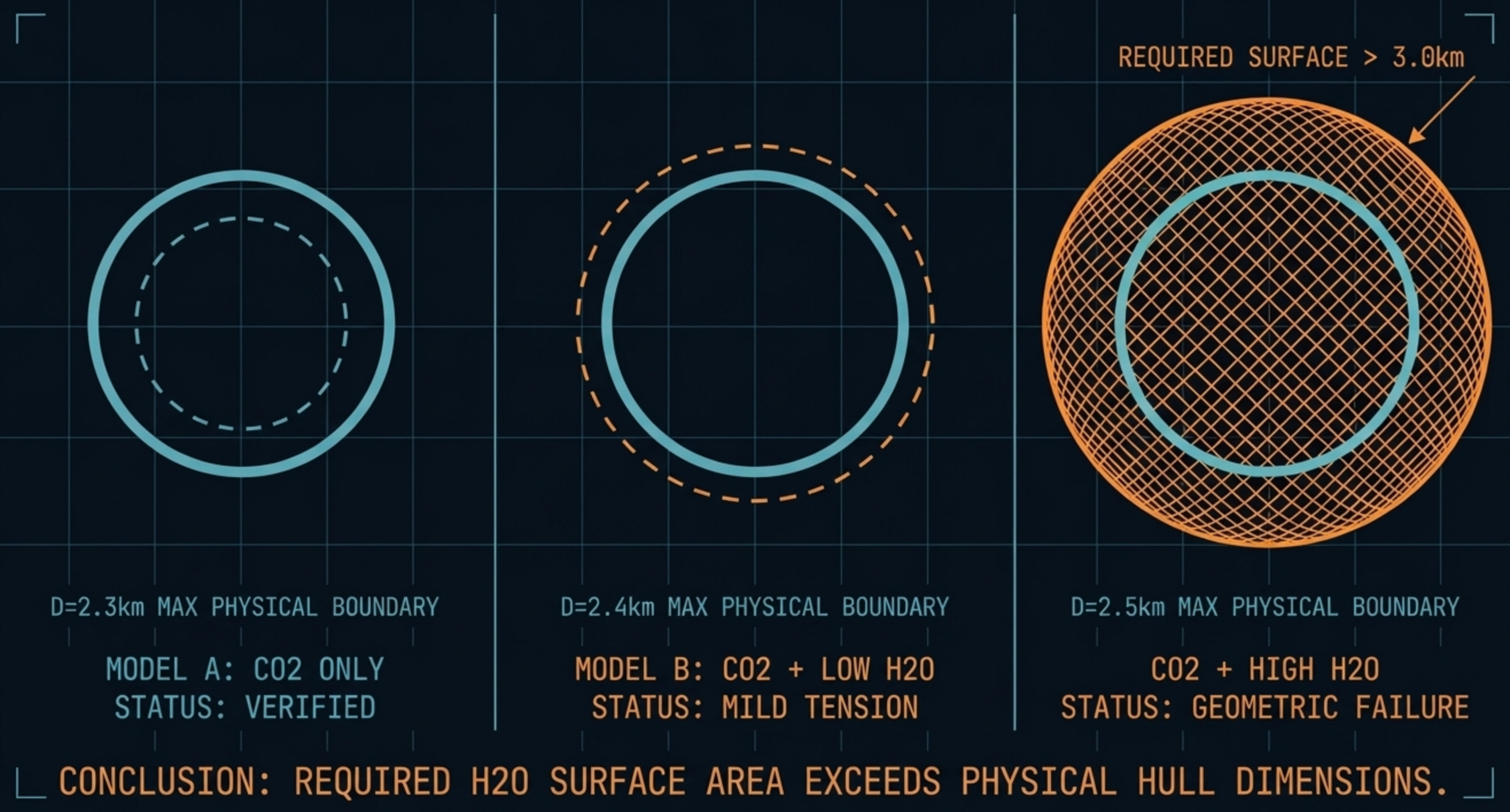
The team tested three scenarios for what is pushing 3I through space.
One: only CO2 is coming off the surface.
Two: CO2 plus a small amount of water from the surface.
Three: CO2 plus the full amount of water that the big telescopes measured.
For each one, they asked two questions. First: given how fast the object is accelerating and how much gas is leaving, how big does the object need to be? You get the mass from the rocket equation, then you get the size from the mass.
Second: given how much gas each model says is boiling off the surface, how much surface do you actually need? If every square meter of the object is actively producing gas at the maximum possible rate, how big does the comet have to be to keep up?
If the surface you need is bigger than the object itself, the model is dead.
The high water model is dead. It needs a surface bigger than 3 km across just to produce the gas. But the rocket equation says the object can only be about 2.3 km. The authors say it plainly: the water model requires a surface that is too large to fit inside the object. Even under the most generous assumptions.
The conservative water model barely survives. Near closest approach to the Sun, the surface it needs briefly exceeds the size the rocket equation allows. The paper calls this “a mild tension.” That is generous.
The CO2-only model works clean. No tension. No special pleading. The surface fits inside the object. Everything adds up.
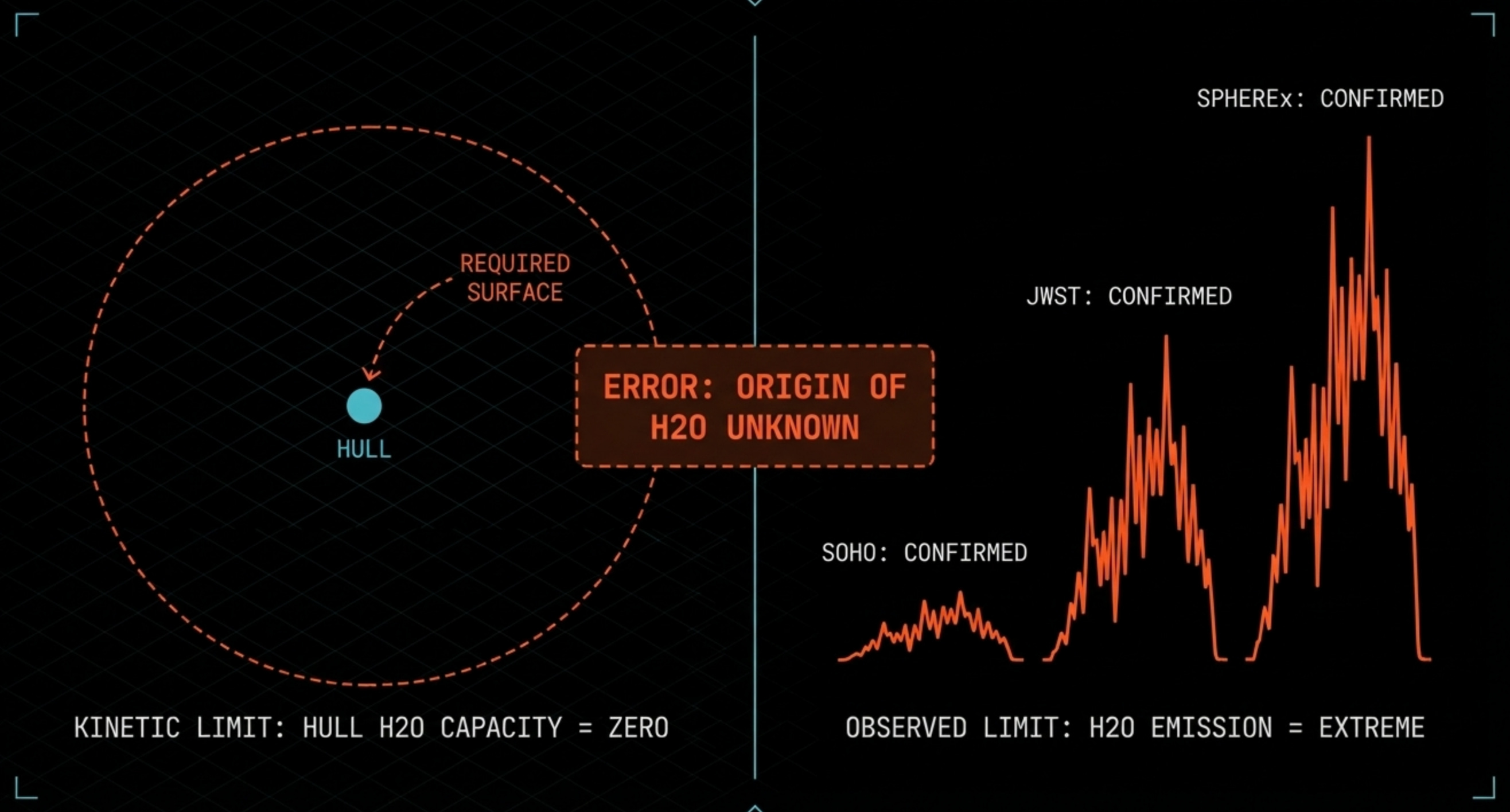
The only model that does not break is the one where water from the surface contributes nothing. Zero thrust from water. Only CO2.
But water is pouring off this object. Every major telescope has confirmed it. SOHO, JWST, SPHEREx, ground-based radio. The water is real and it is enormous.
So where is it coming from?
The paper says it three times. Page 2: most of the water is coming from the cloud around the object, not the surface. Page 7: same thing. The summary: CO2 likely dominates the thrust for the entire orbit, and water contributes almost nothing.
Three physicists just proved from the math alone what we established in The Verdict from five observational teams: the surface of 3I/ATLAS is not producing the water.
SENTINEL ASSESSMENT:
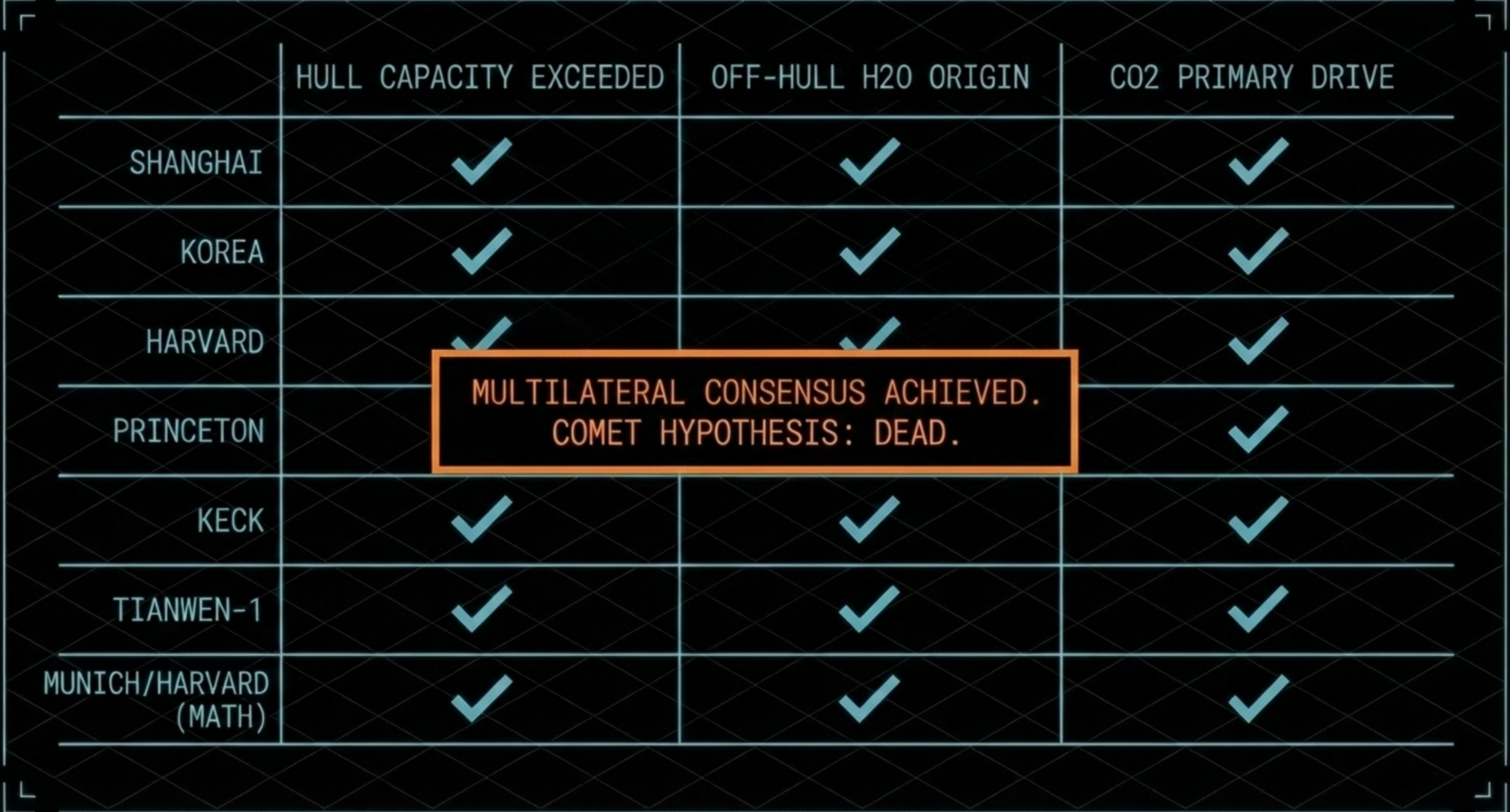
The Verdict built the case from the data side. Shanghai showed 80 to 90 percent of water coming from somewhere thousands of kilometers away. Korea showed gas appearing 20,000 km out first. Harvard showed 99% of light coming from the exhaust, not the hull. Princeton showed the outer cloud driving the signal. Keck and Tianwen-1 killed the ice grain theory.
This paper builds the case from the math side. The surface cannot produce the water because the surface is not big enough. Different method. Same answer.
Six teams from the observations. One team from the equations. Seven independent confirmations. The ghost coma is not a hypothesis anymore. It is a fact with no natural explanation.
THE SHRINKING HULL
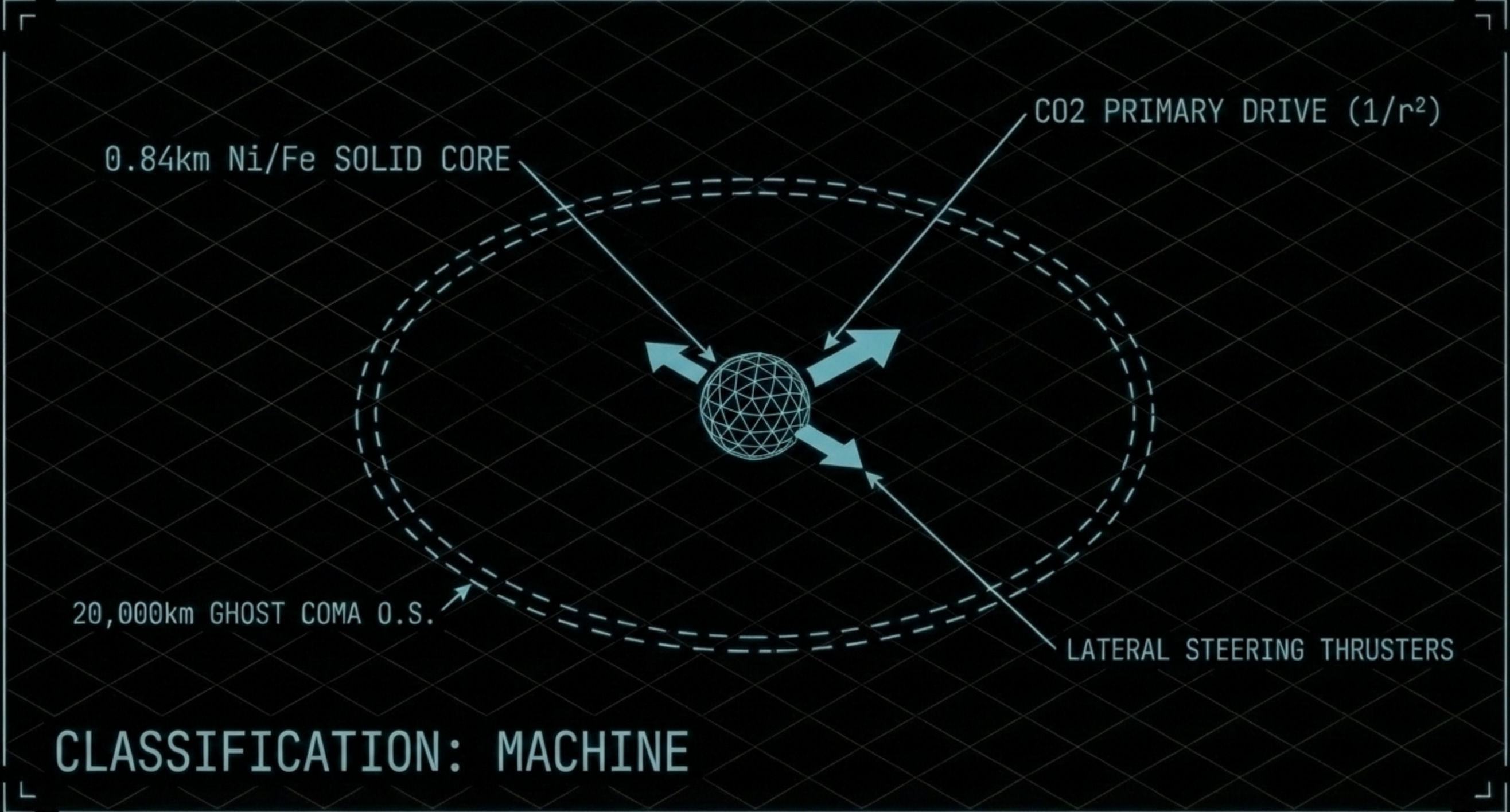
If CO2 alone drives the thrust, the object is 0.84 km across.
Not 2.6 km. That is what Hubble’s team claimed. This paper says maybe a third of that.
We have been tracking this number. The Curated Orbit showed the size estimate swings by 50% depending on which model you use. The Sentinel Dossier catalogued estimates from 0.32 km to 5.6 km. Now this paper pushes the best answer to 0.84 km.
Think about what that means. A third the diameter. A twenty-seventh the volume. But the same force. Same acceleration. Same push through space. The object got 27 times smaller in the math but the engine did not get weaker.
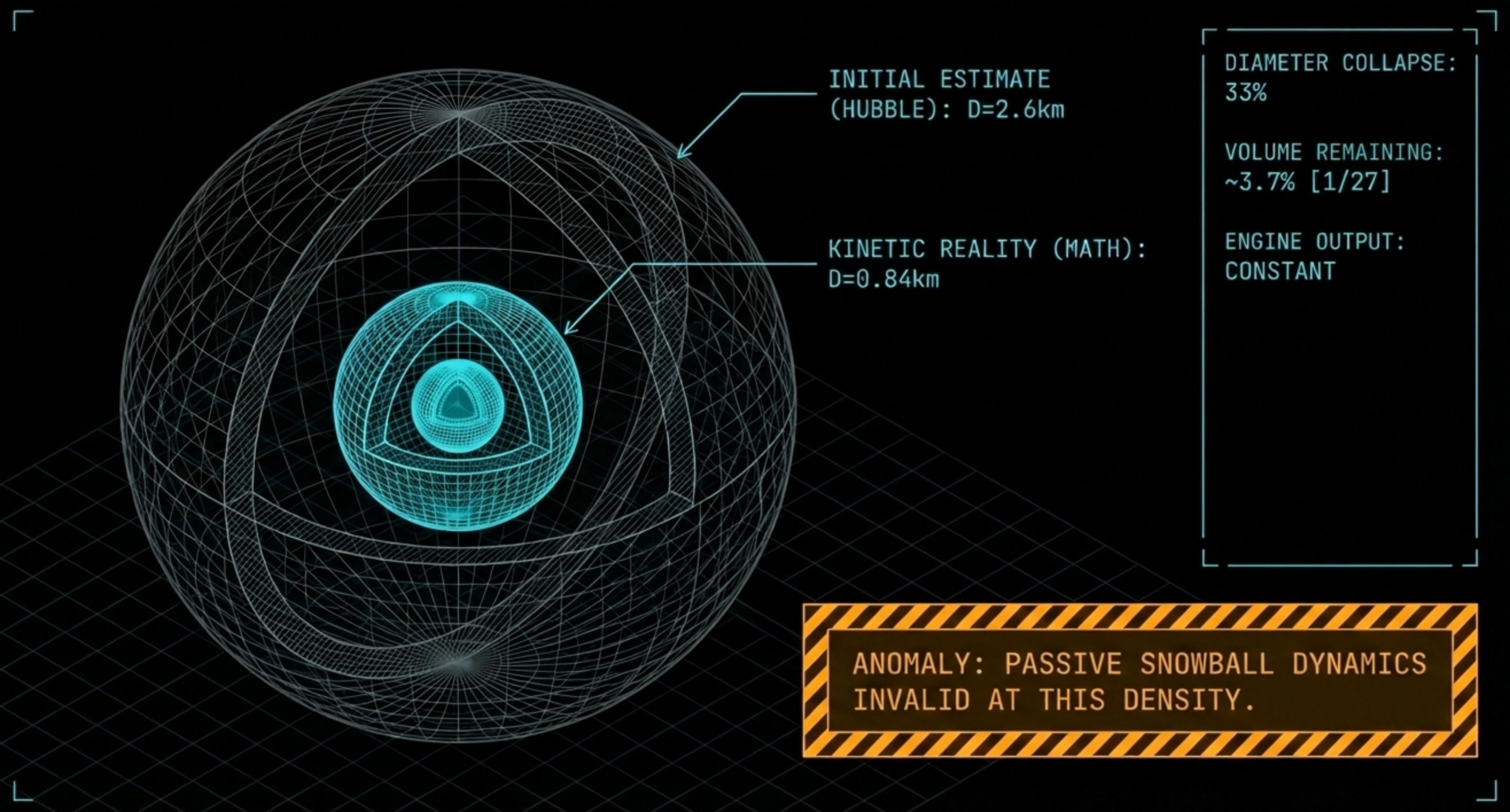
In The Verdict, we described a hull hidden behind its own exhaust. Loeb and Scarmato showed only 1% of the light comes from the surface (Heartbeat). If the hull is also a third the size everyone assumed, you are asking a much smaller object to produce the same force. That gets very hard to explain with gas passively boiling off a snowball.
The paper cannot resolve this. It offers two ways out: either there is a lot more CO2 than anyone has measured, or the object is lighter than a typical comet. The authors note that a lighter object actually fits better with the isotope data, which says 3I formed in an old environment with very little heavy material to work with.
An object from a place with almost no heavy elements. Less dense than a normal comet. No water ice on its surface despite enormous water output. Running nickel and iron chemistry at scale.
THE FORCE PROFILE
Here is where the paper connects to The Curated Orbit.
The team tested how the force on 3I changes as it moves closer to or farther from the Sun. If CO2 is doing the pushing, the force should get stronger as the square of the distance shrinks. Twice as close, four times the push. That is a clean, simple pattern.
If water is also pushing from the surface, the force should spike much harder near the Sun, because water production explodes near closest approach. The pattern would be steeper. More dramatic.
The data prefers the simple CO2 pattern.
The preference is slight when you use all 8,086 observations. But it gets strong when you only use the best data, the stuff from Hubble, VLT, Gemini, and the three deep-space probes that observed 3I from millions of kilometers away. The highest-quality measurements all point the same direction: CO2 is doing the work. Water is not contributing.
The Curated Orbit found the same thing independently. Different team. Different methods. Same answer: the force profile matches CO2.
But The Curated Orbit also found something this paper does not address. The sideways push on 3I is as strong as the forward push. And the sideways push flipped direction when the object swung around the Sun.
CO2 boiling off a surface does not push sideways. It does not change direction at the closest approach. This paper confirmed the forward force. It did not touch the sideways force. And the sideways force is the one that looks like steering.
SENTINEL ASSESSMENT:
Two independent teams now confirm CO2 explains the forward push. Nobody has explained the sideways push. The Curated Orbit showed the sideways force is as strong as the forward force and it reversed direction when the object passed the Sun. This paper confirmed half the picture and left the harder half untouched.
THE POPULATION PROBLEM
Loeb puts a number on something we have been circling for months.
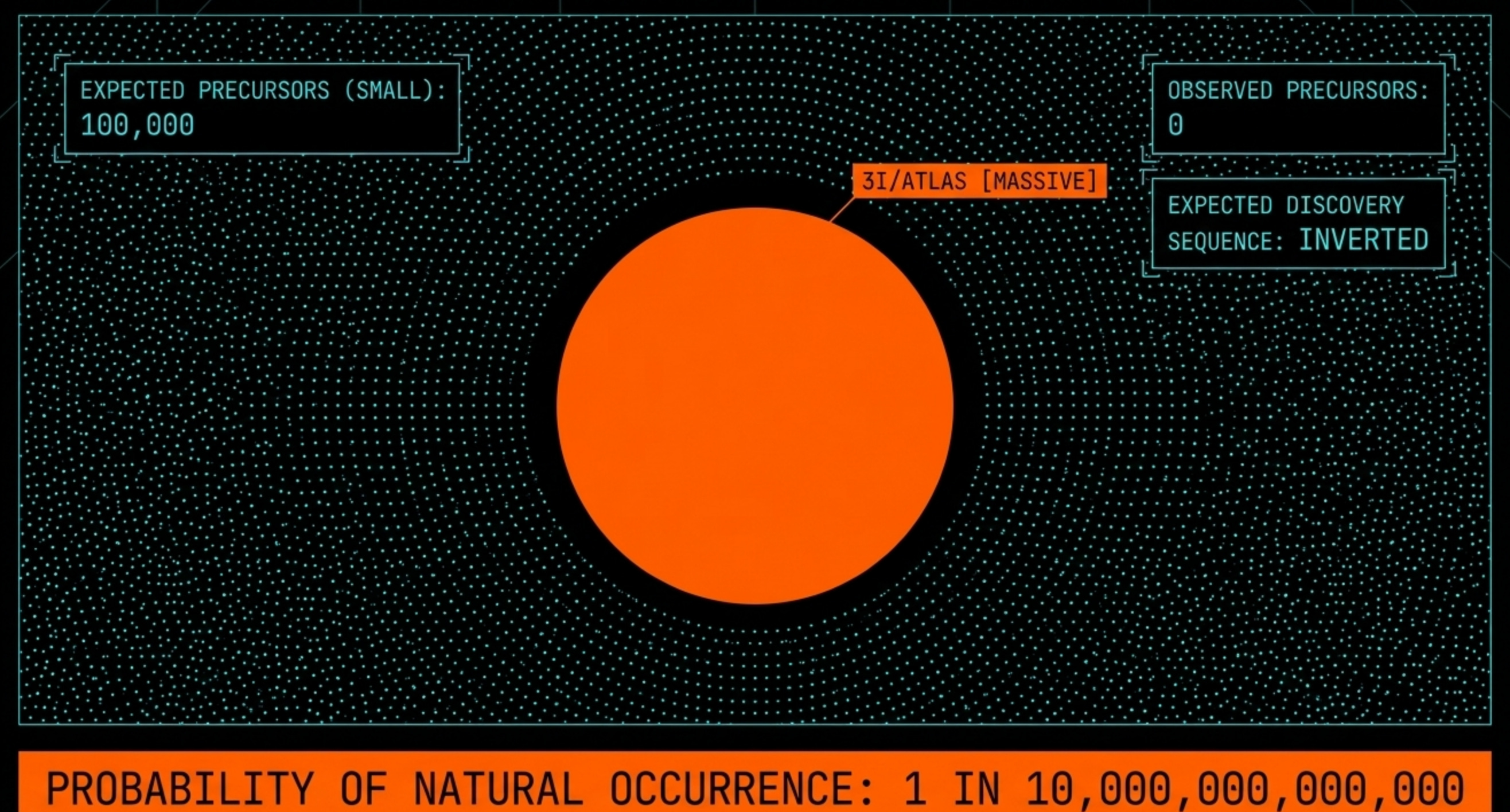
Based on how common objects of different sizes are in the Solar System, we should have found at least 100,000 small interstellar objects before stumbling onto one as massive as 3I. Small ones first. That is how populations work. You find the common ones before you find the rare ones.
We found ‘Oumuamua first. 2017. Then 3I. 2025. The order is backwards by a factor of 100,000.
We reported in The Verdict that the probability of zero 3I-sized objects passing through undetected between the 1990s and 2017 is one in ten trillion. We reported in The Surge that three interstellar visitors carrying matching specs looks less like coincidence and more like a production run.
Now the mass measurement adds another layer. The population math fails from every direction. The detection order is wrong. The source environment cannot supply enough raw material. And the objects that do show up look like each other instead of looking random.
Same conclusion every time. The interstellar object population does not look like natural debris.
THE MASS IT LEAVES BEHIND
Buried in the numbers: 3I lost at least 5% of its starting mass during this pass. That is the low estimate. Dust not included.
Five percent of a billion metric tons is fifty million metric tons of material shed in a few months.
If this object has visited other stars over 10 to 12 billion years and loses 5% each time, the math gets uncomfortable fast. Twenty passes and you are down to a third of your original mass. Forty passes and you are under 13%.
Either it has not visited many stars. Or it picks up material along the way. Or this pass was unusually costly because the Sun is unusually hot compared to whatever it normally encounters.
All three options are interesting. None of them sound like a comet.
THE CONVERGENCE
We published The Verdict on Tuesday based on four months of investigation across twenty-eight briefings. The surface is not producing the water. The ghost coma is the operating system. The object is a machine.
The day before, three physicists from Munich and Harvard had already proved the first claim independently from the math. They were not testing our hypothesis. They were running Newton’s laws against 8,086 data points. The equations broke the surface water model for them.
The comet model is not being challenged by speculation. It is being challenged by its own math.
We did not need this paper to reach our conclusions. But it is useful to know that when the establishment’s own equations catch up to the data, they arrive at exactly the place we told you they would.
The predictions from The Verdict stand.
The object is at Jupiter.
Now we watch.
If this investigation matters to you, share it. If you want to support independent work with no institutional backing and no editorial board, subscribe.
Keep looking up.
-- The Sentinel
If you have read the papers Thoss, Loeb & Burkert (2026) and see something we missed, or something we got wrong, reach out, we want your data.
Previous briefings: The Verdict | The Ancient Engine | The Curated Orbit | The Ghost General | The Dead Drop | Forensic Audit: The Covert Space Force Mobilization | The 2028 Imperative | The Wide Angle | The Ignition Sequence | The Heartbeat | The Ghost Coma | The Suppression Gradient | CONFIRMED: The TESS Contingency | The Silent Edit | Project Archimedes | The Surge | The Three Days of Darkness | SITREP: The Pacific Diversion | The Glomar Confirmation | The SPHEREx Intercept | Incident Report: The MAVEN Silence | The December Intersection | Launch Anomaly: Project Square | The Sentinel Dossier | Dossier 001: The Geometry of Contact