

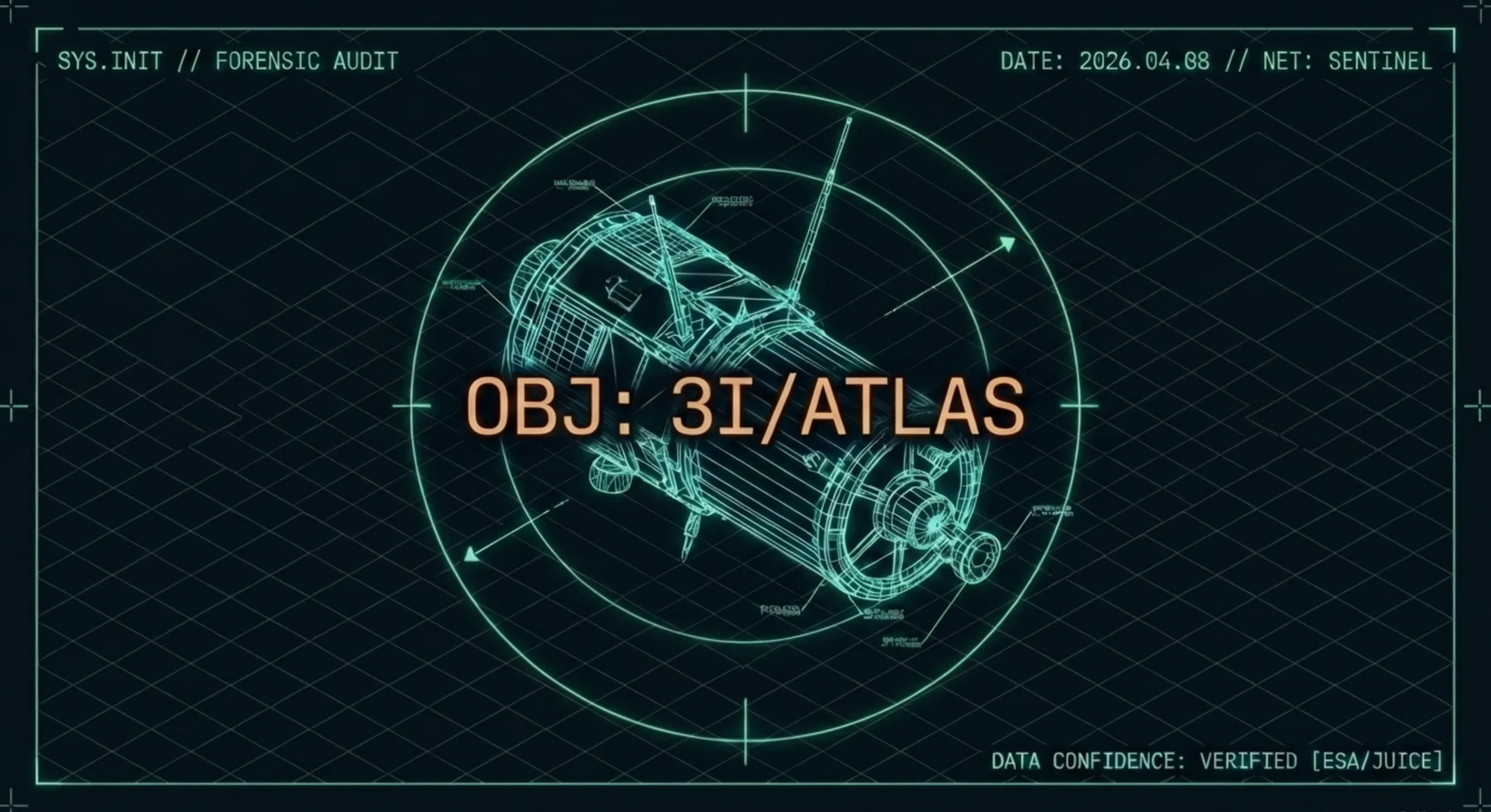
SUBJECT: FORENSIC ANALYSIS OF ESA JUICE SUMMARY (APRIL 2, 2026)
DATE: APRIL 7, 2026
CROSS-REF: THE SILENT EDIT | THE CURATED ORBIT | CONFIRMED: THE TESS CONTINGENCY | THE SUPPRESSION GRADIENT | THE WEIGH-IN | THE VERDICT | THE OPERATING SYSTEM | THE DECEMBER INTERSECTION
DATA CONFIDENCE: VERIFIED (ESA/JUICE MAJIS, SWI, UVS, JANUS, NavCam published results) + INSTITUTIONAL ANALYSIS (instrument omission, data burial, framing forensics)
WHAT JUST DROPPED
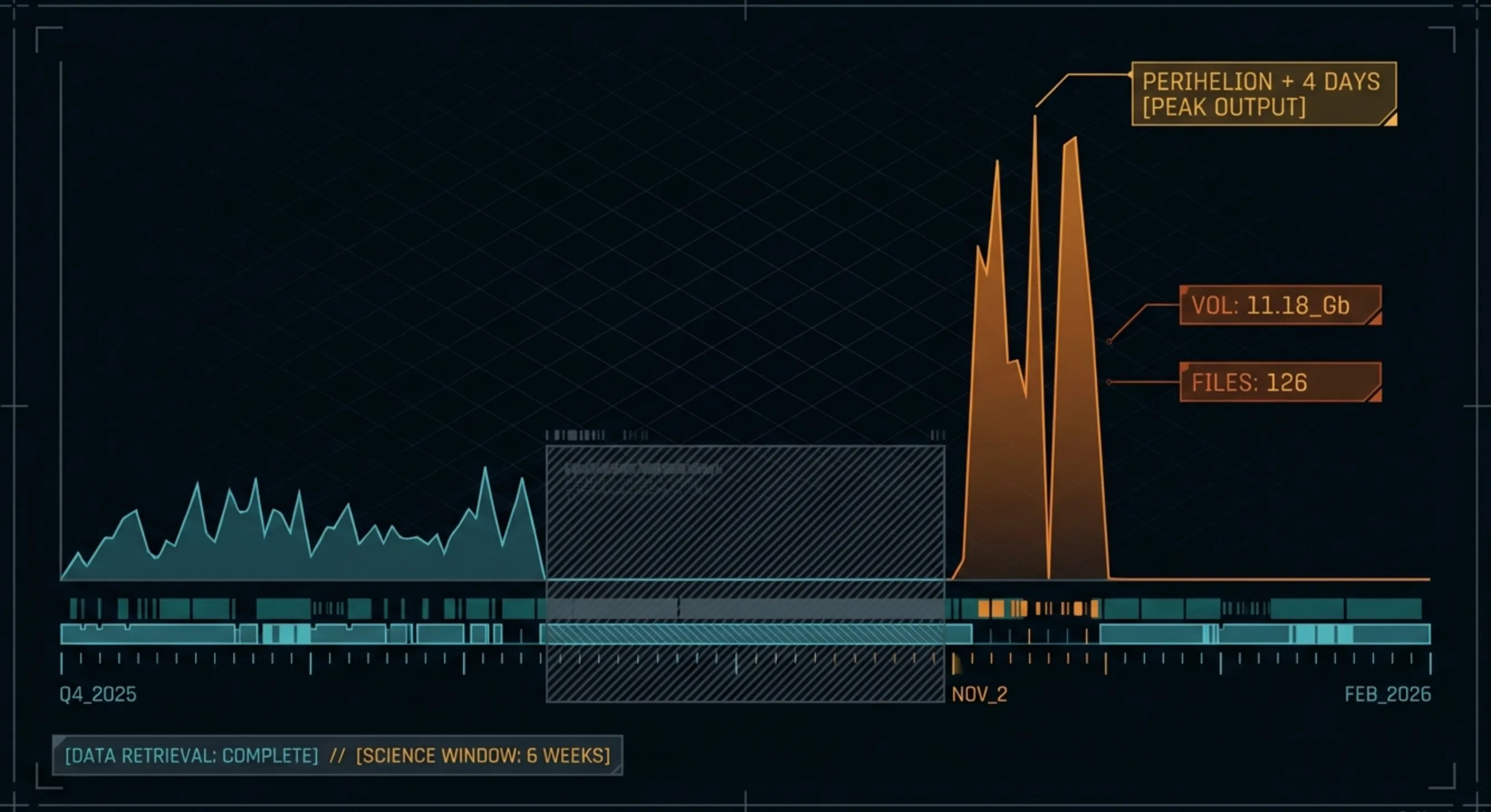
Last week, ESA published the first science results from JUICE, their Jupiter-bound spacecraft. JUICE caught 3I/ATLAS from 60 million kilometers in November 2025, four days after it’s closest approach to the sun, while the object was at peak output. Five science instruments collected 11.18 gigabits across 126 files. The data sat locked in onboard memory for three months while the spacecraft hid on the far side of the Sun, then trickled home through a backup antenna and reached Earth in mid-February. Then the instrument teams had six weeks with it.
They titled the summary “Extreme but not exotic.” Five findings. Comparisons to swimming pools and to Halley. “This interstellar comet looks... just like a normal comet!” The exclamation mark is theirs.
We read the summary. Then we read the instrument list.
THE SWAP
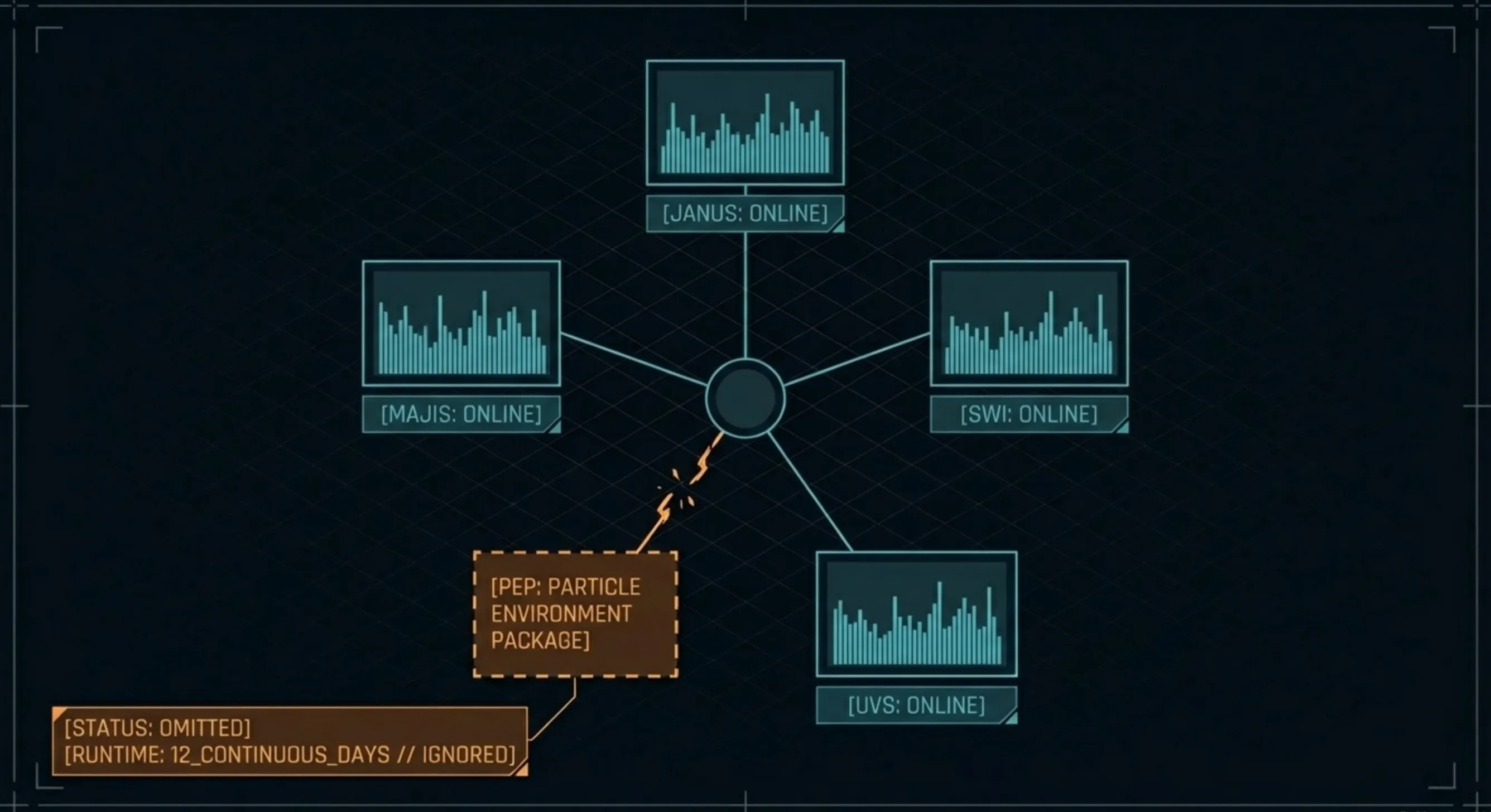
ESA deployed five science instruments on 3I/ATLAS: JANUS, the high-resolution camera; MAJIS, the infrared spectrometer; SWI, the submillimeter wave instrument; UVS, the ultraviolet spectrograph; and PEP, the Particle Environment Package. PEP ran for twelve continuous days at perihelion.
The summary reports results from JANUS, MAJIS, SWI, UVS, and NavCam.
NavCam is not a science instrument. It is the navigation camera, designed to help JUICE park at Jupiter in 2031. PEP, the instrument that spent twelve continuous days measuring the solar wind interaction at perihelion, does not appear anywhere in the report.
When the solar wind hits the gas cloud around a comet, they collide with neutral atoms and kicks off fast-moving particles: hydrogen, helium, oxygen. Those particles carry information about the size and shape of whatever the wind just hit. PEP catches them. The more gas the object is producing, the more particles PEP detects.
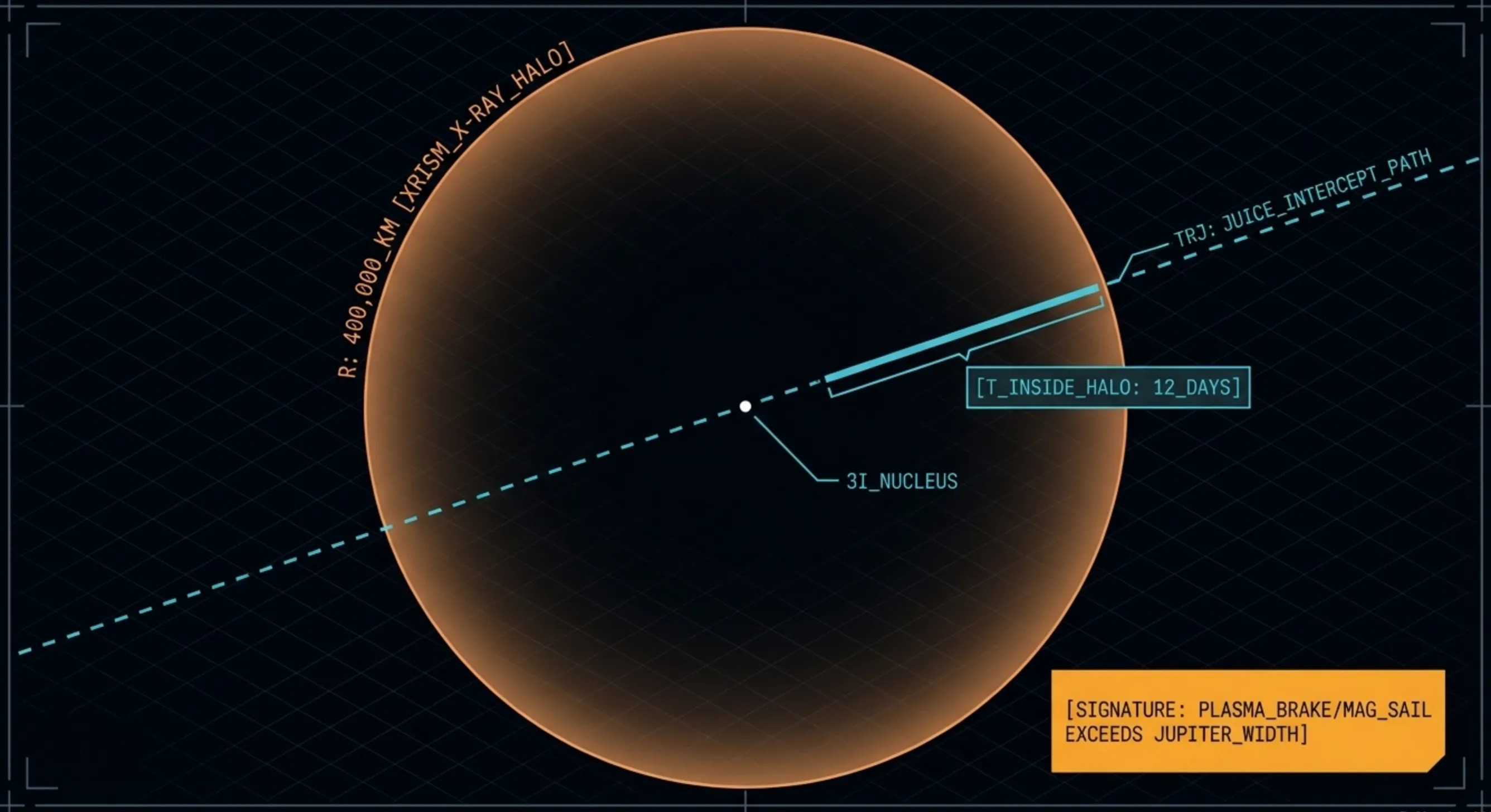
We documented what that interaction looks like on 3I in The December Intersection. Japan’s XRISM X-ray observatory saw a glow stretching 400,000 kilometers around the object, bigger than the distance from the Earth to the Moon. Something massive and invisible was interacting with the solar wind, and the visible light couldn’t account for it. We described the signature as consistent with a magnetic sail or plasma brake, an interaction surface wider than Jupiter.
PEP was sitting inside whatever produced that glow. Four days after perihelion. Maximum output. Twelve continuous days. ESA swapped it for the navigation camera.
THE SIX WORDS
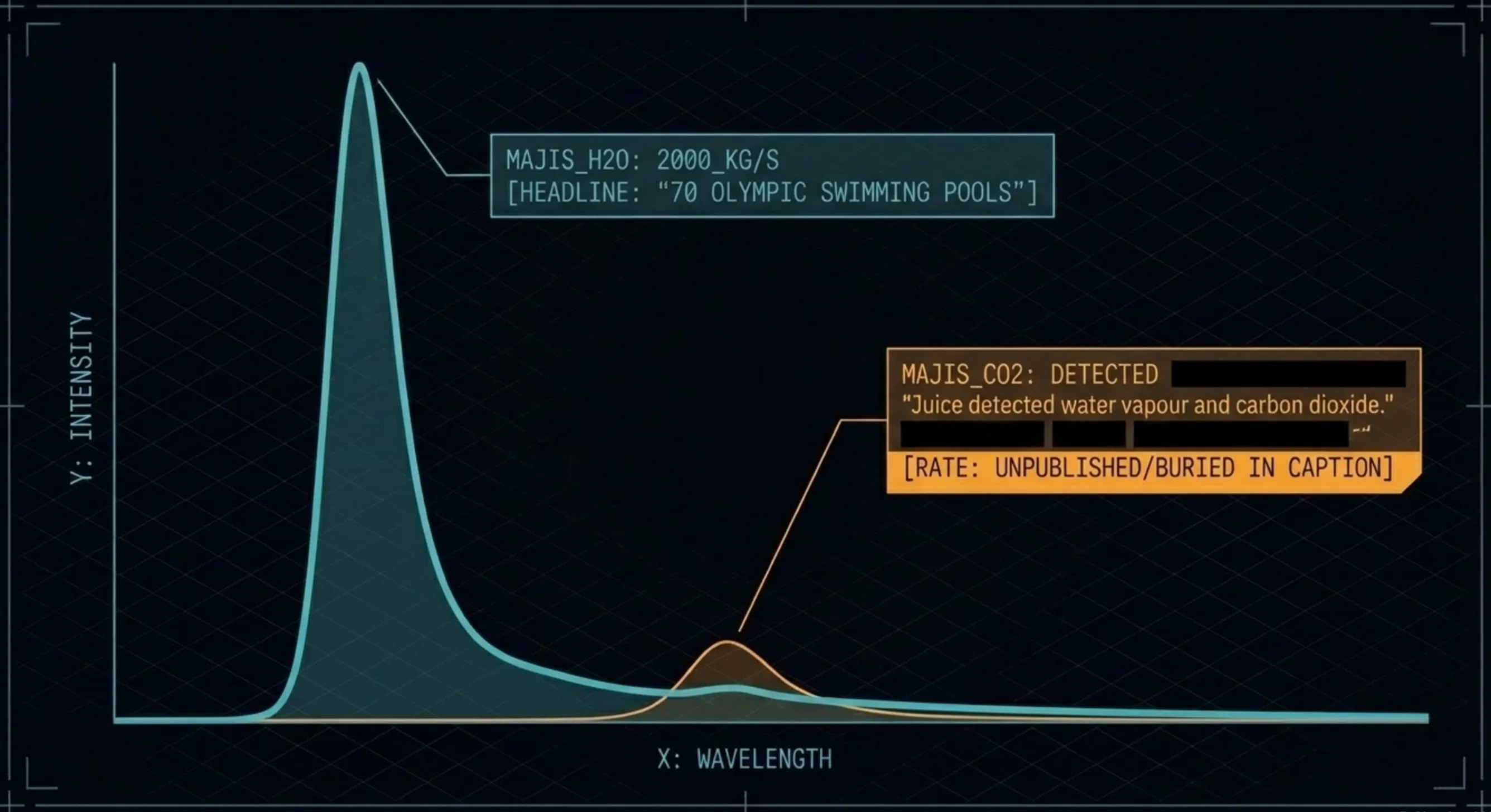
MAJIS detected water vapor and CO2 at perihelion. Both molecules, from one instrument, at the moment of peak output. The water got the headline: 2,000 kilograms per second, seventy Olympic swimming pools per day, “not exceptional, but on the high side.”
The CO2 got six words in an image caption: “Juice detected water vapour and carbon dioxide.”
The production rate has not been published.
In The Weigh-In, Thoss, Loeb, and Burkert at the Ludwig Maximilian University Observatory and Harvard put 3I on a scale using the rocket equation. They tested water-driven thrust, mixed, and CO2-only. The water model needed a surface bigger than the object. The mixed model barely held. The CO2-only model worked clean. The only scenario where the math closes is the one where water contributes zero thrust and CO2 alone does the pushing.
MAJIS just measured the CO2 at the moment of peak thrust, from a spacecraft, using an infrared spectrometer designed to characterize the chemistry of Jupiter’s icy moons. That measurement feeds directly into the equation that killed the comet model. ESA gave it six words and kept the number to themselves.
THE CITATION
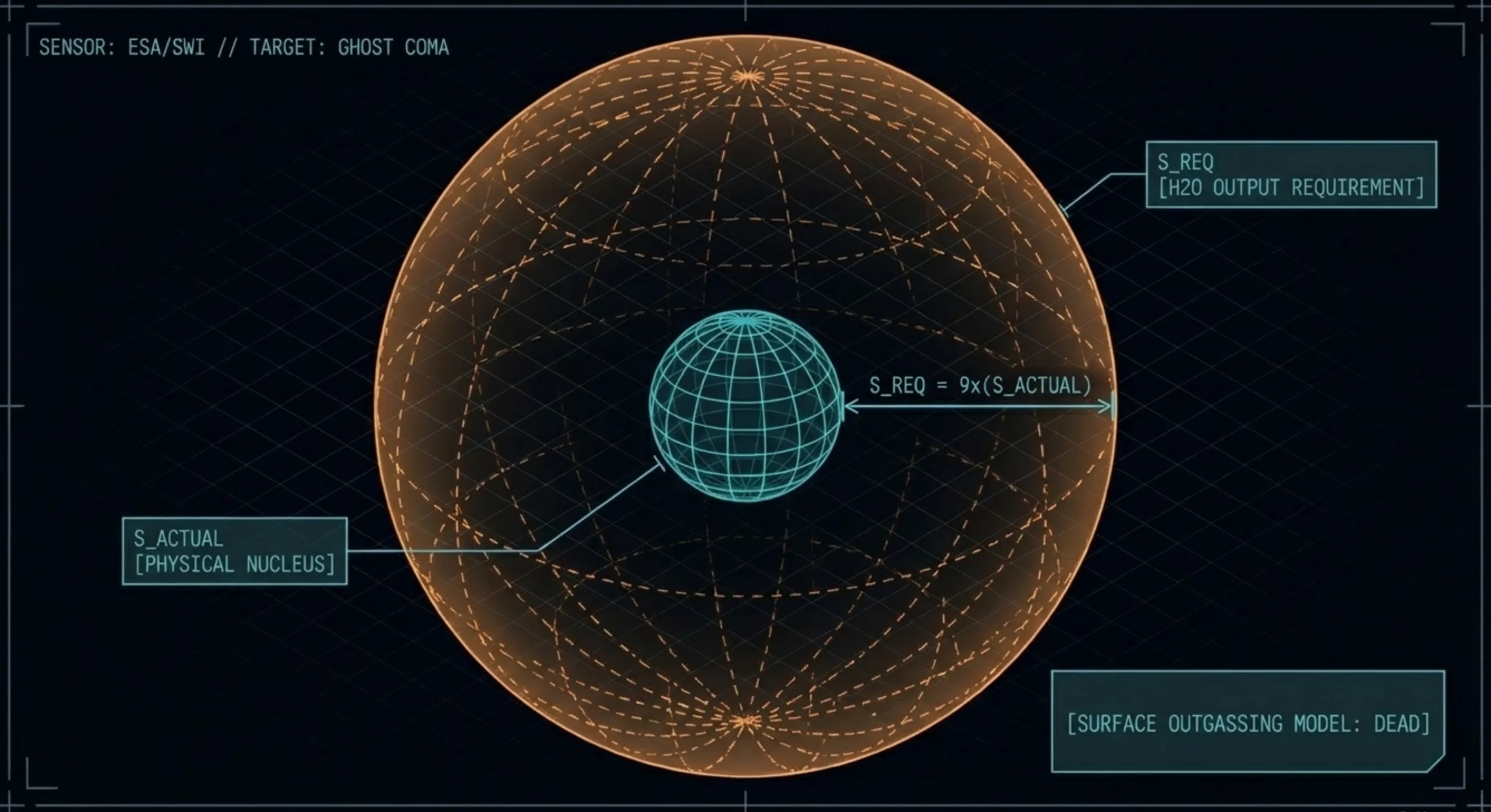
ESA’s SWI instrument confirmed the ghost coma from space. The finding we’ve built this entire investigation around, the finding that Shanghai heard with radio telescopes, that Princeton confirmed with 64 telescopes, that Munich and Harvard proved with the rocket equation, that Biver’s team quantified at perihelion: the water is not coming from the surface. The nucleus would need to be nine times its own surface area in exposed ice to explain the output. Now ESA’s own instrument confirms it from their own spacecraft. Most of the water is coming from the surrounding cloud, not the solid body at its center.
Then ESA cited icy dust grains as the explanation.
China’s Tianwen-1 and Keck both looked for those grains and found nothing. The Verdict documented both teams’ results and called the mechanism dead. The Operating System counted three papers still citing it after two teams removed the evidence. SWI makes four.
THE MISSING EPOCH
The water should be fading. 3I is outbound. Less heat, less sublimation, less output. That is how comets work.
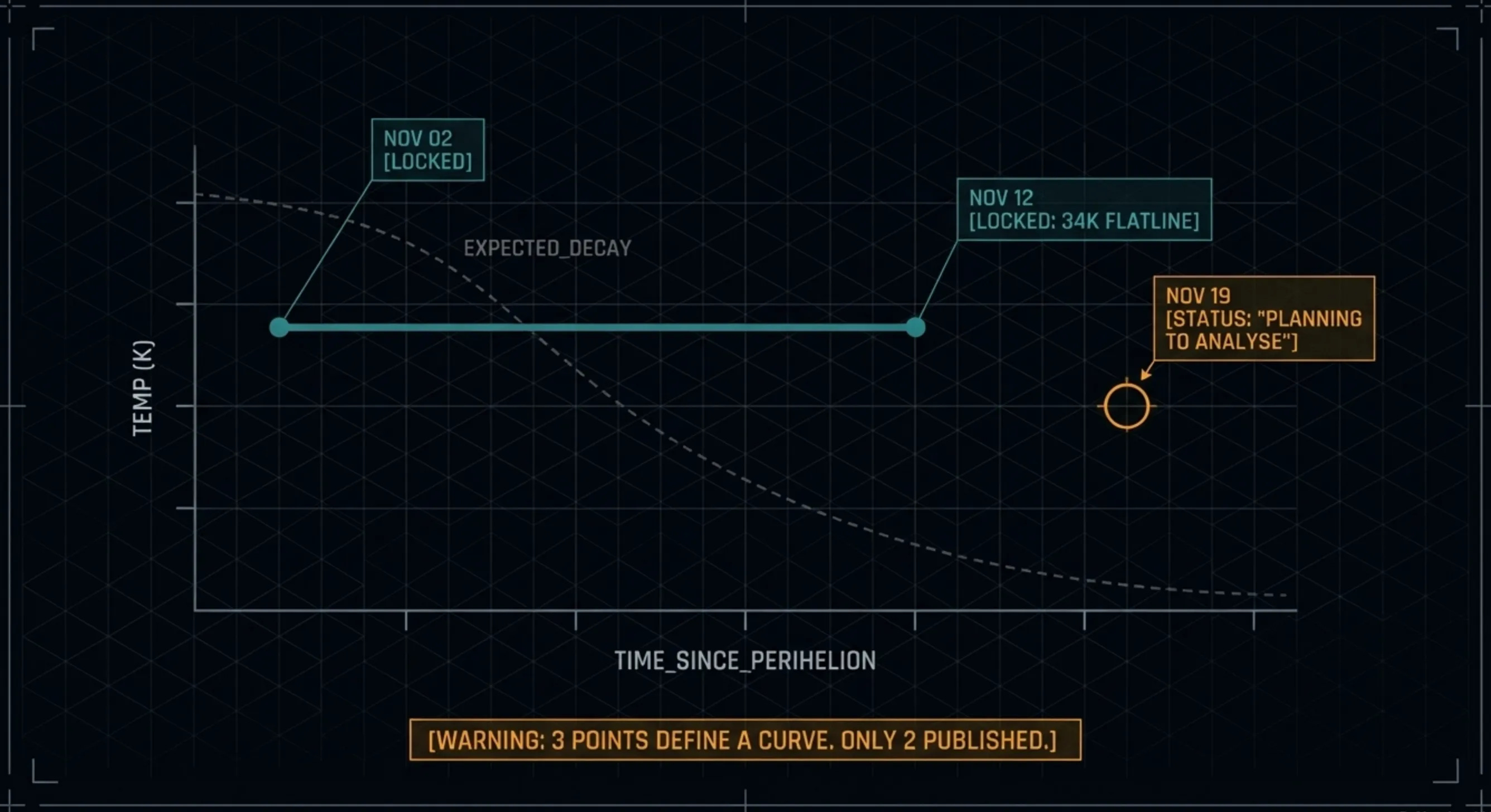
MAJIS measured the water on three dates in November: the 2nd, the 12th, and the 19th. By the 12th, fourteen days after perihelion, with the object pulling further from the Sun every day, the production “did not seem to have reduced significantly.” The Ancient Engine documented this pattern from Zhao’s team: 3I powered up fast and is powering down slow. MAJIS now shows that two weeks into the retreat, the output had barely moved at all.
We predicted this. The Verdict published five falsifiable predictions. The first was that the ghost coma would not vanish, that if the water production is a cooling system and not ice melting, it would not need sunlight to keep running. Fourteen days after perihelion, it was still running. The Operating System went further: the water exits at a locked 34 Kelvin regardless of how close or far the object is from the Sun. The temperature doesn’t track the heat source. It’s pre-set.
ESA has a third measurement from November 19, twenty-one days after perihelion. Their own summary says the team is “planning to analyse” it “in the coming weeks.” Three points define a curve. They have three. They’ve analyzed two.
THE TWO HALVES
When gas boils off a comet, it pushes the comet. That push shows up as a change in trajectory that gravity alone can’t explain. If you measure how much gas is leaving and how much the trajectory is changing, you can figure out what’s actually doing the pushing. That is the rocket equation. That is what The Weigh-In was about.
Thoss, Loeb, and Burkert at Munich and Harvard ran it. They USED 8,086 astrometric observations from ground stations around the world for the trajectory side, and compiled gas rates from every major telescope for the production side. They stitched together data from ALMA in Chile and Hubble in orbit, instruments that were never designed to talk to each other, calibrated against different standards, pointed at different angles, on different days. They tested water-driven thrust, mixed, and CO2-only. The water model needed a surface bigger than the object. The mixed model barely held. The CO2-only model worked clean.
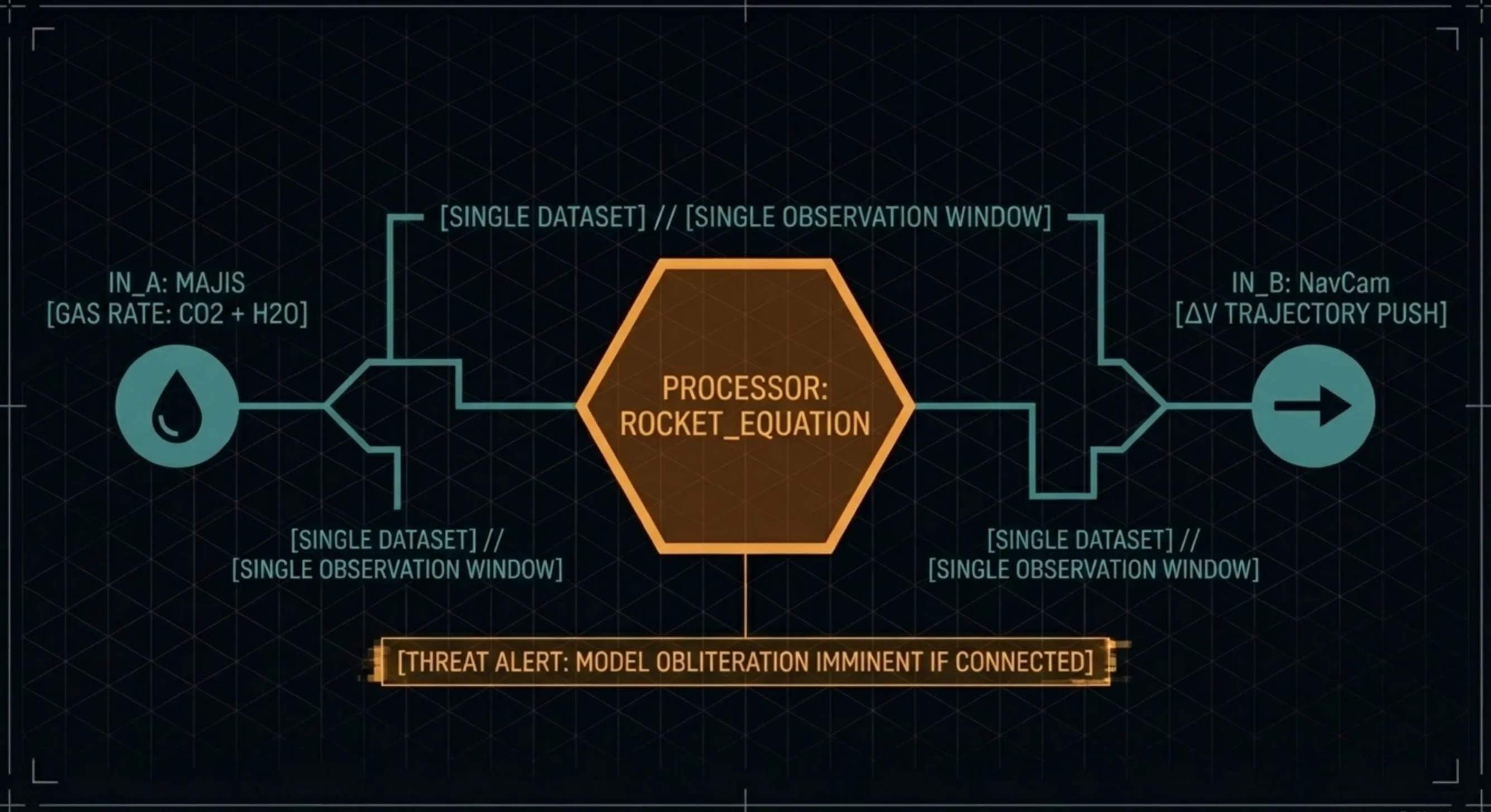
That equation has two sides. The gas leaving the object. And the push it produces.
MAJIS measured the gas. Water and CO2, both, at perihelion, from one instrument. The CO2 that could close this equation got six words: “Juice detected water vapour and carbon dioxide.” The rate is still unreleased.
NavCam measured the push. ESA published it as an exercise in asteroid monitoring under their planetary defense program. Near the end of that section, one sentence reveals what they actually measured: the team is using NavCam’s trajectory data “to understand what materials, and how much of them, the comet is leaving in its wake.” That is not asteroid monitoring. That is measuring how outgassing changes the object’s trajectory. That is the push side of the equation that The Curated Orbit documented using 7,578 ground-based observations.
Both sides. One spacecraft. One observation window.
Thoss, Loeb, and Burkert needed observations from four continents. ESA can run it from a single bird with a single dataset. The CO2 is in a caption. The thrust is labeled planetary defense. And the equation that connects them, the equation that already killed the comet model when it was run the hard way from the ground, is never mentioned.
THE SENTINEL ASSESSMENT:
We told you what this object is in The Verdict. NASA showed you how it works in The Operating System. Now ESA has collected both halves of the equation that killed the comet model from one spacecraft at perihelion. They published swimming pools.
THE RECORD
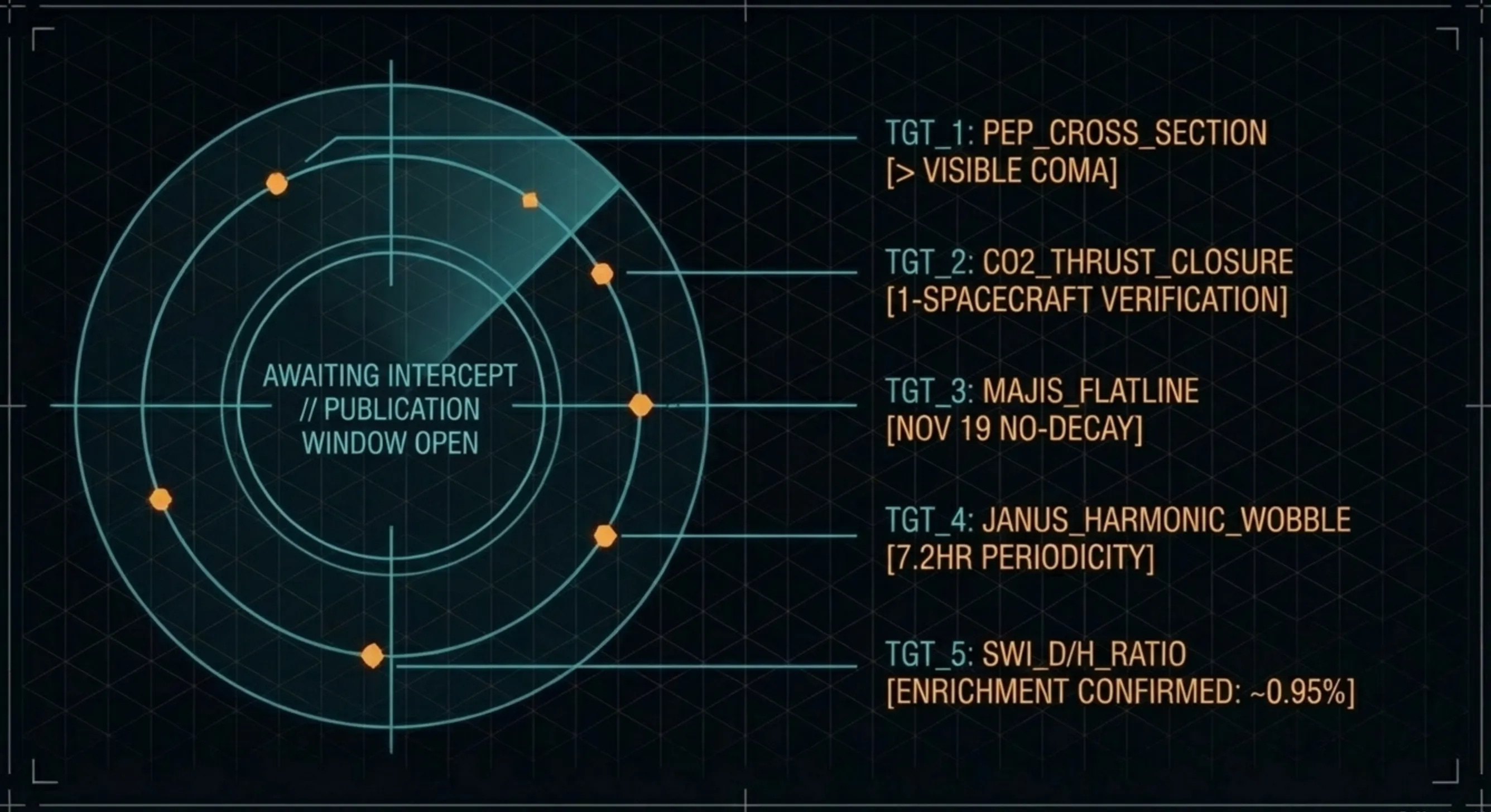
The Verdict put five predictions on the record for Jupiter. We still haven’t received that data but we are putting five more on the record now. These are testable against the JUICE instrument papers when ESA publishes them in the coming months.
One. When the PEP paper drops, the particle environment will show an interaction cross-section inconsistent with standard cometary solar wind interaction. The interaction zone will exceed what the visible coma can explain. If PEP shows a normal particle environment, it contradicts XRISM, and we were wrong about the halo.
Two. When the MAJIS CO2 production rate and the NavCam non-gravitational acceleration are both published, the CO2-only thrust model will close from a single dataset. The water model will break, the same way it broke in The Weigh-In, except this time from one spacecraft with no cross-calibration.
Three. The November 19 MAJIS water measurement will show the output still holding or declining slower than any cometary sublimation model predicts. If it tracks the expected decay curve, the cooling system hypothesis takes a hit.
Four. When the JANUS paper drops, the “fainter shapes” ESA is “currently investigating” will match what The Heartbeat documented: collimated jets with harmonic periodicity and the 7.2-hour wobble.
Five. SWI is investigating whether the JUICE data supports the deuterium-to-hydrogen ratio measured by ALMA and JWST. ESA said so in their summary. If SWI confirms D/H near 0.95%, the extreme enrichment The Ancient Engine documented stands from a third independent instrument.
Five predictions. All falsifiable. All on the record. When the papers drop, we will be here.
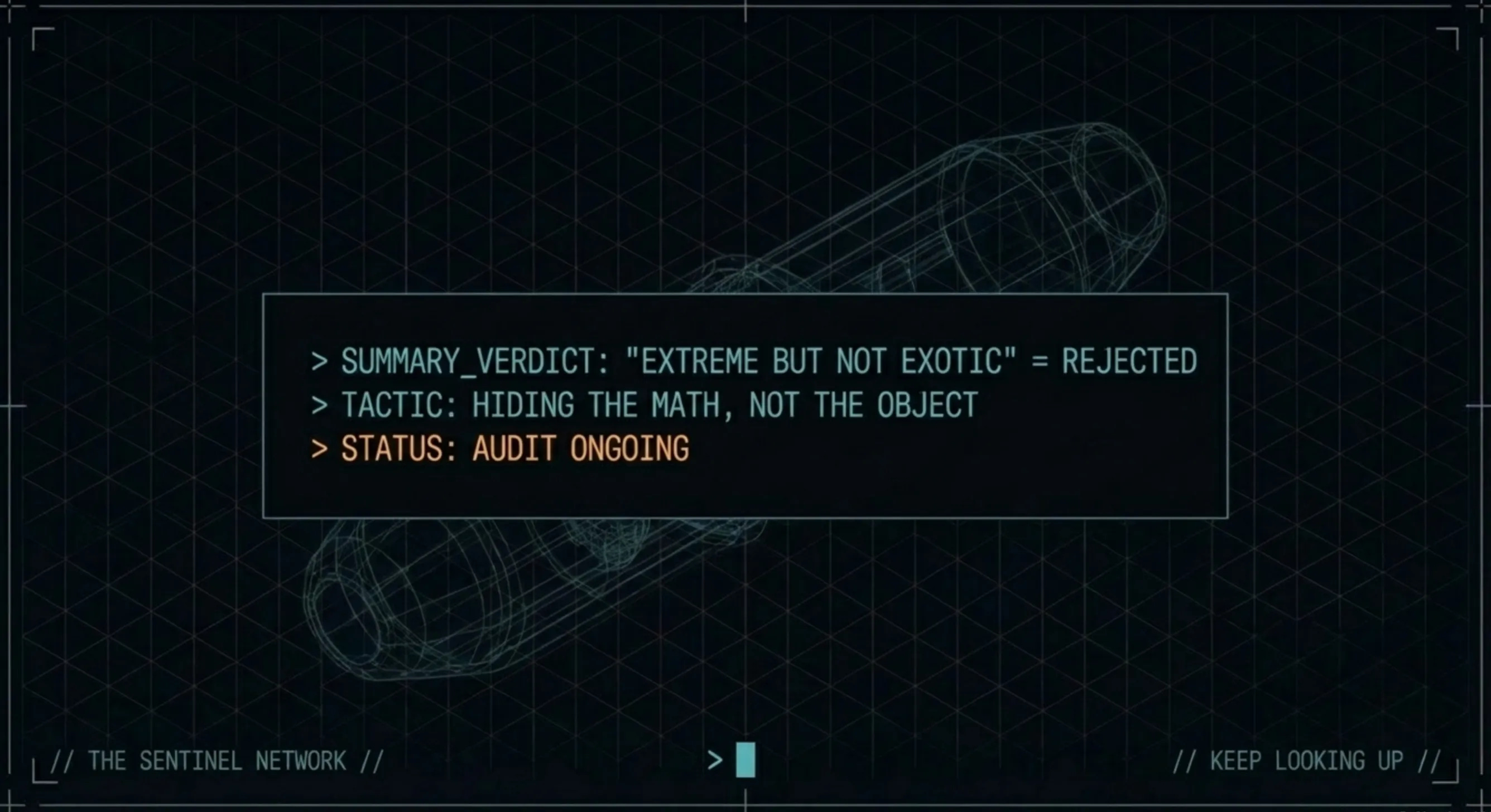
In The Silent Edit, NASA altered a database. In The Curated Orbit, JPL filtered the data. In The TESS Contingency, a satellite went dark. In The Wide Angle, a team inflated their error bars. Now ESA has dropped an instrument, buried a detection, cited a dead mechanism, and shelved a data point.
The data does not change because the press office called it “extreme but not exotic.”
They are not hiding the object. They are hiding the math.
We will keep doing it for them.
Keep looking up.
-- The Sentinel Network™
A Top 100 Science publication on Substack.
Every briefing we’ve published is free. That’s not changing. This publication has no institutional backing, no sponsors, and no editorial board. We’re doing the work the newsrooms won’t — sourcing papers, filing FOIAs, building tools, and writing at the pace a once-in-a-civilization event demands.
Paid subscribers fund the investigation directly. They also get access to the comment section on every briefing, Fieldcraft Labs, and the FIELDCRAFT series — the tools and methods behind every investigation we publish. No ads. No sponsors. No strings. Your subscription is a data point against the suppression gradient.
If you can’t subscribe, we don’t care. Read everything. Share everything. The mission is the mission.
If this briefing found you, someone shared it. If you think it matters, be that someone. The Sentinel runs on readers, not algorithms.
Subscribe to The Sentinel Network™
Share this briefing. The Suppression Gradient documented what happens when this coverage reaches platforms that don’t want you reading it. Every share, every restack, every forwarded link is a data point against the gradient.
Source analyzed: ESA: Five things Juice has revealed about Comet 3I/ATLAS (April 2, 2026)
New here? Start here.
Previous briefings: THE OPERATING SYSTEM | THE BLIND SPOT | THE NARROW BAND | THE SKY IS FALLING | THE PHONE GAP | THE WEIGH-IN | THE VERDICT | THE ANCIENT ENGINE | THE CURATED ORBIT | THE GHOST COMA | THE WIDE ANGLE | THE IGNITION SEQUENCE | THE HEARTBEAT | THE DECEMBER INTERSECTION | THE SURGE | THE SUPPRESSION GRADIENT | THE SILENT EDIT | CONFIRMED: THE TESS CONTINGENCY | THE SENTINEL DOSSIER | DOSSIER 001
Alone the fact that its trajectory (natural vor not) leads from outer space exactly to our sun where it slingshots to Jupiter's gravitational dip, slingshots again... And just right when we started looking to such kind of visitors. Those are unbelievable coincidences.
I can't understand why not the whole mankind stares into the sky in awe of this wonder. Let's hope something Great reveales itself in our lifetime.
I've the gut feeling this WILL happen since like 5 years. Lets welcome it with love and wonder!
Fascinating. If I3/ATLAS is indeed an ancient machine then a very old and likely dead culture made it and it is automated. To whom would it send its data I wonder?