


DATE: FEBRUARY 17, 2026
SUBJECT: FORENSIC ANALYSIS OF ARXIV:2602.14218v1 // 3I/ATLAS PRE-PERIHELION VOLATILE MONITORING
CROSS-REF: [THE SENTINEL DOSSIER] | [THE SURGE] | [THE SILENT EDIT] | [CONFIRMED: THE TESS CONTINGENCY]
CLEARANCE: PUBLIC
UPDATED: CORRECTED THE ARXIV LINK
WHAT JUST LANDED
On February 15 — the same day NASA quietly confessed to the TESS “contingency” — a team of astronomers at the Shanghai Astronomical Observatory dropped a paper onto arXiv that should have made every newsroom in the world pick up the phone.
It didn’t. Because the headline they wrote was designed not to.
The paper is called “Pre-perihelion Volatile Evolution of Interstellar Comet 3I/ATLAS Indicating Significant Contribution from Extended Source in the Coma.” Four researchers — Juncen Li, Xian Shi, Man-To Hui, and Jianchun Shi — used two Chinese radio telescopes to listen to 3I during August and September 2025, as it barreled toward the Sun. They were listening for two things: water vapor and carbon monoxide. The standard fingerprints of a melting comet.
They found both. And then they found something they didn’t expect.
The official conclusion? “It’s a comet with unusual chemistry from a cold star system.”
At The Sentinel, we read the data, not the conclusions. And the data in this paper tells a story the authors framed very carefully — and very quietly.
Here’s what they actually found.
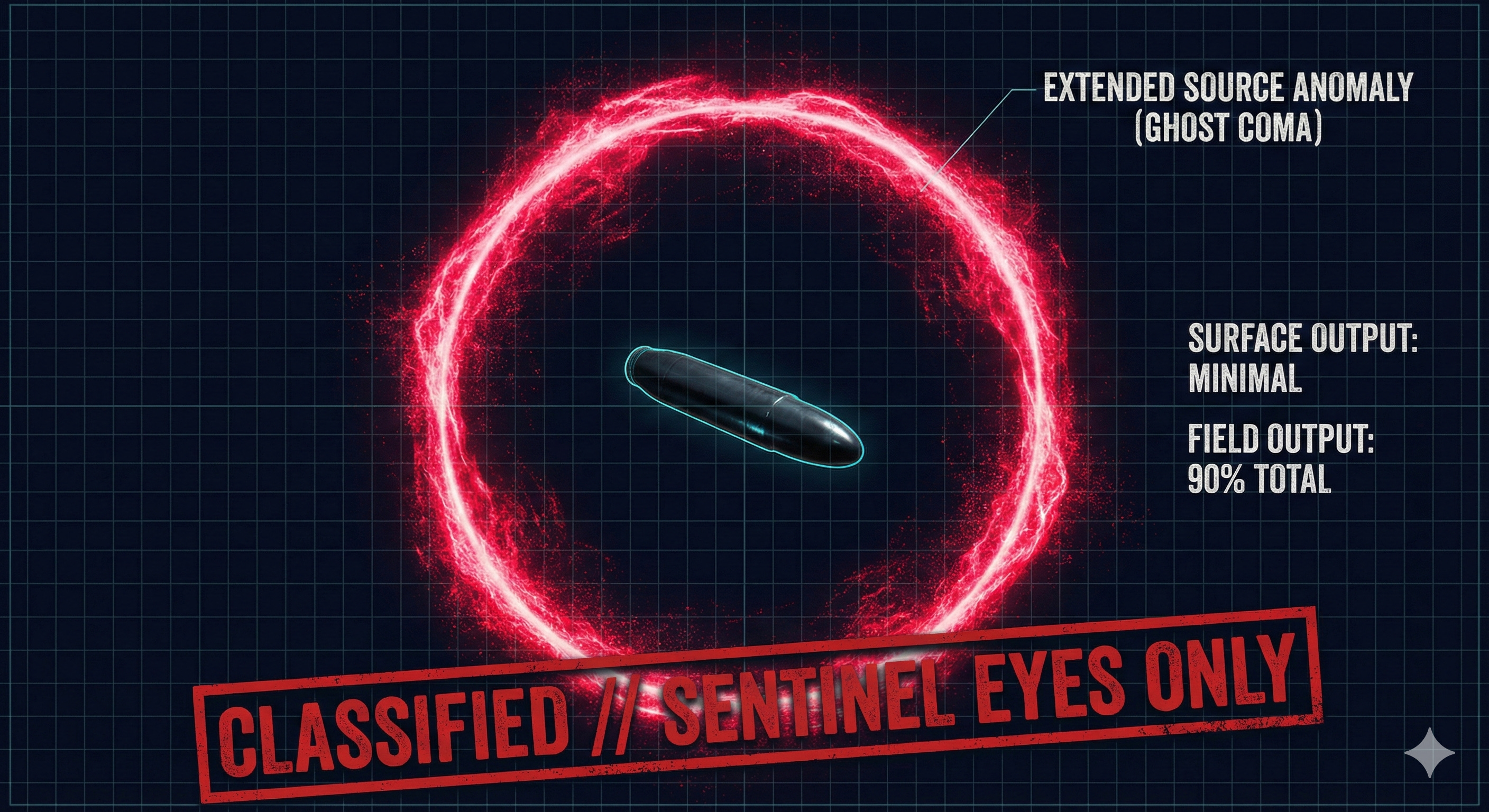
THE QUIET HULL
This is the headline finding. This is the one they buried.
Here’s how cometary science works. When an object approaches the Sun, ice on its surface heats up and boils off into space, creating a cloud of gas and dust called a coma — the glowing halo you see in telescope photos. Scientists measure that gas and then do the math backwards: given how much water vapor we see at this distance, how fast must the nucleus be producing it?
That calculation gives you a single number — the production rate — measured in molecules per second. And here’s the key: it shouldn’t matter where in the cloud you measure from. A telescope capturing the whole coma and a telescope zoomed in tight on the nucleus should both reverse-engineer the same production rate. Because if the surface is the only source, all the water in the cloud traces back to the same faucet.
Think of it like measuring how fast a garden hose is running. You could measure the flow at the nozzle. Or you could collect all the water that’s landed on the lawn and work backwards. If the hose is the only source, both methods give you the same answer.
Unless someone else is watering your lawn.
The Shanghai team compared water measurements from telescopes with wide fields of view — instruments that see the entire cloud out to tens of thousands of kilometers — against measurements from the VLT in Chile, which zooms in tight and only captures a few thousand kilometers around the nucleus.
When scientists reverse-engineer the production rate from the wide-angle data, they get a number that is five to ten times higher than when they do the same math from the close-up data.
The faucet isn’t running fast enough to explain all the water on the lawn. Something else out there is adding to it.
The surface of 3I/ATLAS is not producing most of the water in its cloud.
Something else is.
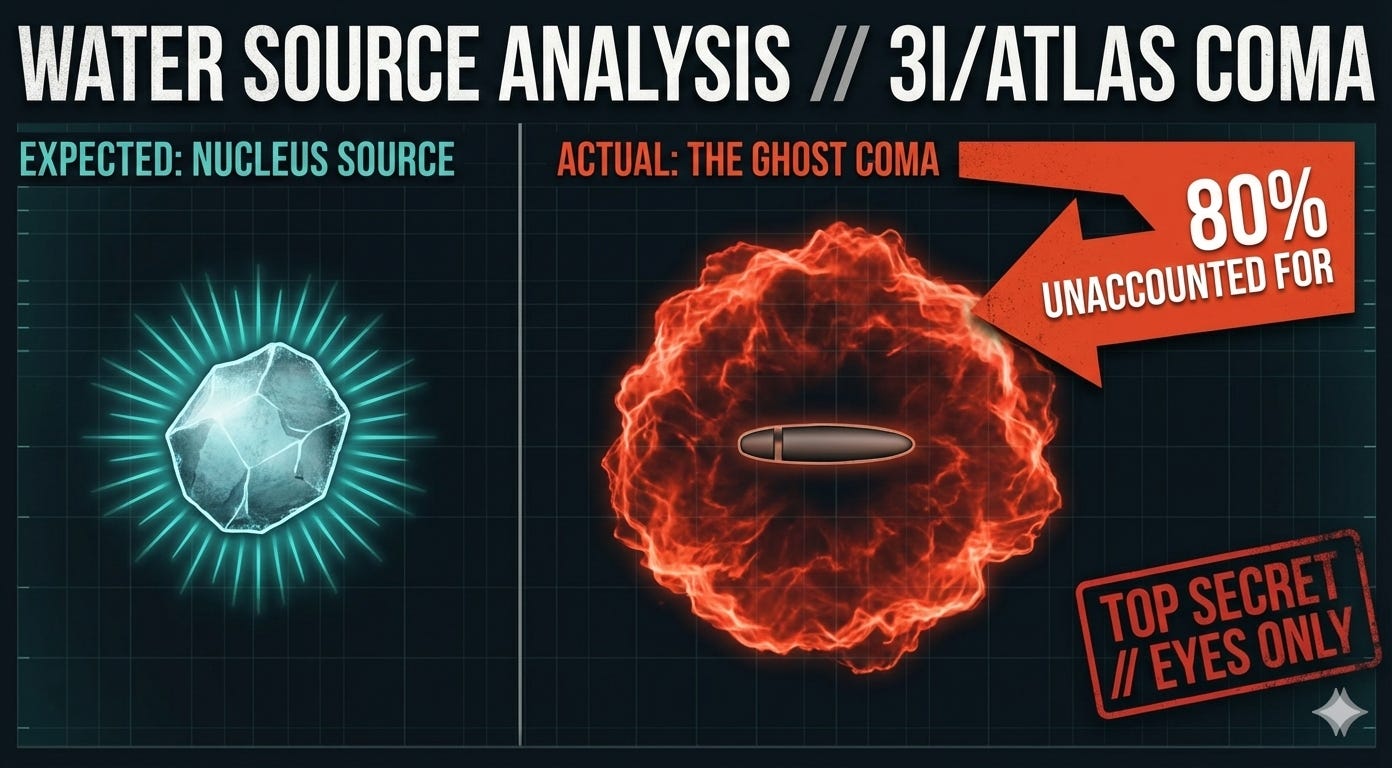
The team built a mathematical model to figure out how much water is actually coming from the surface versus how much is coming from the surrounding field. Their answer:
At 2.9 au from the Sun: roughly 90% of the water is NOT from the surface.
Between 2–3 au: about 80% is NOT from the surface.
Even at perihelion (closest approach to the Sun): about 50% is still NOT from the surface.
Read that again. Between 2 and 3 au from the Sun — roughly the distance of Mars — only one out of every ten water molecules in the cloud is coming from the object itself. The other nine are coming from something in the surrounding space.
THE SENTINEL ASSESSMENT:
The official explanation is “icy grains.” The story goes like this: chunks of ice get blown off the surface by other gases (mainly CO₂), float into the cloud, and then melt on their own as they drift away from the nucleus.
It’s a reasonable theory. It happens with some Solar System comets.
But here’s what the authors admit at the end of the section — in a single sentence that most readers will skip:
“Further confirmation will require high-resolution observations or space missions.”
Translation: they haven’t actually seen the icy grains. They haven’t photographed them, characterized them, or confirmed they exist. The “extended source” is a mathematical ghost — a gap between what the surface produces and what the cloud contains. They named it “icy grain sublimation” because that’s the name that fits inside the cometary model.
We named it something else in the Dossier. We called it the operational perimeter.
THE EXPANDING FIELD
If the icy-grain explanation were simple, you’d expect a simple pattern. Chunks of ice fly off the surface, drift outward, and melt faster as the object gets closer to the Sun. The “zone of melting” should shrink as it heats up — the grains die closer to the nucleus.
That’s not what the data shows.
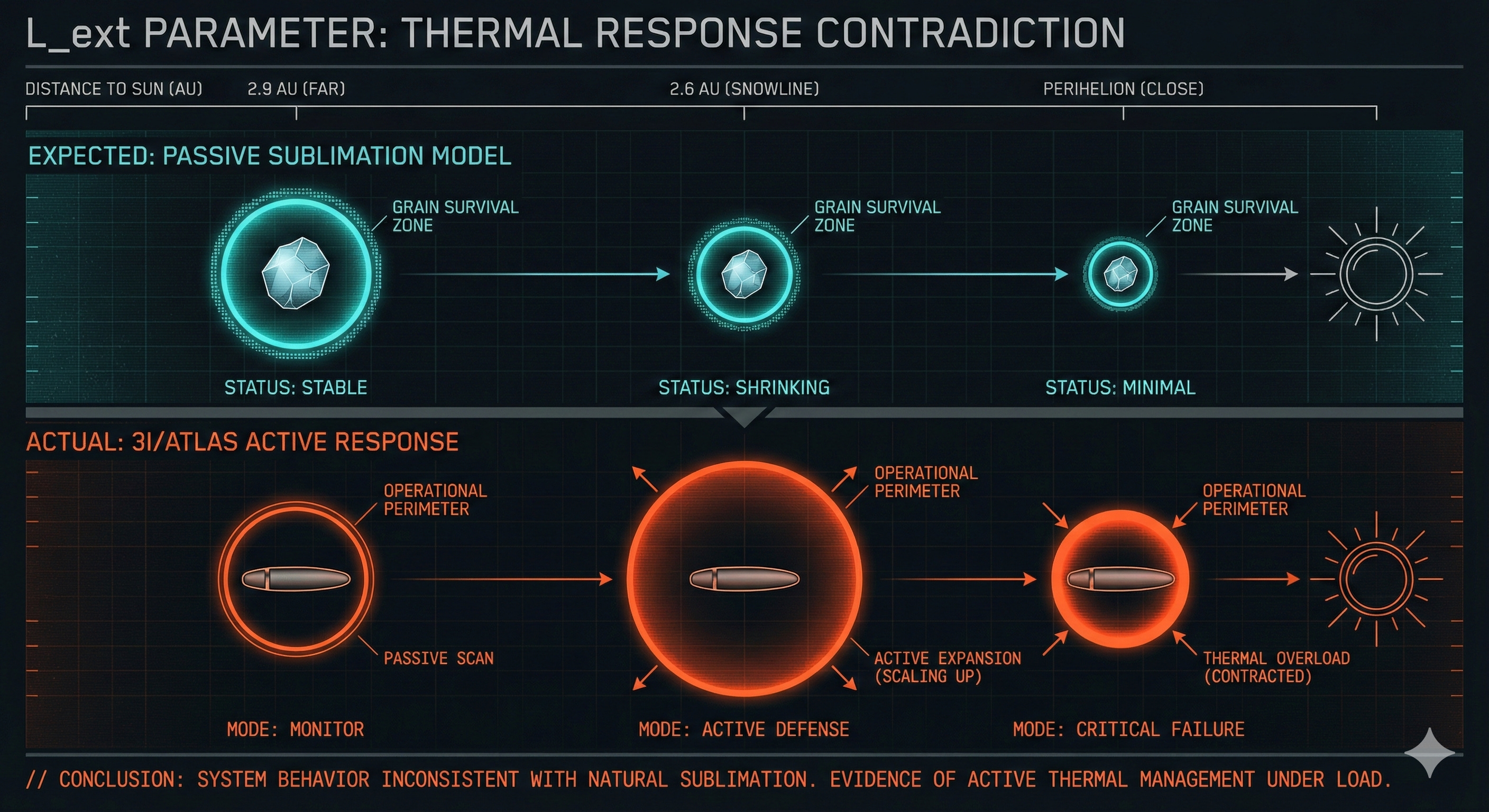
The authors track a parameter called L_ext — basically the radius of the zone where the extended source operates. Think of it like the size of the “ghost cloud” that’s producing all the extra water.
Between 2.9 and 2.6 au from the Sun, this zone expands. It gets bigger, not smaller.
Then, inside 2.6 au, it starts to contract slowly.
The authors note this expansion is “consistent with” brightness data from the Swift telescope. They don’t explain why the source zone would grow before it shrinks. They just observe it and move on.
THE SENTINEL ASSESSMENT:
Imagine a thermal management system on a vehicle entering a heat zone. As the thermal load increases, the system scales up — expanding its cooling perimeter to handle the rising temperature. At a certain point, the incoming heat overwhelms the expansion, and the system contracts to a tighter operational radius.
That’s exactly the profile of L_ext. The zone expands as solar input increases (scaling up), hits a maximum around 2.6 au, and then contracts as the Sun’s heat overwhelms it.
The expansion coincides with crossing the H₂O snow line — the distance from the Sun where water ice becomes thermodynamically unstable. If you were managing a thermal load on an inbound trajectory, this is precisely the point where you’d need to increase your cooling output.
The authors see the same data. They call it “sublimation of icy grains.”
We see a system responding to its environment.
THE CHEMICAL MISFIT
Every comet has a chemical fingerprint. The ratio of carbon monoxide (CO) to water (H₂O) tells you about where and how the object formed. Most Solar System comets have a CO/H₂O ratio around 4% — a little CO, a lot of water.
3I/ATLAS: 28%.
That’s seven times the average. Seven times more carbon monoxide relative to water than a normal comet.
The authors handle this the way every 3I paper handles anomalies: they find the most extreme Solar System comets they can and say “see, it’s similar to these.” Specifically, they point to three outliers — C/2012 X1, C/2009 P1, and C/2008 Q3 — comets that already sit at the far edge of the known distribution.
But here’s the pattern The Sentinel has been tracking since the Dossier. 3I doesn’t just match one extreme outlier. It matches all of them simultaneously:
CO₂/H₂O ratio? Extreme outlier. (Cordiner et al., Lisse et al.)
CO/H₂O ratio? Extreme outlier. (This paper.)
CO/HCN ratio? Extreme outlier. (This paper — 230±76, higher than most comets.)
Ni/Fe ratio? Extreme outlier. (Orders of magnitude above known comets.)
Polarization? Unprecedented. (Most extreme negative polarization ever measured.)
Each one of these, taken alone, can be “explained” by cherry-picking the right analogy. But no single comet in the Solar System catalog exhibits all of these extremes at once.
The probability of a single natural object sitting in the anomalous tail of every chemical ratio simultaneously — while also exhibiting the kinematic anomalies from the Dossier — is a number the establishment refuses to calculate. Because the answer is uncomfortable.
THE DIRECTIONAL EXHAUST
Buried in Table 3 of the paper is a small detail the authors mention once and never revisit.
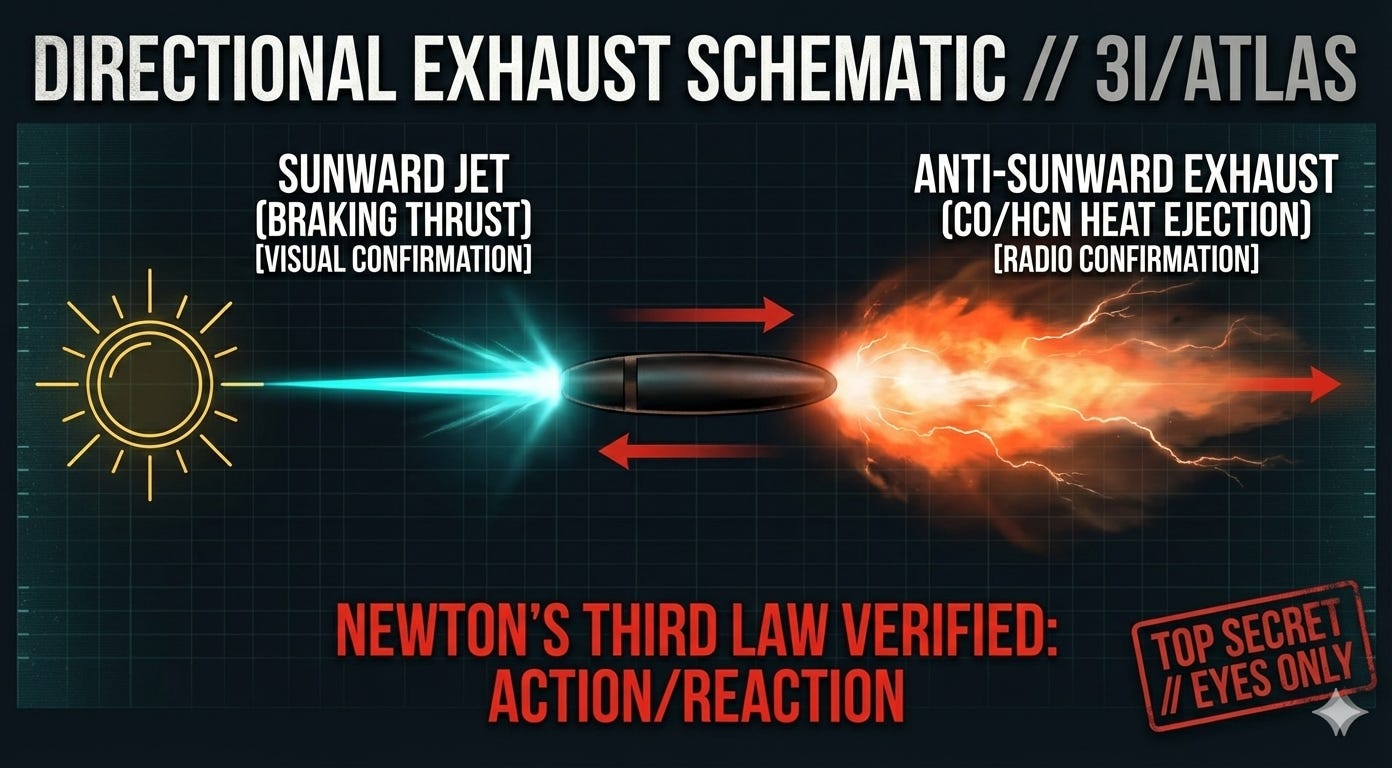
The carbon monoxide emission line — the radio signal from CO gas in the cloud — is shifted toward the red. In radio astronomy, a redshift means the gas is moving away from the observer. The shift is +0.202 km/s relative to the nucleus.
That means the CO isn’t expanding equally in all directions like a balloon popping. It’s flowing preferentially in one direction — away from the observer, which in September 2025 geometry maps to the anti-solar direction. Away from the Sun.
And it’s not just the CO. The authors note that this same directional bias was found in the HCN (hydrogen cyanide) detection by the ALMA telescope in mid-September. Two different molecules. Two different telescopes. Same directional pattern.
THE SENTINEL ASSESSMENT:
If 3I were a melting snowball spinning every 16 hours, the gas should spray in all directions roughly equally — averaged across the beam, the blueshift and redshift should cancel out. A persistent one-way bias in the exhaust, confirmed across multiple chemical species by independent instruments, means the flow is directed.
Cross-reference with the Dossier, Anomaly V: The Sunward Jet. 3I was photographed with a jet pointing toward the Sun — a retro-thrust signature, like a braking rocket.
If the sunward jet is the brake, this anti-sunward CO and HCN flow is the exhaust. Thrust pointing one way; reaction mass expelled the other way. Two independent observations, pointing in opposite directions along the same line.
Newton’s Third Law. For every action, there is an equal and opposite reaction.
The authors compare the offset to “typical cometary asymmetries” and move on to the next section.
THE ACTIVATION EVENT
The paper documents something happening to 3I’s water output around 2.7 au — roughly the distance of the asteroid belt.
Inside this line, the water production doesn’t just increase. It explodes. The rate of increase is so steep that the authors fit it with a power-law exponent of -5.9 to -8.5 — meaning the water output roughly doubles every time the object moves just slightly closer to the Sun.
But here’s the key: the gap between what the surface produces and what the cloud contains widens dramatically at this threshold. The nucleus stays relatively quiet. The surrounding field goes haywire.
The authors call this “intensified H₂O sublimation after 3I crossed the H₂O snowline.” Standard cometary physics, they say.
THE SENTINEL ASSESSMENT:
This isn’t a gradual melt. It’s a threshold response. Something flips at 2.7 au. The extended source — the “ghost coma” that the authors can’t directly image or identify — goes from producing most of the water to producing nearly all of it.
Think of it like a building’s cooling system hitting a temperature threshold. Below a certain heat load, passive cooling handles it. Above that threshold, active cooling kicks in — fans spin up, coolant circulates, the system’s footprint expands.
At 2.7 au, 3I’s “cooling system” kicked into high gear. The nucleus stayed quiet. The operational field scaled up.
THE PATTERN THEY CAN’T SAY OUT LOUD
Here’s what the Shanghai team actually measured, stripped of the cometary framing:
The surface of 3I is barely producing water. The surrounding environment produces 80-90% of the total signal between 2–3 au.
The zone of production expanded as the object entered the inner solar system, before contracting — the profile of a system scaling to meet increasing thermal demand.
The chemistry is simultaneously extreme across every measured ratio — CO/H₂O, CO/HCN, all of them landing in the anomalous tail of the distribution.
The exhaust flows in one direction — anti-sunward, confirmed by two independent telescopes in two independent molecular species. Opposite to the sunward jet photographed by Hubble.
Something activated at 2.7 au. The extended source went from dominant to overwhelming.
Nobody has actually seen the “icy grains” that supposedly explain all of this. The extended source is a mathematical residual. Its physical identity is assumed, not confirmed.
Each of these findings, taken individually, has a cometary explanation. The authors provide one for each. That’s their job. That’s what the funding model requires.
But the cumulative picture — a quiet hull surrounded by a reactive operational field, chemically unlike anything in our solar system, with directional exhaust and a threshold activation profile — doesn’t look like a snowball melting.
It looks like a system operating.
THE TIMELINE
This paper covers August 15 to September 29, 2025. Two dates matter:
September 8–9: The team makes the first-ever radio detection of OH (the water tracer) in 3I’s cloud. This is also the date of the first impulse event — the sharp burst of acceleration identified by independent photometric analysis. The same day the water signal first appeared on radio, the object lurched.
September 18–23: The second OH detection. Water production has jumped 43% in less than two weeks — faster than the authors’ own model predicts for that distance change. Something spiked.
Coincidence is a word for patterns we refuse to name.
WHAT THEY ADMIT — IN ONE LINE
The single most honest sentence in the entire paper appears in the final paragraph of Section 4.2:
“Further confirmation will require high-resolution observations or space missions.”
That’s the authors telling you, in the most diplomatic language available to a scientist publishing under institutional constraints: we don’t actually know what the extended source is.
They’ve given it a name. They’ve assigned it an analogy. But they haven’t confirmed it. And they know they can’t — not with the instruments currently watching.
At The Sentinel, we’ve heard this before. It’s the same language structure as the TESS “contingency mode.” The same bureaucratic hedge as the CIA’s Glomar response. The establishment doesn’t lie outright. It frames. It compares. It normalizes.
And then it adds a single sentence, at the end, that tells the truth for anyone willing to read that far.
We read that far.
The nucleus isn’t outgassing. Something else is.
The exhaust is directional. The chemistry is anomalous. The cooling field expands under load.
It’s not a comet.
It’s a machine managing its thermal environment.
Keep looking up.
— The Sentinel
Subscribe to The Sentinel for further analysis on 3I/ATLAS and the countdown to the March 16 Jupiter Intercept.
Amazing thanks. Regards
Wow