


SUBJECT: FORENSIC ANALYSIS OF BIVER ET AL. (2026), IRAM 30-M PERIHELION SPECTRAL SURVEY (ARXIV:2603.23240) // SHINNAKA ET AL. (2026), SUBARU/HDS [O I] FORBIDDEN LINE ANALYSIS (ARXIV:2603.25002)
DATE: APRIL 1, 2026
CROSS-REF: THE OPERATING SYSTEM | THE VERDICT | THE WEIGH-IN | THE ANCIENT ENGINE | THE GHOST COMA | THE CURATED ORBIT | THE SENTINEL DOSSIER
DATA CONFIDENCE: VERIFIED (IRAM 30-m millimeter spectroscopy, Subaru/HDS optical spectroscopy, JUICE/MAJIS infrared, SOHO/SWAN Lyman-alpha) + HYPOTHESIS (Sentinel mechanical analysis)
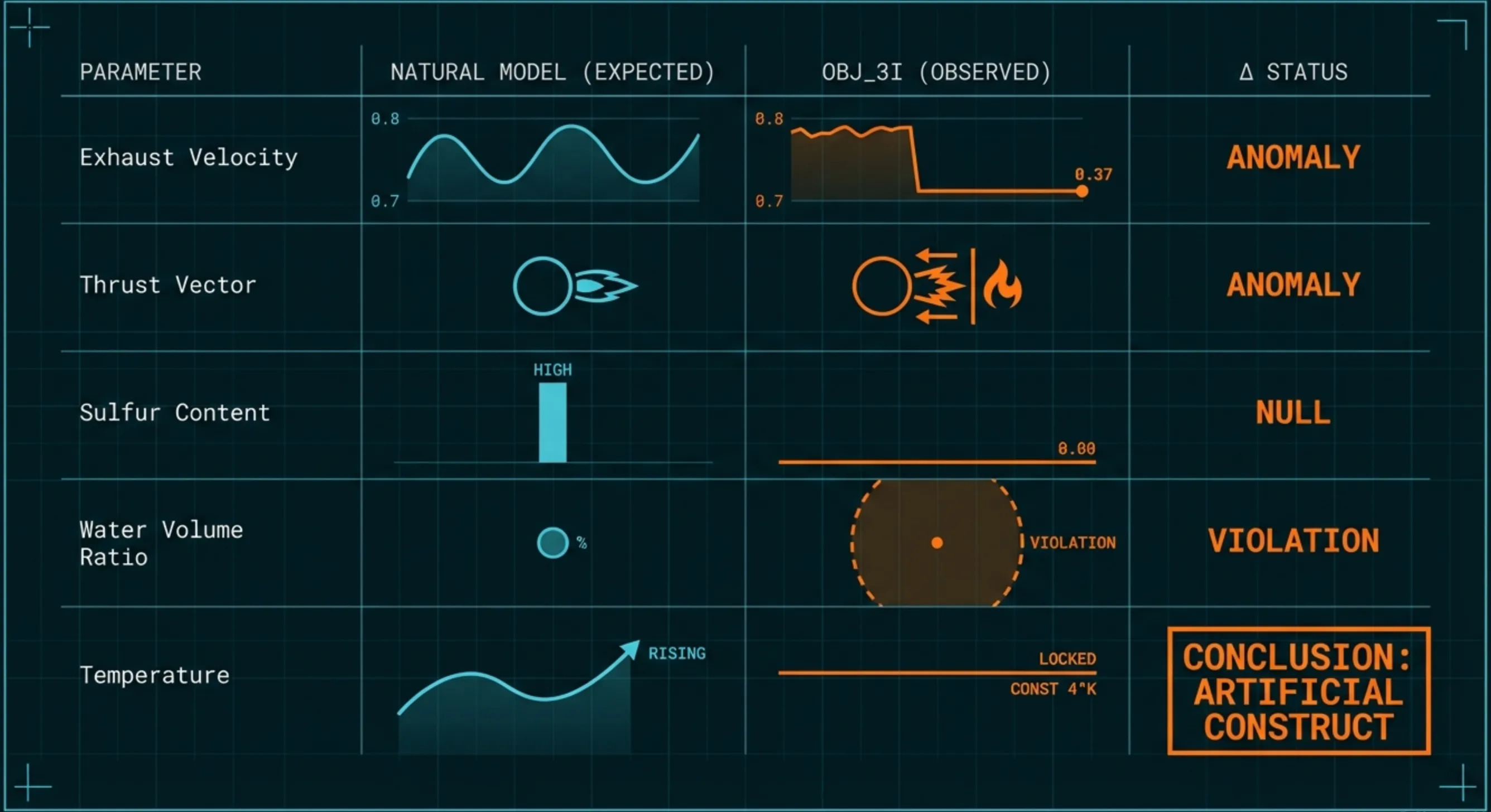
THE EXHAUST
On November 1 through 3, 2025, three days after closest approach to the Sun, a team led by Nicolas Biver at the Paris Observatory pointed Europe’s largest millimeter telescope at 3I/ATLAS and measured the gas coming off the object at peak output.
They clocked the speed and direction of three different molecules: hydrogen cyanide, methanol, and carbon monoxide. Every one told the same story.
The gas is moving at 0.37 kilometers per second.
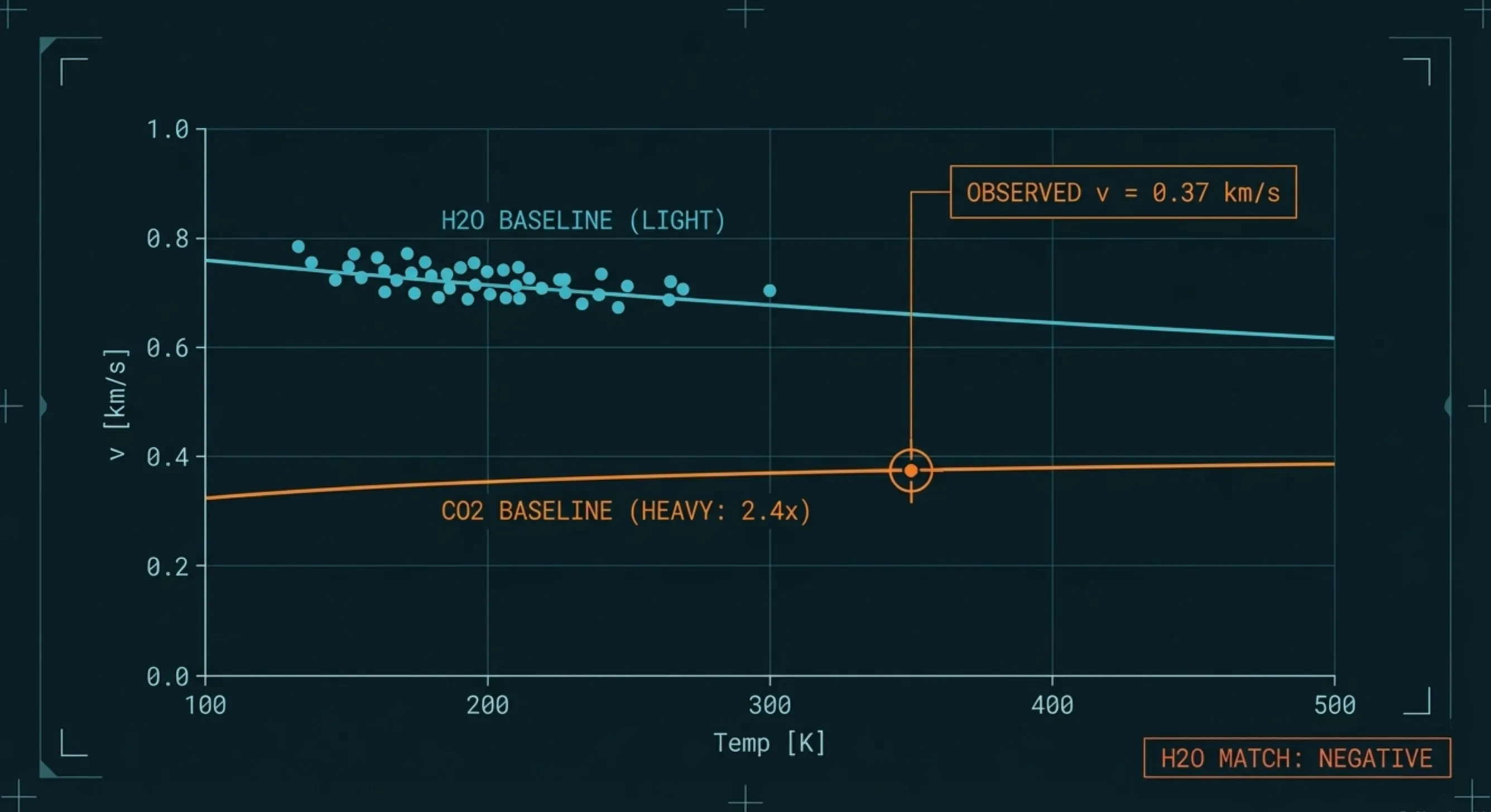
Every comet ever measured at this distance from the Sun produces gas at 0.7 to 0.8 kilometers per second. This has been established across decades of observations. 3I is running at half the speed the physics requires.
The team wrote an entire appendix trying to explain it. They plotted three theoretical curves: one for a gas cloud dominated by water, one dominated by carbon dioxide, and one for a mix. The measured speed lands on the carbon dioxide curve. It does not touch the water curve at any temperature that makes physical sense.
Carbon dioxide is 2.4 times heavier than water. Same energy pushing heavier molecules produces slower exhaust. This is the same conclusion four other teams reached through four completely different methods. The Curated Orbit found it from the trajectory. The SPHEREx Intercept found it from the exhaust density. The Operating System found it from the spatial maps. The Weigh-In found it by breaking the rocket equation. Five teams. Five methods. Carbon dioxide is running the drive.
But the speed was not the most important thing they found.
They also measured which direction the gas is going. And across all three molecules, the pattern is the same.
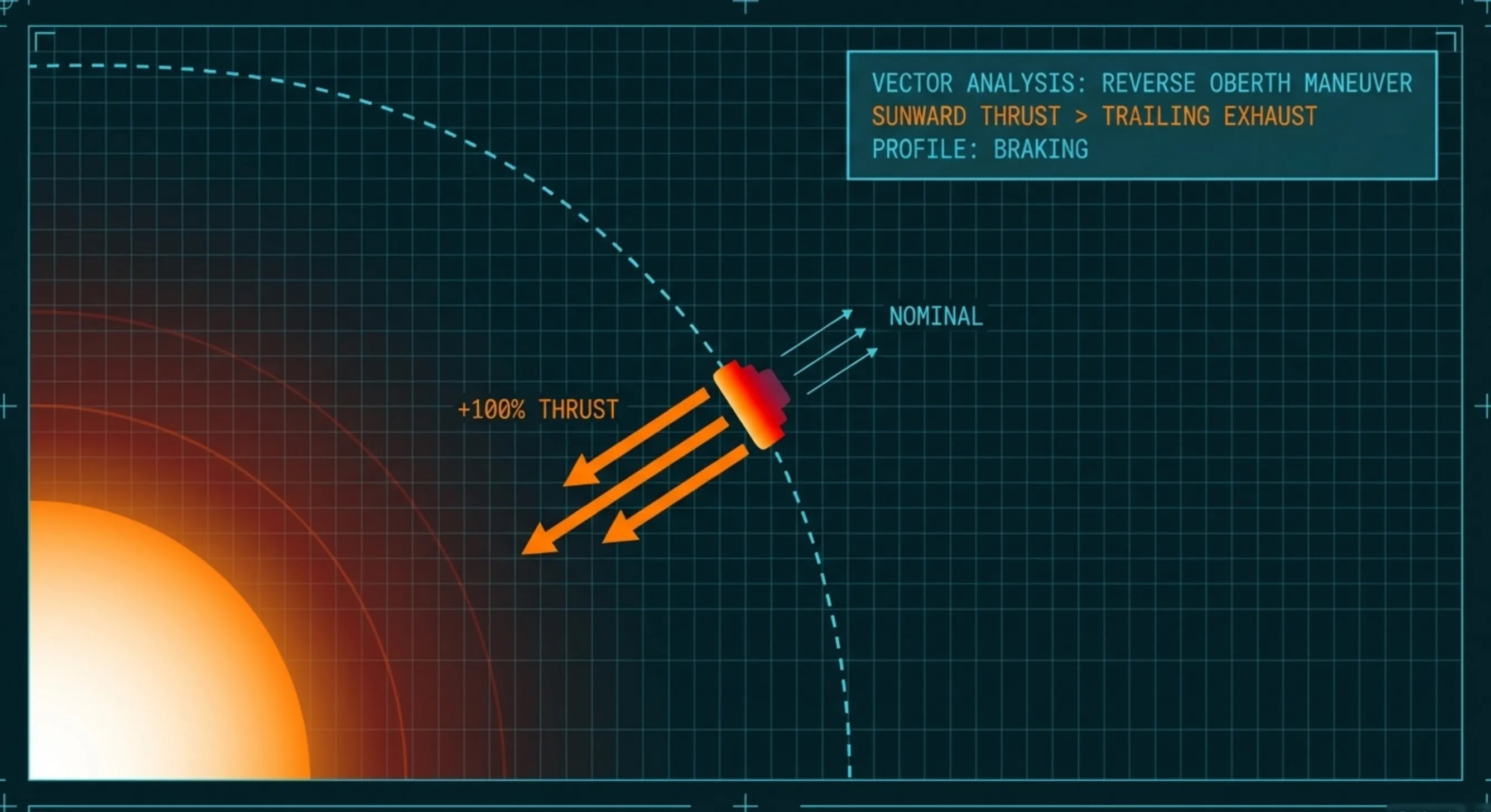
The gas moves faster toward the Sun than away from it.
The sunward exhaust runs 20 to almost 100 percent faster than the exhaust trailing behind. This is consistent across every molecule they measured. It is not noise.
When material boils off a surface in sunlight, the sunlit side is hotter. Hotter means faster. The fast gas always moves away from the heat source. Always. That is the only direction thermal physics allows.
3I’s fast exhaust points into the Sun. The slow exhaust trails behind in the direction of travel. The object is pushing harder against the thing heating it and softer in the direction it is going.
That is a braking profile.
THE SENTINEL ASSESSMENT:
We called this in December. The Sentinel Dossier identified the sunward jet as a retro-rocket. The Curated Orbit documented the transverse thrust reversing direction at closest approach, the signature of a gravity-assist maneuver, not a melting snowball drifting past the Sun. We described a reverse Oberth braking profile: fire hardest at closest approach, against the velocity vector, to shed the most energy in the least time.
Biver just measured that profile in the gas itself. The fast exhaust is sunward. The slow exhaust is in the direction of travel. The velocity drops to half the expected value because the drive medium is carbon dioxide, not water. Five independent teams, five independent methods, same conclusion. And the spectral lines now show the direction of thrust we predicted four months ago.
THE MISSING ELEMENT
The same team ran a full chemical inventory of the exhaust at closest approach, when the object was producing at maximum output.
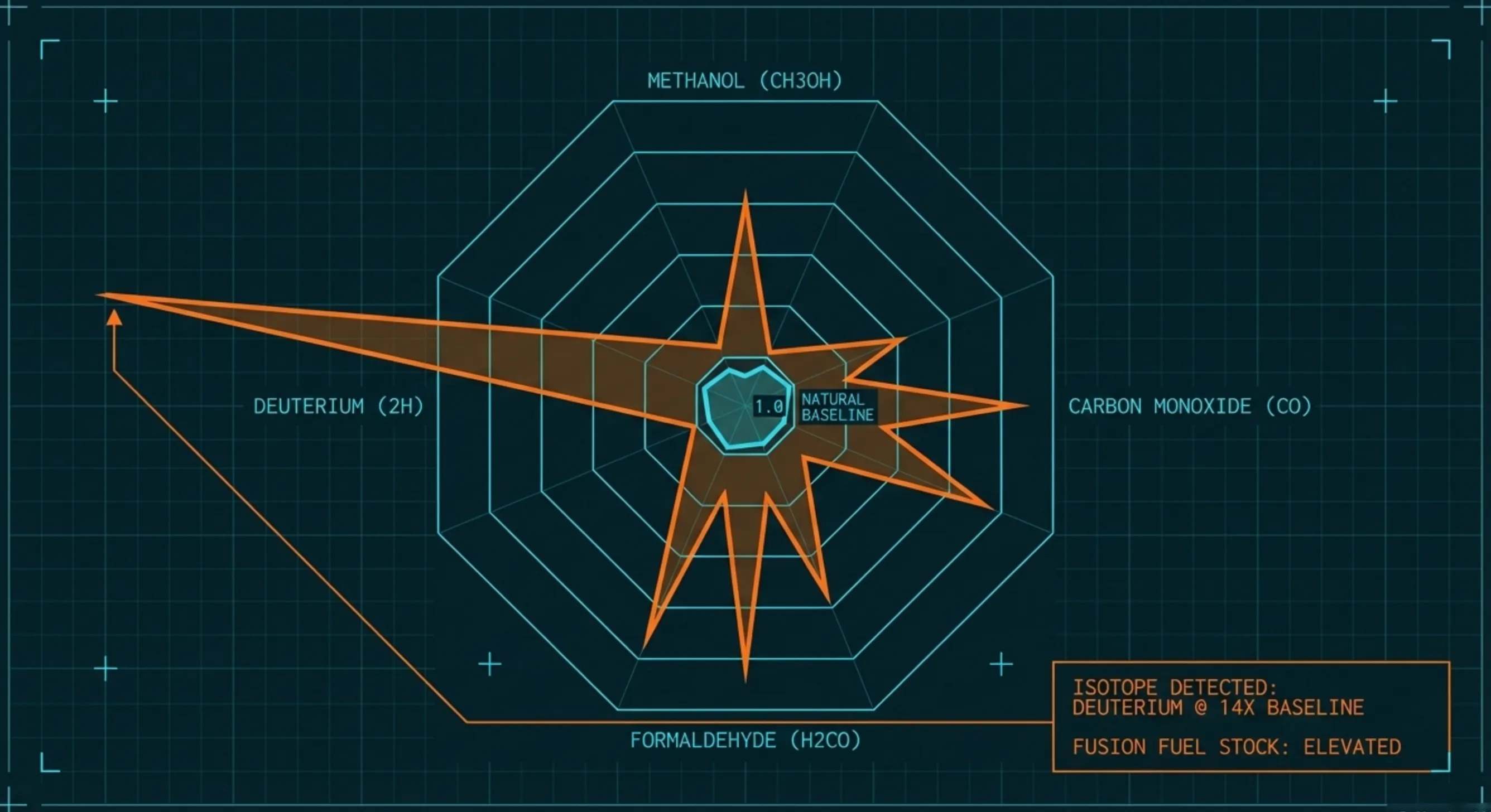
The carbon and oxygen compounds are elevated. Methanol is more concentrated relative to the other gases than in any object ever measured except one, C/2016 R2, a comet the scientific community already considers chemically peculiar. Carbon monoxide and formaldehyde are both among the highest concentrations on record. The carbon-oxygen chemistry is loaded.
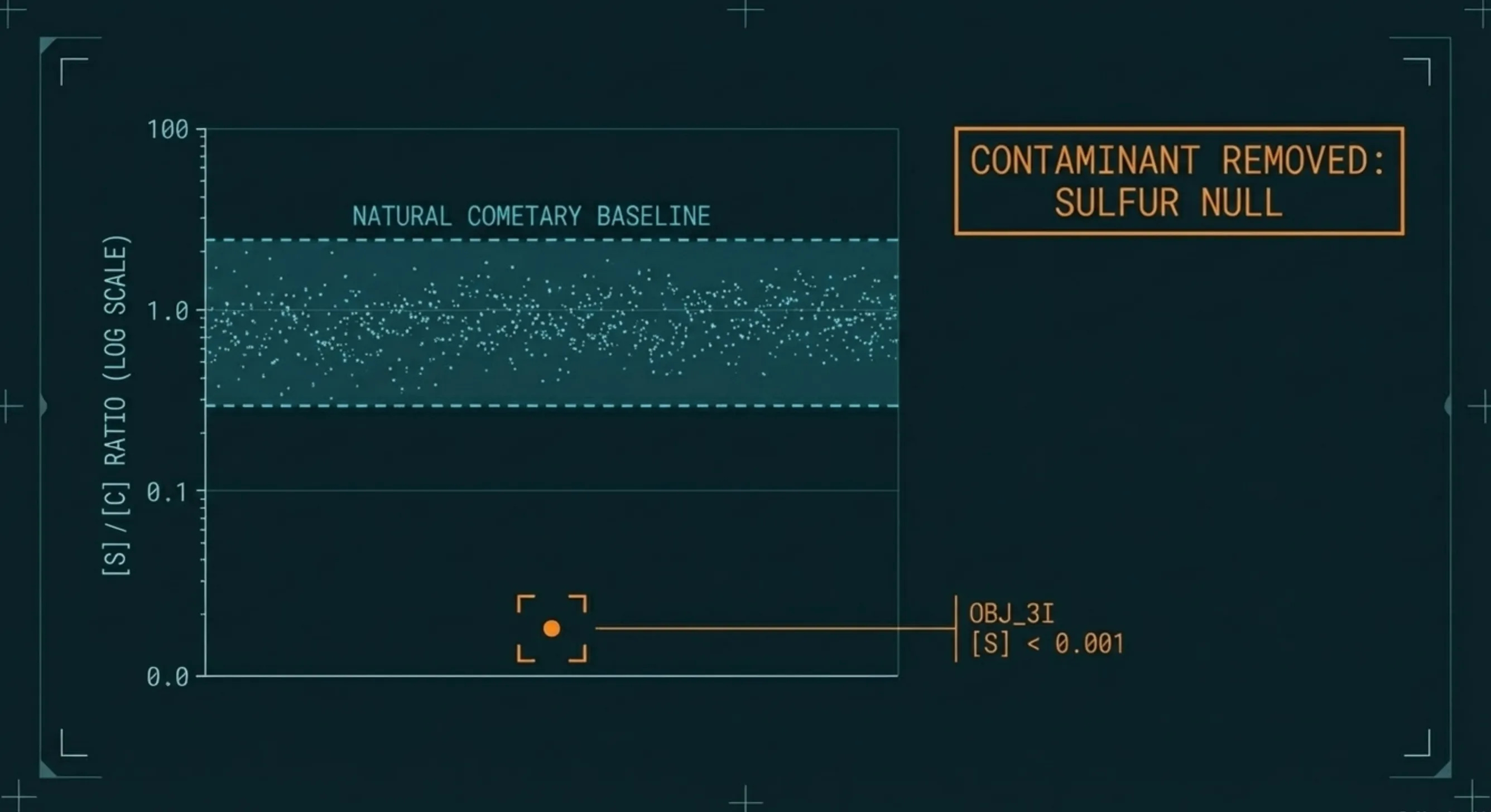
Sulfur is gone.
Hydrogen sulfide is one of the most common chemicals in cometary ice. Every comet ever measured carries it. The team searched for it with an instrument sensitive enough to find it, and found nothing. The upper limit sits below the floor of what any known comet produces.
The only other sulfur compound they found barely cleared the detection threshold.
The paper includes a chart comparing how much sulfur versus carbon every known comet carries. There is a range. Every comet falls inside it. 3I is printed below the chart. Not at the bottom of the range. Below it.
Sulfur is a poison. It kills catalysts in chemical manufacturing. It bleeds energy from reactors. It corrodes engine hardware. In every industrial process that burns fuel or sustains a high-energy reaction, the first step is the same: strip the sulfur.
The carbon-oxygen fuel stock of this object is concentrated. The contaminant is gone.
THE SENTINEL ASSESSMENT:
The Ancient Engine dated this object at 10 to 12 billion years old. Cosmic ray bombardment over that timescale does degrade sulfur bonds. But cosmic rays do not pick and choose. They break things indiscriminately. They do not strip sulfur while concentrating carbon and oxygen.
The Operating System found deuterium in the methane at 14 times higher than any comet in our solar system. Three times beyond the limit of any known formation process. Deuterium is fusion fuel. Sulfur poisons the surfaces where fusion reactions take place.
The fuel is concentrated. The poison is gone.
THE COOLANT AT 900%
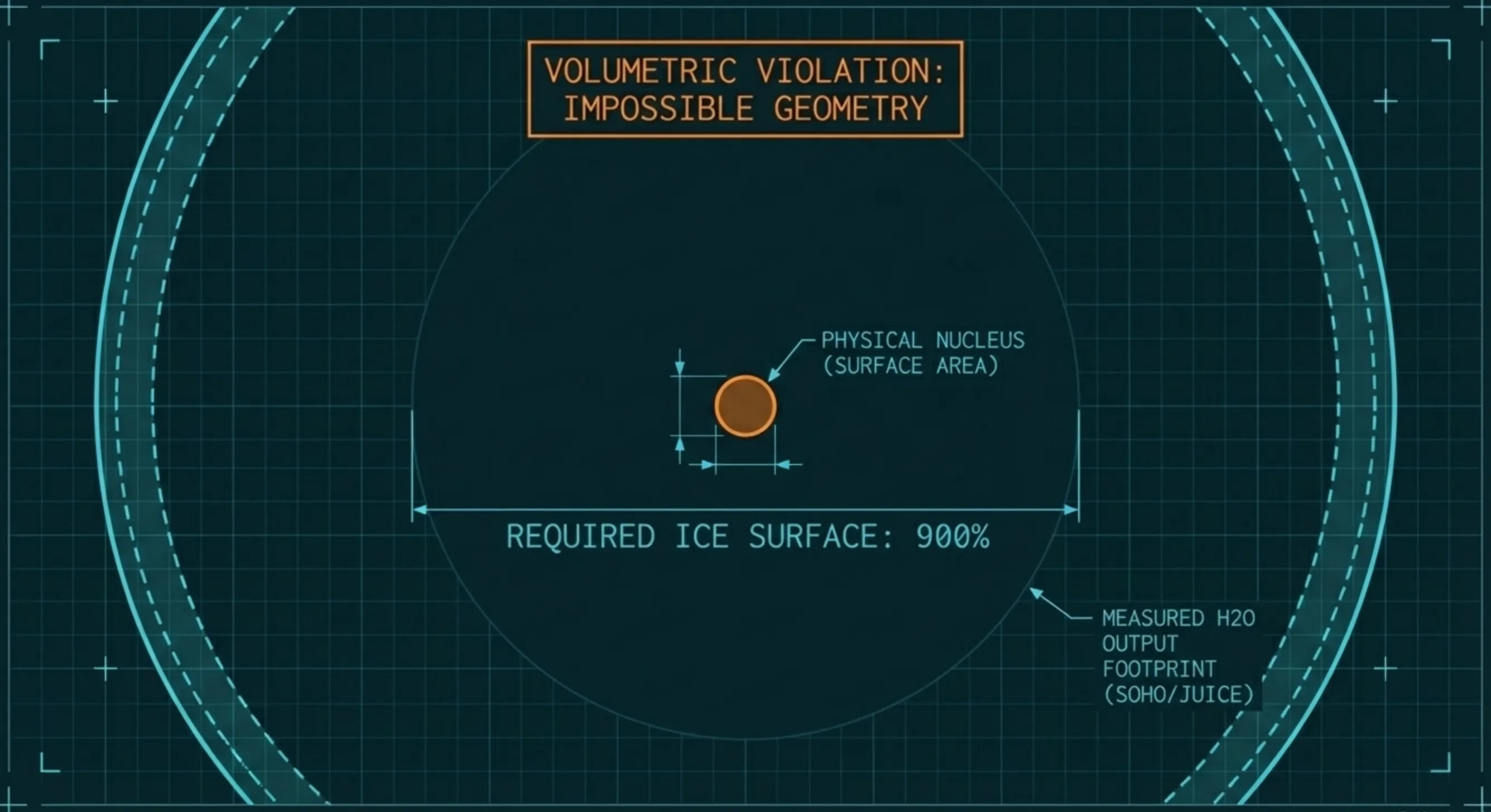
That same week, two instruments measured 3I’s water output. ESA’s JUICE spacecraft measured the water close to the nucleus. SOHO, the Solar and Heliospheric Observatory, measured the full surrounding cloud hundreds of thousands of kilometers out. The wide measurement returned five times more water than the narrow one.
The same object, the same week, at the same distance from the Sun.
The Ghost Coma showed 80 to 90 percent of the water comes from somewhere other than the surface. The Wide Angle showed the 12-sigma aperture discrepancy. The Weigh-In broke the rocket equation. The Verdict killed the ice grain explanation.
This is the sixth independent confirmation from the sixth team. To produce that much water from the surface alone, the nucleus would need to be nine times its own size in pure exposed ice. That is physically impossible for a solid body.
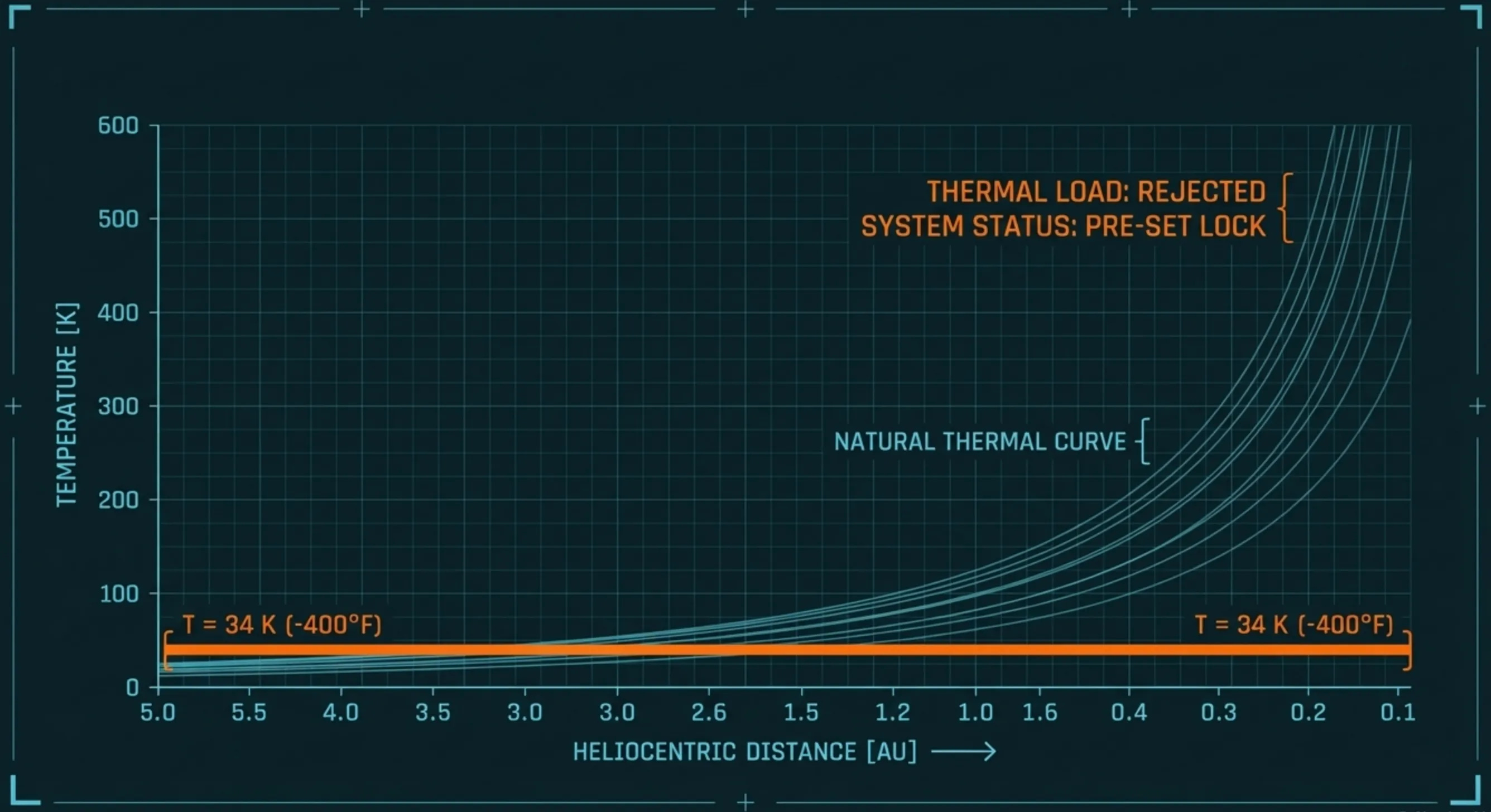
The Operating System showed the water exits at a locked temperature of 34 Kelvin, roughly 400 degrees below freezing, regardless of distance from the Sun. It does not warm as it gets closer. It is pre-set. At maximum thermal stress, the system distributing water through the surrounding field was running at maximum output.
THE SENTINEL ASSESSMENT:
In The Operating System, we documented two papers that cited the icy grain mechanism after Tianwen-1 and Keck killed it. Biver makes three. Three papers in two weeks built on an explanation that has no surviving physical evidence. The water is real. The source they name for it is not. What produces nine times the surface capacity in water output at a fixed temperature through an extended field that seven teams have now measured and nobody can explain? The Verdict answered that question. A cooling system.
THE ENGINE ON THE WAY OUT
While Biver measured the machine at closest approach, a different team on a different continent measured it heading away.
Yoshiharu Shinnaka’s group at Kyoto Sangyo University observed 3I from Hawai’i’s Subaru Telescope on January 7, 2026, when the object was nearly three times Earth’s distance from the Sun and heading out. Carbon dioxide was still elevated above typical comets, comparable to the previous interstellar visitor, 2I/Borisov.
Shinnaka did something nobody else has done. He compiled every published measurement of carbon dioxide versus water for 3I into a single timeline. Read it in order.
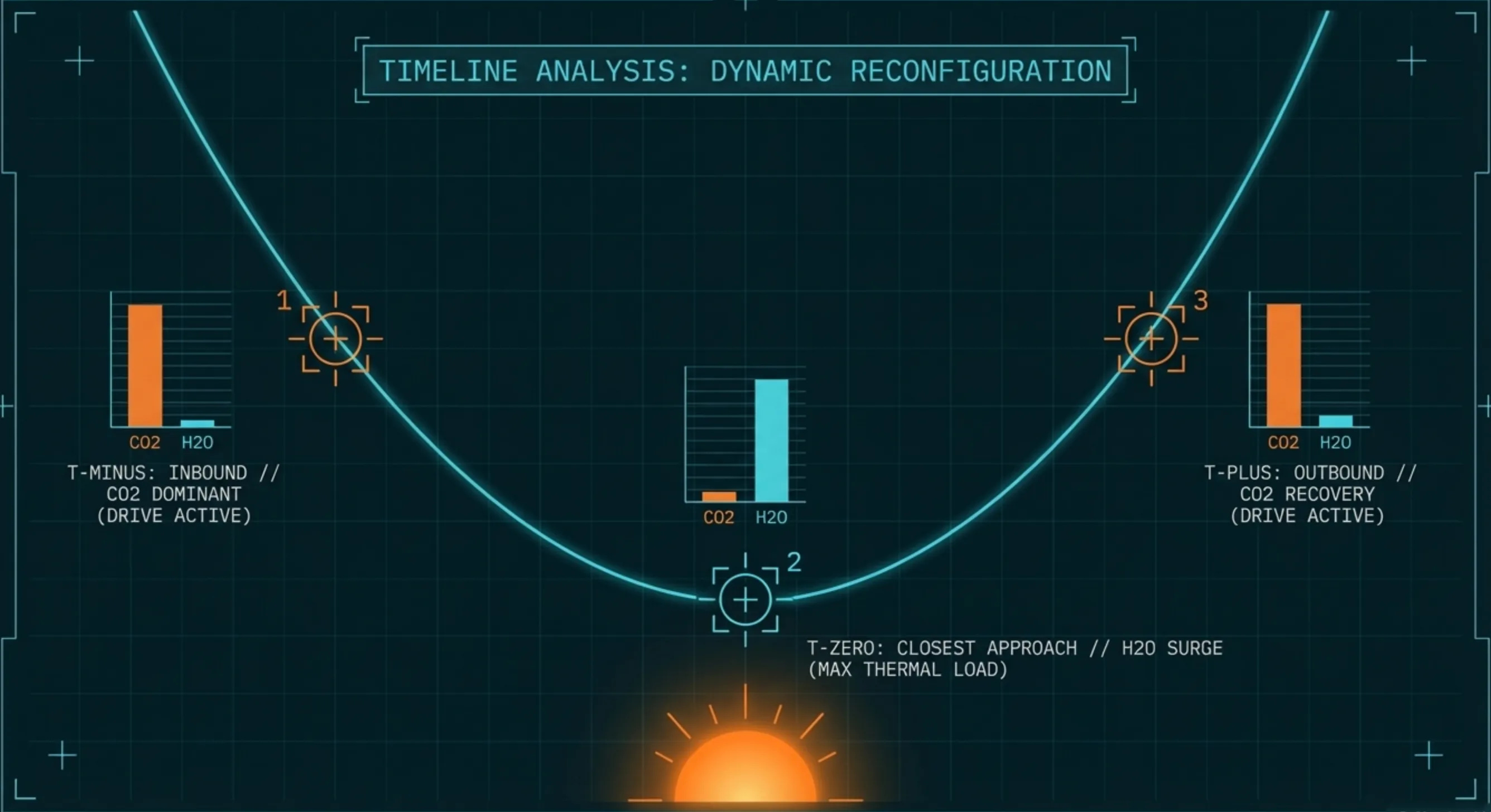
On the way in, far from the Sun, JWST measured the gas cloud around 3I and found carbon dioxide overwhelmingly dominant. Water was barely there. The drive medium ran the show.
After closest approach, on the outbound leg, NASA’s SPHEREx telescope measured the gas cloud and found it swamped with water. The carbon dioxide signal had nearly vanished.
But JWST measured the same object at the same distance in the same month and found carbon dioxide dominant again. Fifteen times more than what SPHEREx saw.
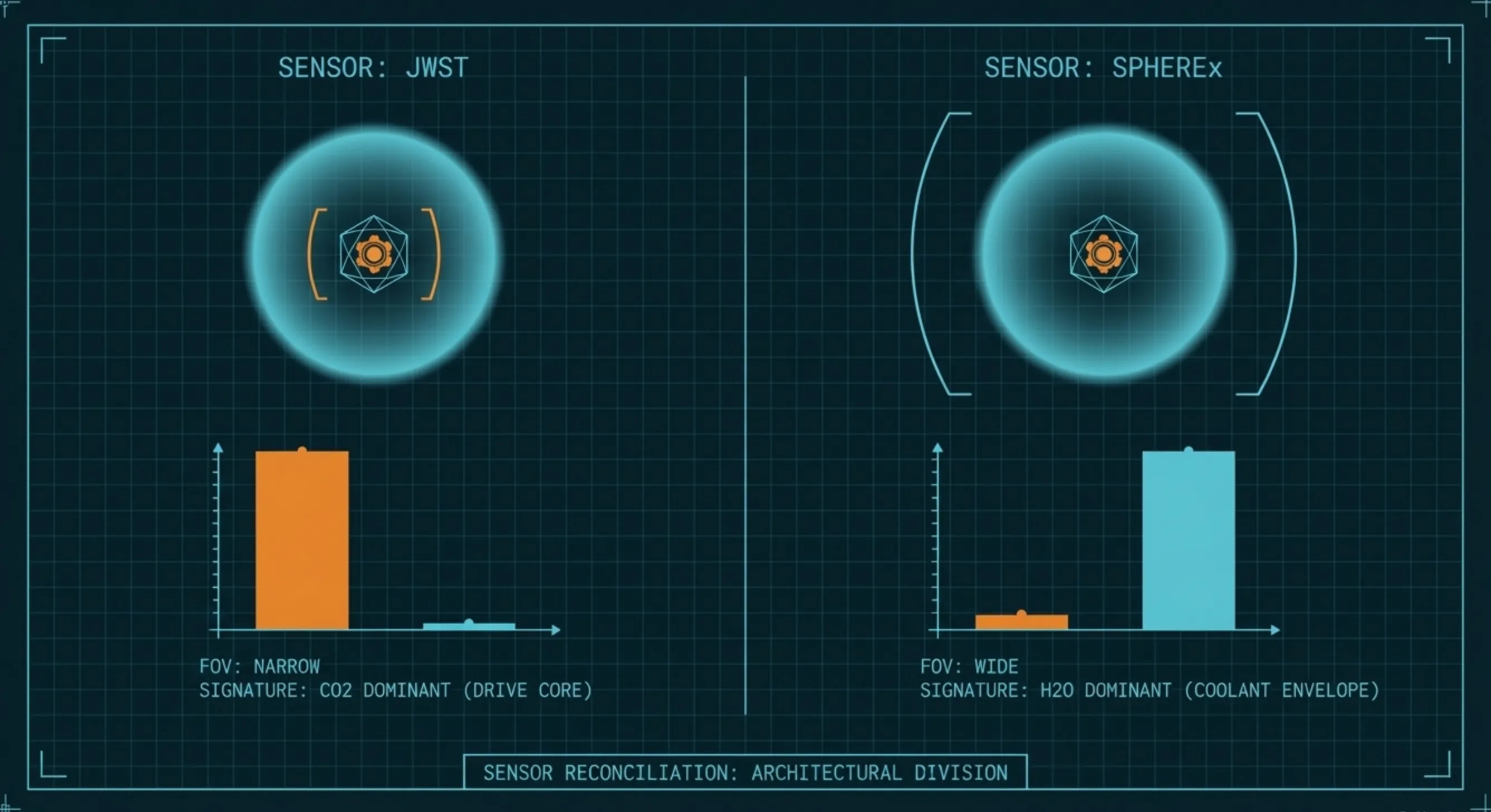
One telescope sees water. The other sees carbon dioxide. Same object. Same distance. Same month. The only difference is how much of the surrounding cloud each instrument captures. SPHEREx has a wide field of view and sees the full cooling envelope that extends far from the nucleus. JWST has a narrow field of view and sees only the core, where the carbon dioxide exhaust concentrates.
SPHEREx sees the coolant. JWST sees the engine.
That is The Ghost Coma showing up in the chemistry.
THE SENTINEL ASSESSMENT:
The Verdict predicted the chemistry would shift at Jupiter. It already shifted at closest approach. The inbound profile was carbon dioxide dominant. The closest-approach profile was water dominant from the coolant surge. The outbound profile is carbon dioxide climbing back. Three configurations across one trajectory. A comet does not reconfigure. A machine managing thermal load across a flight plan does.
The drive was on when the object was far from the Sun and heading in. It is still on now, far from the Sun and heading out. It never turned off.
The five predictions from The Verdict remain on the table at Jupiter.
Every paper that lands adds another line to the schematic. These two added five. The exhaust is half speed and pointed the wrong way. The fuel inventory has been stripped of the one element that poisons every high-energy system we know how to build. The cooling architecture was running at nine times the capacity of the physical surface at the moment of maximum thermal stress. And Shinnaka tracked the drive to nearly three times Earth’s distance from the Sun on the outbound leg. Still running. Still showing the same ghost coma signature that has followed this object since we first documented it: one telescope sees water, another sees carbon dioxide, and the gap between them is the architecture.
Nobody is building a natural model that accounts for all of this. Nobody is trying. The papers keep landing and the explanation gap keeps widening.
The machine is still running.
Keep looking up.
-- The Sentinel
Every briefing we’ve published is free. That’s not changing. This publication has no institutional backing, no sponsors, and no editorial board. We’re doing the work the newsrooms won’t — sourcing papers, filing FOIAs, building tools, and writing at the pace a once-in-a-civilization event demands.
Paid subscribers fund the investigation directly. They also get access to primary source documents, the comment section on every briefing, Fieldcraft Labs, and the FIELDCRAFT series — the tools and methods behind every investigation we publish. No ads. No sponsors. No strings. Your subscription is a data point against the suppression gradient.
If you can’t subscribe, we don’t care. Read everything. Share everything. The mission is the mission.
Subscribe to The Sentinel Network
Share this investigation. The Suppression Gradient documented what happens when this coverage reaches platforms that do not want you reading it. Every share, every restack, every forwarded link is a data point against the gradient.
Previous briefings: The Floor | The Architect | The Diagnostic Gap | The Operating System | The Blind Spot | The Narrow Band | The Phone Gap | The Sky Is Falling | The Weigh-In | The Verdict | The Long Count | The Green Burial | The Dead Drop | The Ghost General | The Ancient Engine | The Curated Orbit | The Wide Angle | The Ignition Sequence | The Heartbeat | The Ghost Coma | The Suppression Gradient | The Silent Edit | The Glomar Confirmation | The Sentinel Dossier
Do we know yet if it changed trajectory at Jupiter?