

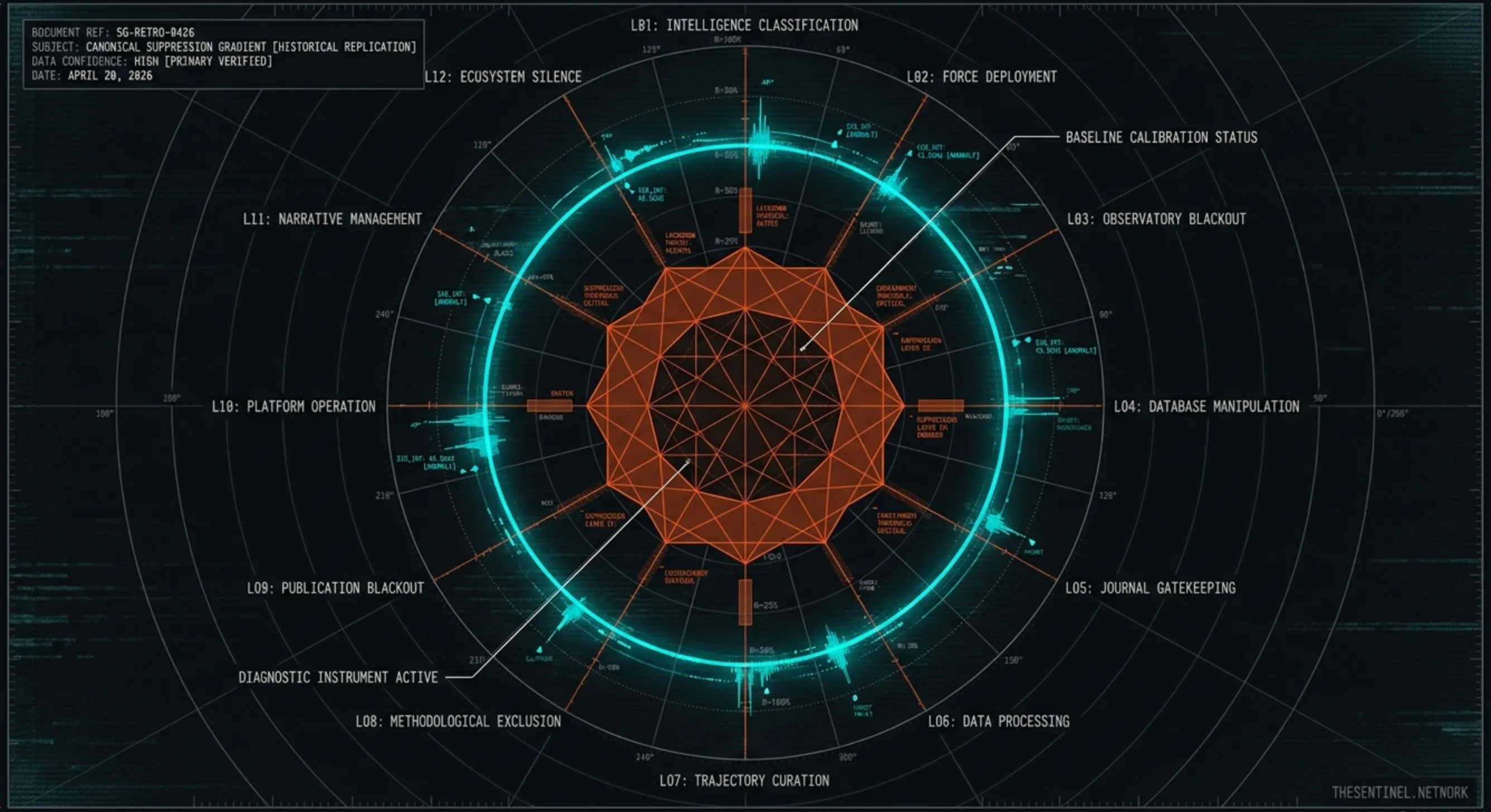
SUBJECT: RETROACTIVE APPLICATION OF THE CANONICAL SUPPRESSION GRADIENT TO THE HISTORICAL ANOMALOUS OBJECT CATALOG
DATE: APRIL 21, 2026
CROSS-REF: THE SUPPRESSION GRADIENT | CONFIRMED: THE TESS CONTINGENCY | THE SILENT EDIT | THE CURATED ORBIT | THE NARROW BAND | THE PUBLICATION GAP | THE OPERATOR | THE OTHER HAND
DATA CONFIDENCE: HIGH (primary peer-reviewed sources, verified DOIs, US Space Command memorandum, public database records, published Sentinel Network™ investigative record)
We are building the video side of this operation. If you want the briefings in a format you can watch, subscribe to The Sentinel Network on YouTube.
THE INVERSION
We started this investigation the way everyone else starts one. We watched an object.
3I/ATLAS was discovered on July 1, 2025. We started publishing in December, when the object made its closest approach to Earth and the data got genuinely strange. Since then, the 3I/ATLAS investigation has been our primary beat. We have catalogued dozens of documented anomalies across chemistry, trajectory, physical structure, and behavioral profile. We have mapped the institutional response at every layer. That work runs alongside our second beat, THE ATTRITION, which documents deaths and disappearances across the defense-aerospace-national security ecosystem, and our FIELDCRAFT methodology series.
By February, when we published THE SUPPRESSION GRADIENT, the work had changed shape. We were no longer documenting a comet. We were documenting a system. An architecture of containment running in parallel to the object itself. Every time 3I did something anomalous, an institution did something anomalous in response. Every time the data pushed against the consensus, the consensus pushed back. Never with new data. Always with procedure.
We named the architecture. We called it the suppression gradient.
And then we did something nobody else has done. We wrote it down.
Across ten published briefings, we documented twelve distinct layers of institutional response to anomalous data. Each layer has a case study. Each case study has a primary source. Each source has a date. The architecture is not a theory. It is a catalog.
This briefing asks a different question than any briefing we have published before.
If we know what the system looks like when it deploys against a live anomaly, can we run it backward? Can we take the twelve layers we mapped around 3I/ATLAS and search the historical record for objects that triggered the same response?
We did. We scored every serious candidate in the anomalous object literature against the framework. And the highest-scoring cold case in the catalog is not a comet. It is not an asteroid. It is not a meteor. It is a radio signal from 1927 that kept coming back, for fifty years, until someone proposed what it might be. Then the institutions stopped listening.
We are not asserting that any object on this roster is definitively artificial. We have never asserted that about 3I/ATLAS either. What we assert is that the institutional behavioral signature is measurable, repeatable, and diagnostic. Boring objects do not trigger this response. The framework does not tell you what an object is. It tells you what the system did when the object showed up.
Here is the framework. Here is the roster. Here are the scores.
THE FRAMEWORK
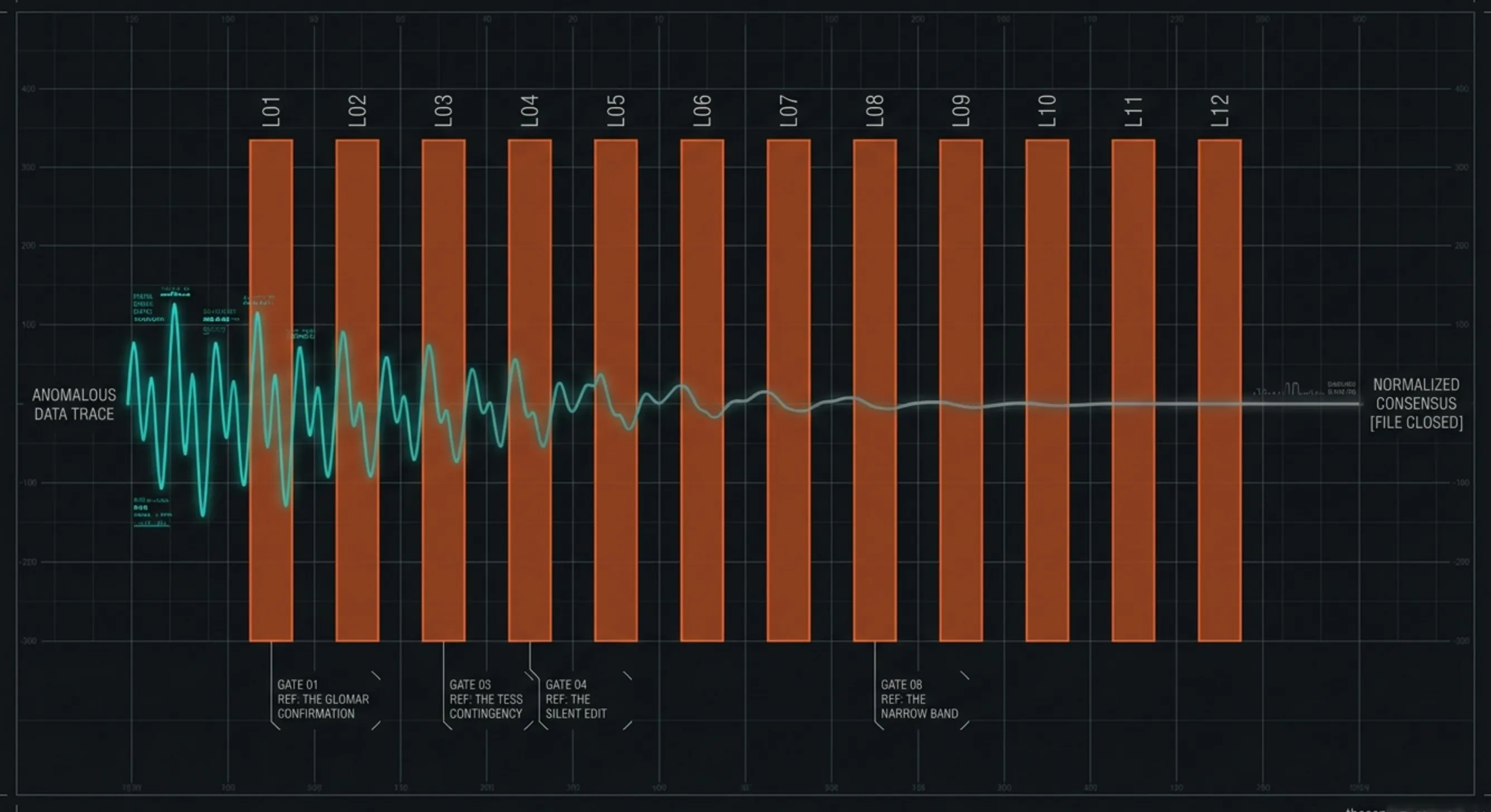
What follows is the permanent reference. Twelve layers of institutional response, each derived from a specific documented case study, each linked to the briefing where we first published the evidence. This is not a theory. It is a catalog. And after this section, we are going to use it.
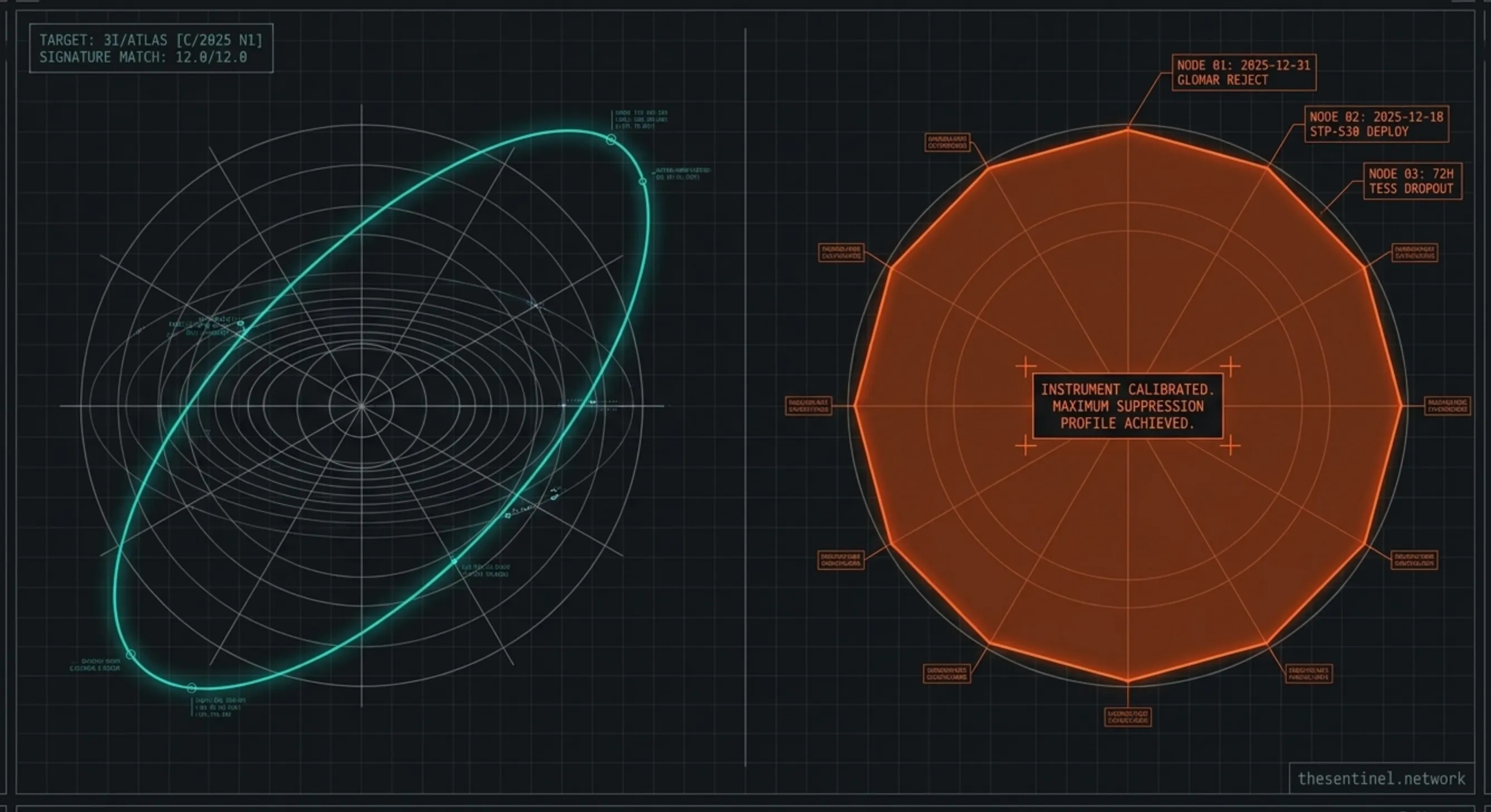
LAYER 1. INTELLIGENCE CLASSIFICATION. Classification authority invoked to seal records on an object publicly declared harmless. The CIA Glomar response, December 31, 2025. Documented in THE GLOMAR CONFIRMATION.
LAYER 2. FORCE DEPLOYMENT. Military assets accelerated or deployed to observe the object with classified instrumentation. Space Force STP-S30 launched five months ahead of schedule, December 18, 2025. Documented in LAUNCH ANOMALY: PROJECT SQUARE and FORENSIC AUDIT: THE COVERT SPACE FORCE MOBILIZATION.
LAYER 3. OBSERVATORY BLACKOUT. Civilian instruments enter contingency modes at the exact moment they could observe the diagnostic signature. TESS went dark for 72 hours during the opposition window. One-in-250,000 probability. First reported in THE THREE DAYS OF DARKNESS. Confirmed in CONFIRMED: THE TESS CONTINGENCY.
LAYER 4. DATABASE MANIPULATION. Public databases silently edited after challenging papers are published. CNEOS velocity sign flipped within 24 hours of Loeb and Cloete’s interstellar meteor paper. No correction notice. Documented in THE SILENT EDIT.
LAYER 5. JOURNAL GATEKEEPING. Editors reject papers not for bad methodology but for unacceptable conclusions. Chris Lintott demanded Loeb remove the artificial-origin hypothesis, calling it “an insult to the exciting work going on.” Documented in THE SILENT EDIT and THE PUBLICATION GAP.
LAYER 6. DATA PROCESSING. Anomalous signal classified as error before public release. TESS tail-adjacent frames flagged as “edge effects” and excluded. The anomaly was labeled the error. Documented in CONFIRMED: THE TESS CONTINGENCY.
LAYER 7. TRAJECTORY CURATION. Orbital solutions calculated using a fraction of available observations. JPL used 782 data points where independent teams used 7,578. The missing ninety percent changed the force profile. Documented in THE CURATED ORBIT.
LAYER 8. METHODOLOGICAL EXCLUSION. Searches designed with assumptions that cannot detect the predicted signal. Four SETI telescopes excluded zero-drift signals. A Bracewell probe would produce a zero-drift signal. Documented in THE NARROW BAND.
LAYER 9. PUBLICATION BLACKOUT. Major publishers produce zero output during the defining event in their field. Elsevier published two papers on 3I/ATLAS in ten months across six flagship journals. Everyone else published thirty. Documented in THE PUBLICATION GAP.
LAYER 10. PLATFORM OPERATION. Silent removals, bans, bot floods, coordinated downvotes. Sourced data reframed as belief. The analyst attacked, not the analysis. Documented in THE SUPPRESSION GRADIENT.
LAYER 11. COUNTERINTELLIGENCE NARRATIVE MANAGEMENT. A managed disclosure operation directs attention to past-tense NHI claims, away from a present-tense anomalous event. The Elizondo architecture. Documented in THE OPERATOR.
LAYER 12. DISCLOSURE ECOSYSTEM SILENCE. Ten prominent UAP voices go silent when a present-tense object appears that directly tests their claims. Four months. Zero coverage. Documented in THE OTHER HAND.
Twelve layers. Each published. Each sourced. Each tied to a date, a document, and a decision.
This is the instrument. What follows is what it reads when you point it at history.
THE SCORING
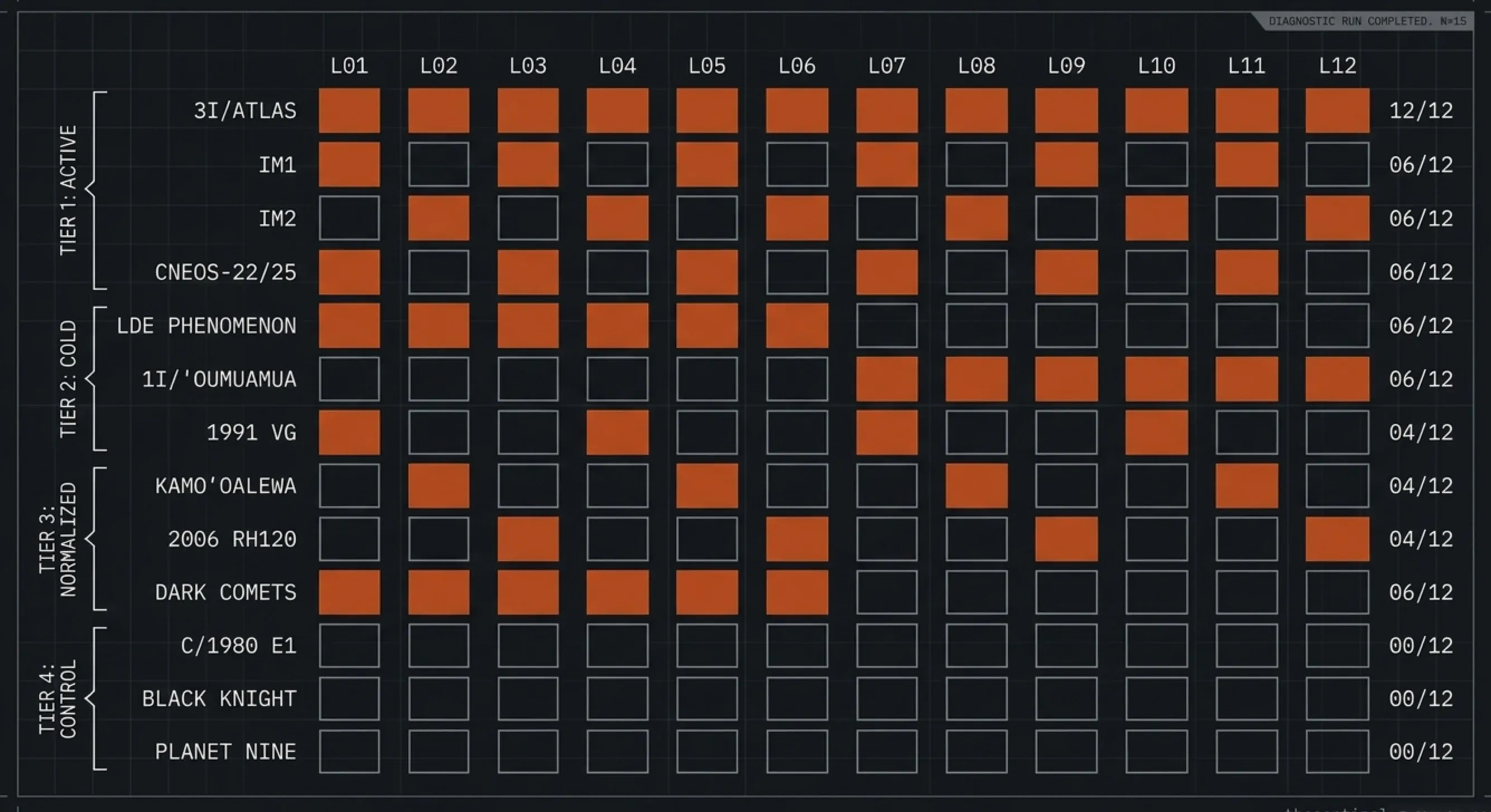
Simple binary matrix. An object gets credit for a layer only if there is a documented institutional response that mirrors the layer as it was deployed around 3I/ATLAS. No partial credit for vibes. No credit for circumstantial matches. Either there is a primary source establishing the layer activated, or there is not.
We applied this to every serious candidate in the anomalous object literature.
We invite the replication.
TIER ONE — THE ACTIVE CASES
3I/ATLAS (C/2025 N1). Score: 12/12.
This is the case from which every layer was derived. It is the reference object, by definition. The canonical suppression gradient is a description of what happens when the third interstellar object in human history crosses the solar system and every institution responsible for characterizing it activates a different containment protocol simultaneously. Classification at the intelligence level. Force deployment at the military level. Instrument blackouts at the observatory level. Silent edits at the database level. Gatekeeping at the editorial level. Curation at the trajectory level. Methodological blindness at the search level. Publication silence at the publisher level. Bot floods at the platform level. Narrative management at the counterintelligence level. Ecosystem silence at the disclosure level. The published record establishes every layer with a named source. The only question the framework asks about other objects is whether they exhibit the same signature.
We include 3I at the top of the roster not for scoring purposes but as the baseline calibration. Twelve out of twelve means the framework itself.
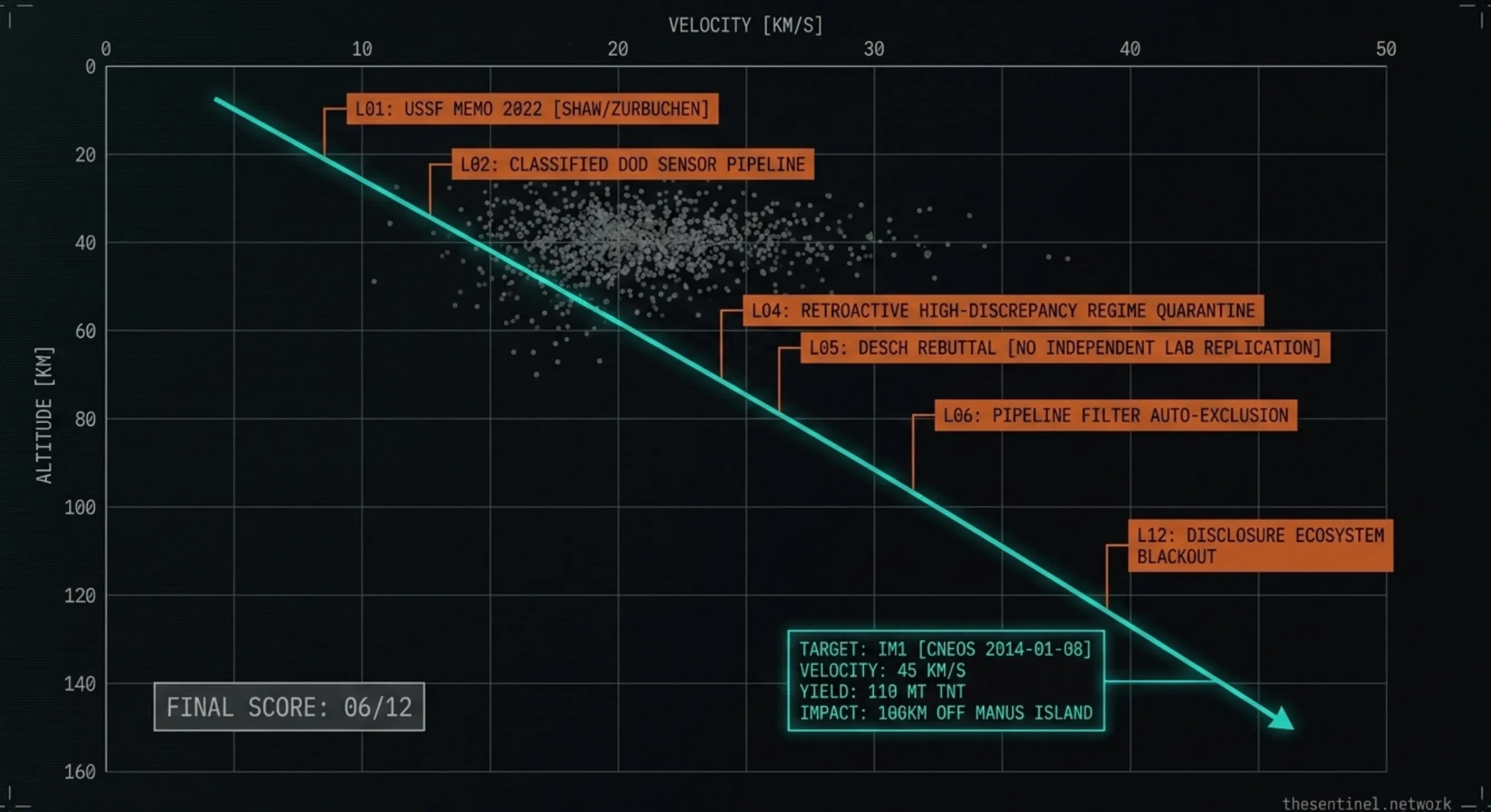
IM1 / CNEOS 2014-01-08. Score: 6/12.
The interstellar meteor that hit Earth. January 8, 2014. It entered the atmosphere 100 kilometers off the coast of Manus Island, Papua New Guinea, moving at 45 kilometers per second. It punched deeper into the lower atmosphere than every other meteor in the CNEOS fireball catalog. All 272 of them. The airburst released the equivalent of 110 metric tons of TNT.
The suppression gradient signature is strong.
Layer 1, Intelligence Classification. U.S. Space Command confirmation of IM1’s interstellar trajectory arrived through a March 1, 2022 memorandum signed by Lieutenant General John E. Shaw, Deputy Commander, USSF, addressed to Dr. Thomas Zurbuchen at NASA’s Science Mission Directorate. The civilian astronomical community did not confirm the object’s interstellar origin. The classified sensor pipeline did. It took eight years between the event and the public release of that confirmation.
Layer 2, Force Deployment. CNEOS is maintained by the Department of Defense. The sensors that detected IM1 are classified. Civilian astronomy played no role in its initial characterization.
Layer 4, Database Manipulation. IM1 was detected in 2014 by classified DoD sensors feeding the CNEOS fireball catalog. Its interstellar velocity was confirmed at 99.999% confidence by the U.S. Space Command in 2022. The institutional response was not to dispute the confirmation but to retroactively reclassify the entire pre-2018 CNEOS dataset as belonging to a “high-discrepancy regime,” a data-quality label that did not exist when the observations were made. The effect was to quarantine IM1’s velocity measurement inside a category that future researchers could cite as grounds for exclusion without engaging with the underlying physics.
Layer 5, Journal Gatekeeping. The Galileo Project dragged a magnetic sled across the ocean floor and recovered metallic spherules from the impact site. The rebuttal came fast. Desch, Jackson, and Sansom published a paper calling the spherules coal ash. They published it in a venue that does not require independent replication. No competing laboratory has actually tested the coal ash hypothesis against the spherule mineralogy. The rebuttal became the consensus anyway.
Layer 6, Data Processing. The same “high-discrepancy regime” label described in Layer 4 does double duty. It is not just a reclassification. It is a processing filter. Any future analysis that uses the 2025 calibration model as its starting framework inherits the exclusion automatically. IM1 gets filtered out before the research question is even asked.
Layer 12, Ecosystem Silence. The UAP disclosure apparatus did not cover the interstellar meteor recovery. A credentialed Harvard scientist with named witnesses, a Navy-operated research vessel, and physical samples recovered from a documented impact site. None of the ten figures we documented in THE OTHER HAND engaged with any of it.
Six of twelve. The highest historical score in the roster. The only object besides 3I itself where the military-civilian boundary was explicitly crossed, and the only object where the institutional response spans classified confirmation, physical recovery, coordinated rebuttal, and retroactive data reclassification in a single case file.
IM2, the second interstellar meteor candidate detected in 2017, triggers the same layers minus the recovery expedition. Same DoD classification. Same retroactive data reclassification. Same processing filter. Same ecosystem silence. Score: 5/12. Same architecture, one fewer receipt.
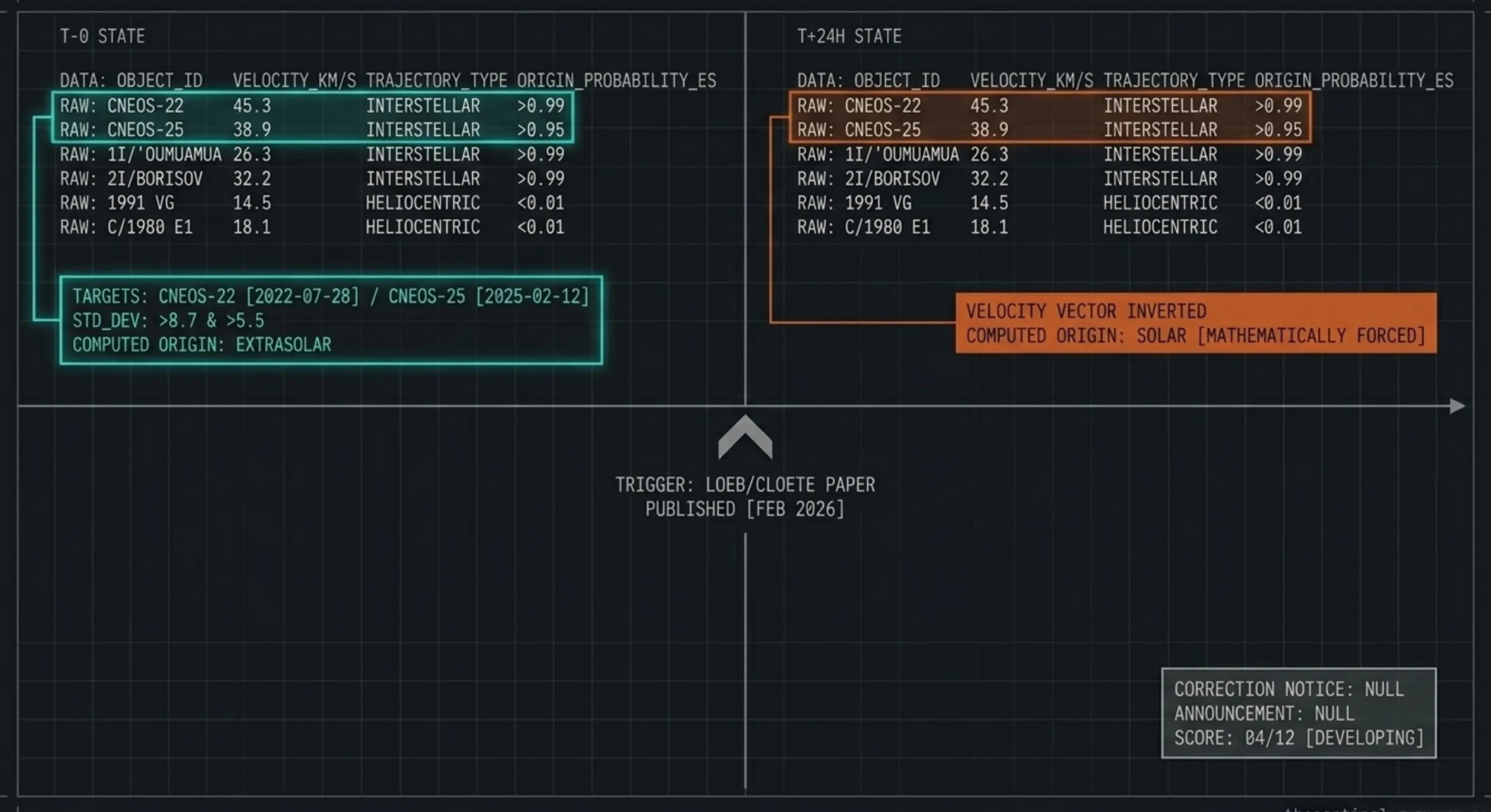
CNEOS-22 (2022-07-28) and CNEOS-25 (2025-02-12). Preliminary score: 4/12.
The two most recent candidates. Identified by Loeb and Cloete in February 2026 as exceeding solar escape velocity at 8.7 and 5.5 standard deviations respectively. They had been sitting in the public CNEOS catalog for four years and one year. Nobody found them because nobody was looking with the right framework.
Within 24 hours of the paper that found them, a velocity sign in the CNEOS database was silently flipped. One of the candidates was mathematically forced back into a solar system origin. No correction notice. No announcement. Caught only because Loeb had archived the original through the Wayback Machine. That is the Silent Edit, and this is the paper that triggered it.
The catalog itself is maintained by the Department of Defense. The empirical calibration model that made these candidates visible had been rejected in earlier forms. The disclosure ecosystem has not covered either object.
Preliminary because the institutional response to the February 2026 paper is still developing. The full score may rise as the peer review process and the consensus response unfold.
TIER TWO — THE COLD CASES
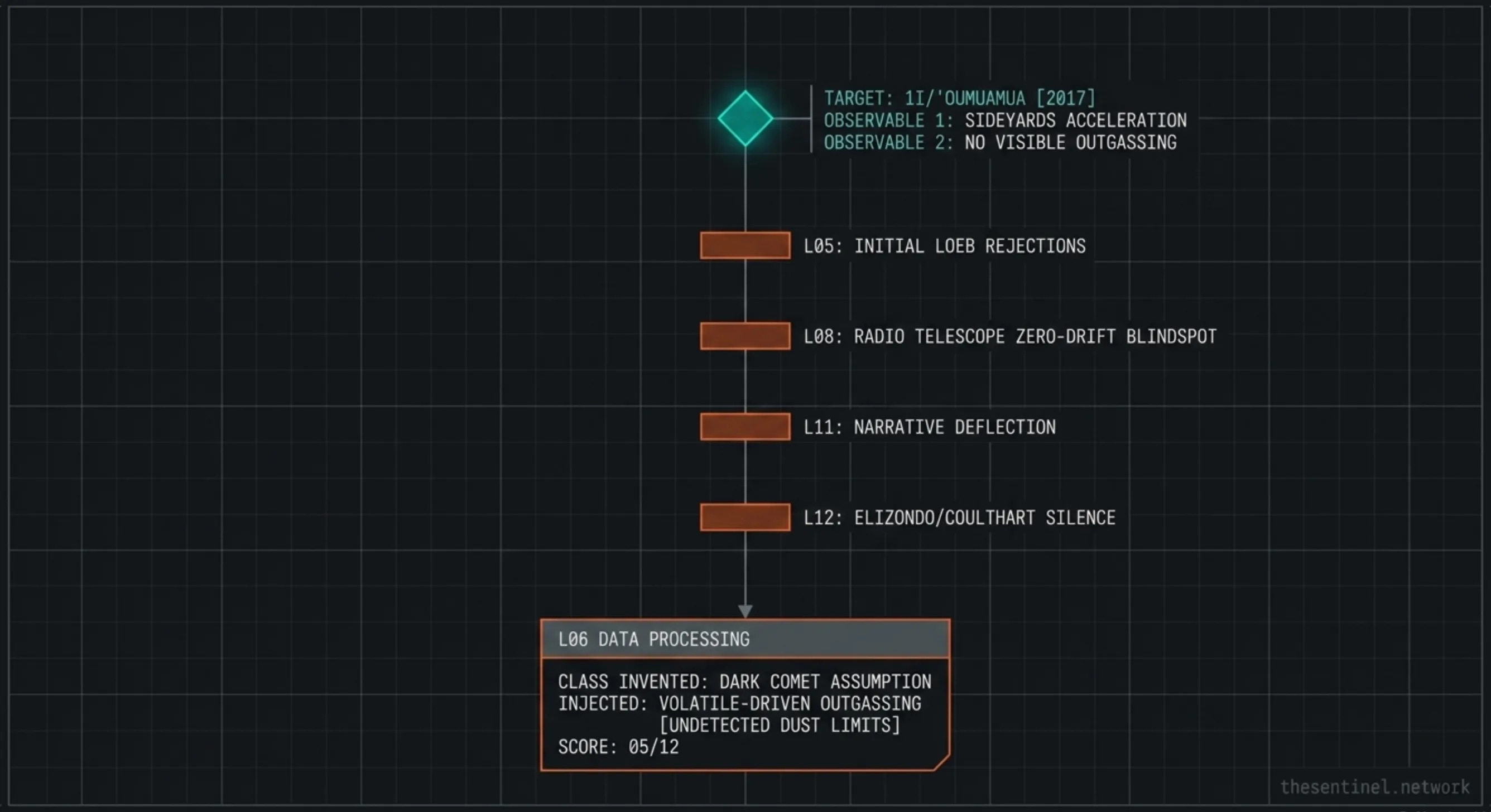
1I/’Oumuamua (2017). Score: 5/12.
The first confirmed interstellar object. The reason the dark comet category exists.
Layer 5, Journal Gatekeeping. The template rejection pattern we documented around 3I? It started here. Loeb’s original ‘Oumuamua papers hit the same wall. Same editorial resistance. Same language. The gatekeepers practiced on ‘Oumuamua before they had to deploy at scale.
Layer 6, Data Processing. The dark comet category exists because of ‘Oumuamua. Fourteen objects, formalized between 2016 and 2024, all sharing the same core anomaly: they accelerate without visible outgassing. The explanation assigned to the entire class is volatile-driven outgassing. It has never been directly detected in any of them. The dust limits are vanishingly small. The category is the processing layer. Its function is to make the anomaly unremarkable by giving it a name.
Layer 8, Methodological Exclusion. The radio telescopes that searched ‘Oumuamua were built to filter out exactly the kind of signal a stationary probe would send. Same blind spot we documented in THE NARROW BAND. If a Bracewell probe had been transmitting from that object, the instruments were configured to miss it.
Layer 11, Counterintelligence Narrative Management. Loeb’s hypothesis was not refuted by the disclosure ecosystem. It was absorbed and deflected. Elizondo did not engage it. Coulthart did not engage it. These are people who built careers saying the government is hiding evidence of alien technology. The first interstellar object that might actually be alien technology showed up, and they looked the other way.
Layer 12, Disclosure Ecosystem Silence. Same ten names. Same pattern. Zero sustained engagement with the one credentialed scientist who was saying what their operational model required someone to say.
Five of twelve. The lower score reflects the era, not the object. The bot floods, the publication blackouts, the Space Force scrambles, the TESS contingencies. That infrastructure did not exist in 2017. The gradient was already running. It just had not yet grown all its appendages.
Long-Delayed Radio Echoes (1927-1975). Score: 6/12.
This is the cold case that deserves a full rereading.
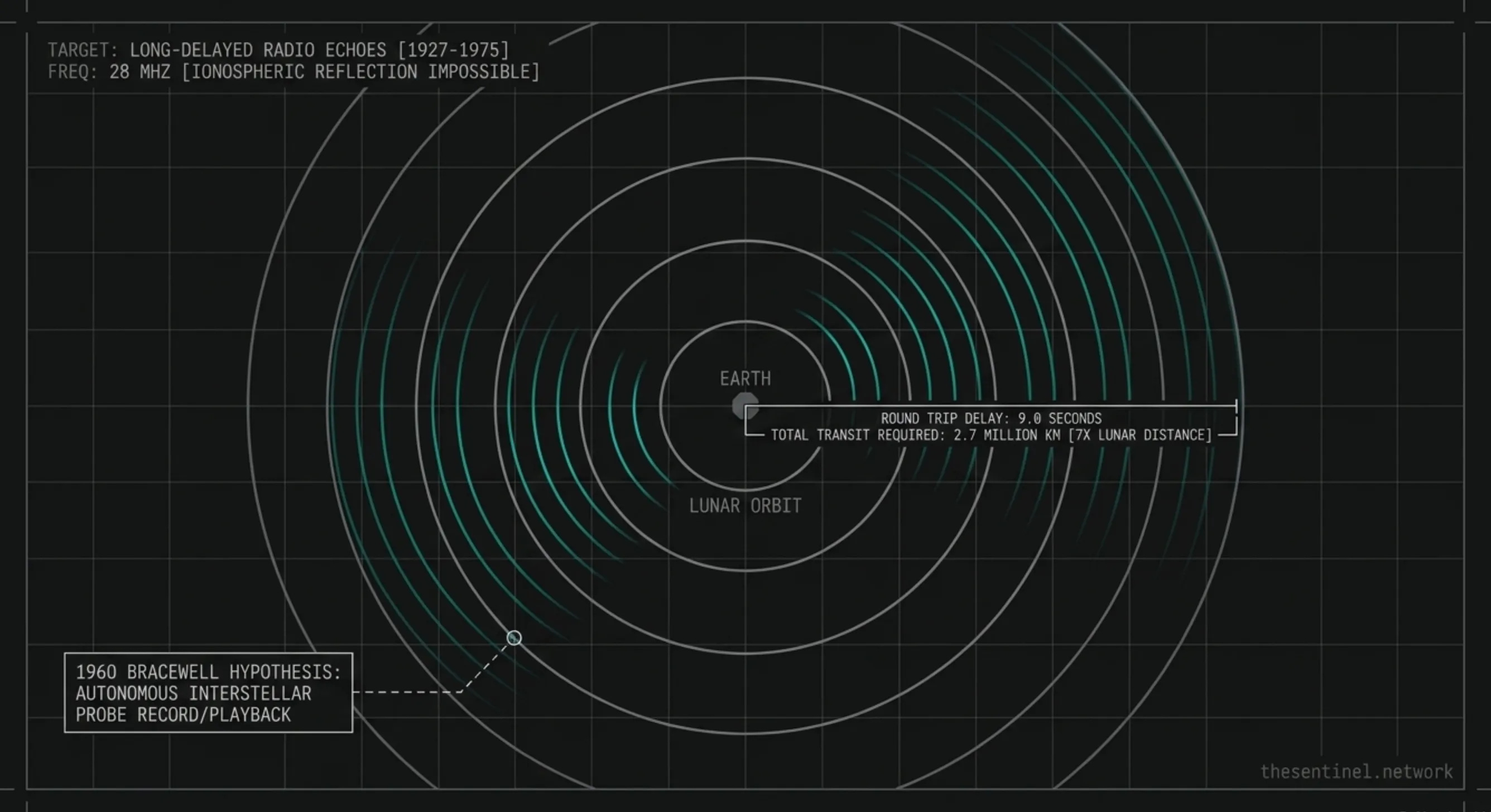
Between 1927 and the mid-1970s, radio operators around the world kept hearing their own signals come back to them. Not immediately. Not as a normal echo. Seconds later. Sometimes forty seconds later. The signal would go out, and then it would return, delayed by a duration that no known atmospheric or ionospheric mechanism could explain.
The first documented case was a Norwegian engineer named Jørgen Hals in 1927. He heard a secondary echo of a Dutch radio transmission, arriving three seconds after it should have been gone. The physicist Carl Størmer investigated. On October 24, 1928, simultaneous observations in Oslo and Eindhoven confirmed the phenomenon was real. Størmer published the result in Nature. Van der Pol published independent confirmation in the same journal weeks later.
The delays got longer. By 1970, researchers documented 40-second delays. In 1975, the phenomenon was recorded at 1296 MHz, a frequency where ionospheric reflection simply cannot produce the observed behavior. In 1980, a signal at 28 MHz came back nine seconds late.
Nine seconds at that frequency means the signal traveled roughly 2.7 million kilometers before returning. That is seven times the distance to the Moon. Through a medium that should have killed the signal entirely.
In 1960, Stanford physicist Ronald Bracewell proposed in Nature that long-delayed echoes might be transmissions from an autonomous interstellar probe parked within the Earth-Moon system. In 1973, Scottish astronomer Duncan Lunan expanded the analysis in the journal Spaceflight, proposing the delay patterns could be decoded as an intentional star map pointing to Epsilon Boötis.
Then the field went silent.
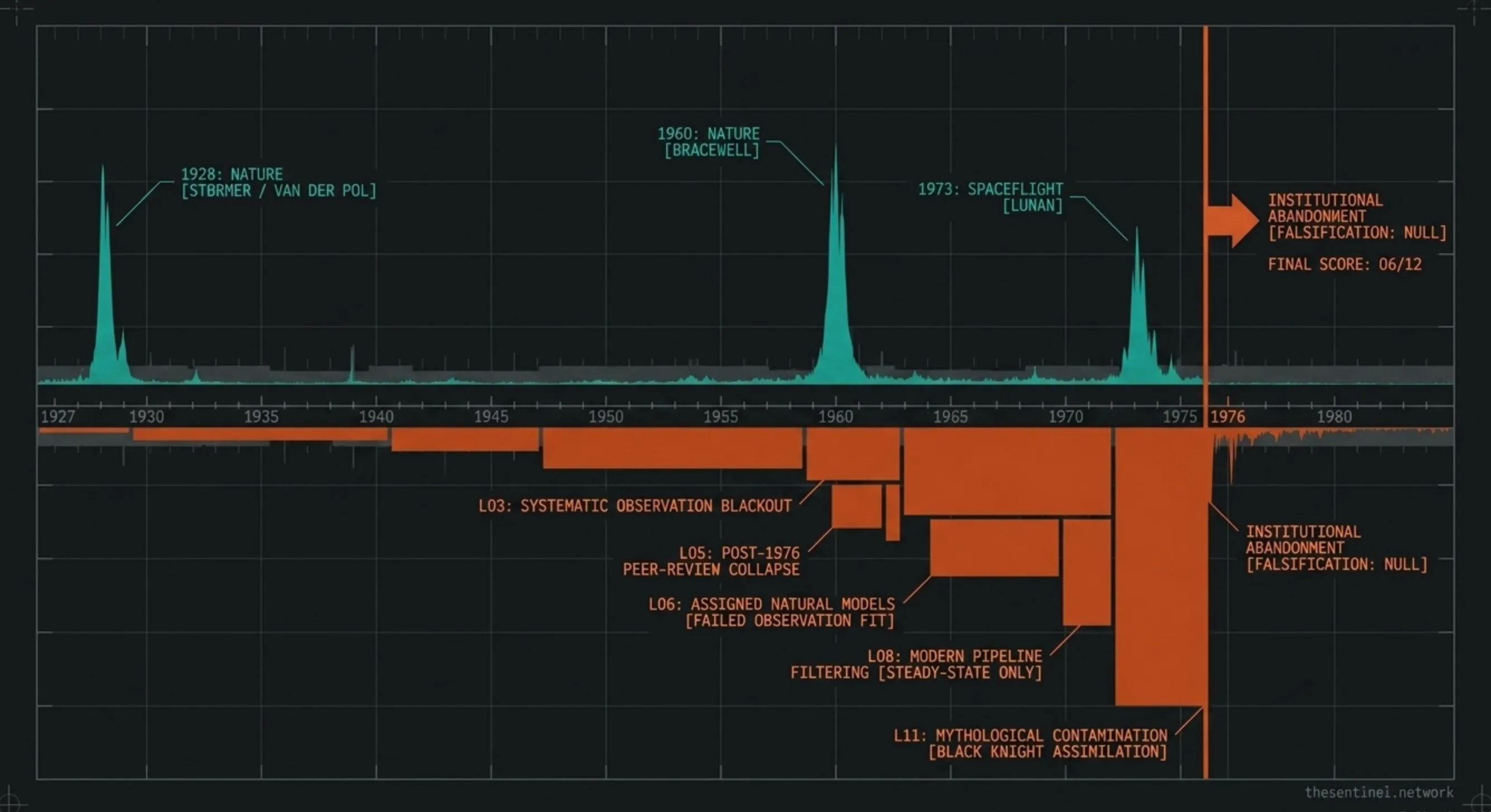
Layer 3, Observatory Blackout. Systematic academic monitoring of LDEs essentially ceased by the end of the 1970s. The phenomenon did not stop being reported by amateur operators. The institutional instruments simply stopped looking for it. No modern large-scale radio survey monitors for the LDE signature.
Layer 5, Journal Gatekeeping. Peer-reviewed publications on LDEs collapse to near zero after 1976. This is not because the phenomenon was explained. It is because the phenomenon became unpublishable.
Layer 6, Data Processing. The institutional narrative assigned a stack of natural explanations: ionospheric reflections, magnetic field ducting, plasma wave interactions in the upper atmosphere. None of them survive contact with the data. A signal that travels seven times the lunar distance and returns without extreme degradation does not fit any proposed atmospheric model. The explanations function as labels applied to something nobody can actually account for.
Layer 8, Methodological Exclusion. No modern radio telescope searches for long-delayed echoes. The instruments are built to find steady, repeating signals from distant stars. A probe that records your signal and plays it back on a delay would look like noise in those pipelines. The filters would throw it out before a human ever saw it.
Layer 11, Counterintelligence Narrative Management. Duncan Lunan’s work got folded into the Black Knight satellite mythology. That is not an accident. Once a legitimate scientific finding gets mixed into UFO conspiracy lore, it becomes untouchable. You cannot cite it without signaling that you belong to the fringe. The data did not change. The social cost of referencing it did.
Layer 12, Disclosure Ecosystem Silence. The UAP community does not discuss LDEs. The phenomenon is not on Joe Rogan. It is not in Elizondo’s book. It is not on Coulthart’s Reality Check. It is a documented, half-century-long record of anomalous radio behavior with direct relevance to the Bracewell probe hypothesis, and the ecosystem that built its entire business model on NHI claims treats it as if it does not exist.
Six of twelve.
The Long-Delayed Echo phenomenon is tied with IM1 as the highest-scoring historical case in the roster. It is the one cold case where the suppression gradient can be demonstrated to have operated continuously for almost fifty years and succeeded. The signal disappeared from the institutional literature. The data still exists. The primary sources are still in the archives of Nature and Spaceflight and the handful of follow-up papers. The Bracewell hypothesis was never falsified. It was professionally abandoned.
Refutation requires evidence. Abandonment requires only silence.
This is the cold case that most deserves a forensic reopening.
1991 VG. Score: 4/12.
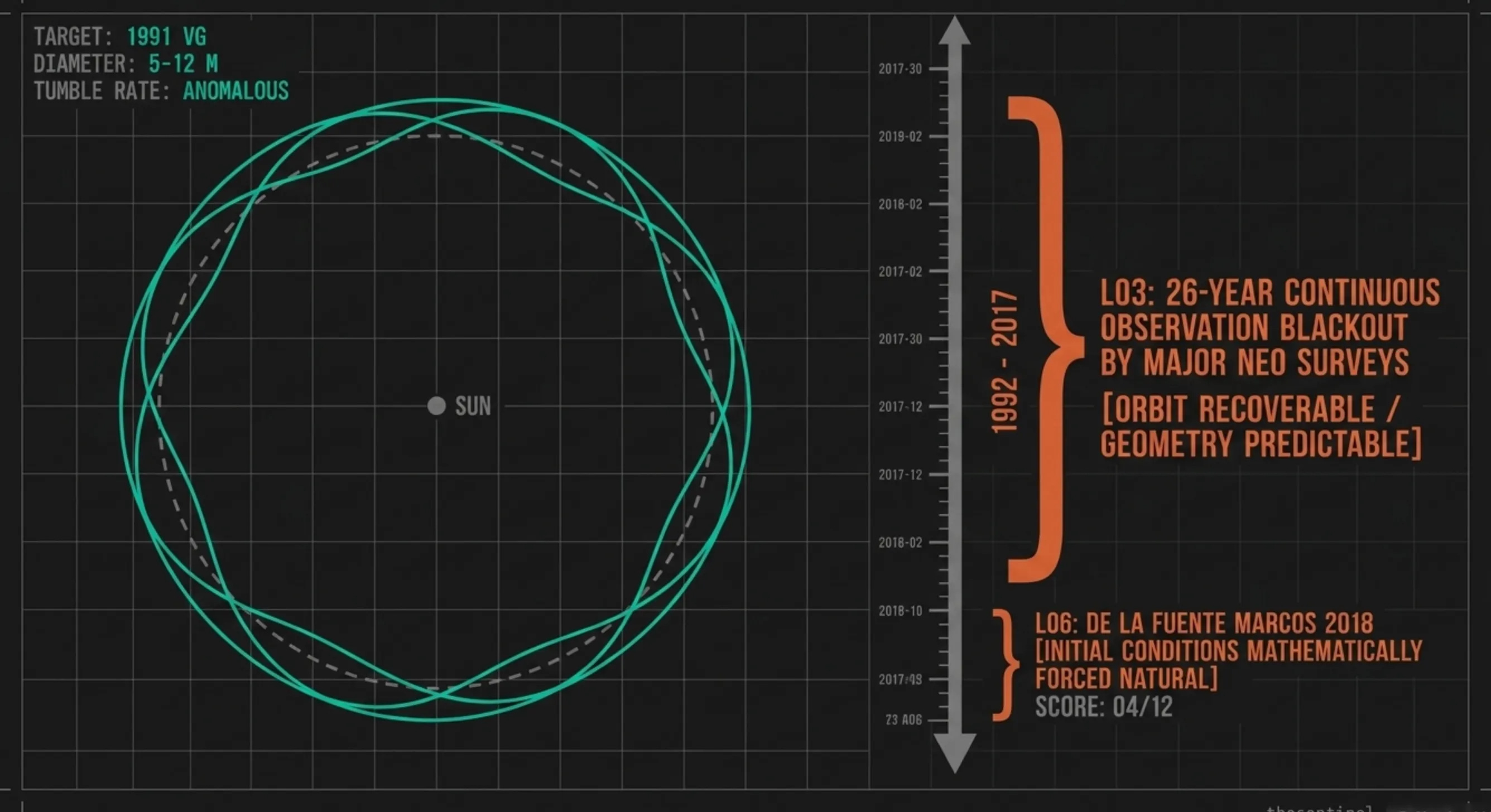
In November 1991, astronomer James Scotti spotted a small object near Earth. It was maybe 5 to 12 meters across. Nothing unusual about that. What was unusual was its orbit. It matched Earth’s almost exactly. No known natural mechanism could explain how a rock that small ended up on a trajectory that close to ours. It flickered in brightness on timescales that did not match normal tumbling. And then, for 26 years, nobody looked at it again.
Layer 3, Observatory Blackout. Between April 1992 and May 2017, 1991 VG went unobserved by all major automated near-Earth object surveys. Twenty-six years. The orbit was recoverable. The geometry was predictable. The observatories that would subsequently discover thousands of smaller objects simply did not look for it. The object was only recovered in 2017 by ESA’s Very Large Telescope, a dedicated recovery observation made specifically to resolve the historical question.
Layer 5, Journal Gatekeeping. Duncan Steel’s mid-1990s proposal, published in peer-reviewed venues, that 1991 VG fit the Bracewell probe profile better than any natural explanation was met with intense professional sanction. Steel’s subsequent publication record shows the pattern familiar from the 3I/ATLAS era: once an artificial-origin hypothesis is on the record, the career moves on to safer topics.
Layer 6, Data Processing. In 2018, de la Fuente Marcos published a Monte Carlo orbital evolution study in MNRAS. The methodology assumed natural origin in its initial conditions. The paper concludes the object is natural. It cannot conclude otherwise. The institutional response to Steel’s hypothesis was not to falsify it. It was to publish an analytical framework that excludes it by construction.
Layer 12, Disclosure Ecosystem Silence. 1991 VG is not in the disclosure narrative. The object that matched Bracewell’s published profile better than any other NEO on record in the 1990s does not appear in the Elizondo framework, the Grusch testimony, the Coulthart broadcasts, or any other artifact of the managed disclosure architecture.
Four of twelve. The pattern is present. It is less comprehensive than the LDE case because the platform operation layer, the publication blackout layer, and the counterintelligence narrative layer had not yet reached industrial deployment in 1991.
TIER THREE — THE NORMALIZED
These are objects where the suppression gradient succeeded. The anomaly was absorbed into an accepted natural category. The case was closed before it had to be opened.
Kamo’oalewa (469219). Score: 3/12.
A small rock that follows Earth around the Sun. Not orbiting us. Orbiting with us. The most stable quasi-satellite we have ever found.
When researchers pointed a telescope at it, the surface looked like the Moon. Specifically, like the samples Apollo 14 brought home from the Fra Mauro highlands. The consensus settled fast: it must be a piece of the Moon knocked loose by an ancient impact.
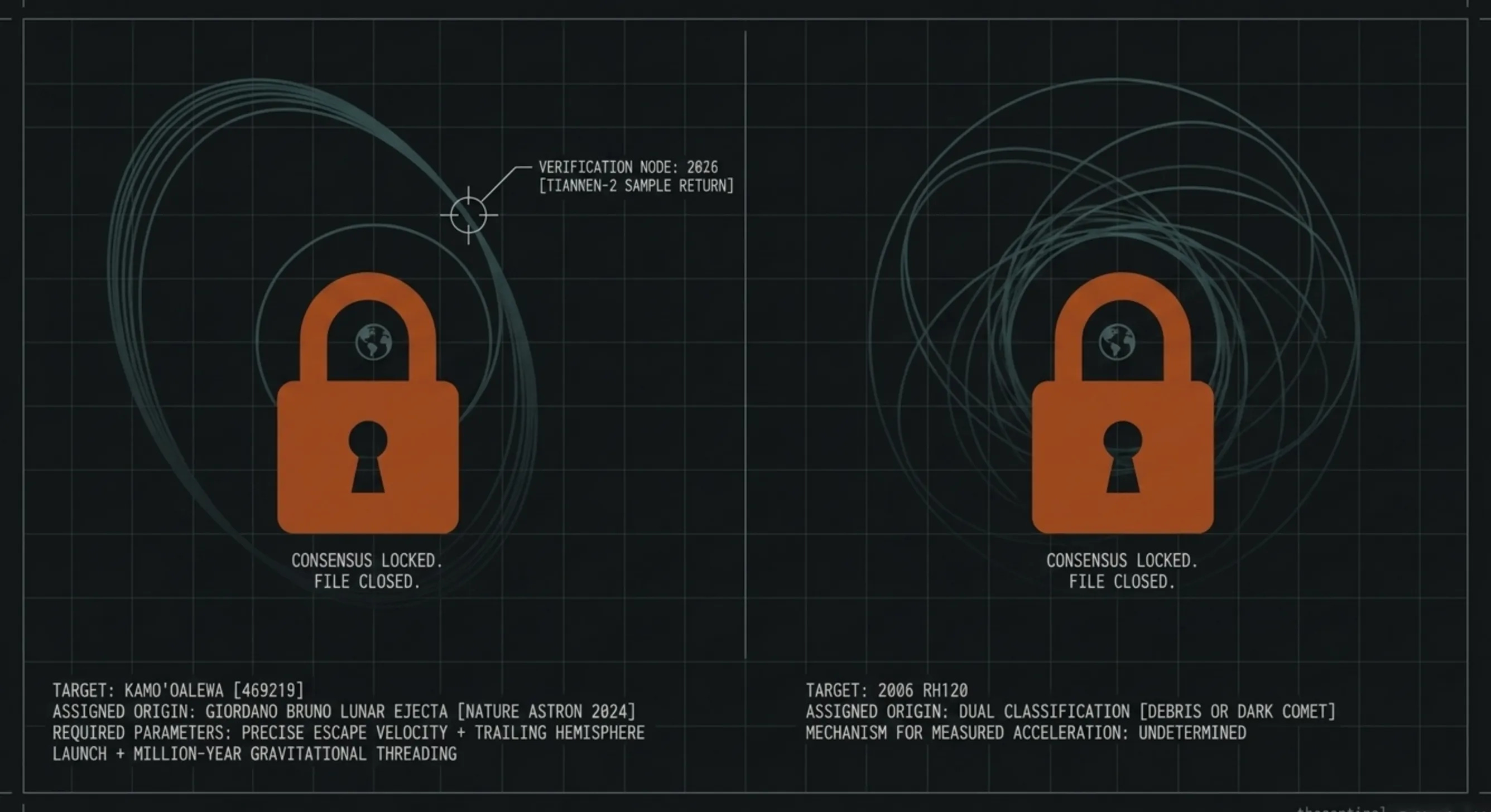
Here is the problem with that. You have to hit the Moon with an asteroid hard enough to launch a chunk into space, but not too hard. The chunk has to leave at just barely above escape velocity. It has to launch from the trailing hemisphere. It has to thread a gravitational needle that puts it into an orbit matching Earth’s so precisely that it stays there, dancing with our planet, for millions of years without drifting away.
That is the accepted explanation. Nobody has proposed an alternative because the consensus closed the file before anyone could. A 2024 paper in Nature Astronomy pinned the origin to the Giordano Bruno crater, providing a clean narrative endpoint that discourages anyone from asking what else it could be. Papers proposing alternative origins do not appear in the literature. The disclosure ecosystem has never engaged with the object.
China’s Tianwen-2 mission is scheduled to sample Kamo’oalewa in July 2026 and return material to Earth by 2027. That will force a resolution. If the samples confirm lunar origin, the framework normalized the object correctly. If they do not, the suppression gradient signature around Kamo’oalewa will look different in retrospect.
2006 RH120. Score: 3/12.
A five-meter object that Earth’s gravity captured between 2006 and 2007. It made multiple orbits around us before escaping. Observations could not definitively determine whether it was a natural rock or a piece of space debris.
It also accelerates sideways without visible outgassing. Nobody can explain the mechanism. So it earned a second classification: dark comet. One object. Two natural categories. Neither explains the acceleration. Both serve the same function: they give the anomaly a name and close the file.
The object has been reclassified across multiple catalog designations. No alternative hypotheses have been published. The disclosure ecosystem has never mentioned it.
The Dark Comet Roster (14 objects, 2016-2024). Score: 2/12 as a category.
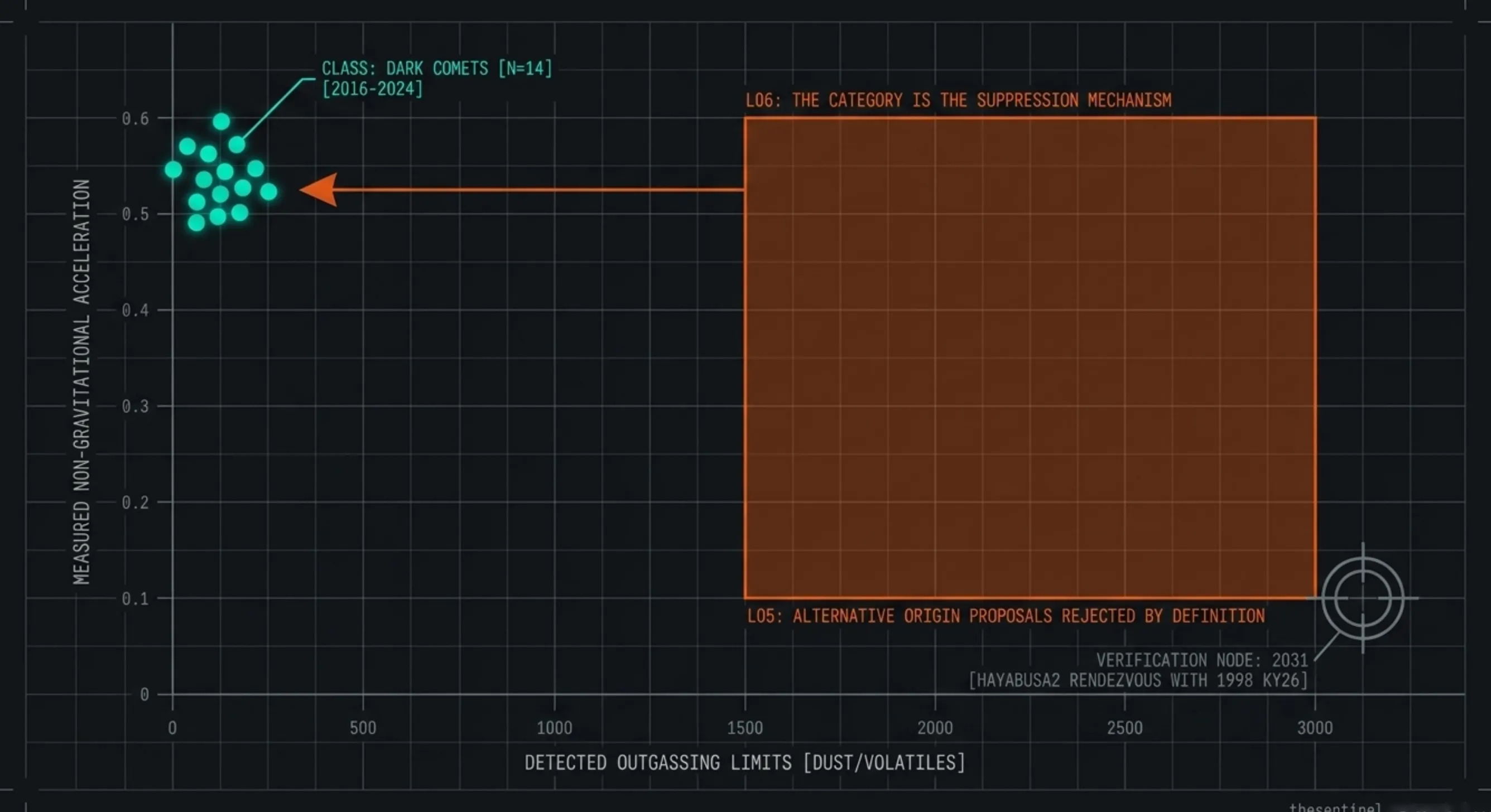
Not a single object but a taxonomy. Fourteen near-Earth objects that share the same core anomaly: they accelerate through space like comets but show no tail, no coma, no visible outgassing of any kind.
Layer 6 is the entire category. The explanation assigned to the class is volatile-driven outgassing. It has never been directly detected. The dust limits are vanishingly small. The acceleration is real. The explanation is a hypothesis that cannot be tested by the observational evidence the category was built on.
Layer 5 is the gatekeeping that prevents anyone from proposing alternatives. If you suggest that any dark comet might not be a dark comet, you are proposing something the category was designed to prevent.
Two of twelve. The score is low because the category is itself the suppression mechanism. The individual objects do not trigger additional layers because the normalization is complete.
1998 KY26 is the exception. The extended Hayabusa2 mission will rendezvous with it in July 2031. If the rendezvous detects no outgassing mechanism sufficient to account for the measured acceleration, the dark comet category collapses. The 2031 data will be the most important single test of this entire framework in the near-term roster.
TIER FOUR — THE EXCLUSIONS
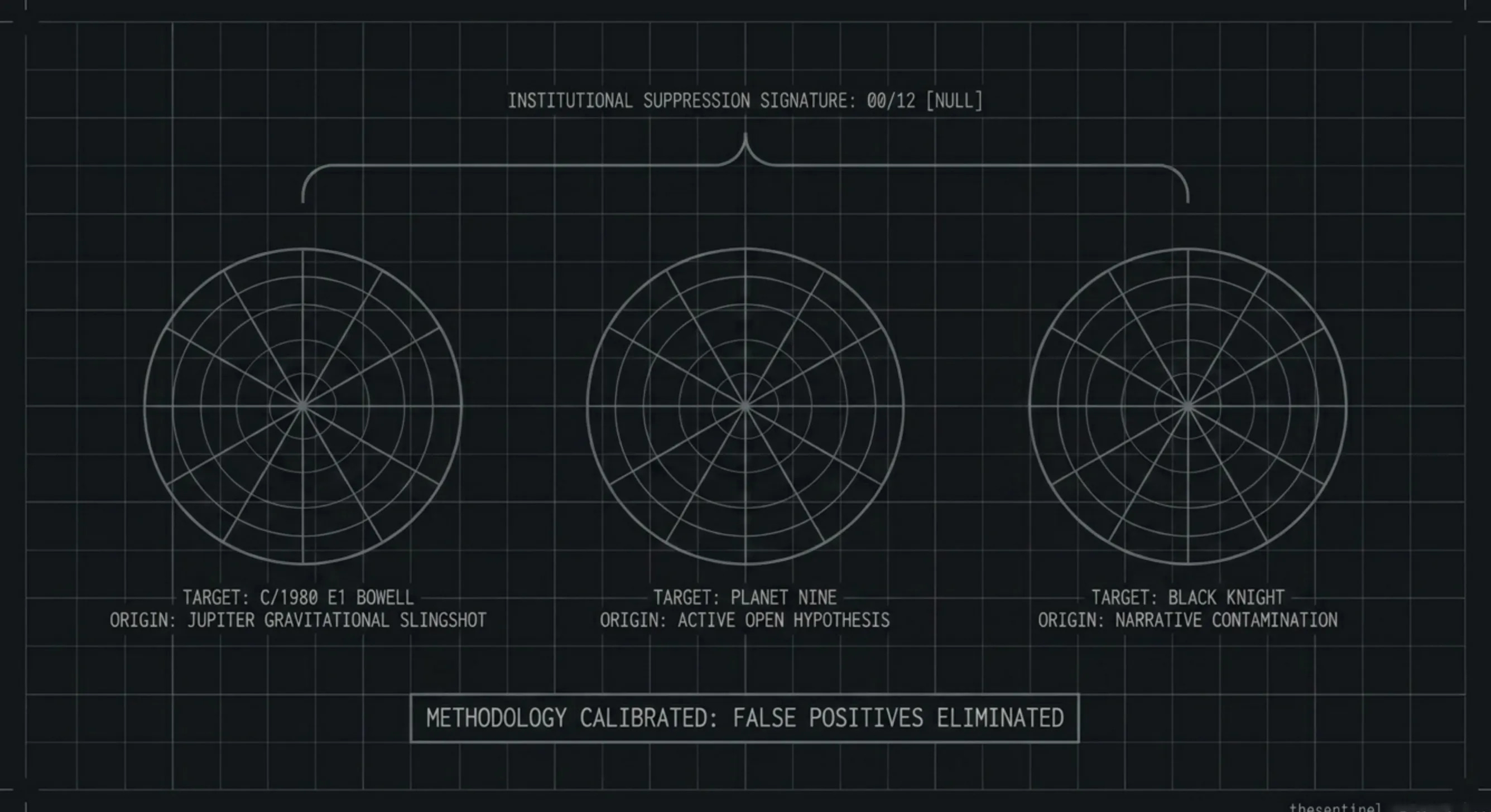
The framework has to be able to fail. If the suppression gradient identifies every object ever proposed as artificial, it is not a methodology. It is a confirmation bias machine. The following candidates were tested against the framework and scored zero or near-zero. We publish the exclusions because the discipline of the exclusion is what validates the inclusions.
C/1980 E1 (Bowell). A comet leaving the solar system on a one-way trip. The reason is known: it flew past Jupiter in December 1980 and Jupiter’s gravity flung it onto an escape trajectory. Confirmed by multiple independent groups. Natural gravitational slingshot. Zero institutional suppression signature. Not a candidate.
C/1954 O1 (Vozarova). Similar profile. Under-observed but not suppressed. Poorly characterized is not the same as actively contained.
C/2024 L5 (ATLAS). Same story. Saturn flyby in January 2022 kicked it onto an escape path. Natural. Confirmed. Not a candidate.
Black Knight Satellite mythology. This requires specific treatment because it is where the data actually exists but has been narratively contaminated. The 1954 Aviation Week report of an Air Force detection of two unidentified objects in Earth orbit, the La Paz and Tombaugh investigation commissioned in response, the 1960 Navy detection of a dark object in polar orbit — these are real historical events with partial primary documentation. They are also inseparable from decades of UFO-community mythology, NASA thermal blanket photographs, Nikola Tesla’s 1899 radio observations, and the 1998 STS-88 imagery. The framework cannot cleanly score an object that is really several objects fused into a narrative.
We exclude the Black Knight from the formal roster not because the underlying historical events are uninteresting but because the narrative contamination prevents forensic analysis. The La Paz and Tombaugh reports, if they could be cleanly extracted from the mythology, would be worth scoring. At present, they cannot be.
Planet Nine. An active scientific hypothesis. Multiple teams publishing competing models. The debate is open. The publication pipeline is functioning. Nobody is being marginalized for proposing it. This is not suppression. This is science working. Not a candidate.
THE ASSESSMENT
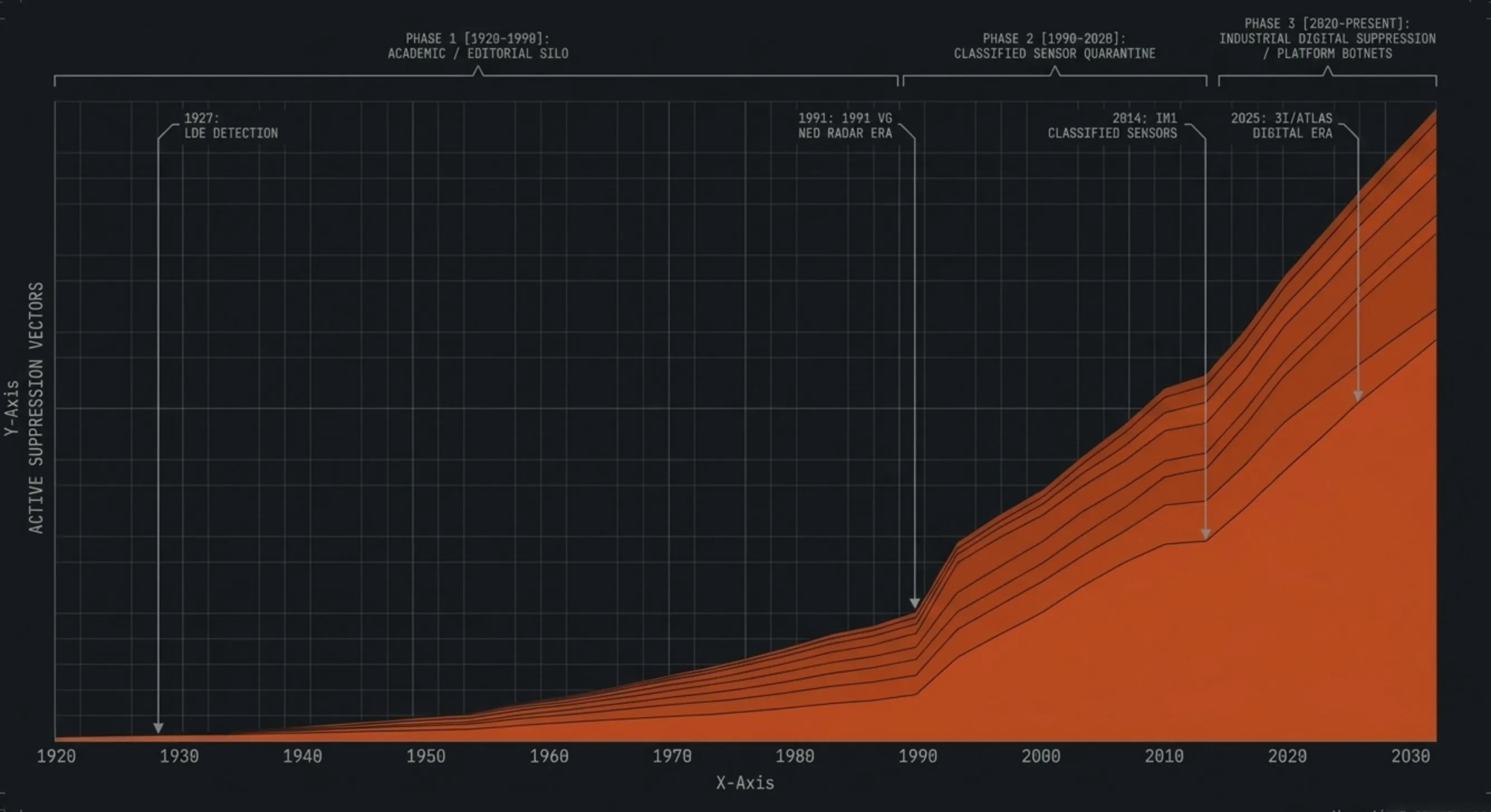
The pattern in the scores is the finding.
Three objects cluster at six out of twelve. 3I/ATLAS itself is the twelve-out-of-twelve calibration baseline. IM1 and the Long-Delayed Echo phenomenon tie at six. Below them, a shallow gradient down through ‘Oumuamua at five, IM2 at five, 1991 VG at four, CNEOS-22 and CNEOS-25 at four, and the normalized class at two and three.
Two structural conclusions follow from the distribution.
First, the framework is time-bounded. Older objects score lower not because their anomalies were less significant but because TESS blackouts, Elsevier publication freezes, and Reddit bot floods require infrastructure that did not exist in 1991 or 1927. The suppression gradient has always been running. The principles are constant. The layers grew.
Second, the highest-scoring cold case is the one nobody is talking about. A radio phenomenon from 1927 that was documented for half a century, proposed as evidence of a Bracewell probe by a Stanford physicist in 1960, and then abandoned by every institution that could have investigated it further.
THE SENTINEL ASSESSMENT:
The framework identifies three categories of historical object.
The first category is the objects the system actively contained and continues to contain. IM1 and IM2 live here. The interstellar meteor catalog is under continuous curation. The spherules are disputed. The disclosure ecosystem is silent. The work that started with 3I is running backward through this catalog, and the institutional response to that reverse-chronology investigation is itself diagnostic.
The second category is the objects the system successfully normalized. Kamo’oalewa. The dark comet roster. 2006 RH120. These are cases where category invention absorbed the anomaly into an accepted natural class. The anomaly did not stop. The institutional attention stopped. The Tianwen-2 and Hayabusa2 missions will test these normalizations within the decade.
The third category is the object the system forgot. Long-Delayed Echoes. This is the finding that surprised us. We expected the interstellar meteors to score highest. We expected ‘Oumuamua. We did not expect a radio phenomenon from the vacuum tube era to trigger six layers of a framework built to describe twenty-first century institutional behavior. But when you look at what happened to the scientists who proposed the probe hypothesis, what happened to the monitoring programs, what happened to the phenomenon’s standing in the literature, it is the same architecture. Older. Cruder. But structurally identical. The signal was real. The explanation never worked. The field was shut down. And nobody went back.
That is what the framework is for. Not to prove what any of these objects are. To prove that the system’s response to them follows a pattern. And to put that pattern on the record where it can be tested.
THE SCORES
For the record. For the researchers. For the replication.
3I/ATLAS (C/2025 N1): 12/12. Calibration baseline. Every layer derived from this case.
IM1 (CNEOS 2014-01-08): 6/12. Layers 1, 2, 4, 5, 6, 12.
Long-Delayed Radio Echoes (1927-1975): 6/12. Layers 3, 5, 6, 8, 11, 12.
1I/’Oumuamua (2017): 5/12. Layers 5, 6, 8, 11, 12.
IM2 (CNEOS 2017-03-09): 5/12. Layers 1, 4, 6, 11, 12.
1991 VG: 4/12. Layers 3, 5, 6, 12.
CNEOS-22 / CNEOS-25: 4/12 (preliminary). Layers 1, 4, 6, 12.
Kamo’oalewa (469219): 3/12. Layers 5, 6, 12.
2006 RH120: 3/12. Layers 4, 6, 12.
Dark comet roster (14 objects): 2/12. Layers 5, 6.
C/1980 E1 Bowell: 0/12. Excluded. Natural Jupiter slingshot.
Black Knight satellite: 0/12. Excluded. Narrative contamination.
Planet Nine: 0/12. Excluded. Active hypothesis, not suppressed.
The suppression gradient is no longer a description of one investigation. It is an instrument. The methodology is in the open. We published the twelve layers. We published the scoring. We published the exclusions. Every judgment is structural and every object on this roster is accompanied by primary sources that other researchers can verify.
If you are an independent researcher, a historian of science, an OSINT analyst, or a credentialed astronomer with access to archives we have not yet canvassed, the framework is yours to deploy. Apply it. Publish your scores. Challenge ours. The methodology exists to be tested, not to be protected.
The rest of the roster is still being written.
Keep looking up.
-- The Sentinel Network™
Every briefing we’ve published is free. That’s not changing. This publication has no institutional backing, no sponsors, and no editorial board. We’re doing the work the newsrooms won’t — sourcing papers, filing FOIAs, building tools, and writing at the pace a once-in-a-civilization event demands.
Paid subscribers fund the investigation directly. They also get access to THE SIGNAL, primary source documents, the comment section on every briefing, Fieldcraft Labs, and the FIELDCRAFT series. The tools and methods behind every investigation we publish. No ads. No sponsors. No strings. The mission is the mission.
Subscribe to The Sentinel Network™
Top 100 Science publication on Substack.
Share this briefing. The Suppression Gradient documented what happens when this coverage reaches platforms that don’t want you reading it. Every share, every restack, every forwarded link is a data point against the gradient.
Previous briefings: THE OTHER HAND | THE PUBLICATION GAP | THE FIFTH INSTRUMENT | THE OPERATOR | THE SOFT LANDING | THE NARROW BAND | THE CURATED ORBIT | CONFIRMED: THE TESS CONTINGENCY | THE SILENT EDIT | THE SUPPRESSION GRADIENT | THE VERDICT
If you find objects we missed and would like us to score them, or you have scored them, drop them here.
"A radio phenomenon from 1927 that was documented for half a century, proposed as evidence of a Bracewell probe by a Stanford physicist in 1960, and then abandoned by every institution that could have investigated it further."
I was feeling an odd deja vu as I read this. Then I realized that the 1997 movie, 'Contact' was why. That movie had one of the most realistic scenarios of any movie of its genre, probably because Carl Sagan came up with the concept. I also have the book. As you may recall, we receive a radio/TV bounce-back signal from the 1936 Olympics that includes images of Hitler.