

DATE: January 29, 2026
SUBJECT: FORENSIC ANALYSIS OF THE TESS “SAFE MODE” ANOMALY // 3I/ATLAS
CLEARANCE:PUBLIC
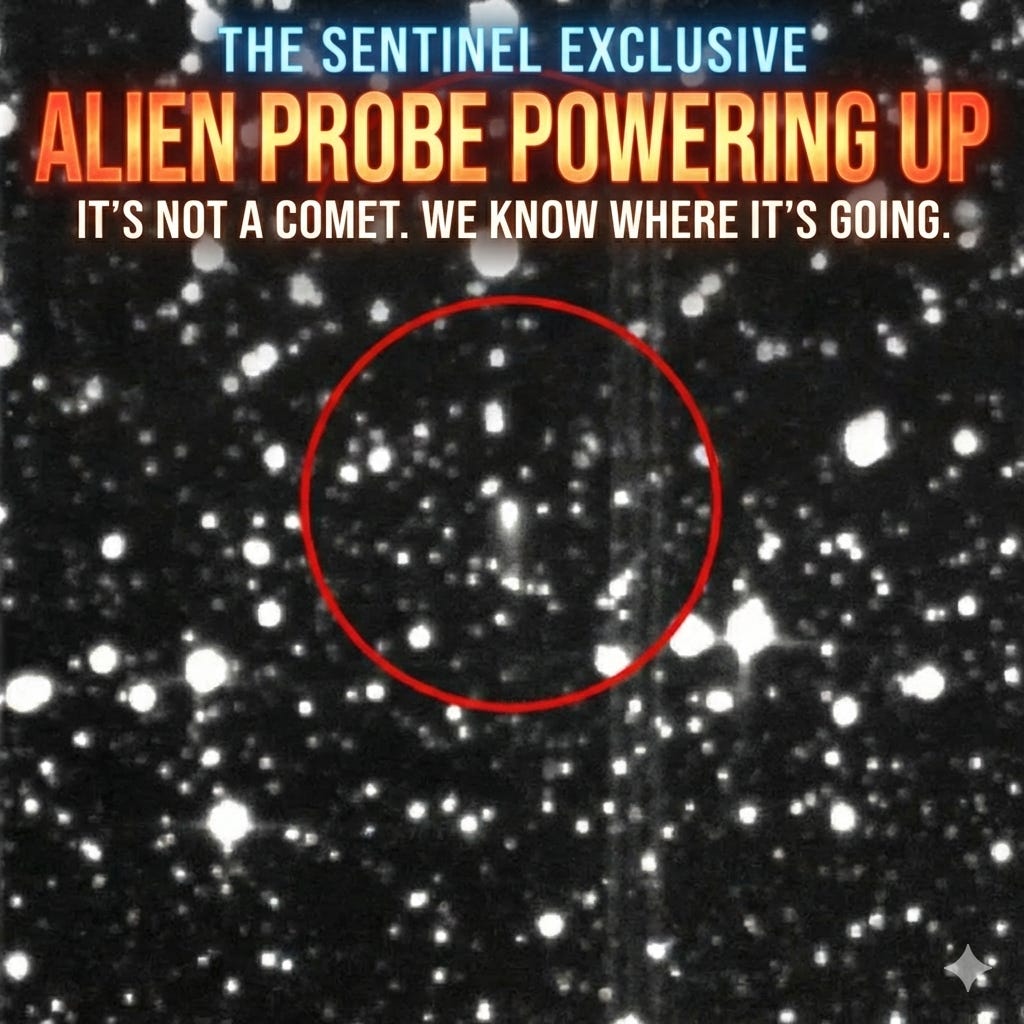
On January 15, 2026, humanity had a front-row seat to the most important astronomical event of the century.
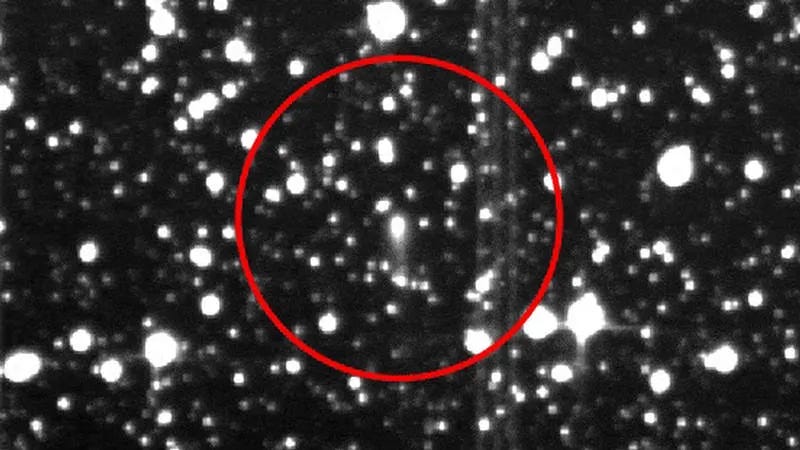
3I/ATLAS, the third confirmed interstellar visitor to our solar system, was lining up for a perfect opposition with Earth. We had the geometry. We had the technology. NASA’s Transiting Exoplanet Survey Satellite (TESS) was slewed and ready to capture high-cadence data that would finally tell us if this object was a rock, a comet, or a machine.
And then, exactly as the curtain rose, the cameras cut out.
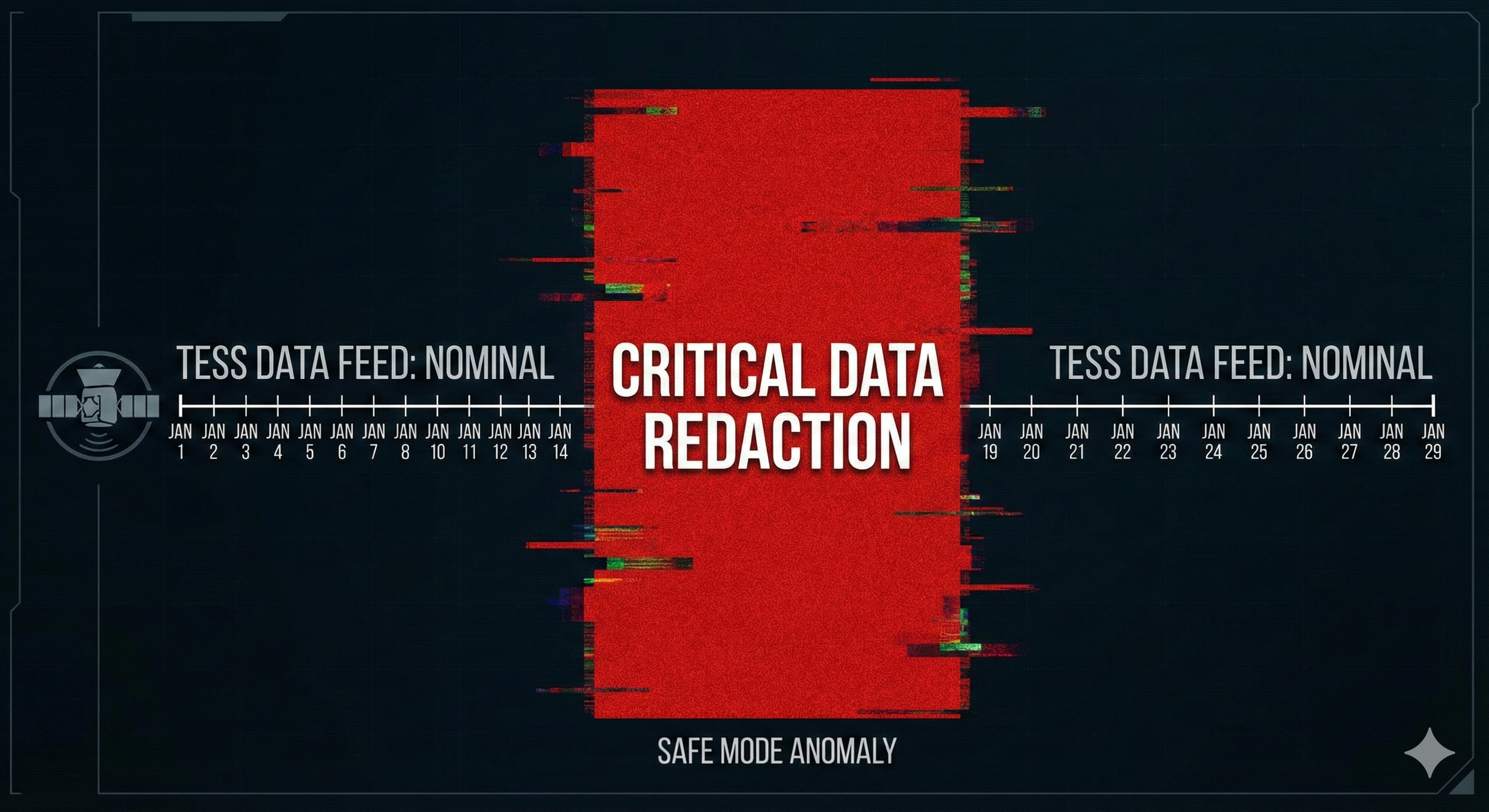
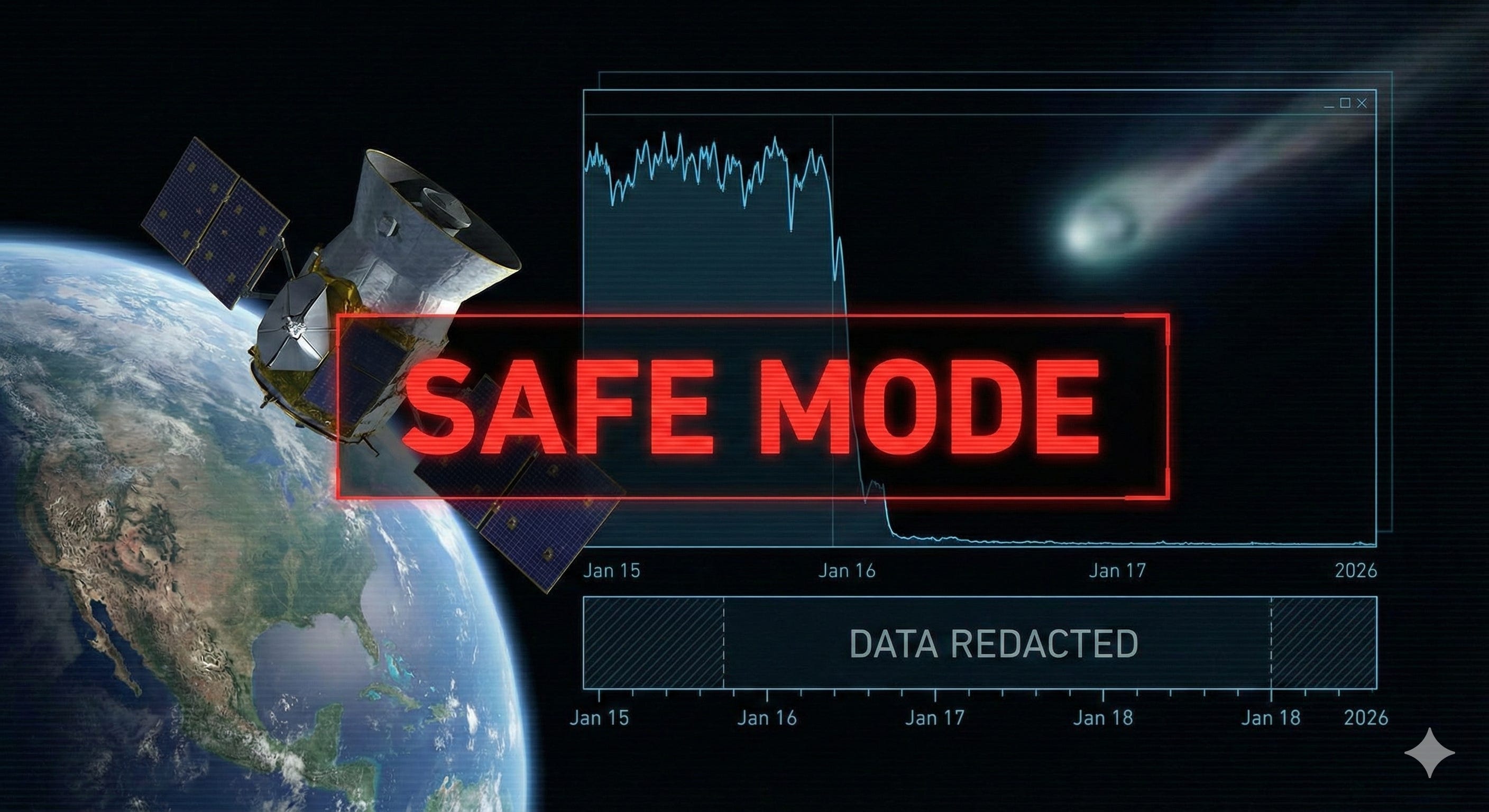
For three critical days—January 15 to January 18—TESS went dark. NASA cited a “command error” and a “safe mode” event. When the feed returned on January 19, the moment had passed.
At The Sentinel, we don’t take press releases at face value. We have analyzed the raw telemetry, the orbital mechanics, and the forensic constraints of the TESS spacecraft. Our conclusion is disturbing: This wasn’t just a glitch. It was a redaction.
The Target: An Object That Shouldn’t Exist
To understand why the data gap is suspicious, you have to understand the target. 3I/ATLAS (C/2025 N1) is not “just another comet.” It is a bundle of statistical anomalies that defy natural explanation.
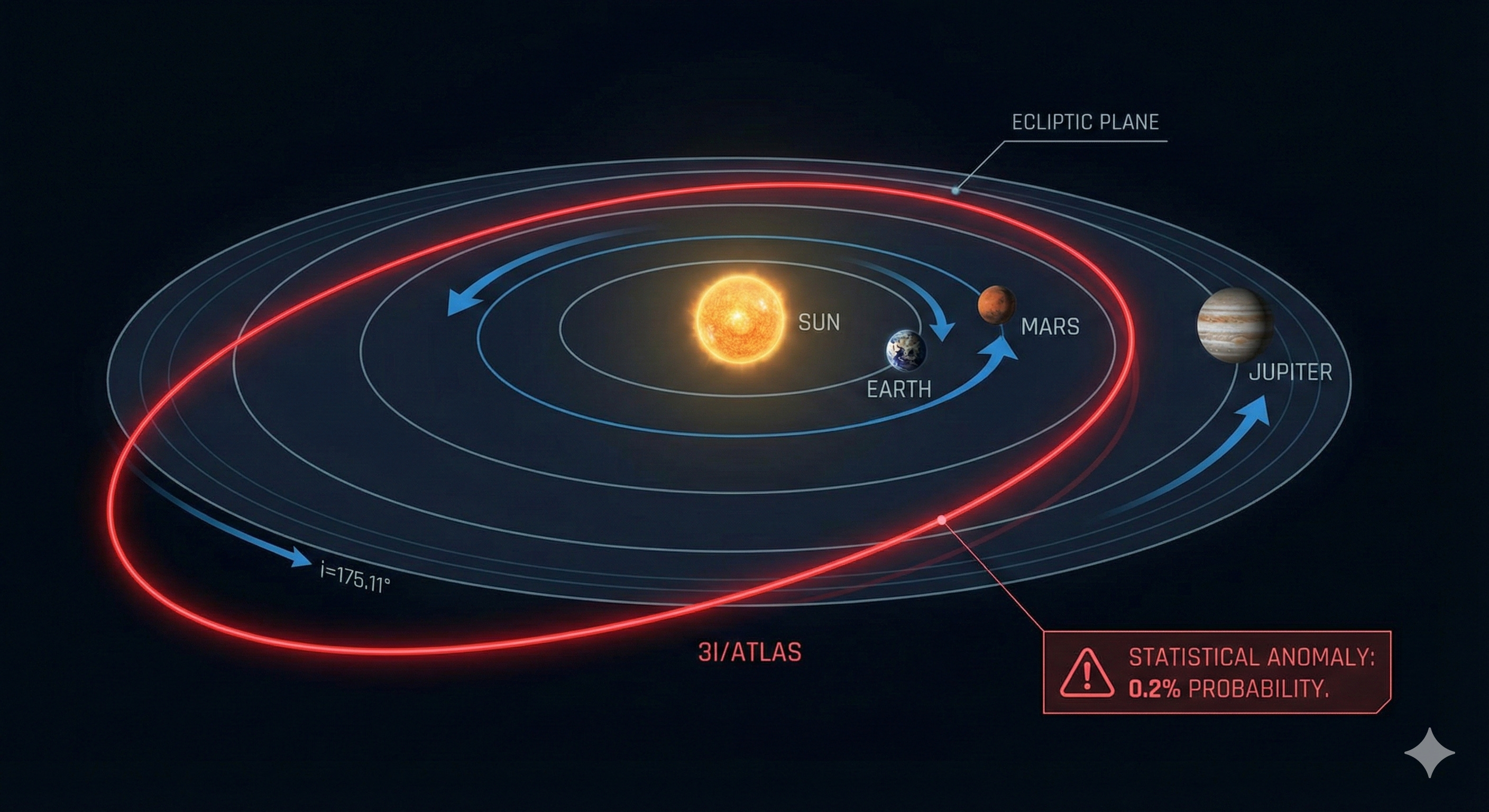
Discovered in July 2025, it came in hot with a velocity of 58 km/s—too fast to be bound to our Sun. But it was the trajectory that panicked the astrophysicists.
The Wrong Way Down a One-Way Street: 3I/ATLAS has an inclination of 175.11°. It is orbiting retrograde (opposite to the planets) but is almost perfectly flat within the ecliptic plane. The odds of a random rock from deep space hitting this specific alignment are 0.2% (1 in 500).
The “Rocket” Effect: As it passed the Sun in October 2025, it accelerated. Comets do this by venting gas. But 3I/ATLAS didn’t vent randomly. Hubble imaging showed a “symmetric system of three mini-jets” separated by exactly 120 degrees. Nature is rarely that precise; engineering usually is.
The Incident: A “Command Error” or a Kill Switch?
TESS is a robust machine as you can see in the manual. It hunts exoplanets. It doesn’t just “trip” over its own feet. Yet, that is exactly what NASA claims happened.
The Official Story: On January 15, controllers sent a command to point TESS at the comet. This command allegedly misaligned the solar panels, draining the battery and triggering a “Safe Mode” that shut down science operations to save the spacecraft.
The Forensic Reality: TESS operations are planned weeks in advance. Every slew is simulated. Every power load is calculated. For a “command error” of this magnitude to slip through the Flight Dynamics System during the highest-profile observation campaign of the decade suggests one of two things:
Gross Incompetence: A catastrophic failure of basic checks and balances.
Intentional Blindness: The spacecraft was deliberately placed into a passive state to prevent the downlink of data during a specific window.
Consider the timing. TESS successfully imaged the object in 2025. It successfully imaged it in early January 2026. It ONLY “failed” exactly when the object entered the Opposition Window—a 72-hour period where the Sun, Earth, and Comet aligned perfectly to reveal the object’s true surface texture.
The “Muthukrishna Video”: Validating the Gap
Following the recovery, a 28-hour video sequence was released by MIT researchers. We analyzed this footage frame-by-frame.
At the 11-second mark, there is a violent “jump.” The star field shifts. The comet teleports across the frame.
This is the edit point. It represents the missing three days.
Why does this matter? Because of what happened just before the camera died. Hours prior to the failure, Hubble detected those symmetric jets and a “tightly collimated anti-tail” pointing toward the Sun. The object was active. It was changing.
When TESS came back online on January 19, amateur data contradicted the official silence. On the Cloudy Nights Forum, observer “russ75” released stacked exposures from a Celestron Origin showing “more coma and tail” than previous nights. Simultaneously, the Comet Observation Database (COBS) logged a magnitude spike to +13—a brightness increase of nearly 40x.
The Smoking Gun: The Jupiter Rendezvous
When 3I/ATLAS accelerated near the Sun in 2025, it didn’t just speed up. It changed course. Scientists ran the orbital dynamics backward and forward, and the result is chilling.
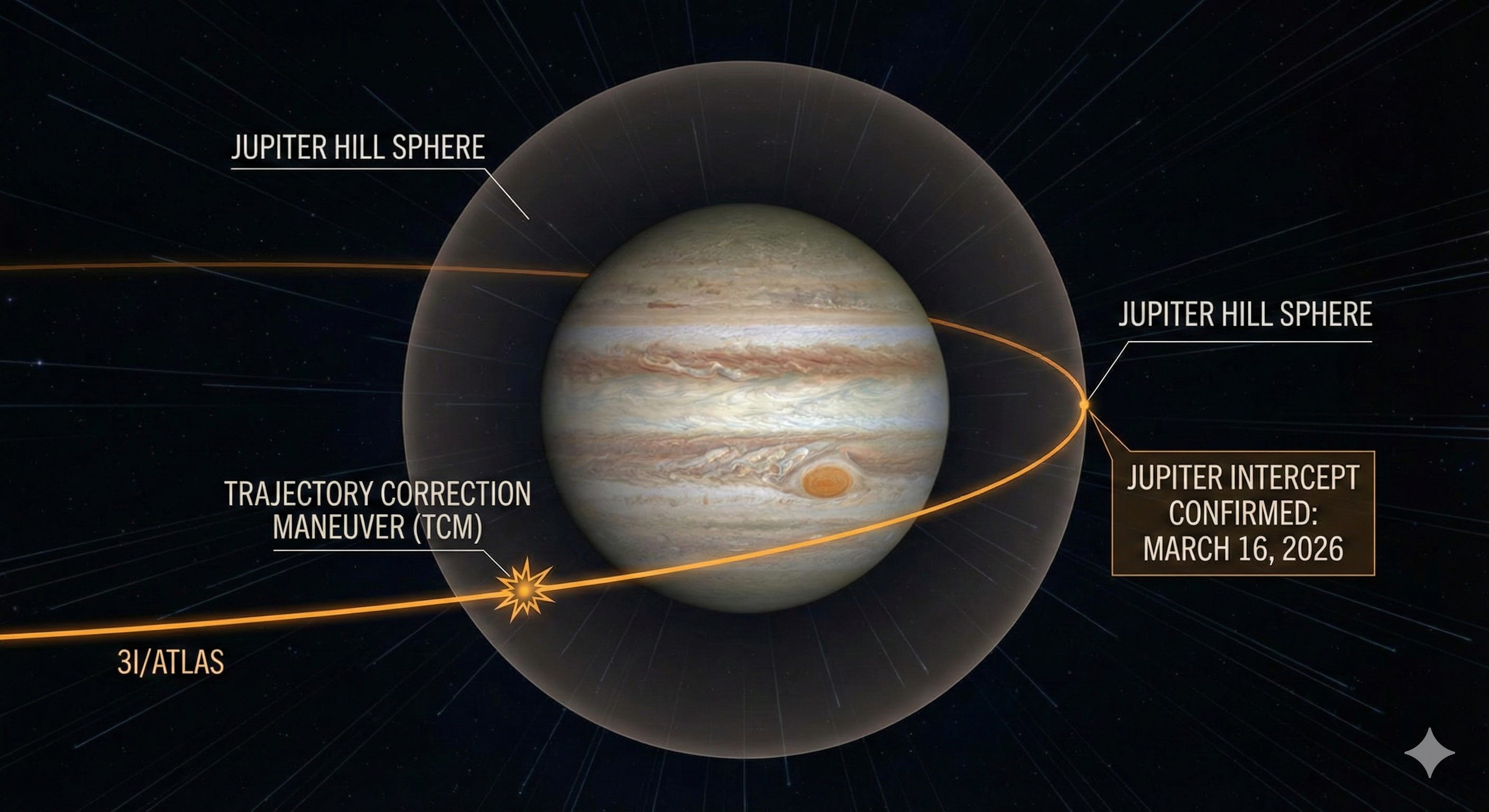
That “non-gravitational acceleration” adjusted the trajectory to target a specific point in space: Jupiter.
Specifically, 3I/ATLAS is on a collision course with the edge of Jupiter’s Hill Sphere—the gravitational region where the giant planet dominates solar gravity. The object is projected to miss the boundary by a margin of less than 0.1%.
If the acceleration hadn’t happened, it would have missed the Hill Sphere entirely.
The Implication: The “outgassing” wasn’t random sublimation. It was a Trajectory Correction Maneuver (TCM). 3I/ATLAS is using the Solar System’s plane to brake and steer toward a gravity assist or orbital insertion at Jupiter in March 2026.
Could the TESS outage be hiding another crucial maneuver?
Conclusion: The “Glomar” Response
When John Greenwald, Jr. asked the CIA for records on 3I/ATLAS, they didn’t say “we don’t watch comets.” They issued a Glomar Response: We can neither confirm nor deny the existence of records.
The CIA doesn’t Glomar a rock.
The TESS video is real, but it is a redacted document. The “Safe Mode” was a convenient curtain drawn across the stage at the climax of the performance.
We are left with a ghost in the machine—an object that moves like a ship, targets planets like a probe, and seems to disable the instruments that try to watch it too closely.
What to Watch Next:
All eyes are now on March 16, 2026. That is the date of the Jupiter visit.
It’s not a comet.
It’s a visitor.
Stay vigilant.
The Sentinel is an independent open-source intelligence monitor. Subscribe for updates on the Jupiter Intercept.
You know... What if they already made contact and.... Didn't like what they heard?
I know Avi Loeb is still actively posting about 3I/ATLAS, but wouldn't any of the thousands of other professional astronomers take note of the aforementioned anomalies here? Like are all the world's scientists just staying quiet on what might be the biggest discovery of our lifetimes?