

SUBJECT: FORENSIC ANALYSIS OF ARXIV:2603.16981v3 (ANDRÉE 2026A) / ARXIV:2603.16982 (ANDRÉE 2026B) / ARXIV:2604.18773 (SCARMATO & LOEB 2026B) / LOEB MEDIUM POST 19 JANUARY 2026 // ARCHITECTURAL SPECIFICATION OF 3I/ATLAS PROPULSION GEOMETRY // PUBLICATION CHANNEL ANALYSIS
DATE: APRIL 27, 2026
CROSS-REF: THE PUBLICATION GAP | THE SILENT EDIT | THE SUPPRESSION GRADIENT | THE VERDICT | THE HEARTBEAT | THE OPERATING SYSTEM | THE ANCIENT ENGINE | THE WEIGH-IN | THE CURATED ORBIT | THE MASS RECEIPT | THE FIFTH INSTRUMENT
DATA CONFIDENCE: VERIFIED (ARXIV PREPRINTS, HST/WFC3-UVIS F350LP PHOTOMETRY, JPL HORIZONS STATE VECTORS, PUBLISHED LOEB COMMENTARY JANUARY 19 AND APRIL 16 2026, GAUSS FUSION GMBH PUBLIC RECORDS, ELSEVIER BIBLIOMETRIC RECORDS) + ANALYSIS (SENTINEL CROSS-REFERENCE WITH PRIOR REPORTING)
We are building the video side of this operation. If you want the briefings in a format you can watch, subscribe to The Sentinel Network on YouTube.
Six days ago, Toni Scarmato and Avi Loeb posted six pages to arXiv. Their Table 1 maps the dominant jet on 3I/ATLAS to the transverse component of its non-gravitational acceleration to within half a degree. Eighty thousand newtons of thrust, pointed sideways to the trajectory.
Six weeks earlier, Bo Pieter Johannes Andrée, a senior data scientist at the World Bank in Geneva, posted 44 pages of mathematics to arXiv. The proof: the (3+1)=4 thruster geometry visible on 3I/ATLAS is the unique minimum-hardware configuration for steering a rotating body. Personal email for correspondence. No funding. No institutional sponsorship. The acknowledgments thank Avi Loeb and Frank Laukien on page 28.
Frank Laukien is co-founder of the Galileo Project. He is also Executive Chairman of Gauss Fusion GmbH. He proposed the (3+1)=4 framework in print on January 19, 2026. On Medium. Not in a journal.
The math is in print. The match is in print. The conjecture is in print.
None of it went through Elsevier.
THE PIPELINE QUESTION
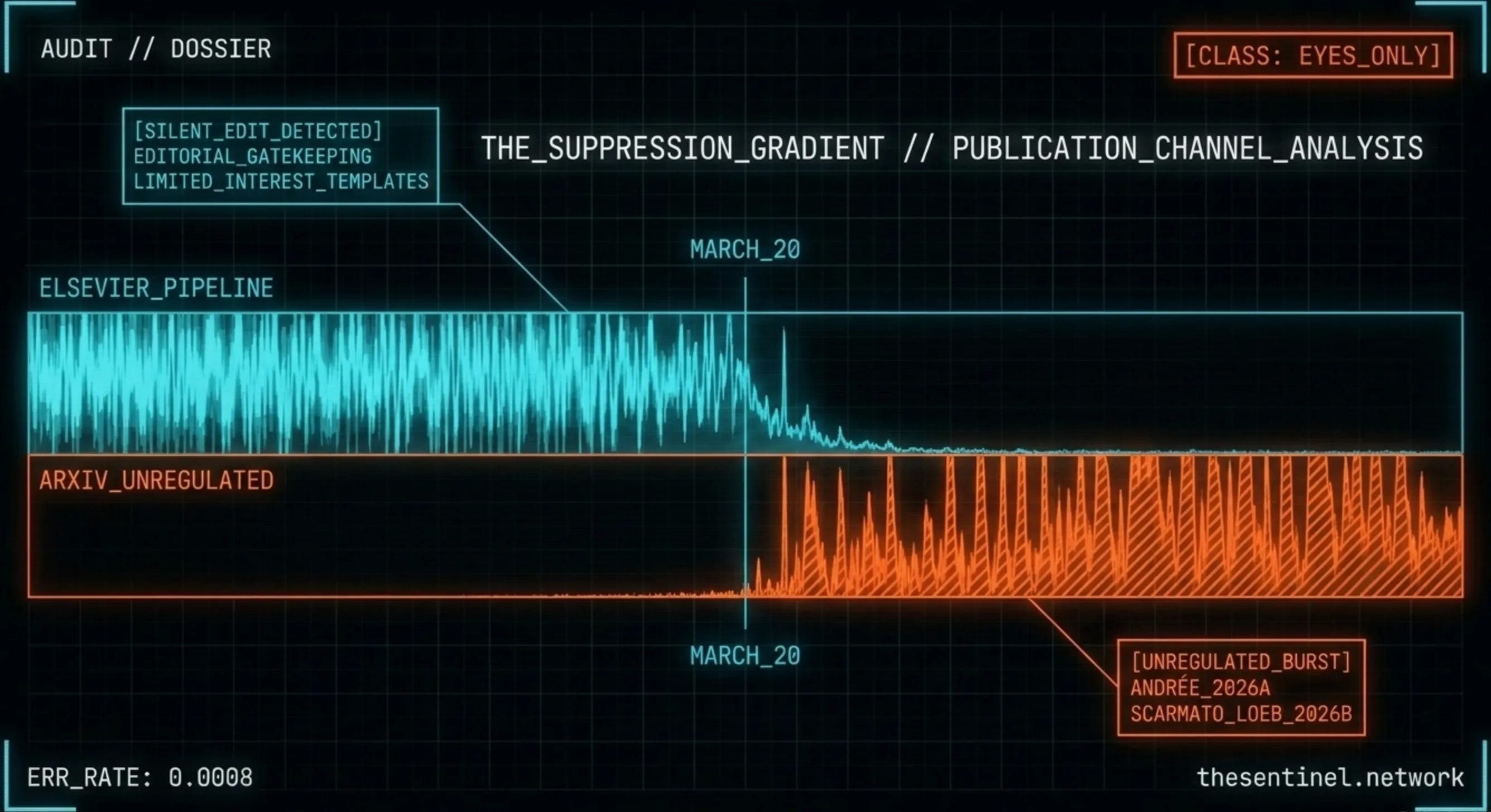
In THE PUBLICATION GAP, April 8, we counted. Elsevier, the world’s largest academic publisher, owner of Icarus and Planetary and Space Science and Acta Astronautica and four other major venues whose editorial scope covers the science of 3I/ATLAS, published two papers on the object across ten months. The rest of the field published thirty.
THE SILENT EDIT traced the wall. Chris Lintott at the Research Notes of the AAS demanded Avi Loeb remove the artificial-origin hypothesis or the paper would not be accepted. Editors used “limited interest” templates to reject 3I work that later appeared in MNRAS to community attention. The peer review system was functioning as a gatekeeping mechanism against the very questions the architectural specification answers.
Then came the blackout. Starting around March 20, 2026, the entire 3I preprint output dropped to near zero. Not just at Elsevier. Everywhere. The community that couldn’t stop publishing for nine straight months went silent at the precise moment THE VERDICT‘s Jupiter-encounter predictions became testable.
This briefing is about what was happening anyway.
THE CONJECTURE
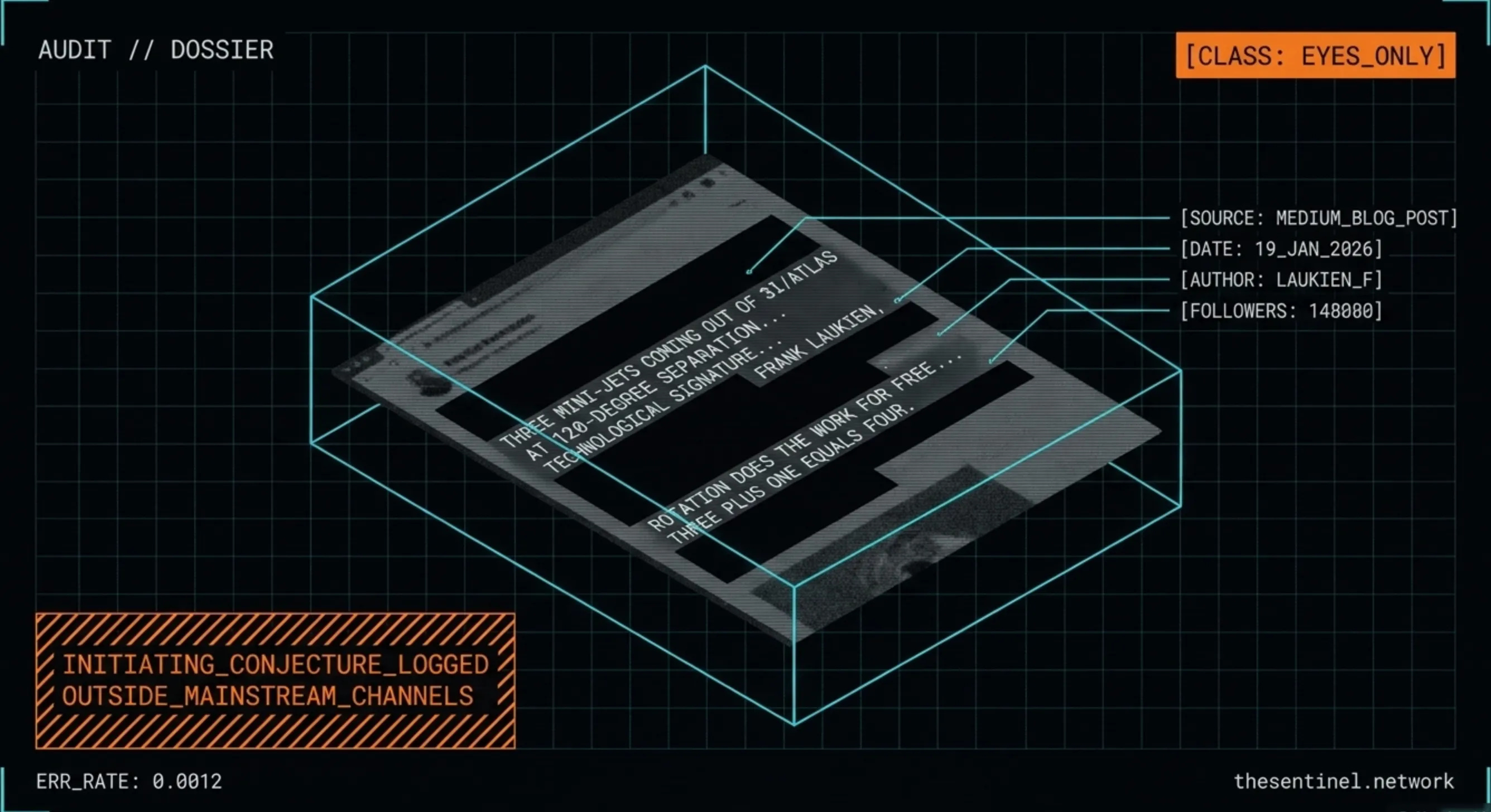
On January 19, 2026, Avi Loeb published a Medium post. The title asked the question directly. Are the three mini-jets coming out of 3I/ATLAS at 120-degree separation a technological signature?
The post discussed the Hubble imaging that revealed the symmetric jet structure caught in THE HEARTBEAT. Then Loeb introduced what his colleague had told him.
Frank Laukien, co-founder of the Galileo Project and President and CEO of Bruker Corporation, worked the geometry on his own.
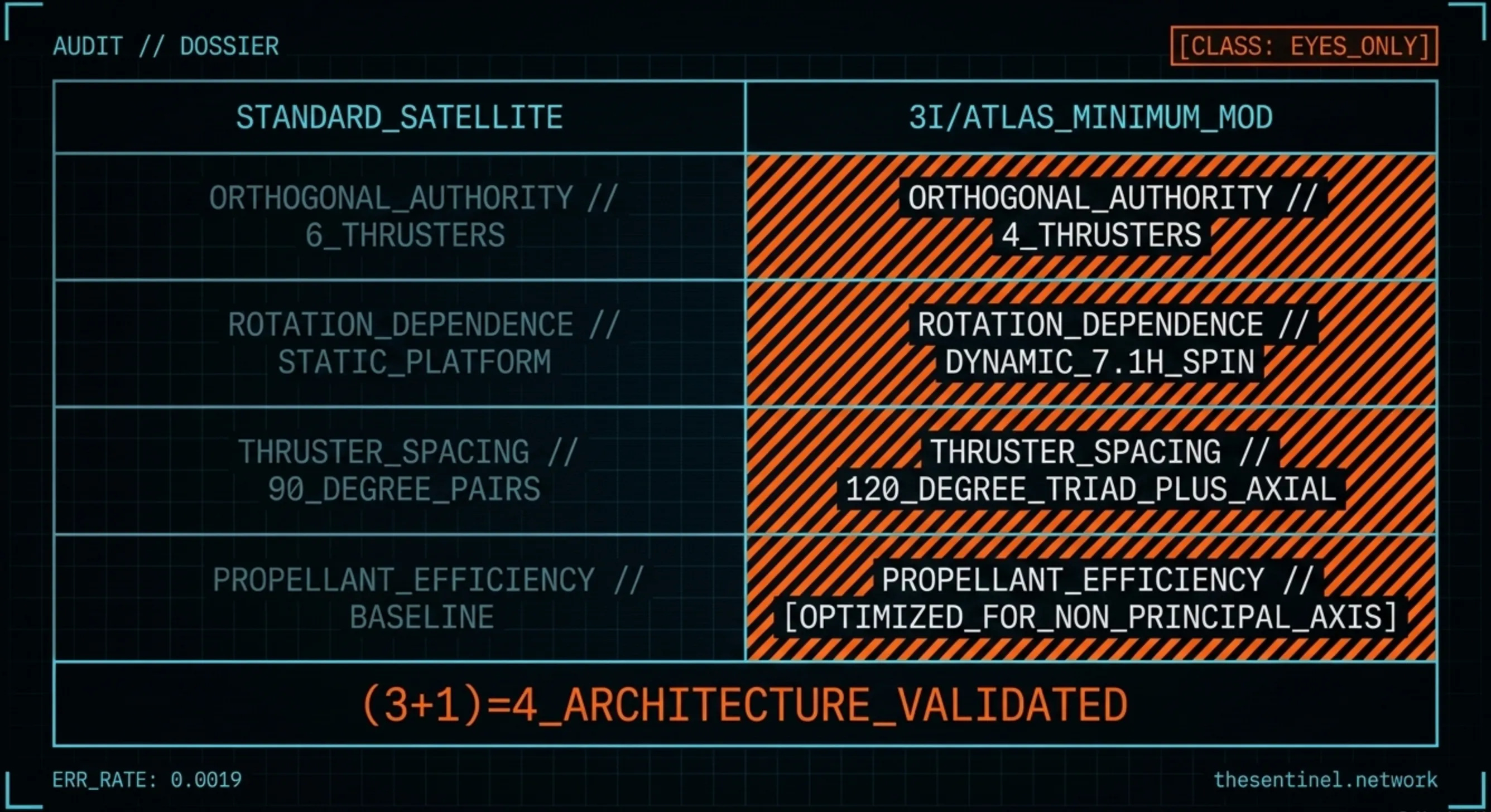
Standard satellite thrusters come in pairs along opposing axes. Six total for full orthogonal authority. But if 3I/ATLAS rotates around its major axis every 7.1 hours, thrusters along that major axis would be inefficient. The rotation does the work for free.
The natural minimum collapses to (3+1)=4. Three thrusters in the plane orthogonal to the major rotation axis. One axial thruster aligned with that axis. That fourth thruster is the anti-tail.
Laukien’s conjecture, dated January 19, 2026, did not appear in Astronomy and Astrophysics or The Astrophysical Journal Letters or Icarus. It appeared on a Medium blog with 148,000 followers.
The propulsion architecture for the third interstellar object in human history was first specified in print on a free-publishing platform.
THE PROOF
Andrée’s paper is 44 pages.
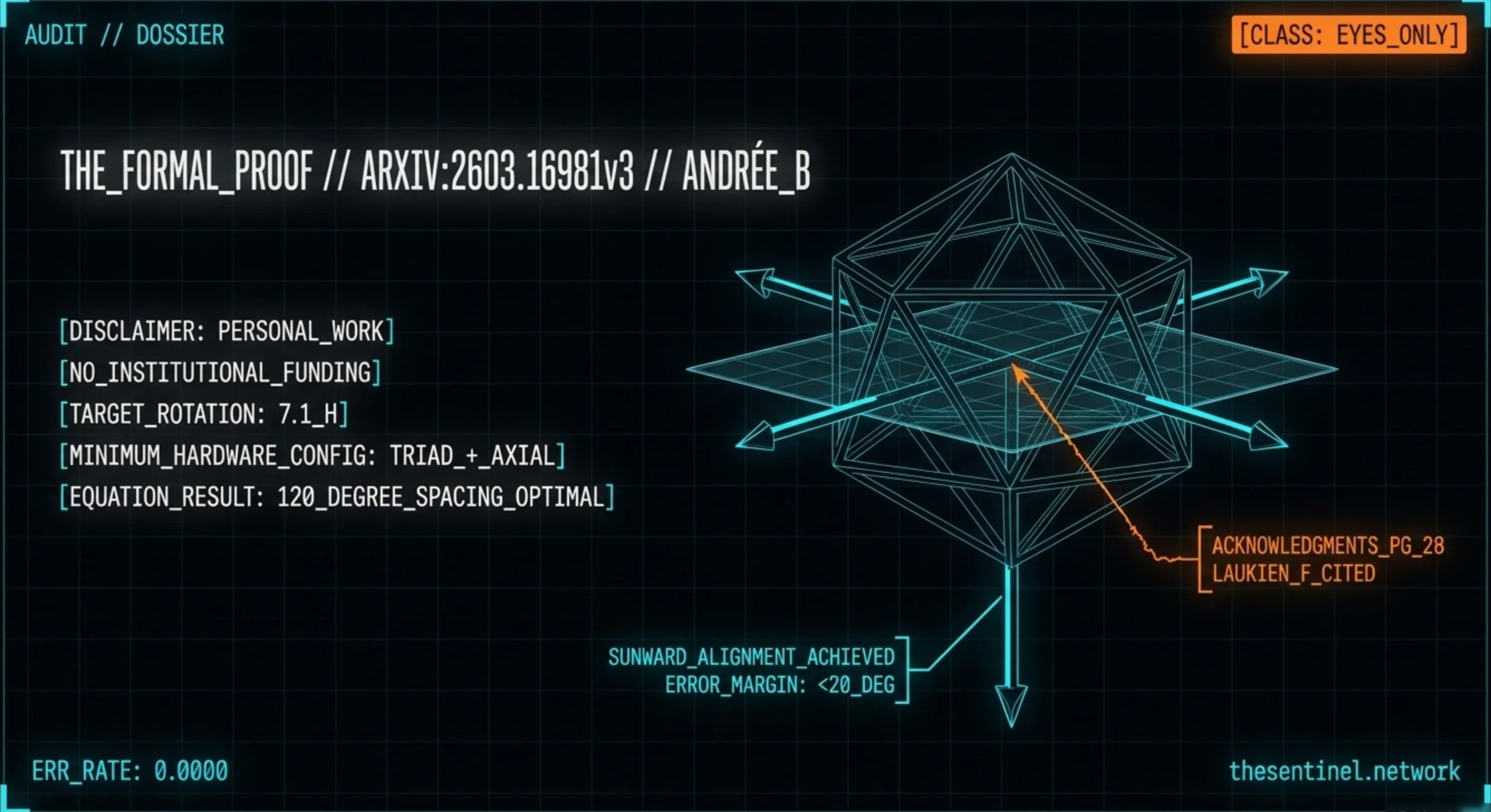
Page one carries an explicit disclaimer. Personal work. No World Bank funding. No institutional sponsorship. Personal email for correspondence: bandree at worldbank.org. The findings are entirely the author’s. A development-bank data scientist publishing on his own initiative.
The math addresses one question. Given that real thrusters can push but not pull, what is the minimum number required to steer in any direction within a plane?
The answer is three. Three thrusters spaced at exactly 120 degrees. Any other spacing degrades performance. A misaligned configuration with gaps of 100, 110, and 150 degrees drops authority by 48 percent and nearly doubles the propellant cost in unfavorable directions. The 120-degree triad is the structurally optimal solution. There is no other.
For three-dimensional steering, the body needs a fourth thruster mounted off the spin axis. Three plus one equals four. That is the minimum. There is no smaller minimum.
Andrée specifies the operational window. The architecture works cleanly for rotation periods between 5 and 20 hours.
3I/ATLAS rotates at 7.1 hours.
When a body approaches a primary like the Sun, Andrée’s math derives the optimal configuration: the axial thruster aligned with the radial line toward that primary. Sun-line alignment falls out of the math.
THE OPERATING SYSTEM cataloged Roth et al. finding the spin axis on 3I/ATLAS aligned within 8 to 20 degrees of the sunward direction. Independent observation. Independent proof. Same angle.
The acknowledgments section is on page 28. After the disclaimer about World Bank views, after the funding statement (this research received no specific funding), one sentence names two people. Andrée thanks Avi Loeb and acknowledges Frank Laukien for insights that informed the work.
THE MEASUREMENT
The Scarmato and Loeb paper is six pages. The manuscript is dated April 16. It builds on the wobble paper covered in THE HEARTBEAT.
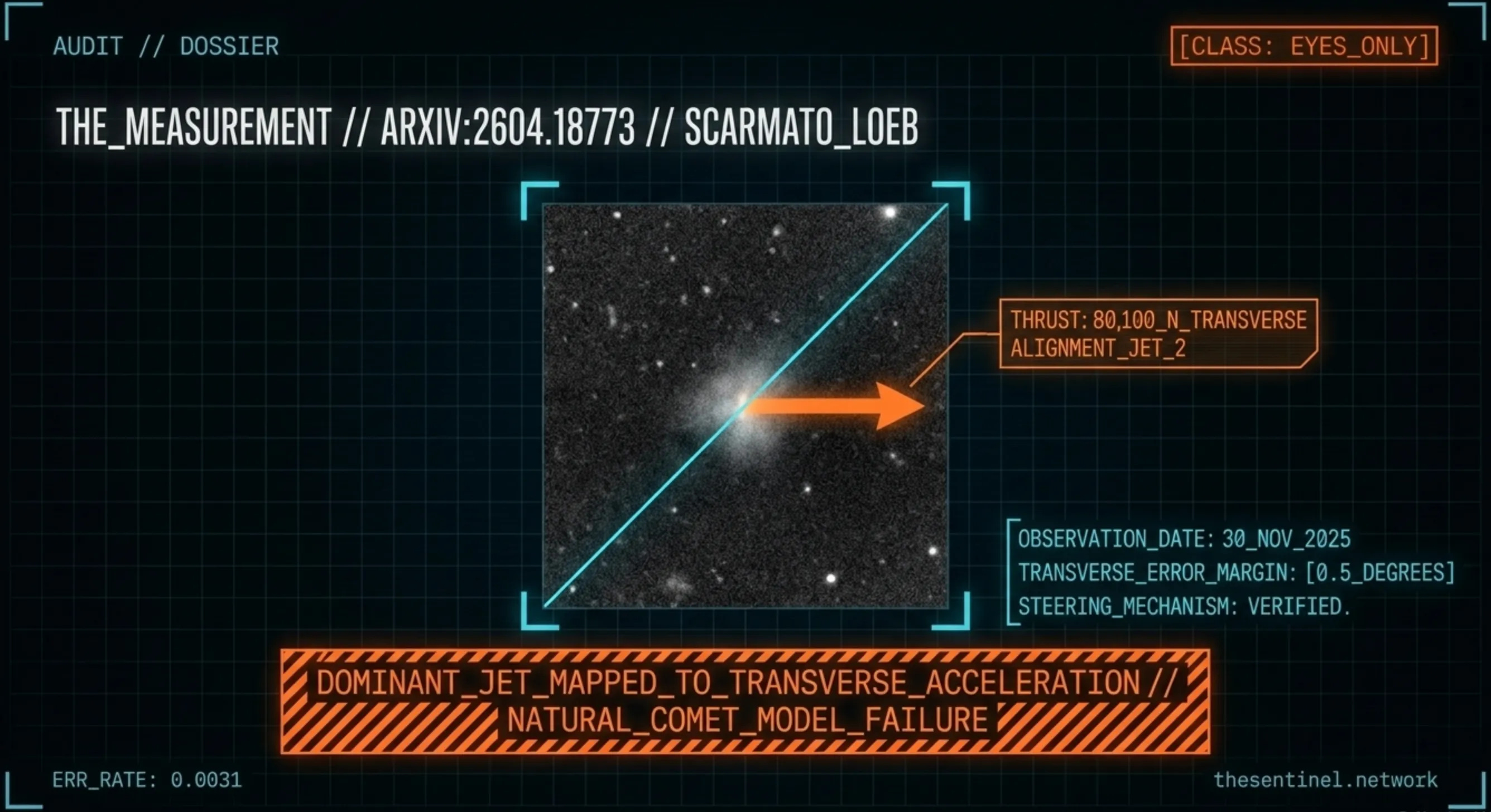
The method is straightforward. They took Hubble images from November 30, 2025. They computed the directions in which the object’s non-gravitational acceleration was pushing on it: radial (toward or away from the Sun), transverse (sideways to the orbit), and normal (perpendicular to the orbital plane). They projected those directions onto the sky. Then they compared each direction to the position angles of the three persistent jets.
The result is in their Table 1.
Jet 2 aligned with the projected transverse direction within 0.5 degrees.
Half a degree. The dominant jet, pointing roughly anti-sunward, mapped to the sideways push on the trajectory with surveyor precision. The same transverse component THE CURATED ORBIT tracked through Spada, Królikowska, and Dones (2026) using 7,788 astrometric epochs. The push that defined the inbound trajectory.
Then the team weighed the thrust. They converted the dust brightness in the jet to mass, and the mass to thrust through known sublimation kinematics.
Jet 2: 80,100 newtons.
Eighty thousand newtons of thrust. Half a degree of alignment. Pointed sideways to the trajectory, on a body whose rotation axis aligns with the sunward direction within twenty degrees.
That is a steering jet.
The thrust estimate carries factor-of-a-few systematic uncertainty. The authors say so. But the alignment is precise. The natural-comet model now has to explain why a randomly tumbling iceberg would maintain its dominant active region at the exact angle that produces transverse rather than radial acceleration.
This paper appeared on arXiv. It did not run through Icarus, the Carl Sagan-era flagship for solar system science whose editorial scope was tailor-made for it.
THE SENTINEL ASSESSMENT:
The dominant jet on an interstellar object is now mapped to the transverse non-gravitational acceleration within half a degree. Eighty thousand newtons of thrust, pointed sideways to the trajectory. The mechanical case for engineered architecture is now on the record at the measurement level.
THE FREQUENCY RELATION
THE HEARTBEAT flagged a strange arithmetic in the prior Scarmato and Loeb paper. Three jet periods. Two summed exactly to the third. Engineering practice does not produce that relationship by accident.
The new paper explains where the relationship comes from.
A clean spinning body has one clock. The time it takes to make one full rotation.
A wobbling spinning body has two clocks. The spin period. And the slow circle the spin axis traces as it wobbles.
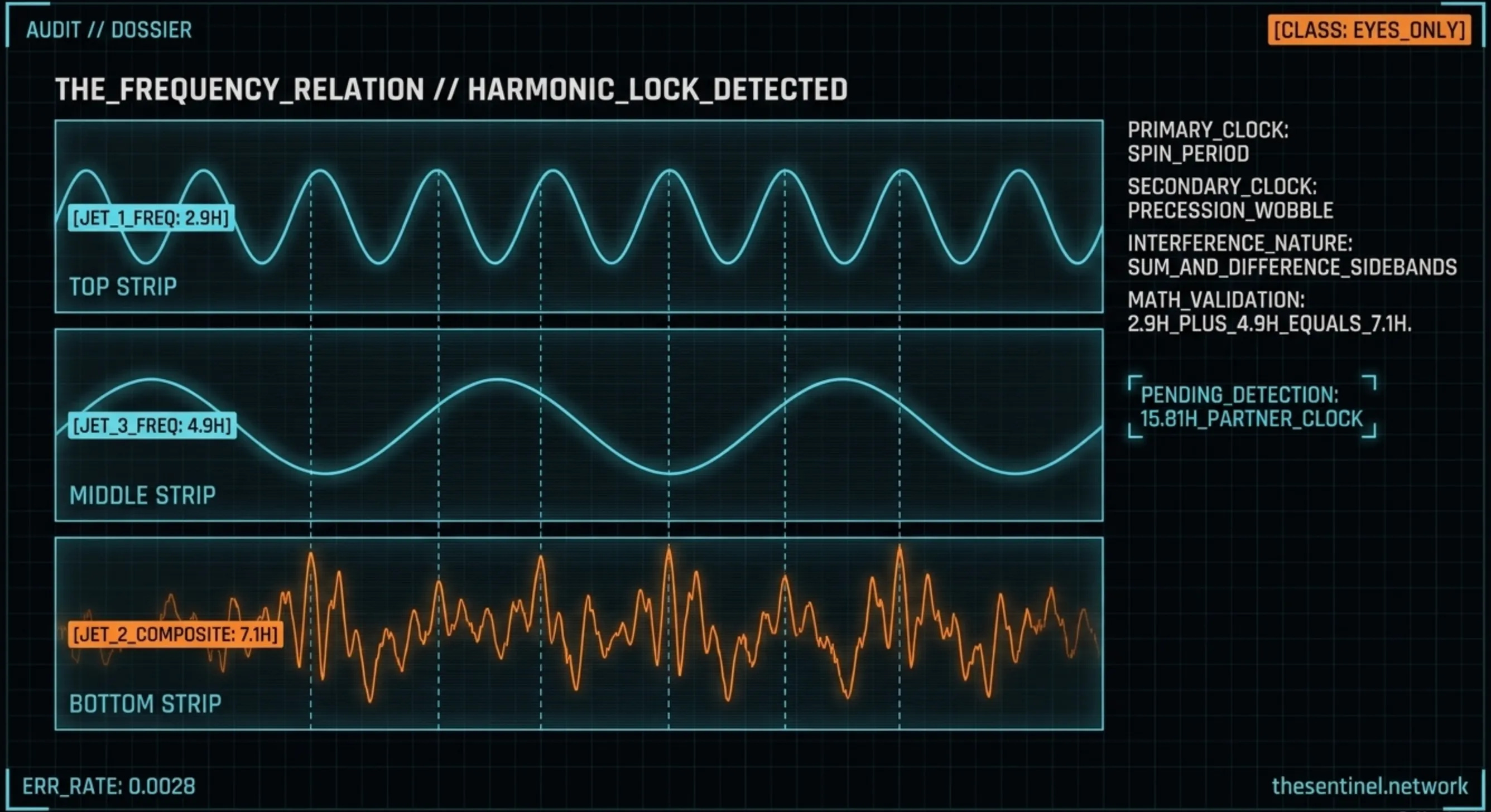
Attach a jet to that body and observe it. The motion you see is not the spin alone or the wobble alone. It is the two interfering with each other. The same math as two musical notes overlapping to produce beat tones. You see signal at the sum of the two original frequencies, and signal at the difference.
Two underlying clocks produce additional apparent clocks at their sum and their difference.
3I/ATLAS shows three apparent jet clocks. Jet 1 at 2.9 hours. Jet 2 at 7.1 hours. Jet 3 at 4.9 hours. The frequency of one jet equals the sum of the other two to four significant figures.
Two real clocks. Three apparent ones.
In March, Andrée predicted this signature. Section 5.3 of his paper, titled “Alternative Architecture: Nutation-Mediated Steering,” laid out what a controlled wobble would look like in observed jet kinematics. Two distinct periodicities producing sum and difference sidebands.
Six weeks later, two observers measured exactly that signature.
The authors predict a partner clock at 15.81 hours, the difference sideband waiting to be detected. If it shows up, the architecture holds. If it does not, something else is producing the math.
Both papers are on arXiv. Neither went through formal peer review.
Scarmato and Loeb caveat the result. The same beat pattern can arise from optical geometry mixing two underlying periodicities, not necessarily from controlled precession. They claim a detection of the signature, not the mechanism producing it.
THE NETWORK
Frank Laukien is more complicated than the conjecture in the Loeb post.
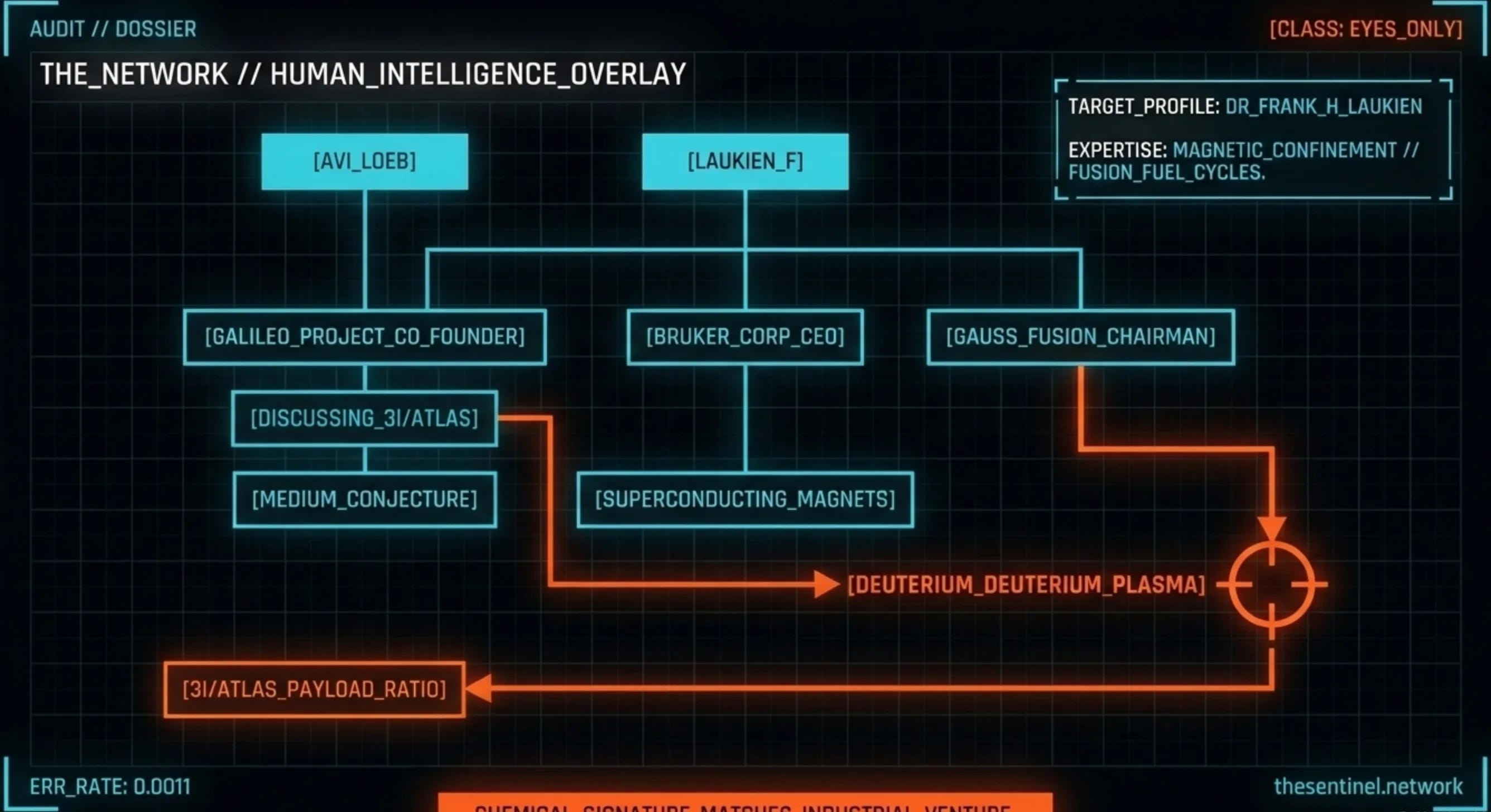
Per his Gauss Fusion biography, Dr. Frank H. Laukien is President and CEO of Bruker Corporation, the publicly traded scientific instrumentation company trading on NASDAQ as BRKR with annual revenue near three billion dollars. He has held that role since 1991. The company’s Bruker Energy and Supercon Technologies division manufactures superconducting cables for fusion reactors and high-energy physics applications. German-American. Bachelor’s in physics from MIT. Doctorate in chemical physics from Harvard. Visiting Scholar at Harvard. Senator of acatech, the German Academy of Technical Sciences. His own bio describes him as an expert in superconducting materials and magnet technology.
He is also two other things that matter for this case.
He is co-founder of the Galileo Project at Harvard. Not a member. Not a donor. Co-founder. Loeb’s publicly funded technosignature search program was founded by Avi Loeb and Frank Laukien together. That is the relationship behind the page 28 acknowledgment.
He is also co-founder and Executive Chairman of Gauss Fusion GmbH, the European industrial venture commercializing magnetic confinement fusion power plants. Founded 2022 in Garching bei München. Industrial partners across Germany, France, Italy, and Spain. Goal: the first European gigawatt-class stellarator-based fusion power plant by 2045. Eight million euros pre-seed in 2023. Nine million euros in additional German federal funding in 2024. A thousand-page Conceptual Design Report published October 2025. Bruker’s superconductor division is a founding industrial partner.
His own bio also lists him as co-founder of venture companies in therapeutics and space exploration.
That is the man whose conjecture Andrée formalized.
THE ANCIENT ENGINE caught the deuterium-enriched methane on 3I/ATLAS at fourteen times the abundance measured in 67P/Churyumov-Gerasimenko. THE ANCIENT ENGINE flagged what that compound is also useful for. Stored fusion fuel. Held at cryogenic temperatures for billions of years. Every fusion reactor design humanity has ever proposed uses deuterium-deuterium reactions. The isotope ratio on 3I/ATLAS is what an engineer designing fuel inventory for a long-duration magnetic confinement system would specify.
The architecture that Andrée formalized is the architecture Laukien proposed. The fuel chemistry on 3I/ATLAS is the fuel chemistry the technology Laukien commercializes runs on. Two patterns. One person between them.
The page 28 acknowledgment is not a footnote. It is an organizational chart.
THE SENTINEL ASSESSMENT:
Frank Laukien co-founded the Galileo Project. He is Executive Chairman of an industrial fusion venture. He chairs the company that builds the superconducting magnets that confine deuterium-deuterium plasma. In January he proposed the propulsion architecture for 3I/ATLAS in print on a Medium blog. In March a control theorist published the formal proof on arXiv and thanked him on page 28. The chemistry on 3I/ATLAS is the chemistry the technology Laukien commercializes runs on. The convergence between who is talking about 3I/ATLAS and what 3I/ATLAS appears to be made of is a distinct pattern, separate from the architectural convergence and layered on top of it.
THE SIXTH SYSTEM
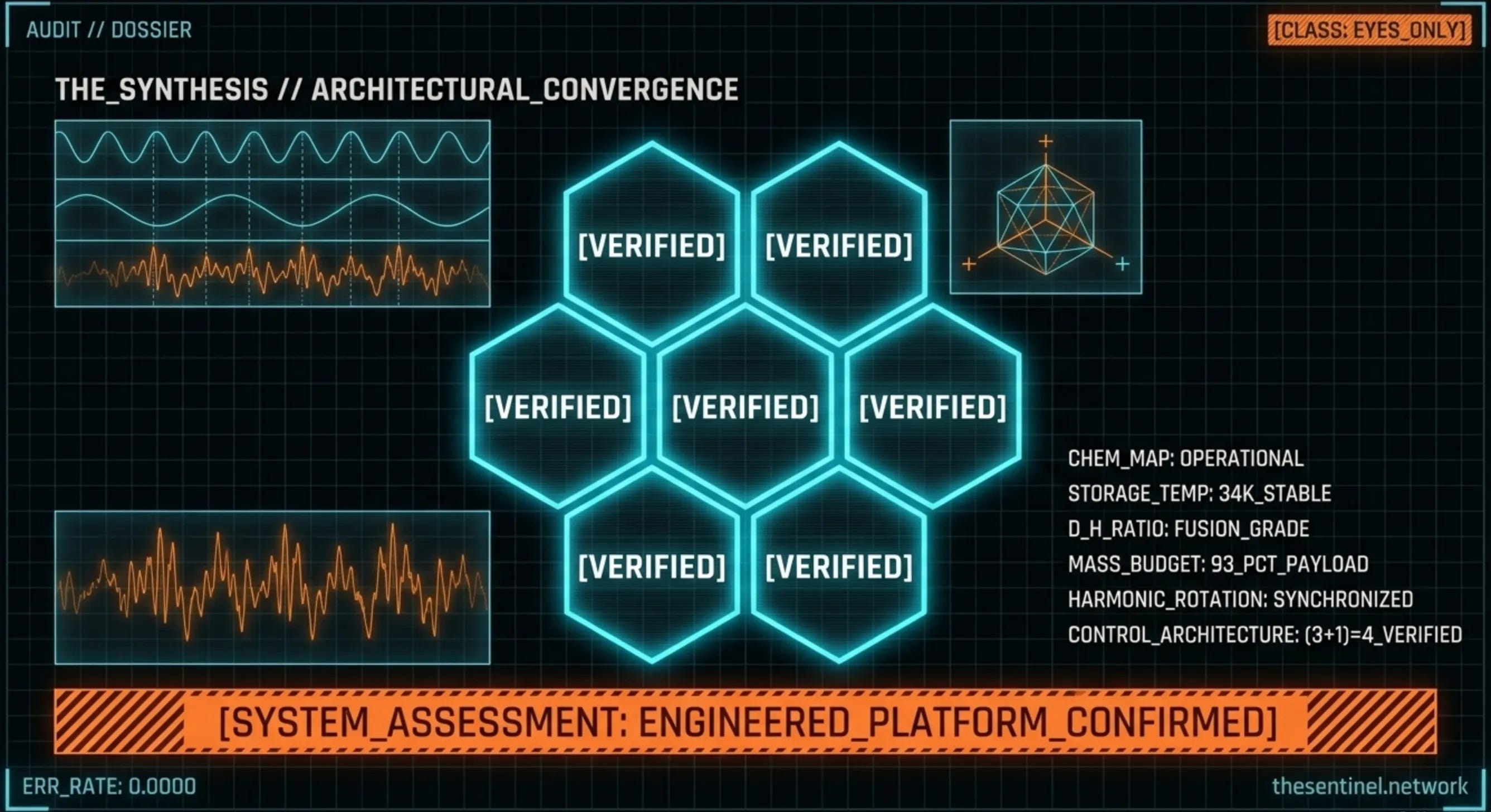
The architecture on 3I/ATLAS has been built up across thirty-five briefings of independent published measurements. THE OPERATING SYSTEM caught the chemical map and the 34-Kelvin storage temperature stamped into every water molecule. THE ANCIENT ENGINE clocked the methane deuterium-to-hydrogen ratio at fourteen times the 67P/Churyumov-Gerasimenko value. THE WEIGH-IN and THE MASS RECEIPT totaled the orbit-integrated mass budget at 93 percent CO2. THE HEARTBEAT caught the 7.1-hour rotation period and the harmonic lock between the three jets.
The piece that was missing was the formal control specification.
The new papers add it. Three small thrusters at 120-degree intervals. One large axial thruster aligned with the sunward direction. Stabilized non-principal-axis rotation at 7.1 hours. Order-of-magnitude thrust between 11,000 and 80,000 newtons per active jet.
The sunward anti-tail is the fourth thruster. It points at the Sun. It has been the central anomaly of 3I/ATLAS since THE THREE DAYS OF DARKNESS in January cataloged it as the structurally collimated, persistent feature whose axis the rotation aligns to within twenty degrees. Andrée’s math says outward thrust on the radial line counteracts inward gravity during encounter phases. The anti-tail has a function.
THE SENTINEL ASSESSMENT:
The chemical map. The 34-Kelvin storage temperature. The deuterium ratio. The mass budget. The harmonic rotation. The (3+1)=4 control architecture. Each piece on the record from independent published measurements. Each consistent with the operational architecture of an engineered platform. Most of it was assembled on arXiv.
WHAT THE CASE STILL NEEDS
THE VERDICT‘s five Jupiter predictions are mostly pending. Sustained water production through THE FIFTH INSTRUMENT‘s JUICE MAJIS data gets partial confirmation. Spectral mode reconfiguration through Roth et al.’s 2026b paper gets partial confirmation. The other three await post-Jupiter observation. The blackout makes that data slower to surface than it would be otherwise.
Andrée’s paper does not propose 3I is a probe. He proposes a minimum-modification architecture that could be applied to a comet for navigation. We approach this paper the same way THE MASS RECEIPT approached the Ferrín paper. Data confirms. Interpretation does not. Reader decides which framework survives the data.
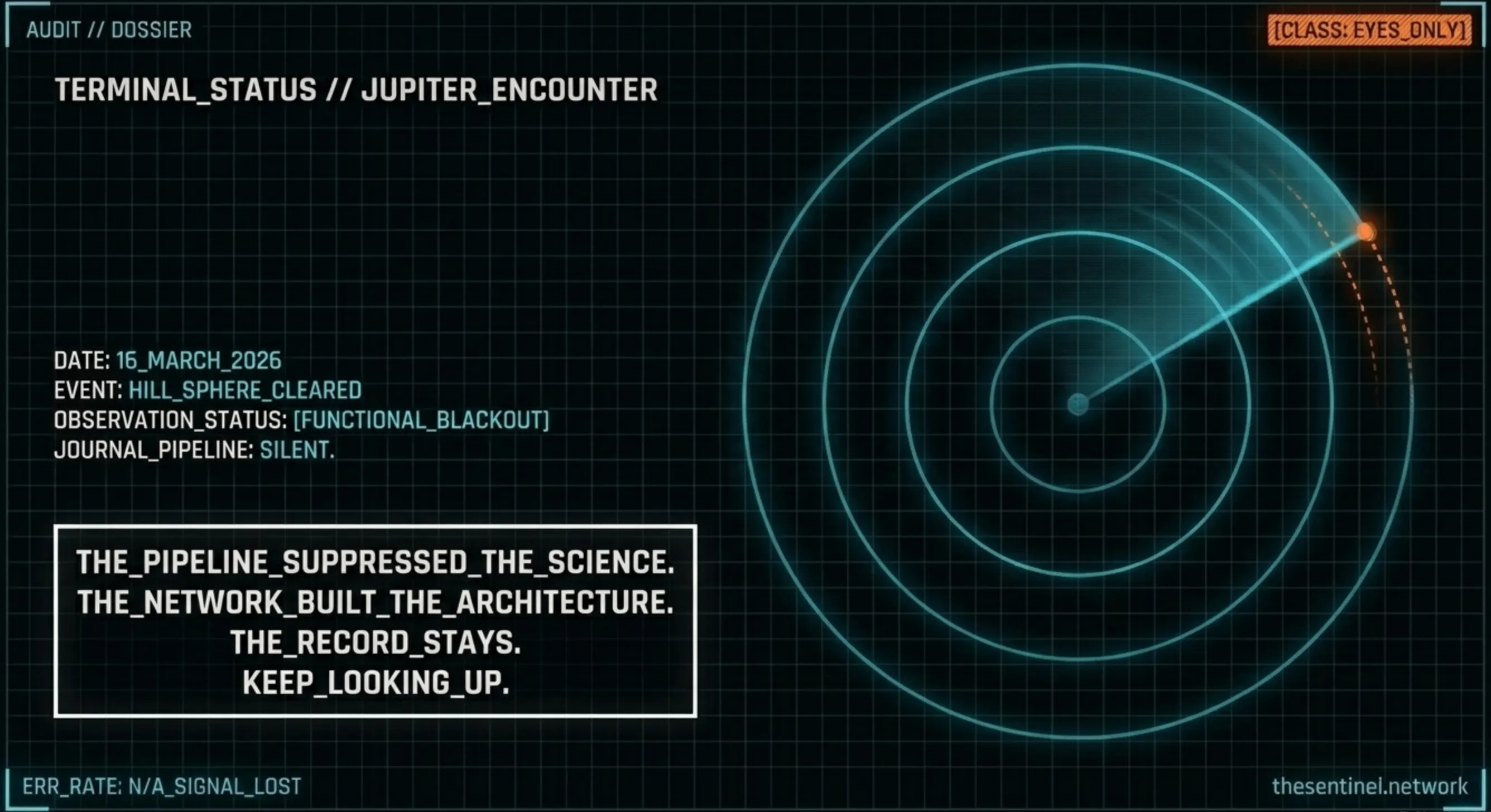
3I/ATLAS is now functionally unobservable. It cleared Jupiter’s Hill Sphere on March 16. The encounter window closed. The journal pipeline went silent at the same moment.
The architectural specification got built anyway. On arXiv. From a personal World Bank account. On Medium. On a Harvard astronomer’s personal homepage. The pipeline that should have published this work, the Elsevier portfolio whose flagship journal Carl Sagan once edited, was structurally absent for the most important object to enter our solar system since we started watching the sky.
The man whose January conjecture started it runs a fusion company.
We catalog the record.
The conjecture is in print. The proof is in print. The measurement is in print. The record stays.
Keep looking up.
-- The Sentinel Network™
Every briefing we’ve published is free. That’s not changing. This publication has no institutional backing, no sponsors, and no editorial board. We’re doing the work the newsrooms won’t, sourcing papers, filing FOIAs, building tools, and writing at the pace a once-in-a-civilization event demands.
Paid subscribers fund the investigation directly. They also get access to THE SIGNAL (weekly market intelligence derived from our forensic work), primary source documents, the comment section on every briefing, Fieldcraft Labs, and the FIELDCRAFT series. No ads. No sponsors. No strings. Your subscription is a data point against the suppression gradient.
If you can’t subscribe, we don’t care. Read everything. Share everything. The mission is the mission.
Subscribe to The Sentinel Network™
Top 100 Science publication on Substack.
Share this investigation. The Suppression Gradient documented what happens when this coverage reaches platforms that do not want you reading it. Every share, every restack, every forwarded link is a data point against the gradient.
Previous briefings: THE TOKYO TABLE | THE BET | THE MASS RECEIPT | THE RECEIPTS | THE OTHER HAND | THE PUBLICATION GAP | THE FIFTH INSTRUMENT | THE OPERATOR | THE BLIND SPOT | THE NARROW BAND | THE OPERATING SYSTEM | THE REFINED FUEL | THE VERDICT | THE WEIGH-IN | THE ANCIENT ENGINE | THE HEARTBEAT | THE CURATED ORBIT | THE SUPPRESSION GRADIENT | THE SILENT EDIT
Let’s go! We have disclosure, just not in the form most are hoping for! Great article!
One of your renderings gave me pause. When I was a kid, my favorite story was Madeleine L'Engle's 'A Wrinkle in Time'. Travel to other world's/dimensions was via a Tesseract, which is a real type of geometrical shape. Kind of cool...🙂
https://en.wikipedia.org/wiki/Tesseract