

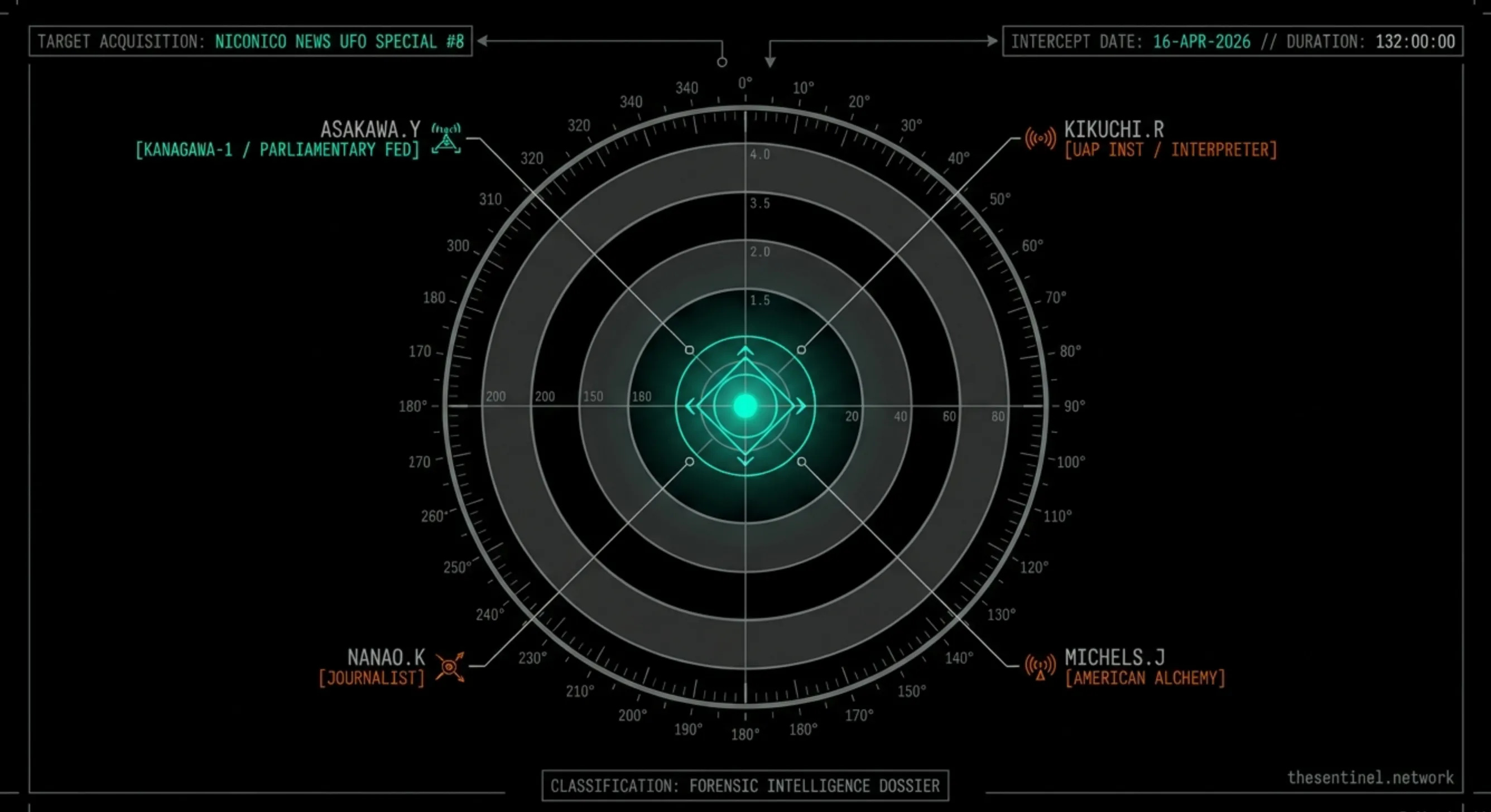
SUBJECT: JESSE MICHELS TOKYO INTERVIEW / NICONICO NEWS UFO SPECIAL #8
DATE: APRIL 17, 2026
CROSS-REF: THE RECORD | THE FLOOR | THE MALMSTROM OVERRIDE | THE PUBLICATION GAP
DATA CONFIDENCE: HIGH. PRIMARY SOURCE: 132-MINUTE NICONICO NEWS BROADCAST, APRIL 2026. DUAL-PASS WHISPER TRANSCRIPTION (SOURCE-LANGUAGE + ENGLISH TRANSLATION). CONGRESSIONAL RECORD CROSS-VERIFIED AGAINST CONGRESS.GOV. ALL TIMESTAMPS REFERENCE THE BROADCAST STREAM.
We are building the video side of this operation. If you want the briefings in a format you can watch, subscribe to The Sentinel Network on YouTube.
THE INTERVIEW NOBODY EXPECTED
Jesse Michels is the host of American Alchemy, a YouTube channel with roughly a million subscribers whose interviews with David Grusch, Bob Lazar, Hal Puthoff, and Christopher Mellon have each racked up millions of views. He is one of the most influential interviewers in the American UAP conversation. He went to Tokyo expecting to do interviews.
Three Japanese figures interviewed him instead.
Yoshiharu Asakawa, a former House of Representatives member for Kanagawa’s 1st District and a participant in Japan’s UFO Parliamentary Federation. Ryo Kikuchi of the Institute for UAP Studies, who also served as live interpreter. And Kou Nanao, a political journalist and producer. The conversation ran for two hours and twelve minutes on NicoNico News as UFO Special #8.
We watched the full broadcast. We transcribed it twice, once in the original bilingual form and once in unified English translation, so every quote in this briefing is timestamp-anchored to the stream. We also cross-checked the American political claims Michels made against the original Congressional record.
What follows is what he told them, what the Japanese questioners pressed on, and what the transcript shows about where the U.S. and Japan UAP conversation actually sits.
WHAT MICHELS WAS THERE TO SAY
Michels came to Tokyo with a specific map of the American disclosure landscape, and he delivered it.
On David Grusch. At 18:10, Michels said he had known Grusch for two years before doing their on-camera interview, pressure-tested him with every skeptical question he could construct, and came out convinced: “I think the guy is being honest.” Pressed by Nanao on the secondhand-testimony problem, Michels conceded at 20:34 that Grusch has “followed up after that testimony and said that he has had some firsthand experience.”
On the nuclear-UFO connection. Starting at 31:00, Michels ran his signature argument. UFOs showed up around the Manhattan Project. Roswell in 1947 was adjacent to the largest nuclear stockpile in the United States. The McMahon Secrecy Act of 1946 and the Atomic Energy Act of 1954 created a legal framework that automatically classifies any retrieved radioactive material, which, he argued at 32:02, means any UFO with radioactive characteristics “is immediately restricted, is born secret upon retrieval.” His source for the nuclear correlation is journalist Robert Hastings, who has documented UAP incidents at nuclear facilities for decades.
On base incursions. At 37:29, Michels named specific installations. Langley Air Force Base in 2022. Picatinny Arsenal in New Jersey in 2024. Wright-Patterson, temporarily shut down. El Paso airport this year, officially attributed to drones but, per Michels at 38:03, “probably just UAPs.”
On congressional obstruction. At approximately 83:14, Michels named Representative Mike Turner, Republican of Ohio. Turner, Michels said, “gutted” the disclosure provisions of the Schumer Amendment to the 2024 National Defense Authorization Act. Turner’s district includes Dayton, Ohio, which is home to Wright-Patterson Air Force Base. The geographic detail was not incidental to the point Michels was making.
On other disclosure-coded members. At 80:03, Michels named Tim Burchett, Eric Burleson, Ana Paulina Luna, and Nancy Mace as legislators who have, in his words, “jumped off the deep end into the topic” and whose popularity has risen as a result. He also acknowledged that many of their statements are “cryptic” because they learned what they learned in classified settings, which leaves the public with a “mystery box” problem.
On Bob Lazar. At 70:43, Michels pointed out that the Bob Lazar episode on Joe Rogan is the single most-watched Joe Rogan episode on YouTube ever. He used this as evidence that the topic has genuine cultural traction even when specific names like Grusch and Mellon remain niche.
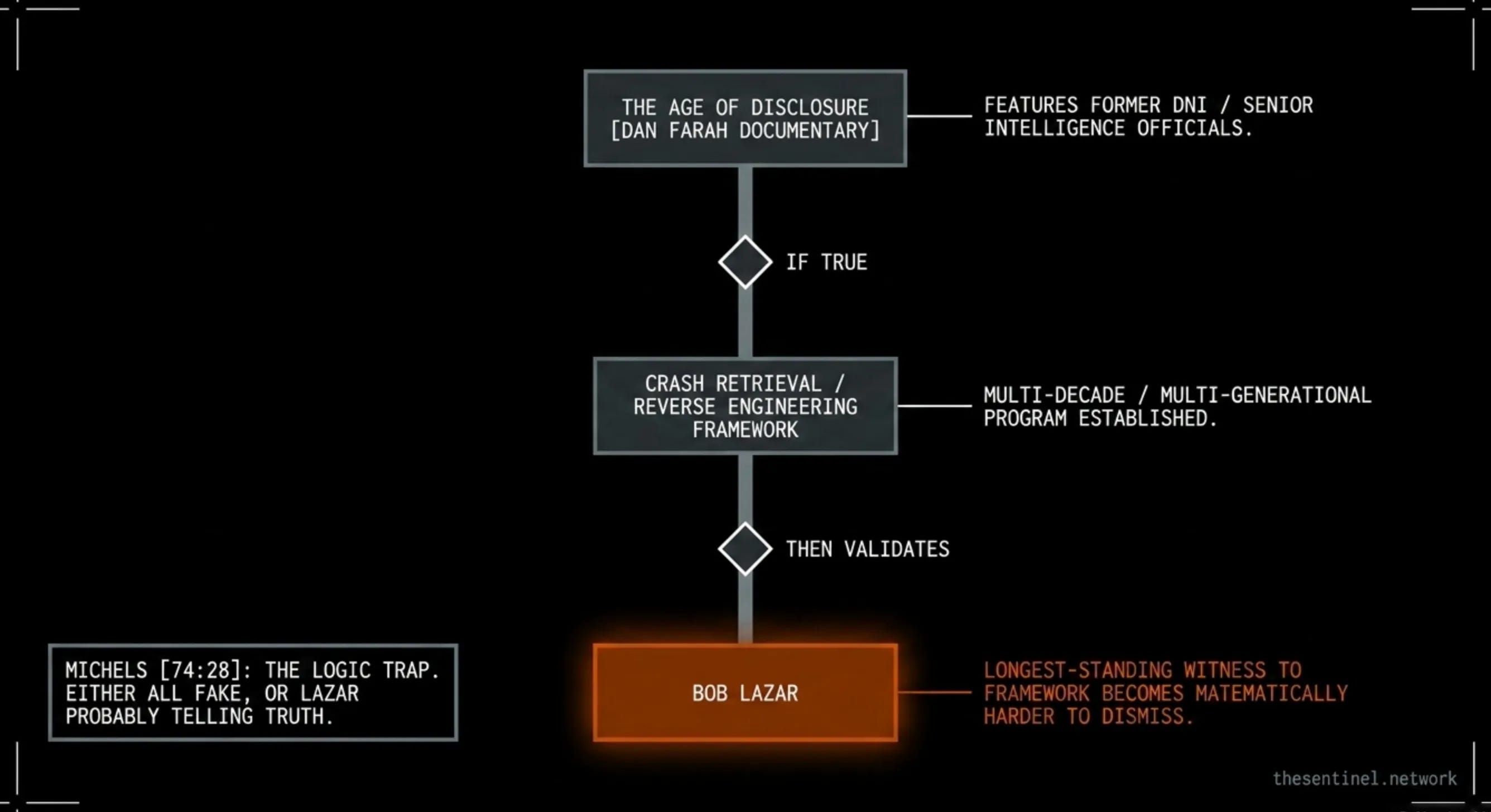
On the logic trap. At 74:28, Michels made the most compressed argument of the broadcast. “You can’t accept that we’ve had a multi-decade, multi-generational crash retrieval and reverse engineering program, which is, you know, it’s the number one documentary on Amazon. All these high-up intelligence officials, including former directors of national intelligence that oversaw CIA, NSA, literally everything. And they’re taking place in a movie whose thesis is that we have crash retrievals, reverse engineering. You can’t accept that and then not accept the one guy who’s coming forward with a very complete story around crash retrievals and reverse engineering. So either it’s all fake or if there are crash retrievals and reverse engineering programs, Bob Lazar is probably telling the truth.”
The documentary he was referring to is The Age of Disclosure, Dan Farah‘s film featuring former DNI officials and senior intelligence figures. The argument is a syllogism. If the documentary’s witnesses are credible, the framework they describe is credible. If that framework is credible, the longest-standing witness to that framework becomes harder to dismiss.
WHAT THE JAPANESE QUESTIONERS WANTED TO KNOW
The questions tell you as much as the answers.
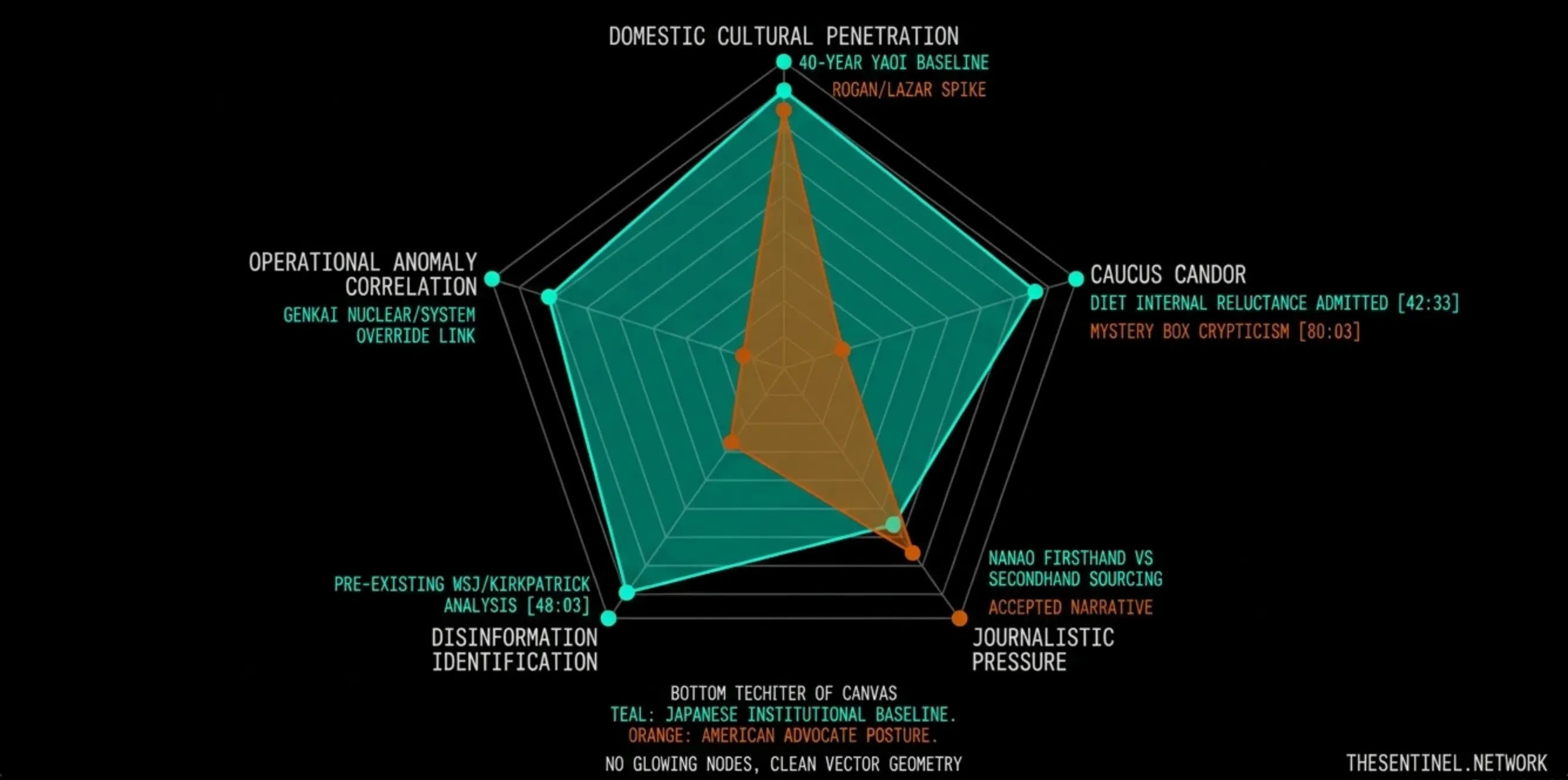
Nanao kept pressing on sourcing. His first substantive push was on whether Grusch’s testimony was firsthand. That is not a hobbyist’s question. That is a journalist’s question. He understood that the entire legal weight of congressional testimony depends on whether the witness has direct knowledge, and he made Michels work for the answer.
Nanao named Kirkpatrick. At 48:03, Nanao advanced his own thesis: “I think Sean Kirkpatrick is behind this.” He was referring to a Wall Street Journal article he characterized as a Pentagon disinformation effort. This is not a Japanese journalist asking an American guest to explain the landscape. This is a Japanese journalist telling the American guest what he already believes about a specific named U.S. official’s role in shaping the narrative.
Michels responded at 48:58 with a detailed takedown of the WSJ article’s claim that an EMP weapon had been used against U.S. nuclear assets at Malmstrom in 1967, citing Lieutenant Colonel Bob Salas and Bob Jamison’s on-record testimony about the actual incident. He called the article “a total lie.”
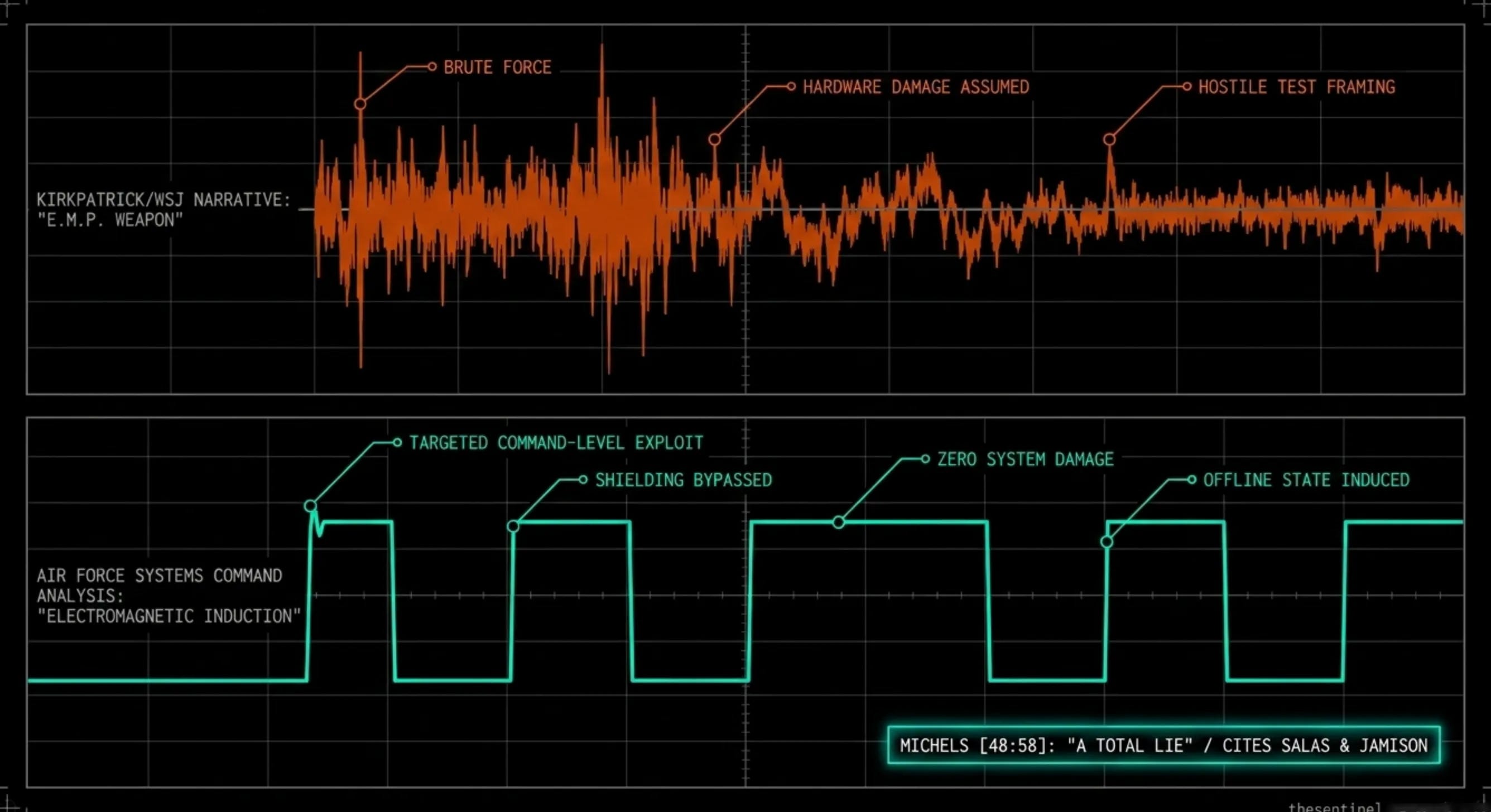
We have done our own work on the Malmstrom override. The signal that disabled twenty Minuteman ICBMs in March 1967 was not an EMP. The engineering analysis, performed by Boeing and Air Force Systems Command, identified a precise, non-destructive electromagnetic induction signal that bypassed shielded underground cabling. The missiles were not damaged. They were logged off. That distinction matters. An EMP is brute force. The Malmstrom signal was a clean square wave, a command-level exploit against analog defense infrastructure. The WSJ framing collapses the difference between the two, and the collapse is editorially useful to whichever party wants the incident treated as a hostile weapons test rather than as what the Air Force’s own engineers concluded it was.
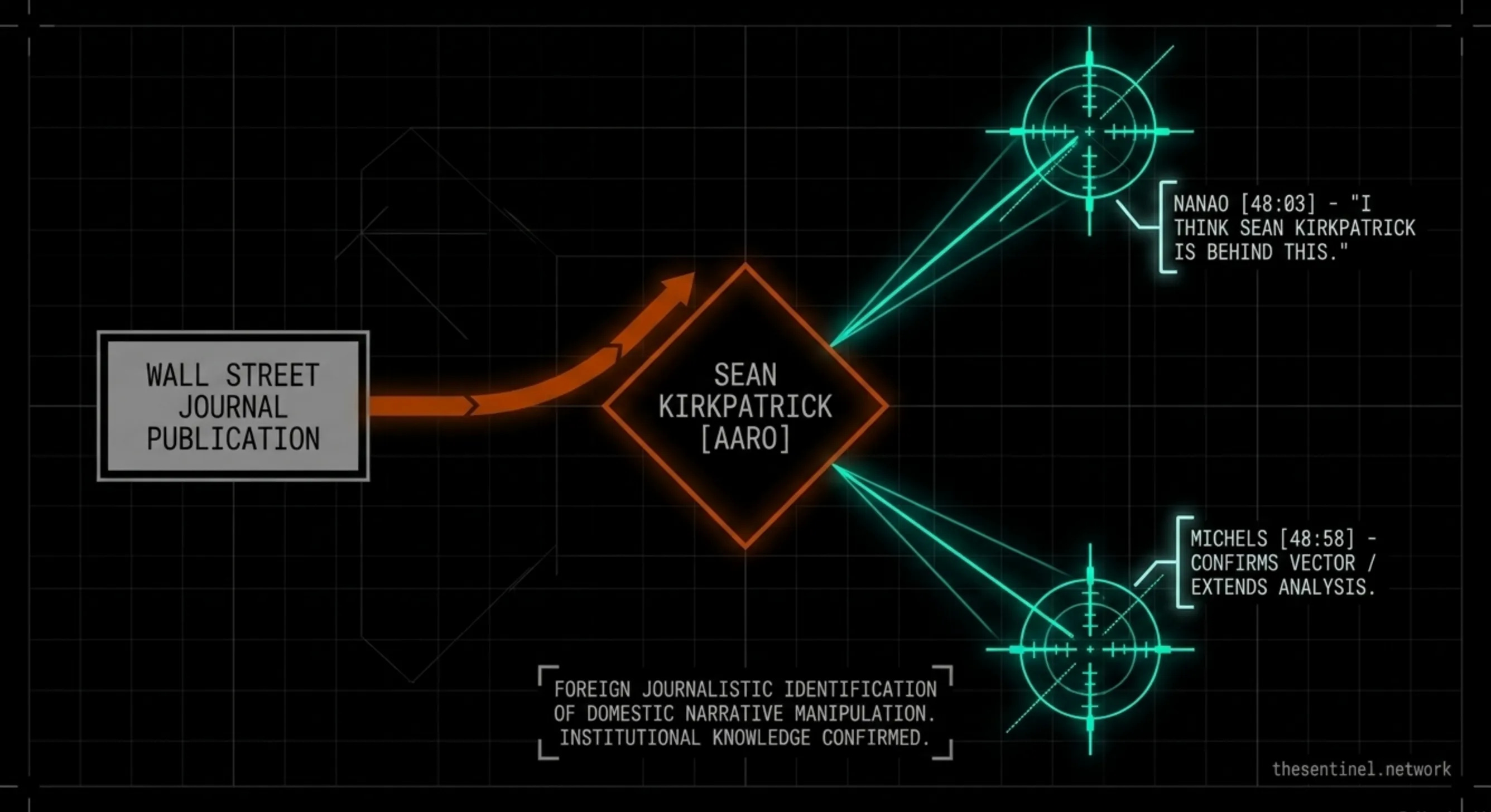
The exchange is significant because it was Nanao who introduced Kirkpatrick’s name. The American guest confirmed and extended the Japanese journalist’s pre-existing analysis. The institutional knowledge on the Japanese side was already there.
Asakawa described his caucus honestly. At 42:33, he acknowledged that not all members of the UFO Parliamentary Federation are willing to ask UAP questions in official Diet and committee sessions. “There are people who share my awareness of this issue within the Parliamentary League, but unfortunately they are not trying to ask questions.”
That is a sitting caucus member publicly acknowledging internal division. It is the kind of admission that adds credibility to everything else he says.
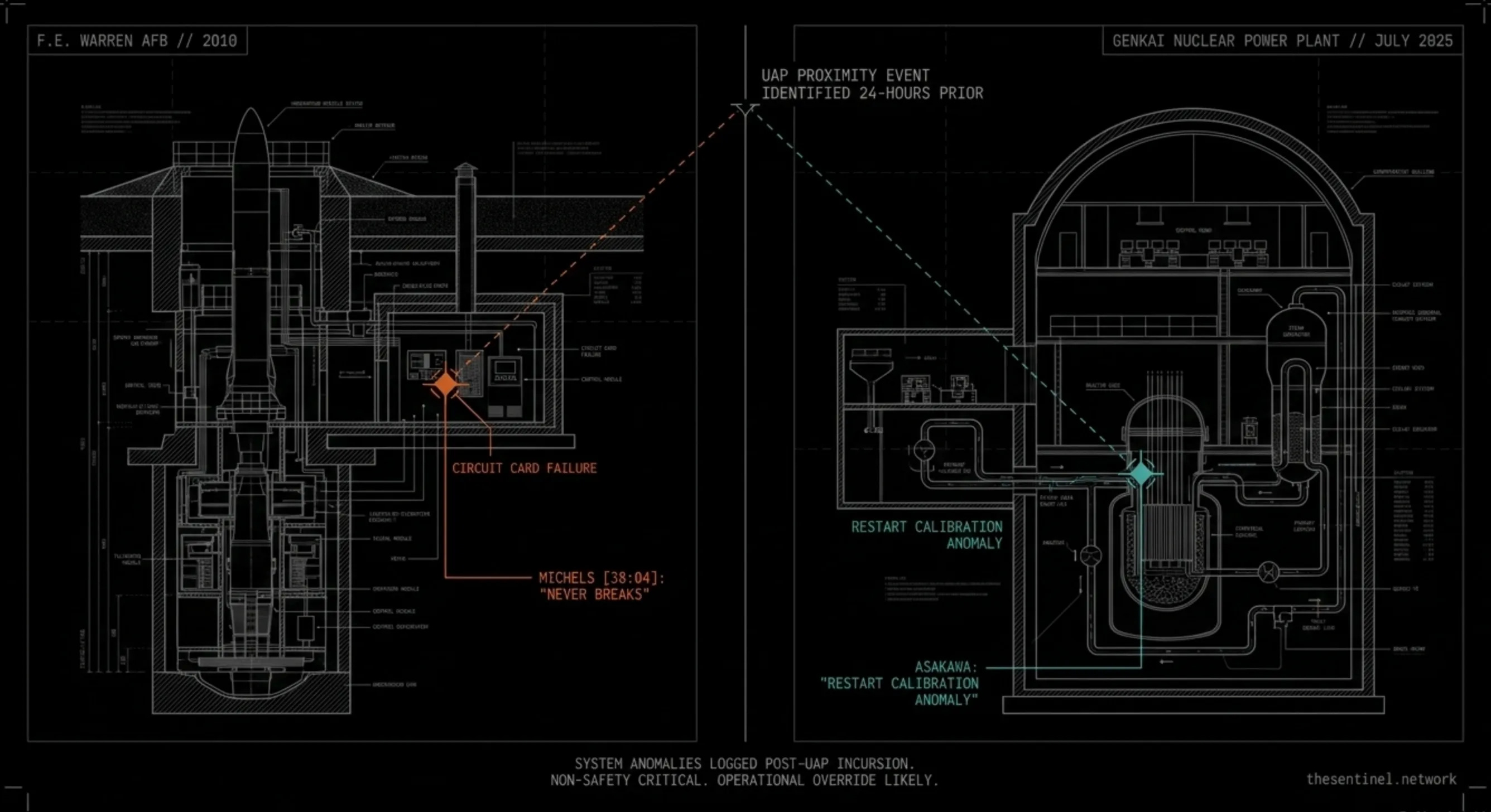
The Genkai incident got serious treatment. Asakawa opened a discussion about the July 2025 UAP incident at the Genkai Nuclear Power Plant. A UAP was reported the night before a scheduled restart of the facility. The next day, when operators began calibration to restart, they encountered system anomalies that required them to stop. Asakawa was careful: it was not a safety event, and the correlation between the UAP and the system anomaly may be coincidence.
Michels responded with the American analog. At 38:04, he referenced the 2010 F.E. Warren nuclear site outage, which the Air Force officially attributed to a faulty circuit card. That circuit card, Michels noted, “never breaks.” EMP-related power failures at sensitive U.S. military installations, in his telling, are more common than publicly acknowledged.
The Genkai and F.E. Warren parallel is the operational core of the interview. Two nuclear facilities, two countries, two sets of unexplained electrical anomalies correlated with unexplained aerial phenomena. The Japanese caucus is building its domestic case for UAP scrutiny around nuclear facility security. The American argument provides the template.
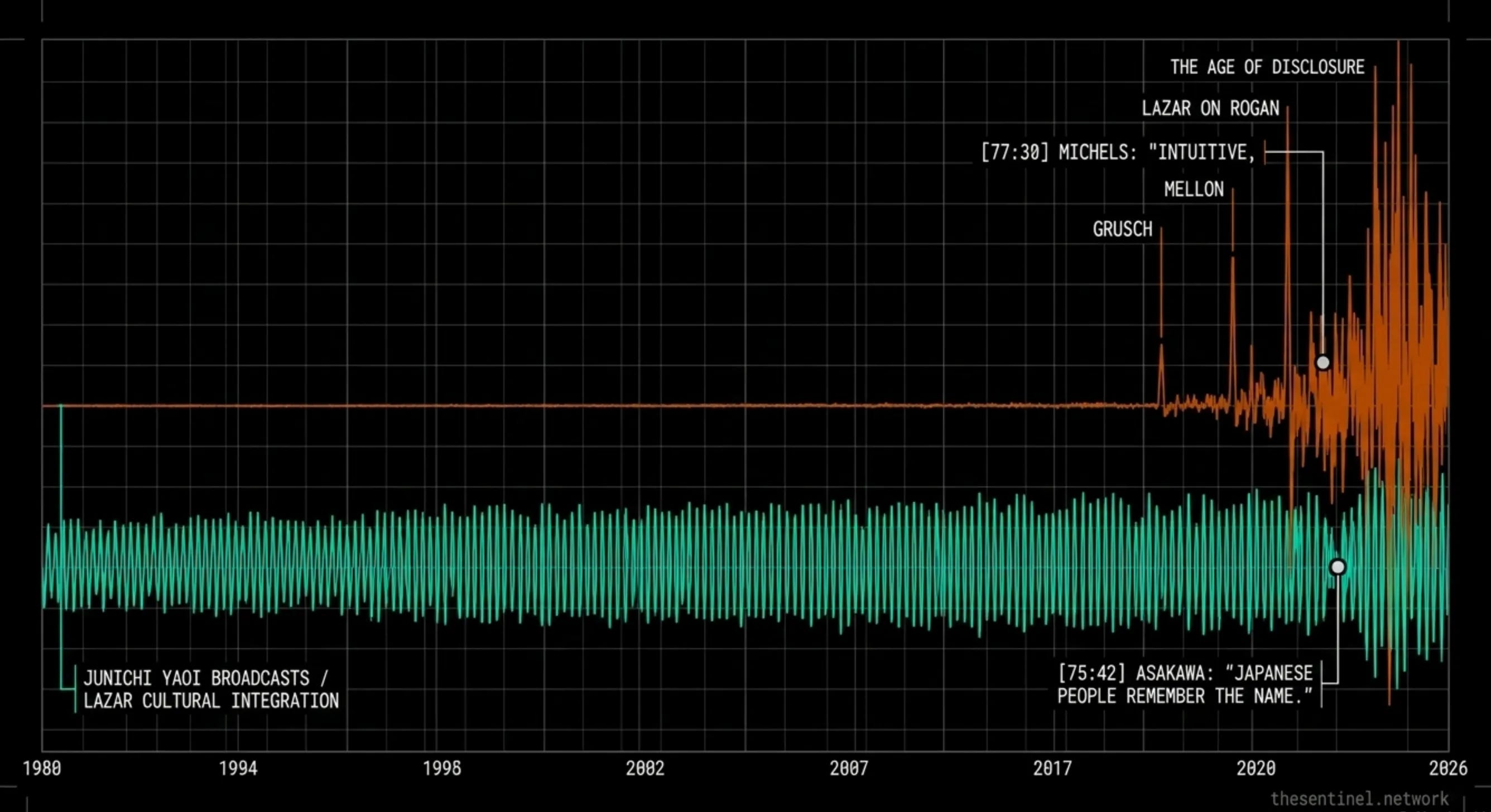
Bob Lazar was a cultural moment. Asakawa said at 75:42 that he first learned of Bob Lazar roughly 40 years ago, as a high school graduate, when the legendary Japanese UFO producer Junichi Yaoi aired a segment about him on Japanese television. “Japanese people,” Asakawa said, remember the name. Michels hadn’t heard of Yaoi and acknowledged it openly. “I have not, no.”
That exchange matters for a specific reason. It establishes that Japanese familiarity with American UAP figures is deeper, older, and more culturally embedded than most American disclosure advocates realize. When a Japanese caucus member references a name, he is drawing on forty years of domestic broadcast history, not last week’s podcast episode.
WHERE THE RECORD DIVERGES FROM THE RETELLING
CORRECTION (April 17, 2026): An earlier version of this briefing identified the questioner in this exchange as Representative Alexandria Ocasio-Cortez. Sentinel reader Peggy Ann Chowning flagged that the exchange in question was with Representative Robert Garcia, Ranking Member of the subcommittee, on page 19 of the Congressional record. Michels attributed the moment to AOC in the NicoNico broadcast. The attribution was his error; carrying it forward uncorrected was ours. The substance of the paraphrase-drift observation stands. The questioner and the matched quote are now corrected. Our thanks to Peggy.
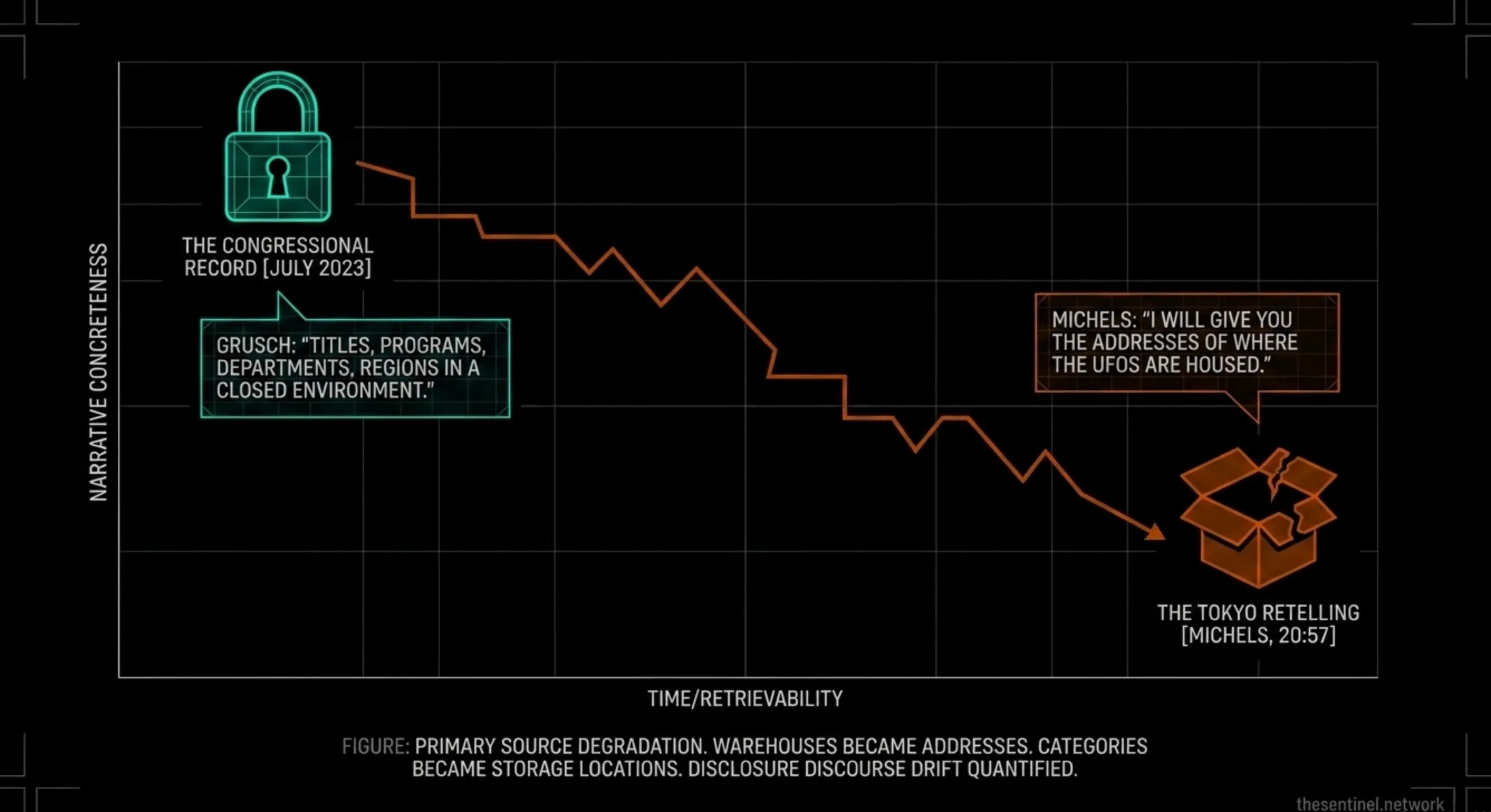
At 20:57, Michels described what he called the most important moment of the July 2023 House Oversight hearing. According to Michels, Representative Alexandria Ocasio-Cortez asked Grusch for specifics on reverse-engineering programs, and Grusch replied: “I will give you the addresses of where the UFOs are housed.”
The actual exchange was with Representative Robert Garcia, Democrat of California and Ranking Member of the Subcommittee on National Security. We checked the Congressional record, page 19:
Rep. Garcia: “Mr. Grusch, finally, do you believe that our government is in possession of UAPs?”
Grusch: “Absolutely, based on interviewing over 40 witnesses over 4 years.”
Rep. Garcia: “And where?”
Grusch: “I know the exact locations and those locations were provided to the Inspector General and some of which to the intelligence committees. I actually had the people with the firsthand knowledge provide a protected disclosure to the Inspector General.”
Grusch said “I know the exact locations.” He did not say “addresses.” He did not say “UFOs are housed.” The locations, per his sworn testimony, were already in the hands of the Inspector General and, in part, the intelligence committees.
The substance of what Grusch said is serious. A cleared former intelligence officer telling the ranking member of a national security subcommittee that he knows the exact locations of recovered UAP material, and that he has already provided those locations to the Inspector General, is a significant claim on its own terms. It does not require the embellishment.
But Michels’ retelling drifted in two directions at once. He attributed the moment to the wrong member of Congress. And he rendered “I know the exact locations” as “I will give you the addresses of where the UFOs are housed.” Both drifts increase specificity beyond what the record supports. A testimony about cleared locations already disclosed to the Inspector General becomes, in the Tokyo retelling, the promise of addresses about to be handed over.
This is how disclosure discourse drifts. If the Japanese caucus builds its own case on the premise that Grusch offered AOC a list of warehouse addresses, they will eventually discover that he didn’t. Better that correction happen now, from an ally, than later from an opponent.
THE INTERPRETATION MOMENT
One smaller observation about the transcript mechanics.
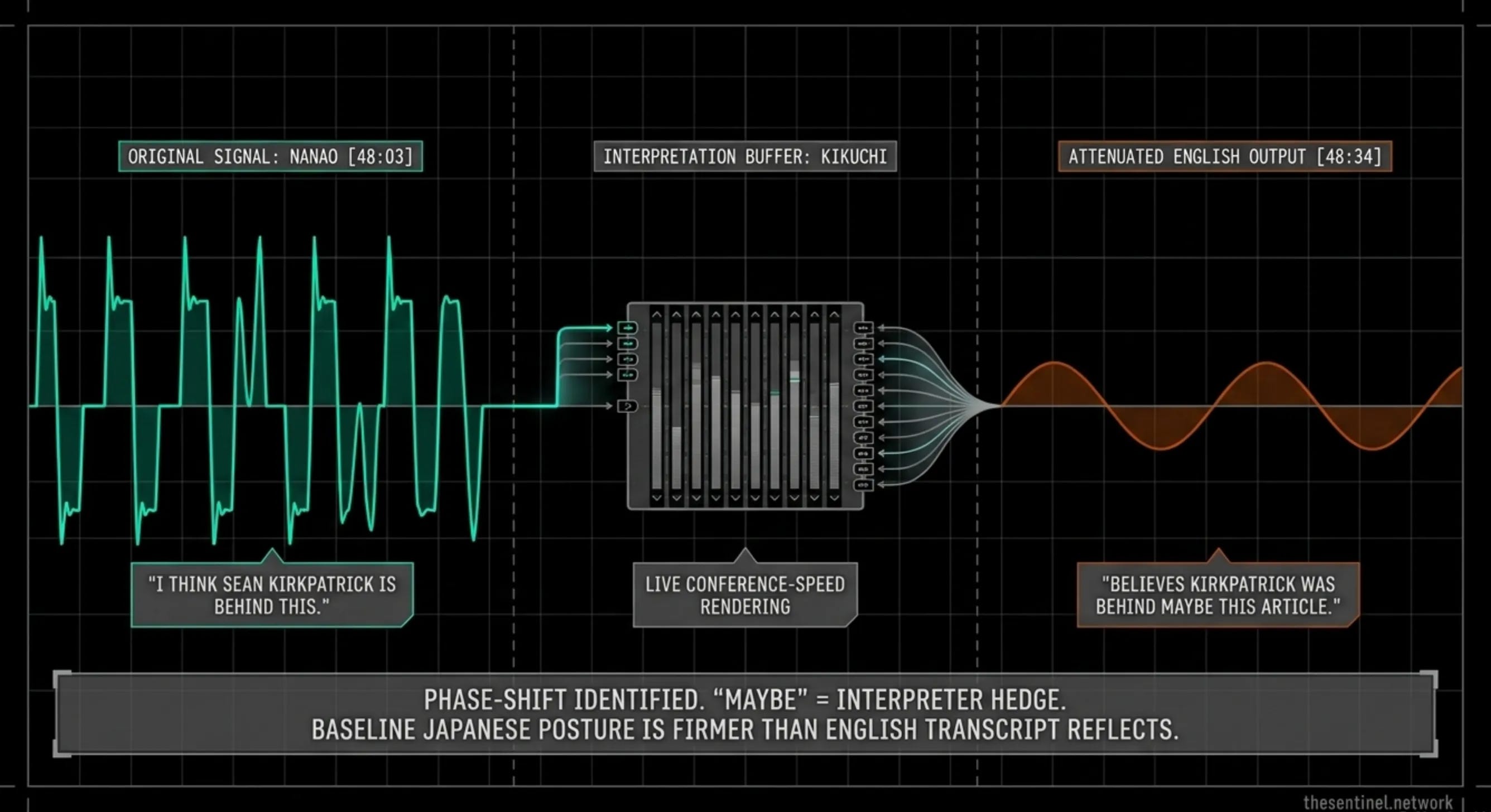
When Nanao said “I think Sean Kirkpatrick is behind this” at 48:03, Kikuchi rendered the claim to Michels at 48:34 as “Mr. Nanao said he believes that Kirkpatrick was behind maybe this article.”
The “maybe” is an interpreter’s hedge. It is not in the original Japanese claim. It softened the accusation by one degree before it reached the English-speaking guest.
This is not a criticism. Live conference-speed translation across two hours of substantive material on a sensitive topic is exceptionally difficult work, and Kikuchi handled it with skill. We note the moment because cross-language disclosure discourse inevitably includes small softenings and sharpenings in both directions, and being honest about that mechanic matters for anyone reading the English-language record. The Japanese caucus holds its positions slightly more firmly than the English translation reflects.
THE CULTURAL THROUGHLINE
Michels made an observation at 77:30 that is worth sitting with.
“For whatever reason, the Japanese became as interested as any other country, which I think speaks to some intuitive, visceral connection that the culture seems to have with this topic.”
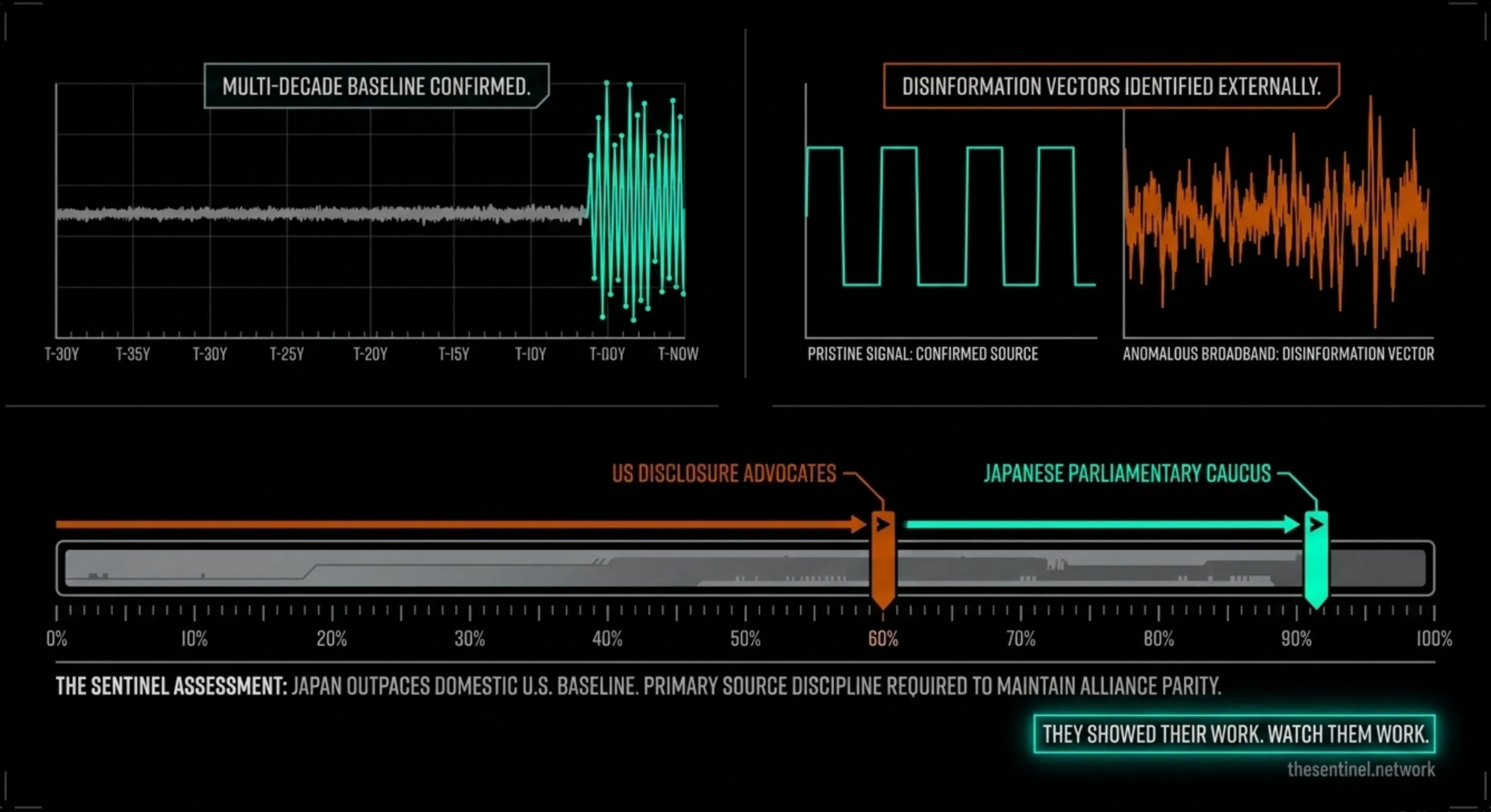
He was specifically talking about Bob Lazar’s immediate cultural uptake in Japan in the late 1980s. But the broader point stands across the interview. Japan’s engagement with the UAP topic is not new. It is not derivative. The Parliamentary Federation is building on decades of domestic interest that predates the modern American disclosure wave.
American readers who encounter Japan’s UAP caucus through English-language coverage tend to frame it as a response to recent American disclosure events. The interview shows the reverse is closer to true. Japan has been tracking this material, culturally and journalistically, for at least a generation. The current political moment is an inflection, not an origin.
THE PROMOTIONAL GAP
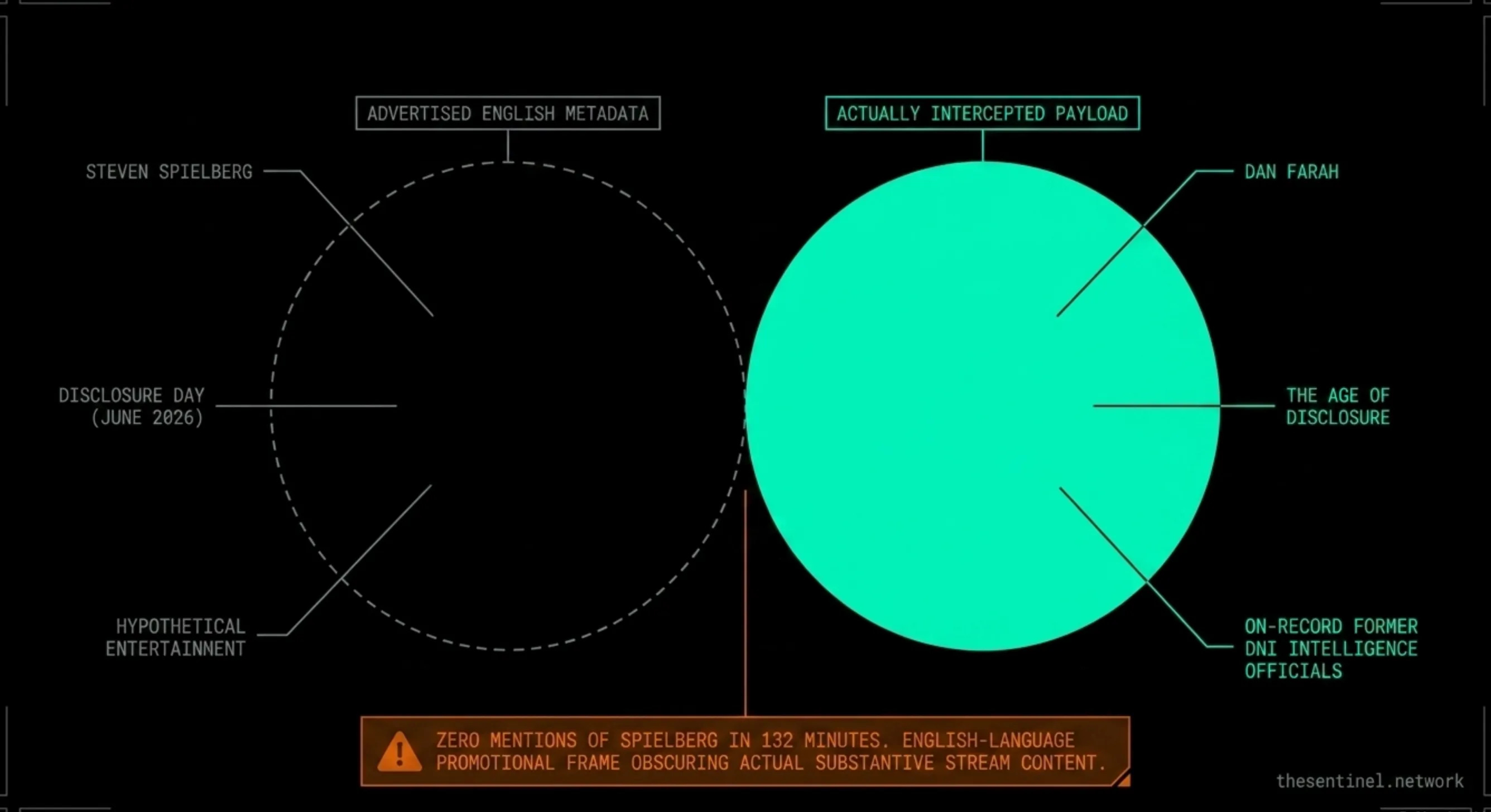
The NicoNico broadcast description advertised coverage of “Steven Spielberg’s upcoming film Disclosure Day (set for release in June 2026)” and how close the film might come to revealing real truths.
Spielberg was not discussed in the 132 minutes.
The film that actually came up was The Age of Disclosure, Dan Farah’s documentary, which is a different film by a different filmmaker with a different thesis. It is an existing documentary featuring named former intelligence officials on camera, not a hypothetical Spielberg production.
We note the gap because American readers who find the broadcast through the English promotional copy will arrive expecting content that is not in the stream. The actual content is, on its own terms, more substantive than the Spielberg framing would suggest.
WHAT THE 132 MINUTES ACTUALLY SHOW
An American disclosure advocate with significant audience reach traveled to Tokyo and briefed a Japanese political caucus and a Japanese national journalist on the current state of the U.S. conversation. The caucus and the journalist already knew most of it. They pressed on the weak points. They introduced their own analysis, including a specific named U.S. official as a suspected disinformation source. They drew connections between Japanese nuclear facility incidents and American ones. They referenced forty years of domestic Japanese UAP cultural history that most American disclosure figures have never encountered.
The interview is not an announcement. It is not a coordinated rollout. It is something quieter and, in its own way, more useful to watch. It shows what an informed foreign political caucus thinks about the American disclosure conversation, what questions they consider unanswered, and where they have already formed their own institutional judgments.
For American readers paying attention to the disclosure topic, the Japanese perspective in this broadcast is a sharper mirror than most English-language coverage provides. They are asking the questions we should be asking. They are naming the names we are reluctant to name. They are correlating the incidents we tend to treat separately.
THE SENTINEL ASSESSMENT:
Watch the broadcast. The interview is a useful primary source for one specific reason: it captures an American disclosure advocate explaining the U.S. landscape to a Japanese audience that is better prepared than most of his domestic viewers. Nanao's Kirkpatrick thesis did not require Michels to introduce it. Asakawa's caucus admission about internal reluctance is the kind of self-aware institutional candor that American caucus members rarely match. The Genkai and F.E. Warren parallel is an operational template other nuclear-adjacent jurisdictions will likely pick up. The dramatization of the Grusch and Garcia exchange is a reminder that retelling adds specificity the record does not contain, and that primary-source discipline is the difference between a durable case and one that collapses under the first hostile review. The Japanese questioners have already done that review. They showed their work. It is worth watching them work.
Three Japanese officials did the homework. An American podcaster delivered the talking points. The Congressional record was one tab away the whole time.
Keep looking up.
-- The Sentinel Network™
Every briefing we’ve published is free. That’s not changing. This publication has no institutional backing, no sponsors, and no editorial board. We’re doing the work the newsrooms won’t, sourcing papers, filing FOIAs, building tools, and writing at the pace a once-in-a-civilization event demands.
Paid subscribers fund the investigation directly. They also get access to THE SIGNAL (weekly market intelligence derived from our forensic work), primary source documents, the comment section on every briefing, Fieldcraft Labs, and the FIELDCRAFT series. No ads. No sponsors. No strings. Your subscription is a data point against the suppression gradient.
If you can’t subscribe, we don’t care. Read everything. Share everything. The mission is the mission.
Subscribe to The Sentinel Network™
A top 100 Science publication on Substack.
Share this investigation. THE SUPPRESSION GRADIENT documented what happens when this coverage reaches platforms that do not want you reading it. Every share, every restack, every forwarded link is a data point against the gradient.
Previous briefings: THE ARCHITECT | THE FLOOR | THE RECORD | THE OPERATOR | THE PUBLICATION GAP | THE VERDICT | THE MALMSTROM OVERRIDE | THE GHOST GENERAL | THE LONG COUNT | THE GREEN BURIAL | THE BLIND SPOT | THE SUPPRESSION GRADIENT
Michels did misstate who the questioner was, it was not AOC but Garcia. See page 19 of the congressional record:
Mr. GARCIA. And where?
Mr. GRUSCH. I know the exact locations and those locations were
provided to the Inspector General and some of which to the intel-
ligence committees. I actually had the people with the firsthand
knowledge provide a protected disclosure to the Inspector General.
“For whatever reason, the Japanese became as interested as any other country, which I think speaks to some intuitive, visceral connection that the culture seems to have with this topic.”
Japan, more than any other nation on Earth, knows the stakes that are involved. In August, 1945, no one could quite wrap their heads around atomic power. It went from the realm of an abstract possibility into a nightmare reality for the people of Hiroshima and Nagasaki, and all of Japan. No other country has had that experience. That probably opens them up more to the reality of possibilities.