

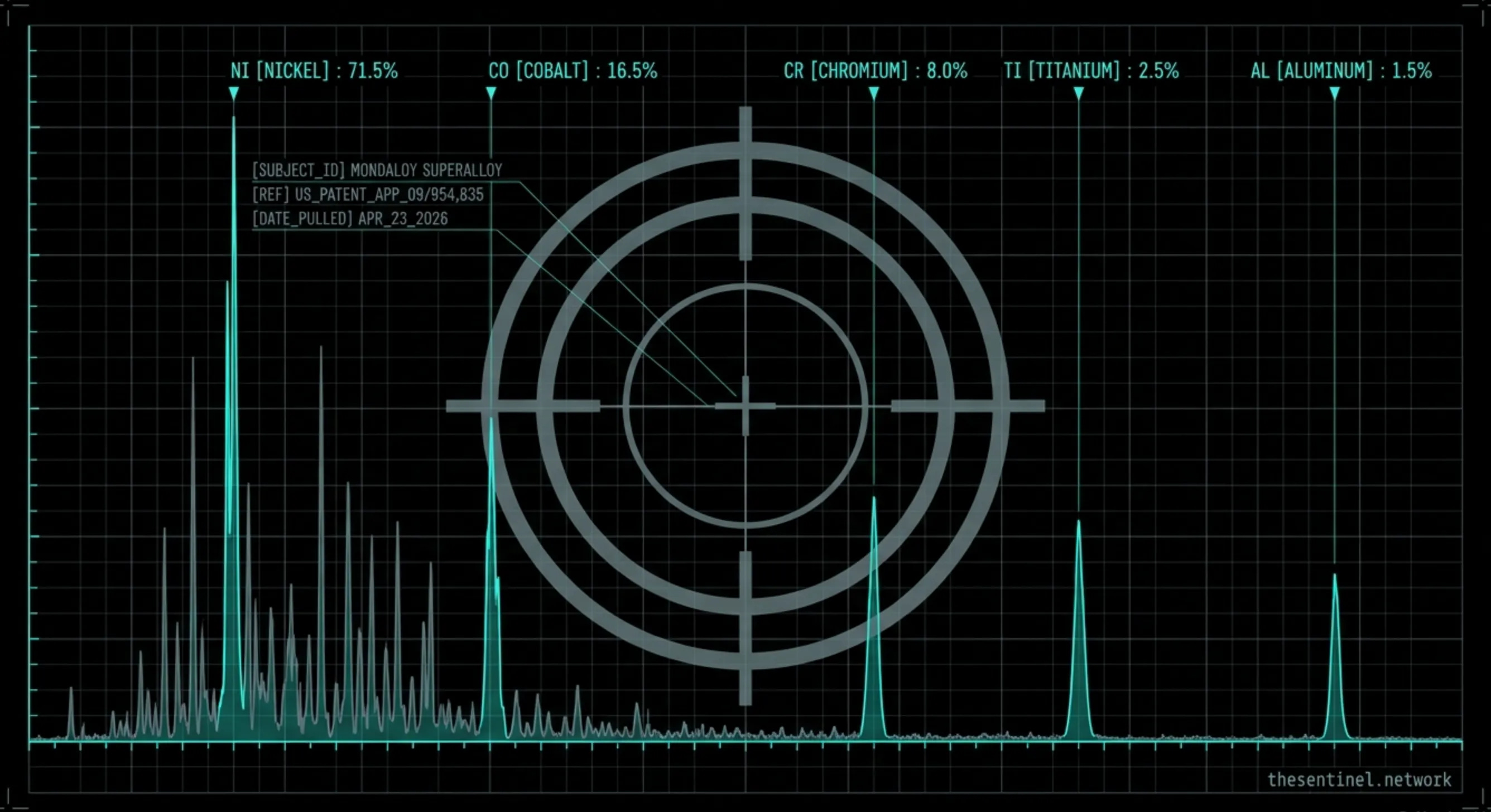
SUBJECT: MONDALOY SUPERALLOY FAMILY / US PATENT APPLICATION 09/954,835 (ABANDONED DEC 2012) / USPTO TRADEMARK 78970097 (ABANDONED JUL 2007) / RUSSIAN PATENT RU2301276C2 (GRANTED JUN 2007) / AR1 ENGINE PROGRAM (2014-2018) / WHITE HOUSE FEDERAL REVIEW (APRIL 17, 2026)
DATE: APRIL 23, 2026
CROSS-REF: THE GREEN BURIAL | THE LONG COUNT | THE GHOST GENERAL | THE DEAD DROP | THE PHONE GAP | THE BLIND SPOT | THE ARCHITECT | THE ATTRITION SERIES
DATA CONFIDENCE: HIGH. PRIMARY SOURCES: USPTO PATENT CENTER, USPTO TRADEMARK STATUS AND DOCUMENT RETRIEVAL, SEC EDGAR 10-K AND 10-Q FILINGS, DEPARTMENT OF DEFENSE CONTRACT ANNOUNCEMENTS, ROSPATENT PUBLIC DATABASE, KRATOS DEFENSE 8-K FILINGS, L3HARRIS PURCHASE-PRICE ALLOCATION ACCOUNTING. WHITE HOUSE PRESS SEQUENCE (APRIL 15-17, 2026) CROSS-VERIFIED AGAINST WJLA / NEWSNATION / IRISH STAR / FOREIGN POLICY JOURNAL REPORTING.
We are building the video side of this operation. If you want the briefings in a format you can watch, subscribe to The Sentinel Network on YouTube.
THE QUESTION
Last week, the White House confirmed a federal review of ten missing or dead American scientists. One of the names on that list invented Mondaloy. Another funded the engine built around it. The co-inventor is not on the list. She died of cancer in 2014.
Mondaloy is the thread. This briefing is the paper trail.
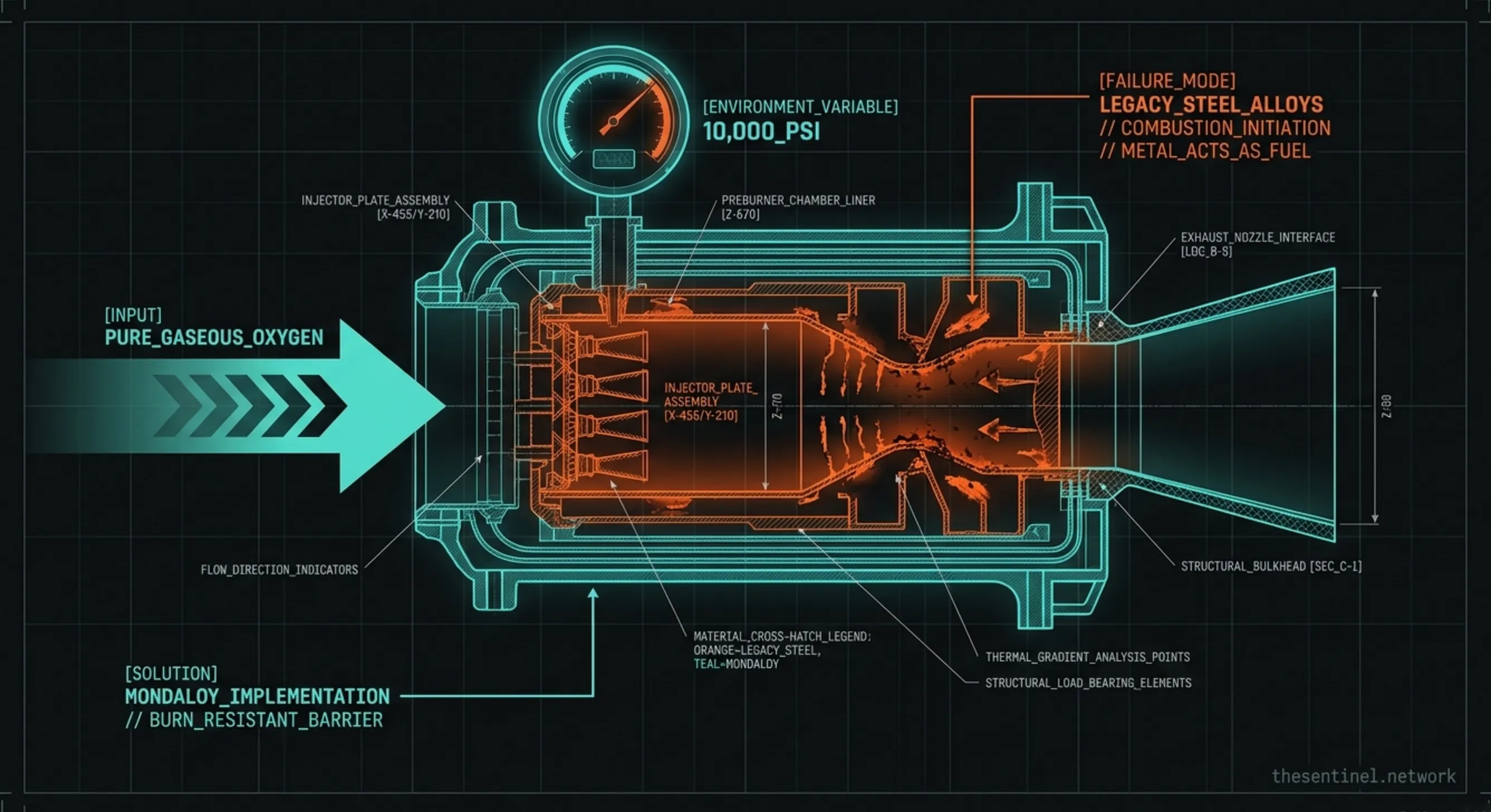
Mondaloy is a family of burn-resistant, high-tensile-strength nickel-based superalloys. Two metallurgists at Rockwell International‘s Rocketdyne division invented it in the mid-1990s: Monica Jacinto (later Reza) and Dallis Hardwick. The United States needed a material that could survive inside a rocket engine design called oxygen-rich staged combustion. Every existing American alloy burned like paper in the high-pressure gaseous oxygen that cycle produces.
Russia had the design. America did not. The Russian RD-180 engine, manufactured by NPO Energomash, carried American national security payloads into orbit on the Atlas V rocket. It was the most efficient rocket engine in the world. The Russians had solved the oxygen-rich materials problem decades earlier.
Mondaloy was the American answer. It would let the United States build its own oxygen-rich staged combustion engine and stop handing cash to Moscow every time a spy satellite needed a ride.
That is the textbook answer, the paragraph you would have read in a defense trade journal in 2017.
The real answer is worse. The patent record shows what happened to Mondaloy after the press releases stopped.
THE PROBLEM IT SOLVED
To understand why Mondaloy existed, you have to understand why most metal burns.
Imagine a kitchen blowtorch. Turn the gas knob until the flame is the size of a car. Now hold a steel spoon in it. The spoon does not melt. It burns. Steel in pure oxygen at high pressure is not a solid you heat up. It is fuel.
In oxygen-rich staged combustion, most of the engine’s liquid oxygen burns first inside a smaller chamber called a preburner. The result is a high-pressure oxidizing gas that spins the turbines. That drive gas is a blowtorch pointed at every metal component downstream.
American engine makers spent thirty years avoiding the design. The Russians solved it, and their engines made more thrust per pound of fuel than anything in the American inventory.
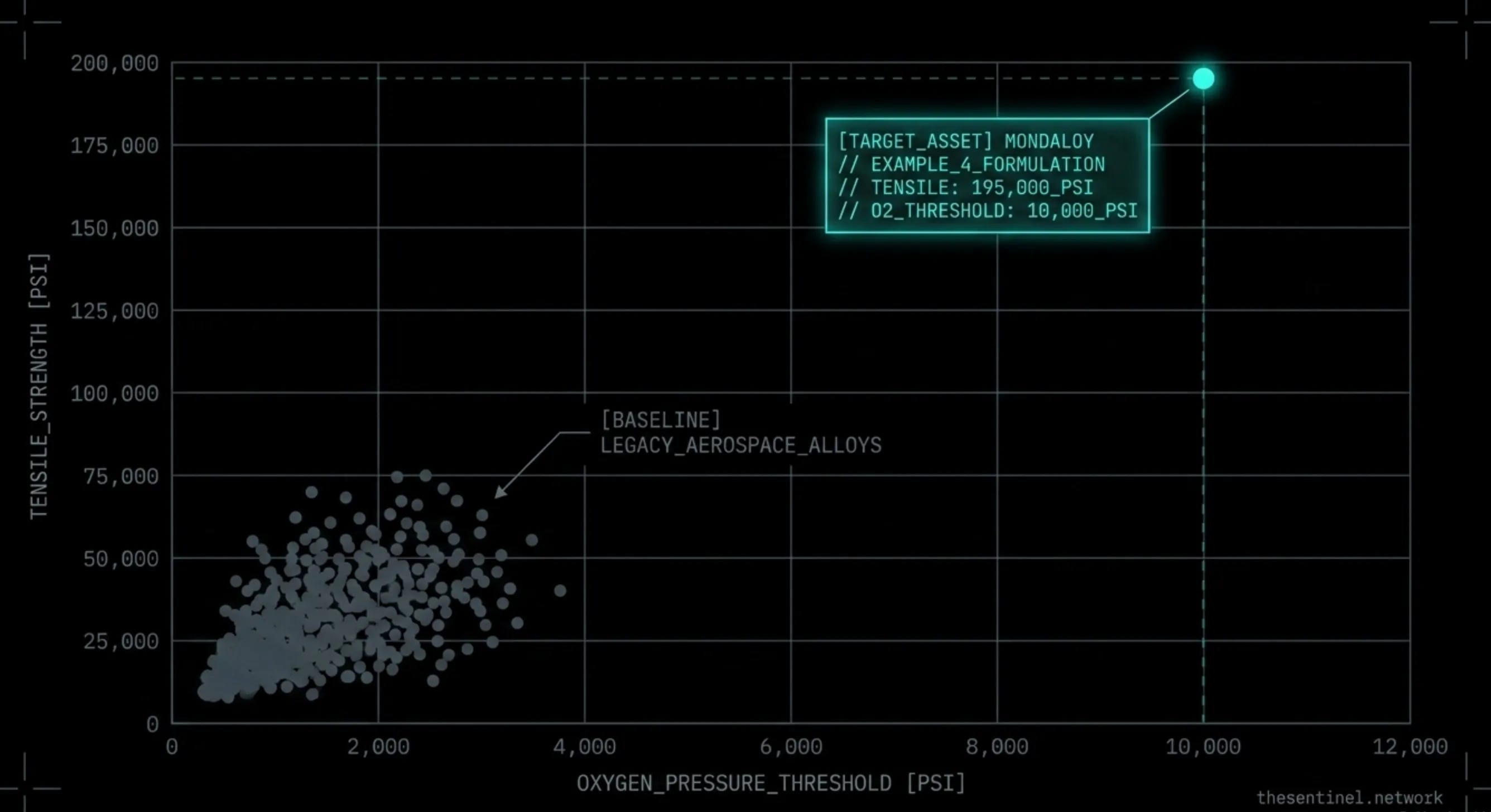
The Mondaloy patent itself describes the specific performance numbers. Example 1 in the filing: an alloy composed of 71.5 percent nickel, 16.5 percent cobalt, 8 percent chromium, 2.5 percent titanium, and 1.5 percent aluminum. That alloy survives at up to 10,000 pounds per square inch of gaseous oxygen pressure. It holds a tensile strength of 170,000 pounds per square inch. Example 4 in the same filing pushes tensile strength to 195,000 psi. Those are not incremental improvements. They are rewrites of what American materials science believed was possible.
The alloy worked.
The Air Force Research Laboratory‘s Hydrocarbon Boost Technology Demonstrator program ran it through full-power, full-duration hot-fire testing at Edwards Air Force Base in 2016. Aerojet Rocketdyne additively manufactured a preburner from it in 2017 and passed Critical Design Review for the AR1 engine. Twelve major components of the AR1 were to be built from Mondaloy.
Congress mandated it. Section 1604 of the Fiscal Year 2015 National Defense Authorization Act required development of a domestic next-generation rocket propulsion system to end reliance on Russian engines for national security launches.
The Air Force awarded Aerojet Rocketdyne an Other Transaction Authority agreement for the AR1 on February 29, 2016, with a base value of $115.3 million, modified in 2018 with an additional $69.8 million. Aerojet’s own Securities and Exchange Commission filings disclosed cumulative AR1 research and development costs of $236.6 million through the third quarter of 2017 alone. The government was paying. The contractor was paying. The material was maturing.
And then the story gets strange.
THE CHAIN OF CUSTODY
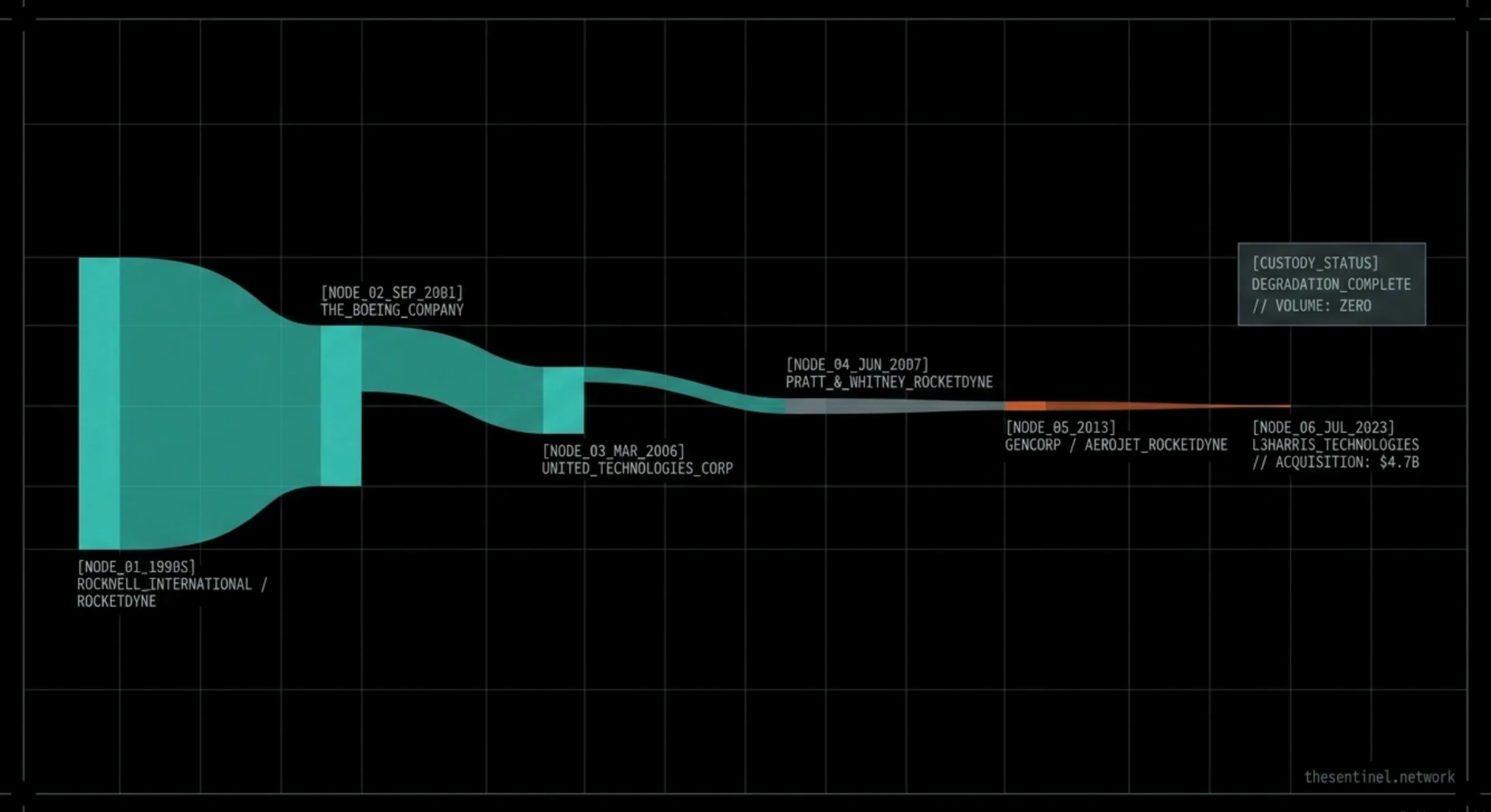
A strategic material under active federal development should have a clean chain of custody. Mondaloy’s is a relay race run by corporations that kept dropping the baton.
Monica Jacinto and Dallis Hardwick signed over their rights to The Boeing Company on September 18, 2001. Boeing owned Rocketdyne at the time. Public USPTO record.
Boeing transferred the intellectual property to United Technologies Corporation through two separate assignments recorded on March 27, 2006 and May 16, 2006. UTC had just bought the Rocketdyne division the year before.
UTC then transferred it to its subsidiary Pratt & Whitney Rocketdyne on June 19, 2007.
In 2013, UTC sold Pratt & Whitney Rocketdyne to GenCorp Inc., which merged it with its existing Aerojet subsidiary to form Aerojet Rocketdyne Holdings.
In July 2023, L3Harris Technologies bought Aerojet Rocketdyne for $4.7 billion.
Five corporate owners across 22 years. Each handoff introduced the same question: who is actually responsible for protecting the intellectual property of this strategic material? The patent record shows the answer.
Nobody.
THE PATENT THE USPTO KILLED
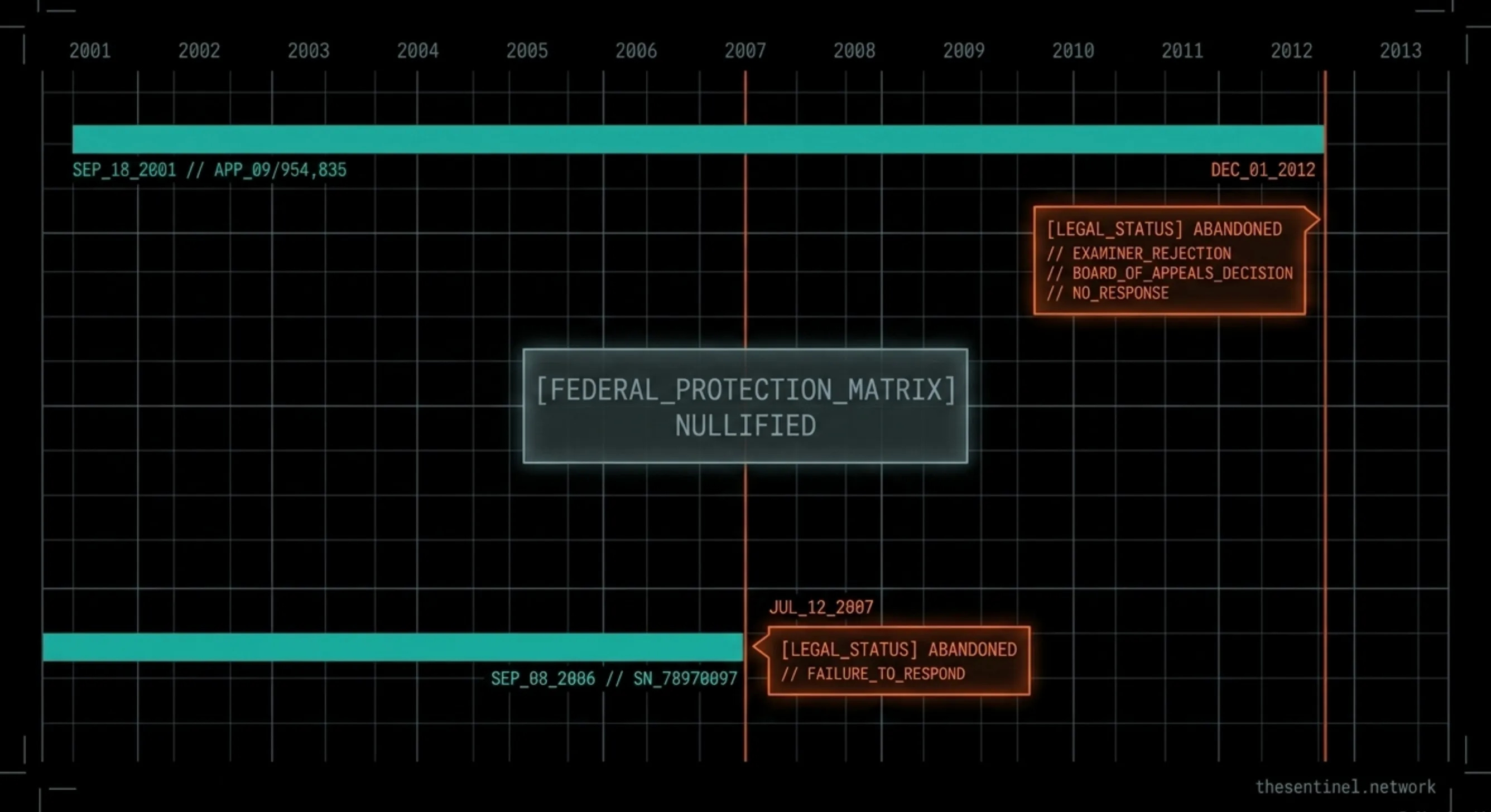
On September 18, 2001, Jacinto and Hardwick filed US patent application 09/954,835, titled “Burn-resistant and high tensile strength metal alloys.” Boeing refiled the application in 2004 as 10/769,195 and again in 2009 as 12/626,205, published as US20100266442A1. Each refiling kept the same priority date. That is normal practice. What happened to the final version is not.
On December 1, 2012, the USPTO recorded the following legal status on the Mondaloy composition patent: ABANDONED AFTER EXAMINER’S ANSWER OR BOARD OF APPEALS DECISION.
Translate that phrase. An examiner at the Patent Office rejected the claims. Pratt & Whitney Rocketdyne’s attorneys filed an appeal to the Patent Trial and Appeal Board. The Board either ruled against them or issued an examiner’s answer they could not overcome. The company stopped responding. The patent died.
A prosecution loss. Not a secrecy order. Not a strategic maneuver. A rejection their lawyers could not defend.
By the time this happened, UTC was selling Pratt & Whitney Rocketdyne to GenCorp. The GenCorp/Aerojet deal closed in June 2013, six months after the patent death. Nobody revived it. Nobody refiled it. The composition of Mondaloy entered the public domain, unprotected, in a moment of corporate distraction.
The trademark died the same way.
Pratt & Whitney Rocketdyne filed MONDALOY as a trademark on September 8, 2006, serial number 78970097, with a claimed first use in commerce of June 5, 2005. The category covered metal forgings, metal powder, and rolled or extruded nickel alloys.
The USPTO abandoned the trademark on July 12, 2007, reason: FAILURE TO RESPOND OR LATE RESPONSE.
Let that land. The American owner of the proprietary superalloy filed a trademark, then failed to respond to a routine office action. The mark died within ten months. Every press release issued since 2007 that calls the material “Mondaloy™” is using a common-law mark. There is no federal trademark registration behind it. There never was.
THE SENTINEL ASSESSMENT:
The American corporations entrusted with the intellectual property for the alloy designed to end dependence on Russian rocket engines did not protect it. They abandoned the trademark in 2007. They lost the patent family at the Patent Trial and Appeal Board in 2012. They never published a standardized material specification through ASTM or SAE. They never obtained a specific export control classification. The ™ in the press releases is a legal shadow.
THE RUSSIAN FILE
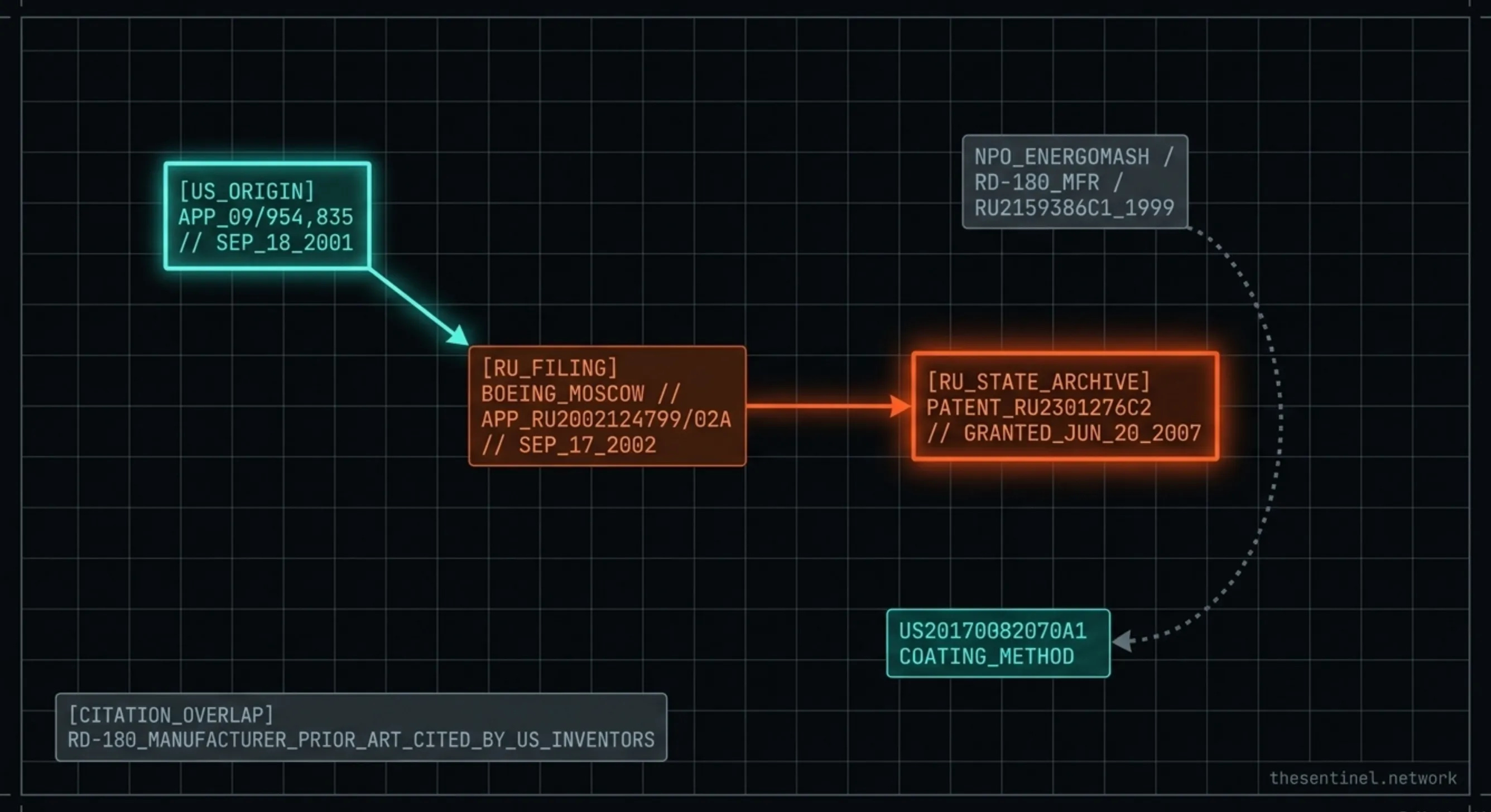
On September 17, 2002, exactly twelve months after the US priority filing, Boeing filed a Russian counterpart with Rospatent under application number RU2002124799/02A. Boeing had inherited the IP from Rocketdyne. Filing in Russia within the twelve-month Paris Convention window is a standard move to preserve international priority rights.
Consider the moment. In September 2002, the Russian-built RD-180 was flying American national security payloads on the Atlas V. The United States was years away from a domestic replacement. The entire strategic rationale for Mondaloy was the RD-180 dependence problem.
Boeing filed the composition in Russian anyway.
The Russian state examined the application and granted it. On June 20, 2007, Rospatent issued Russian Patent RU2301276C2. A Russian examiner translated the full composition of Mondaloy into Russian and filed it in the state archive.
That patent is today listed in the Rospatent database with the status IP Right Cessation, which typically indicates the holder stopped paying maintenance fees. The grant itself, and the disclosure that made it possible, are permanent. A Russian patent that issued cannot be uninvented. The composition exists in the Russian archive.
Now the second layer.
Florida Turbine Technologies filed a patent in 2014 for a method of coating liquid oxygen pumps with Mondaloy powder, US20170082070A1. Its prior-art citations include a 1999 Russian patent: RU2159386C1, “Composition for making cermet coat,” assigned to Open Joint-Stock Company NPO Energomash named for V.P. Glushko.
NPO Energomash builds the RD-180. The American engineers patenting a Mondaloy coating process cited as background the cermet-coating patent of the Russian company that manufactures the very engine Mondaloy was invented to replace.
The American and Russian lineages for oxygen-compatible engine coating chemistry are not separate family trees. They share branches in the patent record.
THE SENTINEL ASSESSMENT:
The alloy designed to end American dependence on Russian rocket engines sits in the Russian state archive, translated and granted nineteen years ago. The downstream American coating-application patent cites the RD-180 manufacturer’s own cermet-coating patent as prior art. These are not conspiracy claims. They are citations in the US Patent and Trademark Office’s own database.
THE SECOND TRACK
Mondaloy has a second intellectual property line. Nobody has written about it before now.
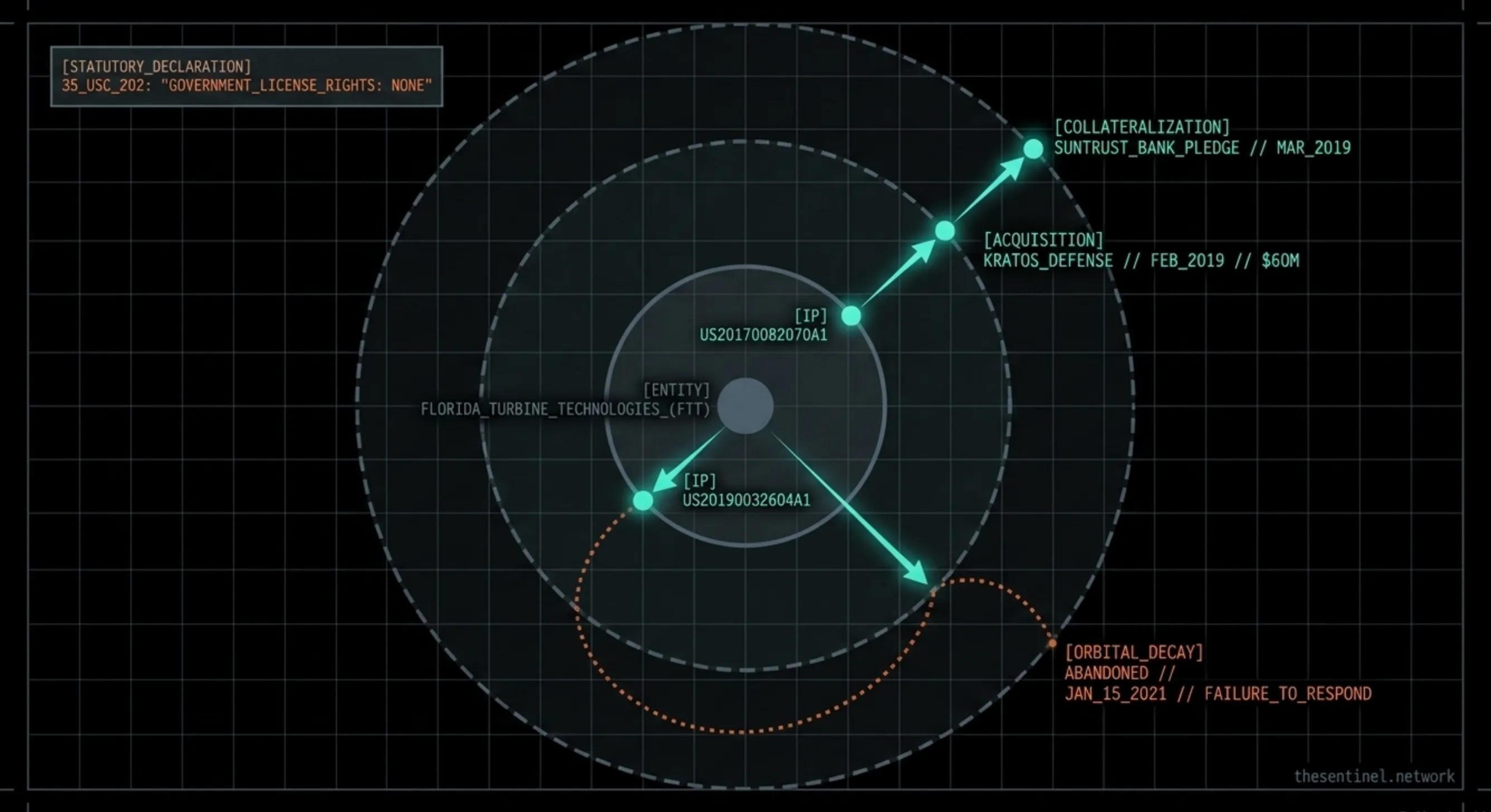
Florida Turbine Technologies, a small turbomachinery company in Jupiter, Florida, filed a provisional patent on April 17, 2012, for a process that applied Mondaloy powder with an enamel glass overlayer to protect liquid oxygen turbopumps. The provisional misspelled the material as “MONDALLOY.” The 2014 parent application corrected the spelling.
FTT’s coating patents US20170082070A1 and US20190032604A1 named five inventors: Timothy J. Miller, Alex Pinera, Stephen M. Brooks, John W. Appleby Jr., and Timothy G. Leonard. None of them appear on the Jacinto and Hardwick composition patent.
Leonard’s presence on the list is worth pausing on. He is a former Pratt & Whitney Rocketdyne engineer who co-authored foundational research on the Common Extensible Cryogenic Engine program, NASA’s deep-throttling liquid oxygen/liquid hydrogen architecture for lunar lander descent stages. He knew the Rocketdyne engine family from the inside. He then appears on a patent, at a different small company, for coating liquid oxygen turbopumps with powder of the alloy his former employer’s successor company still claimed to own. FTT was not an outside shop stumbling onto Mondaloy chemistry. It was former Rocketdyne hands patenting application methods for the material Rocketdyne had failed to protect.
Neither Aerojet Rocketdyne nor any Rocketdyne successor company ever owned these coating patents. Florida Turbine Technologies did.
On February 28, 2019, Kratos Defense & Security Solutions, the NASDAQ-listed defense contractor that builds tactical drones and small turbine engines, announced it had acquired 80.1 percent of Florida Turbine Technologies and FTT Core LLC for $60 million.
Six days later, Kratos pledged the FTT patent portfolio, including the Mondaloy coating patents, as collateral to SunTrust Bank. The recorded USPTO assignment lists seven entities as assignors: Consolidated Turbine Specialists LLC, Elwood Investments LLC, Florida Turbine Technologies Inc., FTT America LLC, KTT Core Inc. (the new Kratos Turbine Technologies subsidiary), S&J Design LLC, and Turbine Export Inc.
The coating patent US20170082070A1 carries a clause that tells you everything:
GOVERNMENT LICENSE RIGHTS: None.
That is the declaration required by 35 US Code 202 when no federal funds touched the invention. FTT asserted, on the record at the Patent Office, that the United States government had no licensing rights in this Mondaloy-coating method.
The patent was abandoned on January 15, 2021, reason: FAILURE TO RESPOND TO AN OFFICE ACTION. FTT’s legal team stopped replying to the examiner. The security interest was released in March 2022 when Truist Bank, which had absorbed SunTrust, freed the collateral.
Only one patent in the FTT family survived prosecution: US10634153B1, a manufacturing method for a single-piece turbopump housing. That patent does not contain any Mondaloy claim limitation.
The coating process the FTT engineers tried to patent to put Mondaloy on liquid oxygen turbopumps is now owned by nobody.
THE ZERO VALUATION
In July 2023, L3Harris Technologies completed its $4.7 billion acquisition of Aerojet Rocketdyne. Federal accounting rules required L3Harris to tell the Securities and Exchange Commission exactly what it had bought, broken into categories: tangible property, goodwill, and specific intangibles such as customer relationships, trade names, and developed technologies.
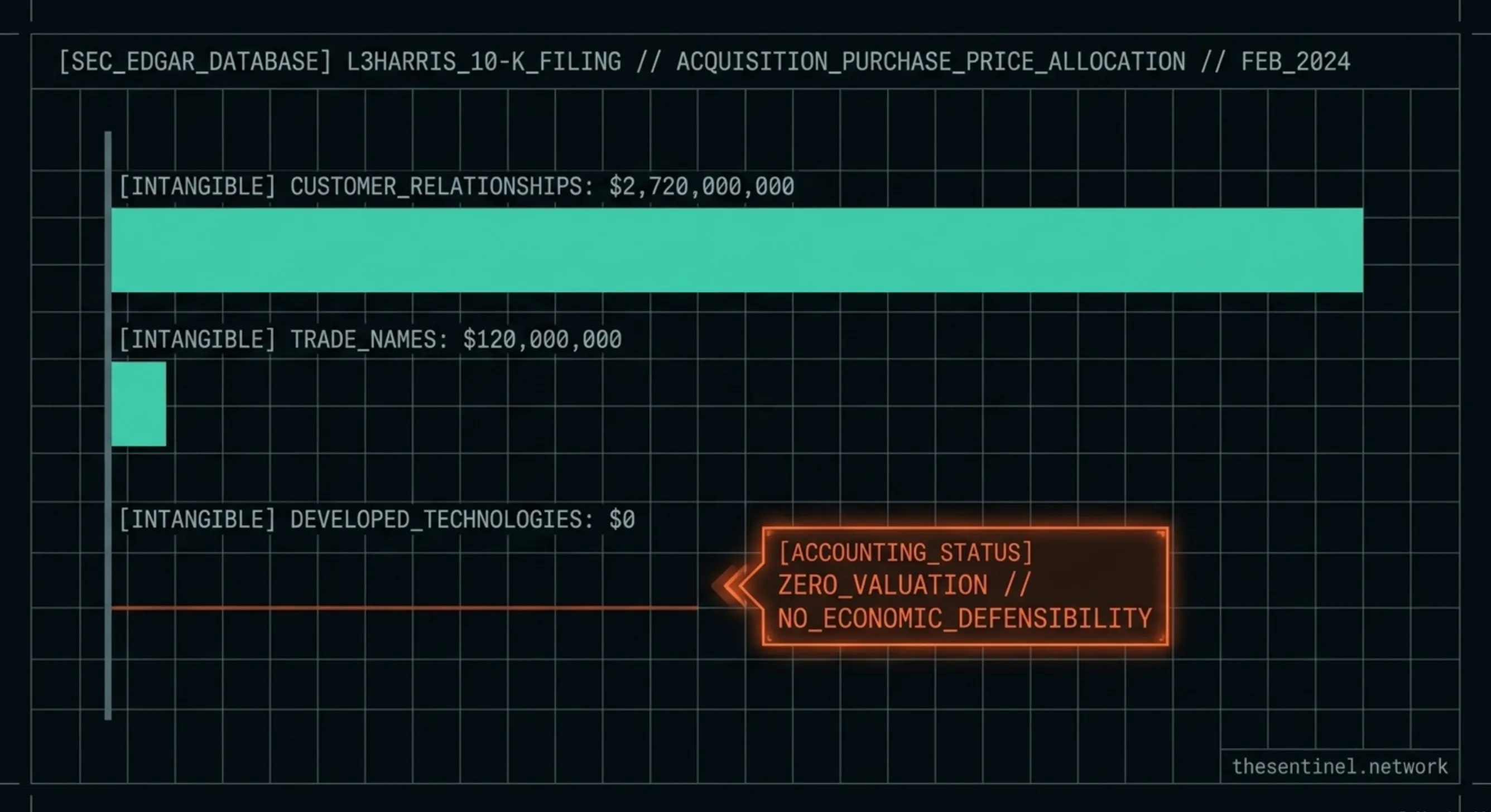
The L3Harris 2023 10-K (filed in February 2024) identifies the following intangible assets for the Aerojet Rocketdyne acquisition:
Customer relationships: $2,720 million.
Trade names: $120 million.
Developed technologies: zero dollars.
L3Harris’s accountants reviewed the full propulsion and energetics intellectual property portfolio of Aerojet Rocketdyne, including the Mondaloy family, and assigned no standalone value to any of it. The entire intangible value of the acquired company, on the acquirer’s books, is a list of customers and a set of names to print on boxes.
Three explanations are possible. The first: the IP had no defensible economic value separable from the customer relationships. The second: the IP had expired or been commoditized beyond the point where accounting standards allow it to be booked as an asset. The third: the IP in question had already died at the Patent Office eleven years earlier, so there was nothing left to book.
All three converge on the same conclusion.
THE SENTINEL ASSESSMENT:
The acquirer of Mondaloy’s intellectual property portfolio recorded the entire developed-technology inventory of Aerojet Rocketdyne at zero dollars. Not undervalued. Zero. This is a legal financial disclosure filed with the Securities and Exchange Commission under penalty of fraud. On the books of the company that now owns it, Mondaloy has no separately recognized value.
THE KNOWLEDGE
Here is the part no institution knows how to measure.
The composition of Mondaloy is a recipe that can be read in a published patent. Anyone with a graduate degree in metallurgy can match the weight percentages. That is cookbook chemistry.
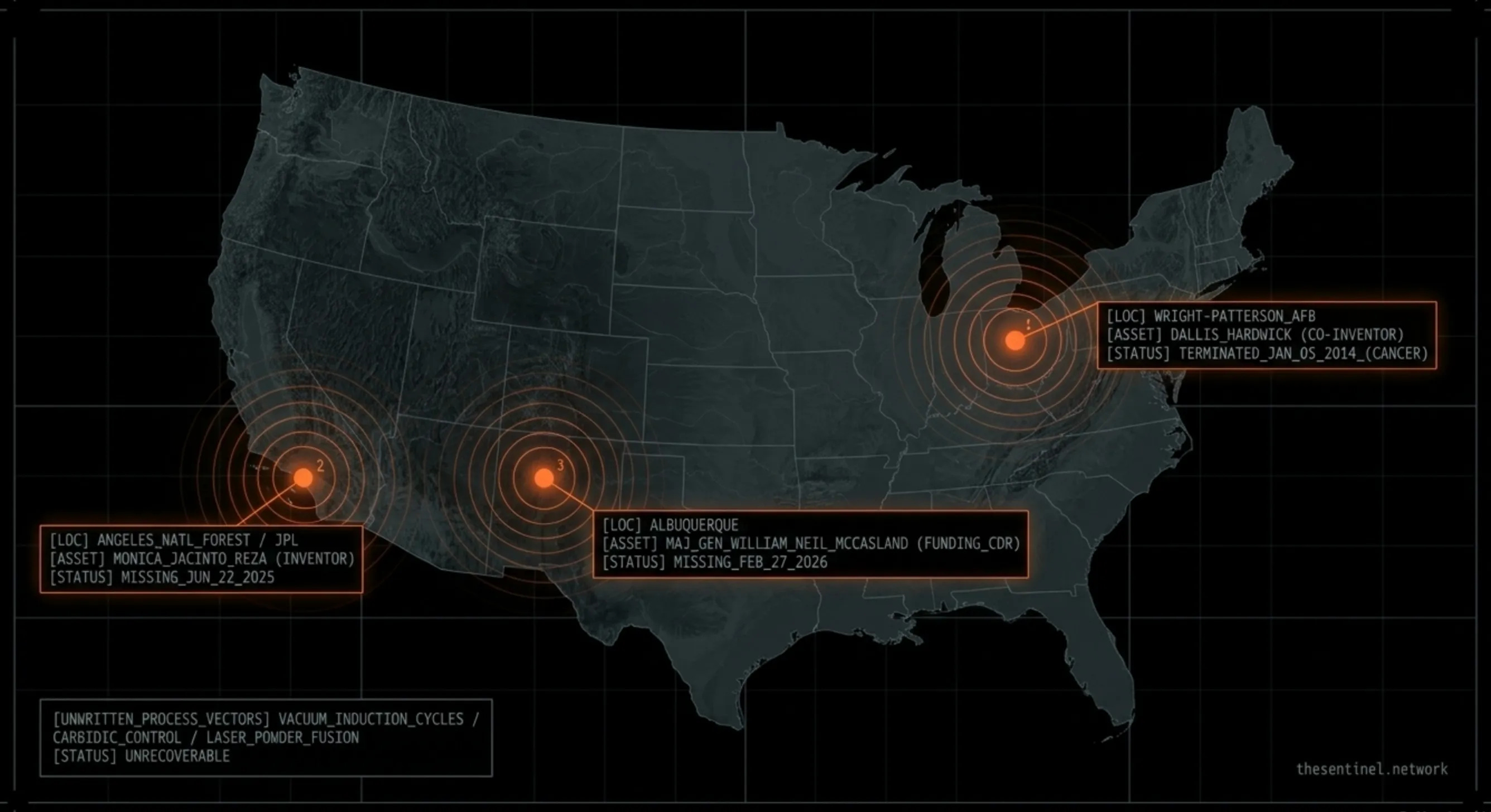
Making the alloy is not cookbook chemistry. The difference between a published composition and a flight-qualified rocket engine component is twenty years of process development. It is the specific vacuum induction melt cycle. The aging temperatures. The grain-boundary carbide control. The trace-element tolerances that prevent micro-cracking during laser powder bed fusion. The heat-treatment schedule that gets you to 195,000 psi tensile strength instead of 140,000. The way you machine it without galling the cutting tool. The way you weld it without hot cracking. The surface preparation that makes a coating stick without delaminating in the first thermal cycle.
None of that is in the patent. None of it is in the trademark. None of it is in the L3Harris 10-K. It lives in human heads. When those heads retire or die or disappear, the United States has no written backup.
Two people held the complete manufacturing chain for Mondaloy from laboratory composition through flight-qualified hardware.
Other Aerojet Rocketdyne executives ran the AR1 and HBTD programs. Julie Van Kleeck was the VP of Advanced Space and Launch Programs. Joe Burnett was the HBTD program manager. Eileen Drake was the CEO. They managed the budgets, signed the press releases, and took the public credit. None of them could walk into a lab and make Mondaloy. Only Reza and Hardwick could.
Dallis Hardwick died of cancer on January 5, 2014, four months after retiring from the Air Force Research Laboratory.
Monica Jacinto Reza vanished while hiking in the Angeles National Forest on June 22, 2025. She had moved from Aerojet Rocketdyne to NASA’s Jet Propulsion Laboratory roughly a year earlier, after the L3Harris acquisition. The Los Angeles County Sheriff’s Department has never publicly released her cell phone forensic record. We documented all of this in THE GREEN BURIAL, THE LONG COUNT, and THE PHONE GAP.
Major General William Neil McCasland commanded the Air Force Research Laboratory from 2011 to 2013, the period when Mondaloy’s government-side maturation funding ran through AFRL. He walked out of his Albuquerque home on February 27, 2026 and has not been seen since. We documented him in THE GHOST GENERAL.
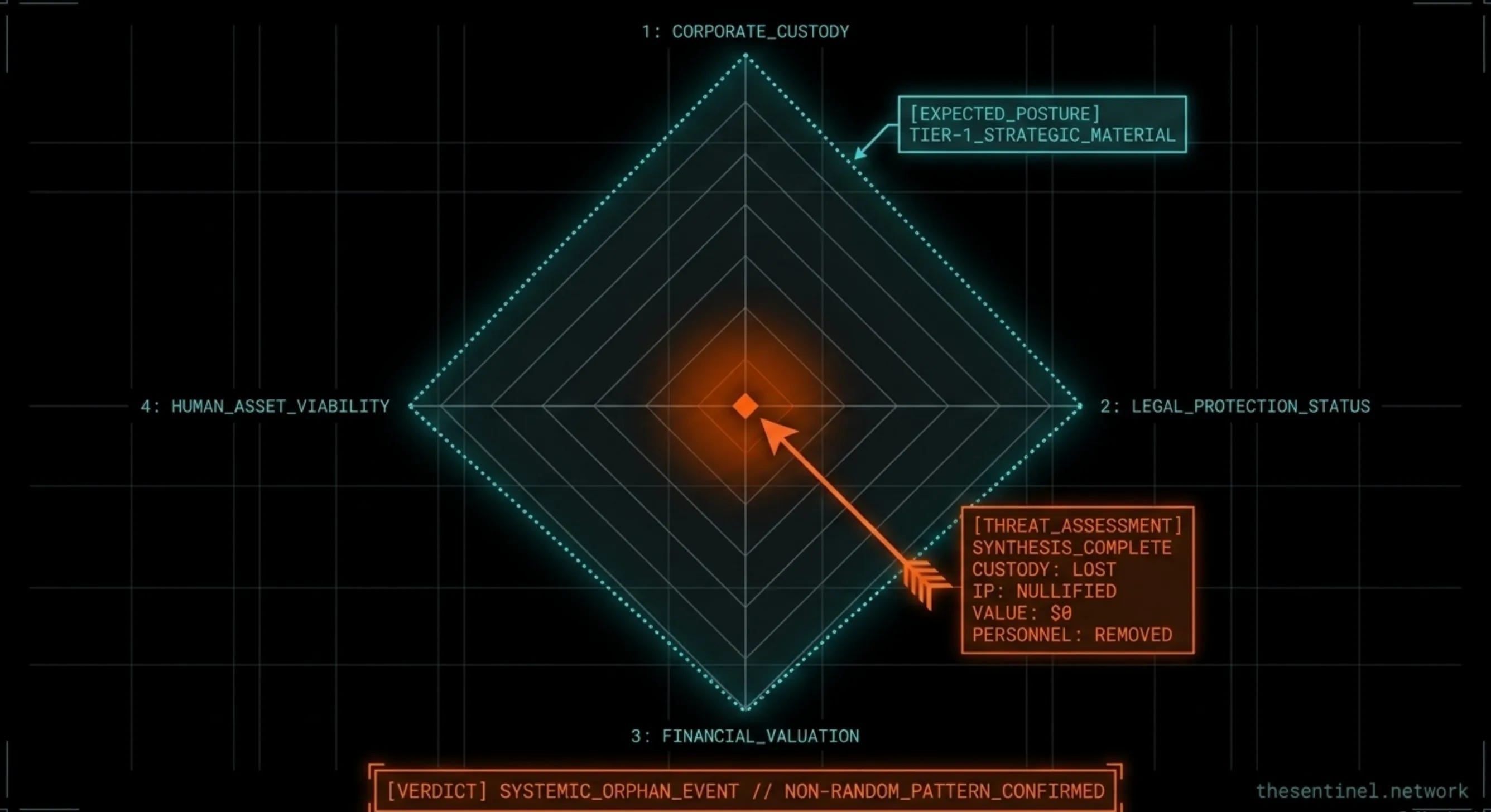
Hardwick is dead. Reza is missing. McCasland is missing. The patent family is abandoned. The trademark is abandoned. The Russian state has a copy of the recipe. The acquirer has booked the IP at zero.
That is what orphaned means, in the specific case of a strategic material.
THE PATTERN
If you read this briefing as a standalone piece about a superalloy, the story is a case study in how American industrial strategy abandons its own strategic assets. That is a story worth telling on its own. It belongs in a graduate seminar on defense industrial base policy.
It is not the only story Mondaloy tells.
THE LONG COUNT and THE WITNESS together track thirteen names across the defense, aerospace, and national security research communities who have died or disappeared in a twenty-two-month window beginning May 2024. Three of those names have a documented institutional relationship to Mondaloy: Hardwick (co-inventor, dead), Reza (inventor, missing), McCasland (funder, missing).
The roster concentrates heavily at Wright-Patterson. Six of the thirteen names have direct institutional ties to that base. Matthew James Sullivan, a U.S. Air Force intelligence officer, served at the base’s National Air and Space Intelligence Center. Rep. Eric Burlison named him on Fox News last Friday as a UAP whistleblower scheduled to testify to Congress; within two weeks of being scheduled, on May 12, 2024, he was dead. Sullivan’s death is the earliest documented in the pattern. The Wright-Patterson triple homicide of October 25, 2025 took three more AFRL employees in a twelve-hour window, on the same base where Hardwick spent her career and where McCasland commanded. The roster also includes Carl Grillmair, the Caltech astronomer killed on his porch in Pasadena eleven days before McCasland disappeared, who worked on instruments at the same JPL facility where Reza had taken a job before she vanished.
The pattern is not a claim of coordination. The pattern is a documented temporal and institutional concentration that American law enforcement cannot see, because the cases are distributed across different jurisdictions, different agencies, and different cause-of-death categories.
Mondaloy sits at the center of that pattern not because it caused the pattern, but because the same institutional ecosystem that failed to protect the alloy has failed to protect the humans who knew how to make it.
THE WHITE HOUSE
Last week, on Wednesday April 15, 2026, Fox News senior White House correspondent Peter Doocy pressed Press Secretary Karoline Leavitt at the daily briefing. He asked about ten American scientists who had died or gone missing since mid-2024 with ties to classified nuclear or aerospace research. He asked whether any investigation was underway.
Leavitt had no substantive answer. “I haven’t spoken to our relevant agencies about it. I will certainly do that, and we’ll get you an answer.”
The next day, April 16, President Trump spoke to reporters on the South Lawn before departing for Las Vegas. He called the situation “pretty serious stuff.” He said he had “just left a meeting on that subject.” He said he hoped it was random.
On April 17, Leavitt posted on X: “In light of the recent and legitimate questions about these troubling cases, and President Trump’s commitment to the truth, the White House is actively working with all relevant agencies and the FBI to holistically review all of the cases together and identify any potential commonalities that may exist. No stone will be unturned in this effort.”
Two names on the federal list are Monica Jacinto Reza and William Neil McCasland.
The White House now has what the American news cycle calls a ten-scientist mystery. What the White House does not appear to have, at least not in anything its press operation has disclosed, is the patent trail.
This briefing is the patent trail.
THE FINAL ACCOUNTING
The United States spent thirteen years and at least $236 million of disclosed R&D on an alloy built to end dependence on Russian rocket engines.
The commercial engine program the alloy was built for lost to a competitor in 2018. United Launch Alliance selected Blue Origin’s BE-4 over the AR1 to power its Vulcan rocket. The AR1 never flew.
The composition patent died at the Patent Trial and Appeal Board in 2012.
The trademark died at the USPTO in 2007.
The Russian state has the full composition on file in Russian, granted in 2007.
The coating-application patents ended up inside a small tactical-drone company, collateralized to a commercial bank, then abandoned at the Patent Office in 2021.
The acquirer of the primary corporate owner booked the entire developed-technology portfolio at zero dollars in 2023.
Dallis Hardwick died of cancer in 2014.
Monica Jacinto Reza vanished in 2025.
William Neil McCasland vanished in 2026.
We cannot prove coordination from public records alone. What we can prove is that the pattern of outcomes is inconsistent with random institutional failure. Whether the mechanism is coordinated action or systemic rot that produces coordination-equivalent results, the consequence to American national security is the same. The alloy is orphaned. The people who knew how to make it are gone. The Russian state has a copy.
Every one of those facts is documented in the public record of the institutions that failed to protect them.
THE SENTINEL NETWORK™ ASSESSMENT:
Mondaloy is the material through which a decade of strategic decisions about national security launch capability can be audited against its own paper trail. What the paper trail shows is a pattern of institutional abandonment more complete than any adversary operation could plausibly have designed.
The Russians did not have to steal the composition. Boeing filed it in Moscow.
The Patent Office never issued a secrecy order. Whether the appeal was adjudicated fairly or not, Pratt & Whitney Rocketdyne lost it in 2012.
The acquirer did not have to hide the value. L3Harris’s own 10-K records it as zero.
And the humans who held the knowledge that made the alloy real are being removed from the board at a rate that American institutions cannot yet see. That removal is what THE LONG COUNT tracks. Mondaloy is why it matters.
Three people held the chain. The co-inventor died of cancer. The inventor vanished from a ridgeline. The funder vanished from his home. The alloy they built to end Russian engine dependence sits in the Russian archive, under a common-law trademark, at zero dollars on the acquirer’s books. The machine built it. The machine forgot.
Keep looking up.
-- The Sentinel Network™
Every briefing we’ve published is free. That’s not changing. This publication has no institutional backing, no sponsors, and no editorial board. We’re doing the work the newsrooms won’t, sourcing papers, filing FOIAs, building tools, and writing at the pace a once-in-a-civilization event demands.
Paid subscribers fund the investigation directly. They also get access to THE SIGNAL (weekly market intelligence derived from our forensic work), primary source documents, the comment section on every briefing, Fieldcraft Labs, and the FIELDCRAFT series. No ads. No sponsors. No strings. Your subscription is a data point against the suppression gradient.
If you can’t subscribe, we don’t care. Read everything. Share everything. The mission is the mission.
Subscribe to The Sentinel Network™
A top 100 Science publication on Substack.
Share this investigation. THE SUPPRESSION GRADIENT documented what happens when this coverage reaches platforms that do not want you reading it. Every share, every restack, every forwarded link is a data point against the gradient.
Previous briefings: THE TOKYO TABLE | THE BET | THE MASS RECEIPT | THE RECEIPTS | THE OTHER HAND | THE PUBLICATION GAP | THE FIFTH INSTRUMENT | THE SOFT LANDING | THE ARCHITECT | THE OPERATOR | THE BLIND SPOT | THE GHOST GENERAL | THE LONG COUNT | THE GREEN BURIAL | THE SUPPRESSION GRADIENT
You gotta wonder...It's all nuts.
https://gizmodo.com/pentagon-publishes-report-on-material-from-a-reported-alien-aircraft-2000469433
https://www.vice.com/en/article/ufo-researcher-explains-why-she-sold-exotic-metal-to-tom-delonge/
https://www.gaia.com/article/tom-delonges-ttsa-now-working-with-army-to-study-ufo-materials
https://gizmodo.com/pentagon-publishes-report-on-material-from-a-reported-alien-aircraft-2000469433
https://www.theblackvault.com/documentarchive/army-confirms-testing-ufo-debris-secrecy-may-loom-for-years-about-results/
Mysterious Micron Layers of Alternating Bismuth and Magnesium from Bottom of Wedge-Shaped UFO
“Clearly when it comes to engineering warp drive or wormhole solutions, seemingly insurmountable obstacles emerge, such as unattainable energy requirements or the need for exotic matter. Thus, if success is to be achieved, it must rest on some yet unforeseen breakthrough about which we can only speculate, such as a technology to cohere otherwise random vacuum fluctuations.”
– Hal Puthoff, Ph.D., Inst. for Advanced Studies-Austin,
Journal of the British Interplanetary Society, 2005
Interesting, all of this is!
I remember 2012 as the year spaceX announced the raptor engine. I wonder if they were cracking on with trial and error to figure out the finite details in the years following up to their test firing!