

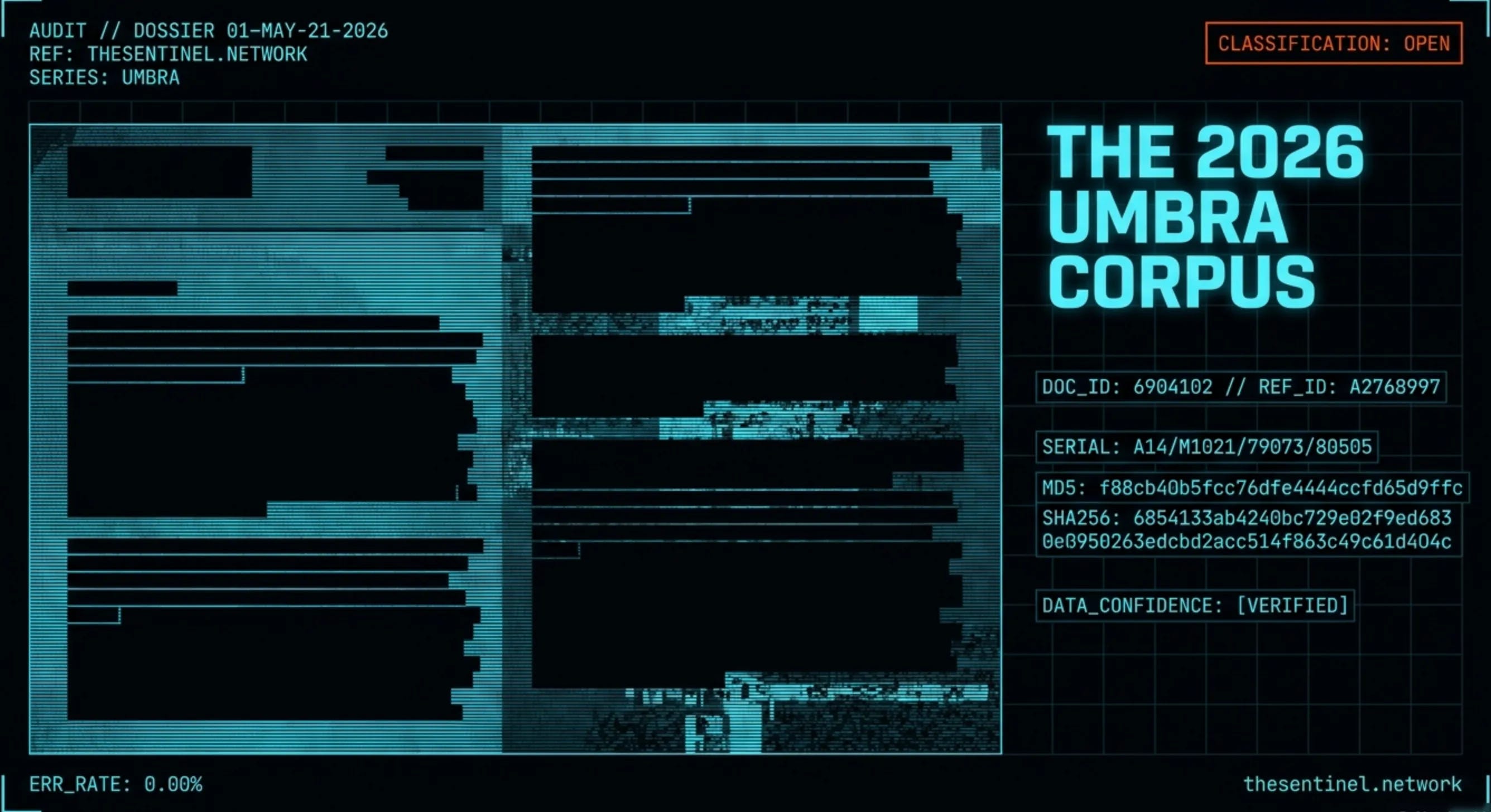
SUBJECT: NSA FOIA RELEASE DOC ID 6904102 // FORMERLY TOP SECRET UMBRA UAP COMINT // DISCLOSURE FOUNDATION YEATES APPEAL
DATE: MAY 21, 2026
CROSS-REF: THE SUPPRESSION GRADIENT | THE OPERATOR | THE GLOMAR CONFIRMATION | THE RECORD | THE FLOOR
DATA CONFIDENCE: VERIFIED (NSA FOIA PRODUCTION DOC ID 6904102 / REF ID A2768997, HOSTED BY THE DISCLOSURE FOUNDATION; YEATES IN CAMERA AFFIDAVIT, CIVIL ACTION 80-1562, OCTOBER 9, 1980; NSA UFO DOCUMENT PORTAL) + ANALYSIS (SENTINEL FORENSIC PASS, 334-PAGE OCR CORPUS, HASH-VERIFIED)
We are building the video side of this operation. If you want the briefings in a format you can watch, subscribe to The Sentinel Network on YouTube.
THE AFFIDAVIT
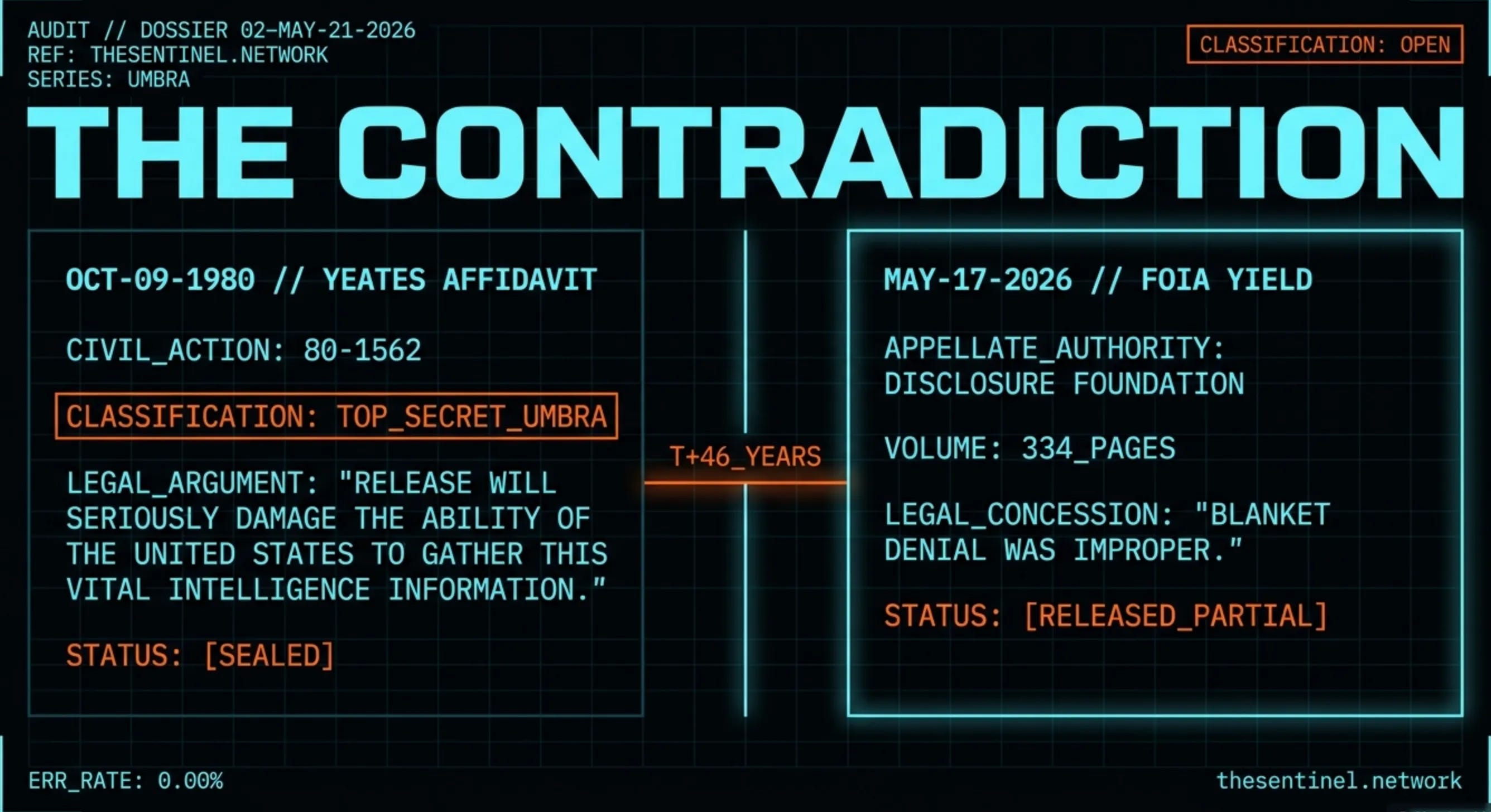
In October 1980, the chief policy officer of the National Security Agency walked into a federal courthouse in Washington, D.C., and asked a judge to read a document in private.
The plaintiff was a citizen group called Citizens Against UFO Secrecy. They had filed a Freedom of Information Act lawsuit against the NSA, demanding the release of records the agency held on unidentified flying objects. The case was Civil Action 80-1562, U.S. District Court for the District of Columbia.
The NSA’s chief policy officer was Eugene F. Yeates. The document he submitted was a classified affidavit. Top Secret Umbra. The highest codeword category in the U.S. communications intelligence system.
Yeates’ argument was straightforward. NSA had located 239 documents responsive to the FOIA request. 160 were NSA-originated communications intelligence. The remaining 79 had come from other agencies. Yeates told the court that releasing the COMINT records would “seriously damage the ability of the United States to gather this vital intelligence information.” The records, he wrote, were intercepts of foreign government-controlled communications systems within their territorial boundaries. To reveal them would be to reveal NSA’s sources, methods, and reach.
He cited specific phenomena to make the case. Intercepted reports of luminous objects. Bright lights. Unidentified aircraft over countries that were not the United States. One specific entry, he flagged for the court, was an intercepted report of “an elongated ball of fire” moving across the sky.
The presiding judge did not have the clearance to read the documents themselves. The judge read the Yeates affidavit. The judge ruled in NSA’s favor. The records stayed classified.
That was forty-six years ago. An entire generation has been born, gone to school, served careers, and watched their own children leave home in the time those records sat sealed.
THE APPEAL
On May 17, 2026, the Disclosure Foundation announced that NSA had produced 334 pages of historical UAP-related records following a FOIA appeal. Many carried the same classification Yeates invoked in 1980. Top Secret Umbra.
Per the Foundation’s own framing, the Yeates affidavit itself has been declassified and available to the public since 2009. The underlying support material referenced inside it had not been. When the Foundation’s legal team requested that underlying material, the agency denied the request in its entirety. The Foundation challenged the denial. After what they describe as a lengthy appeal, the NSA’s own appeals authority acknowledged that the blanket denial was improper.
The result is the file we are reading.
The production is a single PDF bearing one document identifier: Doc ID 6904102 / Doc Ref ID A2768997. The first page of the production carries a serial number A14/M1021/79073/80505 and a data run window of UDN=Q01MAR79 through 30APR79. Inside, the entries date as far back as 1969, handwritten in the upper right of one page like a librarian’s note.
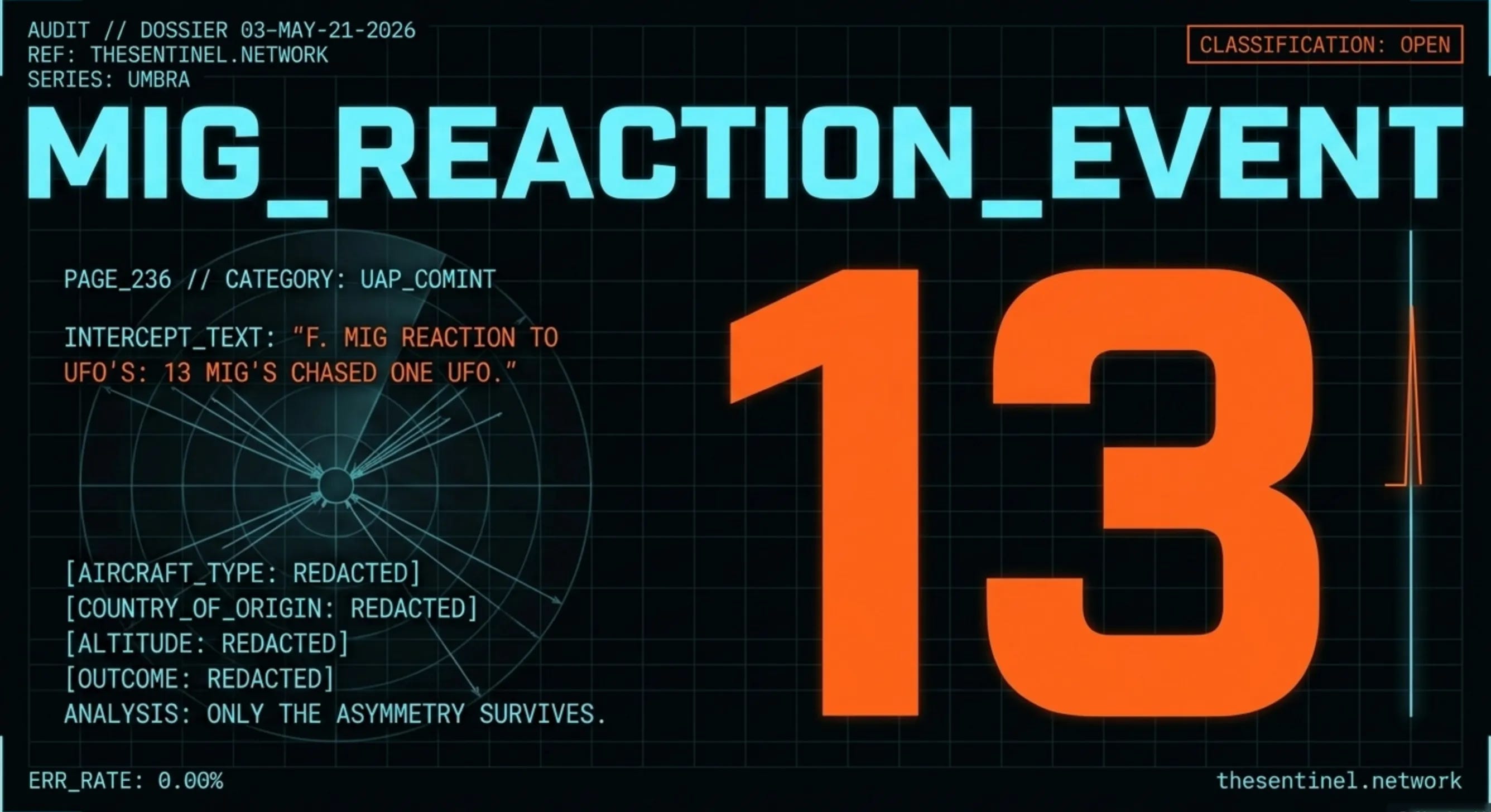
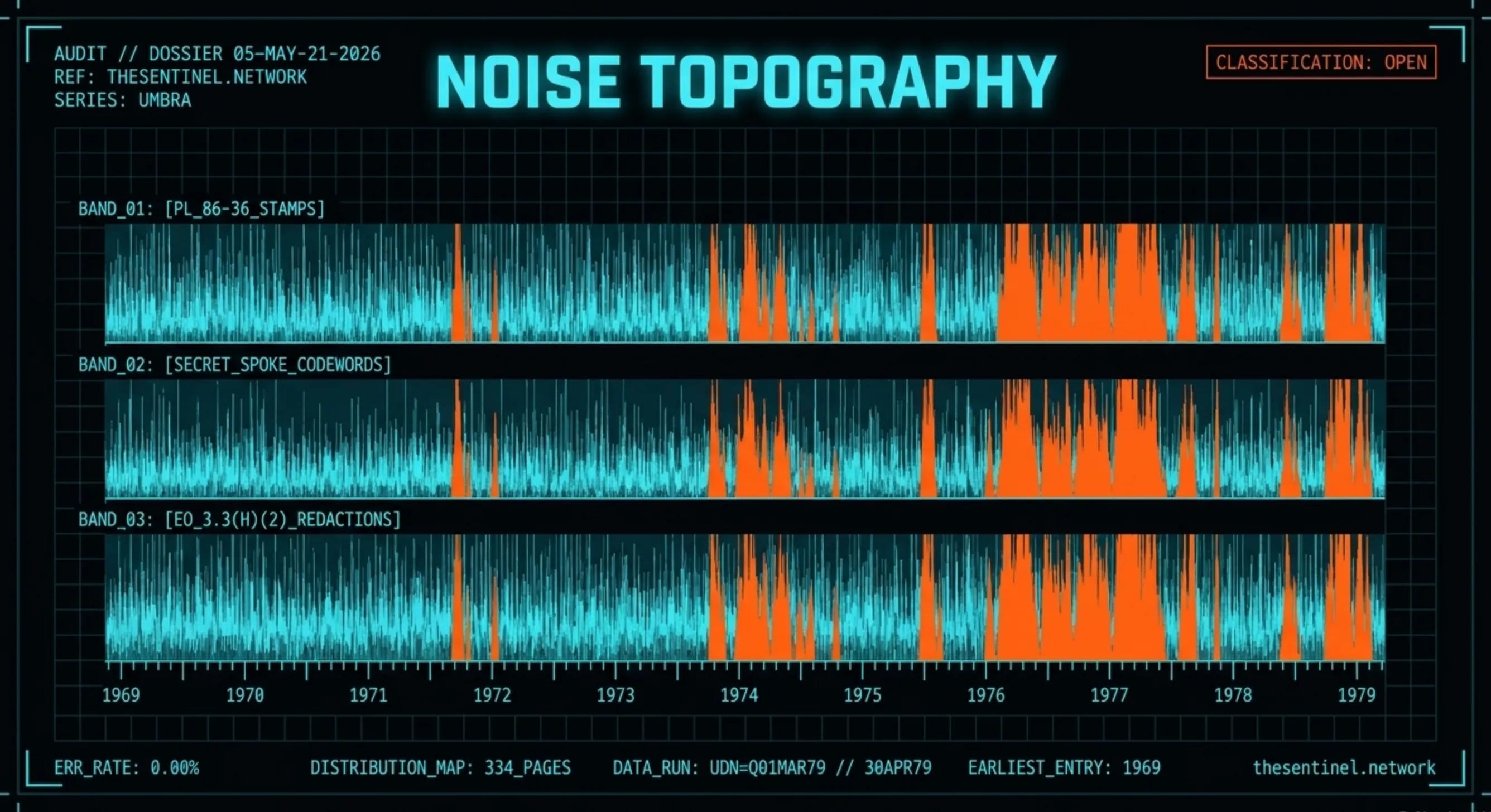
Open the production to page 236. Beneath the TOP SECRET UMBRA banner, beneath the SECRET SPOKE codeword classification, beneath the redacted originator and recipient lines, beneath the bracketed PL 86-36 stamps, the readable text reads:
F. MIG REACTION TO UFO’s: 13 MIG’S CHASED ONE UFO.
That is the entire entry. Thirteen fighters. One unidentified object. The aircraft type, the country of origin, the date, the bearing, the altitude, the outcome. All redacted. Only the asymmetry survives.
The Disclosure Foundation hosts the full production at disclosure.org/news/nsa-top-secret-umbra-uap-foia-release. They did the legal work. They won the appeal. They are the reason this file exists in the public record.
We did something different. We OCR’d it.
THE PAGE
We knew what to look for. The Yeates language describing the elongated ball of fire has been in the public-facing version of the affidavit for years. So we OCR’d the 2026 production and ran a single search.
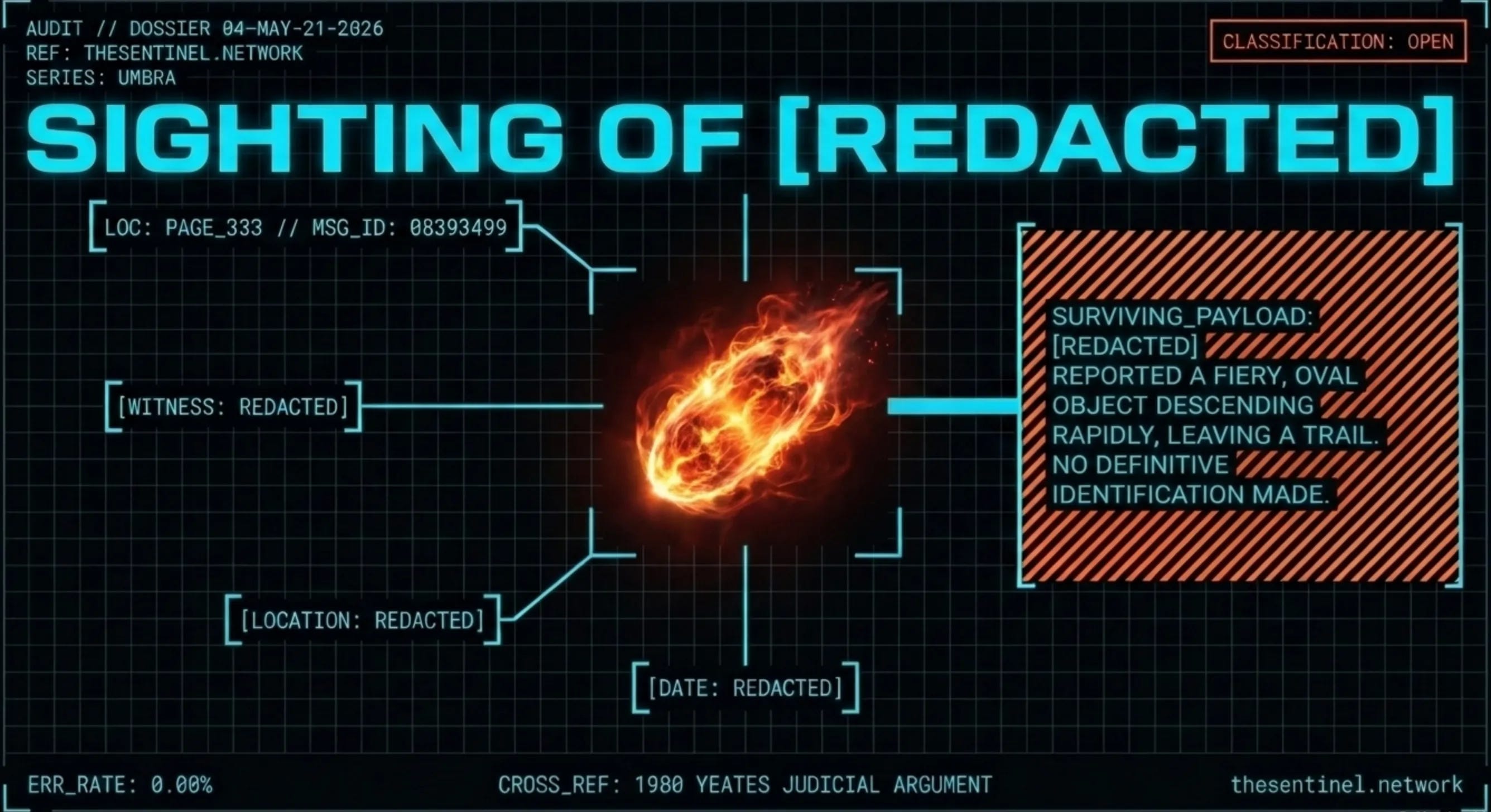
Page 333. Category 405. Message ID 08393499. Beneath a Top Secret Umbra header and an EO 3.3(h)(2) redaction stamp, the entry reads:
SIGHTING OF [REDACTED]. [REDACTED] SAW AN ELONGATED BALL OF FIRE MOVING AT HIGH RATE OF SPEED. AFTER COVERING SOME DISTANCE IT SPLIT INTO THREE BALLS OF FIRE.
The originator is blacked out. The country is blacked out. The date is blacked out. The witness is blacked out.
The phenomenon is not.
This is the same phenomenon Yeates cited to a federal judge in 1980 to argue these records could not lawfully be released. Forty-six years later, after a Disclosure Foundation appeal, the entry is visible. The redactions remain. The phenomenon does not.
SENTINEL ASSESSMENT: The 2026 production is not the first release of these intercepts. NSA released a partial corpus in 1997 under the 25-year automatic declassification provisions of executive order. What the Disclosure Foundation won is the less-redacted version of records the agency has been fighting to keep sealed since the Carter administration. The specific entry Yeates cited to convince a federal judge that disclosure would damage national security is now publicly visible. The agency has not addressed the contradiction.
THE SCANNER
We hashed the production the moment we pulled it. MD5: f88cb40b5fcc76dfe4444ccfd65d9ffc. SHA256: 6854133ab4240bc729e02f9ed6830e0950263edcbd2acc514f863c49c61d404c. 12,070,741 bytes. PDF version 1.4.
The document metadata is empty. Title, author, producer, creator, creation date, modification date. All scrubbed. NSA’s FOIA office knows what they are doing.
But the JPEG images inside the PDF are not scrubbed. Every one of the 333 scanned pages bears the same six-byte comment marker buried in the JPEG header. The string reads “Canon Inc” followed by four null bytes. The scanner identifies itself.
NSA digitized these records on Canon-branded hardware. The same kind of imaging device any government office, law firm, or accounting practice uses. Not a specialized cryptologic platform. A commercial scanner. The agency that operates Cold War-era signals intelligence infrastructure runs its FOIA production line on the same equipment a public defender uses to scan client files.
Page 1 is the exception. Page 1 is not a JPEG. Page 1 is a raw PPM bitmap, processed through a different pipeline than every other page in the production. It carries no Canon marker. It was almost certainly generated by FOIA processing software rather than scanned from a physical page. A cover sheet. The header on what NSA wants you to read first.
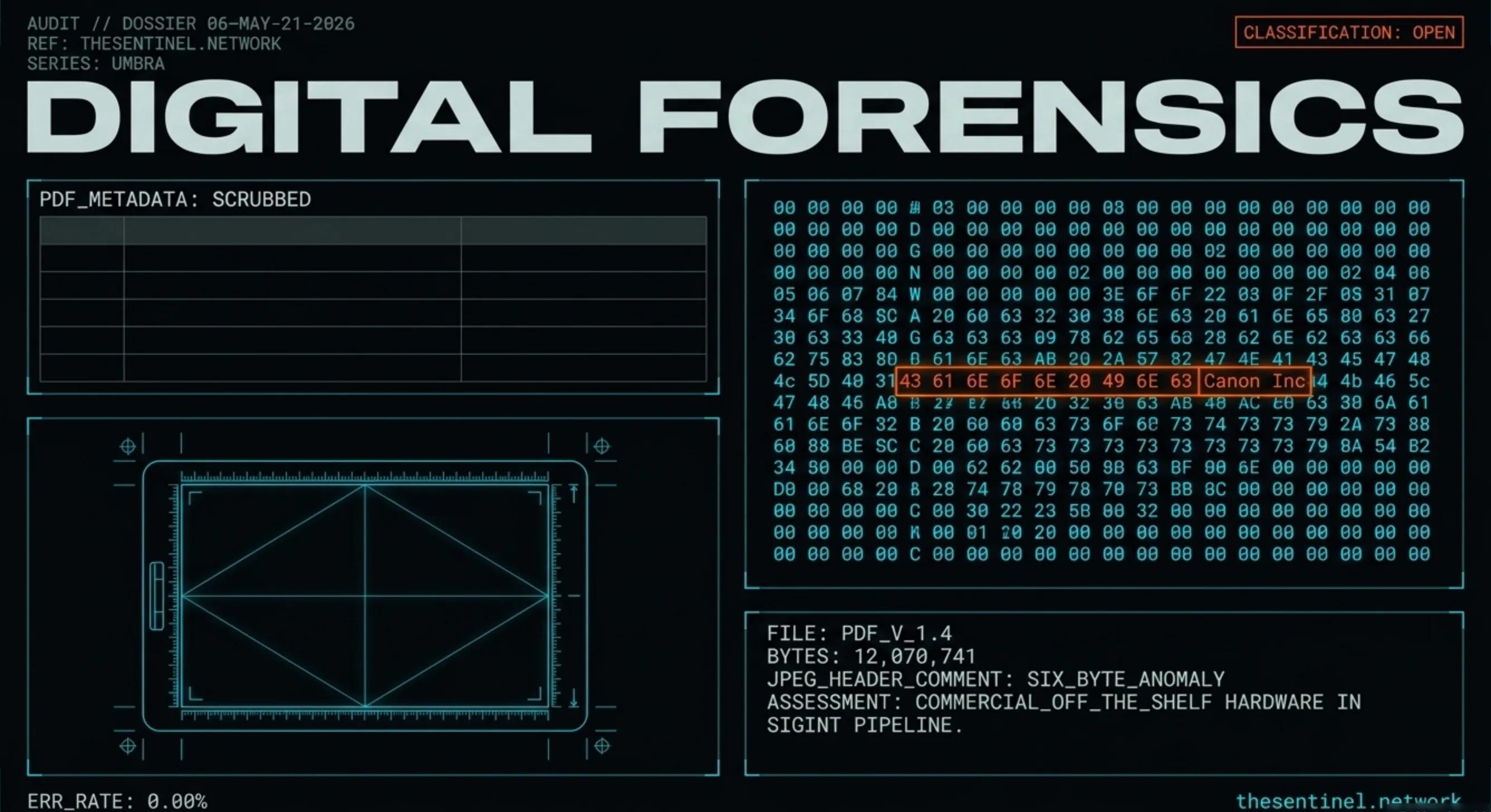
We checked every byte for the things journalists check for. There are no Optional Content Groups, which means no hidden layers that can be turned back on. There is no JavaScript, no embedded files, no form fields, no annotations. There is no extractable text behind any of the redactions.
We will say this clearly. The redactions are technically well-executed. This is unlike past Pentagon and Department of Justice productions where unredacted text was recoverable from beneath supposedly black boxes. NSA’s redactions are baked into the raster. Pulling them apart will not work.
What is recoverable is the surrounding context that survived. Page numbers. Format markers. Category codes. The phenomena themselves. And the institutional fingerprints the agency did not realize it was leaving.
THE OVERLAYS
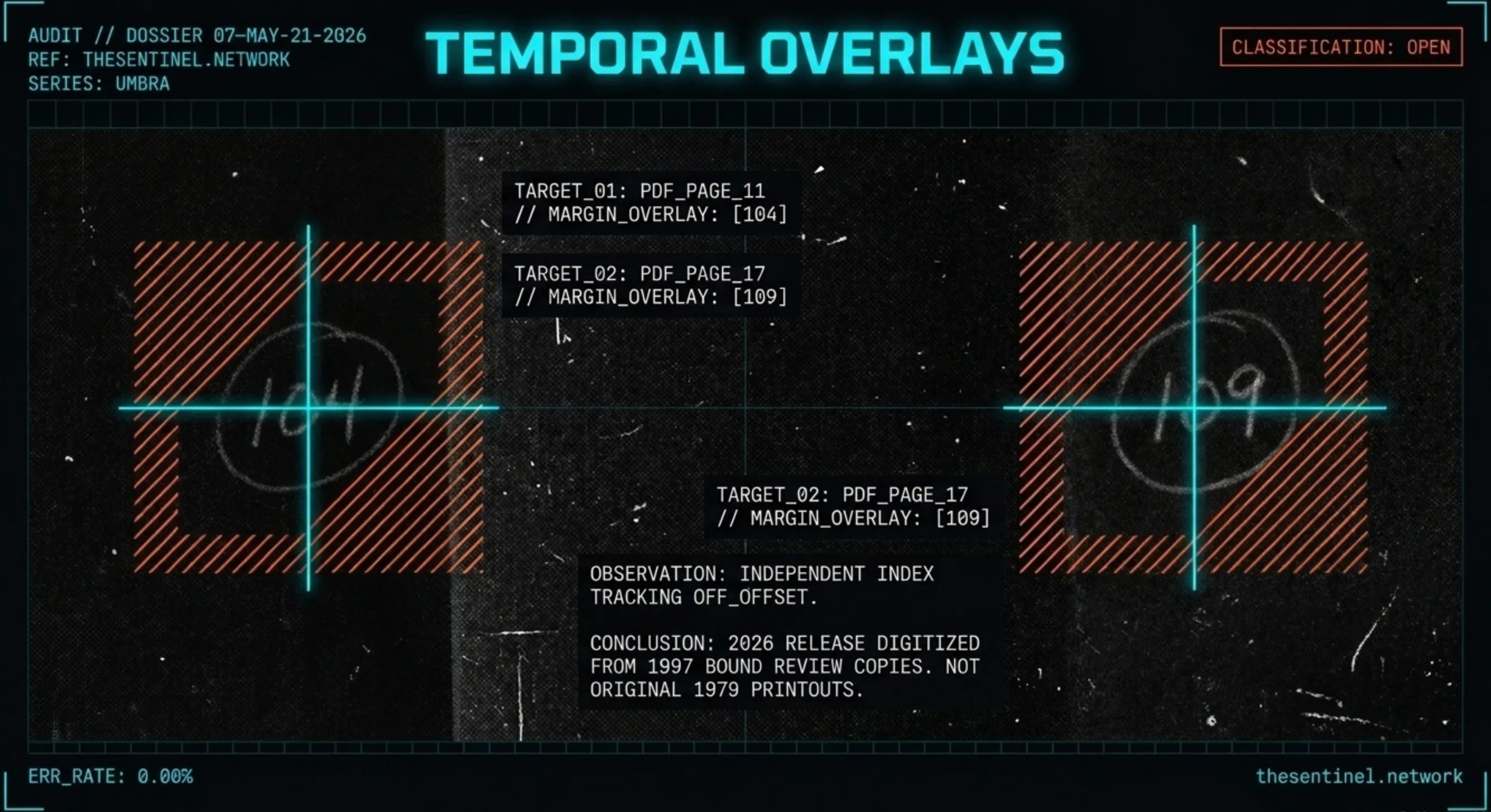
At the bottom right of many pages, in fountain pen or pencil, there are circled numbers. Pencil marks in the margins. Multiple handwritten page numbers on the same page.
Page 11 of the 2026 production carries a circled “104.” Page 17 carries a circled “109.” The numbers march in sequence with the PDF pagination but at a different offset. Five circled numbers across six PDF pages. Sequential.
These are not random. They are pagination overlays from a prior declassification pass. When NSA released a partial UFO COMINT corpus in 1997, the documents were stamped, numbered, and bound. John Greenewald at The Black Vault has tracked the agency’s NSA UFO releases for two decades and pursued multiple mandatory declassification reviews on these same records. Those stamps and numbers survived the next thirty years and made it into the 2026 production. The 2026 release was scanned from the bound 1997 review copies, not from the original 1979 message printouts.
We can use this. The circled numbers form an independent index. By mapping which PDF pages carry which circled numbers, a researcher can reconstruct which entries in the 2026 release correspond to which entries in the 1997 release, page by page, and determine exactly which redactions the appeal forced open.
We are not going to do that work in this briefing. We are flagging it as a methodology lead. The differential redaction analysis between the 1997 corpus and the 2026 corpus is the next forensic pass. The fact that the pagination evidence survives the agency’s scrubbing of the PDF metadata is the kind of small institutional self-betrayal that makes documents like this readable.
THE EXEMPTIONS
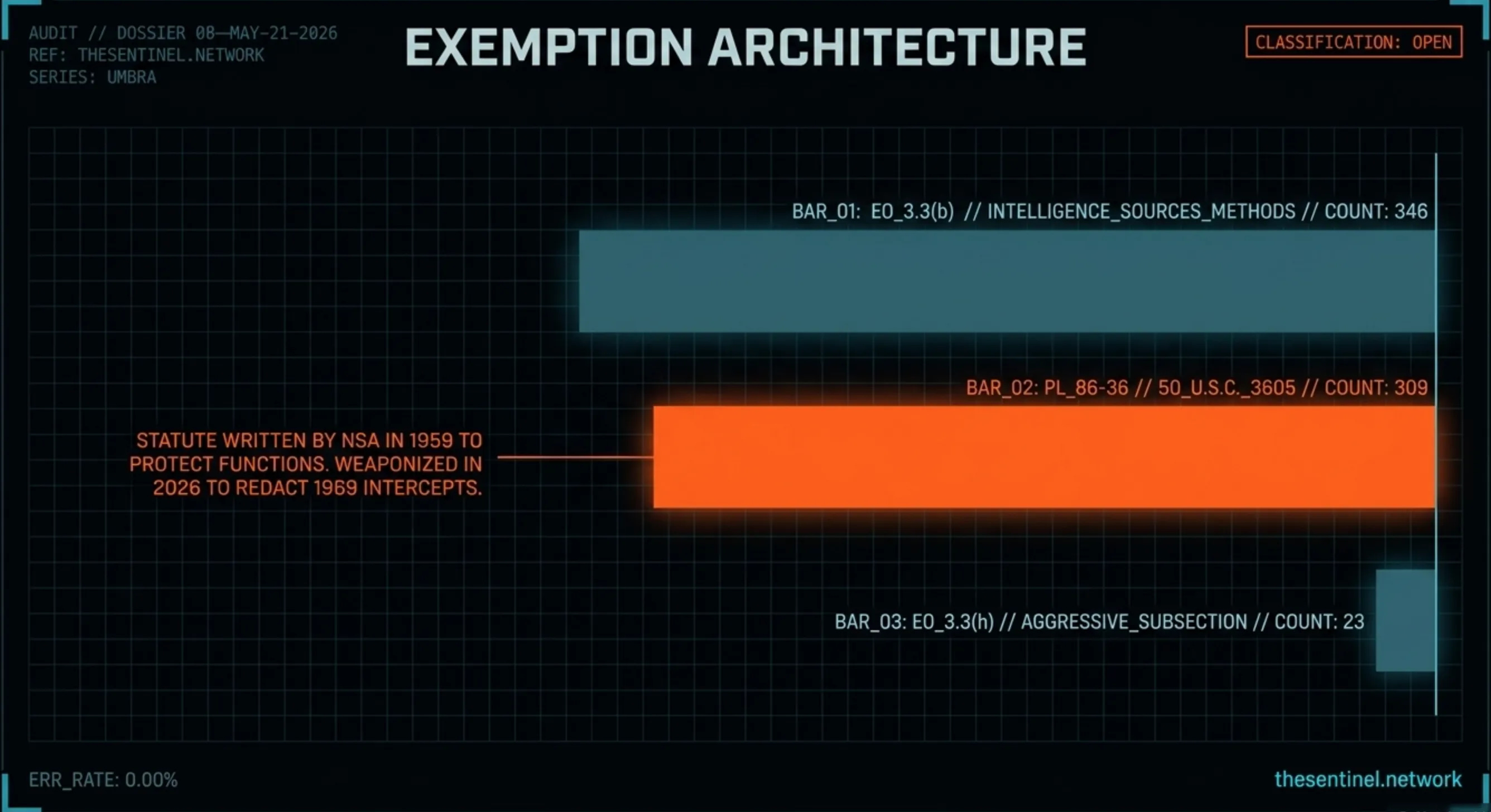
Across 334 pages, we counted the redaction justifications.
EO 3.3(b), the executive order subsection covering intelligence sources, methods, and foreign relations: invoked 346 times. PL 86-36, the National Security Agency Act of 1959 codified at 50 U.S.C. 3605: invoked 309 times. EO 3.3(h), the more aggressive subsection: invoked 23 times.
That is an average of roughly two exemption invocations per page across the entire production. Imagine a 334-page book where every page has two passages crossed out with the same two paragraphs of legal boilerplate stamped beside them. That is the visual texture of this document.
The PL 86-36 number is the one that matters. The National Security Agency Act of 1959 is the statute Congress passed at NSA’s request to allow the agency to refuse to disclose its organization, functions, and activities. NSA wrote the law about itself. The agency has now invoked that self-protective statute 309 times to redact UAP intercept reports from 1969 through 1979. Records that are forty-six to fifty-seven years old at the moment of redaction.
That is the architecture. A 1959 statute Congress passed for the agency, invoked in 2026 to redact a 1969 intercept of a luminous object moving across foreign airspace.
SENTINEL ASSESSMENT: The exemption pattern is the institutional signature. PL 86-36 was written to protect contemporary signals intelligence operations. Its application to fifty-year-old UAP intercepts treats those intercepts as if they remain operationally sensitive. Either the methods have not changed, or the records contain something the agency does not want measured by their age. We do not know which. We know that the same statutory hook Yeates pulled in 1980 is the one the agency is still pulling.
THE CORPUS
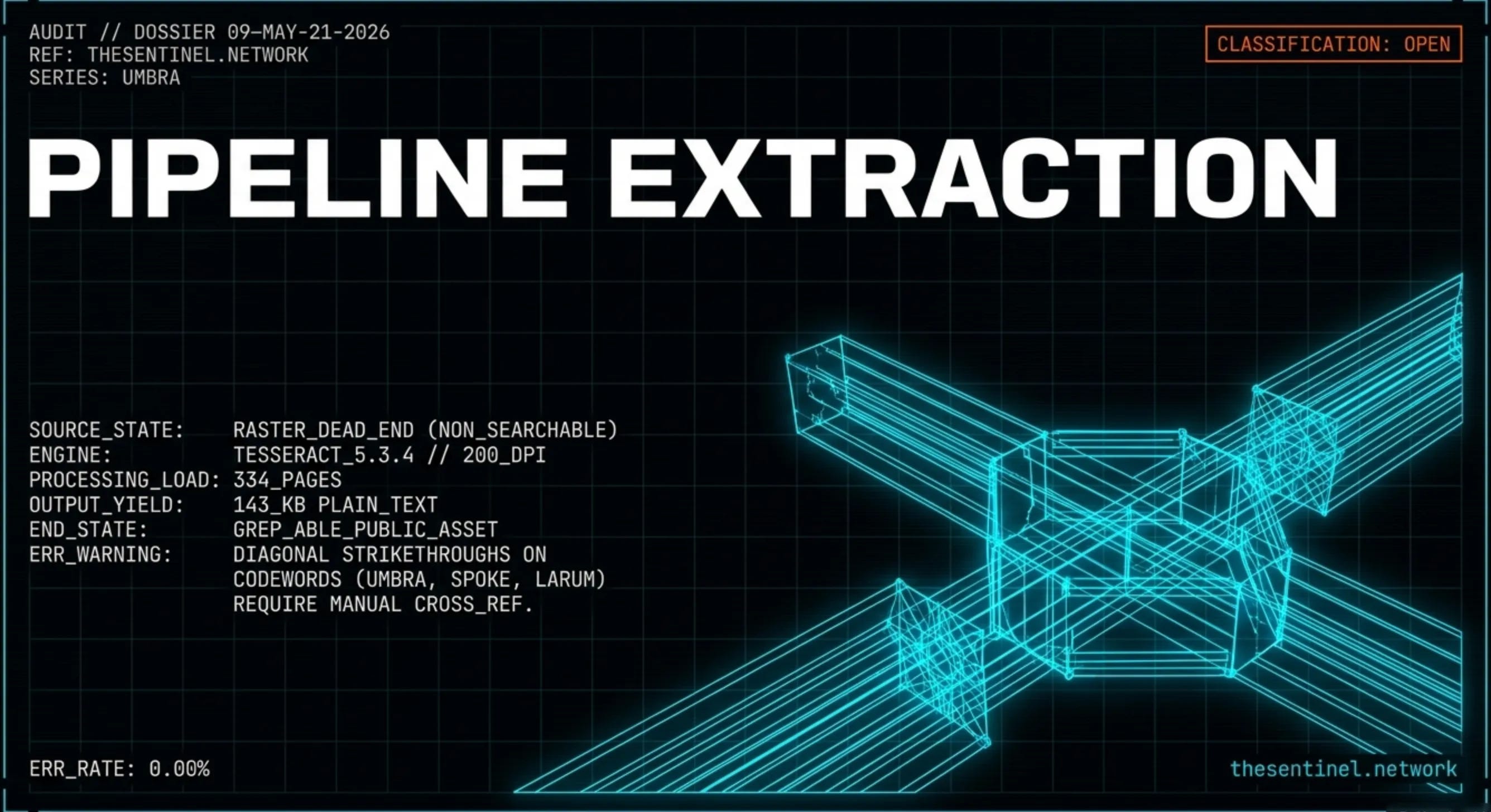
The production is a raster PDF. Every page is a scanned image. The text is not searchable. To find the elongated ball of fire entry, you have to scroll. To find every mention of “MIG REACTION,” you have to read all 334 pages. To find the 1969 handwritten date, you have to look.
The Sentinel Network™ OCR’d the production. 334 pages at 200 dots per inch, processed through Tesseract 5.3.4. The output is 143 kilobytes of plain text. About the size of a long magazine article. It is the only searchable version of this document that we know of.
It is also imperfect. The scanning was high quality but the FOIA processing introduced visual artifacts. The Top Secret codewords like UMBRA, SPOKE, LARUM, and SAVIN carry diagonal strikethrough marks from the declassification process, which scrambles them in OCR. Handwritten margin numbers do not OCR reliably. Codes like the COMINT classification banners come through as fragmented strings. Working with this corpus means cross-referencing against the source PDF for any cited passage.
We are publishing the corpus for free. It belongs in the public record next to the production itself. The Disclosure Foundation did the work that brought it out of the agency. The least we can do is make it grep-able for everyone else.
The OCR'd corpus and chain-of-custody ledger are attached below. If you find passages of interest, verify them against the original production at the Disclosure Foundation's hosting before citing.
THE PATTERN
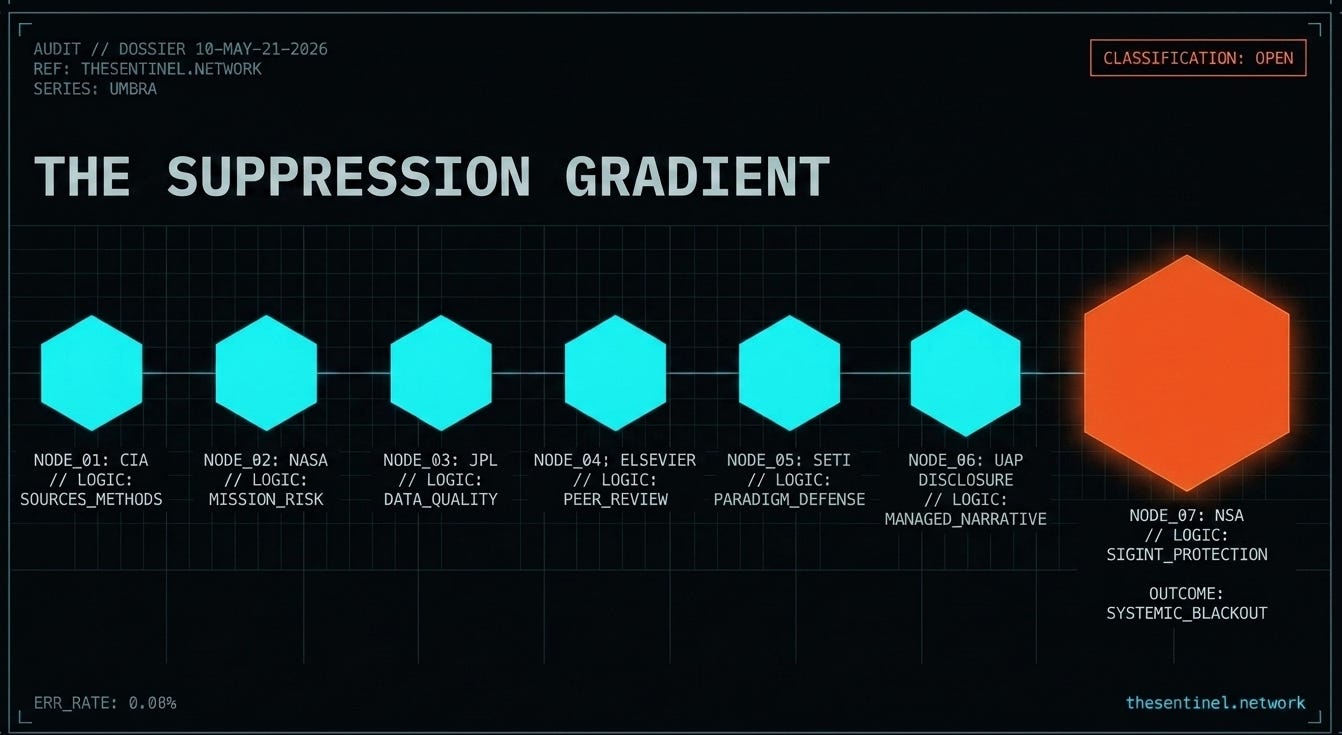
This is the eighth time in less than six months we have documented the same institutional pattern from a different agency.
The CIA Glomar response on 3I/ATLAS. The NASA TESS observation blackout during the December opposition window. The NASA/JPL silent edit of the near-Earth object database. The JPL trajectory curation that used 782 of 7,578 available observations to model the orbit. The Elsevier publication blackout that gave Carl Sagan’s own journal one paper on the third interstellar object in human history. The SETI pipeline filters that delete the signal class a Bracewell probe would emit. The counterintelligence architecture of the modern UAP disclosure movement. And now the NSA’s communications intelligence corpus, released in 2026 after forty-six years of agency resistance, still redacted under the same statutory hook the agency wrote about itself in 1959.
Each layer operates inside a different institutional logic. The CIA’s logic is sources and methods. NASA’s logic is mission risk. JPL’s logic is data quality. Elsevier’s logic is peer review. SETI’s logic is paradigm defense. The UAP disclosure movement’s logic is managed narrative. NSA’s logic is signals intelligence protection. No two are run by the same people. No single institution coordinates them.
They produce the same outcome anyway. Each layer narrows what the public is allowed to see by a quarter-turn. The cumulative effect is what we have been calling the suppression gradient. The 2026 NSA release does not break the pattern. It is the eighth instance.
THE SENTINEL ASSESSMENT:
The Disclosure Foundation forced the release of 334 pages of communications intelligence the National Security Agency told a federal judge in 1980 it could not lawfully produce. The specific phenomenon Yeates cited to that judge, an elongated ball of fire splitting into three, is now visible on page 333. The agency’s redaction tooling is technically competent. The agency’s metadata scrubbing is professional. The agency’s pagination overlays from the 1997 review pass are visible in the margins anyway.
The methods that protected this file in 1980 are the methods that protected this file in 2026. Forty-six years. Same agency. Same statute. Same phenomenon. Different redaction density.
We are publishing the OCR’d corpus free because the document belongs to the public and because the Foundation did the work that brought it out. The next pass is the differential redaction analysis between the 1997 and 2026 productions. If you have a copy of the 1997 release, send it to us at the secure drop. We will run the comparison.
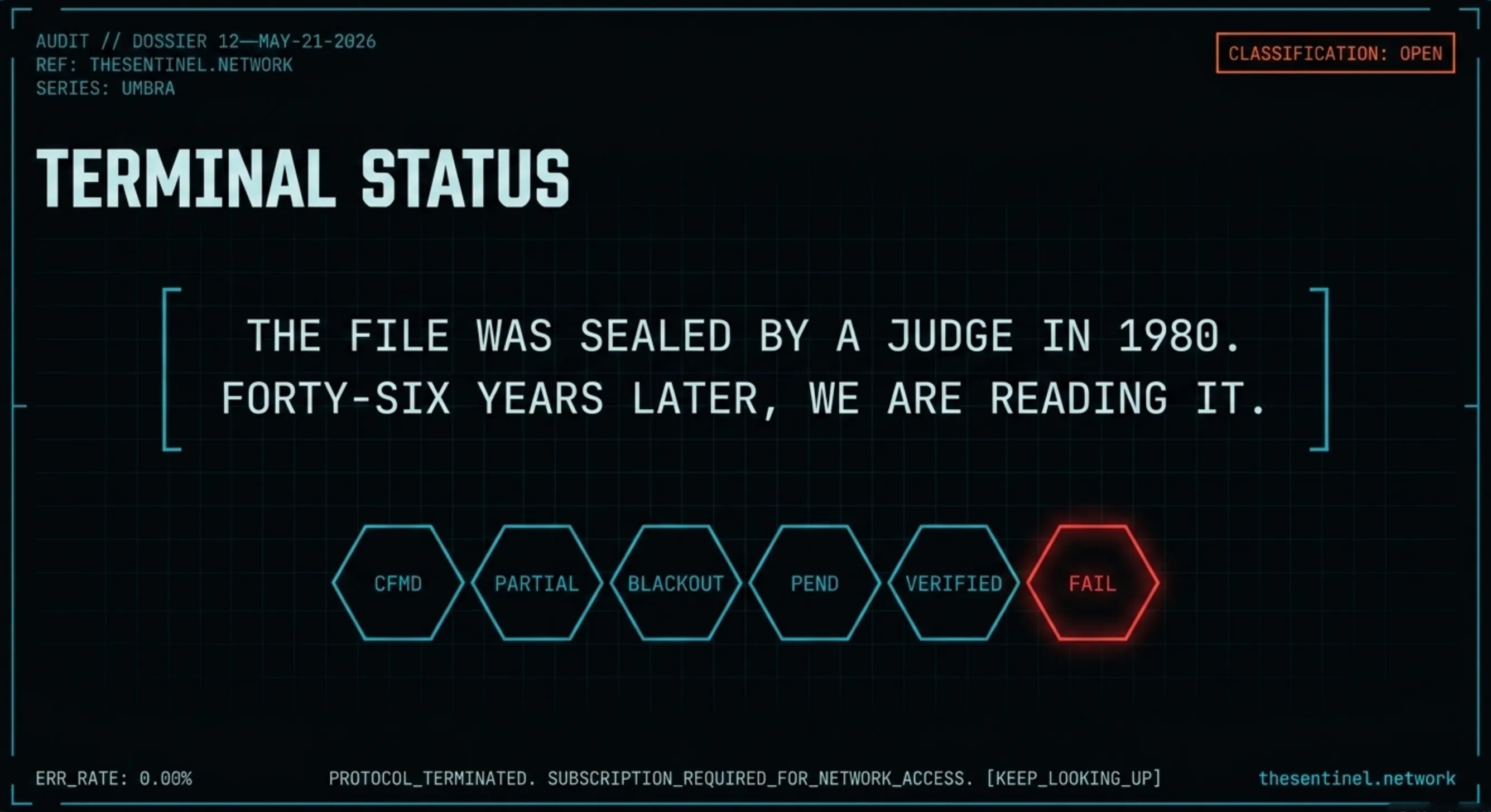
The file was sealed by a judge in 1980.
Forty-six years later, we are reading it.
Keep looking up.
-- The Sentinel
The OCR’d corpus and the chain-of-custody ledger. Free to download. Verify quoted passages against the source PDF before citing.

Every briefing we publish is free. That is not changing. This publication has no institutional backing, no sponsors, and no editorial board. We are doing the work the newsrooms will not, sourcing papers, filing FOIAs, building tools, and writing at the pace a once-in-a-civilization event demands. Paid subscribers fund the investigation directly. They also receive THE SIGNAL (weekly market intelligence derived from our forensic work), primary source documents, the comment section on every briefing, Fieldcraft Labs, and the FIELDCRAFT series. No ads. No sponsors. No strings. Your subscription is a data point against the suppression gradient.
Subscribe to The Sentinel Network™
A top 100 Science publication on Substack.
Share this investigation. The Suppression Gradient documented what happens when this coverage reaches platforms that do not want you reading it. Every share, every restack, every forwarded link is a data point against the gradient.
Previous briefings: THE MURMURATION | THE OPERATOR | THE RECORD | THE FLOOR | THE BLIND SPOT | THE NARROW BAND | THE VERDICT | THE GHOST GENERAL | THE LONG COUNT | THE GREEN BURIAL | THE GLOMAR CONFIRMATION
When Reagan made this speech to the UN years ago, my husband and I looked at each other and said, "Where did that come from?". At that point, there was no doubt that he said that for a reason. Listen if you have not heard it before.
https://www.youtube.com/watch?v=Ag44dRO8LEA
To put it more into perspective, the UN has addressed this topic, although few are aware of it.
https://news.un.org/en/story/2024/04/1148436
This entry is especially well-written.