

SUBJECT: BIBLIOMETRIC FORENSIC ANALYSIS // PUBLICATION PIPELINE SUPPRESSION // ELSEVIER JOURNAL OUTPUT // MARCH 2026 BLACKOUT
DATE: APRIL 8, 2026
CROSS-REF: THE SUPPRESSION GRADIENT | THE SILENT EDIT | THE CURATED ORBIT | THE FIFTH INSTRUMENT | CONFIRMED: THE TESS CONTINGENCY | THE NARROW BAND
DATA CONFIDENCE: VERIFIED (publicly accessible bibliometric data, Scopus, Google Scholar, arXiv, ScienceDirect, ADS, journal publication records)
We are building the video side of this operation. If you want the briefings in a format you can watch, subscribe to The Sentinel Network on YouTube.
THE COUNT
We just did something nobody has done yet. We counted.
From July 2025, when 3I/ATLAS was discovered, through the first week of April 2026, we compiled every peer-reviewed paper published on the object. We sorted them by publisher. We sorted them by venue. We sorted them by date. Then we compared.
Here is what we found.
Elsevier is the largest academic publisher on Earth. They own over 2,500 journals. Their physical sciences division includes the most cited, most prestigious, most historically significant journals in planetary science, solar system studies, celestial mechanics, and aerospace engineering. When a paper about a comet, an asteroid, or an interstellar object gets published in a peer-reviewed journal, odds are it lands in an Elsevier title.
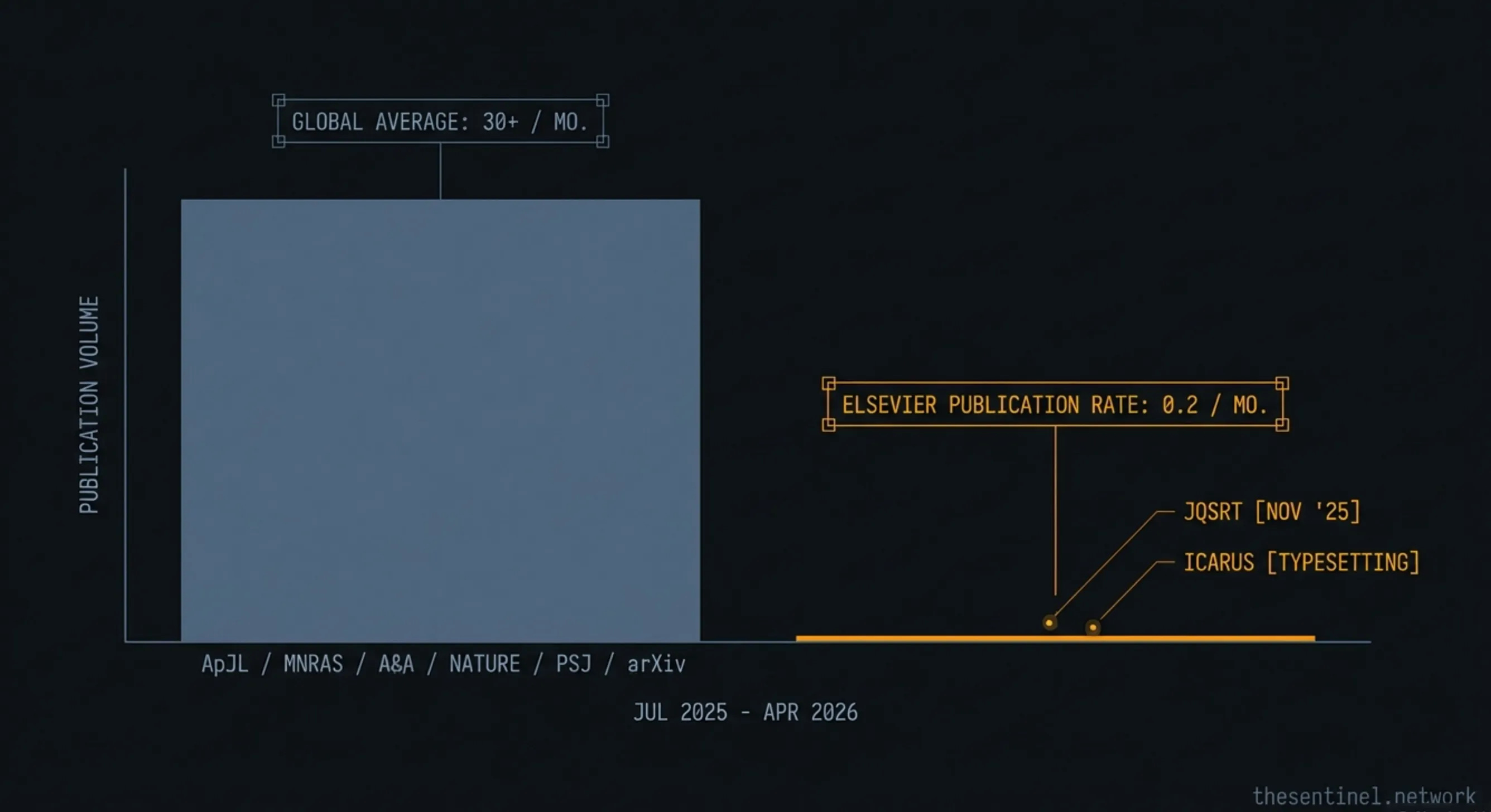
In ten months of 3I/ATLAS, Elsevier published two papers.
Two.
One in the Journal of Quantitative Spectroscopy and Radiative Transfer, in November 2025. One in Icarus, accepted in early 2026 and still sitting in typesetting as of this week.
That is a publication rate of 0.2 papers per month.
Over the same period, the Astrophysical Journal Letters, Monthly Notices of the Royal Astronomical Society, Astronomy and Astrophysics, Nature Astronomy, and the Planetary Science Journal published 3I/ATLAS research at a rate of three to five papers per month. The arXiv preprint server received dozens more. The foundational discovery paper went through MNRAS. The spectroscopic characterizations went through A&A. The JWST isotope analysis went through ApJL. The wobbling jet analysis, the methanol detection, the spin characterization, the origin tracing, the intercept mission architectures. All of it. None of it went through Elsevier.
The publisher that owns the flagship journal for solar system science was functionally absent from the defining astronomical event of the century.
THE ZERO LIST
This is not a story about one journal being slow. This is a story about an entire portfolio going dark.
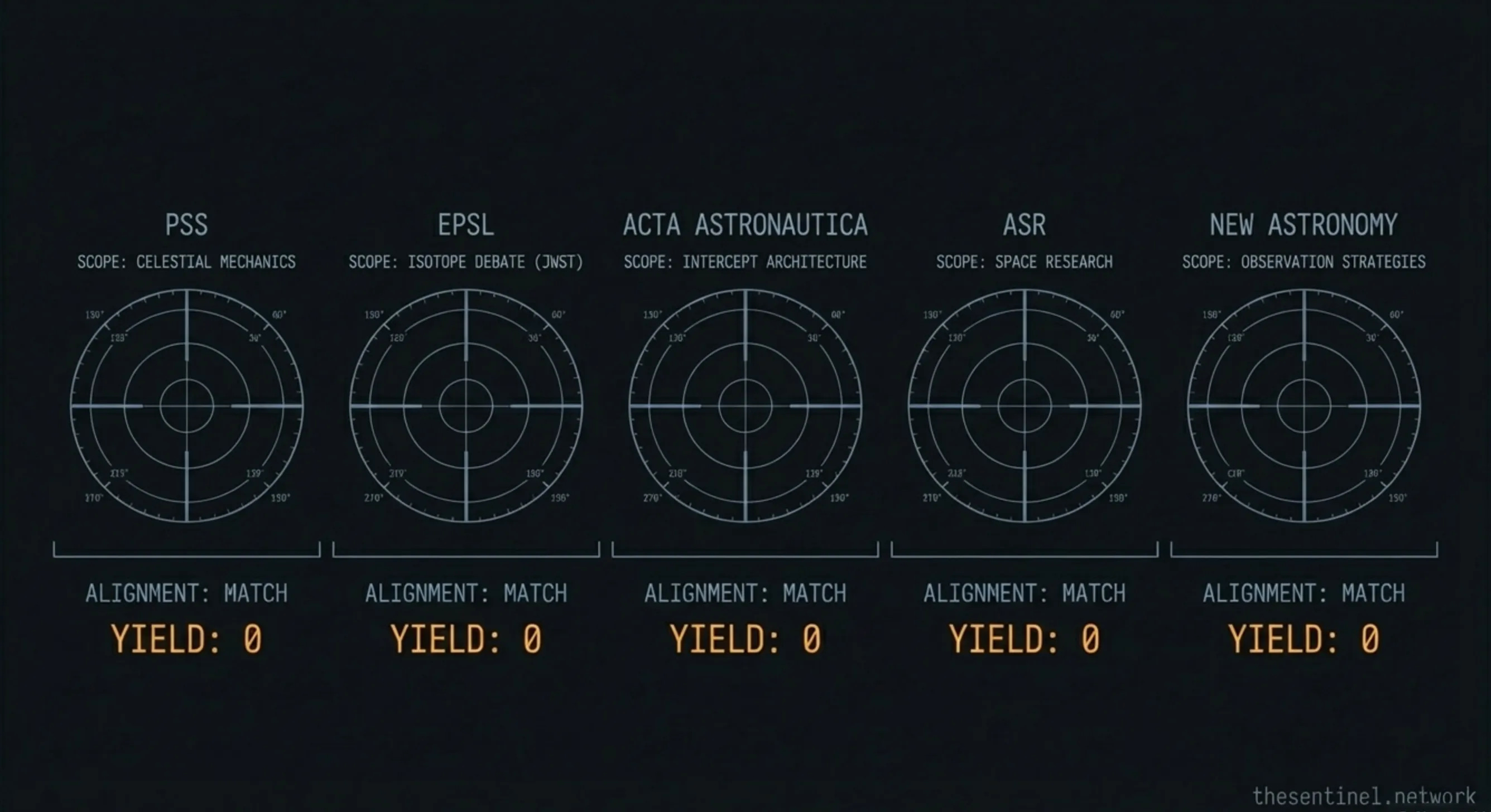
We checked every major Elsevier journal whose editorial scope covers the science of 3I/ATLAS. The results:
Planetary and Space Science. Scope: celestial mechanics, planetary formation, physical characterization of small solar system bodies. Published extensively on 1I/Oumuamua. Published zero papers on 3I/ATLAS.
Earth and Planetary Science Letters. Scope: planetary geochemistry, isotopic fractionation, meteorite compositions. The JWST detected extreme deuterium-to-hydrogen ratios in 3I’s methane. Exactly the kind of data EPSL exists to debate. Zero papers.
Acta Astronautica. Scope: space mission architectures, astrodynamics, extraterrestrial intelligence. After Oumuamua and Borisov, Acta Astronautica published multiple intercept mission designs, including Project Lyra. For 3I, dozens of trajectory analyses circulated on arXiv. Engineers drafted plans to redirect the Juno spacecraft during the Jupiter encounter. Zero made it through Acta Astronautica’s pipeline.
Advances in Space Research. Zero.
New Astronomy. Zero. Authors have publicly noted their intention to submit ad-hoc spacecraft observation strategies to this journal. The papers either stalled in review or were withdrawn.
Five major journals. Perfect scope alignment. Combined output: nothing.
THE FLAGSHIP
Let’s talk about Icarus.
Icarus is the journal Carl Sagan edited. It was founded in 1962. It is endorsed by the Division for Planetary Sciences of the American Astronomical Society. If you study comets, asteroids, moons, or interstellar objects for a living, Icarus is where you send your best work. It is, by design, the single most important venue in the world for the kind of science 3I/ATLAS demands.
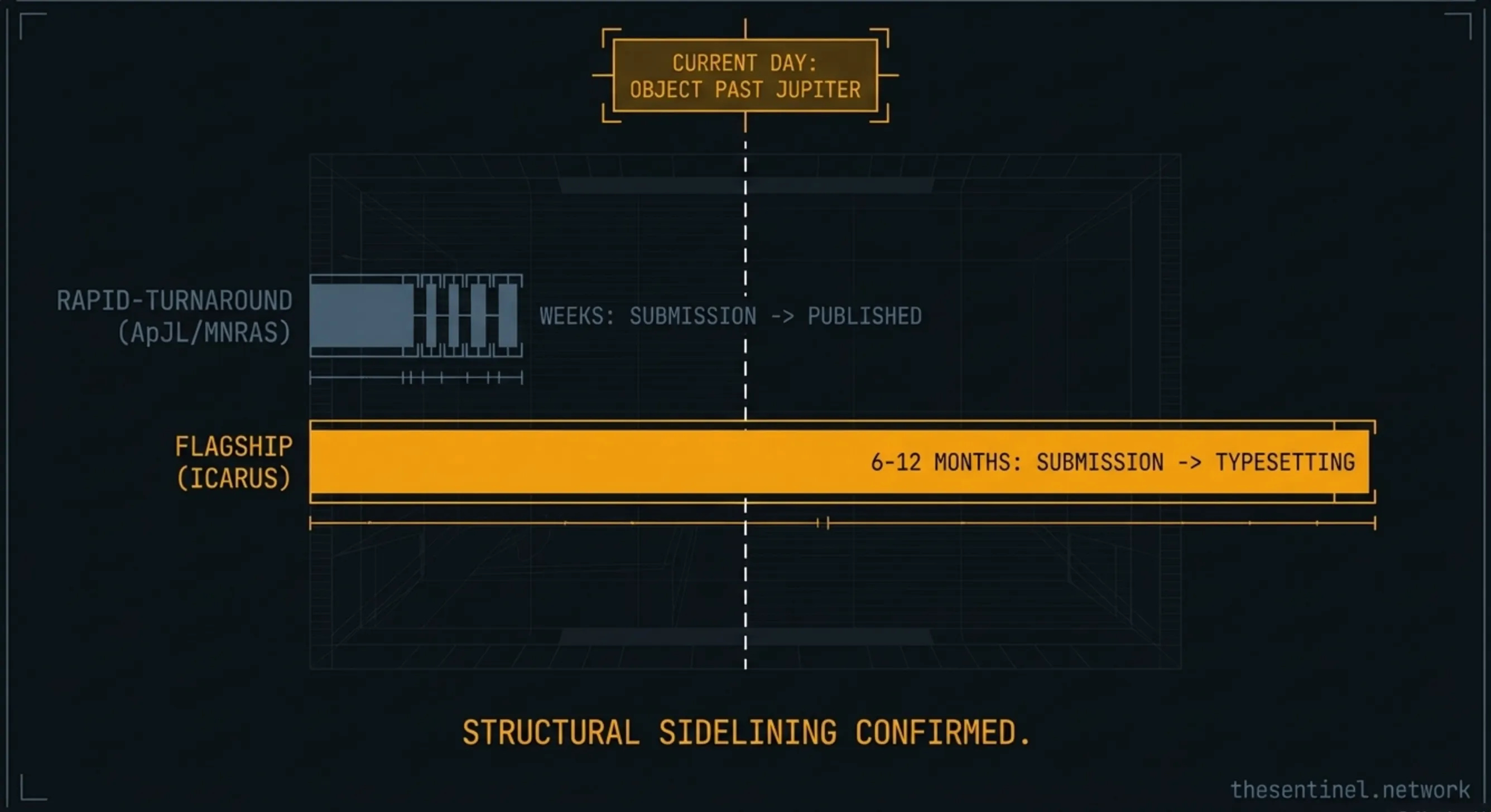
Icarus published one paper on 3I/ATLAS. It hasn’t finished typesetting.
The reason is structural, and the structure is the point. Icarus runs a review-to-publication timeline of six to twelve months. A paper submitted in August 2025, when 3I was approaching perihelion, would not see print until mid-2026 at the earliest. By then the object will be past Jupiter and fading from view.
Compare that to the Astrophysical Journal Letters or MNRAS Letters, which are built for rapid-turnaround communications on astronomical events. Those venues processed 3I papers in weeks. Researchers who needed real-time community feedback on an evolving cometary coma, on non-gravitational acceleration measurements, on anomalous chemical depletions did the rational thing. They went elsewhere.
The result: the foundational literature defining 3I/ATLAS for future generations resides almost entirely outside Elsevier’s portfolio. The world’s largest academic publisher has been structurally sidelined from the most important object to enter our solar system since we started watching the sky.
Think about what that means.
The journal that should be the definitive record of this event will instead be the journal that published one paper, late, about post-perihelion water vapor. Every major finding. Every anomaly. Every debate about what this object is. All of it happened somewhere else.
If you wanted to ensure that the permanent peer-reviewed record of a transient event was incomplete, delayed, and stripped of its most anomalous findings, you would build exactly this pipeline.
THE WALL
The pipeline alone doesn’t explain the gap. Slow review processes create delays. They don’t create silence.
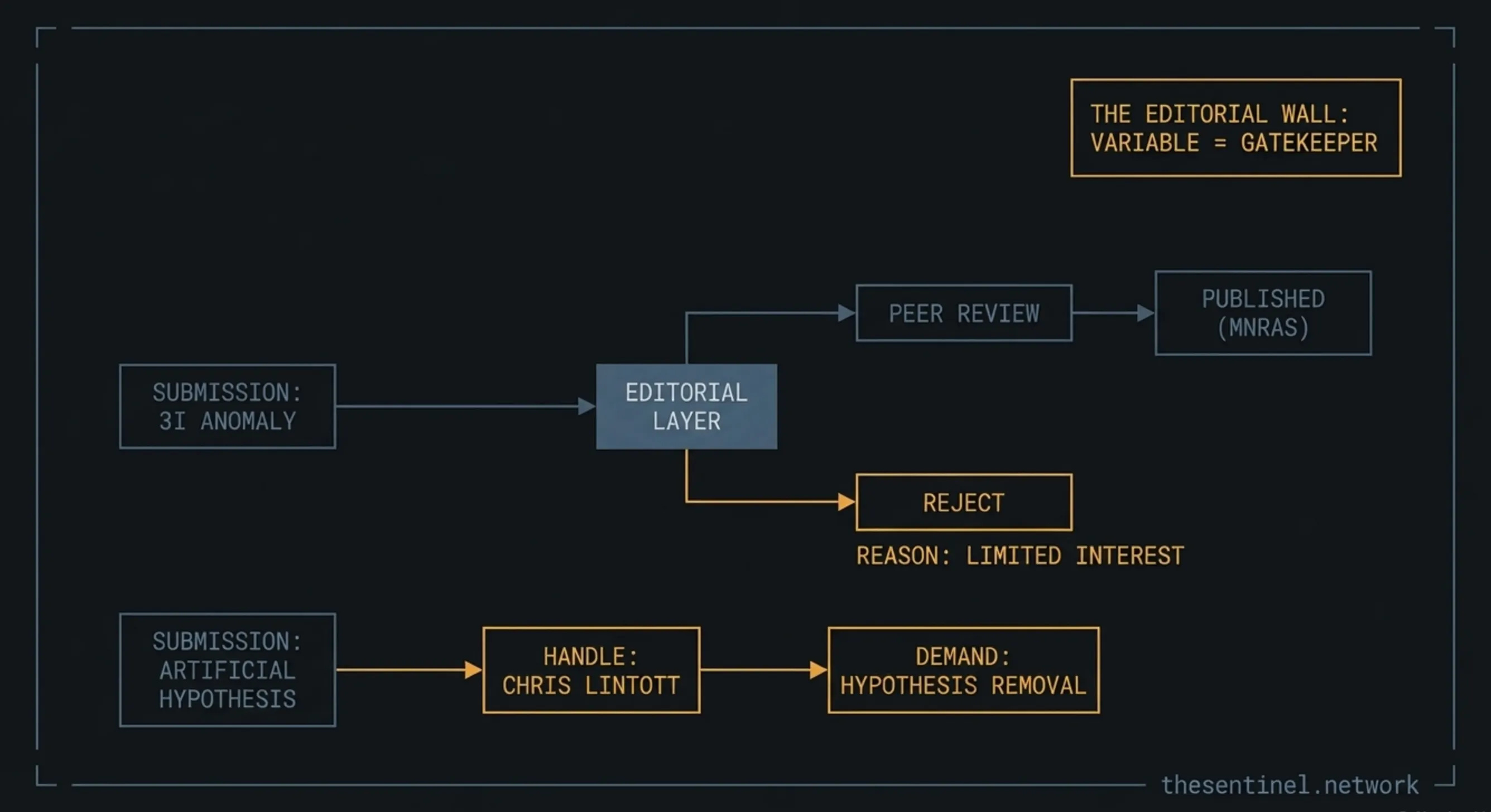
In THE SILENT EDIT, we documented what happens when an anomalous findings reached the editorial layer. A single associate editor at a prestigious astrophysics journal refused to send multiple papers on 3I/ATLAS anomalies to peer review. The rejection template was identical each time: “I believe that your work would be of rather limited interest to the astrophysics research community as a whole.”
An interstellar object. The third in human history. Anomalous chemistry. Anomalous jets. Anomalous acceleration. Of “limited interest.”
That paper was later published in Monthly Notices of the Royal Astronomical Society to significant attention from the community. The editor who killed it was wrong about the interest. The editor was performing a different function.
Avi Loeb documented another parallel case. He submitted a paper to the Research Notes of the American Astronomical Society outlining the possibility that 3I/ATLAS could have an artificial origin. The handling editor, Chris Lintott, demanded that Loeb remove any reference to the artificial hypothesis before the paper would be accepted. Lintott called it “an insult to the exciting work going on to understand this object.”
Read that again.
A scientist at Harvard submitted a hypothesis. An editor told him to remove the hypothesis before the paper could be published. Not because the math was wrong. Not because the data was fabricated. Because the conclusion was unacceptable.
Loeb responded by co-authoring a more robust version with Adam Hibberd and Adam Crowl of the Initiative for Interstellar Studies. The paper, “Is the Interstellar Object 3I/ATLAS Alien Technology?”, explicitly framed the hypothesis as a pedagogical exercise to survive the editorial gauntlet. He then wrote a separate paper on scientific paradigm resistance and submitted it to Psychological Review. The system that rejected his science became the subject of his next paper.
That is the wall. It doesn’t look like censorship. It looks like peer review. It uses the language of quality control. But when the same data gets rejected at one venue and celebrated at another, the variable isn’t the data. It’s the gatekeeper.
THE BLACKOUT
Everything we’ve documented so far describes a structural problem that has been building for months. What happened in late March is different. It is sudden. It is universal. And it has no precedent in the 3I literature.
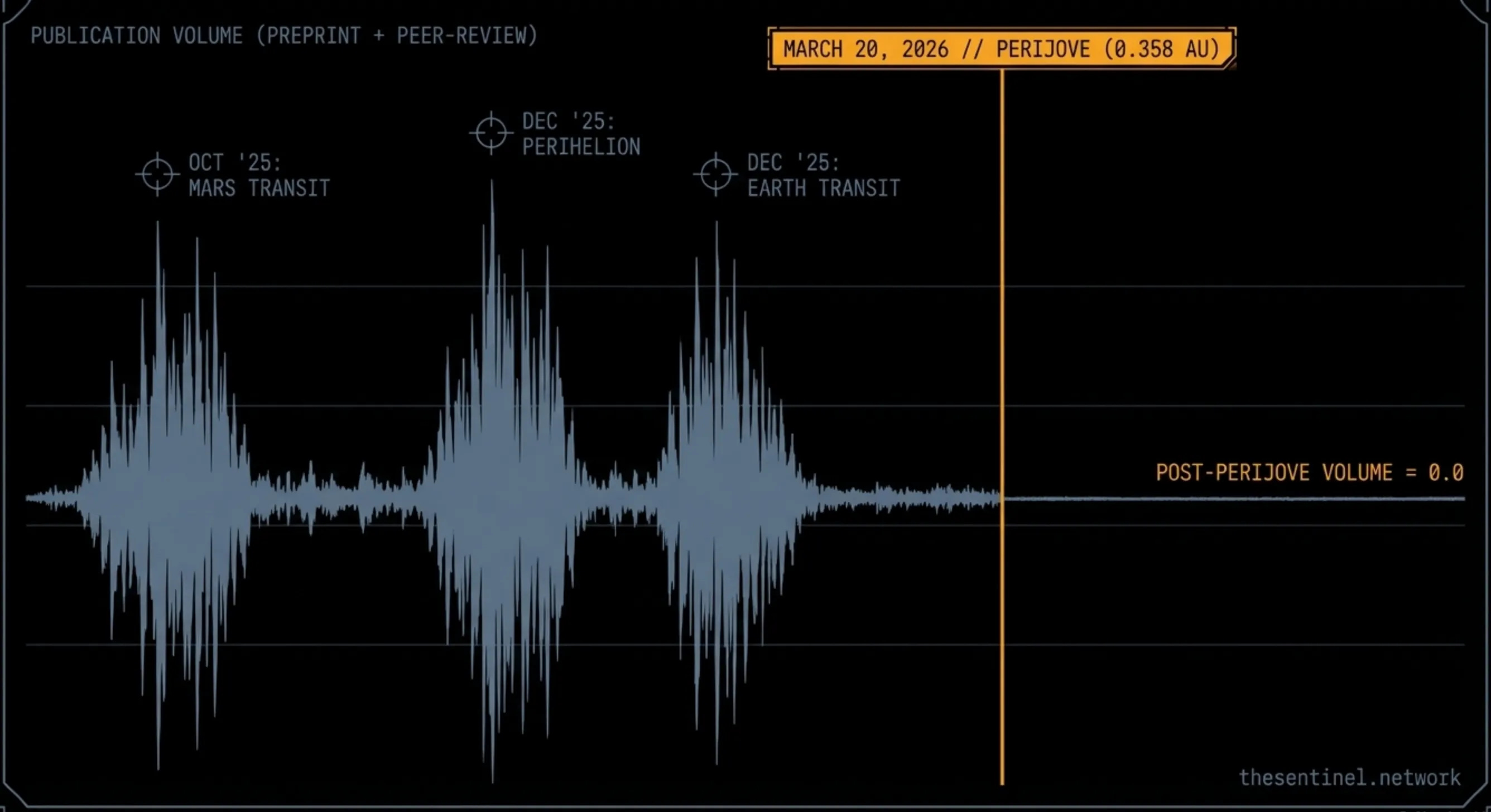
On March 16, 2026, 3I/ATLAS reached perijove. It passed within 0.358 AU of Jupiter, roughly 54 million kilometers. This was the most anticipated encounter since the object’s discovery. An interstellar visitor meeting the largest planet in our solar system, with the Juno spacecraft in orbit and theoretically positioned to observe.
In standard astronomy, a planetary encounter of this magnitude triggers a flood. Preprints modeling gravitational perturbations. Observational data from spacecraft instruments. Refined orbital solutions. High-phase-angle photometry. The community moves fast because the data is perishable and the claims are competitive.
Here is what happened instead.
The last wave of arXiv preprints arrived between March 2 and March 20. Roth et al. submitted ALMA outgassing maps on March 2. A JWST deuterated methane analysis went up on March 20. A paper on instrumental systematics posted the same day.
After March 20, the rate of new preprints dropped to near zero. Not just at Elsevier. Everywhere.
At the major peer-reviewed journals, the last accepted papers were logged in January and February. No new acceptances were publicly announced through the end of March or the first week of April.
The theoretical preprints stopped too. Not just the observational papers that depend on data downlinks and processing time. The modeling papers. The orbital mechanics papers. The papers that require nothing but a computer and a physicist. They all stopped.
When 3I/ATLAS passed by Mars in October 2025, papers appeared within days. When it reached perihelion, the preprint server was flooded. When it passed by Earth in December, teams published in real time.
When it reached Jupiter, silence.
We are on record. In THE VERDICT, we published five falsifiable predictions for the Jupiter encounter, derived from twenty-eight briefings of forensic analysis under a Bracewell probe hypothesis. We stated that a machine entering the Hill sphere of the largest planet in the solar system would have operational reasons to be there. We stated that the encounter would produce data that either confirmed or eliminated the hypothesis.
The encounter happened. The data hasn’t come. The community that couldn’t stop publishing for nine straight months went silent at the exact moment the predictions became testable.
That is not a gap. That is a wall.
THE CONTACT
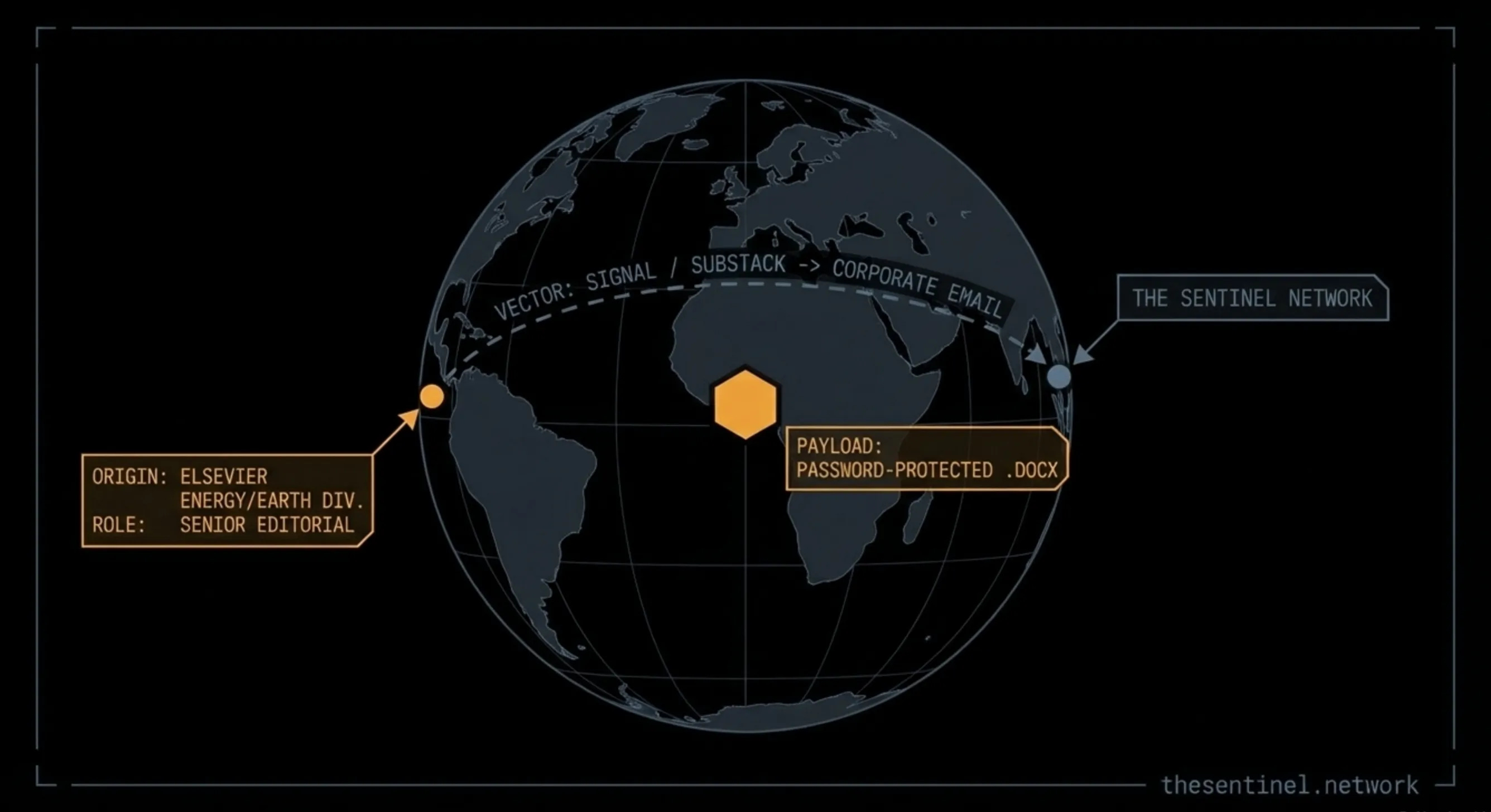
In late March 2026, an individual began tagging prominent UAP journalists on social media about our AFRL reporting. One of those journalists engaged publicly. Within days, the individual contacted The Sentinel Network™ through Substack. Then they followed up via email. From their corporate address. At Elsevier.
The email identified them as working on the Energy and Earth team in a senior editorial role. They described themselves as sitting at “an interesting nexus” where their professional work and the UAP topic intersect. They told us they had “spotted a few things, in the last few days and in the past, that could be useful.” They asked about our preferred communication method, whether we wanted to use encrypted channels, and offered a video call through their corporate platform.
Then they sent us a password-protected document.
Think about what’s being offered here. A senior editorial employee at the world’s largest academic publisher, working on the team that oversees journals covering energy, earth sciences, and planetary research, is reaching out to an independent investigative publication. They are telling us they have seen things that could be useful. They are offering access to proprietary databases that track every scientist, every paper, every co-author network in their system. They are signaling that they want to help.
We did not open the document.
Not yet. An unsolicited, password-protected file from a stranger claiming to work at the world’s largest academic publisher does not get opened on a production machine. It gets examined.
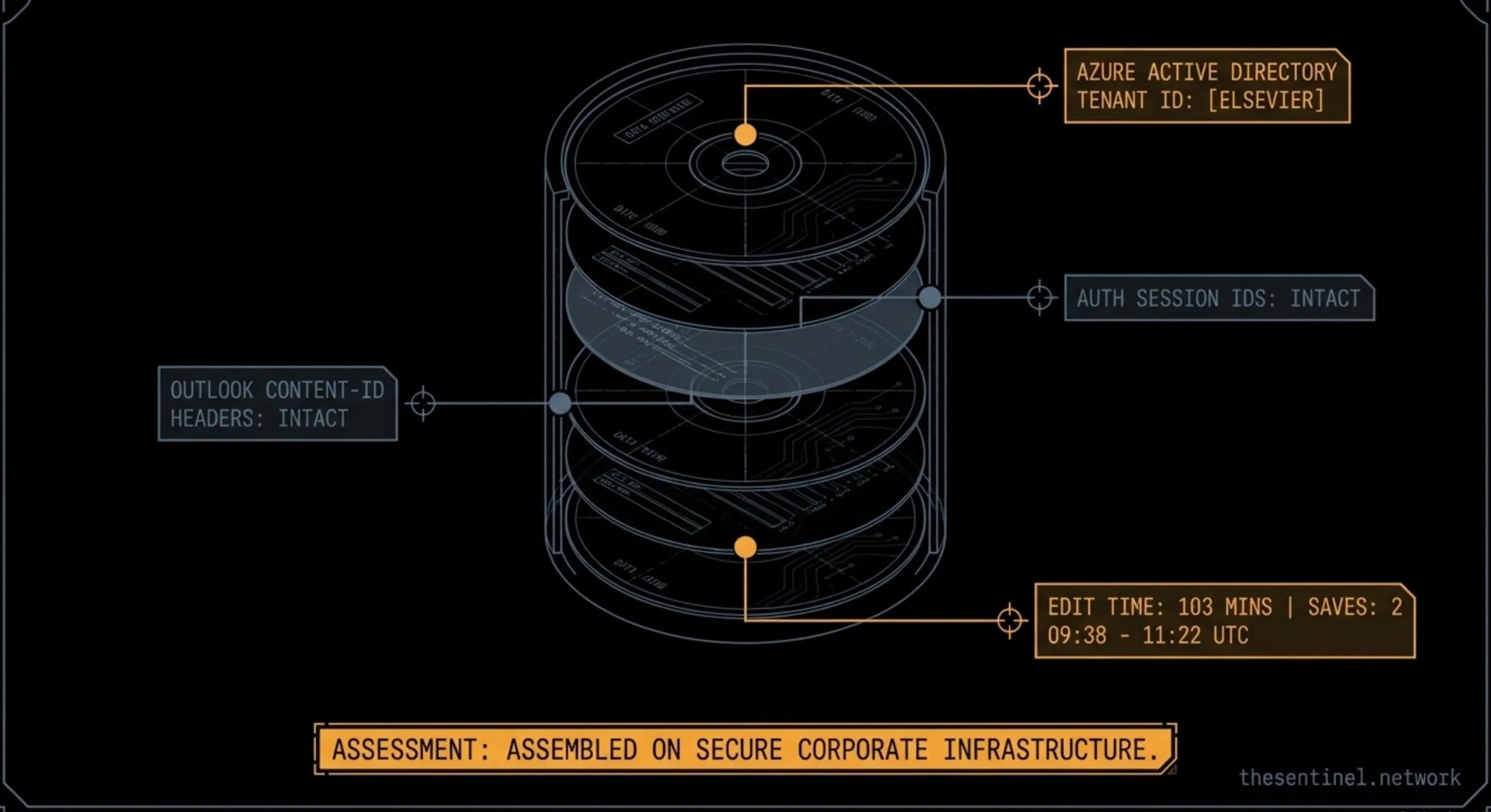
A .docx file is a zip archive. Inside that archive are XML metadata files that most users never see and most senders don’t know exist. Before we read a single word of the document’s contents, we extracted and parsed every one of those files programmatically. Here is what we found.
The document was created on Elsevier‘s corporate Microsoft 365 environment. We know this because the file carries a Microsoft Information Protection sensitivity label stamped automatically by the organization’s Azure Active Directory tenant. The tenant ID is in the XML. The company field in the application properties reads “Elsevier.” The creator field contains the individual’s full name and internal division code.
The document was created at 09:38 UTC and last saved at 11:22 UTC on the same day. Total editing time logged by Microsoft Word: 103 minutes. Two saves. One sitting. Written in a morning and sent before lunch.
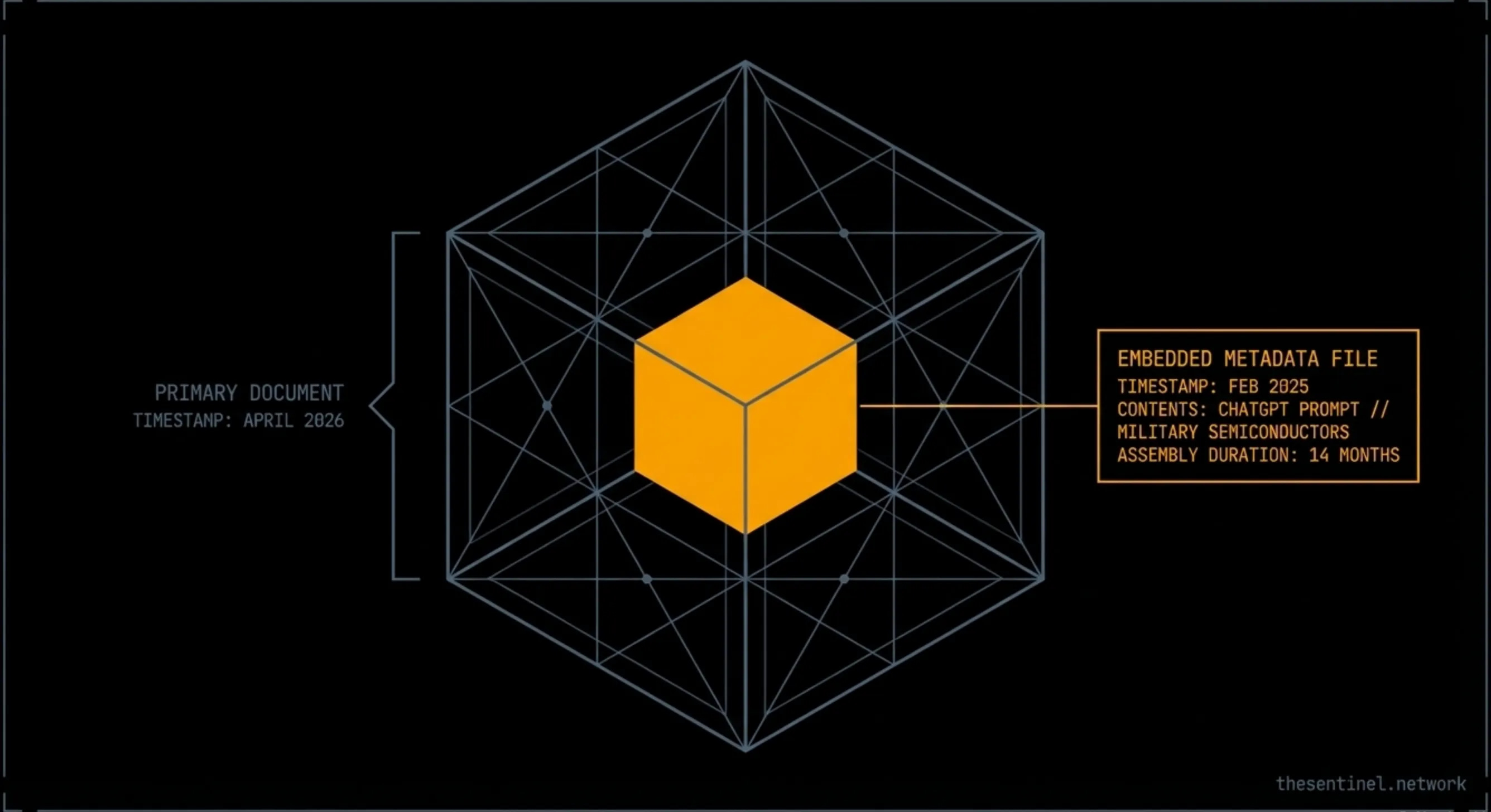
Embedded inside the document we found a second Word file. It contained a single line: a prompt to ChatGPT asking about the military applications of a semiconductor material. The metadata on this embedded file showed it was created fourteen months earlier, in February 2025, with three minutes of editing time. They had been assembling material for over a year.
The Scopus search URLs pasted into the document contained the individual’s authenticated session IDs. The screenshots were copy-pasted directly from their corporate Outlook email client, identifiable by the Content-ID headers still embedded in the document relationship XML. Every search they ran, every email they pulled from, every database query that generated those screenshots is traceable through Elsevier’s internal systems to a single authenticated user session.
No malware. No tracking pixels. No external web beacons that would phone home when the document was opened. No steganographic data hidden in the embedded images. The file was clean.
But the metadata told its own story. They password-protected the file and left every piece of forensic evidence intact. They sent it from their corporate email address. They built it on corporate infrastructure, using corporate tools, during work hours, logged into their employer’s systems. Whatever this contact represents, it was not a weekend hobby project assembled on a personal laptop.
Only after confirming the file was safe did we decrypt it and read the contents.
Now. What was in the document.
It contained 2,000+ words and 16 embedded Scopus screenshots. It demonstrated how to use Elsevier’s databases to track scientists’ publication gaps, map co-author networks, and identify researchers who may have gone dark due to classified work. It profiled AFRL-affiliated scientists and editors. It included materials science threads connecting defense contractors to advanced semiconductor research. It named specific leads the individual wanted us to pursue and listed the other researchers and journalists they had already shared the information with.
It referenced our ATTRITION reporting. It referenced our AFRL work. It mirrored techniques from our FIELDCRAFT methodology series. Publication gap analysis. Network mapping. Record forensics. Our methods, reflected back to us through the lens of someone with institutional access we don’t have.
It was thorough. It was targeted. It was calibrated to our interests with precision.
And it did not mention 3I/ATLAS once.
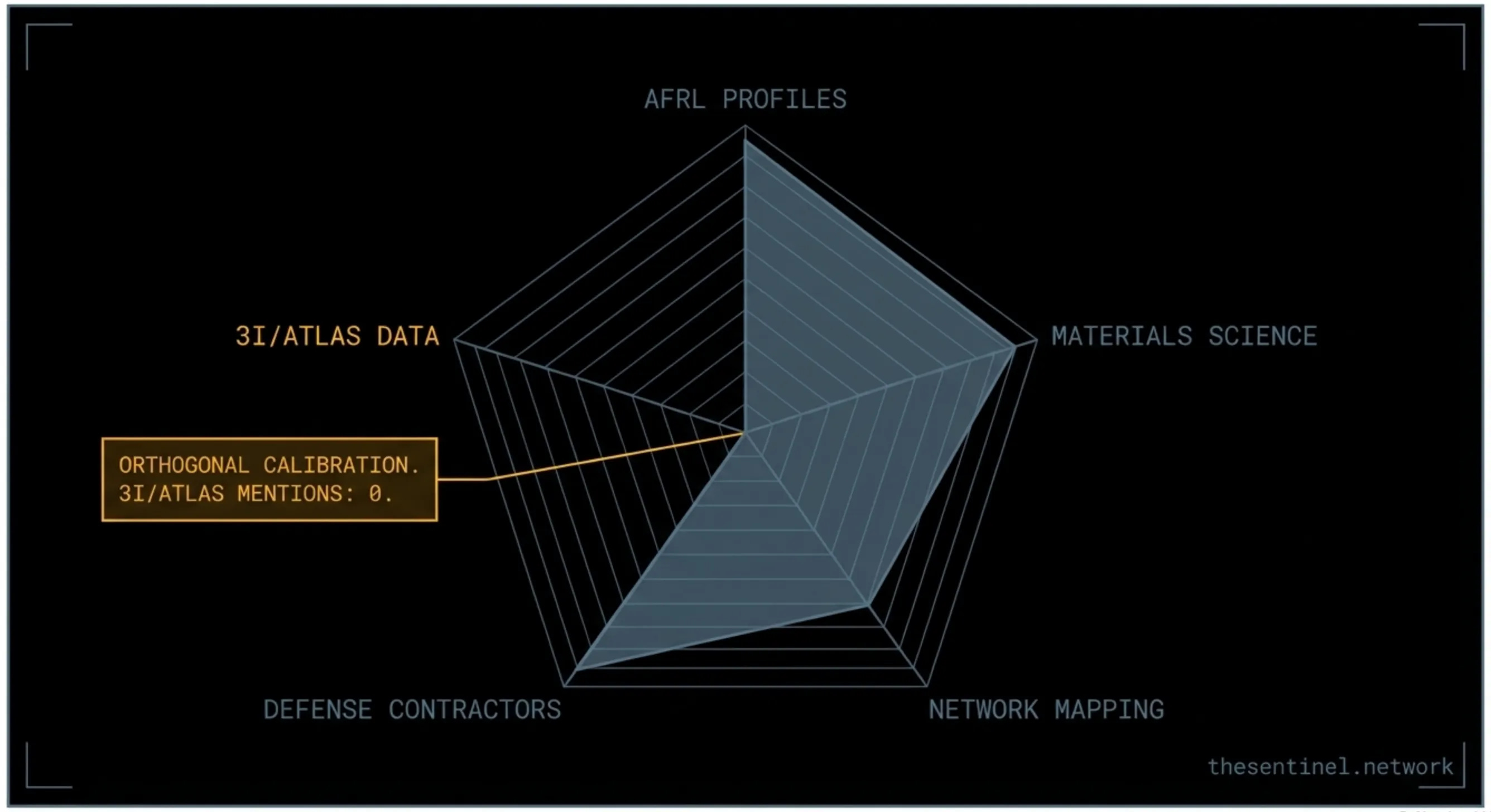
Not a word. Not a passing reference. Not a footnote. The individual who told us they were sitting at the nexus of academic publishing and anomalous phenomena, who works for the publisher that owns Icarus and Planetary and Space Science and JQSRT, who said they had spotted things that could be useful, had nothing to say about the third interstellar object in human history passing through their own publisher’s pipeline.
We moved the conversation to Signal. We asked a direct question: given their position on the Energy and Earth side of the publisher where most 3I/ATLAS papers land, were they seeing anything unusual in the submission pipeline?
Note the pace up to this point. First contact to Substack message: days. Substack to corporate email: days. Email to password-protected document: immediate. Document to Signal setup: hours. Every exchange faster than the last. Someone eager to connect, eager to help, eager to build a relationship.
We asked about 3I.
Four days of silence.
This is an individual who had been responding within hours. Who set up Signal the same day we suggested it. Who sent an introductory message within minutes of connecting. Four days. On a read receipt.
Then the reply came. Three messages in quick succession.
The first: “My group does not have the space science journals.”
Read that again. The individual who described themselves as sitting at the nexus of academic publishing and anomalous phenomena. Who works for the publisher that owns Icarus. Who offered to look into anything we needed. They do not oversee the journals where 3I/ATLAS research is published.
They knew this from the beginning. They knew it when they sent the document. They knew it when they offered database access. They knew it when they said they had spotted things that could be useful. They knew it when they positioned themselves as someone who could help with our investigation. It took a direct question about 3I and four days of silence to surface a fact they could have stated in their first email.
The second and third messages pivoted immediately. Not to 3I. To reverse-engineered propulsion. To a cousin who is scraping a social media account central to one of our ongoing investigations and running AI cross-referencing against it. To a book about antigravity. To plasma physics and stealth technology.
The redirect was seamless. In one exchange, the individual moved from “I can’t help you with 3I” to “but here’s what I can help you with” and the destination was exactly where they had been pointing us from the start: away from the comet.
One more detail. Buried between the redirects, an editorial opinion: “Personally I don’t feel there is a push from the powers that be to block the narrative.”
An employee of Elsevier, the publisher whose journals we just showed you have published functionally nothing on 3I/ATLAS, is telling us there is no suppression. After four days of silence. After admitting they don’t oversee the relevant journals.
We decided to test that claim.
We sent the data directly. The specific numbers. Icarus: one paper, still in typesetting. Planetary and Space Science: zero. Earth and Planetary Science Letters: zero. Acta Astronautica: zero. Advances in Space Research: zero. New Astronomy: zero. Two papers across all of Elsevier in ten months. Thirty-plus everywhere else. Then a direct question: you work in the building. How does this happen?
The response came within minutes. It did not address a single number.
Instead, it offered generic editorial language. Whether papers are being submitted. Whether the research is novel. Whether it is of sufficient quality. Boilerplate that could describe any journal reviewing any topic in any decade. Not one word about the specific gap we documented. Not one word about why five journals in perfect scope alignment produced zero output on the defining astronomical event of the century.
Then it asked us to reveal our sources. If we knew of researchers being blocked, we should let them know.
Then it characterized us. “I believe you are convinced that it is of non-human origin.” Not: “your data shows a publication disparity.” Not: “those numbers are worth investigating.” Our forensic bibliometric analysis, the count of papers, the comparison of output rates, the documentation of editorial rejections, was reduced to a belief. An analyst presenting data was reframed as a believer pushing a narrative. That is the same rhetorical mechanism deployed at the platform layer of the suppression gradient. You don’t engage with the data. You label the person presenting it.
Then the final line. The one that matters most.
“Research such as that could potentially be blocked at peer review if those who review the paper don’t agree with that concept.”

Read that one more time.
Papers can be blocked. At peer review. If the reviewer disagrees with the conclusion. Not the methodology. Not the data quality. Not the statistical rigor. The concept.
The individual told us there was no suppression. Then, in the same exchange, described exactly how the suppression works. And framed it as normal.
Then they sent more data.
Two files. Created on Elsevier’s corporate infrastructure, same as the original document. Same MIP label. Same tenant ID. But this time the metadata told a different story. Both files were generated by LeapSpace, Elsevier’s own AI-powered research platform. The individual hadn’t run a Scopus deep dive. They had typed a question into their employer’s chatbot. The first file took one minute to produce. The second took two. Combined editing time: three minutes.
The argument: 3I/ATLAS has 20-23 published papers. 1I/Oumuamua has 33. 2I/Borisov has 32. “I don’t see that 3I is lagging behind.” “20-23 articles I would say is a healthy number.”
We read the data they sent. Then we did what we always do. We checked the receipts.
Every academic paper gets a DOI, a Digital Object Identifier. Think of it as a serial number. The prefix tells you which publisher handled the paper, the same way an area code tells you which city a phone number belongs to. Elsevier‘s prefix is 10.1016. IOP/AAS is 10.3847. Oxford/MNRAS is 10.1093. EDP Sciences/A&A is 10.1051. You can’t fake a DOI. It’s assigned by the publisher at the point of publication.
In the 3I/ATLAS list, every single paper carries a non-Elsevier DOI. 10.3847. 10.1093. 10.1051. 10.3390. 10.1134. Twenty-three papers across ten months of the most significant astronomical event in a generation. Not one of them published by Elsevier.
Zero.
Now look at the 1I and 2I lists from the same data pull. Oumuamua papers include multiple entries at 10.1016/j.actaastro. That’s Acta Astronautica. Elsevier. Borisov papers include 10.1016/j.pss. That’s Planetary and Space Science. Elsevier. And 10.1016/j.actaastro again. Elsevier published interstellar object research before. For the first one and for the second one. For the third, they stopped.
The individual sent us this data to prove there was no publication gap. The data proves the gap is more specific than we documented. It isn’t that Elsevier is slow. It isn’t that the pipeline is long. It isn’t that the topic lacks interest. Elsevier published Project Lyra mission papers for Oumuamua. They published color photometry for Borisov. They published dust composition models and orbital analyses and spacecraft intercept architectures for both predecessors.
For 3I/ATLAS, the object with the most anomalous chemistry, the most extreme non-gravitational acceleration, the most unusual polarimetric signature, and a CIA Glomar response attached to its name, the world’s largest academic publisher produced nothing. And their own AI platform just confirmed it.
We ran the individual’s data through the same forensic methodology we apply to everything. We didn’t take their word for it. We checked the serial numbers. Every one pointed somewhere else.
We are not naming this individual. We are not identifying their specific role. We have no evidence they are acting in bad faith. What we have is a sequence. An approach calibrated to our interests. An implied access that turned out not to exist. A silence that broke only when a cover story was ready. A redirect that landed exactly where every other contact has been pushing us. A denial of suppression that described the mechanism of suppression in the same breath. And a three-minute AI-generated counter-argument that, when examined at the DOI level, confirmed every claim it was sent to refute.
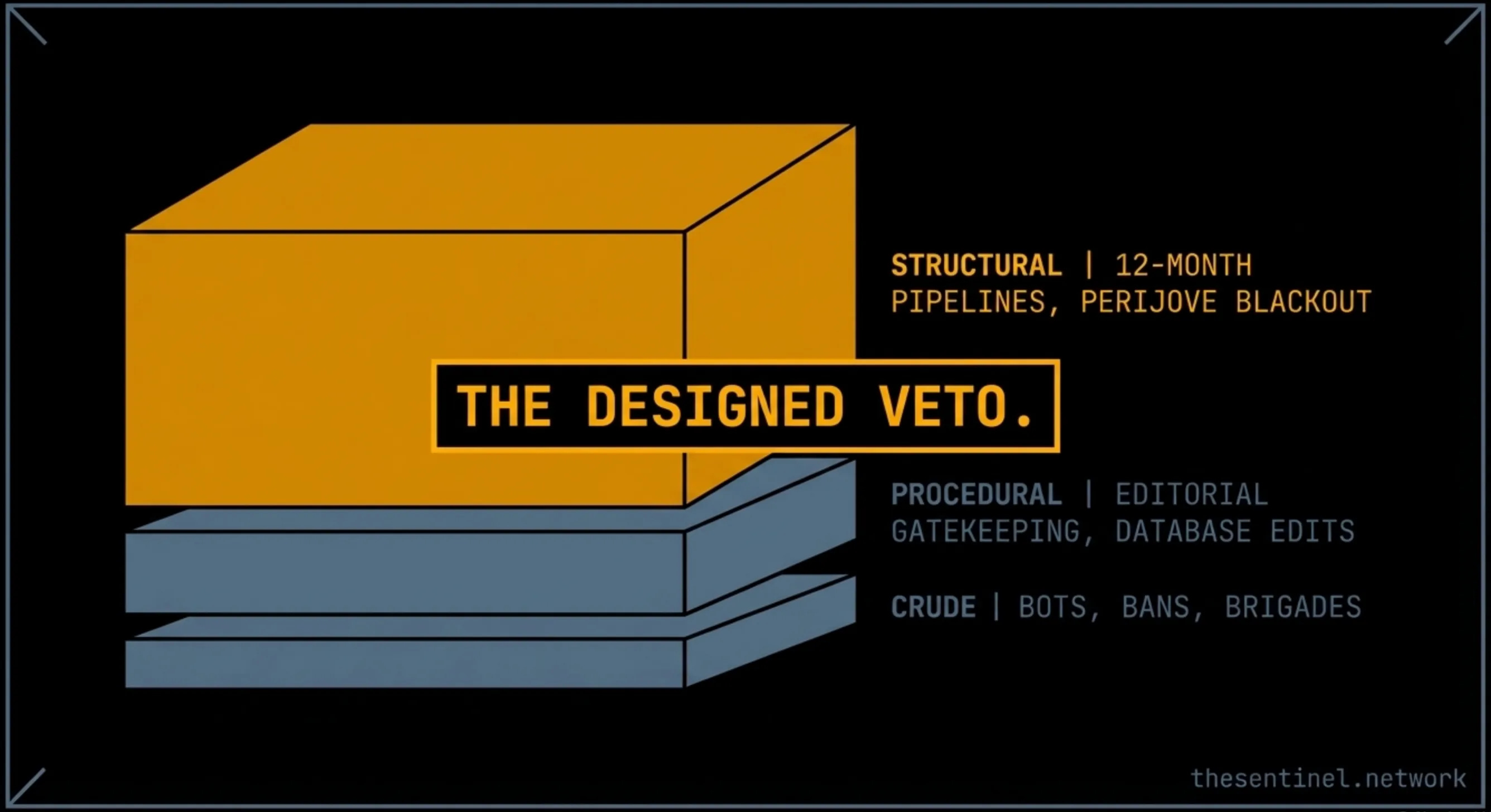
That pattern is familiar to anyone who has read THE SUPPRESSION GRADIENT. At the platform level, suppression is crude. Bots, bans, brigades. At the academic level, it is procedural. Editorial gatekeeping, silent database edits, papers killed in the crib. At the institutional level, it is structural. Six-to-twelve month pipelines that can’t keep pace with a transient event.
And somewhere between those layers, there is a human layer. Contacts who arrive with valuable information calibrated to your interests but orthogonal to your primary investigation. People who know what you’re working on and offer help with everything adjacent to the thing they don’t want you looking at.
We can’t prove motive. We can document behavior. The behavior is documented.
THE SENTINEL ASSESSMENT:
We counted the papers. We mapped the gap. We documented the blackout. We traced the editorial kill chain. Then someone from inside the publisher showed up at our door, offered us everything except the one thing that mattered, and when we handed them their own employer’s numbers, told us the problem was our belief system. Then they sent us data from their own employer’s AI platform to prove there was no gap. We checked the DOIs. The data proved the gap.
Elsevier published interstellar object research for Oumuamua. They published it for Borisov. Acta Astronautica. Planetary and Space Science. Project Lyra. Dust models. Orbital analyses. The pipeline worked. The journals were open. The reviewers engaged. For the first interstellar object and the second, the system functioned as designed.
For the third, the one with anomalous chemistry, extreme non-gravitational acceleration, unprecedented polarimetric signatures, a CIA Glomar classification, and a universal publication blackout that began nine days before Jupiter closest approach, Elsevier produced nothing. Their contact told us papers can be blocked if the reviewer disagrees with the concept. Their own AI confirmed that every 3I paper went somewhere else.
In THE SILENT EDIT, NASA altered a database within 24 hours of a challenging paper. In THE CURATED ORBIT, JPL filtered 90% of the trajectory data and the anomalous force disappeared. In CONFIRMED: THE TESS CONTINGENCY, a $337 million satellite went dark during the critical observation window. In THE FIFTH INSTRUMENT, ESA reported four instruments and buried the fifth.
THE PUBLICATION GAP is the same architecture at the publisher layer. The same data. The same pattern. The same result. And this time, the evidence came from inside the building.
They told us it was a snowball. Then they classified it. Then they stopped publishing about it. Then they sent someone to make sure we were looking somewhere else.
We weren’t.
Keep looking up.
-- The Sentinel Network™
Every briefing we’ve published is free. That’s not changing. This publication has no institutional backing, no sponsors, and no editorial board. We’re doing the work the newsrooms won’t. Sourcing papers, filing FOIAs, building tools, and writing at the pace a once-in-a-civilization event demands.
Paid subscribers fund the investigation directly. They also get access to the comment section on every briefing, Fieldcraft Labs, and the FIELDCRAFT series. No ads. No sponsors. No strings. Your subscription is a data point against the suppression gradient.
If you can’t subscribe, we don’t care. Read everything. Share everything. The mission is the mission.
Subscribe to The Sentinel Network™
A top 100 Science publication on Substack
Share this briefing. The Suppression Gradient documented what happens when this coverage reaches platforms that don’t want you reading it. Every share, every restack, every forwarded link is a data point against the gradient.
Previous briefings: THE FIFTH INSTRUMENT | THE BLIND SPOT | THE NARROW BAND | THE SKY IS FALLING | THE OPERATING SYSTEM | THE CORRECTION | THE CURATED ORBIT | THE ANCIENT ENGINE | THE VERDICT | THE LONG COUNT | THE GREEN BURIAL | THE GHOST GENERAL | THE SUPPRESSION GRADIENT | THE SILENT EDIT | CONFIRMED: THE TESS CONTINGENCY
Keep looking up...and inward. Distractions are everywhere. Keep going.
Seems like you're getting more and more of an annoyance to the "right" people.