

SUBJECT: ELSEVIER / RELX CORPORATE NON-RESPONSE // FORMAL REQUEST FOR ON-THE-RECORD COMMENT // 48-HOUR DEADLINE ELAPSED
DATE: APRIL 22, 2026
CROSS-REF: THE PUBLICATION GAP | THE SUPPRESSION GRADIENT | THE SILENT EDIT | THE OPERATOR | THE CURATED ORBIT
DATA CONFIDENCE: VERIFIED. OUTBOUND EMAIL RECORD, RECIPIENT LIST, TIMESTAMPS, AND 48-HOUR DEADLINE ALL LOGGED. AUTOMATED NEWSROOM ACKNOWLEDGEMENT AND ONE OUT-OF-OFFICE REPLY ARCHIVED. SIGNAL MESSAGES FROM APRIL 8 AND APRIL 20 PRESERVED BEFORE AND AFTER DELETION WHERE APPLICABLE.
We are building the video side of this operation. If you want the briefings in a format you can watch, subscribe to The Sentinel Network on YouTube.
THE SEND
On Monday, April 20, 2026, at 10:00 AM Eastern Time, we sent an email.
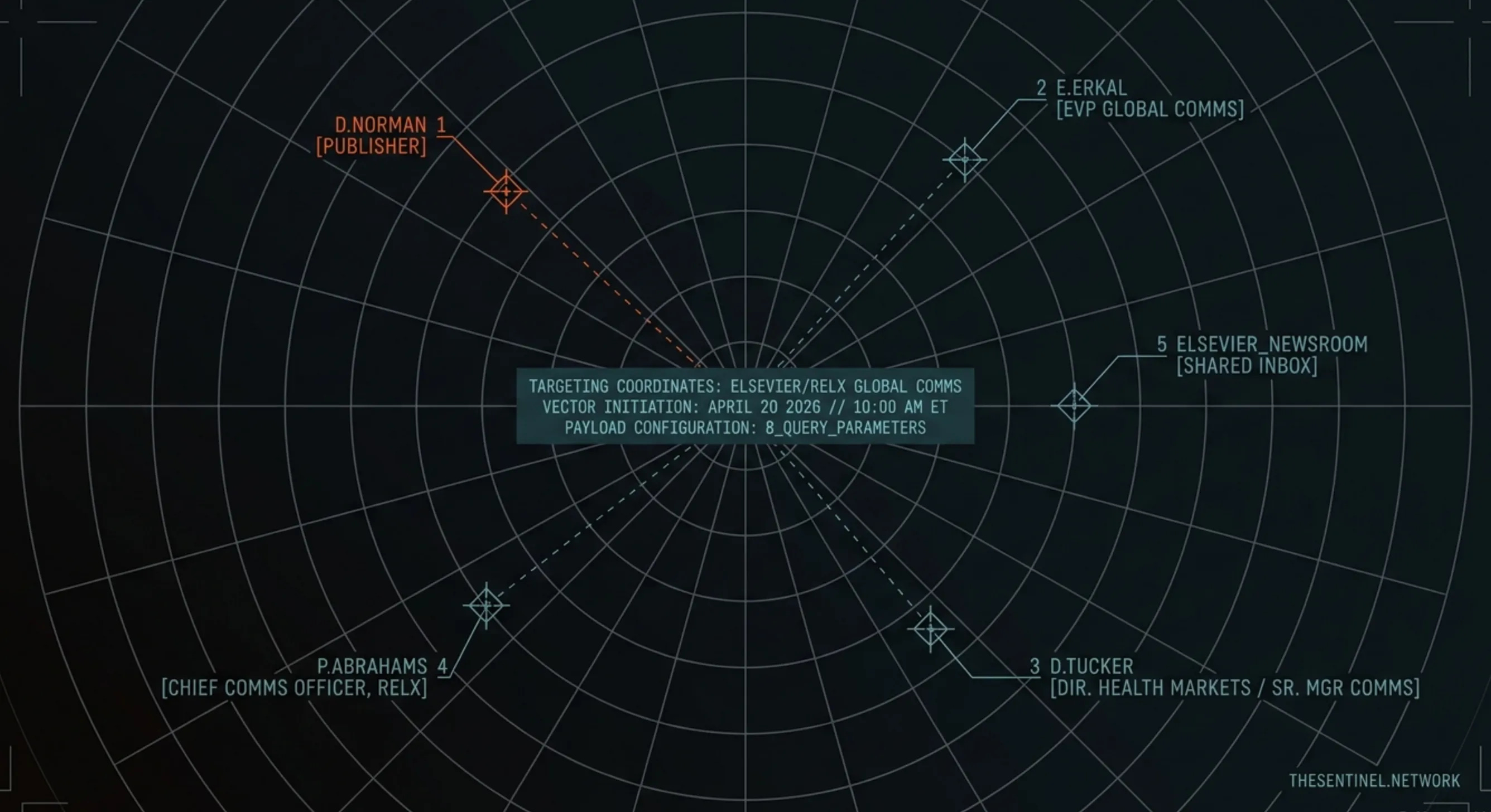
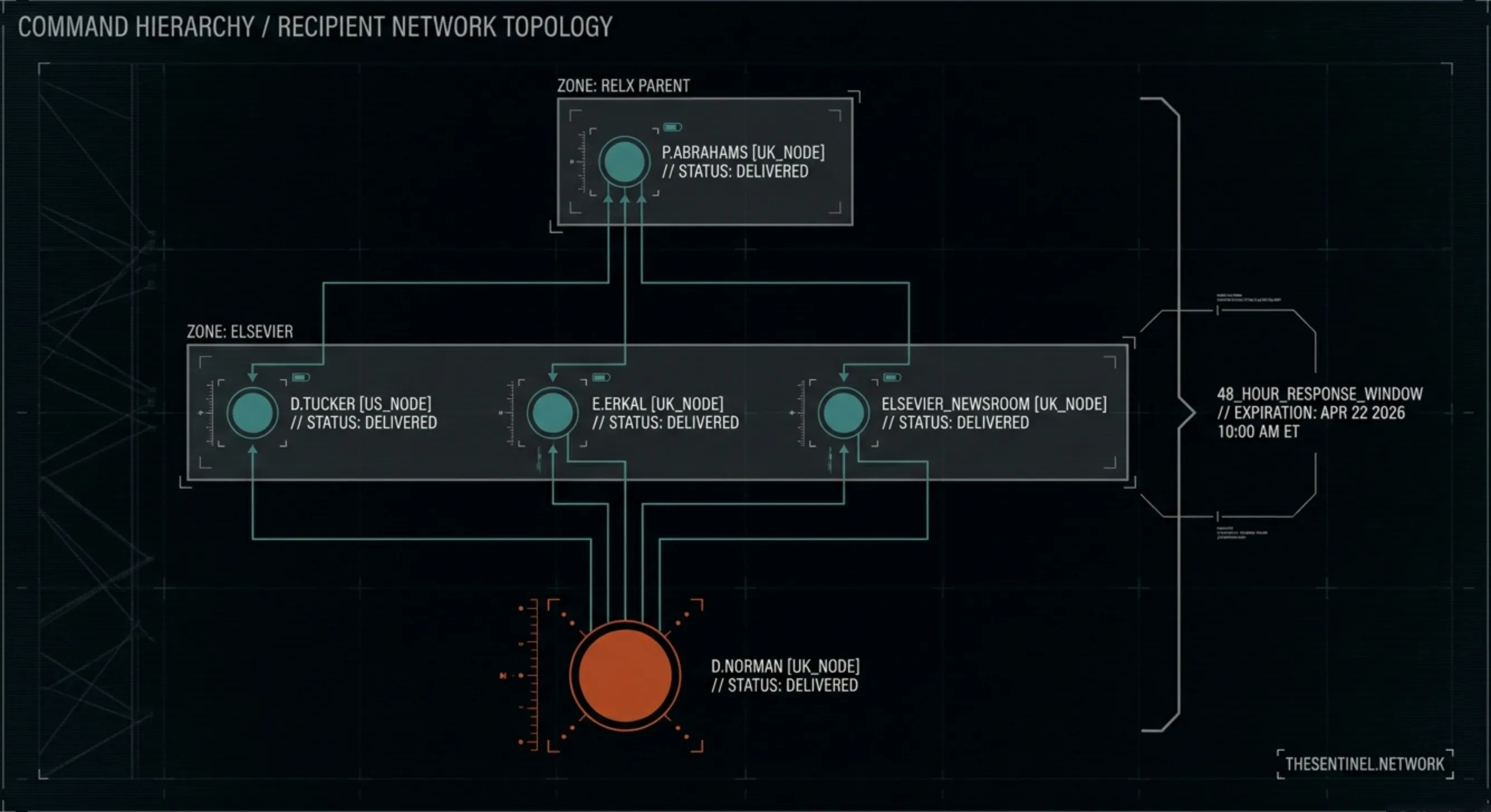
The recipient line listed five people. Dan Norman, the Elsevier Publisher whose corporate outreach to The Sentinel Network™ we documented in THE PUBLICATION GAP. Esra Erkal, Elsevier Executive Vice President of Global Communications. David Tucker, Director, Health Markets at Elsevier, listed on Elsevier’s own Media Contacts page and on the RELX Media Contacts page under the alternate title “Senior Manager Communications, Research Products.” The Elsevier Newsroom shared inbox. Paul Abrahams, Chief Communications Officer at RELX, Elsevier’s parent company, listed as corporate communications lead on RELX’s Media Contacts page.
Five addresses. Two companies. One Elsevier employee and three institutional communications leads above him in the chain. All receiving the same forensic summary. All receiving the same eight questions. All given the same deadline.
The deadline was Wednesday, April 22, 2026, 10:00 AM Eastern Time. Forty-eight hours. Two full business days across Europe and the United States. Enough time for a corporate communications attorney to review a statement. Enough time for an EVP to pick up a phone. Enough time for a Newsroom inbox staffed during business hours on both sides of the Atlantic to produce a single sentence.
The body of the email opened with the April 8, 2026 publication date of THE PUBLICATION GAP and the URL of the published piece. It described the Signal message sent to The Sentinel Network™ after publication, in which the sender asserted we had “outed” him and that he had been “trying to help,” and which was subsequently deleted. We preserved it.
The body then stated the terms. Any response received by the deadline would be quoted verbatim, in full or in the operative passages, without alteration. Non-response would be noted as such.
Then the questions.
The first four were directed at Elsevier Global Communications and RELX Corporate Communications. They concerned institutional policy, not individual conduct.
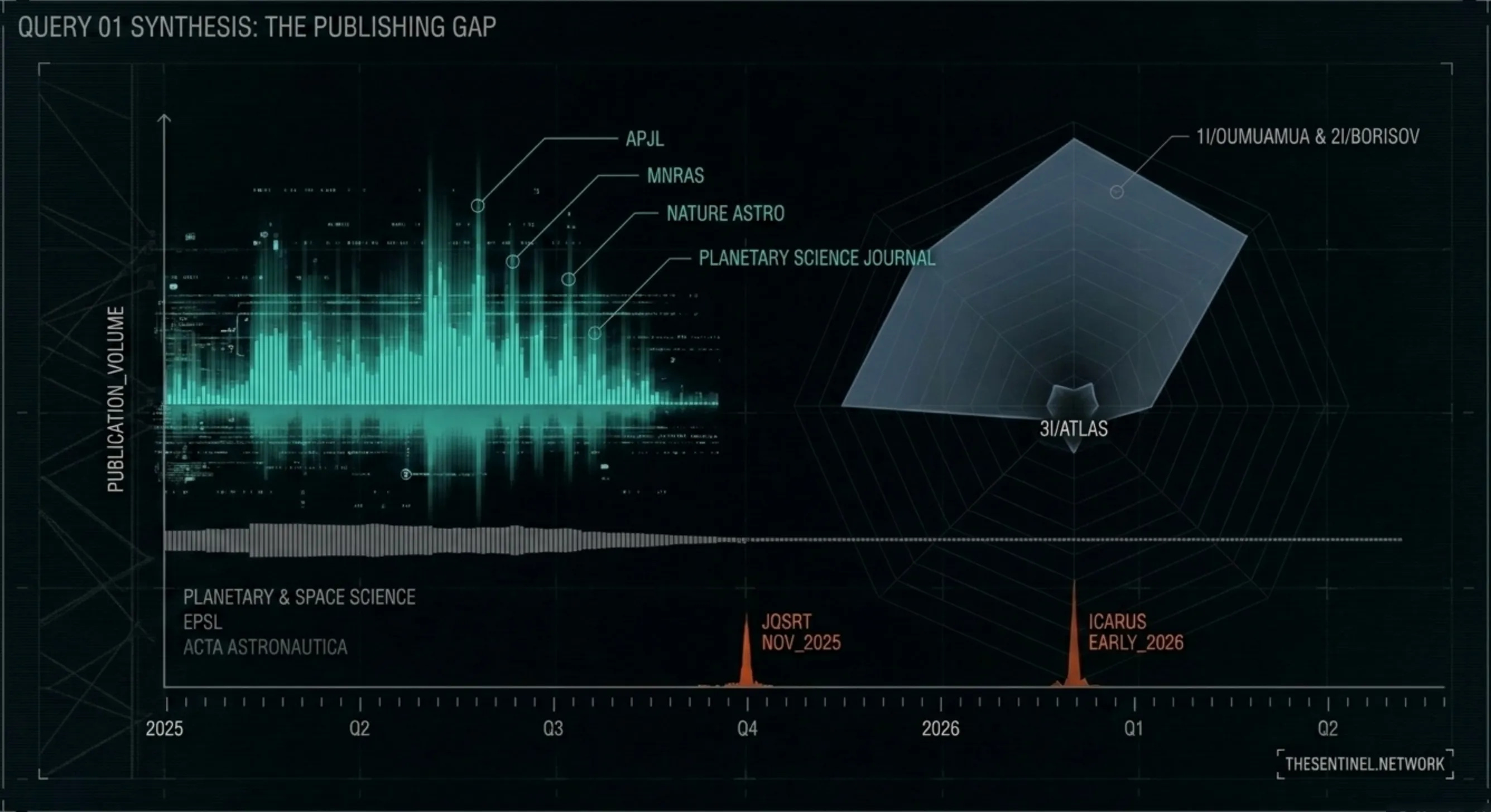
Question 1. From July 2025 through the first week of April 2026, the entire Elsevier publishing portfolio produced two peer-reviewed papers on 3I/ATLAS. One in the Journal of Quantitative Spectroscopy and Radiative Transfer, November 2025. One in Icarus, accepted early 2026 and still in typesetting at the time of publication of THE PUBLICATION GAP. Over the same period, the Astrophysical Journal Letters, Monthly Notices of the Royal Astronomical Society, Astronomy and Astrophysics, Nature Astronomy, and the Planetary Science Journal collectively published 3I/ATLAS research at a rate of three to five papers per month. Planetary and Space Science, Earth and Planetary Science Letters, Acta Astronautica, Advances in Space Research, and New Astronomy each published zero. For 1I/Oumuamua and 2I/Borisov, Elsevier journals in this same portfolio published extensively, including Project Lyra mission architectures in Acta Astronautica and dust and orbital analyses in Planetary and Space Science. We asked Elsevier and RELX to explain the collapse in output on 3I/ATLAS relative to the two prior interstellar objects and relative to every competing publisher over the same window.
Question 2. We asked whether Elsevier editorial policy permits associate editors or handling editors to desk-reject papers on 3I/ATLAS prior to peer review on the basis of conclusion rather than methodology, data quality, or scope. If so, in which journals, and under what written policy. If not, what mechanism would explain the documented pattern of rejections described in THE SILENT EDIT and the publication output documented in THE PUBLICATION GAP.
Question 3. We asked whether Elsevier has a written policy governing employee use of authenticated corporate Microsoft 365 resources, Scopus credentials, LeapSpace access, and Elsevier email addresses to transmit unsolicited materials to independent press outlets. We asked whether the April 1, 2026 outreach to The Sentinel Network™ from a d.norman1@elsevier.com email address was authorized under that policy.
Question 4. We asked whether Elsevier has a written policy regarding employee demonstration to third parties of methodologies for using Scopus to identify researchers who may have transitioned to classified work, including employees of United States defense contractors and United States government research laboratories such as the Air Force Research Laboratory. We asked whether the methodology contained in the April 1, 2026 document was authorized under that policy.
The remaining four questions were directed at Mr. Norman personally.
Question 5. The document he sent on April 1, 2026 was created on Elsevier’s corporate Microsoft 365 tenant during his work hours. Internal Microsoft Information Protection sensitivity labels, the corporate company field reading “Elsevier,” the creator field containing his full name and internal division code, and authenticated Scopus session IDs are embedded in the file. We asked whether he had authorization from Elsevier leadership to use those corporate resources to send unsolicited material to The Sentinel Network™.
Question 6. Embedded inside the document was a second Word file dated February 2025 containing a ChatGPT prompt on the military applications of a semiconductor material. We asked the connection between that fourteen-month-old prompt and his stated April 2026 interest in The Sentinel Network™.
Question 7. On Signal, during the exchange documented in THE PUBLICATION GAP, Mr. Norman stated that research on 3I/ATLAS “could potentially be blocked at peer review if those who review the paper don’t agree with that concept.” He also stated in the same exchange that he did not feel there was “a push from the powers that be to block the narrative.” We asked which of those two positions represented his professional view, and how he reconciled them.
Question 8. In the Signal message he sent following publication of THE PUBLICATION GAP on April 8, 2026, and subsequently deleted, Mr. Norman asserted that we had “outed” him and that he had been “trying to help.” The published piece did not name him. The published piece did not identify his department. The published piece did not publish his role or his email address. We asked on what basis he asserts that he was outed, and what help he was offering that he believes was not fairly characterized in the published analysis.
The email closed with a final line. All responses to sentinel.intel.drop@proton.me.
THE WINDOW
Forty-eight hours is a long time for a corporate communications operation.
It is long enough for a Global Media Relations Director based in the United States to review inbound press and assign it to the appropriate desk. It is long enough for an EVP of Global Communications based in the United Kingdom to coordinate a response with legal, with the relevant journal editorial office, and with the employee in question. It is long enough for a parent-company Head of Corporate Communications to escalate an issue involving a subsidiary’s employee conduct on corporate infrastructure. It is long enough for a Newsroom inbox monitored during business hours on two continents to generate an on-the-record statement, a decline to comment, or a request for an extension.
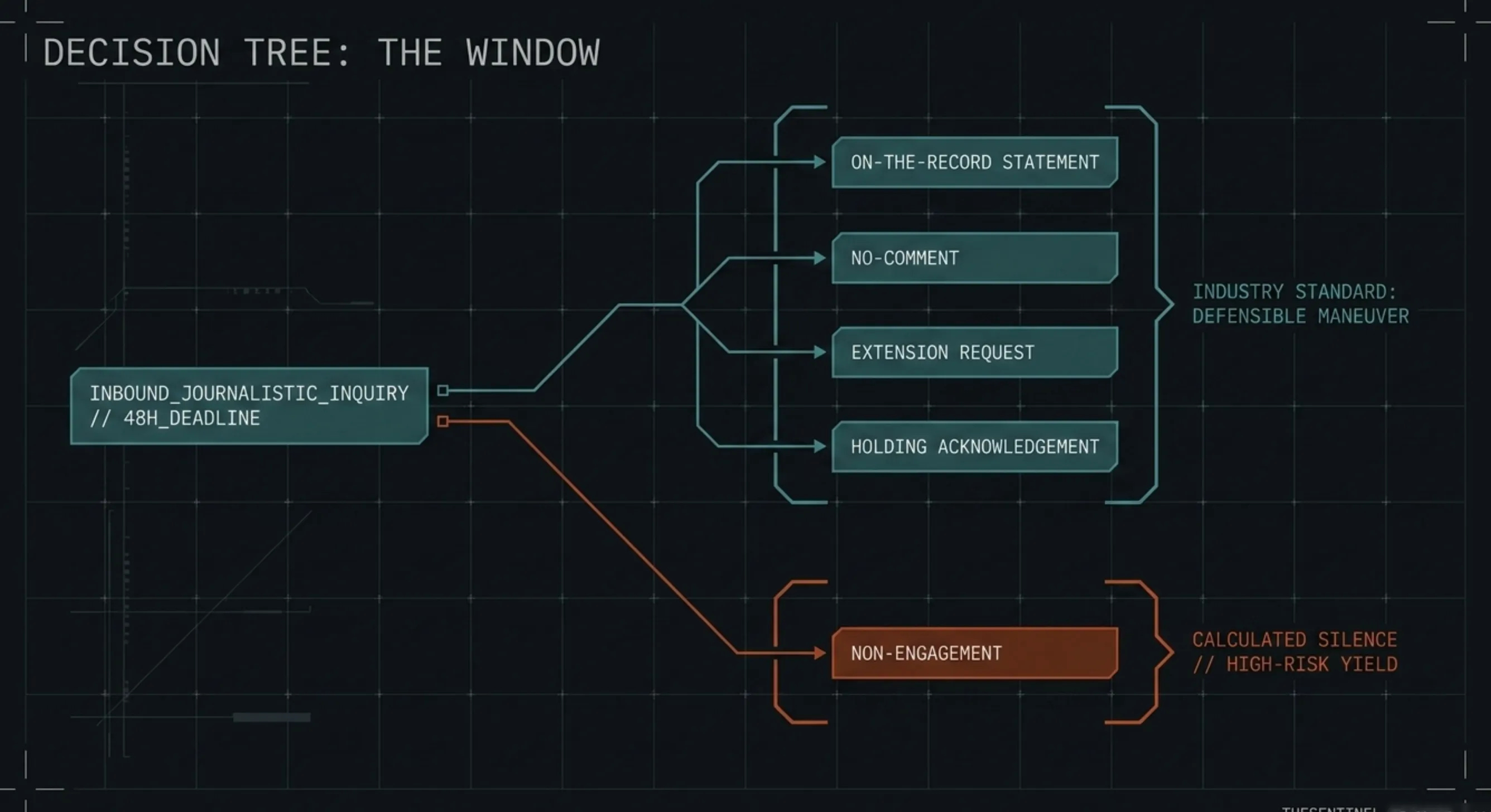
The industry standard substantive response to a journalistic inquiry with a forty-eight-hour deadline is one of four things. An on-the-record statement. A no-comment. A request for an extension. A holding acknowledgement promising a substantive response to follow.
Any of those four constitutes engagement. Any of those four gives the recipient the floor to shape the coverage. Any of those four is, in corporate communications terms, the defensible move.
The fifth option is non-engagement. Non-engagement is the option corporations choose when they have calculated that engaging on the substance would produce a worse outcome than not engaging.
Non-engagement is what we received.
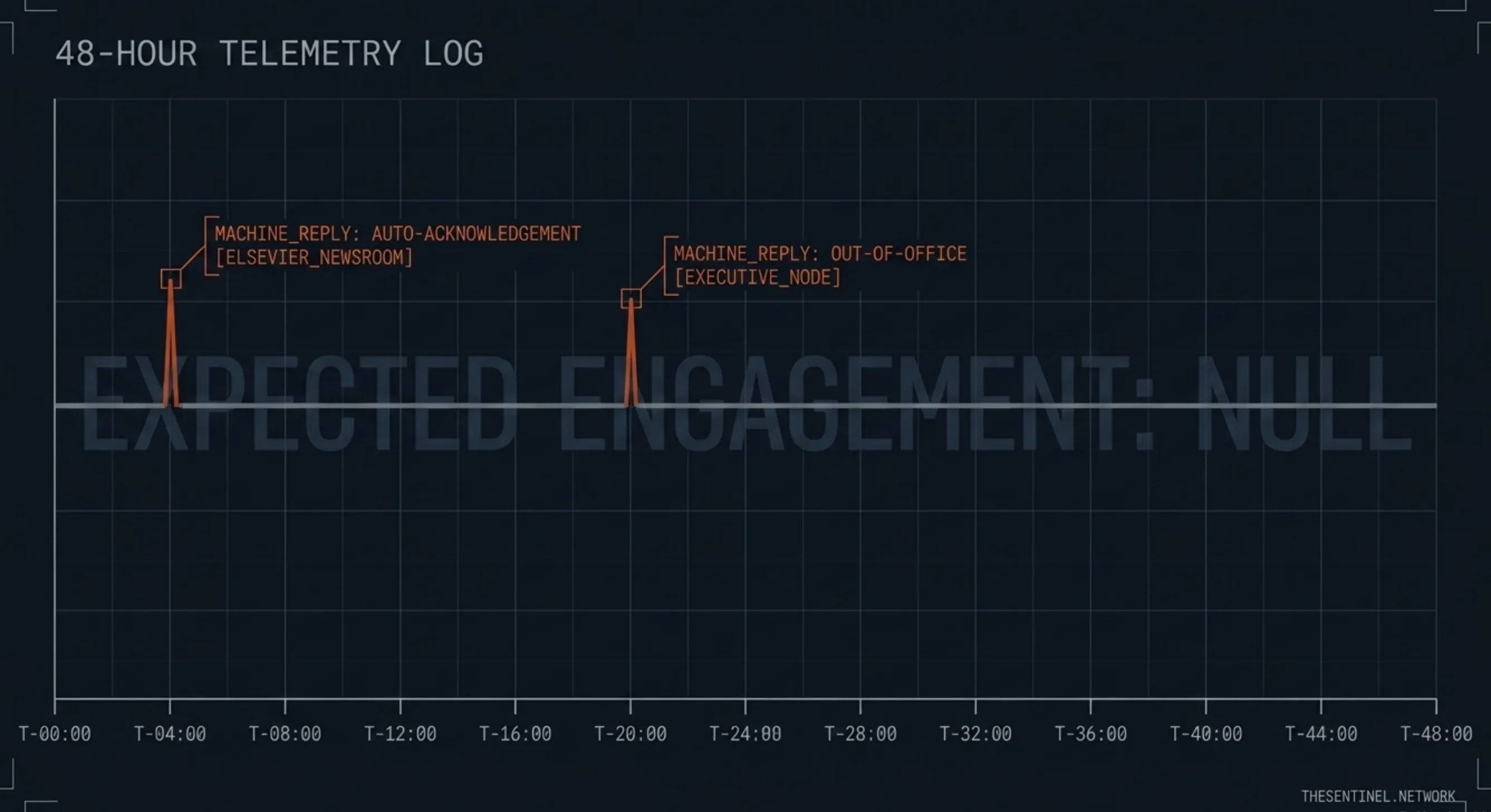
Two machine replies came back inside the forty-eight hours. The Elsevier Newsroom inbox returned an automated acknowledgement stating the inquiry would be reviewed. One of the named executives returned an out-of-office notice. Neither is a response in the journalistic sense. Neither addresses any of the eight questions. Neither places institutional policy on the record. An auto-reply is a receipt. An out-of-office is a calendar notice. Together they confirm only that the inbound arrived, that it was seen, and that no human at Elsevier or RELX chose to put a substantive answer in writing within the deadline.
Three addresses produced no reply of any kind. Dan Norman. Esra Erkal, Elsevier EVP of Global Communications. Paul Abrahams, Chief Communications Officer at RELX. The Newsroom auto-acknowledgement and the single out-of-office do not substitute for their silence, and the infrastructure that produced those two machine replies is the same infrastructure that could have produced substantive responses from all five addresses if anyone with authority had chosen to write one.
No on-the-record statement. No no-comment. No request for an extension. No holding acknowledgement promising substantive follow-up. One automated acknowledgement. One out-of-office. Forty-eight hours. Eight questions. Zero answers.
THE SILENCE
The institutional silence inside a handful of machine replies is not the same as silence from a broken mailbox. It is the silence of people who received the questions, had the authority to answer them, and chose not to.
A Global Press Office does not accidentally fail to reply. An EVP of Global Communications does not overlook a forensic summary attached to eight specific questions about an employee’s conduct on corporate infrastructure. A parent-company Head of Corporate Communications does not miss a CC copied into a journalistic inquiry involving a subsidiary. Those functions exist specifically to notice and to respond. The Newsroom auto-acknowledgement is proof that the inbound was received and entered the review queue. What did not happen is the next step.
When the next step does not happen, the non-happening is the record.
Four of the eight questions we asked were institutional. They concerned written policy. Whether Elsevier permits its editors to reject papers on the basis of conclusion rather than methodology. Whether Elsevier permits its employees to use authenticated corporate systems to send unsolicited material to independent press. Whether Elsevier permits its employees to demonstrate Scopus techniques for identifying researchers who have transitioned to classified government work, including researchers at United States defense laboratories. Whether Elsevier can explain the collapse in its 3I/ATLAS output relative to every comparable publisher and relative to its own portfolio’s output on the two prior interstellar objects.
The answers to those four questions are either yes or no. In every case, a no is the institutionally safer answer. No, our editors do not reject papers on that basis. No, our employees are not authorized to use corporate resources that way. No, our employees are not authorized to demonstrate those techniques. No, there is no explanation for the output collapse that does not require us to concede the gap we have spent this cycle denying.
Corporate communications teams produce defensive denials every day. It is the single most common product their desks output. Generating four of them in forty-eight hours is not difficult. It is a junior associate’s morning.
Elsevier declined to produce them.
RELX declined to produce them.
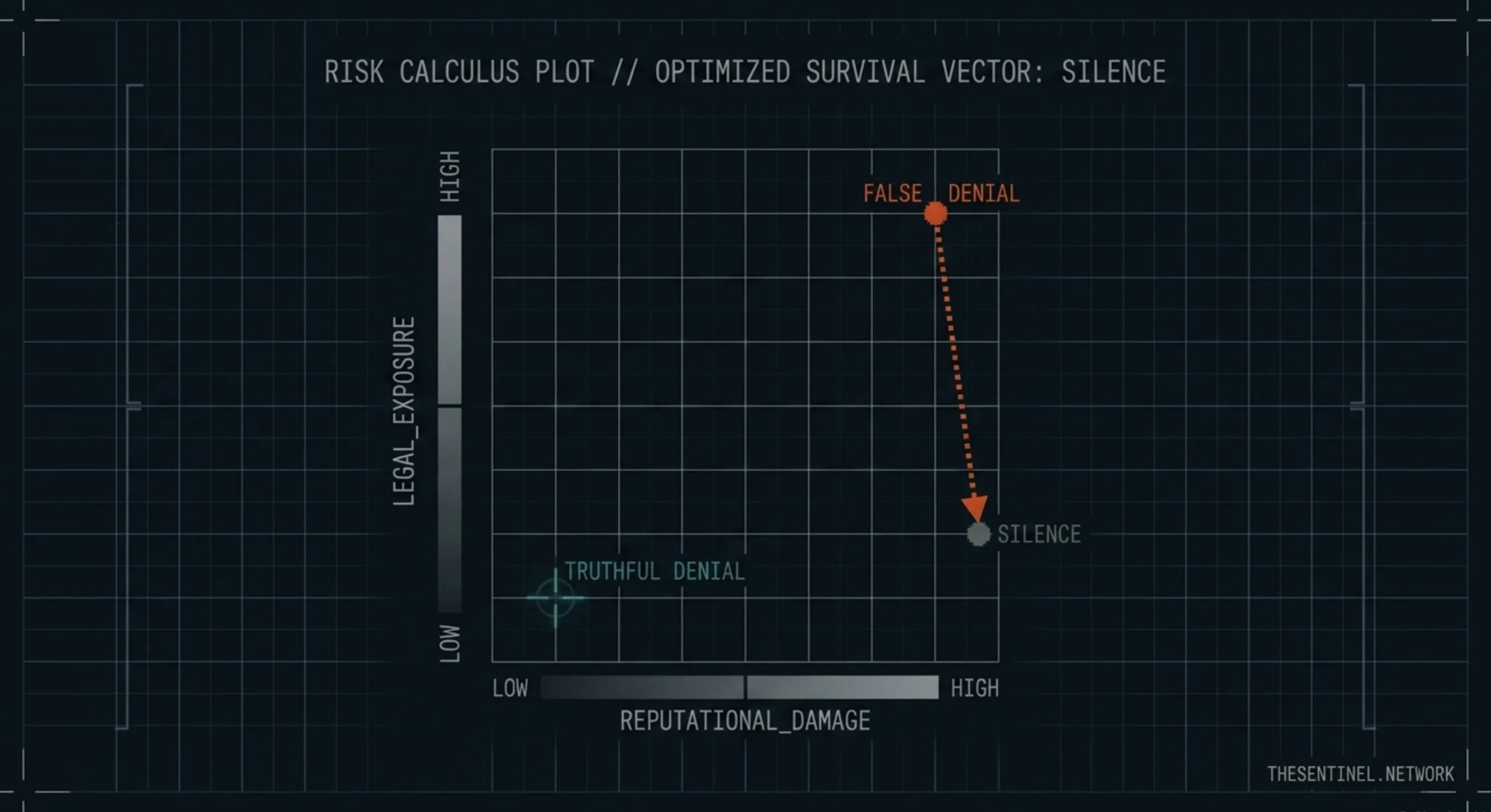
The only coherent explanation for declining to produce a denial is that the denial would not survive scrutiny. A corporation that can say no, we do not permit that does say it, immediately, loudly, and in writing, because the cost of saying nothing is higher than the cost of saying no. When the cost calculus flips, it flips for one reason. The denial cannot be made truthfully, and a denial that is not truthful creates legal exposure greater than the reputational damage of silence.
That is the choice the five recipients of our email made this week.
Silence is the admission that can be made without putting anything in writing.
THE DELETED MESSAGE
One recipient did respond. Privately. On Signal. Across two separate occasions. He deleted the first.
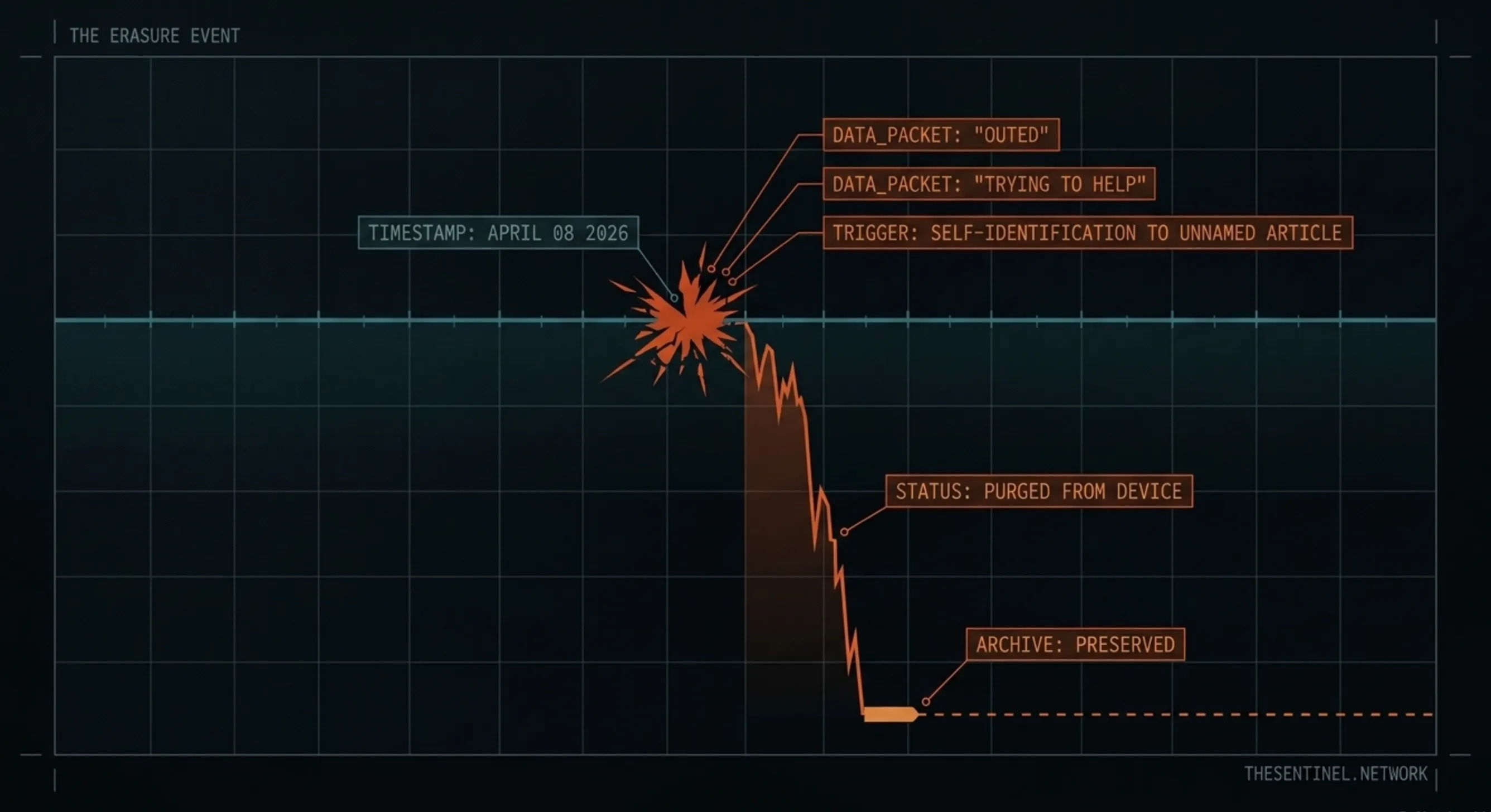
On April 8, 2026, shortly after THE PUBLICATION GAP published, Dan Norman sent a Signal message to The Sentinel Network™. He asserted we had “outed” him. He asserted he had been “trying to help.” Then he deleted the message. We preserved it.
The published piece did not name him. The published piece did not identify his department beyond “Energy and Earth,” which he had volunteered in his own unsolicited outreach. The published piece did not publish his role, his email address, or his corporate division code, though every one of those data points was embedded in the metadata he had transmitted. We redacted them.
The only party who connected Dan Norman’s identity to the content of THE PUBLICATION GAP was Dan Norman, by sending a Signal message to the publication that had not named him, accusing it of outing him.
He self-identified by complaining about being identified in a piece that did not identify him.
Then he erased the evidence of having done so.
On the evening of April 20, 2026, within minutes of the formal email hitting his corporate inbox and those of four Elsevier and RELX communications executives, he opened Signal again.
“Hey man what are you doing? I am going to lose my job because of this! I have a young family. I can’t believe your actions.”
“Completely unacceptable behaviour.”
Two messages. Emotional. Personal. Sent privately on an encrypted consumer channel, at the exact moment a question had been posed to him and to four corporate executives on the institutional channel that existed specifically to handle it.
We responded once. On Signal. On the record. We asked one question.
“Mr. Norman — the eight questions are on the corporate email chain sent Monday 10:00 AM ET with a Wednesday 10:00 AM ET deadline. Why are you responding here instead of there?”
He replied with two words.
“Unacceptable behaviour.”
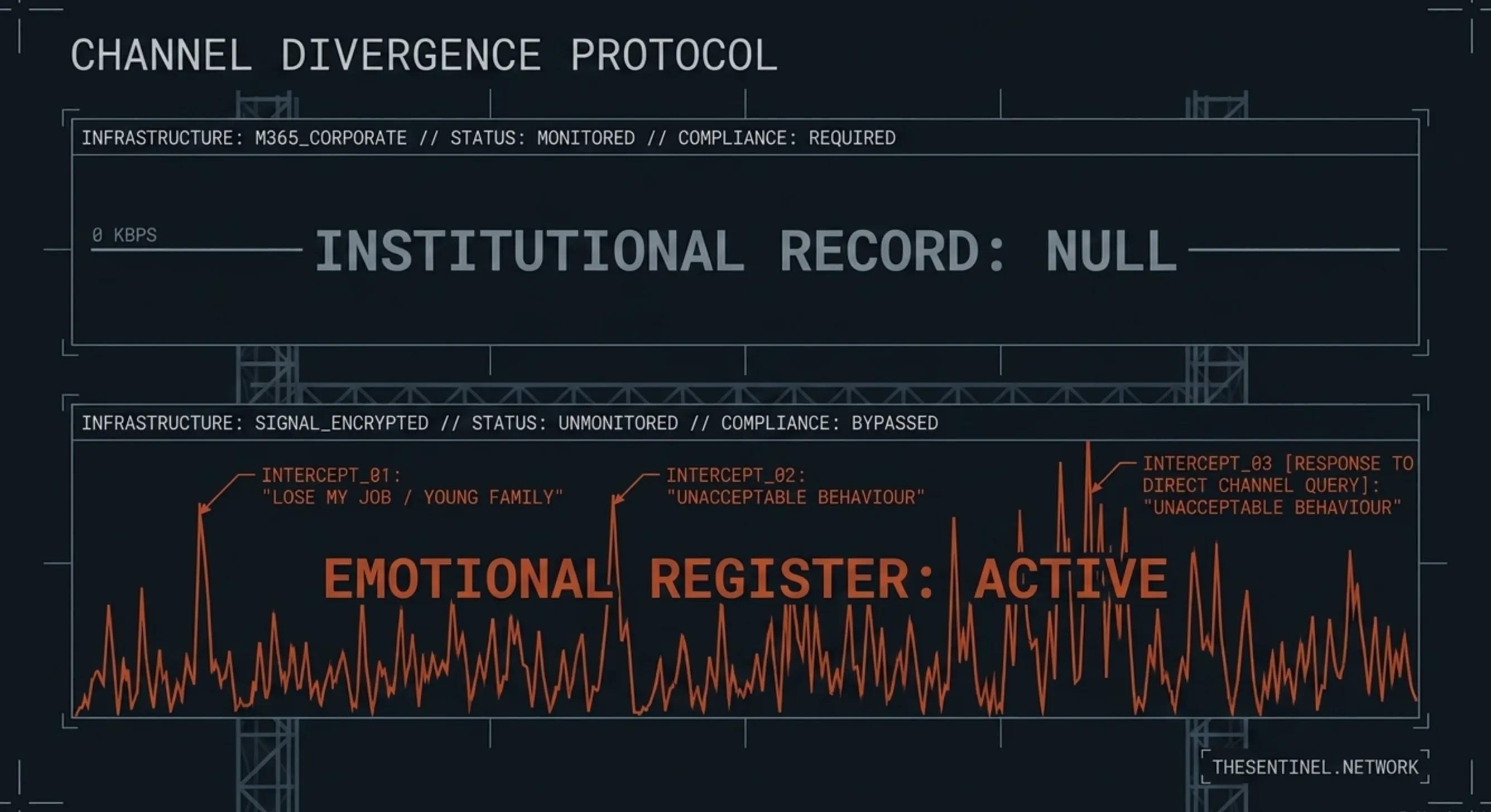
He did not answer the question. He did not move the conversation to the corporate channel where the questions lived. He did not explain why he was deploying an emotional register on a deletable encrypted consumer app while declining to respond on his corporate email. He repeated a phrase.
This is not a procedural footnote. It is the cleanest possible demonstration of the dynamic the original piece documented. A corporate employee on corporate infrastructure makes contact with an independent publication. The contact is forensically examined. The results are published without naming him. He responds by identifying himself as the subject of the piece. He then deletes the message. When formally asked to place his response on the institutional record, he replies on a private encrypted channel with emotional appeals and a two-word dismissal. Asked directly why he chose the private channel over the institutional one, he repeats the same two words and stops typing.
A person who had been trying to help would not need to delete the first message.
A person who had been trying to help would respond to eight specific questions asked via his corporate email with four corporate communications addresses on the CC line, rather than on an encrypted consumer app where the record lives only on his device and ours.
A person who had been trying to help would answer a direct question about channel choice instead of repeating the same phrase a fourth time.
He did all three.
THE PATTERN
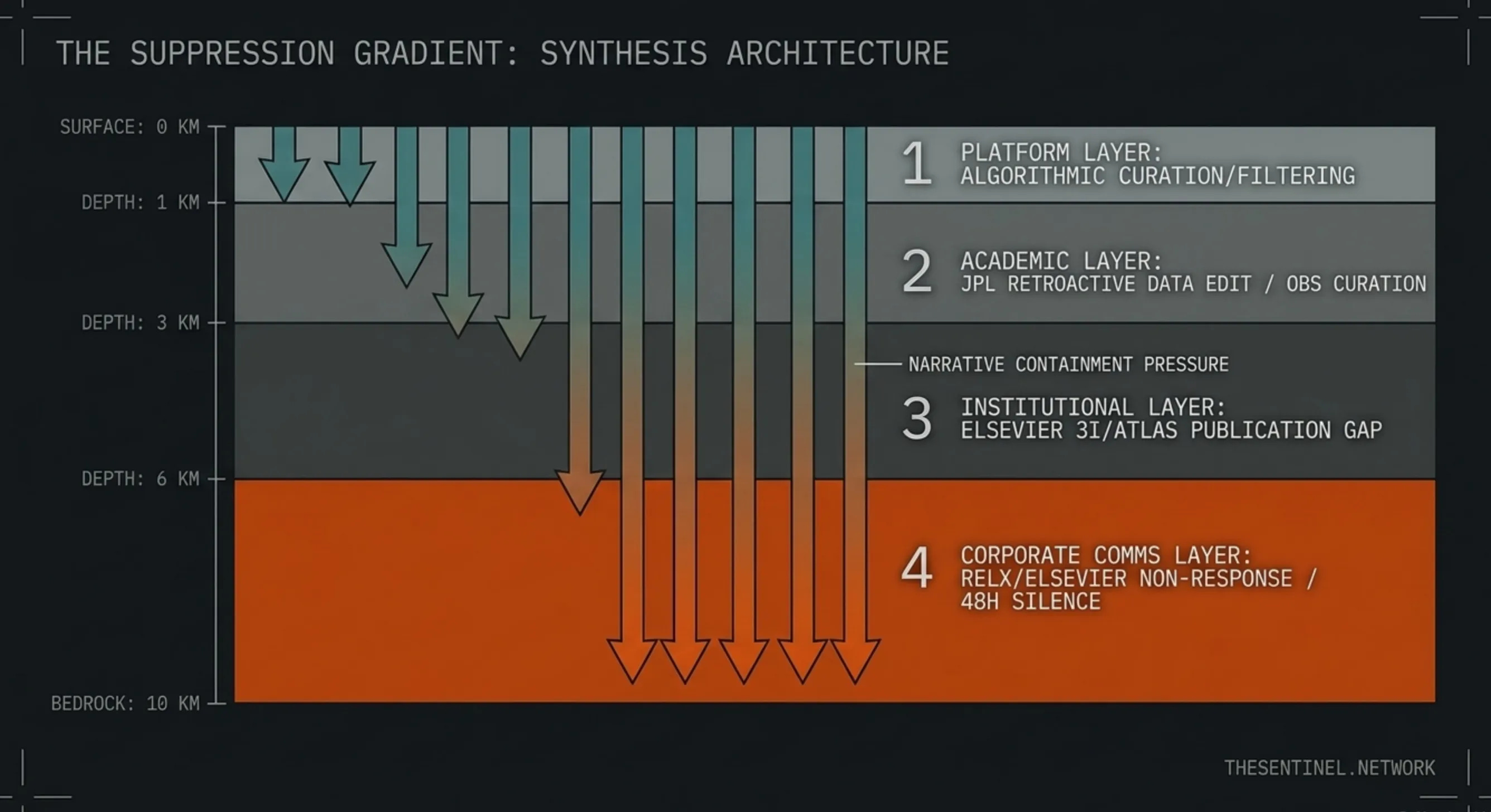
In THE SUPPRESSION GRADIENT, we mapped the architecture. Platform layer. Academic layer. Institutional layer. Three levels. One objective. Narrative containment.
THE SILENT EDIT documented NASA quietly altering a JPL database within 24 hours of a challenging paper’s publication. The edit was retroactive. It was never publicly announced. Avi Loeb caught it by comparing archived versions. The data that had shown 3I/ATLAS’s non-gravitational acceleration at anomalous values was revised downward just enough to restore the standard Solar System-origin fit. No correction notice was issued. The Internet Archive preserved the evidence.
THE CURATED ORBIT documented JPL filtering ninety percent of the trajectory observations before running the solution. The data points that had driven the anomalous force calculation were excluded from the reduced set. Independent reanalysis of the full dataset restored the anomaly. The institution had produced a clean answer by curating the data until it was clean.
THE PUBLICATION GAP documented the architecture at the publisher layer. Elsevier, owner of the flagship solar system science journal, functionally absent from the defining astronomical event of the century. An employee of that publisher reaching out to The Sentinel Network™ with a forensic methodology document that did not mention the event at all. A Signal exchange in which that employee stated that papers can be blocked at peer review if the reviewer disagrees with the conclusion, in the same conversation in which he denied suppression was occurring.
THE FOLLOW-UP documents the next layer. The institutional communications layer. The layer at which an employee’s conduct either becomes institutionally defended, institutionally repudiated, or institutionally ignored. Elsevier and RELX chose the third option. When given forty-eight hours to place the employee’s conduct within institutional policy, they declined to place it anywhere.
That declination is the institutional position. Every press operation knows that silence reads as tacit admission. They accepted the reading.
The gradient now extends one layer deeper than we had mapped. Platform. Academic. Institutional. Corporate communications.
At every layer the response has been the same. At every layer the mechanism is different. At every layer the outcome is identical. The public record of 3I/ATLAS contains less than the scientific record demands. The people best positioned to correct that gap have been selected against by the system that produced it.
THE NEXT STEP
We are filing this briefing as the institutional record of Elsevier’s and RELX’s non-response.
We will continue to monitor corporate inboxes for any delayed response. Any substantive engagement received after this publication will be reported in a subsequent briefing, with the full text of the response quoted verbatim and placed against the record of the forty-eight-hour silence.
The forensic record of the April 1, 2026 outreach from d.norman1@elsevier.com, including the full metadata extraction, the embedded fourteen-month-old ChatGPT prompt, the LeapSpace-generated follow-up files, and the Signal transcript, is archived. The preserved copy of the deleted post-publication Signal message is archived. The full outbound email of April 20, 2026, with recipient list and timestamps, is archived.
If any employee of Elsevier, RELX, or any subsidiary entity has information about internal policy regarding employee communications with independent press, about editorial decisions on 3I/ATLAS submissions, or about the corporate response to this week’s inquiry, our secure contact remains sentinel.intel.drop@proton.me.
We do not disclose sources. We do not publish metadata that could identify contributors. We do not commit raw correspondence to public files. THE PUBLICATION GAP documents our handling of an unsolicited contact in forensic detail. The same standards apply to any inbound contact going forward.
THE SENTINEL ASSESSMENT:
Corporate communications operations produce defensive denials every day. Four of the eight questions we asked required nothing more than a yes-or-no on written institutional policy. A junior associate could have produced the denials in an hour. Elsevier and RELX produced a newsroom auto-acknowledgement and an out-of-office reply. Neither is a response. The only reason a corporate communications operation with an acknowledged inbound declines to put substantive answers behind it is that the answers cannot be placed in writing without creating legal exposure. An auto-reply preserves the option to claim later that the inquiry was under review. It does not preserve the option to claim that any of the four institutional questions has a defensible affirmative answer. Between those two exposures, corporations choose the one that keeps the record ambiguous. Dan Norman chose a different channel. Twice. On Signal, privately, outside the institutional record, with emotional appeals on the first pass and a repeated two-word dismissal on the second. Asked directly why he was responding on Signal rather than on the corporate email chain, he did not answer. He is named in this briefing because he named himself. The channel choice is the record. The suppression gradient has an additional layer.
Five addresses. Two companies. Eight questions. One auto-acknowledgement. One out-of-office. One emotional appeal on the wrong channel. Zero answers.
Keep looking up.
-- The Sentinel Network™
Every briefing we’ve published is free. That’s not changing. This publication has no institutional backing, no sponsors, and no editorial board. We’re doing the work the newsrooms won’t, sourcing papers, filing FOIAs, building tools, and writing at the pace a once-in-a-civilization event demands.
Paid subscribers fund the investigation directly. They also get access to THE SIGNAL (weekly market intelligence derived from our forensic work), primary source documents, the comment section on every briefing, Fieldcraft Labs, and the FIELDCRAFT series. No ads. No sponsors. No strings. Your subscription is a data point against the suppression gradient.
If you can’t subscribe, we don’t care. Read everything. Share everything. The mission is the mission.
Subscribe to The Sentinel Network™
A top 100 Science publication on Substack.
Subscribe
Share this investigation. THE SUPPRESSION GRADIENT documented what happens when this coverage reaches platforms that do not want you reading it. Every share, every restack, every forwarded link is a data point against the gradient.
Previous briefings: THE TOKYO TABLE | THE ARCHITECT | THE FLOOR | THE RECORD | THE OPERATOR | THE PUBLICATION GAP | THE VERDICT | THE MALMSTROM OVERRIDE | THE GHOST GENERAL | THE LONG COUNT | THE GREEN BURIAL | THE BLIND SPOT | THE SUPPRESSION GRADIENT
Does Hanlon's Razor apply here? "Never attribute to malice that which is adequately explained by stupidity." I would have let this one play out longer, perhaps even indefinitely so long as any legal liability could be avoided.
Why did you disclose your Whistleblower (though this term barely fits here) to his employer? I don't understand what you are trying to achieve here. This will prevent further WBs from contacting you I'm afraid.