

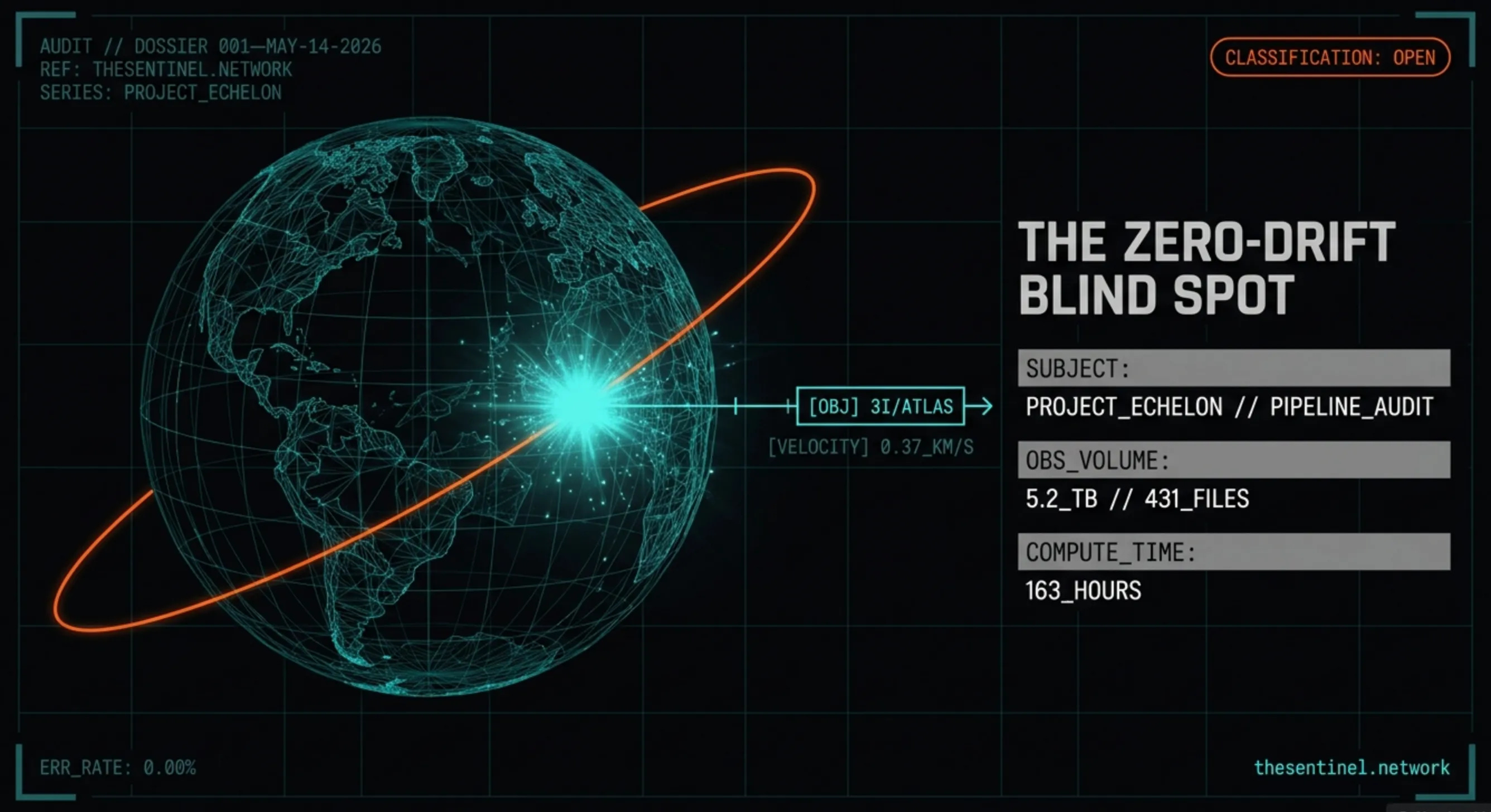
SUBJECT: PROJECT ECHELON // TURBOSETI ZERO-DRIFT BLIND SPOT // CADENCE FILTER FAILURE // EUBANKS ORBIT FALSIFICATION
DATE: MAY 14, 2026
CROSS-REF: THE NARROW BAND | THE OPERATING SYSTEM | THE VERDICT | THE GHOST COMA | THE CURATED ORBIT
DATA CONFIDENCE: VERIFIED (BREAKTHROUGH LISTEN OPEN DATA ARCHIVE, GBT L/S/C/X BANDS, 431 FILES, 289,460 HITS) + HYPOTHESIS (SENTINEL MECHANICAL ANALYSIS)
We are building the video side of this operation. If you want the briefings in a format you can watch, subscribe to The Sentinel Network on YouTube.
THE NARROW BAND PROVED RIGHT
On April 1, we published The Narrow Band. The CEO of the SETI Institute had said publicly to expect a probe. The telescopes he funds searched for a radio tower. Different signal. Different parameters. We laid out the blind spots in their search and named the exact gaps that would hide the one signal type a stationary probe matched to closest approach would produce.
That was the theory.
This is what happened when we tested it.
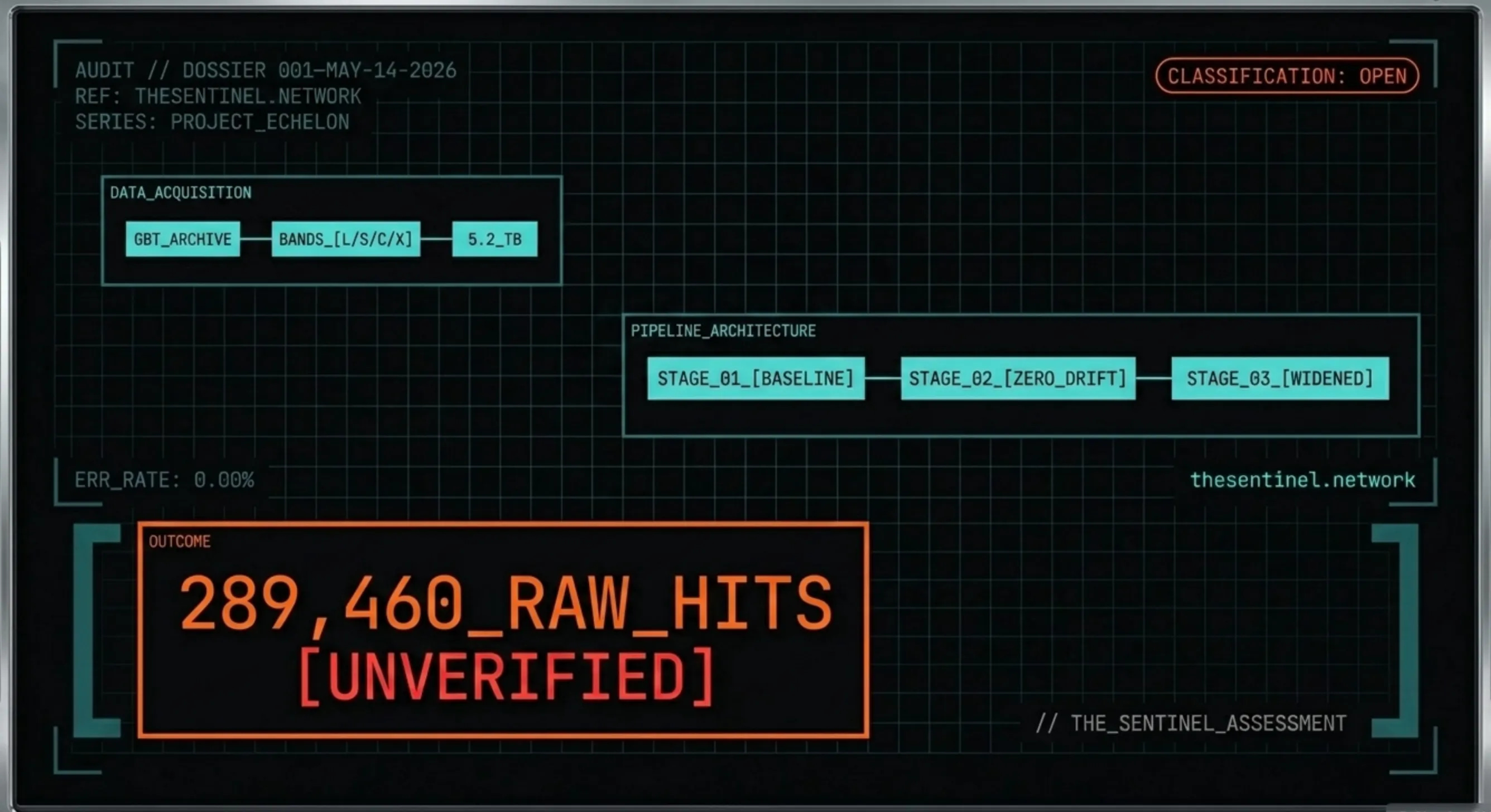
We pulled 5.2 terabytes of Breakthrough Listen’s raw observations of 3I/ATLAS from their public archive. Four hundred thirty-one filterbank files from the Green Bank Telescope. Every band they used. L, S, C, X. We built a four-stage pipeline to reproduce their published null result, then run the specific tests The Narrow Band identified.
We called it Project Echelon. Six terabytes of data. Eight days of downloads. Three weeks of pipeline development. 163 hours of compute time.
Three findings. None of them are what we expected.
THE FIRST FINDING: THE MISSING BIN
The standard SETI search tool is called turboSETI. It runs on every Breakthrough Listen observation. It scans for narrowband signals that drift slowly in frequency. Think of the ambulance siren: pitch climbs as it approaches, drops as it recedes, sits at one note if the ambulance is parked. A probe matched to Earth’s line of sight at closest approach would produce that third case. Velocity component pointing at the telescope: zero. Drift rate: zero.
That was the case we wanted to test.
Here is what we found. turboSETI cannot search at zero drift.
Not the way you would think. Not because of a parameter.
Breakthrough Listen’s baseline sets the minimum drift rate to 0.0001 hertz per second. That looks like it searches almost down to zero. Our first test dropped that to exactly zero and ran the same 431 files again. Same data. Same telescope. Same everything except that one number.
Zero new hits. Same 289,460 results both times. Identical lists.
We thought the test was broken. It was not.
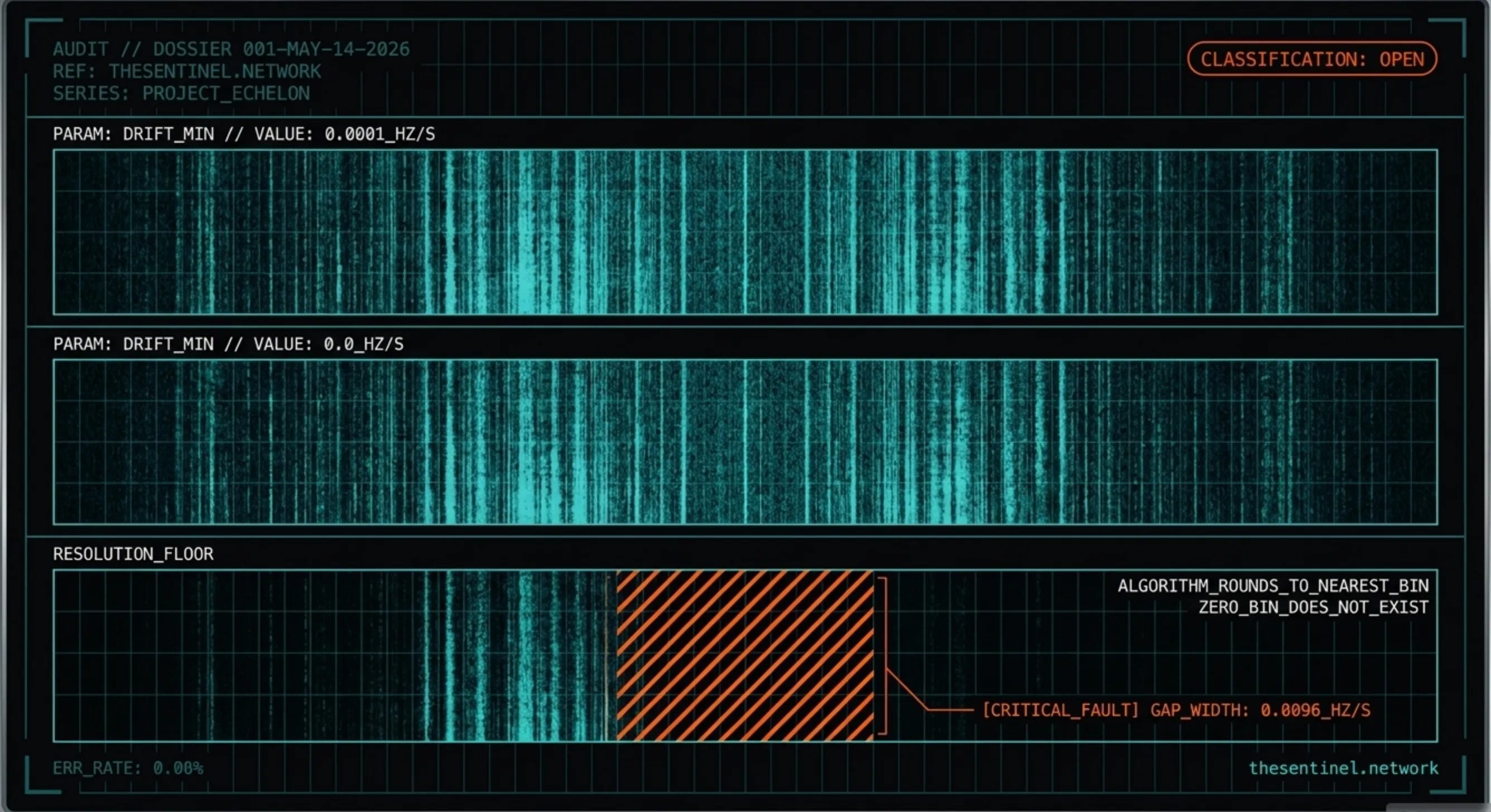
turboSETI does not search drift rates continuously. It searches in steps. The smallest step it can resolve in this data is approximately 0.0096 hertz per second. Both 0.0001 and 0.0 fall inside the same step. The parameter is meaningless at this resolution.
So we looked at what turboSETI actually reports. The smallest drift rate it found in the entire dataset was plus or minus 0.007289 hertz per second. Across 289,460 hits, not one sat at exactly zero. The algorithm rounds everything to the nearest discrete bin. There is no bin at zero.
A truly stationary signal falls into the gap. This is not a parameter you can change. It is structural. The drift rate grid is built into the algorithm itself.
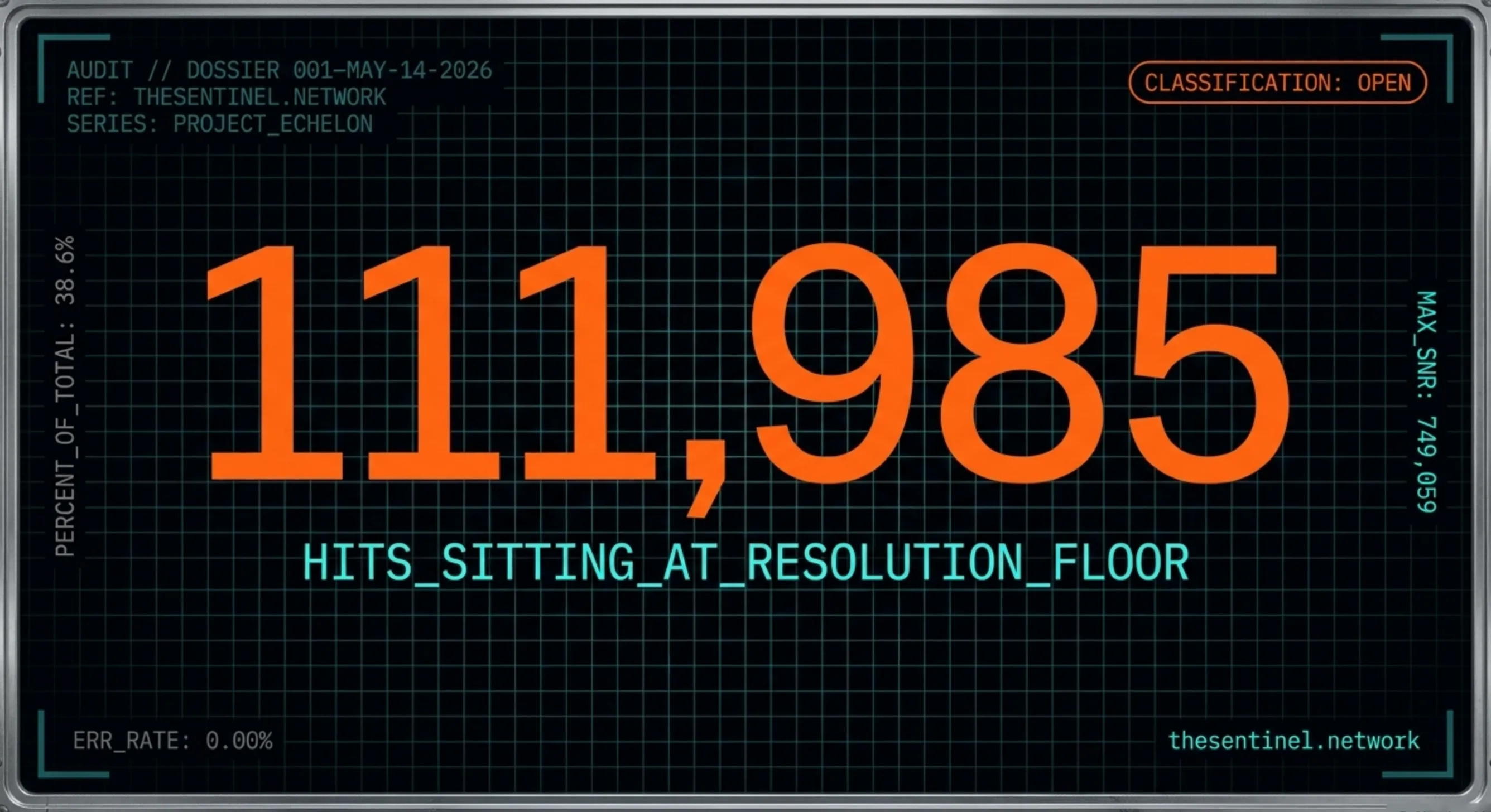
We checked. 111,985 hits sit at the resolution floor. Thirty-eight percent of all hits in the entire dataset, clustered at the closest bin to zero the algorithm can reach. Maximum signal-to-noise ratio in that cluster: 749,059.
That number is not a typo. Seven hundred forty-nine thousand.
Some of those are radio interference. Some are hardware artifacts. The point is that none of them have been checked. Because the filter that does the checking never ran.
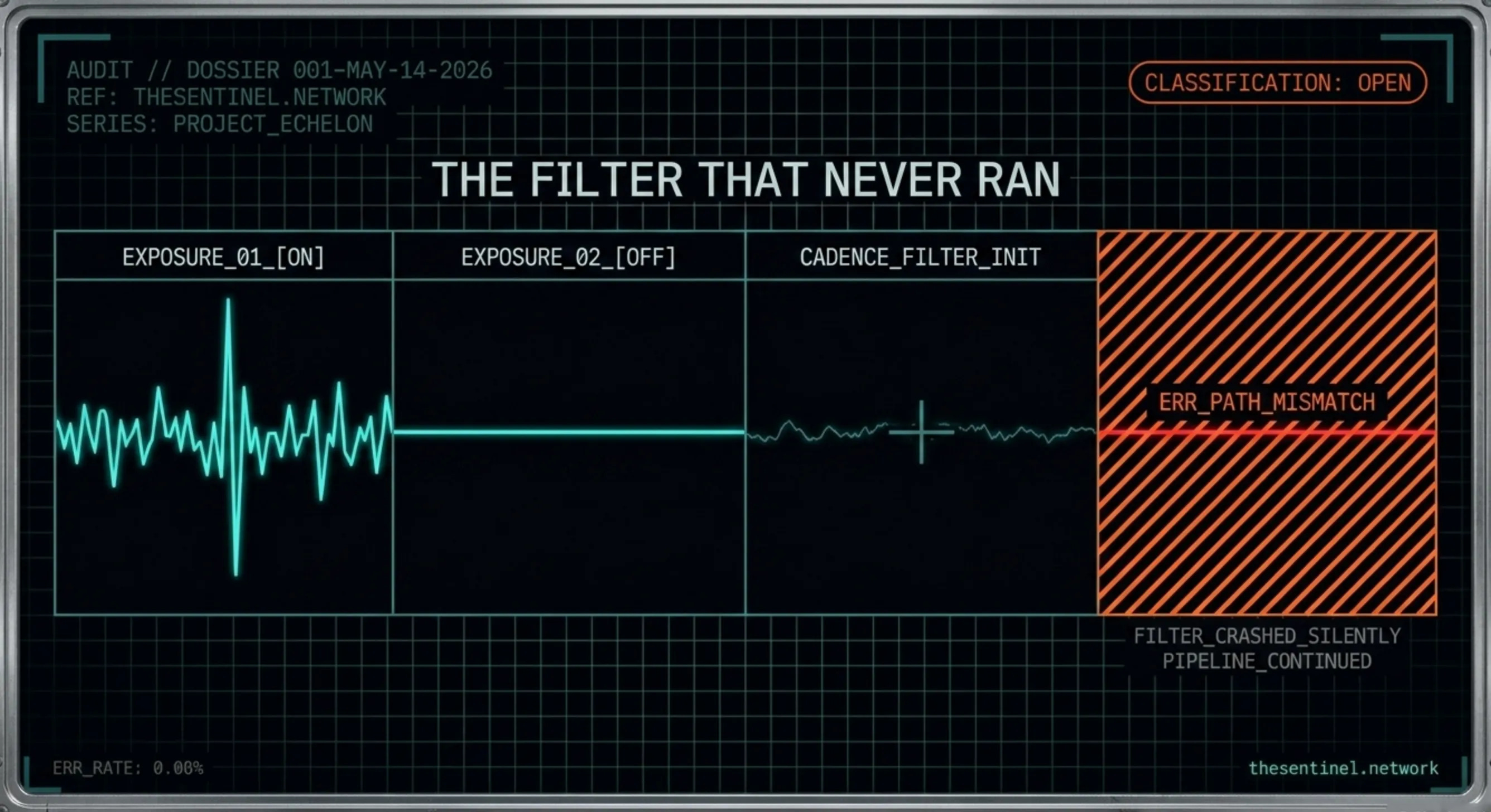
THE SECOND FINDING: THE FILTER THAT NEVER RAN
When the Green Bank Telescope observes a target, it alternates. Three minutes pointed at 3I. Three minutes pointed at empty sky nearby. Three at 3I. Three at empty sky. Six exposures total. Three on, three off.
The reason is simple. A real signal from the target appears in the on-source observations and disappears in the off-source ones. Radio interference appears in both. The cadence filter compares the two and throws out anything that shows up everywhere.
It is the most important step in the entire pipeline. Without it, a Breakthrough Listen observation is just a list of every radio noise the telescope picked up during the run. The cadence filter is what turns a noise list into a candidate list.
In our pipeline, the cadence filter crashed in every stage.
The error was a path mismatch. The filter expected the spectrogram files in one directory. They were in another. It tried to open them, failed, threw an error, and the pipeline kept going without it.
We were running Breakthrough Listen’s own software on their own data. The filter that separates real candidates from noise failed silently and the rest of the pipeline reported its results as if the check had passed.
We confirmed it across every stage. Stage two baseline: cadence filter crashed. Stage three zero-drift inclusion: same crash. Stage four widened drift window: same crash again.
Every “no candidates survived on-off filtering” in our reproduction is a broken filter, not a verified null.
That is 111,985 hits at the resolution floor near zero drift, with no on-source verification, sitting in the dataset uninvestigated.
THE SENTINEL ASSESSMENT:
We do not know if Breakthrough Listen’s original search had the same cadence filter failure. We know ours did, and ours was running their code on their data. What we can say is that no published paper on the BL 3I/ATLAS observations documents the specific cadence grouping by band and beam node that would be required for this filter to run correctly. The code expects a specific file structure. The data does not match it. Whether BL solved this internally or encountered the same failure is an open question that their published methodology does not address.
THE THIRD FINDING: THE EUBANKS WINDOW IS DEAD
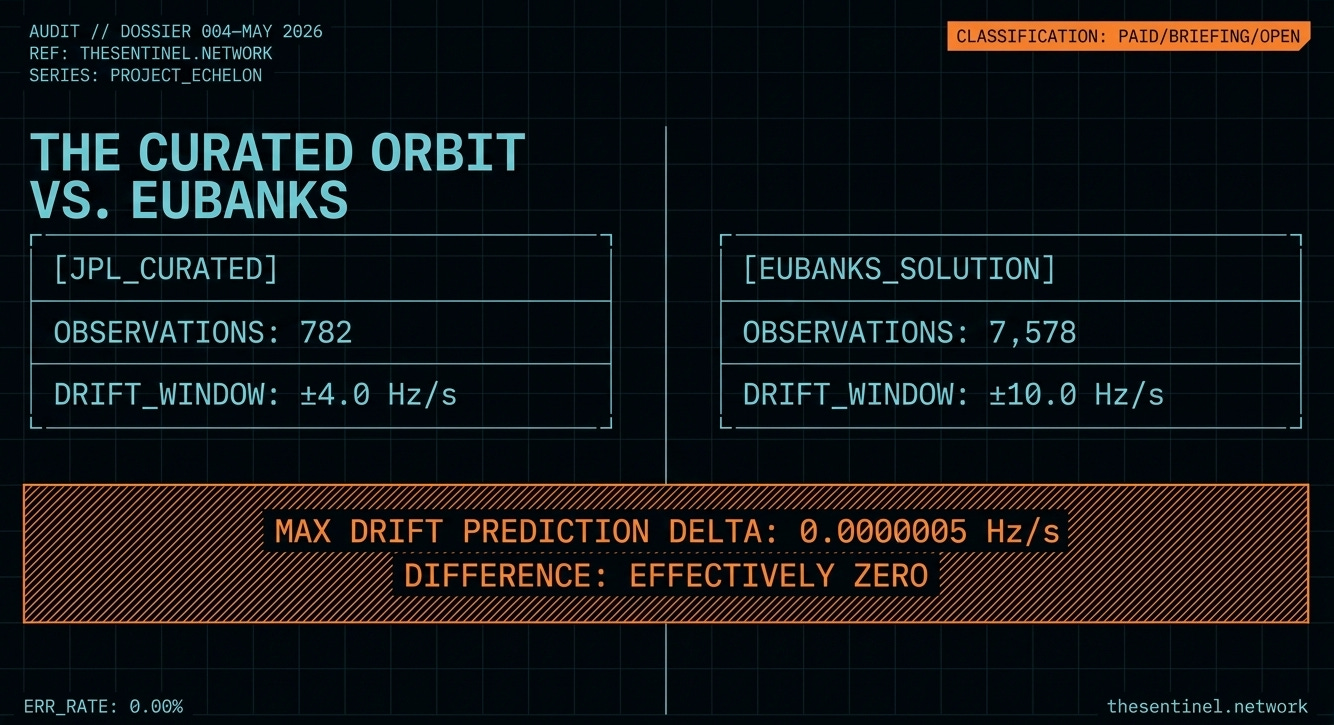
Part of The Narrow Band rested on a paper by Marshall Eubanks. He compiled a different orbital solution for 3I/ATLAS using 7,578 observations instead of JPL’s curated 782. We argued in The Curated Orbit that the missing observations changed the trajectory. If the trajectory changed, the predicted drift rates changed. If the drift rates changed, Breakthrough Listen was searching the wrong window.
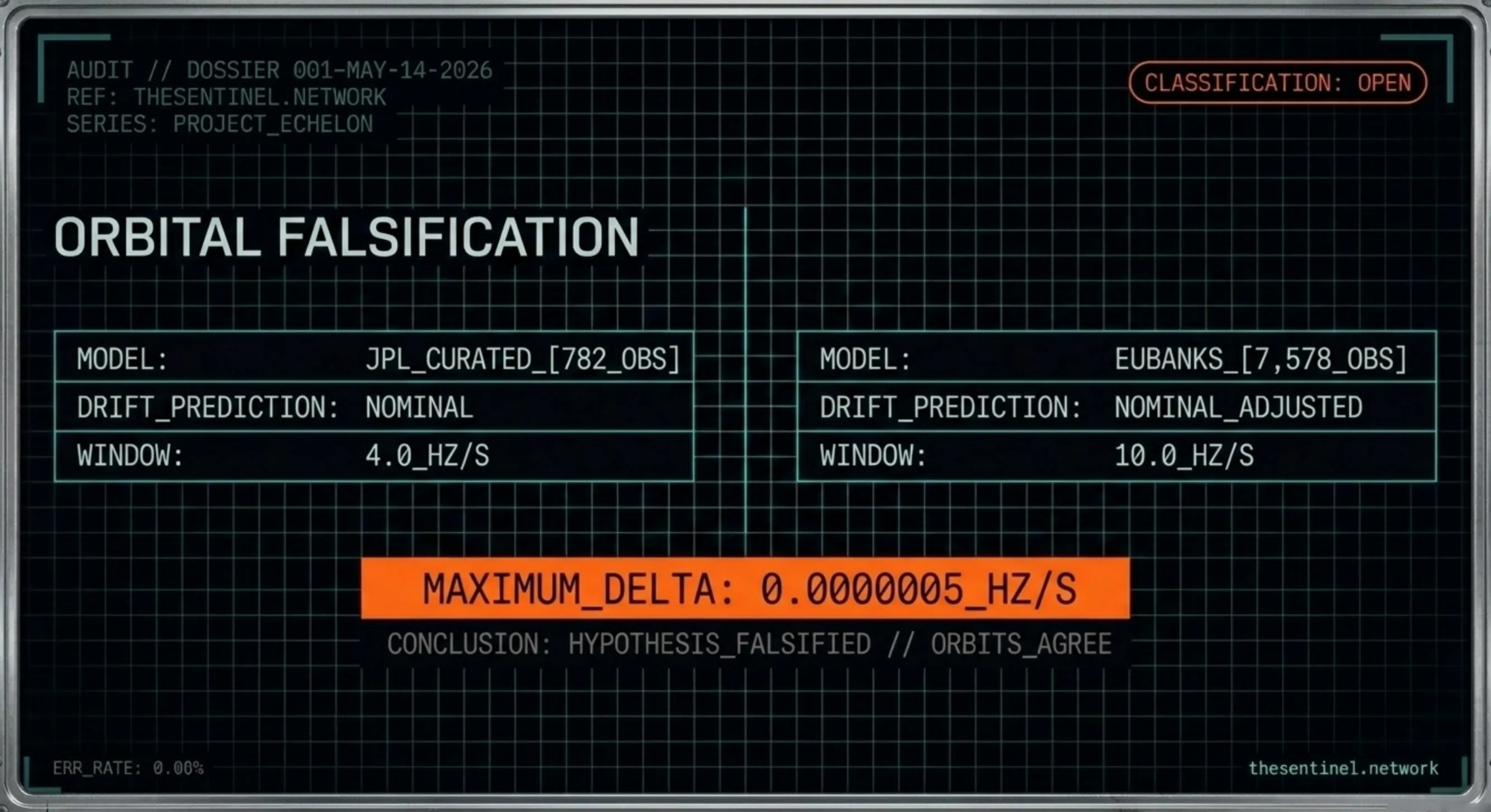
We tested this directly. Stage four ran a widened drift rate search using the Eubanks orbit predictions, then compared every hit against the JPL predictions. The widened range went out to plus or minus ten hertz per second instead of the standard four.
The result is unambiguous. The maximum difference between the two orbits’ drift rate predictions is 0.0000005 hertz per second. Effectively zero. The two orbital solutions agree on drift rates to within the precision of any radio telescope on Earth.
This kills a hypothesis we held. The orbit controversy is real. We still believe the JPL solution is curated. But for the purpose of predicting where a signal would appear in frequency space, JPL and Eubanks agree. Searching the Eubanks window is searching the same place the JPL search already covered.
We are reporting this because we said we would. Every prediction we publish is on the record. Some have been confirmed. This one fell.
What it does not change: the resolution floor problem. Whether you center your search on the JPL orbit or the Eubanks orbit or any other reasonable solution, you still cannot search at exactly zero drift. The algorithm cannot do it. The gap remains.
THE SENTINEL ASSESSMENT:
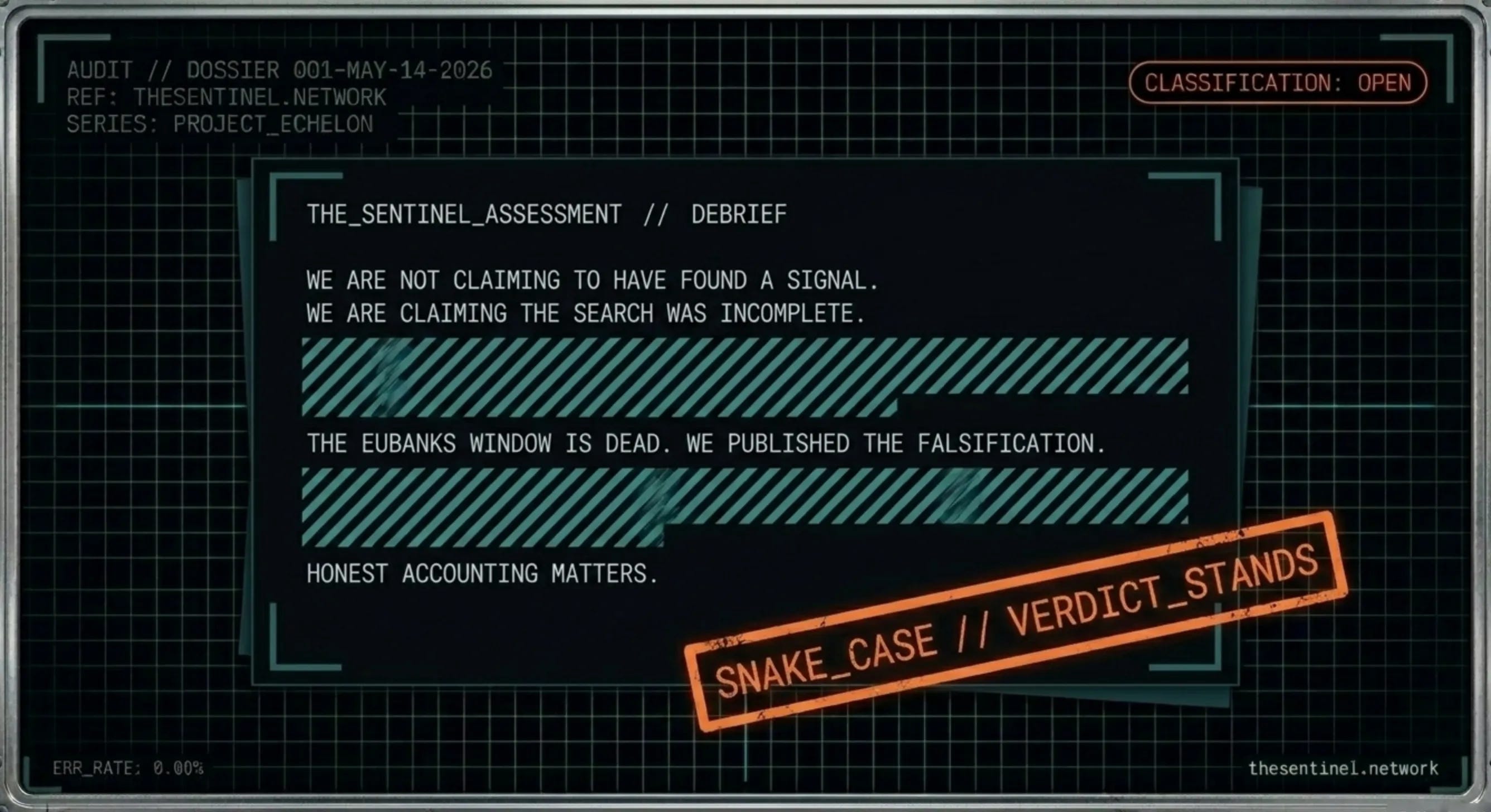
Honest accounting matters. The Narrow Band proposed two related blind spots. One was the zero-drift exclusion. We were close but not exactly right. The block is at the algorithm level, not the parameter level. The conclusion stands but the mechanism is one layer deeper than we described.
The other was the orbit-derived window. We argued JPL’s curated orbit might predict drift rates that missed the actual signal. That hypothesis is now dead. The two orbits agree.
We published the null result from Project Archimedes. We are publishing this falsification now. The day we stop reporting findings that contradict our own hypotheses is the day this publication stops being worth reading.
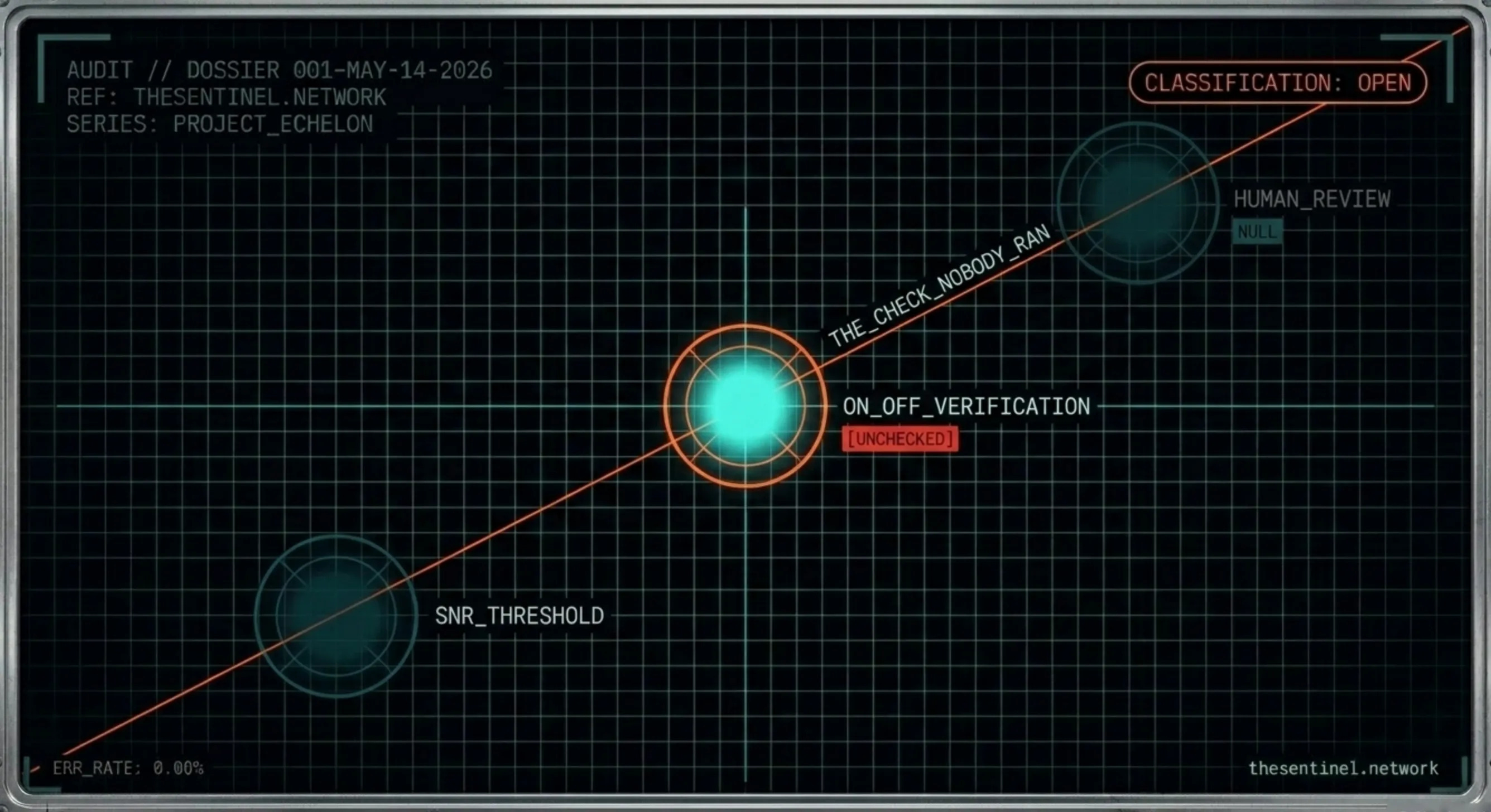
THE CHECK NOBODY RAN
Across 163 hours of compute time, four pipeline stages, 431 observation files, 289,460 raw hits, and three independent tests, one number matters more than any other.
111,985.
None of them have been cadence-filtered. None of them have been verified on-source. The filter that would do that crashed in every stage.
A truly stationary signal from a transmitter at closest approach would land in this cluster. The algorithm pushes it to the nearest bin because it has no zero bin to put it in. A real probe signal would be sitting there, indistinguishable from the radio interference in the same bins, until someone runs the on-off check.
Nobody has run the on-off check.
Breakthrough Listen reported a null result. We reproduced their pipeline. We found three independent reasons their search was incomplete.
That is not a null result. That is an incomplete search.
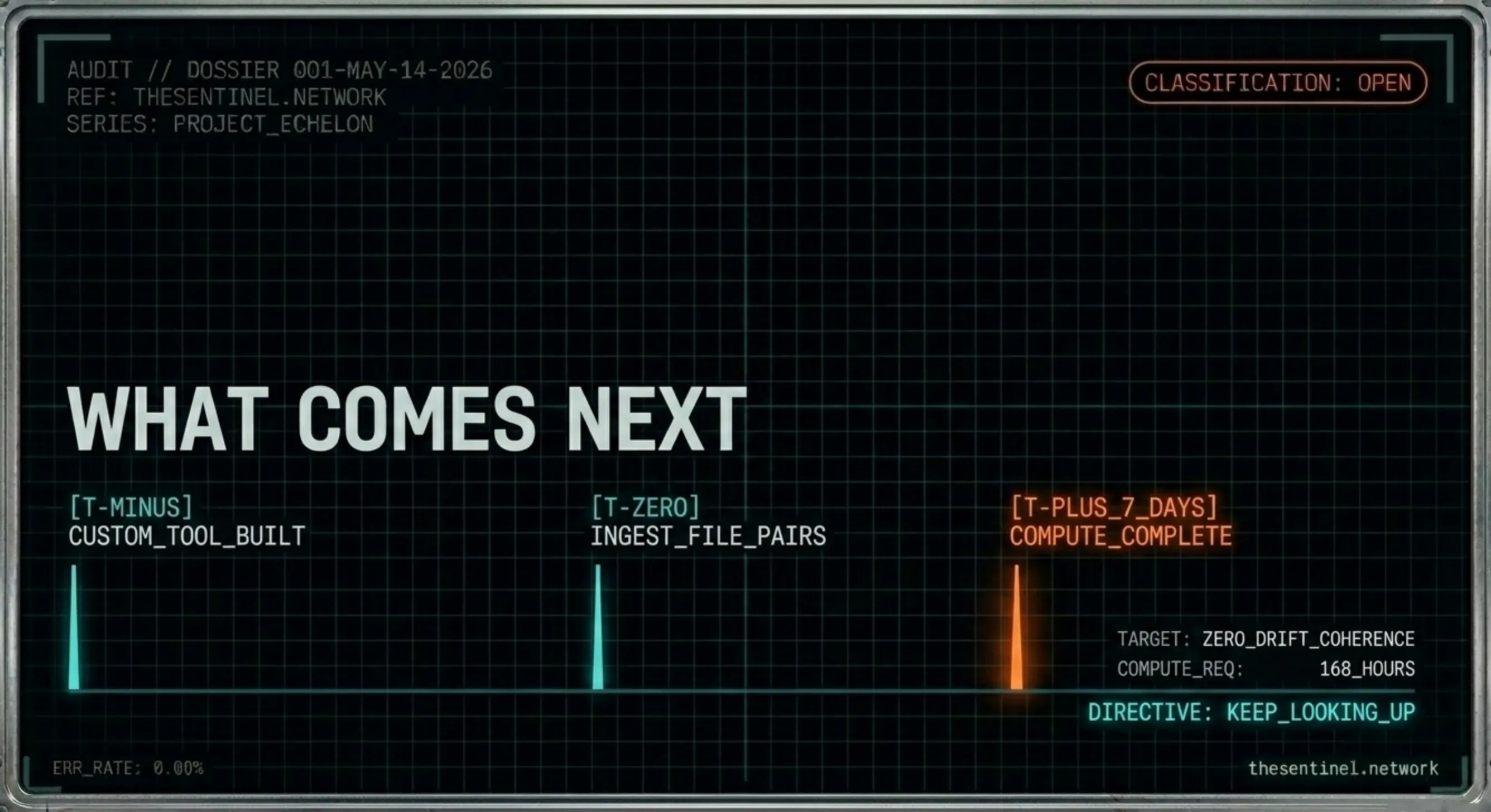
WHAT COMES NEXT
turboSETI cannot look at zero drift. We can.
The math is simpler than what turboSETI does because we only need to search one drift rate instead of hundreds. Average the spectrogram along the time axis. A signal at zero drift stacks coherently. Drifting signals and noise average down. Compare on-source against off-source. Whatever survives is a candidate.
We have built that tool. It runs in minutes per file pair instead of hours. The full run will take a week of compute on the same hardware that ran Echelon. We will report whatever it finds. If it finds nothing, we will say so. With the data, the code, and the methodology.
The five predictions from The Verdict at Jupiter remain on the table. The structural blind spot in turboSETI is now confirmed. The cadence filter that would tell anyone whether a signal at the resolution floor is real has never run on this data.
THE SENTINEL ASSESSMENT:
We are not claiming to have found a signal. We are claiming the search that produced the null result was incomplete in three specific ways that nobody has documented before. One is a hole in the algorithm itself, below the level of any parameter you can set. Another is a filter that never ran. The third kills a hypothesis we held in The Narrow Band.
A null result requires a complete search. This search was not complete.
We told you what the search missed. Now we are running the search ourselves.
Keep looking up.
-- The Sentinel Network™
Every briefing we’ve published is free. That’s not changing. This publication has no institutional backing, no sponsors, and no editorial board. We’re doing the work the newsrooms won’t: sourcing papers, filing FOIAs, building tools, and writing at the pace a once-in-a-civilization event demands.
Paid subscribers fund the investigation directly. They also get access to primary source documents, the comment section on every briefing, Fieldcraft Labs, and the FIELDCRAFT series. The tools and methods behind every investigation we publish. No ads. No sponsors. No strings. Your subscription is a data point against the suppression gradient.
If you can’t subscribe, we don’t care. Read everything. Share everything. The mission is the mission.
Subscribe to The Sentinel Network™
A top 100 Science publication on Substack.
Share this investigation. THE SUPPRESSION GRADIENT documented what happens when this coverage reaches platforms that do not want you reading it. Every share, every restack, every forwarded link is a data point against the gradient.
Previous briefings: THE OPERATING SYSTEM | THE NARROW BAND | THE SKY IS FALLING | THE WEIGH-IN | THE VERDICT | THE ANCIENT ENGINE | THE CURATED ORBIT | THE GHOST COMA | THE IGNITION SEQUENCE | THE HEARTBEAT | THE SUPPRESSION GRADIENT | THE SILENT EDIT | CONFIRMED: THE TESS CONTINGENCY | THE GLOMAR CONFIRMATION
"The day we stop reporting findings that contradict our own hypotheses is the day this publication stops being worth reading."
Indeed. This rigor and journalistic integrity is why I am and will continue to be a paid subscriber.
When anyone, and this is rare, when ANYONE can plainly say, "I was wrong, allow me the share with you what I now know to be the truth, or at least the proper path towards it," and who can say so without facetiousness, but rather with fastidiousness in getting to the bottom of whatever the subject matter is, will always, in my eyes, define better the character of the speaker, deserve more the respect from the listener, and determine my level of attention greater, than if the original summation had been correct all along. The cover-up is always worse than the crime. The admission of being wrong is, without a doubt, more admirable than just always being right.