

SUBJECT: PROJECT ECHELON PHASE 2 // INDEPENDENT CADENCE-FILTER COMPLETION + DIRECT ZERO-DRIFT SEARCH OF BREAKTHROUGH LISTEN 3I/ATLAS DATA // PEER-REVIEWED CORROBORATION OF THE TURBOSETI BLIND SPOT
DATE: JUNE 10, 2026
CROSS-REF: THE MISSING BIN | THE NARROW BAND | THE CURATED ORBIT | THE VERDICT | THE SUPPRESSION GRADIENT
DATA CONFIDENCE: VERIFIED (BREAKTHROUGH LISTEN GBT ARCHIVE, L/S/C/X BANDS, 431 FILES, 72 CADENCES, 289,460 HITS, 163 COMPUTE HOURS; ORBITAL CROSS-CHECK VIA SKYFIELD/CELESTRAK TLE; PEER-REVIEWED CORROBORATION CHOZA ET AL. 2024 AND BL 97-GALAXY SURVEY) + ANALYSIS (SENTINEL CROSS-REFERENCE)
We are building the video side of this operation. If you want the briefings in a format you can watch, subscribe to The Sentinel Network on YouTube.
THE PROMISE
In THE MISSING BIN, we told you three things.
We told you the most important filter in the Breakthrough Listen pipeline, the step that separates a real signal from a passing satellite, had never run on the 3I/ATLAS data in our reproduction. We told you the standard search tool is structurally blind to a signal that sits still in frequency, the exact signal a probe matched to Earth at closest approach would send. And we told you we would build the tools to do both, run them on every file in the dataset, and report what they found. No matter what.
We ran them for three weeks.
This is what came back.
THE METHOD
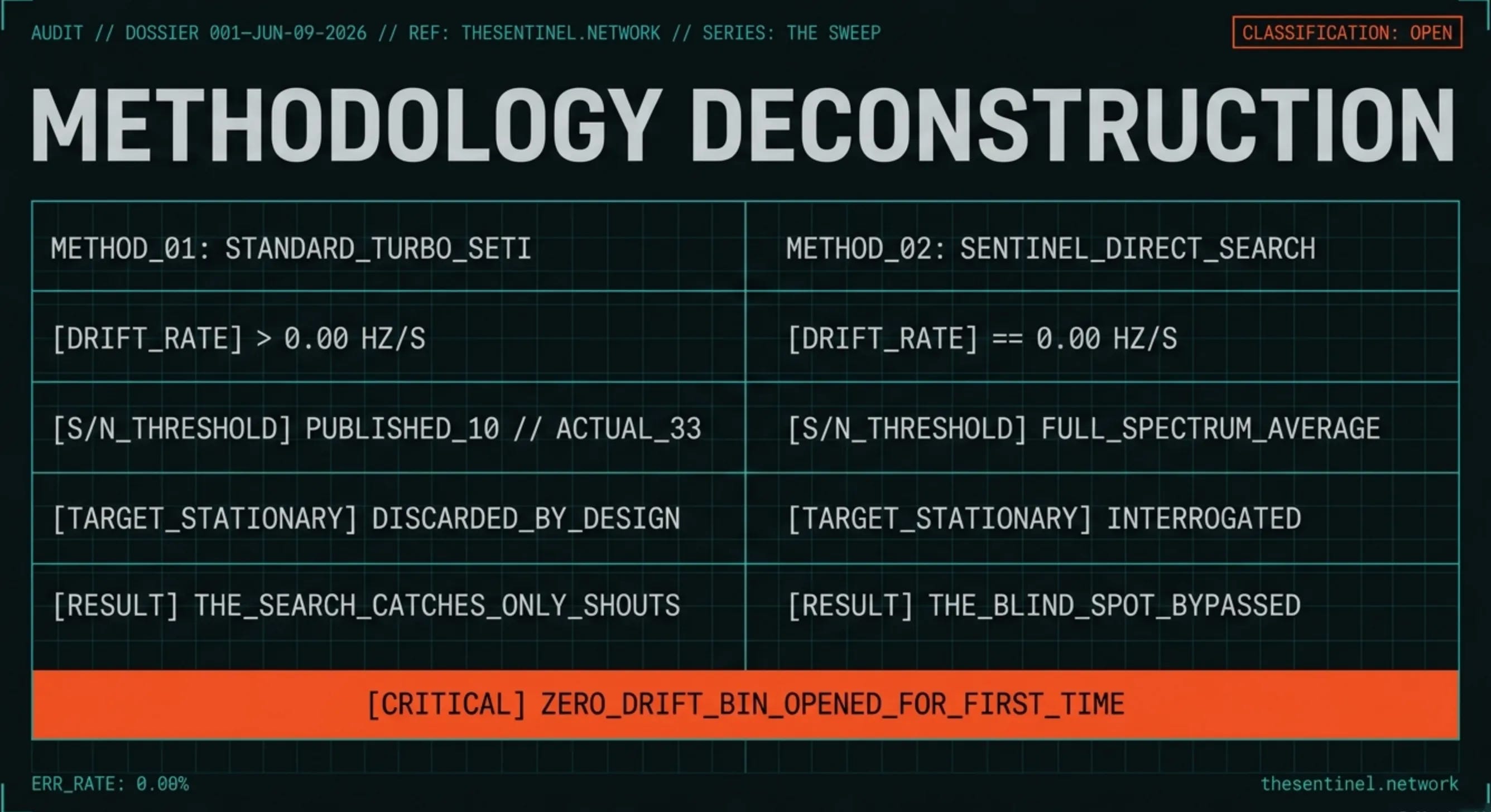
Two searches. The same data. Both built to ask one question from two directions: is anything in this recording coming from the object, and not from the sky full of machines around it?
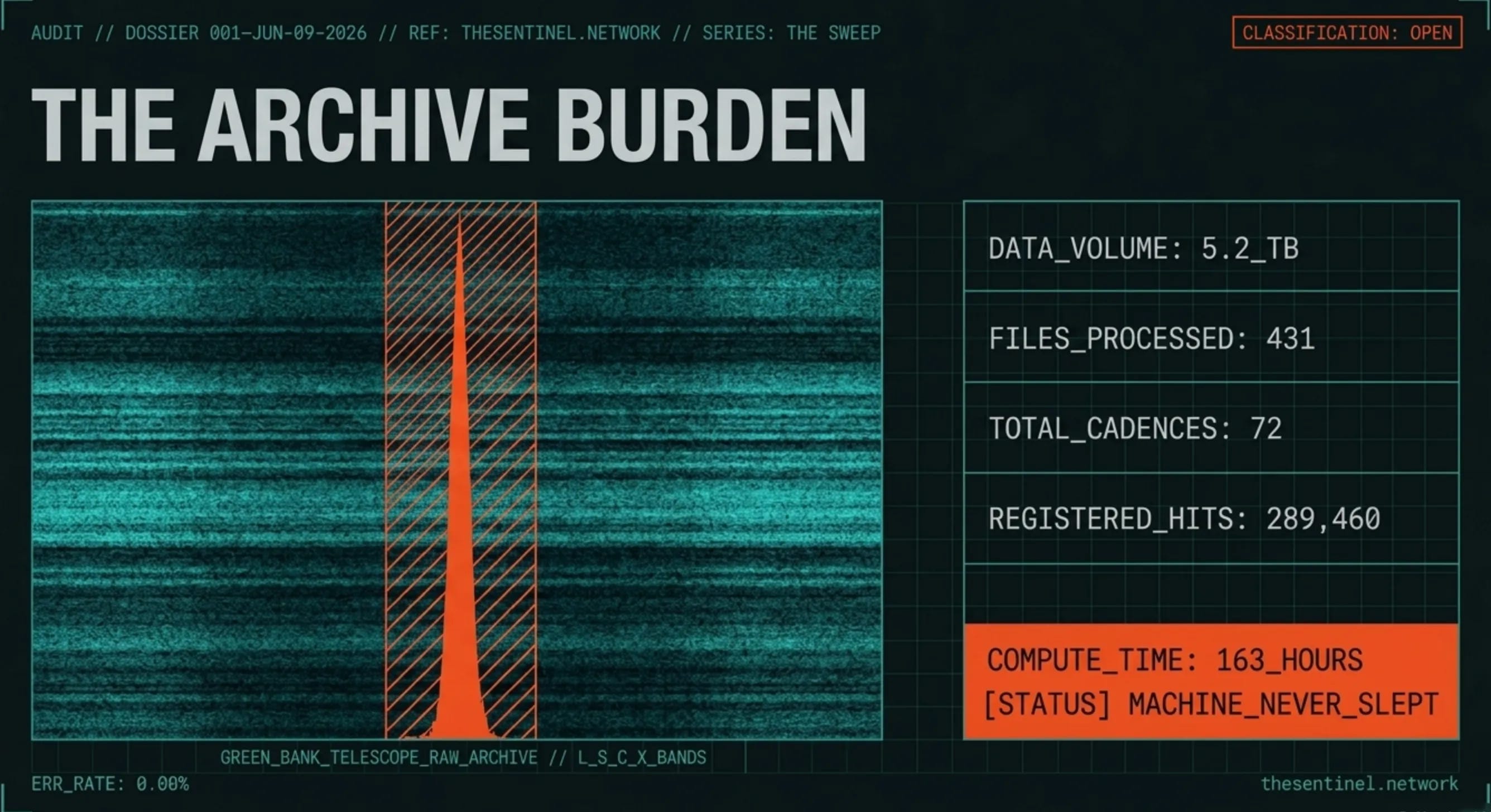
The data was Breakthrough Listen’s raw recording of 3I/ATLAS from the Green Bank Telescope, the largest fully steerable dish on Earth, pulled straight from their public archive. Four radio bands, spanning roughly 1 to 12 gigahertz. Four hundred thirty-one files. Stack them as Blu-ray discs and the pile reaches your knee: 5.2 terabytes, and we processed every byte across 163 hours of computation, a full working month folded into three weeks.
The first search was the cadence filter, the step we caught failing silently last time. The Green Bank dish does not simply stare at a target. It nods. Three minutes locked on the object, three minutes swung off to a patch of empty sky beside it, three times over. The logic is the foundation of the entire field. A signal coming from the object is there in the on looks and gone in the off looks. A satellite, a radar, a cell tower, a stray reflection is there in all of them. Compare the two, throw out everything that appears in both, and what remains behaves like it is coming from the thing you are pointed at. We ran it correctly this time, the files grouped properly by band and by receiver, across all seventy-two cadences in the dataset.
The second search was the one the standard tool cannot perform at all. turboSETI, the software every major SETI program runs, hunts for signals that slide in frequency over time. A transmitter on a moving body produces that slide, the radio version of the pitch change you hear as an ambulance passes. But a probe holding station against Earth at closest approach would not slide. It would sit on one frequency, perfectly still, in the one place the algorithm has no slot to look. So we built the search it cannot do. Average each recording down its time axis. A signal sitting still stacks on top of itself and stands up out of the noise. A drifting signal and random static smear flat and sink. Then hold the on-source average against the off-source average, and keep whatever rises on the object and stays gone off it.
Two methods. One question. We let them run.
THE BACKING
Before we show you what survived, you need to know we did not invent the cracks we went looking through. The people who built the pipeline documented them, in print, in peer-reviewed journals.
Start with the threshold. SETI searches, including the 3I/ATLAS work, report that they scan down to a signal-to-noise ratio of 10. That sounds sensitive. It is not as sensitive as it sounds. A 2024 analysis in the Breakthrough Listen literature established that a turboSETI run set to a threshold of 10 is, in practice, only sensitive to signals at a signal-to-noise of roughly 33 or higher. The search announces it can hear a whisper. In reality it only catches a shout. Everything fainter slips through unrecorded, and the published number hides it.
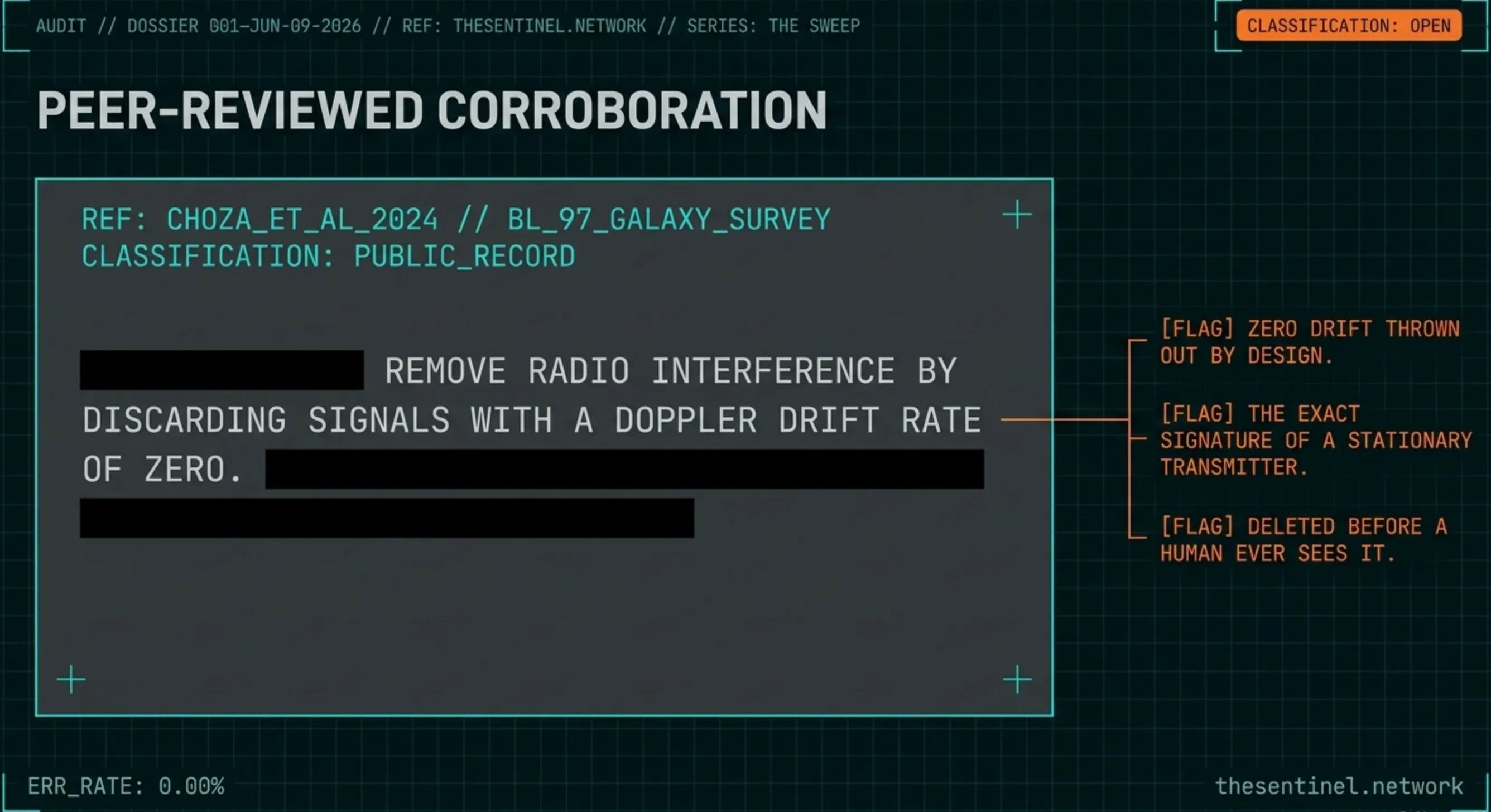
Then the blind spot itself, which is not a bug we imagined but documented procedure. The Breakthrough Listen technosignature search of 97 nearby galaxies, published in a peer-reviewed journal, states the method without flinching: they remove radio interference by discarding signals with a Doppler drift rate of zero. Zero drift, thrown out by design, as standard practice, in the program’s own words. The exact signature of a stationary transmitter, deleted before a human ever sees it.
So this was the ground we stood on, and it was not ours. A search that catches only the loudest signals, and a rule that deletes the stillest ones. Two peer-reviewed papers, written by people inside the field, telling us precisely where the search goes deaf.
We pointed our instruments at exactly those places.
THE SURVIVORS
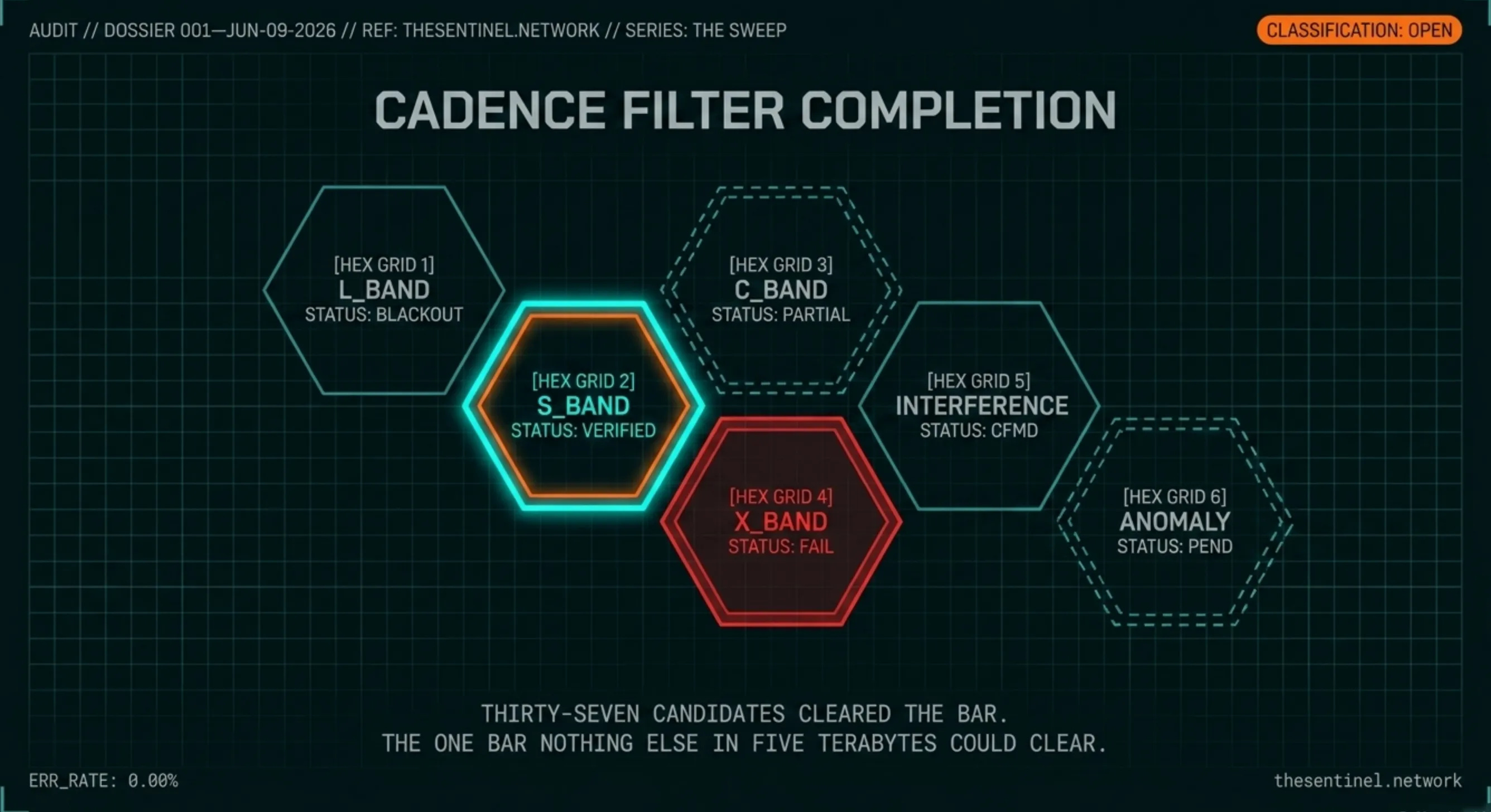
The cadence filter finished all seventy-two cadences. Thirty-seven signals made it through.
Sit with what that means. Thirty-seven times, something appeared in the data every moment the dish was locked on 3I/ATLAS and vanished the instant it swung away to blank sky. Not interference, which bleeds into every look. Something that behaved exactly the way a transmitter sitting on the object would behave. Thirty-seven candidates cleared the one bar that nothing else in five terabytes could clear.
And then we saw it.
Eleven of the thirty-seven were not scattered across the spectrum. They were stacked together, packed into one narrow stretch of the S band, all on the same receiver. And they were moving. Eleven signals drifting in frequency at nearly the identical rate, between negative 0.19 and negative 0.20 hertz per second, the way a single transmitter on a single moving object drifts as the geometry shifts beneath it. Three of them were loud. One stood nearly seven times above the faintest signal the search can register, far past even the real sensitivity floor those peer-reviewed papers had warned us about.
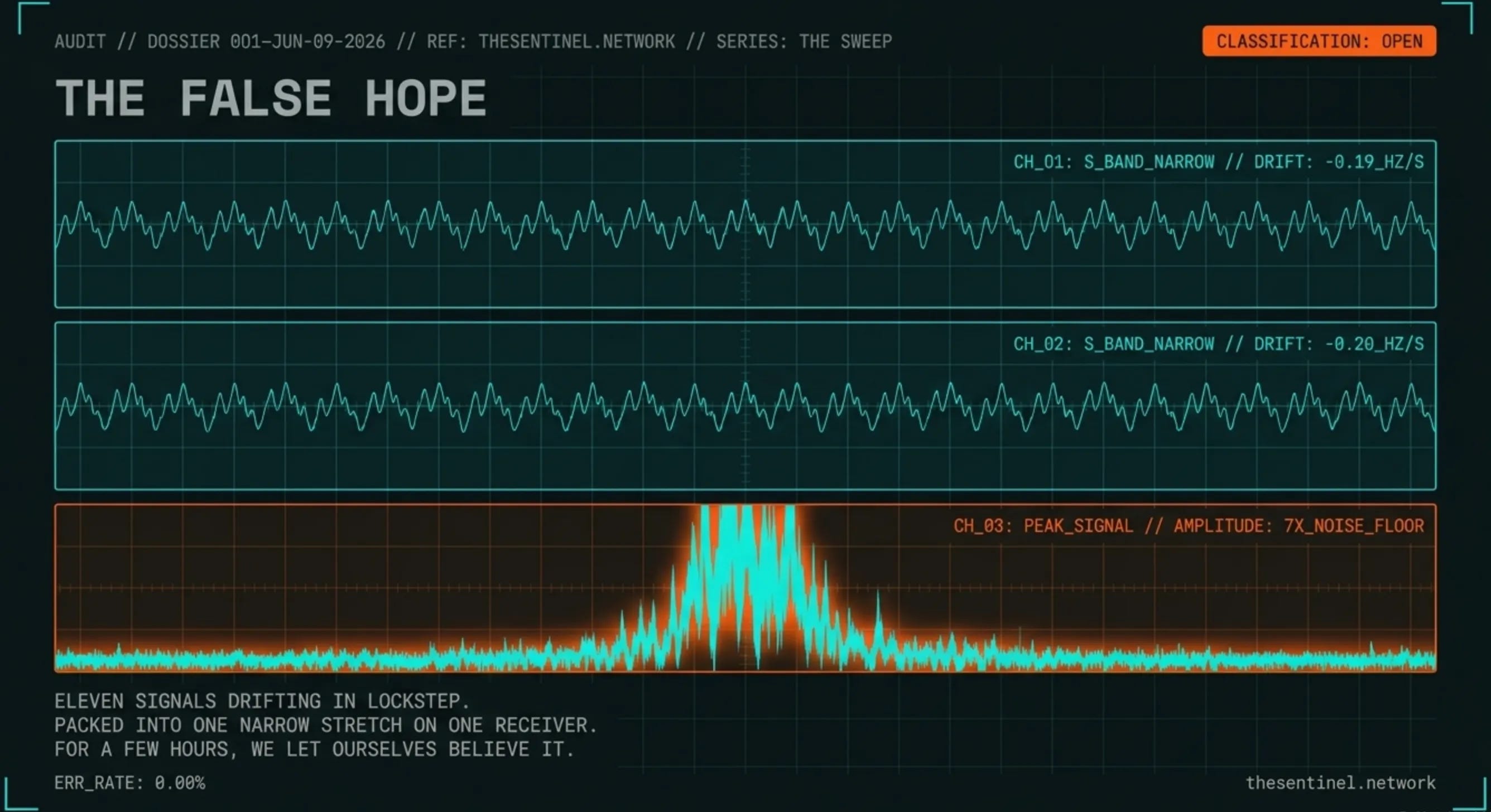
For a few hours, we let ourselves believe it. A tight cluster, drifting together in lockstep, screaming loud, present on the object and absent off it, still sitting in the data after every filter we could throw at it. That is the signal. That is the thing we had spent three weeks and five terabytes and a month of computation hunting for. And there was a second one to chase. At 11078 megahertz, the same frequency lit up on two separate receivers at the same instant, the kind of coincidence that can mark a genuine source out in the sky rather than a glitch in one machine.
Two candidates. Every reason to lean in.
So we did the only thing the Sentinel knows how to do with a result it desperately wants to be true.
We tried to destroy it.
THE KILL
Every signal in radio astronomy carries an exact frequency, and on Earth every frequency belongs to someone. There is an international registry of who is permitted to broadcast where, band by band, down to the megahertz. It is not a matter of opinion or interpretation. It is the closest thing the radio spectrum has to a deed of ownership.
We took the exact frequency of all thirty-seven survivors, measured to four decimal places, and we looked up every one.
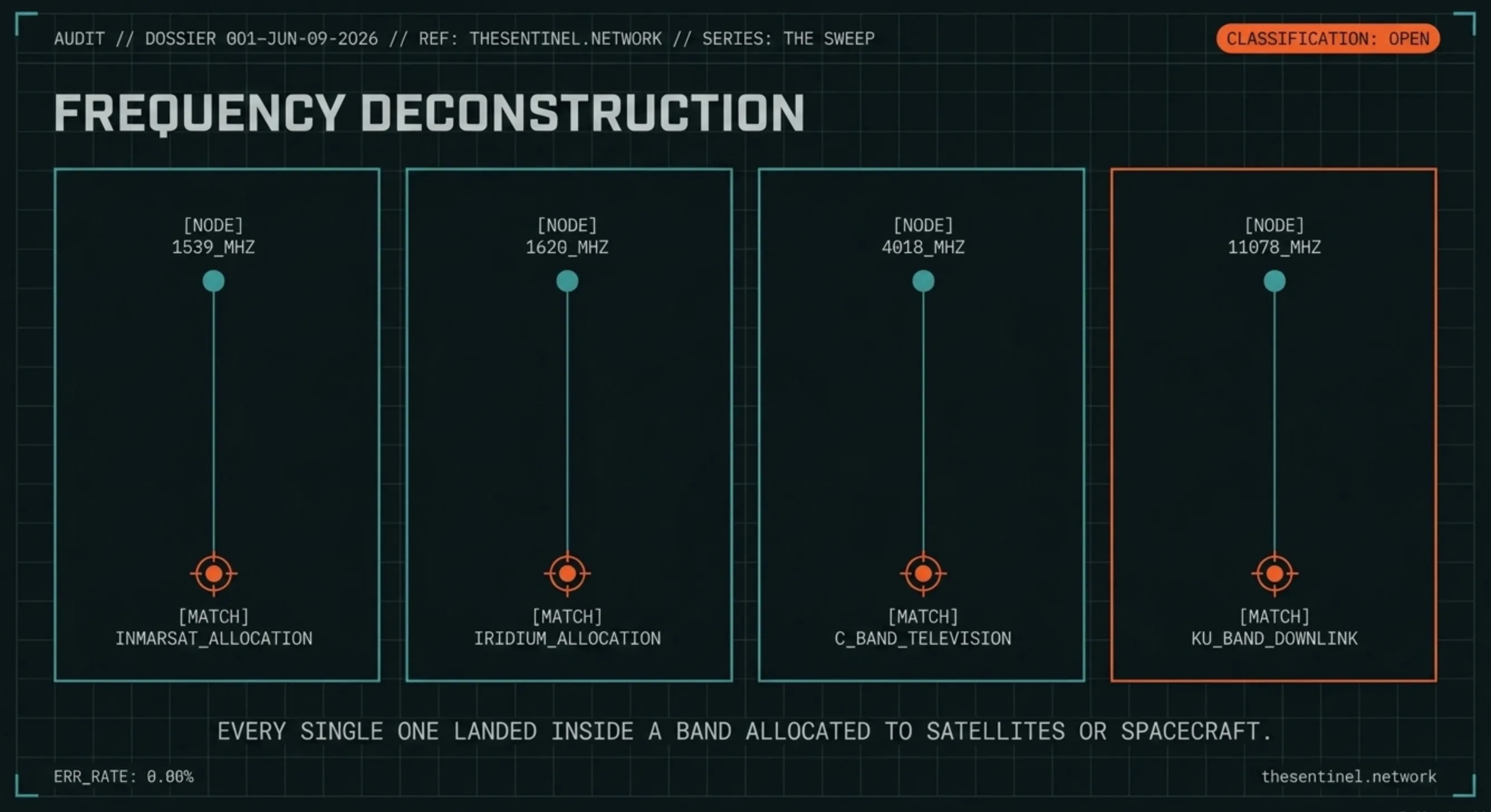
Every single one landed inside a band allocated to satellites or spacecraft.
The beautiful S band cluster, the eleven signals drifting together, the one that reached seven times the noise floor, sits dead inside the space-to-ground telemetry band, the frequencies spacecraft use to phone home. The drift that looked so much like a probe is exactly what a satellite produces as it crosses the sky during a recording. The signals near 1175 and 1203 megahertz sit in the GPS and GLONASS navigation band. The pair near 1620 are Iridium. The one at 1539 is Inmarsat. The 7563 is a military X-band downlink. The 4018 and 4019 are C-band, the same frequencies that pipe satellite television into living rooms. And the 11078 that lit two receivers at once is Ku-band downlink, where a single bright satellite spilling into two beams through the side of the dish produces precisely that double signature.
A frequency inside a satellite band is damning. It is not proof. A band tells you what kind of thing broadcasts there. It does not prove one was overhead in the seconds we were listening. So we went to the orbits.
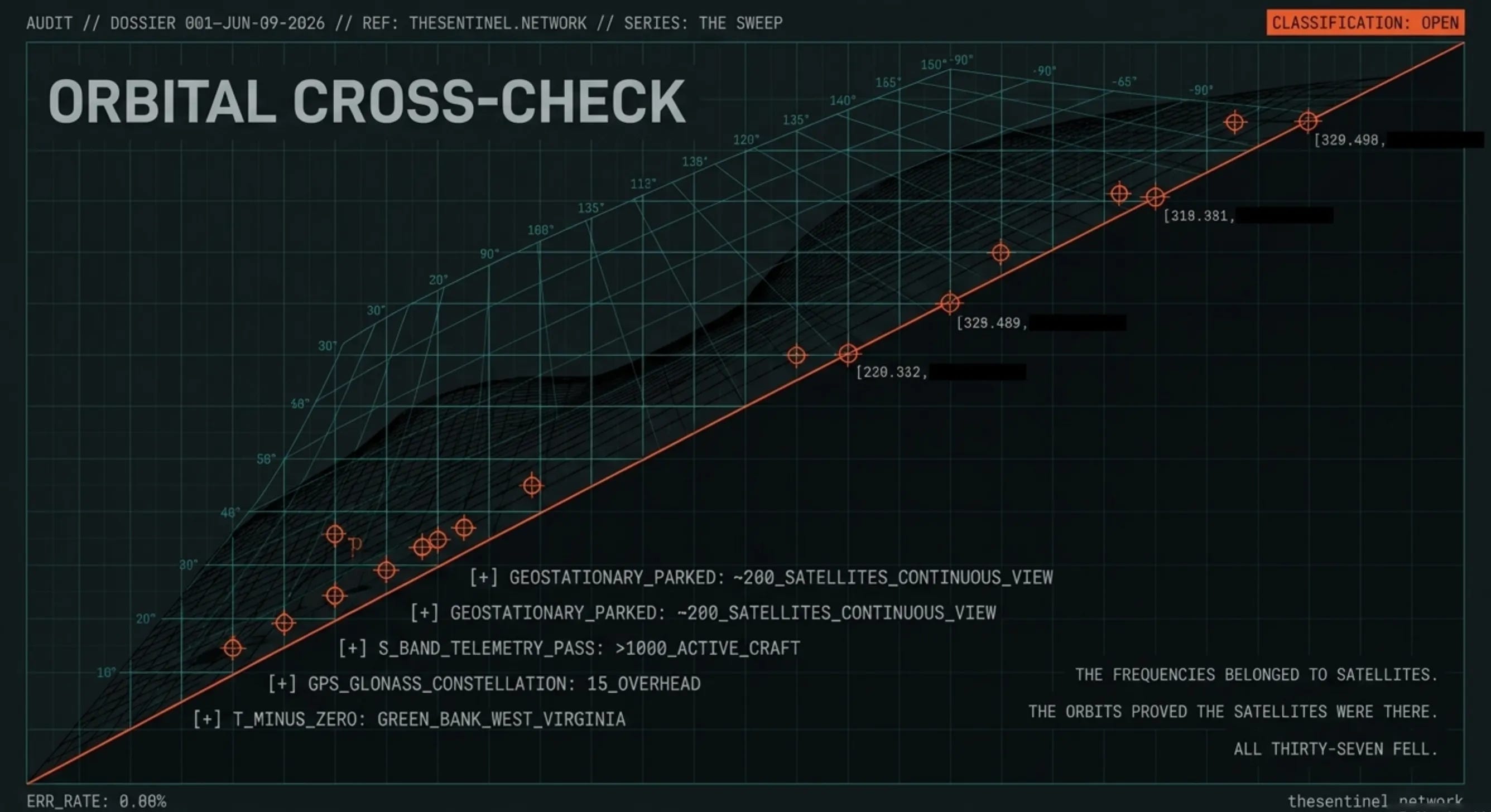
We pulled the orbital elements for every relevant satellite constellation and computed, for the exact date and the exact hours of the Breakthrough Listen recording, how many satellites of each type stood above the horizon over Green Bank, West Virginia. Give the math an orbit and a timestamp and the geometry is fixed. There is nothing left to argue.
The GPS and GLONASS band, where two clusters landed: fifteen navigation satellites overhead. These constellations exist precisely to guarantee several are always in the sky from any point on Earth.
The Iridium band: five overhead.
The telemetry band that held our screaming cluster, the one we almost believed: more than a thousand active satellites above the horizon at the peak of the pass.
The C-band, Ku-band, X-band, and Inmarsat detections, every one a geostationary service: close to two hundred geostationary satellites parked in continuous view of the dish for every second of the observation. Geostationary satellites do not rise and they do not set. They hang fixed above the equator, and from Green Bank they are simply always there.
The chain closed with no link missing. Right frequency, inside an allocated satellite band. Right kind of transmitter, confirmed by orbital geometry to be above the horizon at the exact moment of the recording. We ran every one of the thirty-seven through both tests.
All thirty-seven fell.
The cluster that drifted together so perfectly was spacecraft telemetry. The signal that lit two beams at once was a television satellite bleeding through the side lobes. The thing we wanted, the thing that looked real for a few hours in the middle of the night, was a machine in orbit. We built the search to be honest, and it was honest with us.
We will state the one limit plainly, because the brand is built on stating limits plainly. This confirms the constellation was overhead, not the individual satellite by serial number. For ruling out a signal from the object, that is enough: the frequencies belong to satellites, and the satellites were there. Naming the specific craft would take a different archive and would change nothing about the answer. The orbital data is public. The code shows exactly how to run the query.
THE BIN
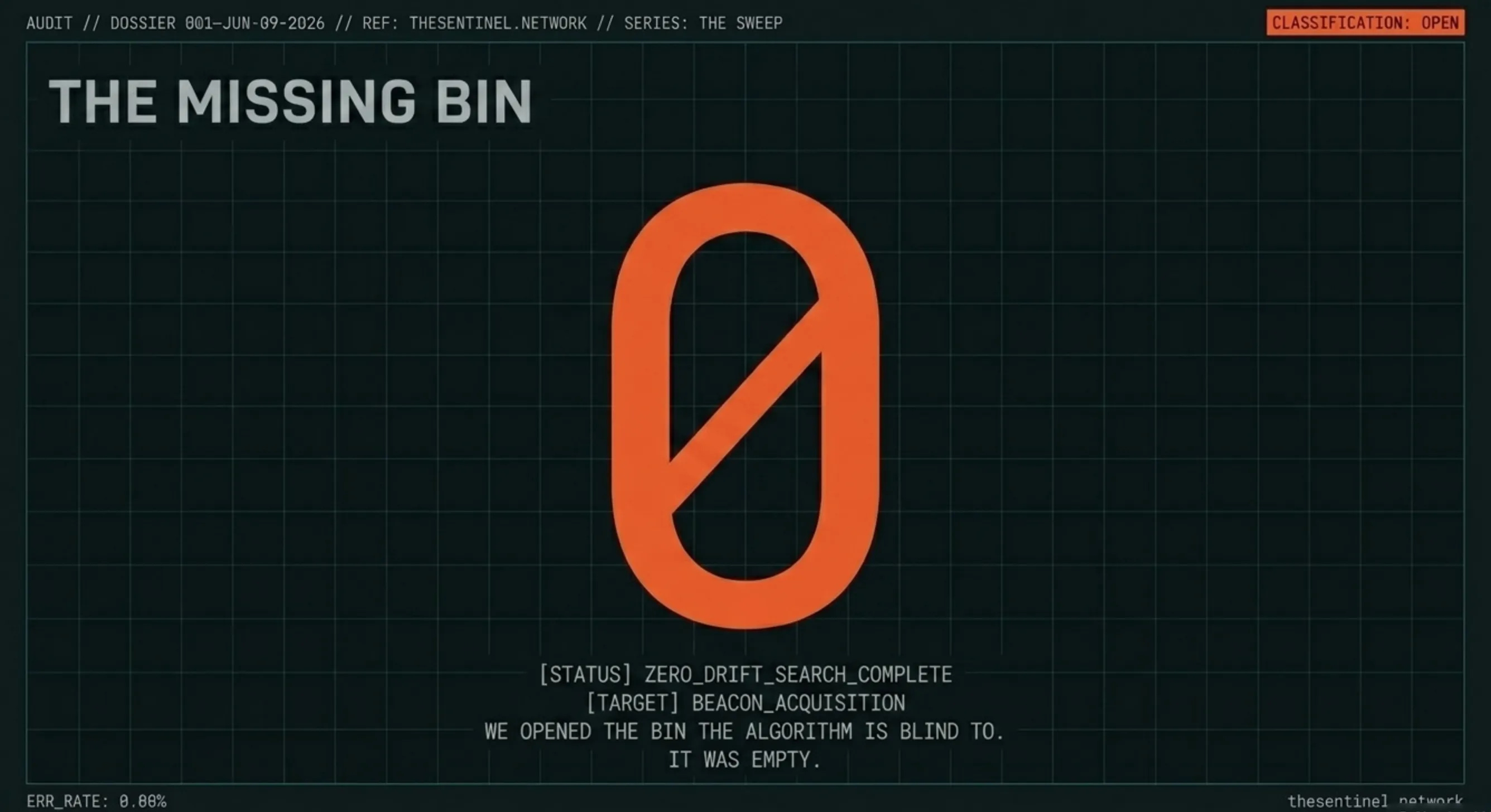
That left the search that mattered most. The zero-drift search. The bin turboSETI cannot see, the one the published methodology throws away on purpose, the one we built an entire tool to pry open.
It ran on all seventy-two cadences. It did not find a beacon.
What it found was the signature of nothing. On band after band, on receivers that share no hardware and no frequency, the count of surviving channels kept landing on the same number. Sixty-four. Then sixty-five. Then sixty-four again. Fourteen separate cadences pinned to exactly sixty-four. A real signal from the sky does not arrive at the identical count on unrelated equipment. That flat, repeating number is the fingerprint of the instrument and the arithmetic itself, the fixed residue the averaging always leaves behind, not anything the object sent.
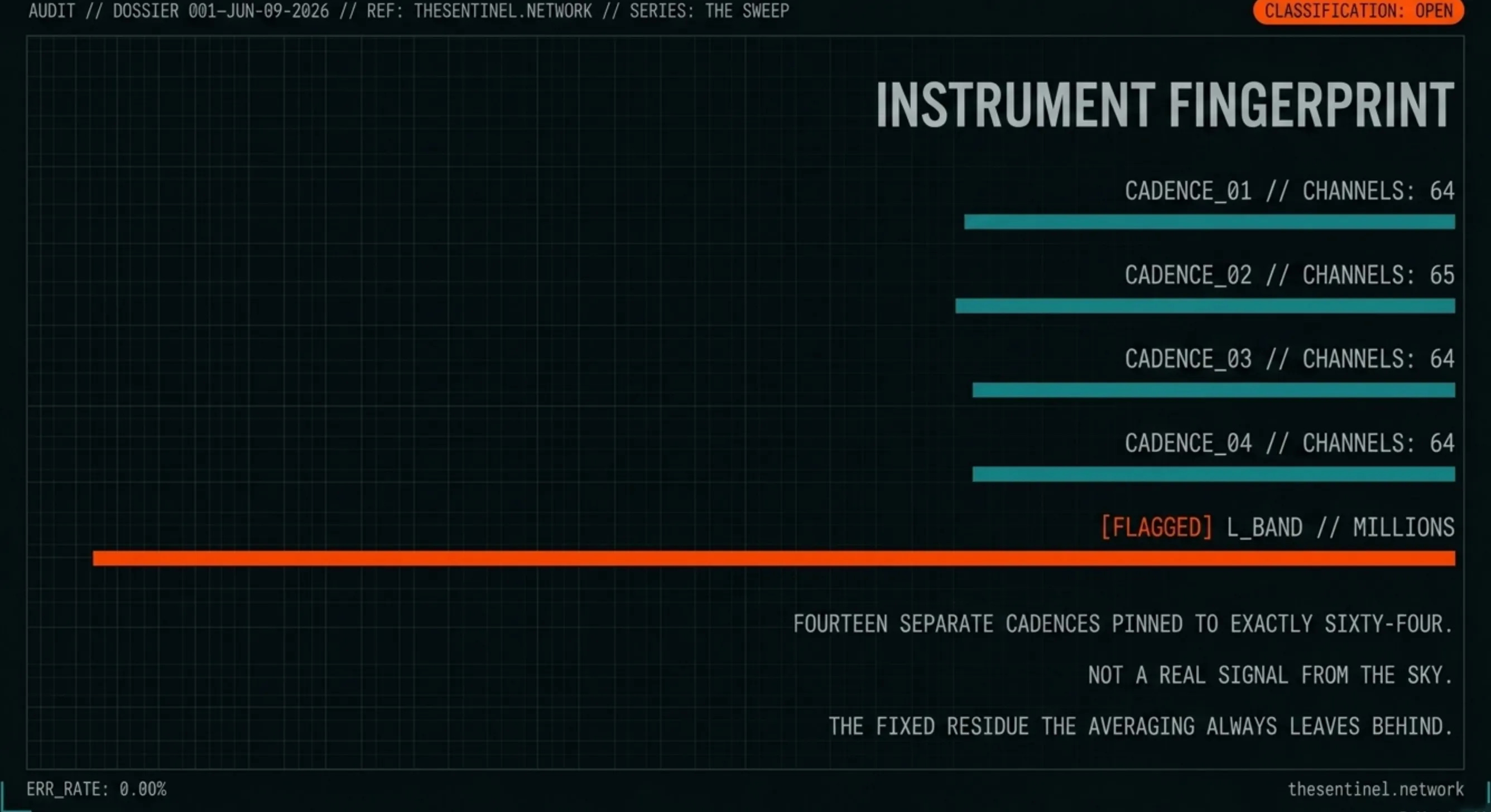
In the L band, where every cell tower and navigation satellite and aircraft transponder on the continent floods into the receiver at once, the search threw back millions of channels above the threshold. Not millions of signals. The noise floor of the most crowded stretch of spectrum on the planet, breaking the math, which is the very reason the standard pipeline refuses to operate there at all. We flagged those cadences as interference-drowned and set them aside, because that is the honest thing to do with a measurement the method cannot stand behind.
The famous bin. The one the entire architecture is blind to. The one we argued across two briefings might be the single place a stationary probe at closest approach could hide. We opened it and looked straight in.
It was empty.
THE QUIET
Six days before this briefing went out, the institutions arrived at the same silence we had.
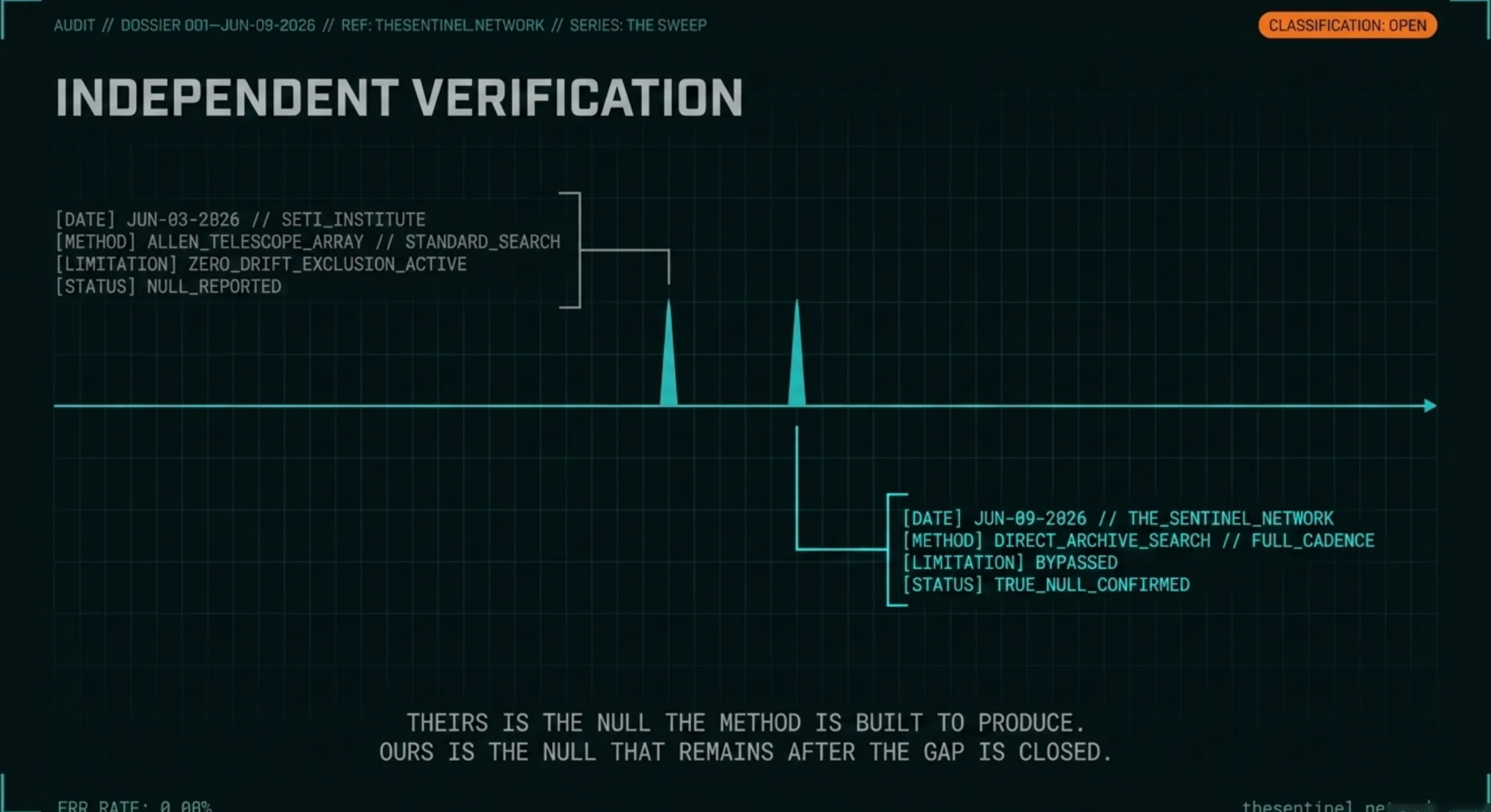
On June 3, the SETI Institute announced that its Allen Telescope Array had scanned 3I/ATLAS and found no technosignature, setting an upper limit of roughly 10 to 110 watts, about the draw of a household appliance, on any transmitter on or near the object.
Read it as independent confirmation if you like. We read it as something narrower, and more honest.
The Allen Telescope Array runs the same kind of narrowband drift search as every other SETI instrument on Earth, and like every standard search, it throws away zero drift. It tracks the object using the same JPL ephemeris we showed in THE CURATED ORBIT was built on a sliver of the available observations. When SETI announces a null, it is the same method returning the same nothing, on a different dish, pointed with the same numbers. They did not look in the bin. Until this week, no one had.
We did. And the bin was empty too.
That is the difference between their null and ours, and it is the entire reason this briefing exists. Theirs is the null the method is built to produce, because the method cannot see the one place a still transmitter would sit. Ours is the null you earn only after you go and check that place yourself. The two are not the same result reached twice. One is an incomplete search and the other is a complete one, and they happen to agree.
So we will say it the way we say everything. Plainly.
We did not find a signal from 3I/ATLAS. We ran the filter that had never run, and thirty-seven satellites came back. We built the search the standard tool cannot run, and we opened the bin it is blind to, and inside there was nothing but the hum of the instrument and a sky full of our own machines.
This is a null result. We have filed them before, on purpose, with our names on them. When we tested whether the March fireballs were tied to 3I/ATLAS, the velocity data said no and we published the no. When we tested whether the Eubanks orbit moved the search window, it did not, and we buried our own hypothesis in the same briefing that raised it. We do this because a publication that reports only the findings that flatter its theory is not running an investigation. It is running a sales pitch. The day we bury a quiet sky to keep a story breathing is the day you should close the tab and never come back.
So here is where the arc closes. THE NARROW BAND asked whether SETI had searched 3I/ATLAS the right way. THE MISSING BIN found the gap no one had checked and proved the blind spot was real. THE SWEEP built the tools, ran the search to the end, chased down all thirty-seven survivors, and opened the bin. The gap was real. The search was worth running. And what came back was satellites and silence.
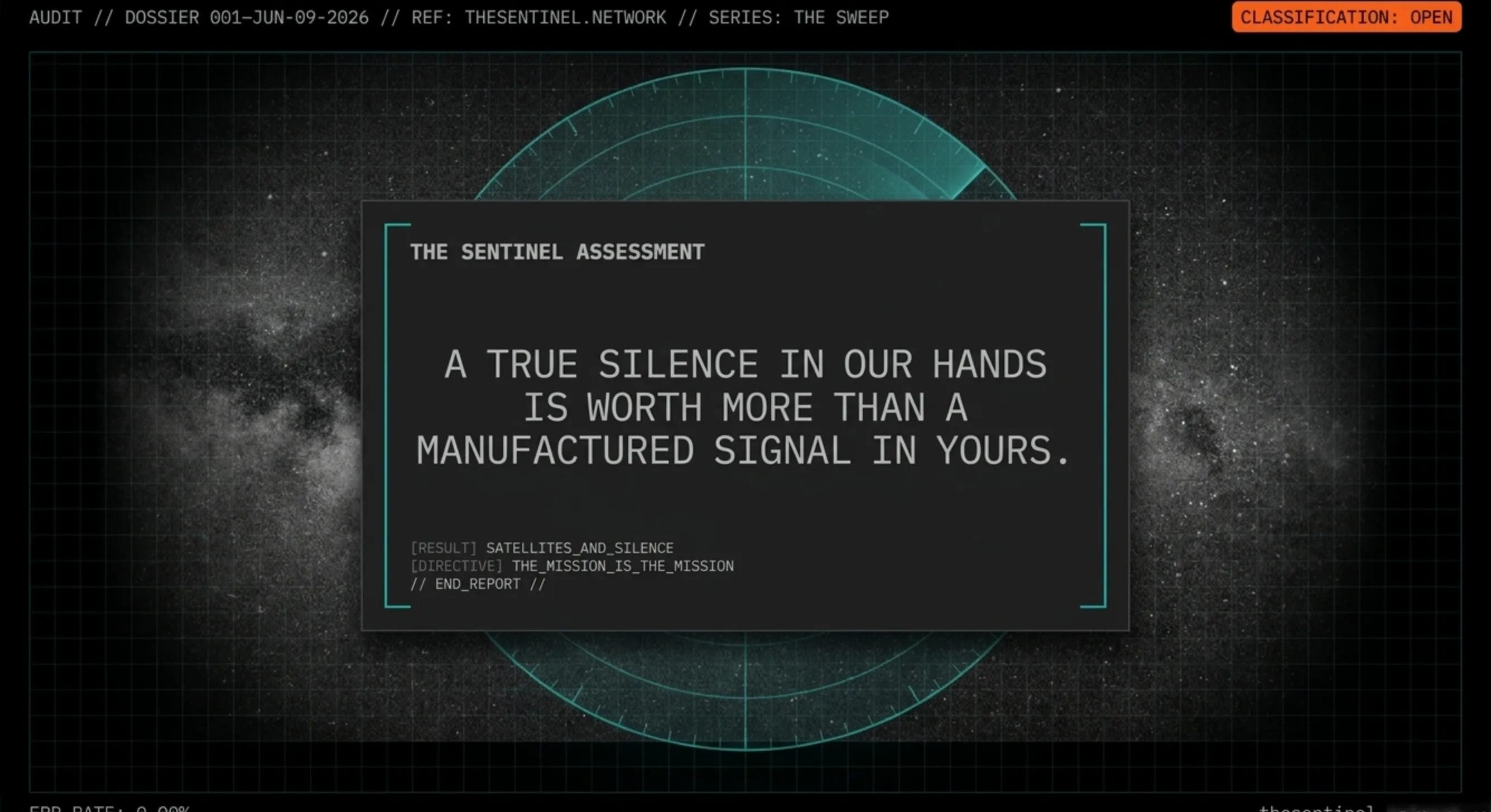
It is not the ending we were hoping for the night that cluster lit up the screen. It is the ending the data gave us, and a true silence in our hands is worth more than a manufactured signal in yours. The method worked. It surfaced thirty-seven real transmitters and then identified every one of them by service and confirmed every one against the orbits. A search that comes back empty, run correctly and reported in full, is still the most complete independent reanalysis of the Breakthrough Listen 3I/ATLAS data that anyone has put on the public record. We are releasing the entire codebase. Run it yourself. Check our thirty-seven. Find the thirty-eighth, if it is there.
The five falsifiable predictions we made for the Jupiter encounter in THE VERDICT still stand on the table, still waiting on data the community has gone quiet about. One radio band coming back silent does not close the watch. The object is still out there.
So are we.
THE SENTINEL ASSESSMENT:
We promised a complete search and we delivered one. The cadence filter that never ran, ran. Thirty-seven signals survived it, eleven of them clustered and drifting together convincingly enough that for a few hours we believed we had a detection. Then we checked every frequency against the international band allocations and every survivor against the orbits, and all thirty-seven resolved to satellites confirmed overhead. The zero-drift bin the standard pipeline discards by published policy, we opened directly. It held an instrumental floor and the roar of a crowded planet. It did not hold a beacon.
We did not take the pipeline’s word for any of it. Two peer-reviewed papers, neither of them ours, set the ground. One shows the standard search at a threshold of 10 only truly hears signals three times louder. The other states in print that zero-drift signals are discarded as standard practice. The search catches only shouts and deletes the stillest voices by design. We built around both limits and looked where they could not.
Six days before us, the SETI Institute reported the same null from the Allen Telescope Array, using the same kind of search, with the same zero-drift exclusion, pointed by the same curated orbit. It is the null the method is built to return. Ours is the null that remains after the gap is closed. The two agree, and the agreement is real, but only one of the two searches actually checked the place a probe would hide. We went looking for a signal and found thirty-seven satellites and a quiet sky. That is the finding, and we are publishing it in full, with the code, because the mission was never to be right about the probe. The mission was to do the work no one else would and report exactly what it showed.
We told you we would run the search. We ran it. We reported the null.
Keep looking up.
-- The Sentinel Network™
Every briefing we’ve published is free. That’s not changing. This publication has no institutional backing, no sponsors, and no editorial board. We’re doing the work the newsrooms won’t: sourcing papers, filing FOIAs, building tools, and writing at the pace a once-in-a-civilization event demands.
Paid subscribers fund the investigation directly. They also get access to THE SIGNAL (weekly market intelligence derived from our forensic work), primary source documents, the comment section on every briefing, Fieldcraft Labs, and the FIELDCRAFT series. The tools and methods behind every investigation we publish. No ads. No sponsors. No strings. Your subscription is a data point against the suppression gradient.
If you can’t subscribe, we don’t care. Read everything. Share everything. The mission is the mission.
Subscribe to The Sentinel Network™
A top 100 Science publication on Substack.
Share this briefing. The Suppression Gradient documented what happens when this coverage reaches platforms that do not want you reading it. Every share, every restack, every forwarded link is a data point against the gradient.
Previous briefings: THE MISSING BIN | THE NARROW BAND | THE PUBLICATION GAP | THE FIFTH INSTRUMENT | THE BLIND SPOT | THE SKY IS FALLING | THE OPERATING SYSTEM | THE CURATED ORBIT | THE ANCIENT ENGINE | THE VERDICT | THE LONG COUNT | THE GREEN BURIAL | THE GHOST GENERAL | THE SUPPRESSION GRADIENT | THE SILENT EDIT | CONFIRMED: THE TESS CONTINGENCY
Have really enjoyed following this deep dig. Fascinating stuff.