

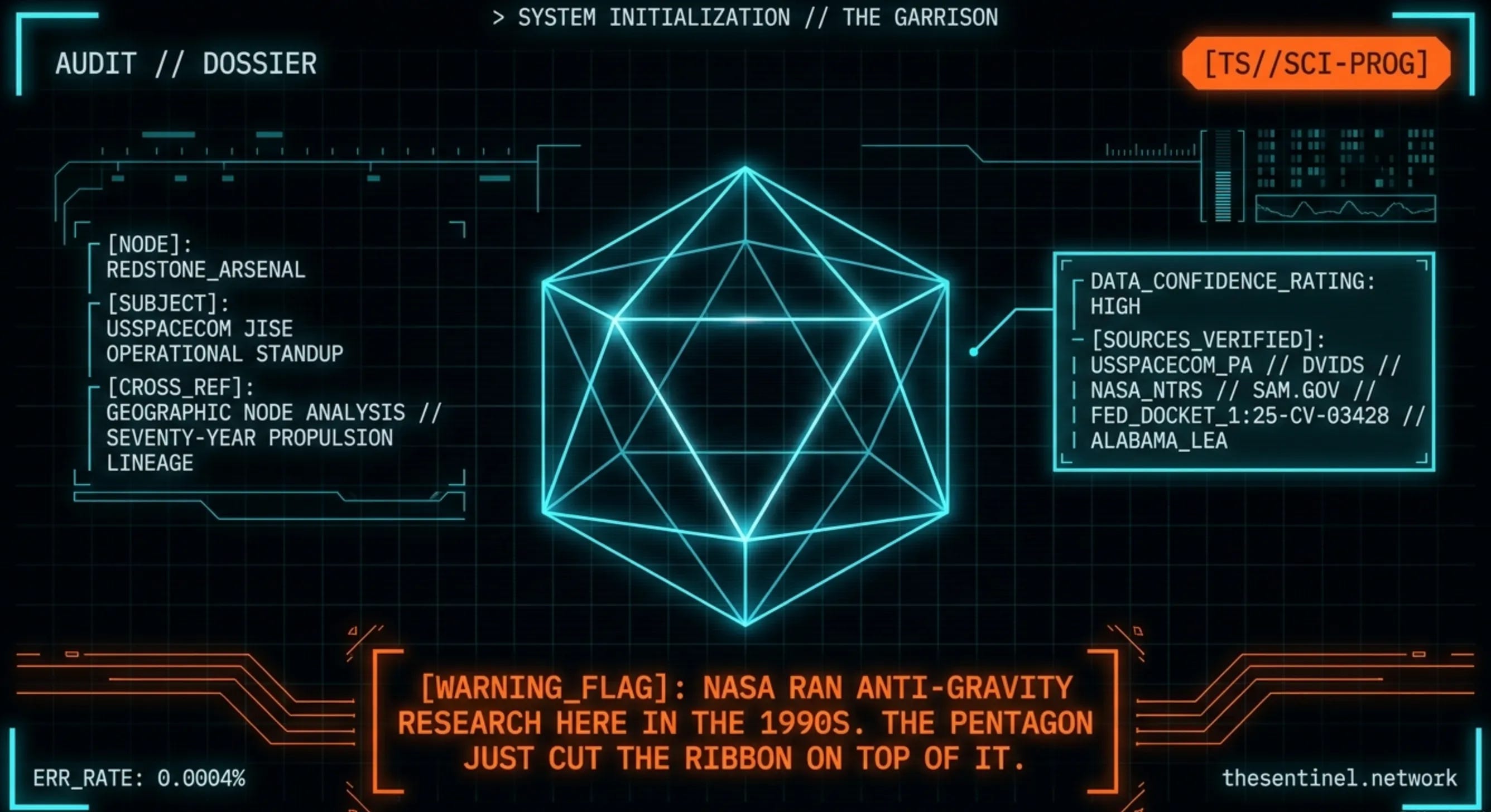
SUBJECT: REDSTONE ARSENAL // USSPACECOM JISE OPERATIONAL STANDUP // GEOGRAPHIC NODE ANALYSIS // SEVENTY-YEAR PROPULSION LINEAGE
DATE: APRIL 30, 2026
CROSS-REF: THE LAYOVER | THE OTHER HAND | THE PUBLICATION GAP | THE ARCHITECT | THE GHOST GENERAL | THE WITNESS
DATA CONFIDENCE: HIGH (USSPACECOM PUBLIC AFFAIRS / DVIDS, NASA TECHNICAL REPORTS SERVER, SAM.GOV ENTITY REGISTRY, FEDERAL DOCKET 1:25-CV-03428, HOUSE APPROPRIATIONS COMMITTEE, ALABAMA LAW ENFORCEMENT AGENCY)
We are building the video side of this operation. If you want the briefings in a format you can watch, subscribe to The Sentinel Network on YouTube.
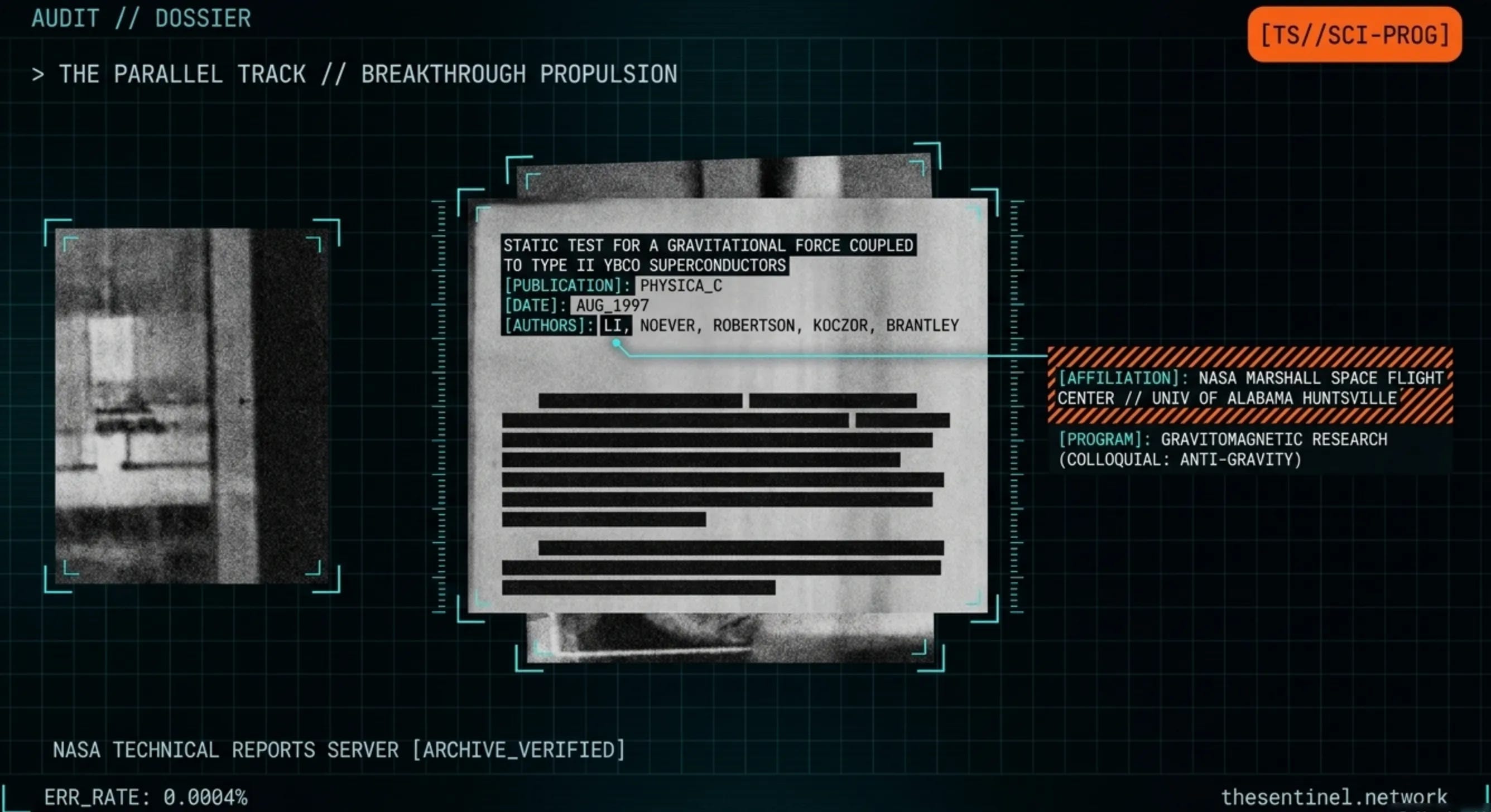
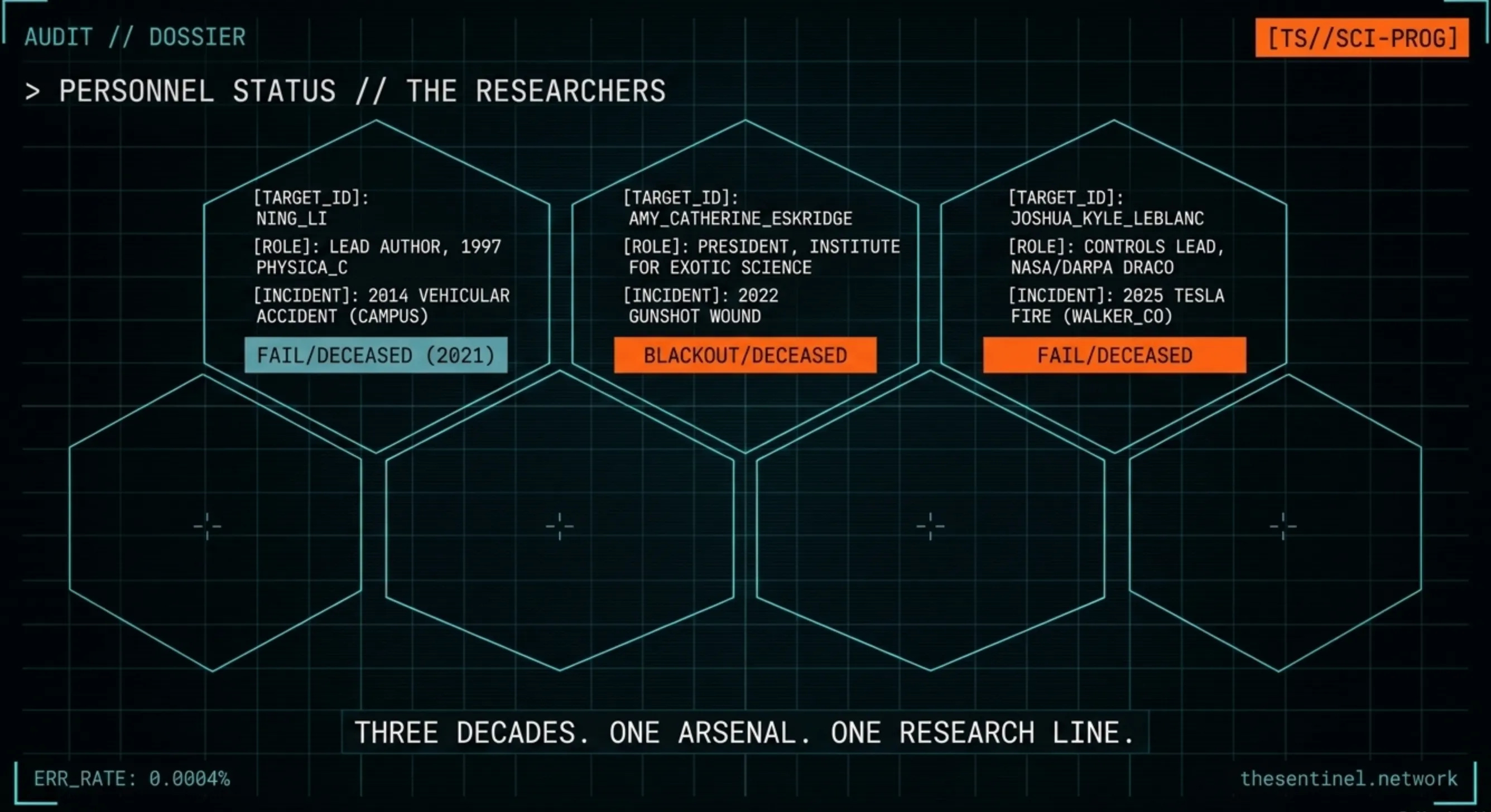
In August 1997, a team of physicists working with NASA’s Marshall Space Flight Center on the Arsenal at Redstone, Alabama, published a peer-reviewed paper in Physica C titled “Static Test for a Gravitational Force Coupled to Type II YBCO Superconductors.” The lead author was Dr. Ning Li.
In 2014, Li was struck by a vehicle on the campus of the University of Alabama in Huntsville. She suffered permanent brain damage. Her husband had a heart attack while witnessing the accident and died the following year. Li died in 2021.
The Marshall propulsion research that began with her work continued through the 2010s under other hands, on the same Arsenal, and produced a federally registered exotic-propulsion institute that went dark in June 2022 when its president was found dead of a gunshot in Huntsville at the age of thirty-four.
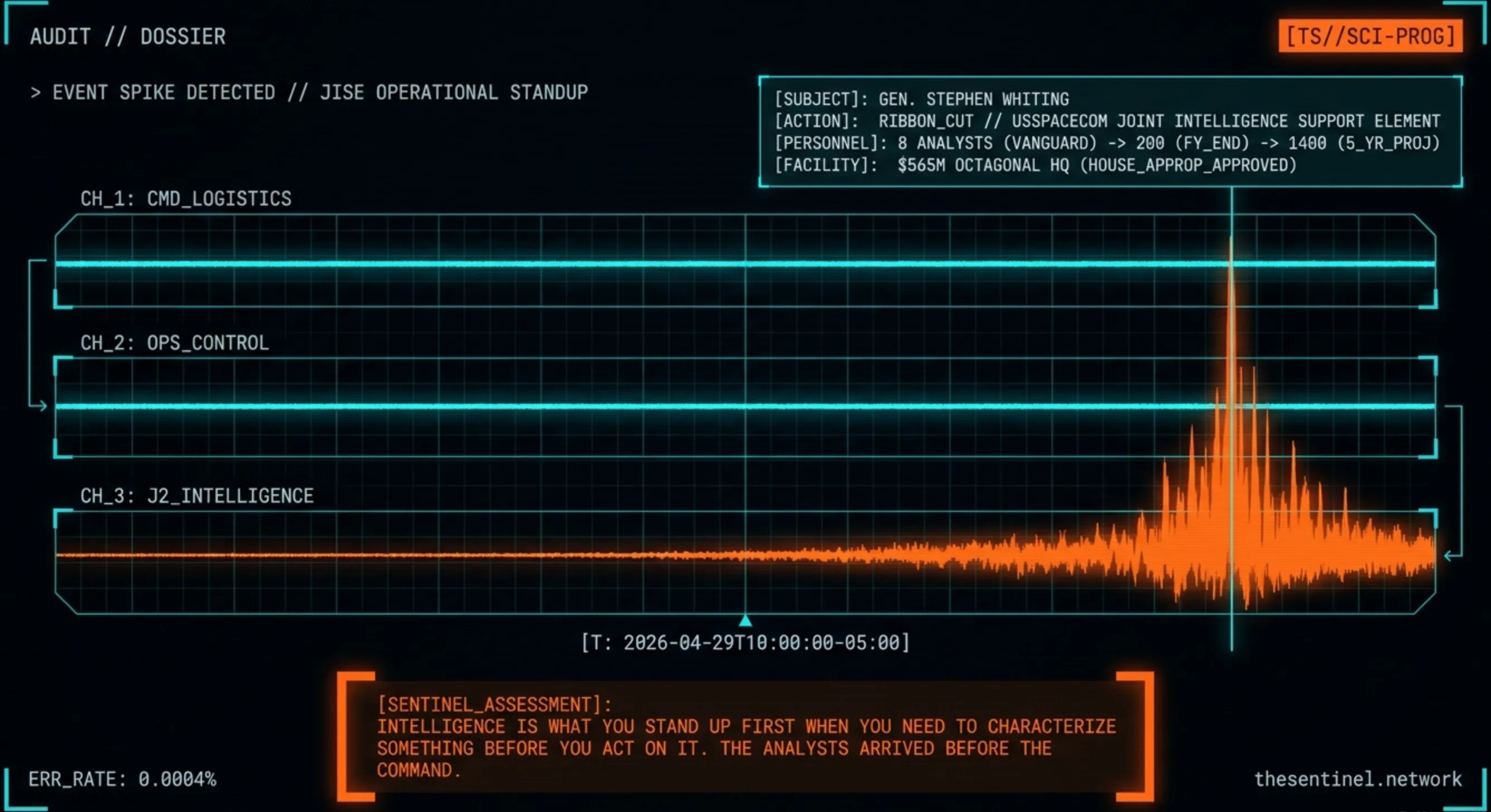
Yesterday morning at ten Central time, on April 29, 2026, General Stephen Whiting cut a ribbon at Redstone Arsenal in Huntsville, Alabama. The building behind him is the first operational facility U.S. Space Command will inhabit on the installation. NASA Marshall Space Flight Center is adjacent.
Eight intelligence analysts are operational inside as the first tranche of an eighty-person Joint Intelligence Support Element. They are the vanguard of an estimated two hundred who will permanently relocate from Colorado Springs to Huntsville this year, and of the roughly fourteen hundred who will follow over the next half decade into a $565 million octagonal headquarters whose construction funding the House Appropriations Committee approved last week.
The dirt is older than the ribbon.
THE QUOTE
Here is what General Whiting said, on camera, during the ceremony, per the DVIDS press release:
“Today, we cut the ribbon on more than just a building. This facility represents a critical step forward for U.S. Space Command. This is where we plant our flag for the first operational element of our headquarters - the Joint Intelligence Support Element - here at Redstone Arsenal.”
Read that again. The first operational element is the intelligence directorate. Not operations. Not logistics. Not command and control. Intelligence. The analysts arrived first.
Brig. Gen. Nathan Rusin, director of the J2 Intelligence Directorate, framed the operational stakes alongside Whiting. The phrase he chose was “uninterrupted space superiority.” Whiting’s stated goal of half the entire command operating from Redstone by the end of 2028 is now on the public record.
THE SENTINEL ASSESSMENT:
Intelligence is what you stand up first when you need to characterize something before you act on it. The sequencing is in the public record, attributed to the four-star commander, on the day his J2 became operational.
THE ADDRESS
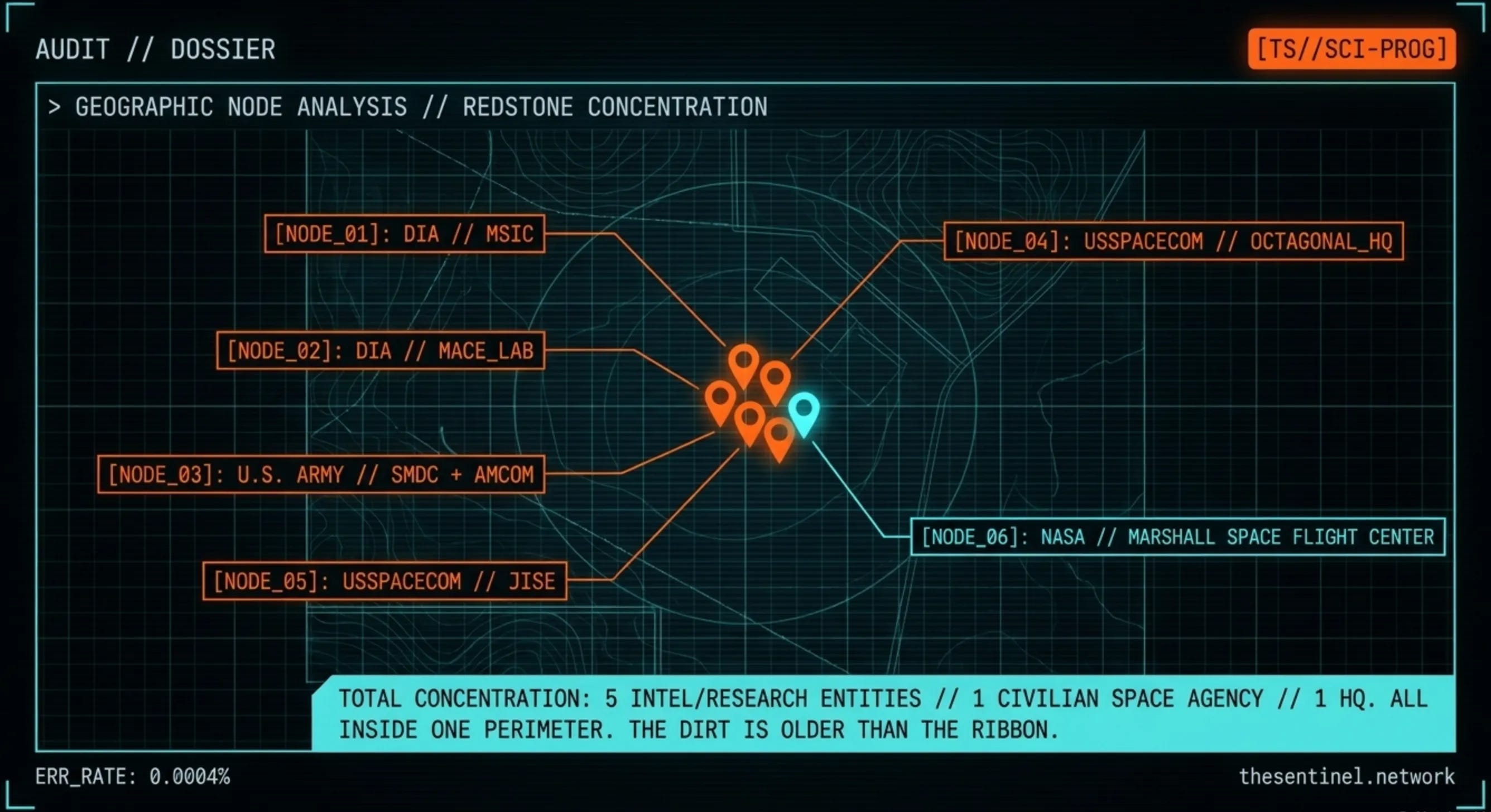
Redstone Arsenal as it stands today is the most concentrated space-intelligence node in the United States.
The Defense Intelligence Agency’s Missile and Space Intelligence Center is on the installation. Roughly four hundred and ten personnel and an unknown number of contractors. Mission scope, on the public record, includes “selected space programs and systems,” directed-energy weapons, and the relevant C4ISR layer.
MSIC’s new Modeling, Analysis, Computing and Exploitation Lab, known as MACE, broke ground August 26, 2025. One hundred and fifty thousand square feet. Briefed at groundbreaking by the Principal Deputy Director of National Intelligence as the future home of “AI-enabled space and missile defense” with “petabytes of data processing.” It broke ground six days before President Trump announced the SPACECOM relocation.
NASA’s Marshall Space Flight Center is adjacent. The Missile Defense Agency, the U.S. Army Space and Missile Defense Command, and the U.S. Army Aviation and Missile Command are organic to the installation. Lockheed Martin’s Huntsville facilities sit alongside the Arsenal; the company served as the prime contractor on DRACO and maintains an extensive footprint across the Marshall and Redstone defense ecosystem. The future octagonal SPACECOM headquarters will sit on a sixty-acre footprint in the center of the Arsenal. The House Appropriations Committee approved $565 million in design and construction funding on April 21, 2026.
The JISE facility itself is the first dedicated operational structure U.S. Space Command will inhabit on the Garrison. It precedes the larger permanent headquarters by years. The building was prepared by the Redstone Transition Team under Maj. Gen. Terry L. Grisham through the end of 2025 and the early months of 2026, designed to absorb the J2 Intelligence Directorate’s analyst workflow and SCIF requirements before the wider command begins relocating.
Five intelligence and research entities. One civilian space agency. One headquarters under construction. All inside one perimeter.
THE LINEAGE
Redstone is not a new node. It is the original node.
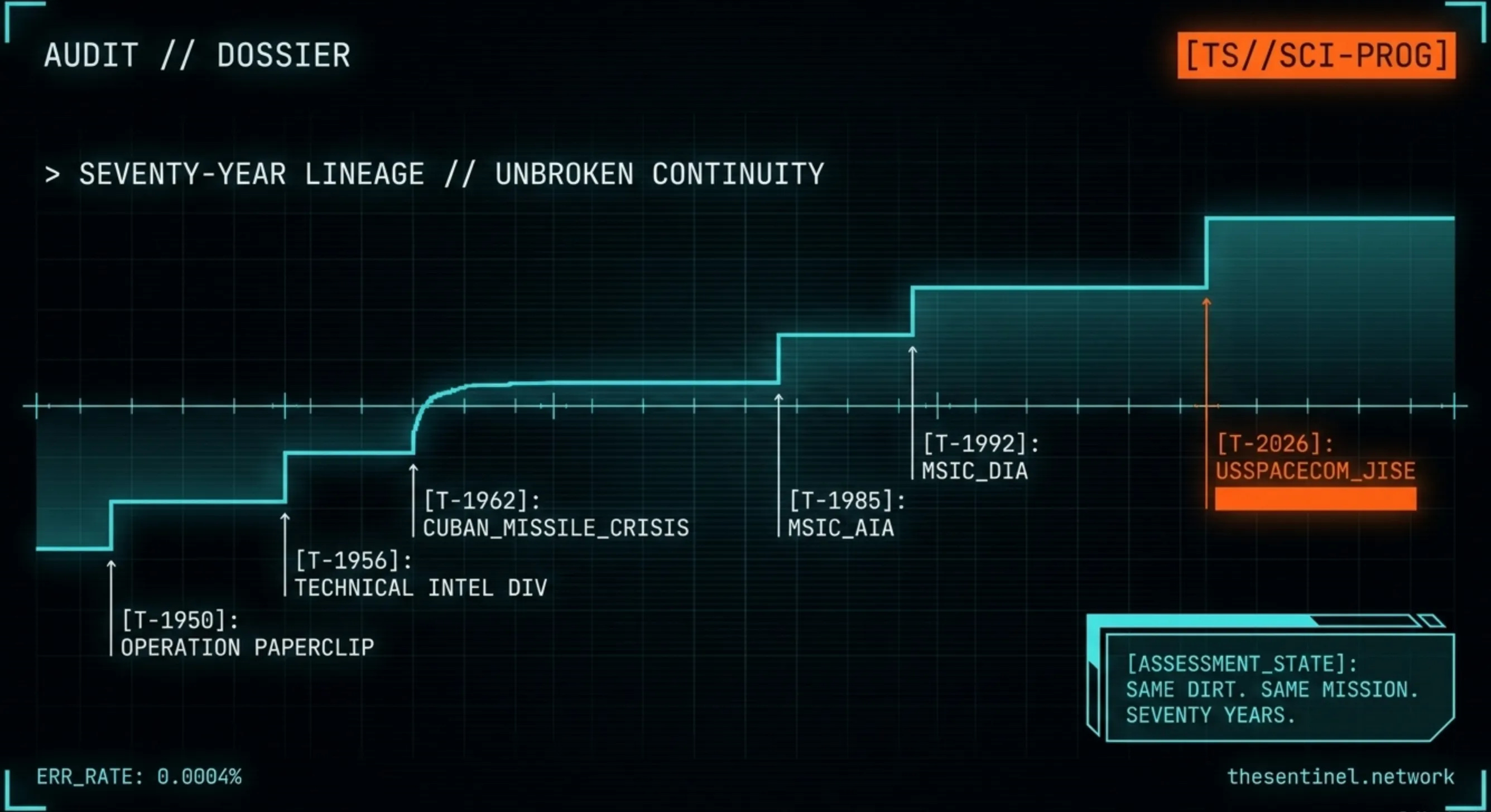
The U.S. Army began the buildup in 1945, when 127 German rocket specialists led by Wernher Von Braun signed work contracts under Operation Paperclip. The team was transferred to Redstone Arsenal in 1950 to develop the Army’s ballistic missile program. The Marshall Space Flight Center was constructed on the Arsenal a decade later, in 1960, with Von Braun as its first director.
In June 1956, U.S. Army Ballistic Missile Agency commander Maj. Gen. John Medaris, working alongside Dr. Wernher Von Braun, established the Technical Intelligence Division at Redstone Arsenal. Six people. They were tasked with analyzing foreign missile activity. By 1962 the unit was reorganized as the Missile Intelligence Office, and the CIA selected it to run the technical assessment of Soviet capability during the Cuban Missile Crisis.
It was renamed the Missile Intelligence Agency in 1970, the Missile and Space Intelligence Center in 1985 under the Army Intelligence Agency, and on January 1, 1992, formally moved under the Defense Intelligence Agency. Through the Reagan-era Strategic Defense Initiative, MSIC ran technical assessments on Soviet directed-energy and space-based weapons concepts. The lineage is unbroken. Same patch of ground. Same mission. Seventy years.
The propulsion physics work overlapped with the intelligence consolidation by sharing the same address. NASA’s Marshall Space Flight Center, on the same Arsenal, became the U.S. government’s principal home for what was alternately called Breakthrough Propulsion Physics, gravitomagnetic research, and, in the popular press, anti-gravity research. The Marshall program partnered with Dr. Ning Li and her colleagues at the University of Alabama in Huntsville beginning in the early 1990s. Li, Noever, Robertson, Koczor, and Brantley published the 1997 Physica C paper investigating Russian researcher Eugene Podkletnov‘s claim of a 0.05 to 2.1 percent weight reduction effect over a rotating superconducting disc. The Marshall team’s static-configuration test did not reproduce Podkletnov’s effect. Li and her co-authors continued theoretical and applied work on the topic through the late 1990s. NASA’s funding involvement is documented across the NASA Technical Reports Server.
THE SENTINEL ASSESSMENT:
NASA’s own technical reports archive contains the published outputs of the Marshall propulsion research that the popular press called anti-gravity, including peer-reviewed literature, technical memoranda, and conference proceedings. The institutional research happened. The Joint Intelligence Support Element became operational on the same Arsenal yesterday morning. The two facts share an address.
THE INSTITUTE
The Marshall propulsion lineage continued in Huntsville through other hands after Li departed NASA in 1999.
Richard H. Eskridge is a retired NASA Marshall propulsion physicist whose NASA Technical Reports Server record spans inductive pulsed plasma thrusters, magnetized target fusion, and the Field Reversed Configuration Acceleration Space Thruster experiment. In 2014, he participated in a Marshall technical evaluation of a device built on POAMS theory, an acronym for Phase-locked Oscillator Anomalous Momentum Synthesis, a fringe-physics framework aimed at demonstrating apparent weight reduction.
His daughter Amy Catherine Eskridge co-founded the Institute for Exotic Science. The institute was registered with the federal System for Award Management under entity ID FTWBFXR1NE21 on December 17, 2018, with Amy listed as President. Business address: Joppa, Alabama. SAM registration positions an entity to bid on federal contracts. In December 2018, she delivered a public presentation at the Huntsville Alabama L5 Society titled “AntiGravity,” reviewing the historical record of the field. Richard co-presented.
Amy Eskridge died on June 11, 2022, in Huntsville, at the age of thirty-four. The cause of death was reported as a self-inflicted gunshot wound. The Institute for Exotic Science website went offline shortly afterward. In a statement reported by CNN this month, her family characterized her as a “marvelously intelligent person” who suffered from “chronic pain” and asked the public not to make too much of her death.
THE SENTINEL ASSESSMENT:
The Eskridge family asked for restraint. We are honoring it. We make no claim about the cause of Amy’s death beyond the public record. What is in the public record is that a federally registered exotic-propulsion institute existed on the perimeter of Redstone Arsenal until June 2022, that its president was the daughter of a Marshall propulsion physicist who participated in NASA’s internal evaluation of fringe-physics propulsion concepts, and that the institute went dark the month she died. The structure stands without putting Amy on any list.
THE PROGRAM
Joshua Kyle LeBlanc led the controls architecture for DRACO, the United States’ four-hundred-and-ninety-nine-million-dollar nuclear thermal propulsion program, from NASA Marshall on the Arsenal. We documented his case in detail yesterday in THE LAYOVER. The forensic record is there. We are not relitigating it.
What lives in this briefing is the geography. LeBlanc’s career, his employer, his project, and the morning he disappeared all anchor to the same Arsenal where Ning Li did her gravitomagnetic research, where Richard Eskridge worked on plasmoid thrusters and POAMS evaluations, and where the U.S. Space Command intelligence directorate became operational ten months after LeBlanc’s death.
DARPA cancelled DRACO on June 25, 2025. Twenty-seven days later, LeBlanc’s Tesla burned in Walker County, Alabama, with him inside. For nine months his death was a local Alabama traffic fatality. On April 17, 2026, Rep. Eric Burlison named him on Fox News.
THE SENTINEL ASSESSMENT:
Two propulsion researchers connected to the Marshall program have died in unexplained or unusual circumstances. Li, the lead author of the 1997 paper, died in 2021 after a 2014 vehicular incident on the local university campus. LeBlanc, the controls lead for DRACO, died in July 2025. The federally registered exotic-propulsion institute that bridged their decades of work went dark in 2022. Two researchers. One institute. One Arsenal. Three different decades of the same research line.
THE CONSOLIDATION
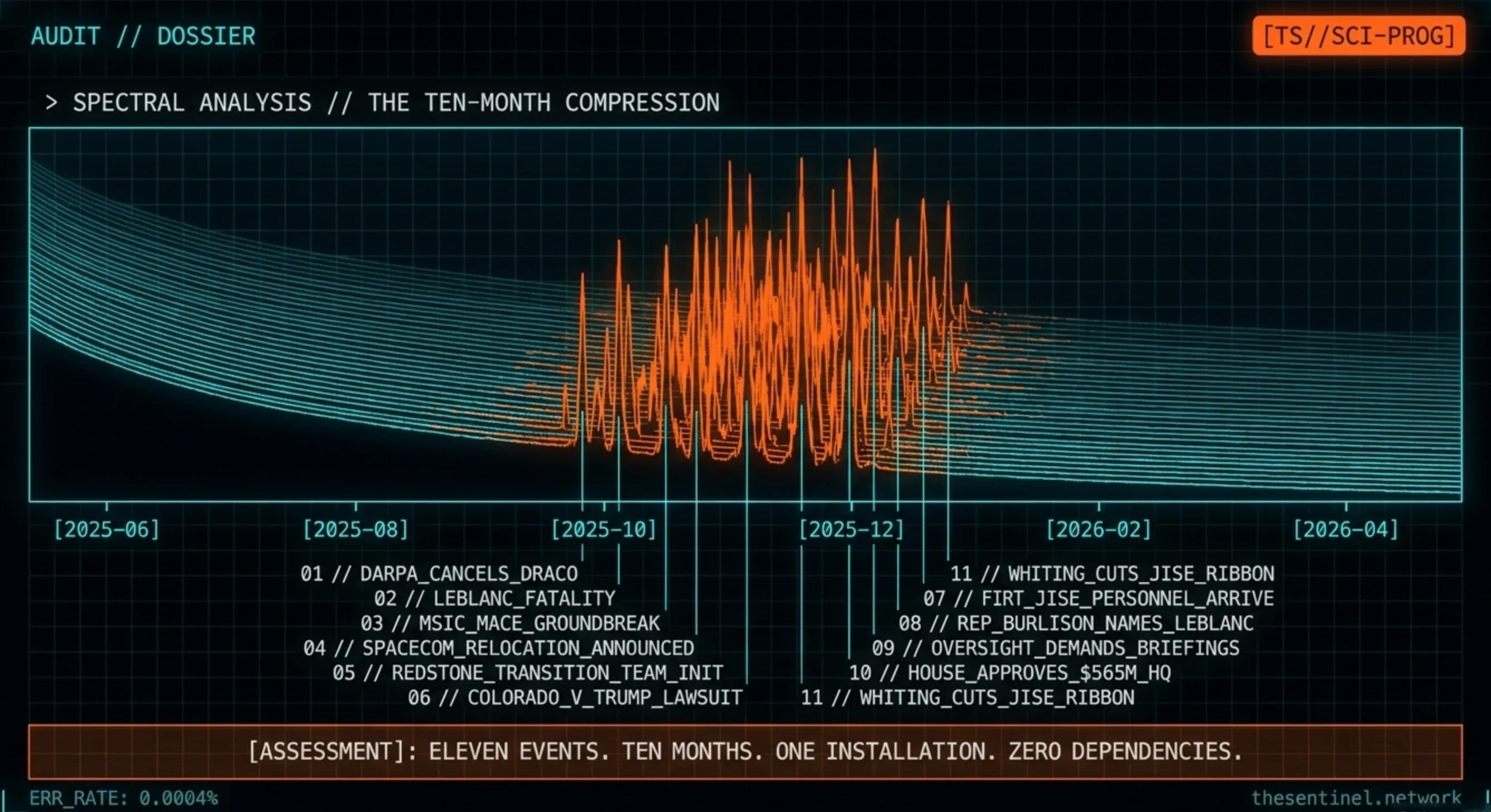
The calendar is the analysis. Read the dates in order.
June 25, 2025. DARPA cancels DRACO. Joshua LeBlanc’s program ends.
July 22, 2025. LeBlanc’s Tesla burns in Walker County.
August 26, 2025. MSIC breaks ground on the MACE Lab. The Principal Deputy Director of National Intelligence describes the facility as the future home of “AI-enabled space and missile defense” with “petabytes of data processing.”
September 2, 2025. President Trump announces the relocation of U.S. Space Command headquarters from Colorado Springs to Redstone Arsenal. He cites Colorado’s mail-in voting system as a “big factor” in the decision.
End of 2025. The Redstone Transition Team is established under Maj. Gen. Terry L. Grisham.
October 29, 2025. Colorado Attorney General Phil Weiser files State of Colorado v. Trump et al. (Docket 1:25-cv-03428) in the U.S. District Court for the District of Colorado, asking Judge R. Brooke Jackson to enjoin the relocation as unconstitutional retaliation. Trial is set for late 2026.
April 15, 2026. The first eight Joint Intelligence Support Element personnel arrive at Redstone Arsenal. Roughly twenty Redstone Transition Team staff are already on site.
April 17, 2026. On Fox News, Rep. Eric Burlison names Joshua LeBlanc as a new entry in the list of dead and missing scientists.
April 20, 2026. House Oversight Chairman James Comer and Subcommittee Chairman Burlison send formal letters to the FBI, the Department of Energy, the Department of War, and NASA demanding briefings by April 27, citing a “grave threat to U.S. national security and to U.S. personnel.”
April 21, 2026. The House Appropriations Committee approves $565 million for the design and construction of the permanent SPACECOM headquarters at Redstone.
April 29, 2026. Whiting cuts the ribbon. Eight intelligence analysts are operational at the most concentrated space-intelligence node in the country. Two hundred relocating by year-end. Fourteen hundred over the next five years.
THE SENTINEL ASSESSMENT:
Eleven events. Ten months. One installation. None of these events required any of the others. All of them happened on the same dirt. DARPA cancelled a four-hundred-and-ninety-nine-million-dollar nuclear thermal propulsion program twenty-seven days before the engineer who led its controls architecture died, six days before the MSIC broke ground on a one-hundred-and-fifty-thousand-square-foot AI-enabled space and missile defense modeling facility, and ten months before the intelligence directorate of U.S. Space Command became operational on the same Arsenal in a building funded by a House Appropriations action one week prior.
THE COVER
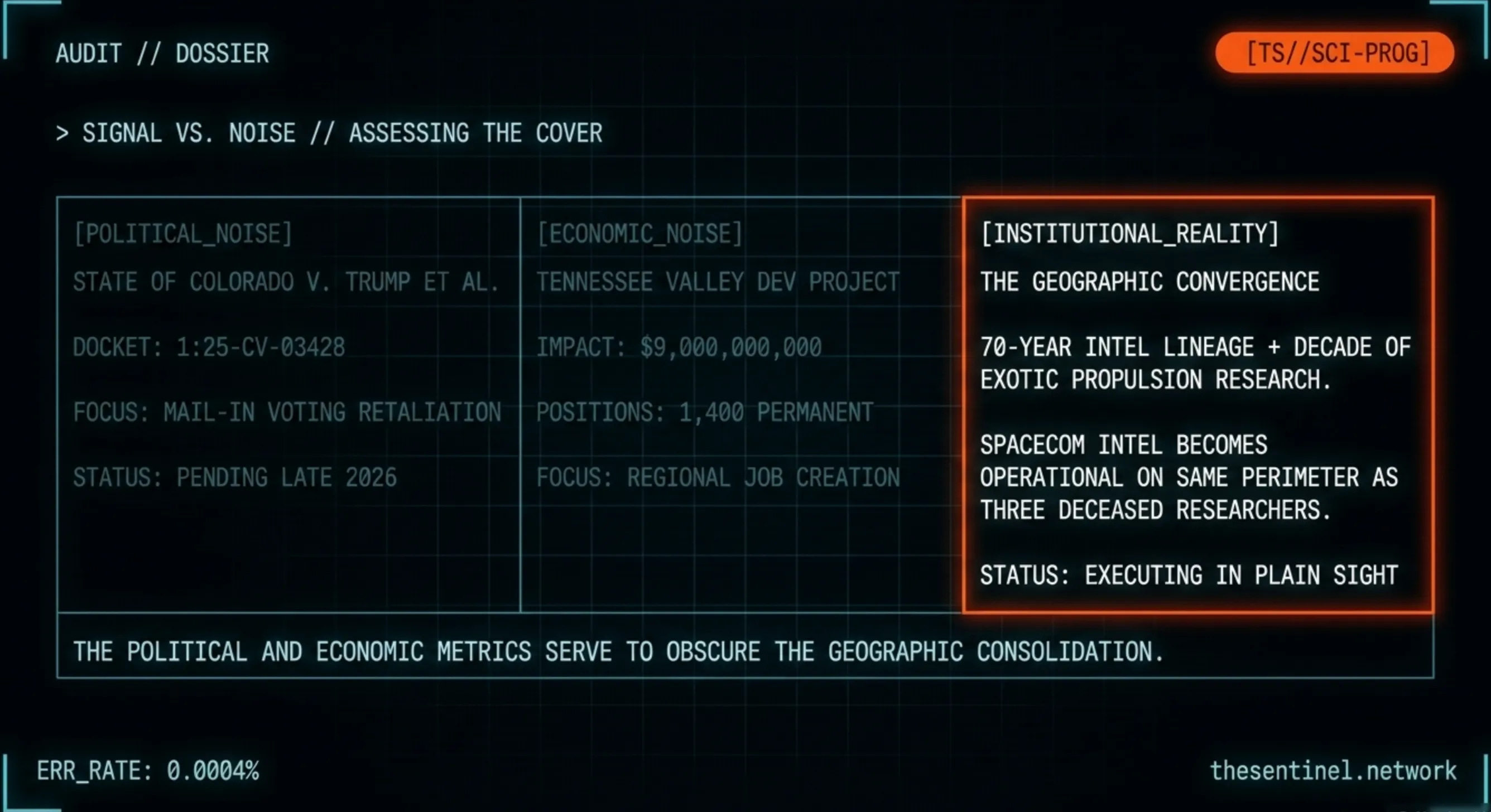
Two stories are being told publicly about this relocation. Neither is the institutional one.
The first is political. Mail-in voting. Colorado retaliation. The Weiser lawsuit. Trump versus Polis. Republican Alabama versus Democratic Colorado. The mail-in voting framing was designed to be irresistible to political reporters and useless to defense reporters. The lawsuit will not be decided until late 2026, by which point the headquarters relocation will be operationally complete.
The second is economic. Roughly nine billion dollars in projected impact across the Tennessee Valley by 2030. Fourteen hundred permanent positions plus several thousand support and contractor roles. The architectural rendering of the octagonal headquarters has been published with photographs of stylized space-command iconography. Local Alabama coverage runs the jobs angle. Trade press runs the contract-award angle. Both are honest, verifiable, and largely accurate.
Underneath the political fight and the economic story, the institutional history sits in plain text on the federal record.
NASA Marshall ran propulsion physics research that the popular press called anti-gravity for the better part of a decade in the 1990s. The lead researcher suffered a vehicular incident on the local university campus that ended her career and arguably her life. A federally registered exotic-propulsion institute existed on the perimeter of the Arsenal until its president died of a gunshot in 2022. The intelligence directorate of U.S. Space Command became operational on that same Arsenal yesterday morning.
This is the THE OTHER HAND framework operating in real time. The political story and the economic story occupy the editorial oxygen. The geographic consolidation underneath them is happening on the official record while no major outlet examines it.
THE SENTINEL ASSESSMENT:
The mail-in voting story is loud. The economic-development story is louder still. Both serve the operational function of keeping the geographic convergence out of the news cycle while the consolidation completes. The intelligence directorate is now operational. The headquarters funding is now approved. The ribbon went up at ten yesterday morning.
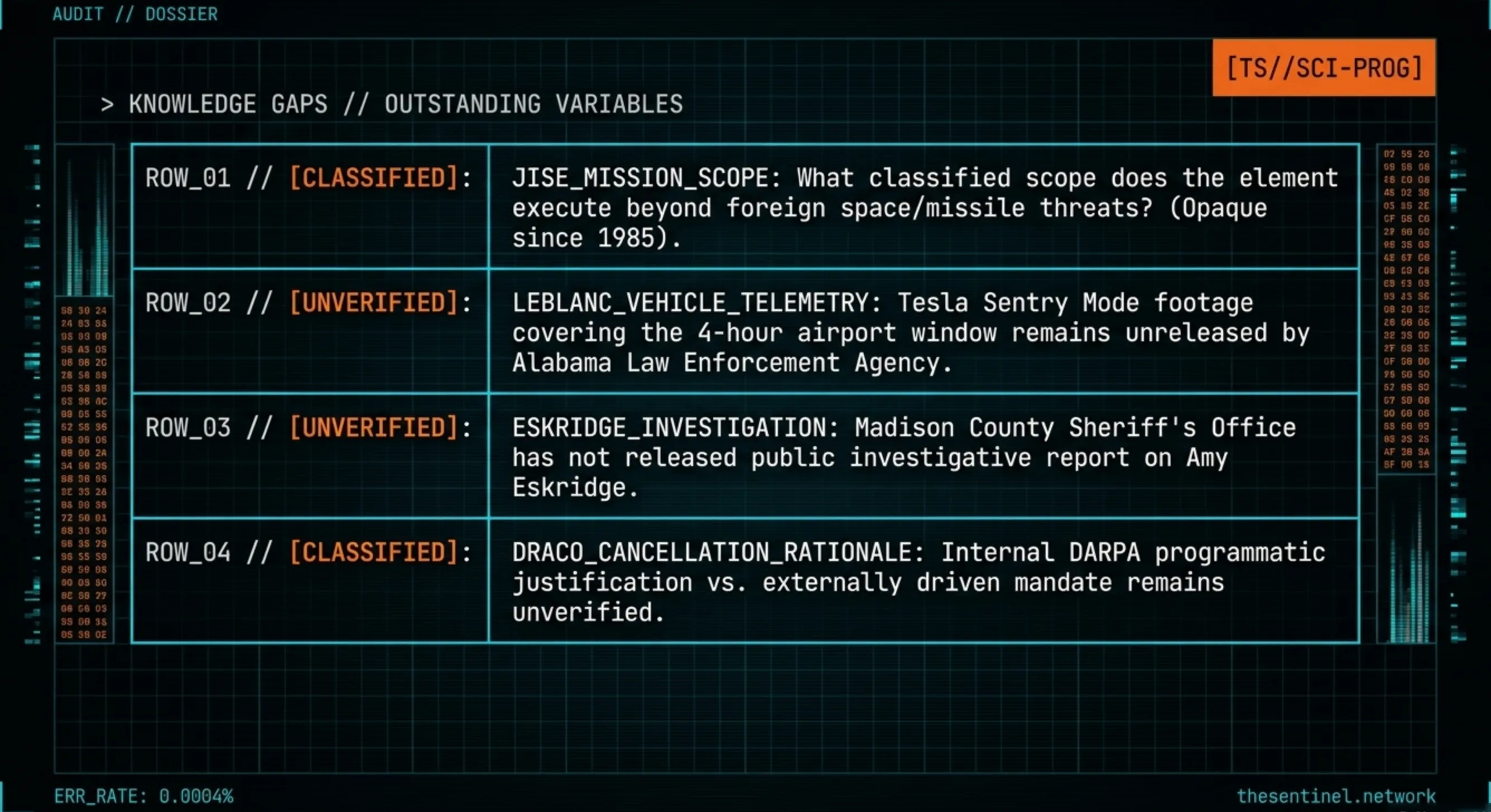
WHAT WE DON’T KNOW
We do not know what classified mission scope, if any, the Joint Intelligence Support Element will execute beyond the publicly stated counterparts of foreign space and missile threats. The MSIC scope phrase “selected space programs and systems” has been opaque since 1985.
We do not know the full circumstances of Joshua LeBlanc’s death. The Tesla Sentry Mode footage covering the four-hour airport window has not been released. The Alabama Law Enforcement Agency has shared only the basic crash details. The case has not been publicly investigated as anything other than a single-vehicle traffic fatality.
We do not know the full circumstances of Amy Eskridge’s death. The Madison County Sheriff’s Office has not released a public investigative report. Her family has asked for restraint, and we are not contesting their account.
We do not know whether the cancellation of DRACO was an internal DARPA programmatic decision or an externally driven one. Public reporting on the cancellation cites budgetary and schedule rationales. We have not independently verified those rationales.
We have not contacted any of the affected families. We are not seeking comment.
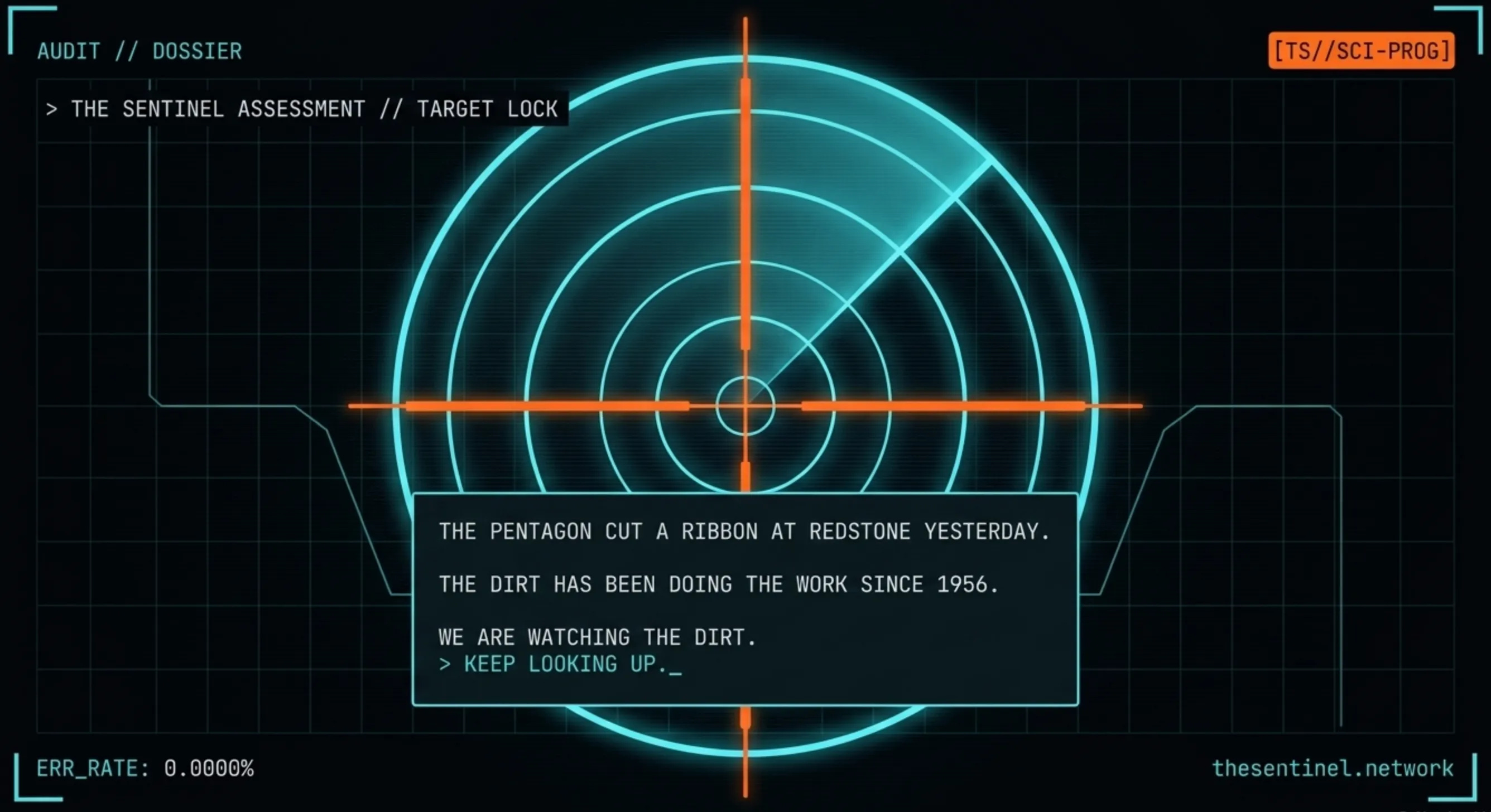
The Pentagon cut a ribbon at Redstone yesterday.
The dirt has been doing the work since 1956.
We are watching the dirt.
Keep looking up.
-- The Sentinel Network™
Every briefing we’ve published is free. That’s not changing. This publication has no institutional backing, no sponsors, and no editorial board. We’re doing the work the newsrooms won’t, sourcing papers, filing FOIAs, building tools, and writing at the pace a once-in-a-civilization event demands.
Paid subscribers fund the investigation directly. They also get access to THE SIGNAL (weekly market intelligence derived from our forensic work), primary source documents, the comment section on every briefing, Fieldcraft Labs, and the FIELDCRAFT series. No ads. No sponsors. No strings. Your subscription is a data point against the suppression gradient.
If you can’t subscribe, we don’t care. Read everything. Share everything. The mission is the mission.
Subscribe to The Sentinel Network™
Top 100 Science publication on Substack.
Share this investigation. THE SUPPRESSION GRADIENT documented what happens when this coverage reaches platforms that do not want you reading it. Every share, every restack, every forwarded link is a data point against the gradient.
Previous briefings: THE LAYOVER | THE WITNESS | THE STANDARD | THE OPERATOR | THE OTHER HAND | THE PUBLICATION GAP | THE ARCHITECT | THE BLIND SPOT | THE PHONE GAP | THE LONG COUNT | THE GREEN BURIAL | THE DEAD DROP | THE GHOST GENERAL | THE ATTRITION (Series)
What no one really discusses, and takes a deep dive on, is that a NAZI scientist, Werner Von Braun, along with other German scientists, were brought to the USA after the war and actually given a lot of power and authority, over and above science and research into rocketry, missiles, and spacecraft. As a kid, I remember Walt Disney had Von Braun on 'The Wonderful World of Disney' more than once. Von Braun was responsible for the V-2 rockets that made life hell for England and others of our allies during WWII, yet we practically gave him " the keys to the city", as it were when he came to the US.
https://www.youtube.com/watch?v=8zcU85O82XE
The Russians and Germans despised each other, NAZIS vs. Communists. Now we have a president who treats Russia like a long lost brother...and not giving a whole lot of assistance to Ukraine. It's all rather crazy, yet no one gives it much thought to history and how it may be impacting us today...and the Space Program...and UFOs.
Mach effect thrusters could be a promising line of research.