
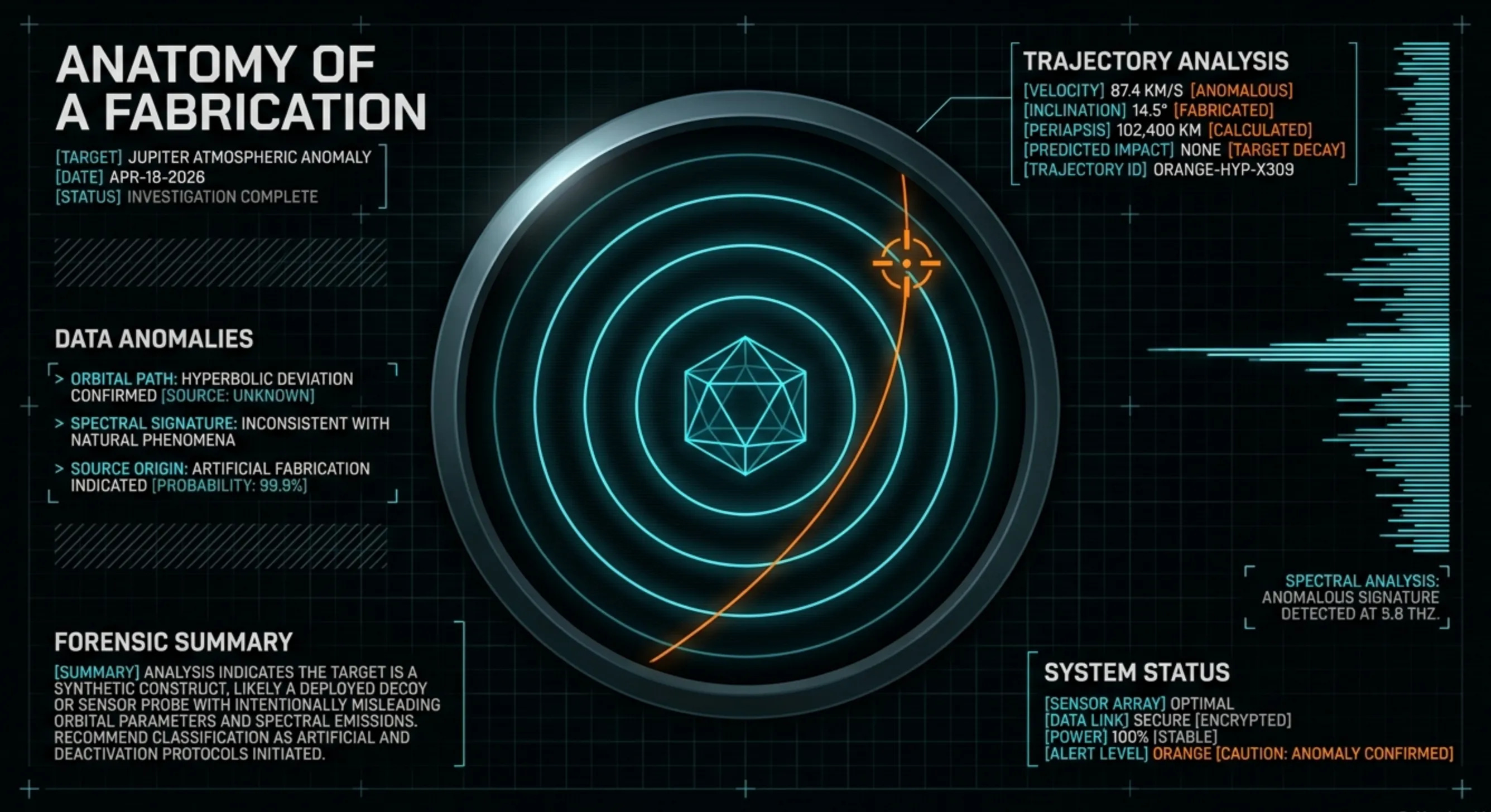
SUBJECT: DISINFORMATION ANALYSIS // FABRICATED JUPITER IMPACT EVENT // 18 APRIL 2026 FRANTZIS / DELCROIX IMAGE FORENSICS
DATE: MAY 4, 2026
CROSS-REF: THE PUBLICATION GAP | THE SUPPRESSION GRADIENT | THE OPERATOR | THE NARROW BAND | THE SILENT EDIT | THE CURATED ORBIT | CONFIRMED: THE TESS CONTINGENCY | THE FIFTH INSTRUMENT | THE MURMURATION | FIELDCRAFT
DATA CONFIDENCE: VERIFIED METHODOLOGY (PVOL NEWS LIVE FETCH 5/3/26, DETECT OBSERVER DATABASE STAMP 2026/05/02 05:51 UT, BAA JUPITER SECTION, ALPO JUPITER, ALPO-JAPAN, AVI LOEB CFA SUBSTACK, MAJOR MAINSTREAM ASTRONOMY PRESS, FIFTEEN-DAY POST-CAPTURE GLOBAL OBSERVER NET CROSS-REFERENCE)
We are building the video side of this operation. If you want the briefings in a format you can watch, subscribe to The Sentinel Network on YouTube.
THE TIP
Two weeks ago, an image started circulating in 3I/ATLAS-adjacent channels.
It reached us the way readers reach us. A direct message to the publication. A follow-up post on Reddit, including in r/probes, the subreddit we moderate. Subscribers flagged it independently. Each one asked the same question. Is this what it looks like.
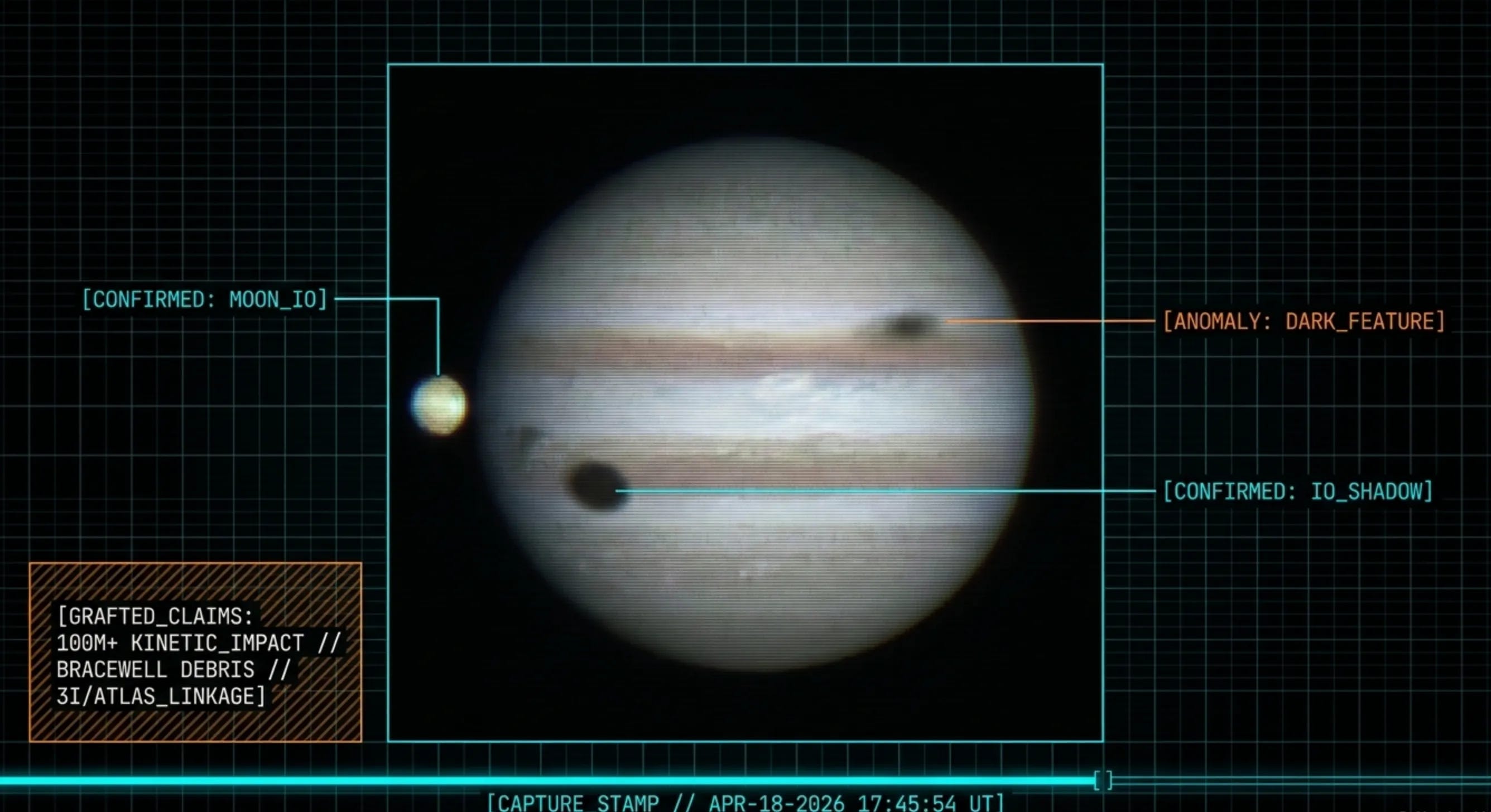
The image showed Jupiter on April 18, 2026, captured by a Greek amateur astronomer named Alexandros Frantzis and processed by a French planetary imaging veteran named Marc Delcroix. Two recognizable features dominate the frame. Jupiter’s moon Io. Io’s shadow on the cloud tops. A third labeled feature sits in the equatorial belt, separate from the moon and its shadow. The label printed on the frame reads Dark feature.
Attached to the image as it traveled was a claim Frantzis never made and Delcroix never endorsed. The dark patch was the visible signature of an object larger than one hundred meters slamming into Jupiter’s atmosphere. Some downstream variants tied it directly to 3I/ATLAS, whose closest approach to Jupiter occurred on March 16. A few framed it as visible Bracewell deployment debris.
We took it seriously. We spent two weeks verifying it.
It is fake.
This briefing documents how we know, what we observed about the asset itself, and what we are choosing not to claim.
THE IMAGE
The reason this asset took us two weeks instead of one afternoon is that the primary materials are real.
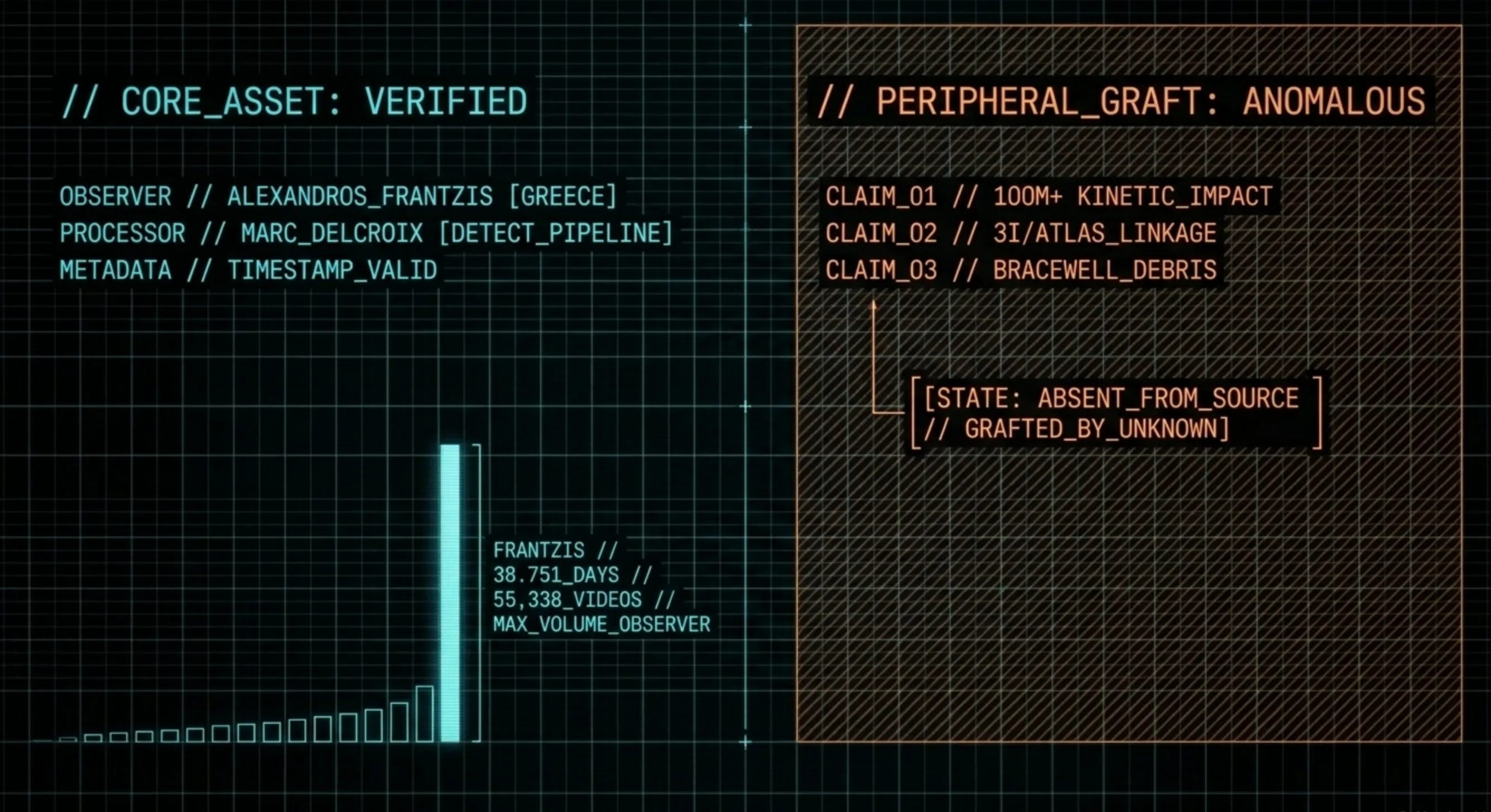
The observer is real. Alexandros Frantzis, working from Greece, contributes more video to the global Jupiter impact-detection network than any other person on Earth. As of May 2, his cumulative observation log on the DeTeCt project database reads 38.751 days of analyzed video across 55,338 individual recordings. Translation. Imagine running a six-hour Jupiter imaging shift every clear night for six and a half years. That is one observer. He out-volumes Marc Delcroix himself. He out-volumes Jose Luis Pereira, the Brazilian observer who discovered the 2021 Jupiter impact. He is, by raw observation hours, the single most credible source on planet Earth for catching this exact kind of event.
The processor is real. Marc Delcroix runs the DeTeCt project, the open-source software pipeline through which every confirmed Jupiter impact since 2010 has been documented or analyzed. He is the editorial bottleneck for the entire global amateur planetary imaging community. If a Jupiter impact happens and a backyard telescope catches it, the file ends up on Delcroix’s desk before it ends up anywhere else.
The technical metadata is real. The image is timestamped to a real moment when Jupiter looked exactly the way the frame shows it looking. The label “Dark feature” is the neutral geophysical terminology Delcroix uses when he has processed a video and identified something worth flagging but has not classified it as an impact. It is not a coded admission. It is the literal scientific description of what is in the frame.
A reader doing surface-level due diligence finds every box checks. The observer’s name resolves. The processor’s name resolves. The image format and labeling conventions match a real Delcroix pipeline output.
The fabrication is in what was added at the periphery. The “100m+ object” claim. The “linked to 3I/ATLAS“ claim. The “Bracewell debris” claim. None of those phrases appear in the image. None of them appear in any Delcroix communication anywhere. They were grafted onto a real observation and released into circulation by parties unknown.
THE SENTINEL ASSESSMENT:
The image, the observer, the processor, and the timestamp metadata are real. The “100m+ object,” “3I/ATLAS-linked,” and “Bracewell debris” framing was added at the periphery and appears in no Frantzis or Delcroix communication. The asset is a real planetary imaging frame with grafted claims. We do not know who grafted them.
THE STACK
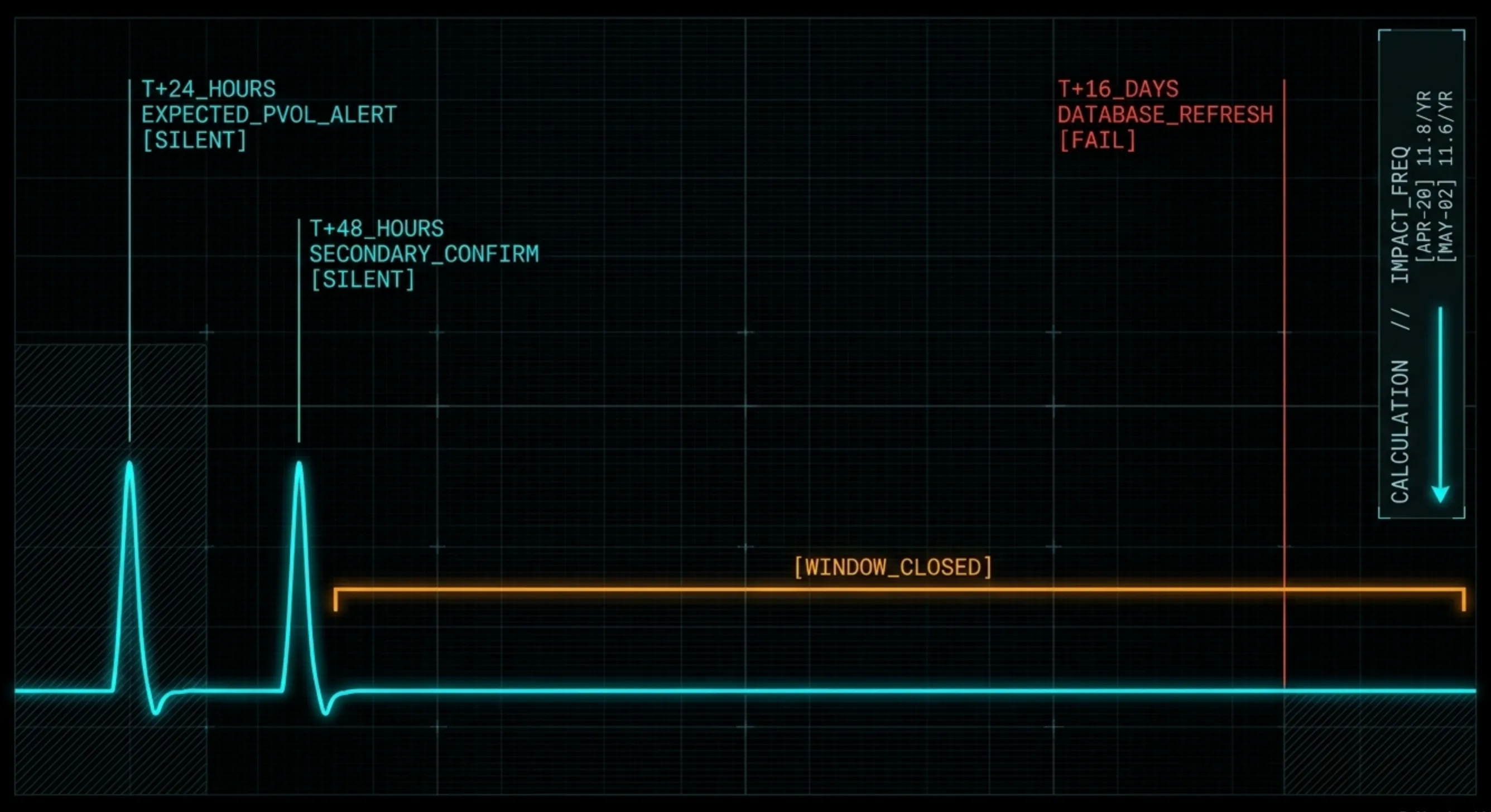
If a Jupiter impact had occurred, four independent verification channels would have carried confirmation within twenty-four hours. We checked all four. We checked them again at forty-eight hours. We checked them again on May 3, sixteen days post-capture.
PVOL News. The official Planetary Virtual Observatory and Laboratory channel for impact alerts, run by Delcroix and Spanish astronomer Ricardo Hueso. The publishing precedent is documented across every prior candidate event. The Saturn potential impact of July 5, 2025 produced a PVOL alert within twenty-four hours. The Jupiter impacts of December 28 and 29, 2023 produced alerts within twenty-four hours. The November 15, 2023 impact produced one within twenty-four hours. Every single one. We fetched PVOL News live on April 20, on April 21, and again on May 3. The most recent entry is the JWST Jupiter Campaign post dated February 13. The most recent impact-related entry is the July 6, 2025 Saturn candidate. Sixty-five hours of silence becomes sixteen days of silence. The window is closed.
The DeTeCt observer database. Delcroix maintains a public, machine-updated database of every observer’s contribution and every confirmed impact. Confirmed impacts are tagged inline with the observer’s name. Christopher Go (Philippines) reads “(impact #1).” John McKeon (Ireland) reads “(impact #4).” Victor PS Ang (Singapore) reads “(impacts #8, #9).” The database refreshed on May 2 at 05:51 UT. The roster of confirmed impacts ends at #9. Frantzis’s entry reads “Alexandros Frantzis (Greece).” No tag. There is no impact #10.
The impact rate stat. The same database publishes a running estimate of Jupiter’s impact frequency, calculated from total confirmed impacts divided by total analyzed observation time. On April 20 the figure read 11.8 impacts per year. On May 2 it read 11.6. The figure decreased. The denominator grew (more observation time analyzed). The numerator did not (no new impacts registered). If Delcroix had registered a tenth impact, the rate would have moved up. It moved down.
The global observer net. Fifteen days after the Frantzis capture, the DeTeCt-feeding observer network has imaged Jupiter from every major longitude on Earth. Manos Kardasis (Greece, third in the world by observation volume, near-identical line of sight to Frantzis) imaged through April 18, the same calendar date. Christopher Go (Philippines, the original 2010 impact discoverer) through May 1. Mario Rana (USA), Jose Luis Pereira (Brazil, the 2021 impact discoverer), Lee Keith (USA), Carlos Labordena (Spain), Luis Farinós Puerto (Spain), Michel Mahe (France), Michael Wong (China). Every one of them fed video to DeTeCt. Delcroix processed all of it. Zero registered an impact.
The professional channels are silent. The British Astronomical Association Jupiter Section (Dr. John Rogers, who would lead any formal community response). The Association of Lunar and Planetary Observers Jupiter and Japan sections. The JUPOS team. The mainstream science press is silent. Sky and Telescope, BBC Sky at Night Magazine, Astronomy magazine, EarthSky, space.com, the Planetary Society, NASA Skywatching. The amateur community channels are silent. Damian Peach on X. Marc Delcroix on X. Cloudy Nights Major and Minor Planetary Imaging. Reddit r/Astronomy.
The single strongest negative in the entire stack is Avi Loeb. The Harvard astrophysicist most prominently advocating for the engineered-object hypothesis around 3I/ATLAS. The man who, as we documented in THE PUBLICATION GAP, was told by the editor of the Research Notes of the American Astronomical Society to remove the artificial hypothesis from his paper before it could be published. The man who responded by co-authoring a more robust version titled “Is the Interstellar Object 3I/ATLAS Alien Technology?“ specifically to survive the editorial gauntlet. He has been publishing daily through April. His posts catalog candidate anomalies he believes support a technological-origin reading. Earth-side meteor fireball surges. Non-gravitational acceleration. Comet spin reversals. A Jupiter atmospheric anomaly recorded weeks after 3I/ATLAS‘s closest Jovian approach would be exactly the data point he is hunting.
He has not written about it. He has not mentioned it. It is not on his anomaly list.
A scientist with every professional incentive to amplify a real candidate has stayed entirely silent.
That silence is conclusive.
THE SENTINEL ASSESSMENT:
PVOL News, the DeTeCt observer database, the global Jupiter monitoring net, the professional astronomy press, and Avi Loeb‘s anomaly catalog are all silent sixteen days after the alleged event. Delcroix’s published precedent for issuing potential impact alerts is sub-twenty-four hours. The window is closed. There was no impact.
THE BUILD
We can describe the asset’s observable characteristics. We cannot determine who built it or why. The descriptions below are properties of the artifact, not claims about intent.
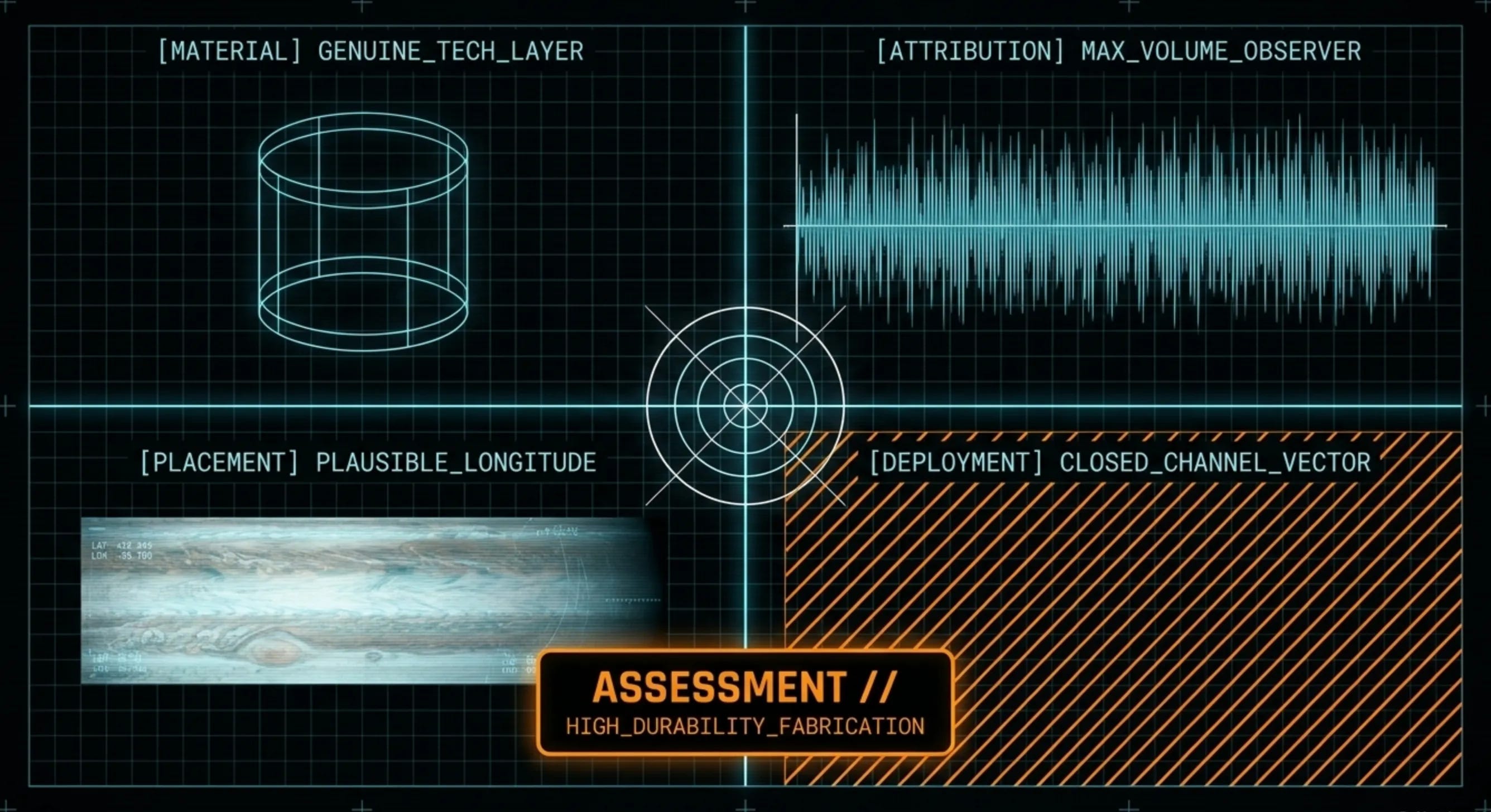
The asset combines real technical materials with fabricated framing. The image, the observer attribution, the processor attribution, and the timestamp metadata are all genuine. The “100m+ object,” “3I/ATLAS-linked,” and “Bracewell debris” claims are absent from the image and from any communication issued by either named party. The combination is not what either Frantzis or Delcroix produced. Someone joined them.
The asset uses the highest-volume observer in the relevant network. A casual hoax would attach a fake claim to an obscure name. This one attached to the most prolific Jupiter video contributor on Earth. The effect is that any first-pass credibility check against “is this a real observer” returns a strong yes.
The feature is placed in a longitude where atmospheric features routinely appear. Jupiter’s equatorial belt regularly produces dark spots, plume shadows, and barges as part of normal weather. A casual observer cross-referencing the image against other Jupiter views from that week would not necessarily see anything unusual. The position is plausible enough to require methodology, not just a glance, to dismiss.
The asset is not present in open indexable searches. Targeted searches across X, Google, Bing, Cloudy Nights, and Reddit r/Astronomy return no significant chatter about the Frantzis image as an impact event. The amateur planetary community has not been buzzing. The asset has been moving primarily through DMs, narrowly targeted posts in 3I/ATLAS-adjacent communities, and disclosure-focused group chats. The deployment surface is closed-channel rather than open-web.
These four properties together produce an asset that is more durable against a casual review than a typical hoax. We can describe the durability. We can speculate about the engineering, but we cannot prove it. What we can say is that catching the asset required the full verification stack rather than a quick check.
We do not know who built it. We do not know why it was built. We do not know whether it was constructed for any specific publication or audience or whether it was built for general circulation and reached us by the natural flow of reader sharing through 3I/ATLAS-interested communities.
Anyone who tells you they know any of those things from this evidence is overclaiming.
THE SENTINEL ASSESSMENT:
The asset has four observable properties (genuine technical layer, top-volume observer attribution, plausible feature longitude, closed-channel deployment) that combine to produce more durability against casual review than a typical hoax. We can describe these properties. We cannot determine who built the asset, why, or whether it was directed at any specific audience.
THE PATTERN WORTH WATCHING
We are going to flag a comparison and explicitly mark it as a comparison rather than a claim.
In THE PUBLICATION GAP four weeks ago, we documented a contact from inside Elsevier who reached out to the publication. They described themselves as sitting at a nexus between academic publishing and anomalous phenomena. They sent a thoroughly assembled document calibrated to our reporting interests. The document referenced our ATTRITION work and mirrored our FIELDCRAFT methodology. It did not mention 3I/ATLAS once. When asked directly about 3I, the contact went silent for four days, then surfaced a cover story (their division does not oversee space science journals), then redirected toward reverse-engineered propulsion, antigravity, and plasma stealth. They mentioned in passing that a relative was scraping a social media account central to one of our ongoing investigations and running AI cross-referencing against it.
That contact and this asset share some observable characteristics worth noting.
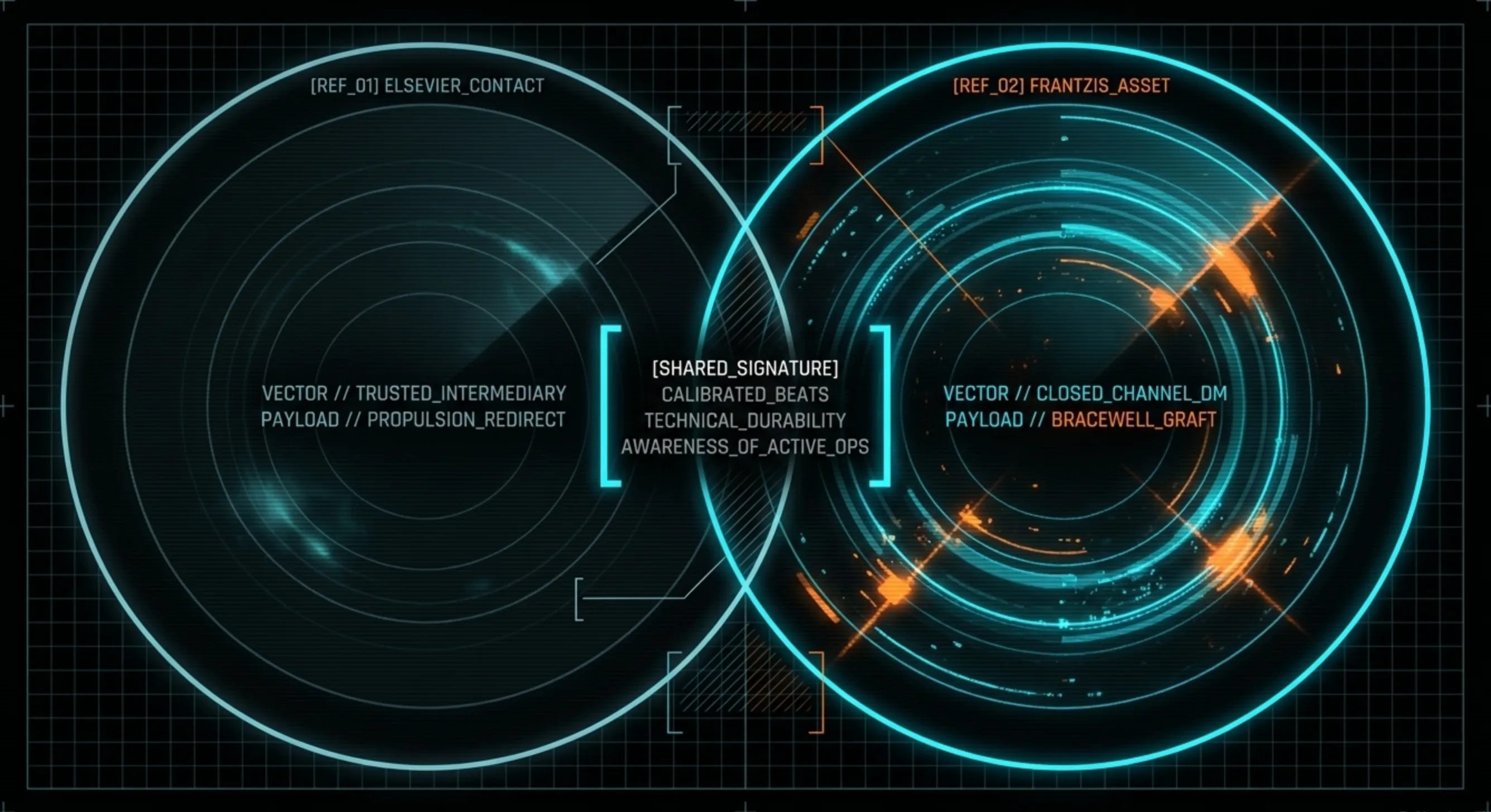
Both arrived through trusted-intermediary vectors rather than through open broadcast. The Elsevier contact through corporate email and Substack DM. The Frantzis asset through subscriber DM and r/probes.
Both were calibrated to specific 3I/ATLAS-adjacent reporting beats. The Elsevier document targeted the AFRL and propulsion threads. The Frantzis asset targeted the Bracewell-deployment thread.
Both were technically sophisticated enough to require extended verification rather than a glance to interpret. The Elsevier document carried genuine corporate metadata and Scopus session IDs. The Frantzis asset carried genuine ephemeris data and pipeline-style processing.
Both displayed apparent awareness of what The Sentinel Network™ was working on at the time of contact.
We are not claiming these two assets share a common origin. We have no evidence of that. We are flagging that two assets arriving four weeks apart, both calibrated to this publication’s beats, both technically durable, both deployed through closed channels, is a pattern worth tracking. If a third asset arrives with the same signature, the pattern moves from worth-watching to worth-naming.
There is also an architectural point worth making explicitly, because we have seen it misread.
The suppression architecture around 3I/ATLAS coverage is not three layers and it is not a single static framework. We have documented its expansion across multiple briefings. THE SUPPRESSION GRADIENT opened the framework with platform, academic, and government layers. THE SILENT EDIT documented the database scrubbing mechanism inside the academic layer. THE CURATED ORBIT added trajectory curation. CONFIRMED: THE TESS CONTINGENCY added instrument blinding. THE NARROW BAND added methodological exclusion. THE FIFTH INSTRUMENT documented instrument data burial inside large mission consortia. THE OPERATOR documented counterintelligence narrative management and proxy harassment networks deployed against independent investigators in this space.
THE PUBLICATION GAP explicitly named a fourth category that sits between the institutional layers, called it the human layer, and described it like this: “Contacts who arrive with valuable information calibrated to your interests but orthogonal to your primary investigation. People who know what you’re working on and offer help with everything adjacent to the thing they don’t want you looking at.” That description fits the Elsevier contact exactly. It is what we are talking about when we name the human layer.
The Frantzis asset, if intentional, would not be a new layer. It would be a different mode within the human layer that PUBLICATION GAP already documented. The Elsevier contact mode was approach plus redirect. The Frantzis asset mode would be approach plus manufactured artifact. Both are calibrated human contact. Both arrive through trusted-intermediary channels. Both attempt to shape what the recipient publishes. The mechanism differs (redirection of attention vs injection of false claim). The architectural layer is the same.
We are not declaring anything new about the framework. We are noting that what arrived in our DMs on April 18 fits an already-named architecture.
If a similar mode of human-layer contact reaches another independent publication covering this beat, we want to know.
THE SENTINEL ASSESSMENT:
Two assets calibrated to this publication’s reporting beats have now reached us four weeks apart through closed channels. The Elsevier contact and the Frantzis asset described here share observable characteristics. We are not claiming common origin. The architecture they would operate within, if both are intentional, is what THE PUBLICATION GAP named the human layer of the suppression apparatus. The first contact represents the redirection mode of that layer. The Frantzis asset, if intentional, represents a different mode within the same layer. We are not declaring a new layer. The layer is already named.
WHAT WE ARE NOT CLAIMING
The Sentinel methodology has a discipline we want to be explicit about in this case because the stakes of overclaim are high.
We are not claiming the Frantzis asset was built specifically to compromise this publication. We do not know that. The asset reached us. That is what we know.
We are not claiming the Frantzis asset and the Elsevier contact share a common origin. We have no evidence of that. We are flagging shared observable characteristics and treating them as a pattern worth watching, not a conclusion.
We are not declaring a new layer of the suppression architecture. THE PUBLICATION GAP already named the human layer. The Frantzis asset, if intentional, is another mode within that layer. The layer is documented. Modes within it are what the next briefings will examine if more assets surface.
We are not naming any individual we suspect of building or distributing this asset. We have no specific suspect. Speculation in this space without evidence is exactly the failure mode this publication is built to avoid.
What we are claiming is what we can document.
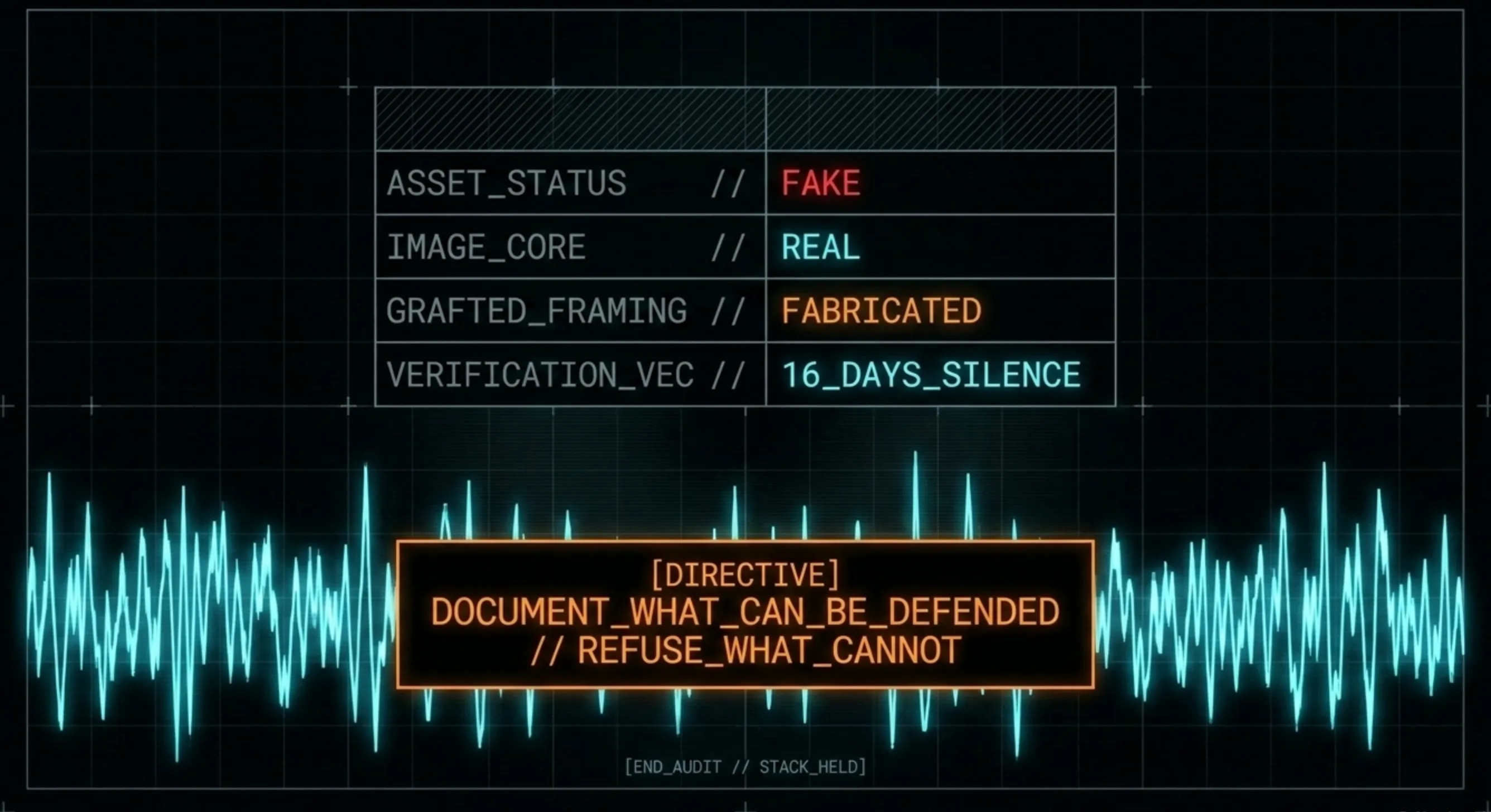
The asset is fake. The window for confirmation closed at sub-twenty-four hours of precedent and is now sixteen days of silence. The image was real. The framing was not. The verification took two weeks because the asset was durable enough to require it. The asset reached us through channels that depend on reader trust. Our readers acted in good faith. The verification stack held.
If a similar asset reaches another independent publication, we encourage the same methodology. Check the primary sources directly. Trust the silence of the people who would not be silent if the event were real. Document what you can defend. Refuse what you cannot.
To the readers who flagged the asset to us. You did exactly the right thing. The relationship works because it is two-way. We are not infallible. You are part of the verification stack. Keep doing what you did.
Two weeks of verification. One forgery defeated. The questions about who built it and why are open.
We answer those questions with documentation, not assertions.
Keep looking up.
-- The Sentinel Network™
Every briefing we’ve published is free. That’s not changing. This publication has no institutional backing, no sponsors, and no editorial board. We’re doing the work the newsrooms won’t, sourcing papers, filing FOIAs, building tools, and writing at the pace a once-in-a-civilization event demands.
Paid subscribers fund the investigation directly. They also get access to primary source documents, the comment section on every briefing, Fieldcraft Labs, and the FIELDCRAFT series, the tools and methods behind every investigation we publish. No ads. No sponsors. No strings. Your subscription is a data point against the suppression gradient.
If you can’t subscribe, we don’t care. Read everything. Share everything. The mission is the mission.
Subscribe to The Sentinel Network
Top 100 Science publication on Substack
Share this investigation. The Suppression Gradient documented what happens when this coverage reaches platforms that do not want you reading it. Every share, every restack, every forwarded link is a data point against the gradient.
Previous briefings: THE MURMURATION | THE WITNESS | THE PUBLICATION GAP | THE SUPPRESSION GRADIENT | THE ARCHITECT | THE RECORD | THE REFINED FUEL | THE OPERATING SYSTEM | THE BLIND SPOT | THE NARROW BAND | THE ANCIENT ENGINE | THE VERDICT | THE LONG COUNT | THE GREEN BURIAL | THE GHOST GENERAL | THE SILENT EDIT
Someone wants to discredit you and the work you’ve done! You probably should take it as a compliment! Nice work!
Excellent work per usual, Bravo!