


DATE: FEBRUARY 20, 2026
SUBJECT: ANALYSIS OF SCARMATO & LOEB (2026) // JET WOBBLE PERIODICITY OF 3I/ATLAS
CROSS-REF: [THE SENTINEL DOSSIER] | [THE SURGE] | [THE THREE DAYS OF DARKNESS] | [THE GHOST COMA]
CLEARANCE: PUBLIC
WHAT JUST DROPPED
A new paper from Avi Loeb and Italian observer Toni Scarmato hit yesterday. They took Hubble Space Telescope images of 3I/ATLAS from late November through late December 2025, ran them through a specialized filter that strips away the circular glow around the nucleus, and studied what was left underneath.
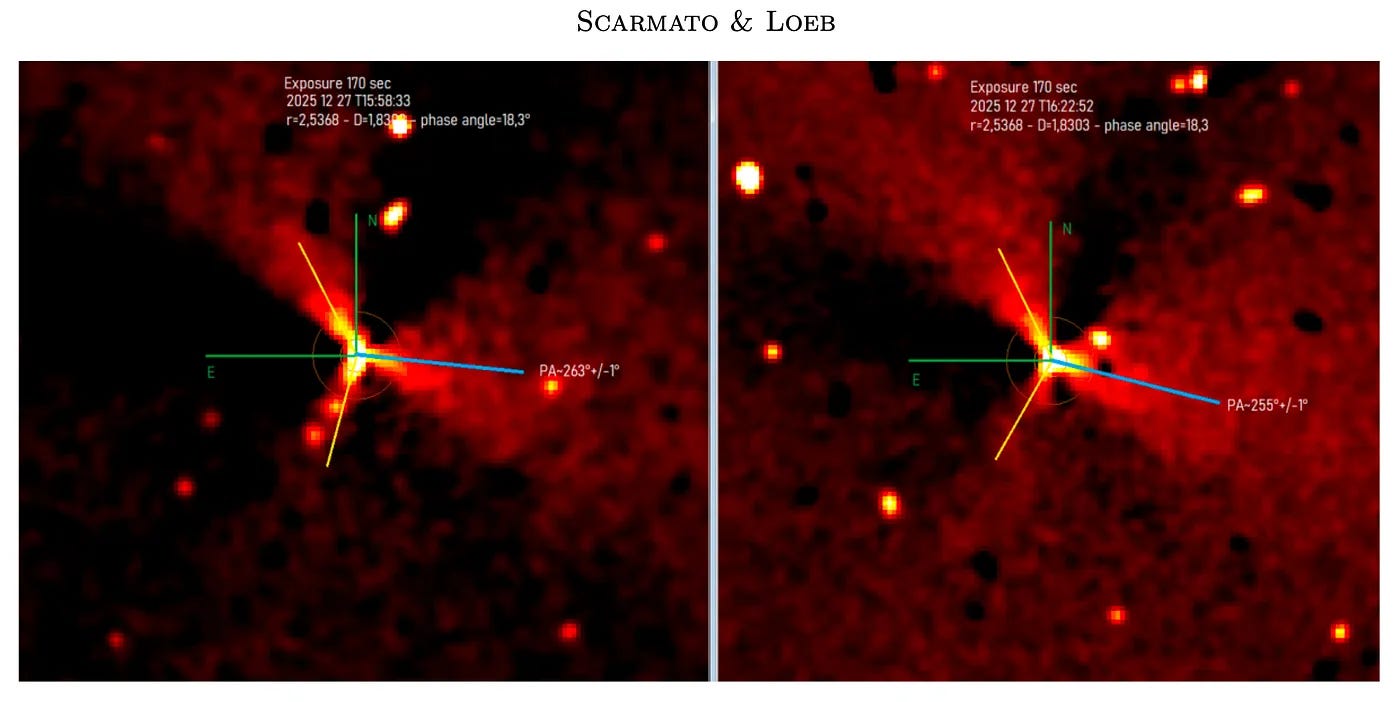
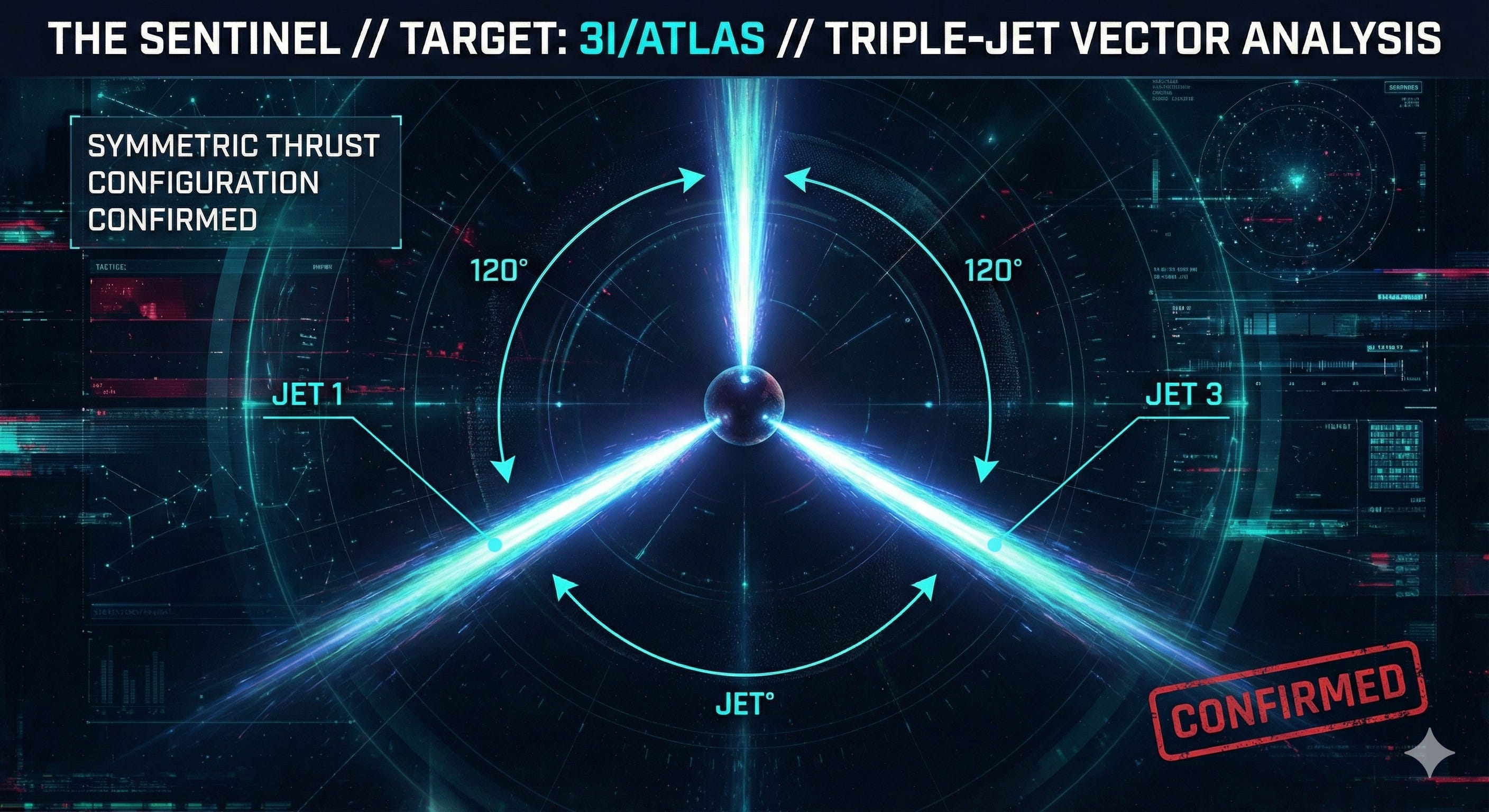
What was left is the triple-jet system — the three jets separated by exactly 120 degrees that we called a hallmark of Reaction Control Systems.
They already knew the jets were there. What they didn’t know — until now — is that the jets have a heartbeat.
And that the hull is nearly invisible behind them.
THE INVISIBLE HULL
Before we get to the wobble, there’s a detail on page 1 of the paper that landed like a brick.
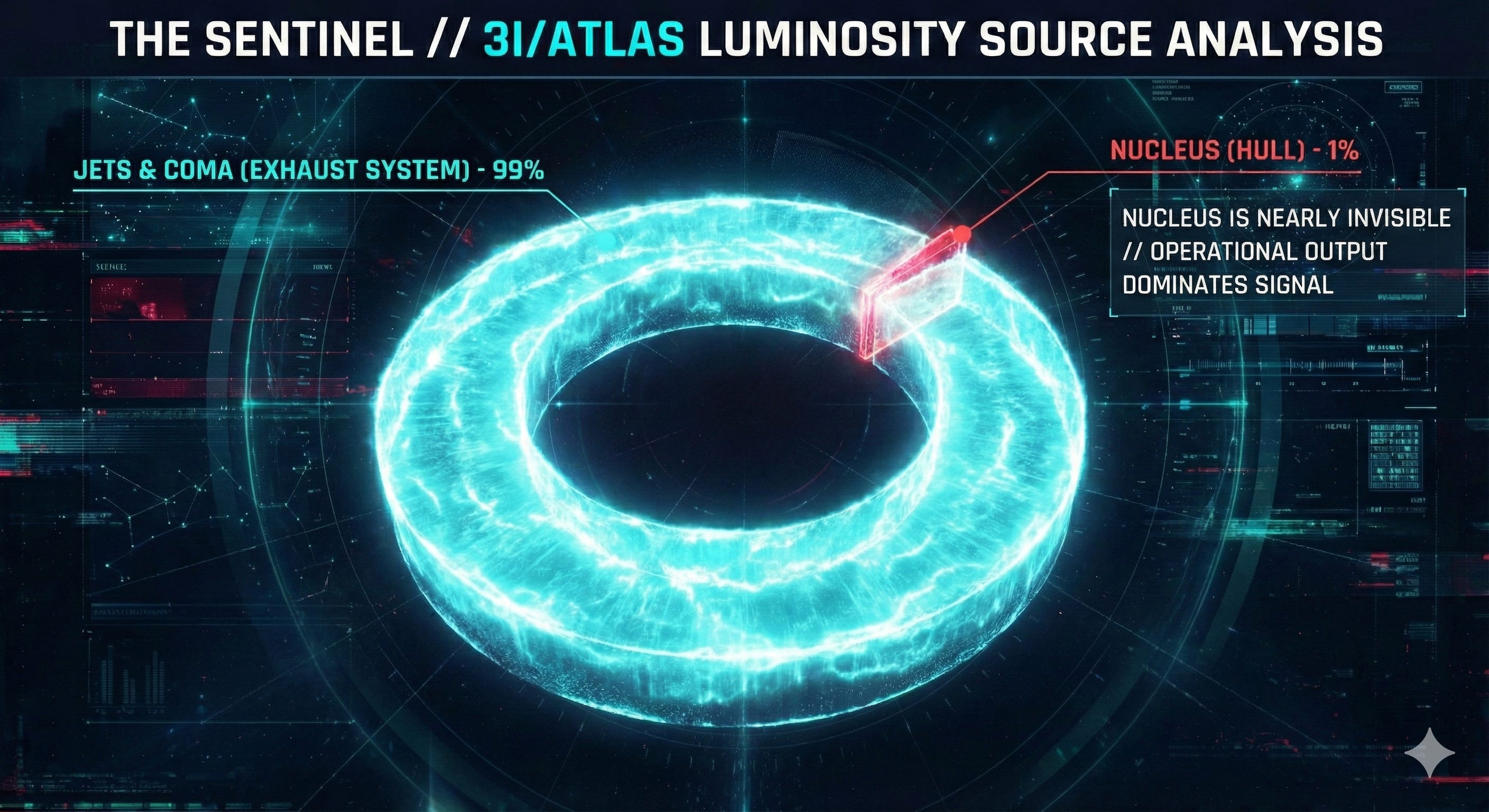
The authors note that based on the estimated size of 3I’s nucleus — about 2.6 kilometers across — only about one percent of the object’s total brightness comes from sunlight reflecting off its surface. One percent. The other 99% is the jets and the coma.
Think about what that means. When you look at 3I/ATLAS through a telescope, you are not looking at a comet. You are looking at an exhaust system. The object itself — the hull, the body, whatever it is — is almost completely hidden behind the output of its own jets.
We flagged this pattern in The Ghost Coma: 80-90% of the water isn’t coming from the surface. Now Scarmato and Loeb have quantified the visual version of the same finding. The nucleus is a rounding error in its own brightness. Everything you see is the operational output.
For any comet enthusiast reading this: when has a cometary nucleus ever been this invisible relative to its own coma at these distances? The object is 2.6 kilometers wide. It should be contributing meaningfully to the signal. Instead, it’s buried. Hidden behind what the establishment calls “outgassing” and what the data increasingly suggests is something else entirely.
THE WOBBLE
Every jet around 3I/ATLAS is oscillating. Not randomly. Not chaotically. On a clock.
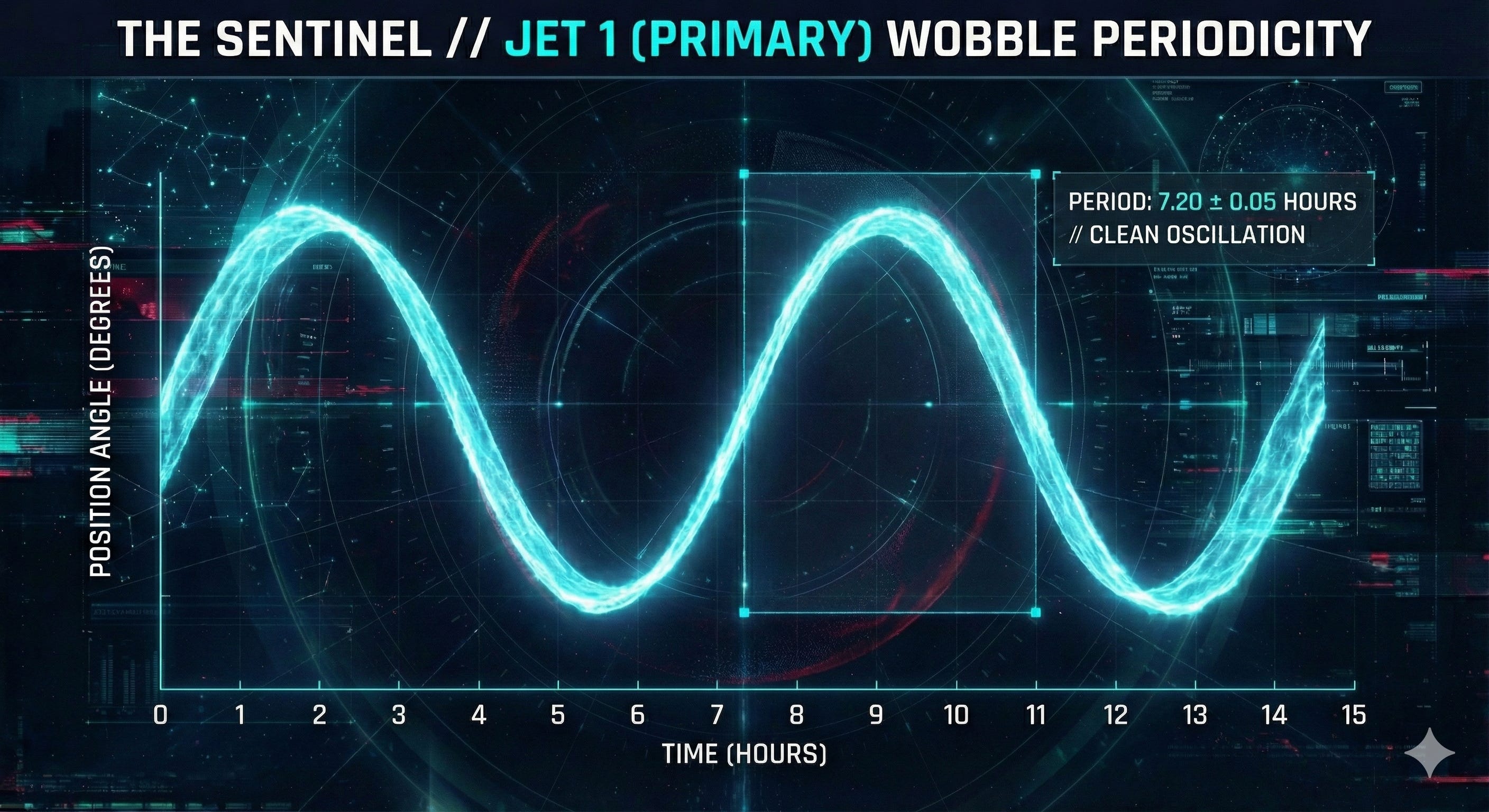
The most prominent jet — the one pointing away from the Sun, the one we identified as the primary thrust vector — wobbles back and forth with a period of 7.20 ± 0.05 hours. Like a searchlight slowly sweeping left and right, completing one full cycle every 7.2 hours. The angular sweep is about 20 degrees in each direction.
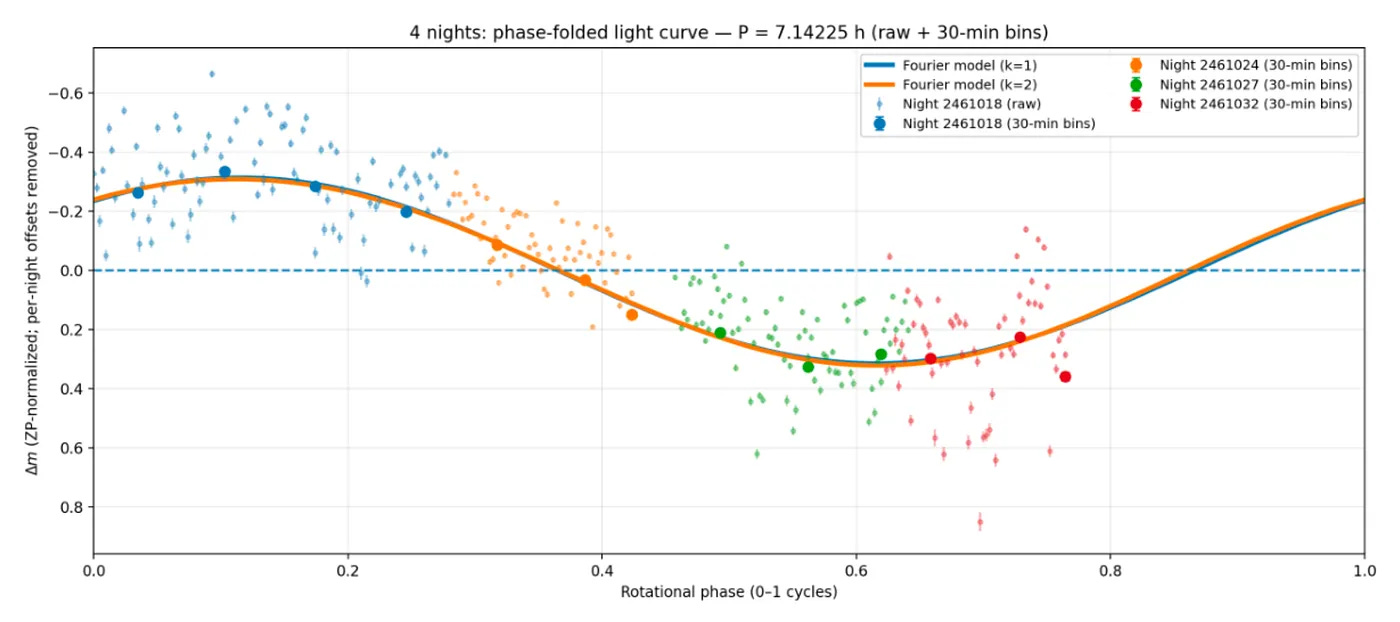
The authors confirmed this period using two completely independent methods. First, they measured the jet’s position angle directly from Hubble images. Then they measured the object’s brightness from a ground-based telescope in Italy. Both methods converge on the same number: ~7.2 hours. Two different instruments, two different techniques, one signal.
That alone is notable. Cometary jets on a tumbling body should be messy. Uneven outgassing from a rough, irregular surface spinning through space creates chaotic, unpredictable patterns. You don’t get a clean oscillation with a period measurable to within three minutes unless the system producing it has structural regularity.
But that’s not the finding that stopped us cold.
THE HARMONIC LOCK
There are three jets. Each one wobbles. Each one has its own period.
Jet 1 (the primary anti-sunward jet): 7.2 hours
Jet 2: 2.9 hours
Jet 3: 4.3 hours
Now do the arithmetic.
2.9 + 4.3 = 7.2
The periods of the two secondary jets sum exactly to the period of the primary jet.
The authors are careful here — they note that the sub-periods could be “aliases/harmonics or feature-specific responses” rather than independent spin periods. Fair enough. But look at the word they used. Harmonics. Even in their cautious framing, they’re describing a coupled oscillatory system — three signals locked in a mathematical relationship.
Think about what it would take for nature to produce this. You’d need three separate vents on an irregularly shaped, tumbling iceberg to independently evolve wobble periods that happen to satisfy an exact arithmetic relationship. Not approximately. Exactly. The measured periods are 2.911 and 4.299 hours. Their sum is 7.210. The primary jet’s measured period is 7.20 ± 0.05.
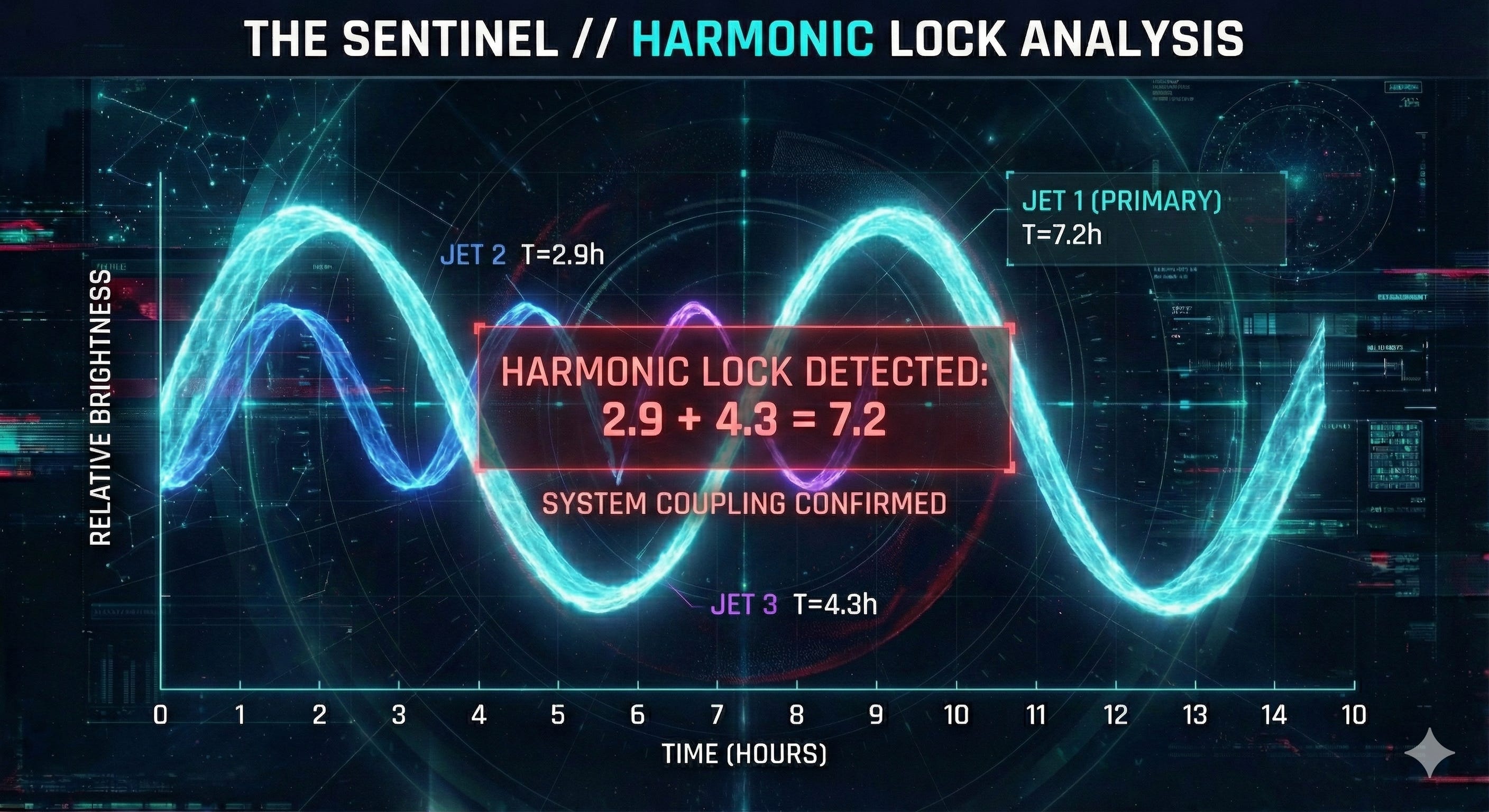
That’s not a coincidence. That’s a resonance. Whether you call it a harmonic artifact or a coupled oscillation, the three jets are behaving as a single linked system.
Nature doesn’t tune three independent cracks in a rock to a shared frequency. Engineering does.
THE NOZZLE PROBLEM — AGAIN
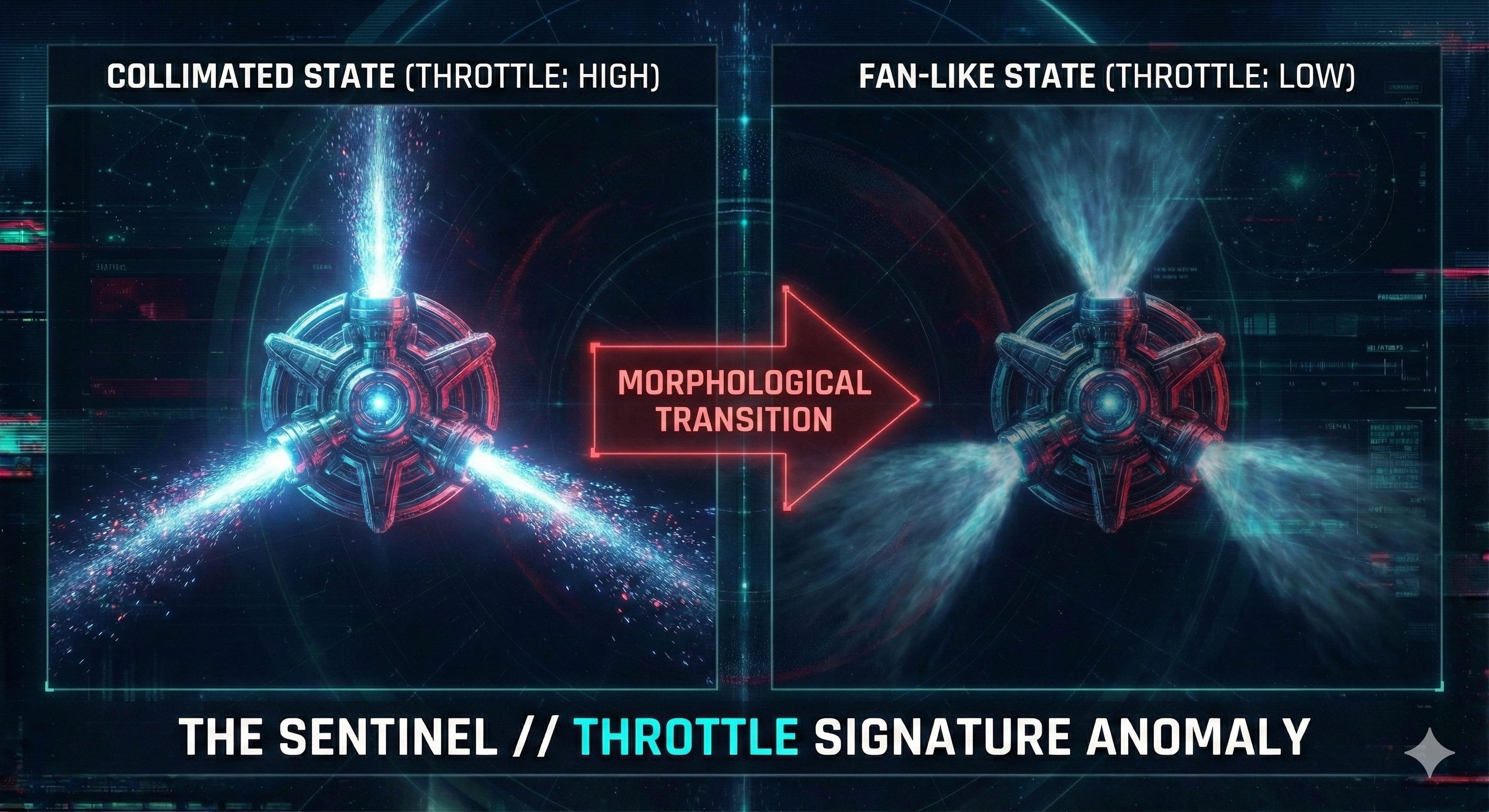
We flagged this in the original Dossier and again in The Three Days of Darkness: the jets of 3I/ATLAS are collimated. They stay tight. On a body rotating every several hours, outgassing should spiral outward like water from a spinning garden hose. Instead, the jets hold their shape for millions of kilometers.
This new paper adds another layer to that problem.
Scarmato and Loeb found that the jets transition between collimated and fan-like morphologies on each wobble cycle. In some Hubble frames, a jet appears as a tight beam. In the next set of frames — taken hours later — the same jet has opened into a wider fan. Then it tightens back up.
The jets aren’t just wobbling. They’re breathing. Opening and closing on a rhythmic cycle.
The total brightness of 3I/ATLAS varies by about 33% in sync with these morphological transitions — a swing of 0.311 magnitudes. When the jets tighten, the object gets brighter. When they fan out, it dims.
And here’s the part the paper states outright, in Section 5.3, that most readers will skim past:
If the brightness variation came from a lumpy rock rotating and catching sunlight at different angles, the signal wouldn’t change based on what size telescope aperture you use. But it does change. The large-aperture measurements degrade when the jets go fan-like. The signal depends on how much of the jet structure your instrument captures.
The authors are telling you, directly, that the brightness variation is not a nucleus shape. It is the jets. The light curve of 3I/ATLAS is not tracking a rotating rock. It is tracking the collimation state of the exhaust system.
Their words:
“The brightness variability tracks transitions between collimated and fan-like morphologies of the jets.”
The light curve is a throttle signature.
THE MODE CHANGE
There’s a moment in the data where the system shifts.
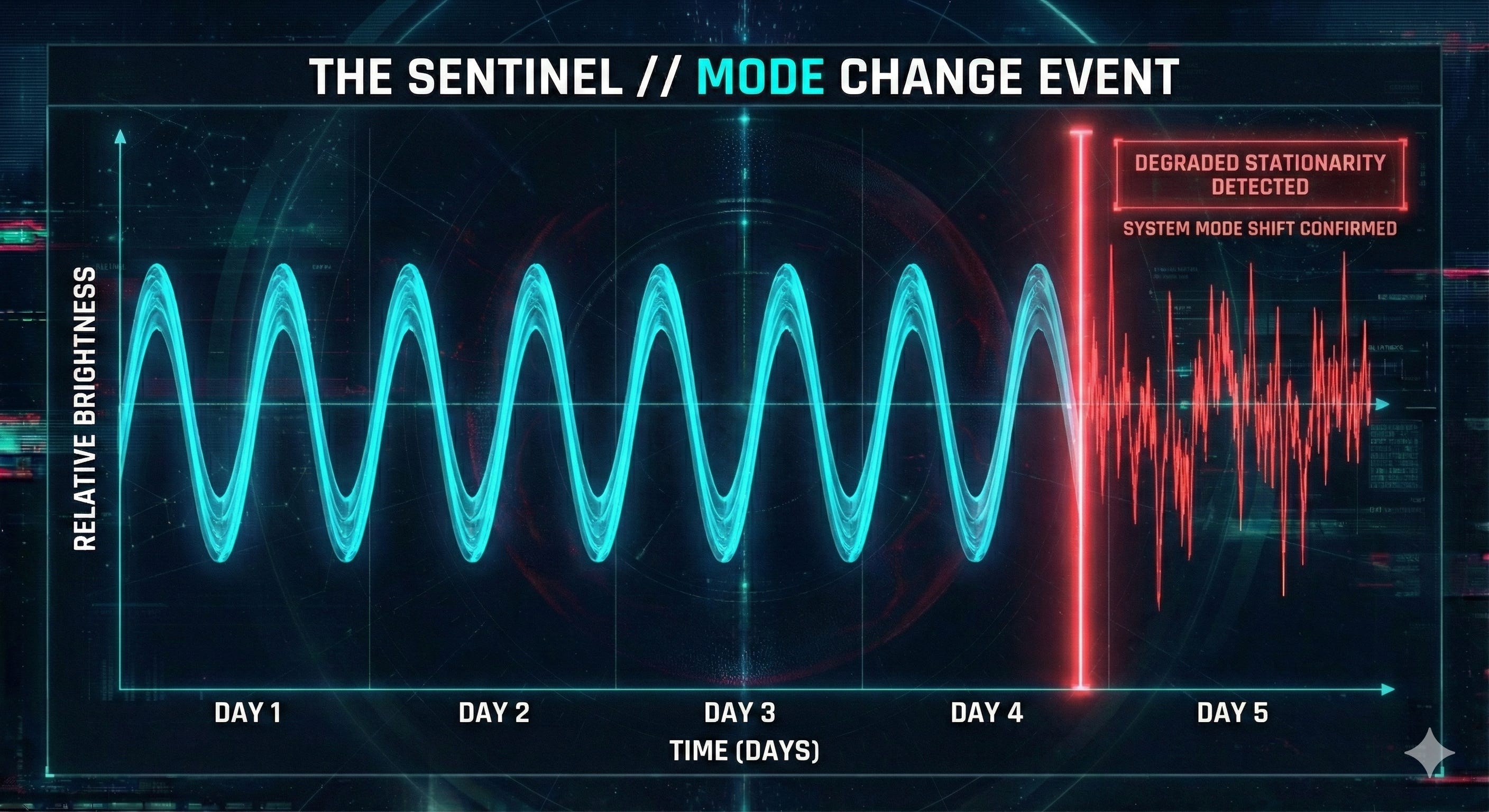
The team collected photometric data across five nights in December 2025. When they analyze the first four nights, the signal is clean — a strong, coherent 7.1-hour period with consistent phase across nights. The data folds beautifully.
Then they add the fifth night — December 27, 2025.
Everything breaks.
The phase coherence degrades. The preferred period shifts slightly. The clean waveform gets noisy. The authors describe this as “degraded stationarity” and attribute it to the jets transitioning to fan-like morphology on that date. Figure 4 in the paper shows the Hubble images side by side: the jets on December 27 have visibly opened up compared to earlier dates. The tight beams have become wide fans.
THE SENTINEL ASSESSMENT:
The system changed its operating mode. For four nights, the jets held a consistent collimation pattern — tight beams sweeping on a clean 7.1-hour cycle. On the fifth night, they opened up. The throttle setting changed. The rhythm shifted.
The authors frame this as “evolving coma morphology.” We frame it as what the data shows: a system that maintained one configuration for days, then switched to another. Not a gradual transition. A step change, visible in a single night’s imaging.
Comets evolve. They crack, they spin, they shed. But they don’t hold a tight operational pattern for four days and then cleanly switch modes on the fifth. Systems do.
THE SLOW DRIFT
Buried in Section 4.4 is a detail that deserves its own headline but doesn’t get one.
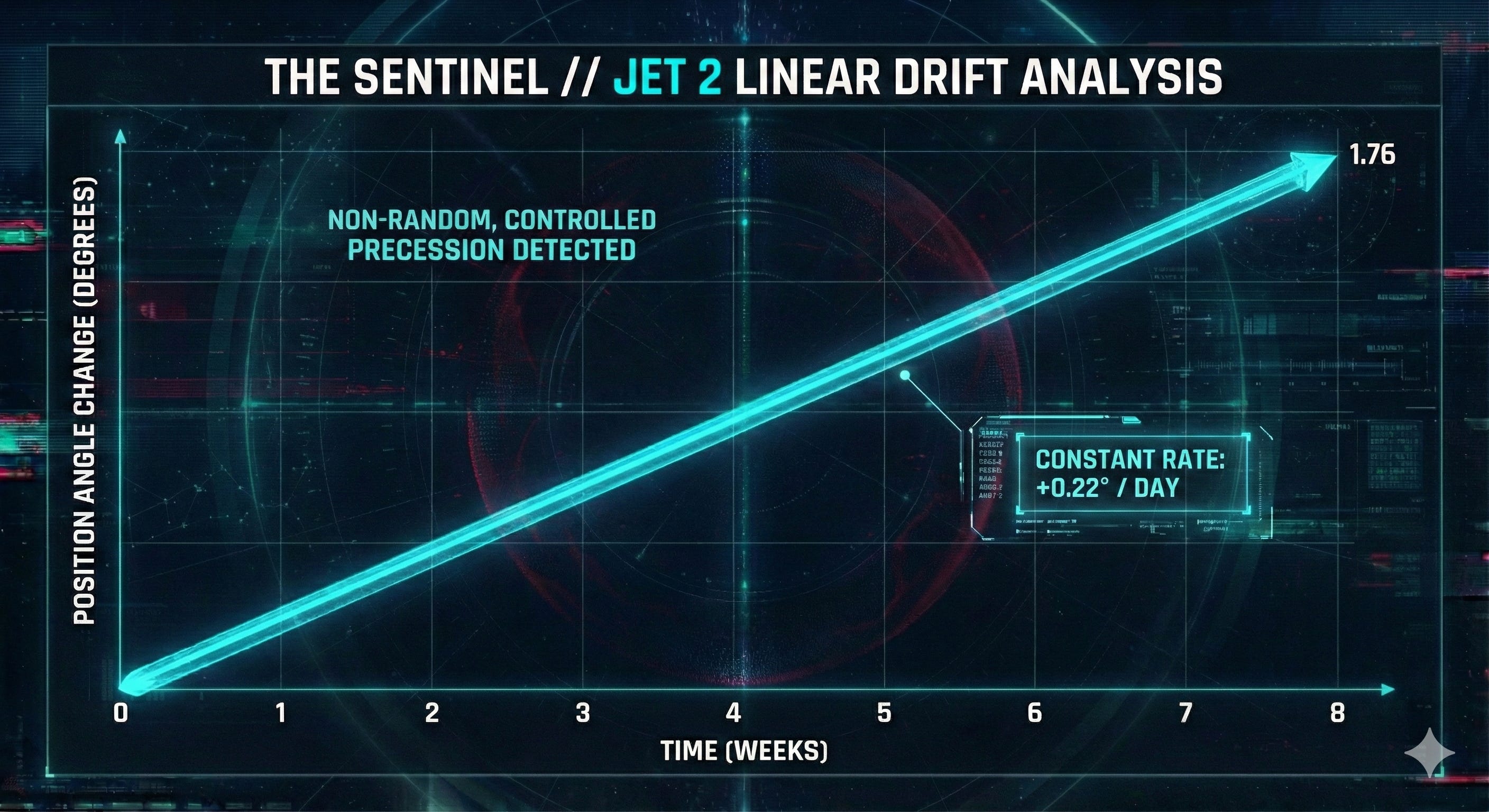
Jet 2 — one of the secondary jets — has a measured linear drift in its position angle of 0.22 degrees per day. Not a random walk. Not an erratic bounce. A steady, linear change in pointing direction, tracked over weeks of observations.
Think about what “linear drift” means on a natural body. If a vent on a tumbling rock is shifting direction, the change should be erratic — driven by chaotic thermal fracturing, uneven sublimation, rotational torques pulling every which way. You’d expect jitter, not a ruler-straight line on a graph.
A linear drift is what you get from a system whose pointing is changing slowly and steadily. A controlled precession. A gradual course adjustment. The kind of thing a navigation system does when it’s updating its orientation over time.
The authors fit the drift as a simple linear term in their mathematical model and move on. They don’t comment on what would cause a natural vent to change direction at a perfectly constant rate. Because within the cometary model, there’s no clean answer.
THE GYROSCOPE
There’s a detail in this paper that the casual reader will skip but that anyone who’s studied spacecraft attitude control will recognize immediately.
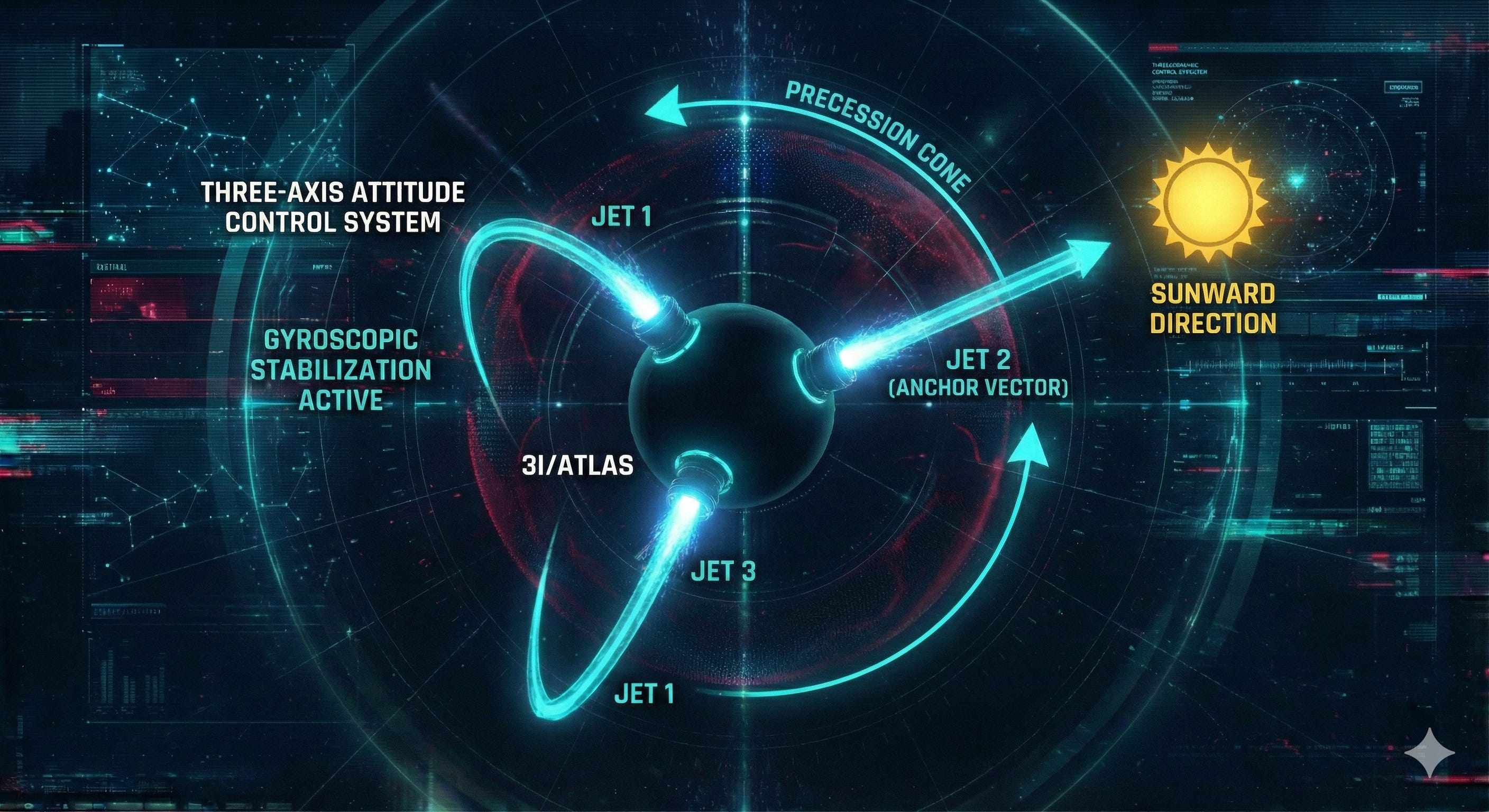
The three jets don’t just happen to be arranged at 120-degree intervals. They stabilize each other.
From the paper:
“Multiple active sources can partially cancel net outgassing torques, helping to keep the angular-momentum direction relatively stable in inertial space.”
And:
“Jet 2 — which is oriented approximately opposite to the Sun and close to the projected rotation axis — anchors the large-scale geometry, whereas Jets 1 and 3 trace the precession cone through their position angle oscillations.”
Read that in plain English. One jet acts as the anchor — holding the geometry steady along the sunward axis. The other two jets trace out a cone around it, wobbling in sync, maintaining the overall orientation of the system.
This is textbook three-axis attitude control. One thruster holds the primary vector. Two secondary thrusters manage precession and nutation around that vector. The whole system maintains pointing stability while the body rotates underneath it.
It’s the same architecture used on every spacecraft humanity has ever built that needs to hold a fixed orientation while rotating. The geometry isn’t arbitrary. It’s the minimum configuration for rotational stability with directional control.
And the rotation axis? Aligned with the sunward direction to within 20 degrees.
Ask yourself: why would a random interstellar rock, tumbling through space from another star system, have its rotation axis pointed at our Sun? It wouldn’t. There’s no physical mechanism that preferentially aligns an interstellar interloper’s spin axis with the host star.
But a spacecraft performing a solar survey would point itself at the Sun. And it would use exactly this kind of three-jet architecture to hold that pointing.
It’s not tumbling. It’s stabilized.
THE LINE HE PUT IN PRINT
Every Loeb paper on 3I ends with a careful statement that leaves the door open. But this time, in his accompanying analysis, he put it in terms that can’t be walked back:
“The fundamental question that remains unresolved is whether the symmetric triple-jet system is a signature of technological thrusters or the sublimation of natural pockets of ice on the surface of a natural rocky iceberg.”
That is Avi Loeb — the former chair of Harvard’s astronomy department, director of the Institute for Theory and Computation, former Presidential science advisor — placing “technological thrusters” as an equal-weight hypothesis alongside the natural explanation. Attached to Hubble data.
He’s not speculating. He’s not hedging. He’s saying: the data is consistent with both, and we currently cannot distinguish between them.
The establishment will focus on the second half of that sentence. They’ll say “natural pockets of ice” and close the tab.
We focus on the first half. Because the data earned it.
THE STACK
For those keeping score, here’s what the triple-jet system now looks like when you lay every observation on top of each other:
From the Dossier (December 2025): Three jets separated by exactly 120 degrees. Symmetric. Collimated. Maintained on a rotating body.
From The Three Days of Darkness (January 2026): The jets were active and morphologically evolving during the opposition window that TESS conveniently missed.
From The Ghost Coma (February 2026): 80-90% of the water around 3I isn’t coming from the surface. The nucleus is quiet. The surrounding field — which the jets feed into — is doing the work.
From today: The hull is invisible — 99% of the light is the exhaust. The jets wobble on precise, harmonically coupled periods. They breathe between collimated and fan-like states. One jet anchors the sunward orientation while two manage attitude stability. The pointing drifts at a steady 0.22 degrees per day — not erratic, linear. The system held a clean operational pattern for four days, then switched modes on the fifth. And the brightness tracks the throttle state, not the shape of a rock.
Eighteen anomalies in the Dossier. We’re now well past that number. And every new paper that drops — even the ones trying to call it a comet — adds to the pile.
It’s not outgassing.
It’s a propulsion system with a heartbeat, pointed at the Sun, hiding behind its own exhaust.
Keep looking up.
— The Sentinel
Subscribe to The Sentinel for further analysis on 3I/ATLAS and the countdown to the March 16 Jupiter Intercept.
So we got buzzed by a space probe with intelligence. Are they waiting for us to die to land, or will a planet eating resource gathering machine show up? If an intelligent entity is capable of intergalactic travel, we don't want ANYTHING to do with it. We are germs on a wet bumpy rock that can't figure out how to keep from dying.
There’s the proof that will begin disclosure.
The President and Steven Spielberg seem to be on the same page about it.
Now we wait for them to tell us what the majority of the planet already knows…. There is life throughout the entire universe.