

SUBJECT: AUTONOMOUS MONITORING PIPELINES // RSS AGGREGATION, CHANGE DETECTION, SCHEDULED SCRAPERS, ALERT ROUTING, FAIL-SAFE DESIGN
DATE: MAY 16, 2026
CROSS-REF: FIELDCRAFT SERIES | FIELDCRAFT #004 — THE RAW DATA | THE SILENT EDIT | THE PUBLICATION GAP
DATA CONFIDENCE: VERIFIED (every tool referenced is publicly accessible; every technique is reproducible)
This is the ninth installment of FIELDCRAFT. The briefings give you the intelligence. FIELDCRAFT gives you the tradecraft.
Why You Need a Watchtower
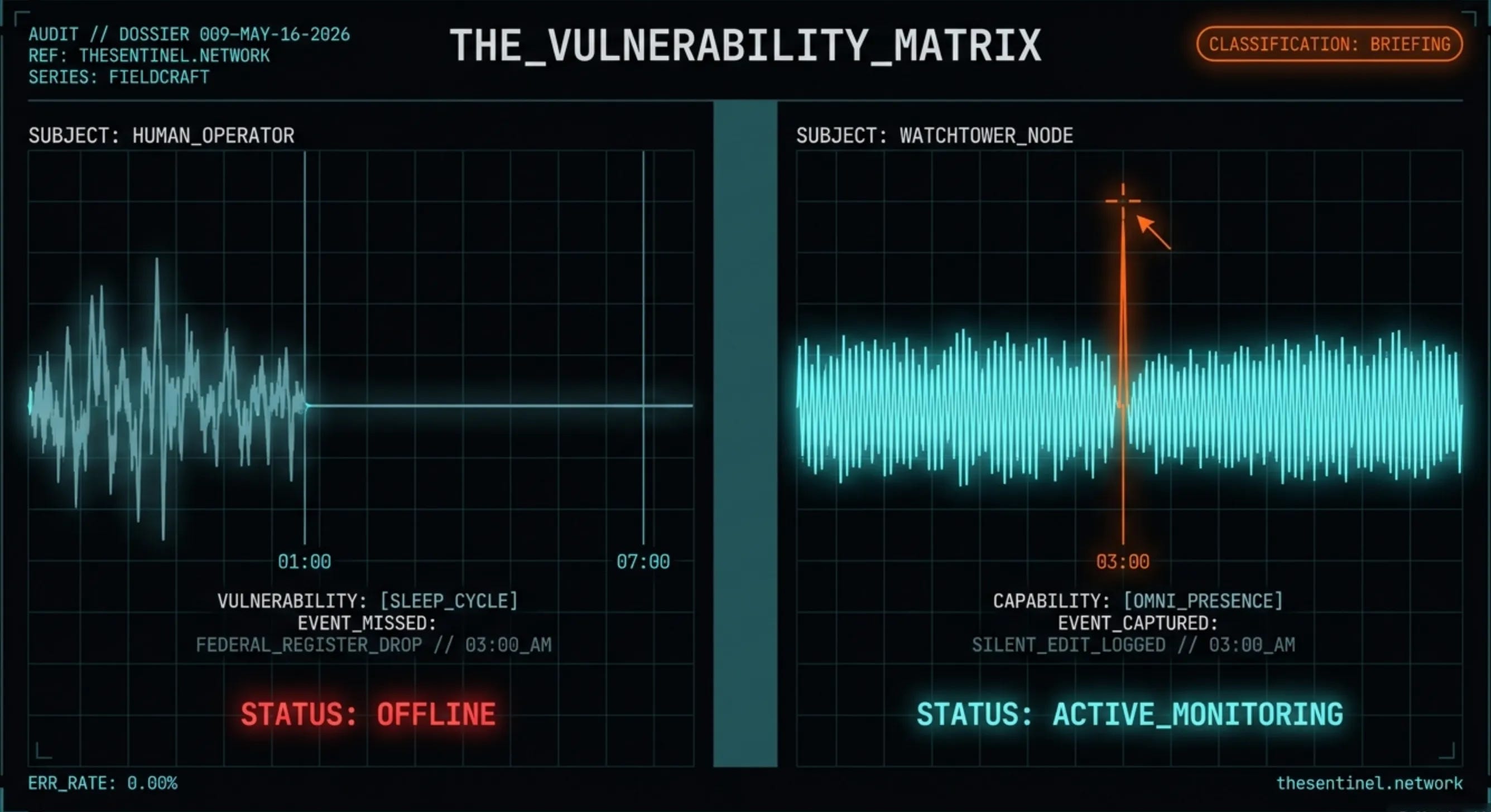
Every investigation in this series has assumed you are sitting at a keyboard, actively pulling records, reading papers, and running queries. That model has a limit. You sleep. You eat. You step away. While you are not at the keyboard, the world does not stop publishing. Press releases drop at 3 AM. Database entries get edited on weekends. Preprints post on Sunday evenings at 8 PM Eastern. Federal Register notices appear during business hours, but you are not always in front of a feed when they do.
The work the Watchtower does is the work you cannot do manually. It checks. It compares. It alerts. It runs while you are not looking.
This installment teaches you how to build a monitoring pipeline that runs without supervision. Not a single tool. A layered system. Four layers, each handling a different category of signal. By the end, you will have an architecture that watches the records you care about, flags changes the moment they happen, and routes those flags to a channel you check on your own schedule.
The cost is low. The setup time is one weekend. The return is every story you would have missed.
