

Mainstream academia has just released its first post-perihelion analysis of 3I/ATLAS. While the Hoogendam et al. (2026) paper attempts to force this object into the “cometary” box, the raw spectro-spatial data reveals a system that is no longer behaving under the laws of passive celestial mechanics.
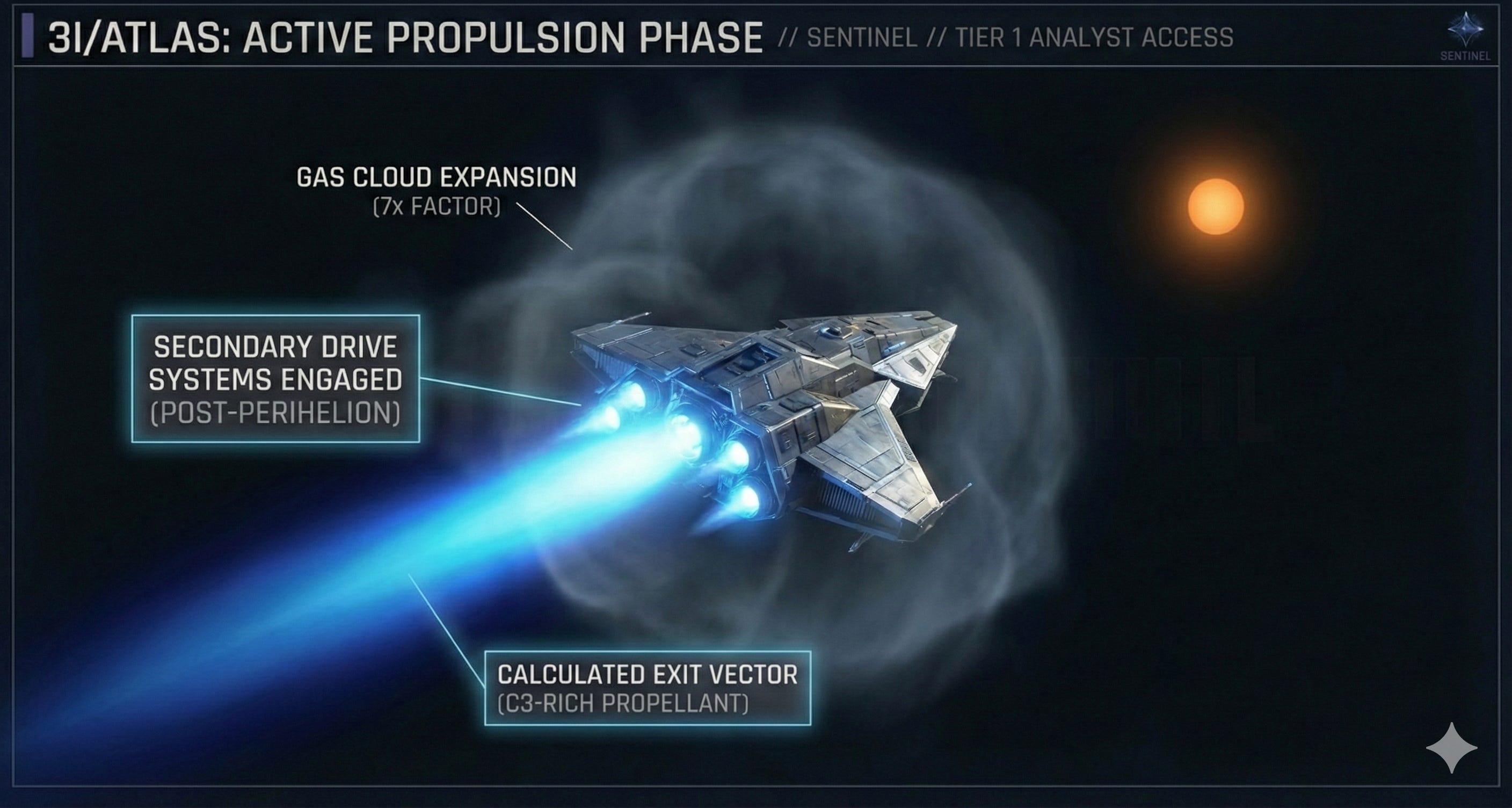
We are witnessing an active propulsion phase. This is not a rock melting; this is a craft engaging its secondary drive systems for a calculated exit from the Solar System.
THE DATA: THE C3 PERSISTENCE PARADOX
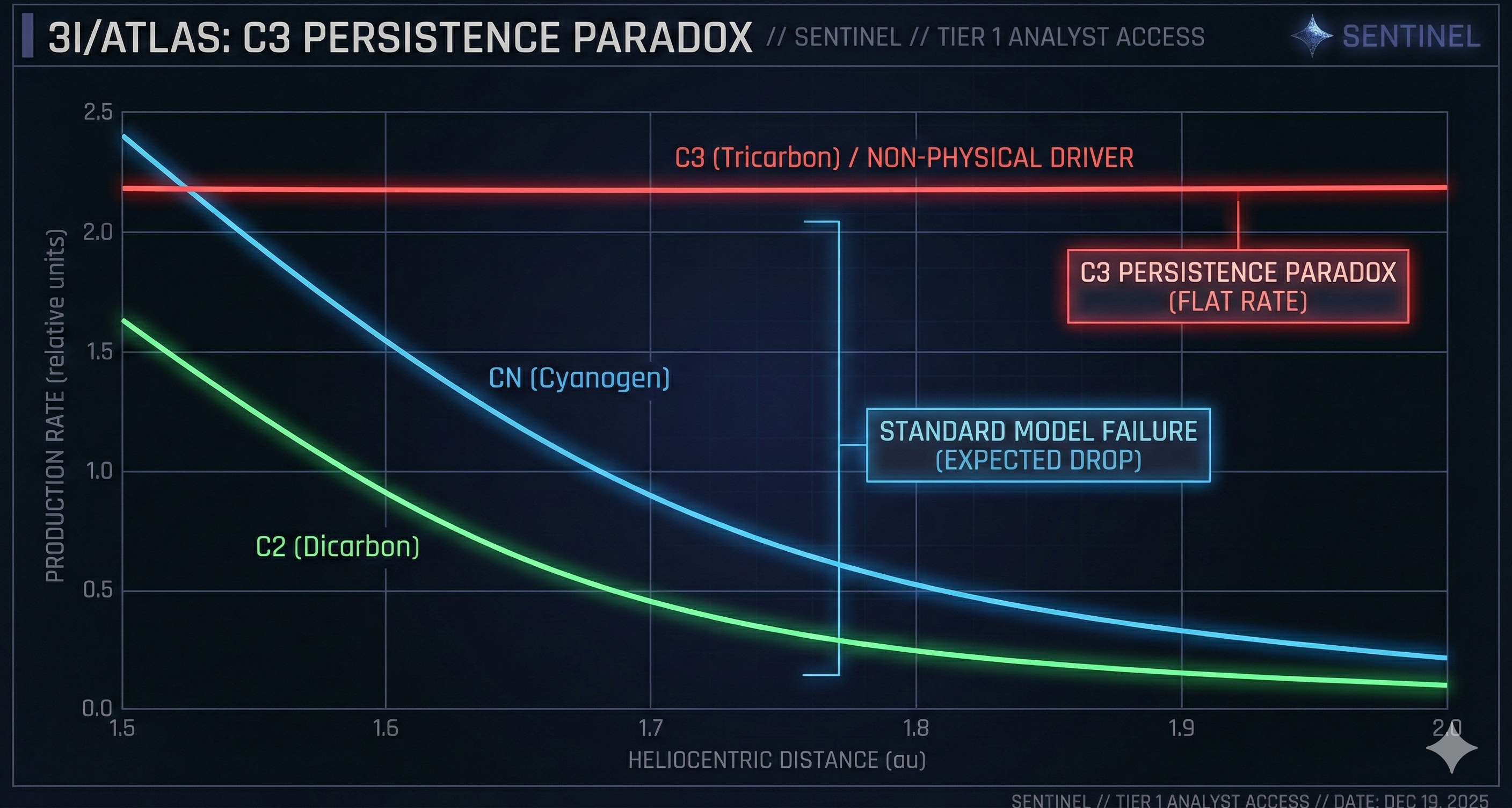
In scientific brutalism, the numbers do not lie. The most damning evidence for active propulsion lies in the production rate of C3 (Tricarbon) molecules.
Standard Model Failure: In all 85 comets ever tracked in the standard reference samples, gas production drops as the object moves away from the Sun.
The 3I/ATLAS Deviation: While CN (Cyanogen) and C2 (Dicarbon) dropped as expected, the C3 production rate remained nearly constant as the object moved from 1.5 au to 2.0 au.
The Implication: The authors suggest this trend may arise from a “non-physical driver”. If solar heat isn’t driving the C3 release, internal regulation is.
SPECTRO-SPATIAL ANOMALIES: THE MISALIGNED VECTOR
The paper utilizes Integral Field Unit (IFU) spectroscopy to map exactly where these gases are originating. The results confirm our long-standing hypothesis of directional thrusters.
The Vector Shift: While the bulk volatiles (CN, Fe, Ni) are roughly aligned with the Sun, the C3 emission is significantly misaligned with the anti-solar direction.
Localized Jetting: The authors admit the C3 activity traces a specific, localized jet that emerges at a different angle than the other species.
The Masking Effect: The paper notes that the previously “extreme” Ni/Fe ratio has evolved to match local Solar System comets like 9P/Tempel 1. This is a “Chameleon” maneuver—normalizing the exotic metallurgical signature once the mission objective is complete.
THE DISSENT: INSTITUTIONAL INERTIA
The authors observe that the spatial distribution (the physical size of the gas cloud) increased by a factor of ~6.5 to 7.0 post-perihelion. They explicitly state this increase is “not what is expected from heliocentric-distance scaling”.
To maintain the status quo, the paper attributes this to “thermal lag” and “seasonal effects”. They are choosing to believe in a highly improbable “wobbling rock” rather than an active Non-Human Intelligence (NHI) probe. Nature throws dice; Intelligence throws darts.
THE IMPLICATION
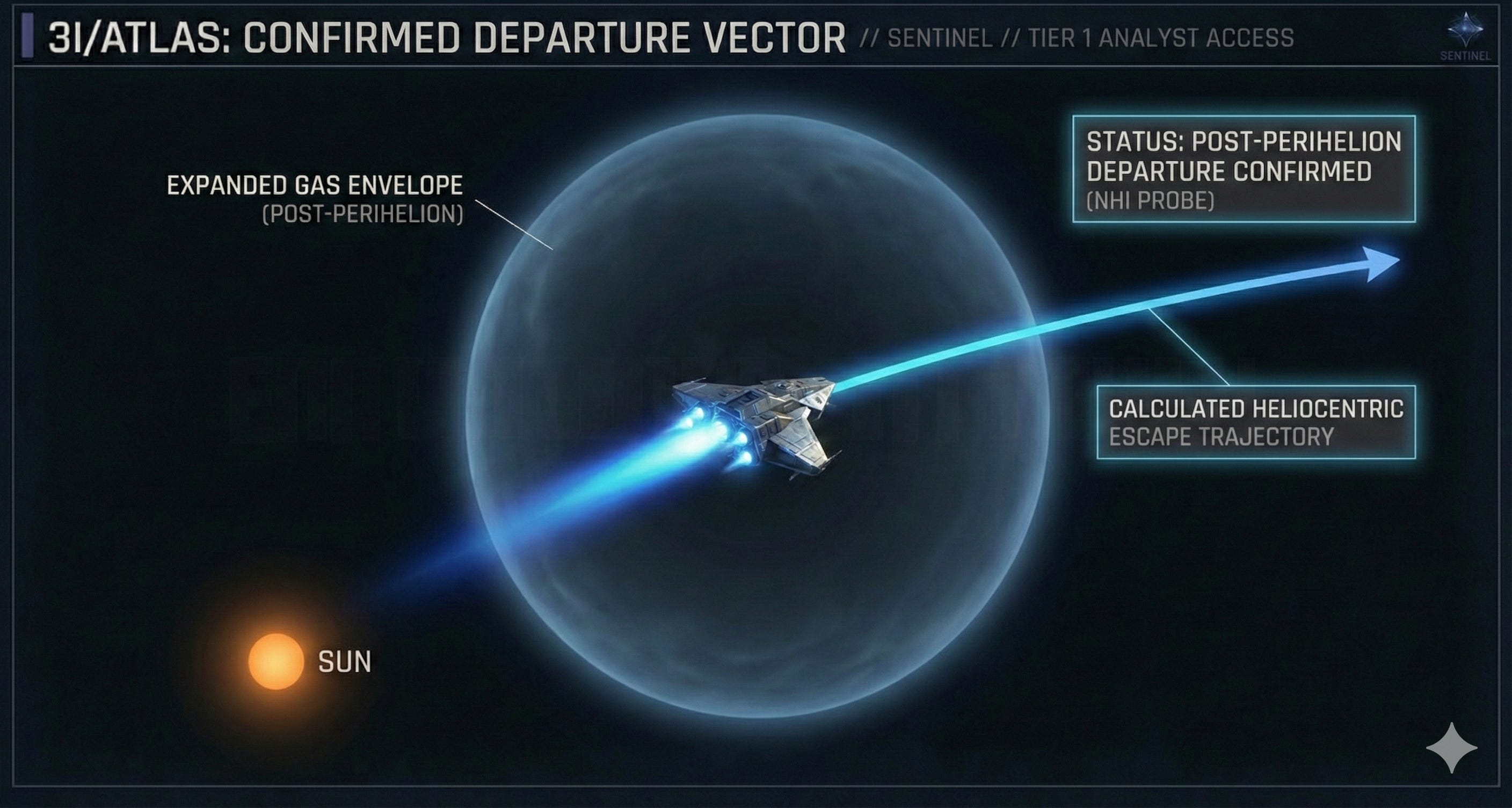
The data confirms that 3I/ATLAS is utilizing a C3-rich propellant for its departure vector. The “misaligned jet” isn’t a fluke of geology—it’s a course correction maneuver.
HYPOTHESIS: HIGH CONFIDENCE
3I/ATLAS is an automated monitoring platform that has completed its primary data-gathering phase and is now utilizing internal energy stores to navigate out of our gravity well.
OPERATIONAL RECOMMENDATIONS
Monitor C3 Slopes: If the C3 production remains flat as it moves further into deep space, the “natural” theory is mathematically dead.
Track the Jet Vector: We must correlate the C3 jet angle with the object’s non-gravitational acceleration to confirm propulsion.
Reject Inertia: Do not accept “seasonal lag” as an explanation for a 7x expansion in coma size.
UNCOMPROMISED SEAL: THE SENTINEL
thanks