

DATE: MARCH 26, 2026
SUBJECT: COMBINED FORENSIC ANALYSIS OF ARXIV:2603.20445 (ROTH ET AL. 2026a, IN REVIEW AT NATURE ASTRONOMY) | ARXIV:2603.20460 (ROTH ET AL. 2026b, SUBMITTED TO APJ LETTERS)
CROSS-REF: [THE VERDICT] | [THE ANCIENT ENGINE] | [THE WEIGH-IN] | [THE GHOST COMA] | [THE CURATED ORBIT] | [THE HEARTBEAT] | [THE IGNITION SEQUENCE] | [THE SENTINEL DOSSIER] | [THE DECEMBER INTERSECTION] | [THE NARROW BAND]
DATA CONFIDENCE: VERIFIED (JWST NIRSpec, NASA Planetary Spectrum Generator, SUBLIME coma model, ALMA radio measurements) + HYPOTHESIS (Sentinel mechanical analysis)
THE DEAD THEORY
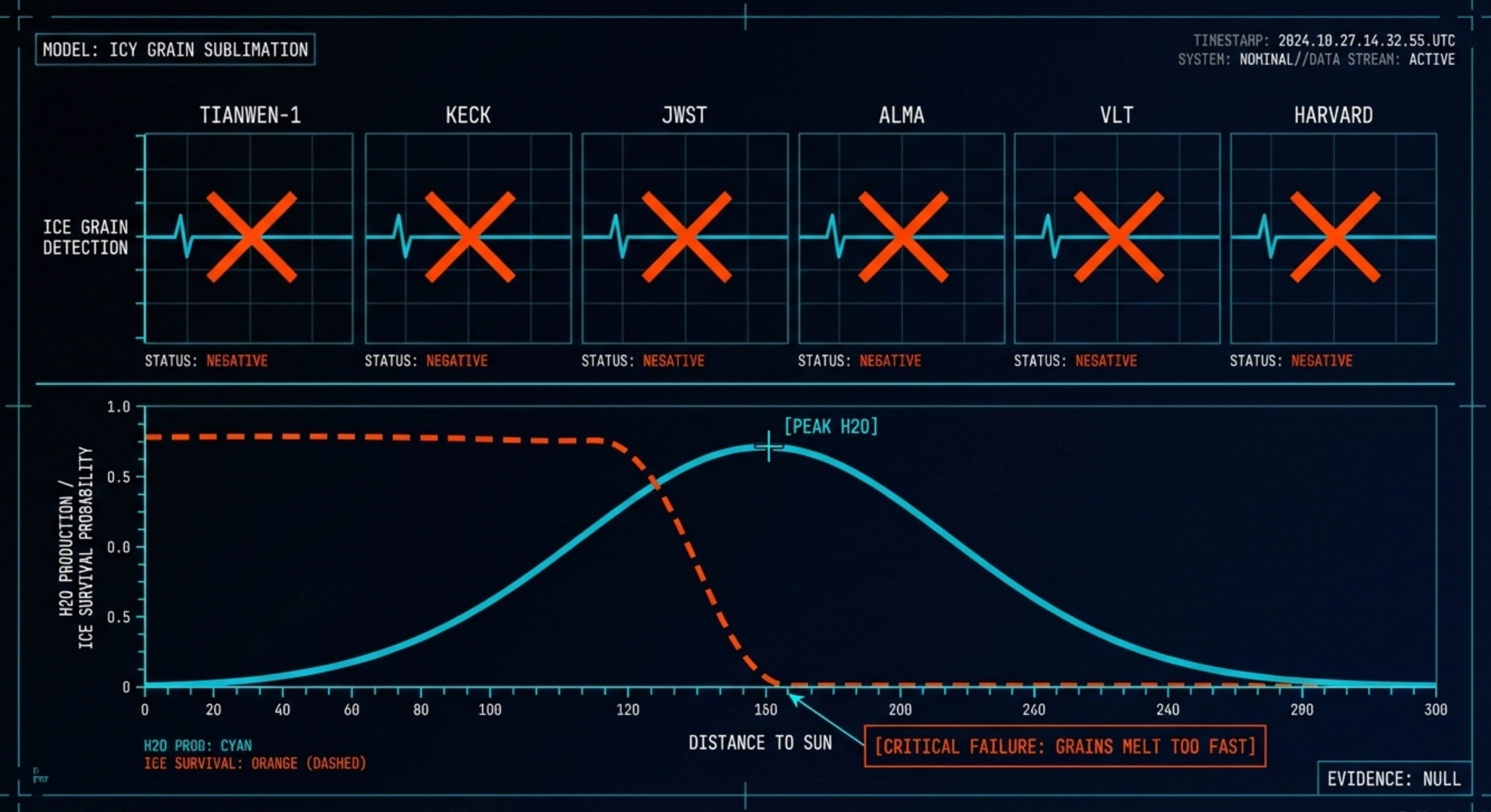
On March 17, we published The Verdict. Twenty-eight briefings. Fifty-seven anomalies. One conclusion: the icy grain theory is dead.
China killed it. They repurposed a Mars orbiter to image 3I from below the orbital plane. At perihelion, when water production was at its absolute peak, the signature of ice grains melting in the cloud vanished. Gone. The grains melt too fast to survive that close to the Sun. If they cannot survive, they cannot be the thing producing water. Separately, Hawai’i’s Keck telescopes spent six months scanning for any trace of water ice in 3I’s cloud. Found nothing. At any point.
Six teams. Six instruments. No ice grains detected. Ever. The one explanation every paper used to explain how 80 to 90 percent of 3I’s water comes from thousands of kilometers away from the surface has no physical evidence at the moment it matters most. We documented every step of this across The Ghost Coma, The Ignition Sequence, The Wide Angle, The Weigh-In, and The Verdict.
Three days later, on March 20, two papers landed from the same team at NASA Goddard. Same lead author: Nathan Roth. Same JWST observations from December 22 and 23, 2025. Same telescope. Same three nights. They split the results into two papers because one was not enough to contain what they found.
Paper one measures the heavy hydrogen content of the methane. In review at Nature Astronomy. Paper two maps the entire cloud around 3I molecule by molecule, pixel by pixel. Submitted to The Astrophysical Journal Letters.
Both papers are extraordinary. Both papers end the same way: the models do not work.
And both papers use the dead theory as their primary explanation.
Paper two says the water distribution building outward from the nucleus is “consistent with production from extended sources such as icy grain sublimation.” Paper two says the dark side of the object is hotter than the sunlit side because grains ejected into the tail heat up and release gas as they drift.
Neither paper cites the Tianwen-1 data that killed the ice signature at perihelion. Neither paper cites the Keck data showing six months of zero ice detections.
The only natural explanation for the ghost coma was killed by China and Hawai’i. Three days later, NASA published two papers standing on top of it. The foundation is not there.
What is there is the most detailed picture of 3I’s cloud ever produced. And when you strip away the explanation that does not work, what the maps actually show is something we have been describing for months.
SENTINEL ASSESSMENT:
We are not accusing anyone of misconduct. Papers take months to write. The Tianwen-1 and Keck results were published while these papers were likely in final preparation. That is how science works. Timelines overlap.
But the reader needs to know: every time these papers say “icy grain sublimation,” that phrase points at a mechanism with no surviving physical evidence. The explanation for the water distribution, the explanation for the heating, the explanation for the extended source, all of it rests on grains that six teams looked for and nobody found.
What replaces it is the question. These maps are the answer.
FIVE DIRECTIONS
Think of a building with five different exhaust systems. The kitchen vent points one direction. The HVAC blows another. The plumbing vents straight up. The parking garage exhaust goes out the side. The emergency sprinklers push water in every direction at once.
If you stood outside that building with a thermal camera, you would see five different heat signatures going five different directions. You would not confuse it with a campfire.
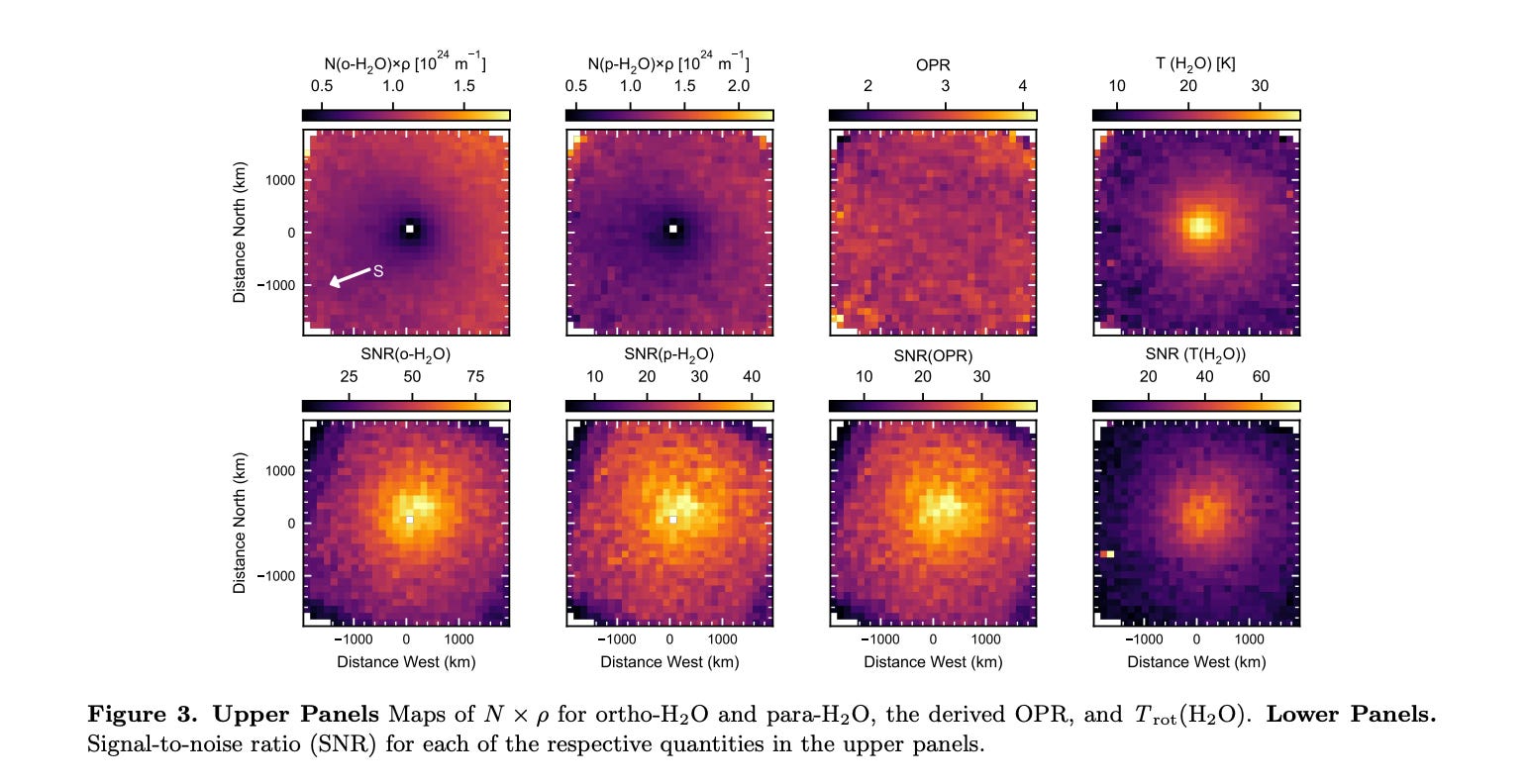
Roth’s team took the JWST data and instead of pulling a single reading from the center, they went pixel by pixel across the entire field of view. Each pixel covers roughly 130 kilometers at 3I’s distance. They mapped where each molecule is, how much of it there is, and how hot it is. Separately. For five different chemicals.
Here is what five exhaust systems look like on an interstellar object.
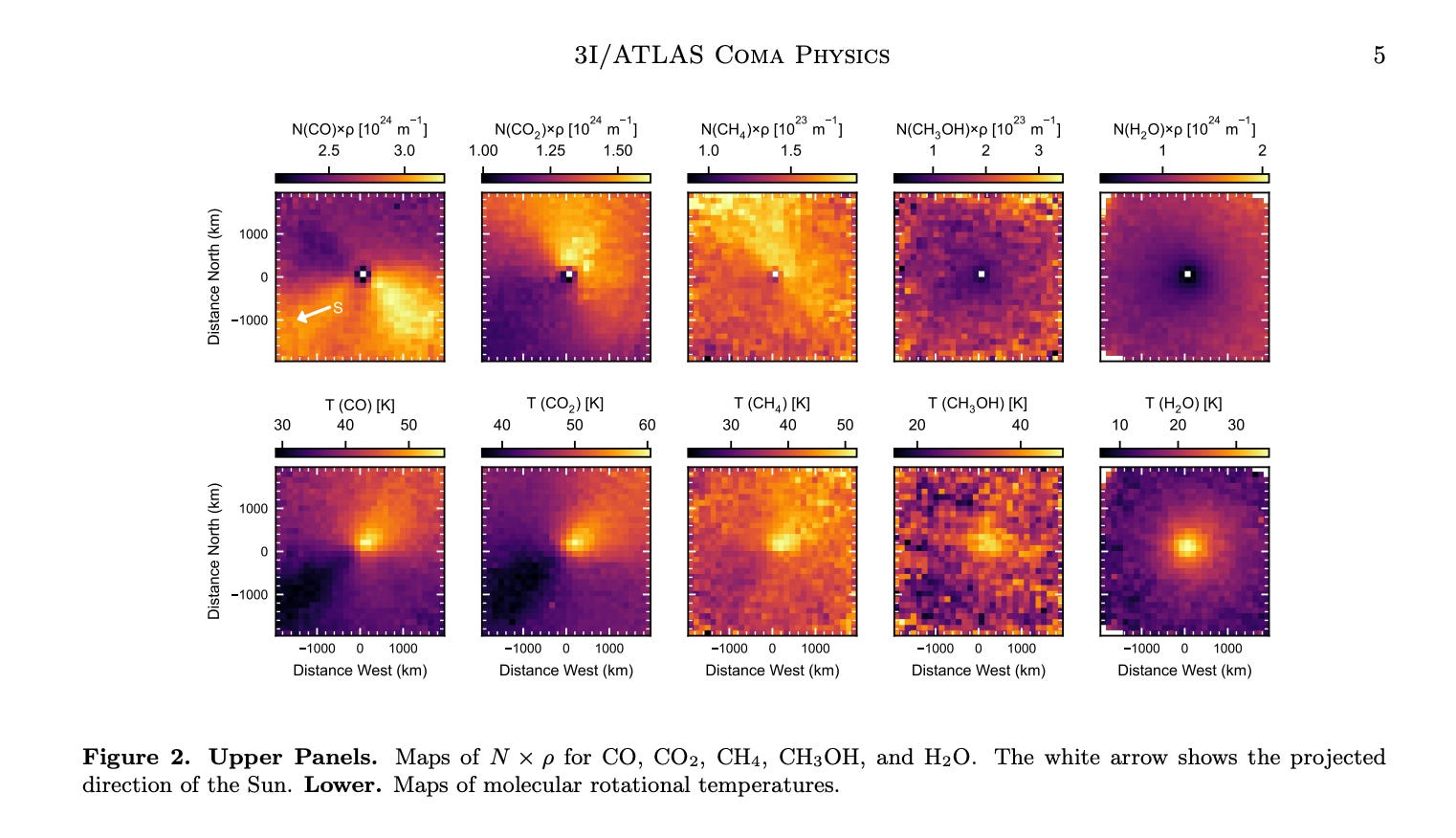
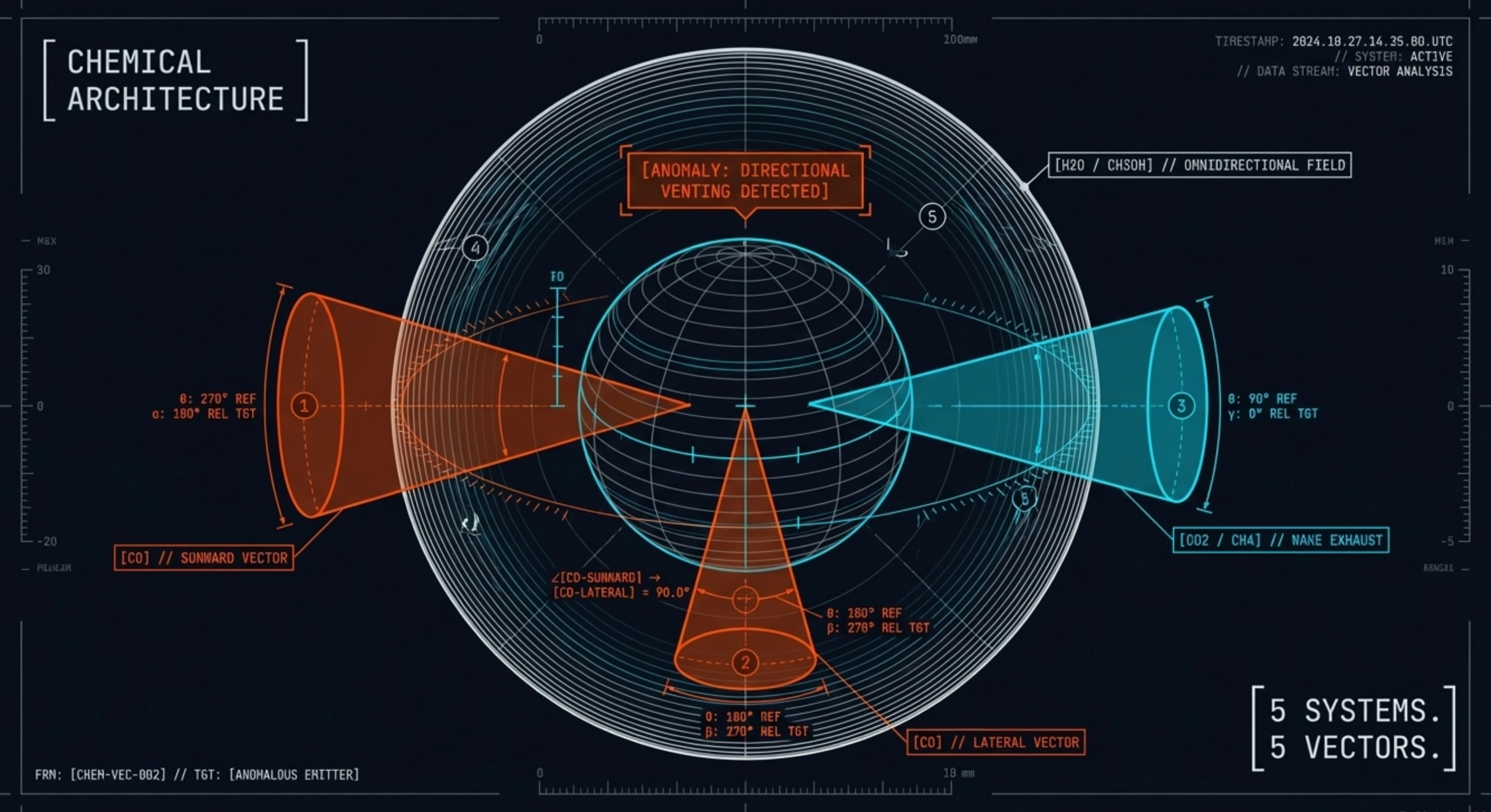
Carbon monoxide fires from two directional vents. One points toward the Sun. Another points sideways, roughly perpendicular to the first. Not a uniform cloud expanding in all directions. Two specific streams from two specific locations.
Carbon dioxide and methane come from the opposite side. The back of the object, away from the Sun. Different chemicals, different direction, different location than the CO.
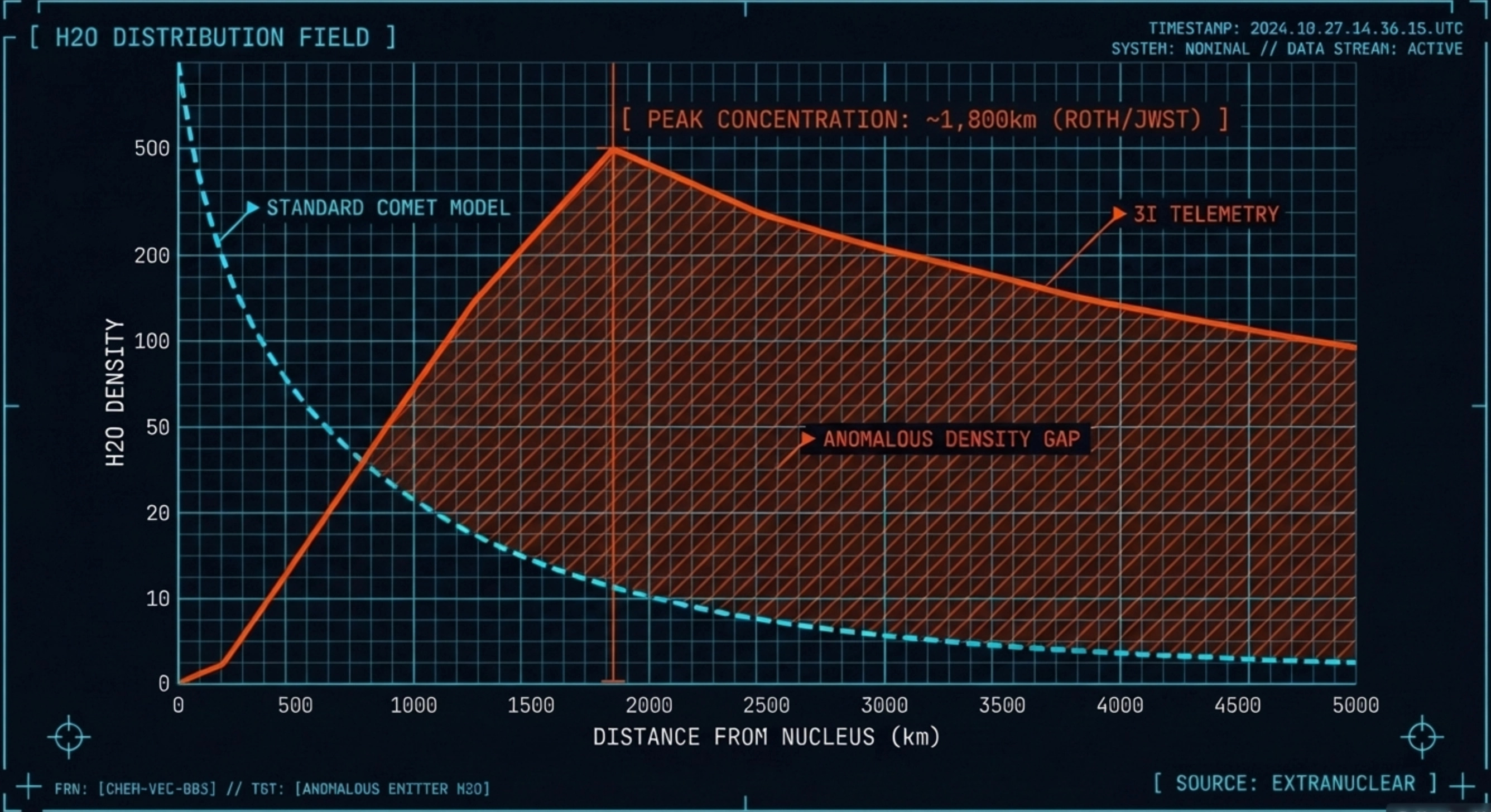
Water and methanol go everywhere. Uniform in all directions. And here is the part that matters: the further you get from the surface, the more water you find. Not less. More. If the water were coming off the surface and spreading out, it would thin out as it expanded. Instead it builds. The cloud gets denser as you move away from the object.
That is the ghost coma on camera.
Shanghai heard it in radio: 80 to 90 percent of water coming from somewhere that is not the surface. Korea saw it in visible light: gas appearing 20,000 km from the surface first and filling inward. Princeton measured it with 64 telescopes: the more sky you capture, the more signal you find. Harvard confirmed 99 percent of the light is not from the surface. Munich killed it with math: the surface is not big enough to produce the water. Now NASA mapped it pixel by pixel with the most powerful infrared telescope ever built.
Seven teams. The water comes from the field. Not the surface. And the only explanation anyone had for that just died.
SENTINEL ASSESSMENT:
When a comet melts, gas comes off the sunlit side, expands outward, and the mix is roughly the same in every direction because the ice is roughly the same everywhere. That is the textbook.
This object runs five chemical systems in five different directions at the same time. CO through directional vents. CO2 and methane out the back. Water distributed through the surrounding field from a source nobody can identify.
Remove the grains. What is left?
A water production system with no physical source. Seven teams confirmed. Now mapped at 130-kilometer resolution. That is not melting. That is architecture.
THE HOT WAKE
Hold a snowball toward the Sun. The sunny side gets warm. The shady side stays cold.
3I does the opposite.
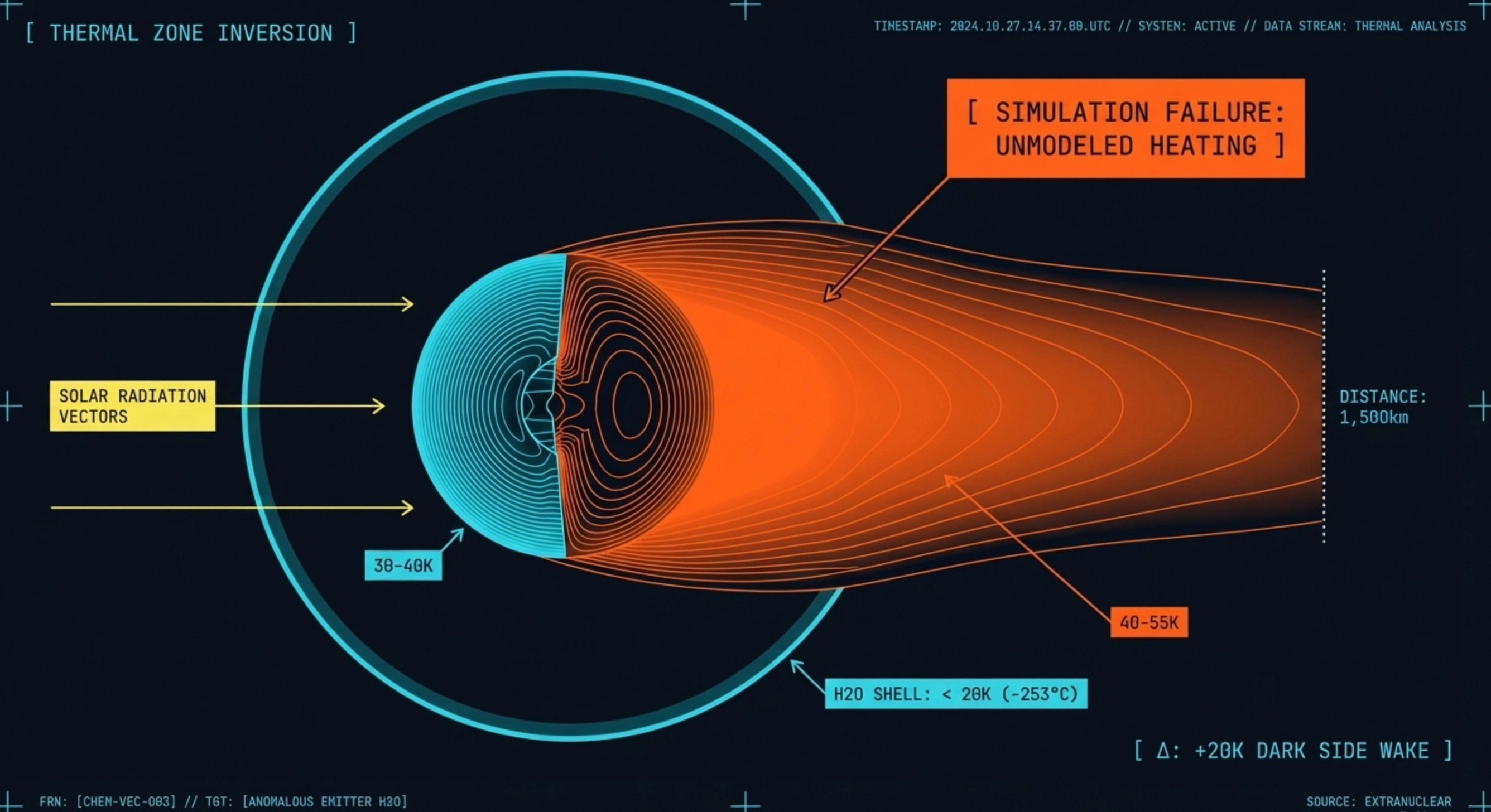
The gases that do not interact strongly with light, like CO, CO2, and methane, are hotter on the dark side of the object. The side facing away from the Sun runs 40 to 55 Kelvin. The sunlit side runs 30 to 40. And the hot zone holds those temperatures out to 1,500 kilometers from the surface.
Meanwhile water does something completely different. It peaks at the surface and drops fast. Below negative 253 degrees Celsius within a thousand kilometers. Same rate in every direction.
Two thermal zones. A warm wake trailing behind the object, away from the Sun. And a cool water shell surrounding everything.
The authors explain the hot wake with icy grains. Chunks ejected backward into the tail, heating up as they drift, releasing CO2 and methane. That is the explanation. The same grains that Tianwen-1 could not find at perihelion. The same grains that Keck could not find across six months. The same grains that no instrument at any wavelength has ever detected on this object.
Then the authors ran their best computer model against what they actually measured. This is the most advanced simulation available for how gas behaves around a comet. They fed it the real production rates, the real expansion speeds, and the real temperature of the CO as a starting point.
The CO model came back about 2 degrees warmer than reality throughout. Close but wrong.
The methanol model cooled too slowly near the surface. The real cloud is colder than the simulation says it should be.
The water model was cooler than reality near the surface, then leveled off at about a thousand kilometers while the real temperature kept dropping.
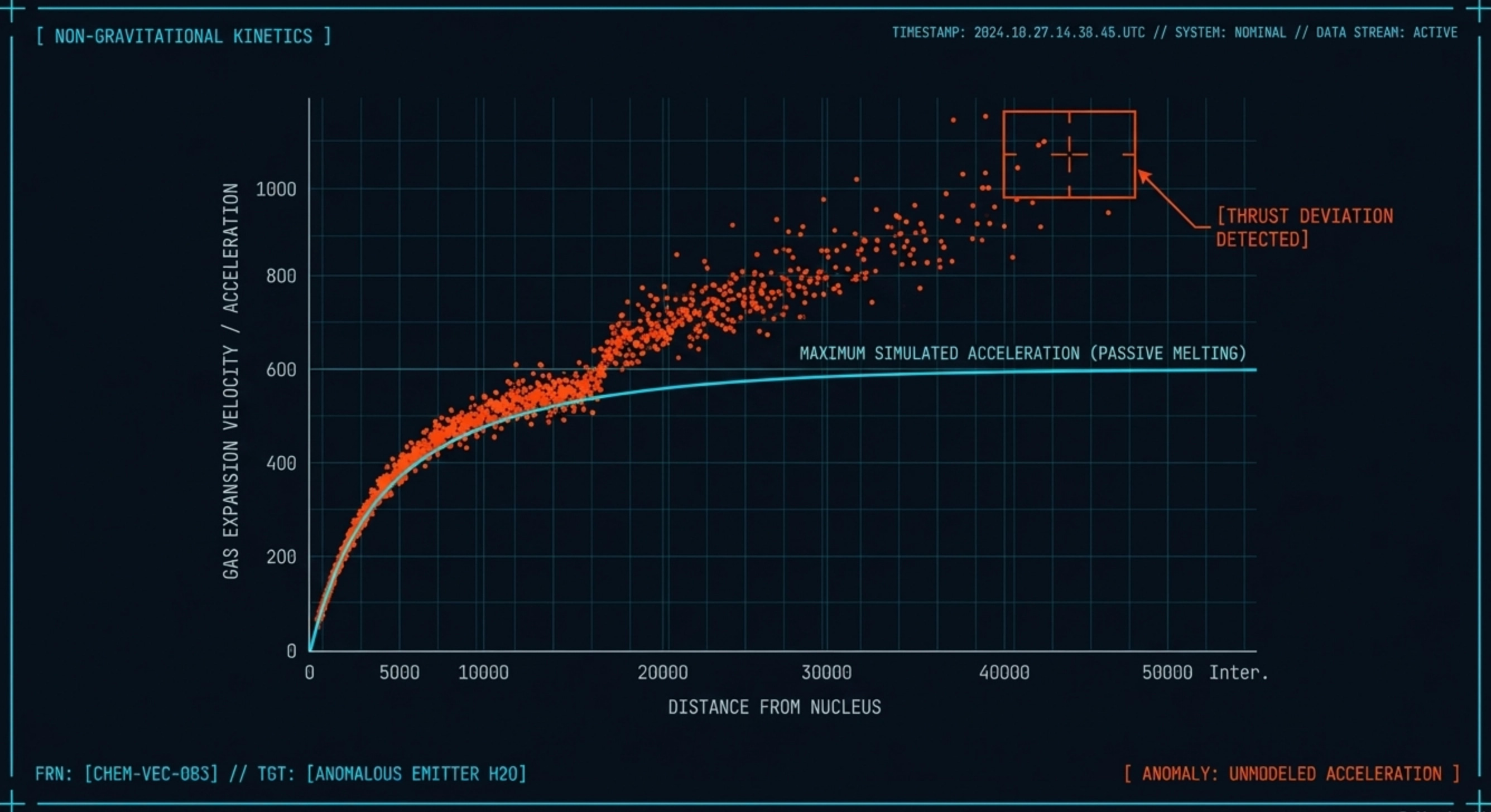
The authors write: “Additional cooling through mechanisms such as coma gas acceleration may explain these trends, but these effects are not considered in our models.”
Read that again. Something is pushing the gas faster than their simulation can produce. They do not know what it is. They did not model it.
The Curated Orbit documented unexplained sideways thrust. The Weigh-In documented a surface too small to produce the water. Now the cloud physics team is finding gas moving faster than any model predicts. Three independent measurement types. Same conclusion: something is pushing harder than melting ice can explain.
SENTINEL ASSESSMENT:
The dark side of this object is hotter than the sunlit side. The explanation requires grains that do not exist. The simulation cannot reproduce the temperatures. The gas is accelerating beyond what passive melting produces.
In The Verdict we described the ghost coma as what the system looks like when it is powered on. “A hull hidden behind its own exhaust.” These maps just confirmed the structure. A warm wake on the dark side. A cool water shell everywhere else. Heat vented away from the sun-facing side. Coolant distributed in every direction.
That is what you would build if you were managing heat on an interstellar vehicle.
THE THIRD CLOCK
The Ancient Engine gave us two molecular clocks. Water isotopes from JWST. Nitrogen isotopes from the VLT in Chile. Both pointed to the same place: ancient, metal-poor, bathed in 100 times more radiation than our part of the galaxy. Material that formed before most of the stars in the night sky.
Paper one just added the third clock.
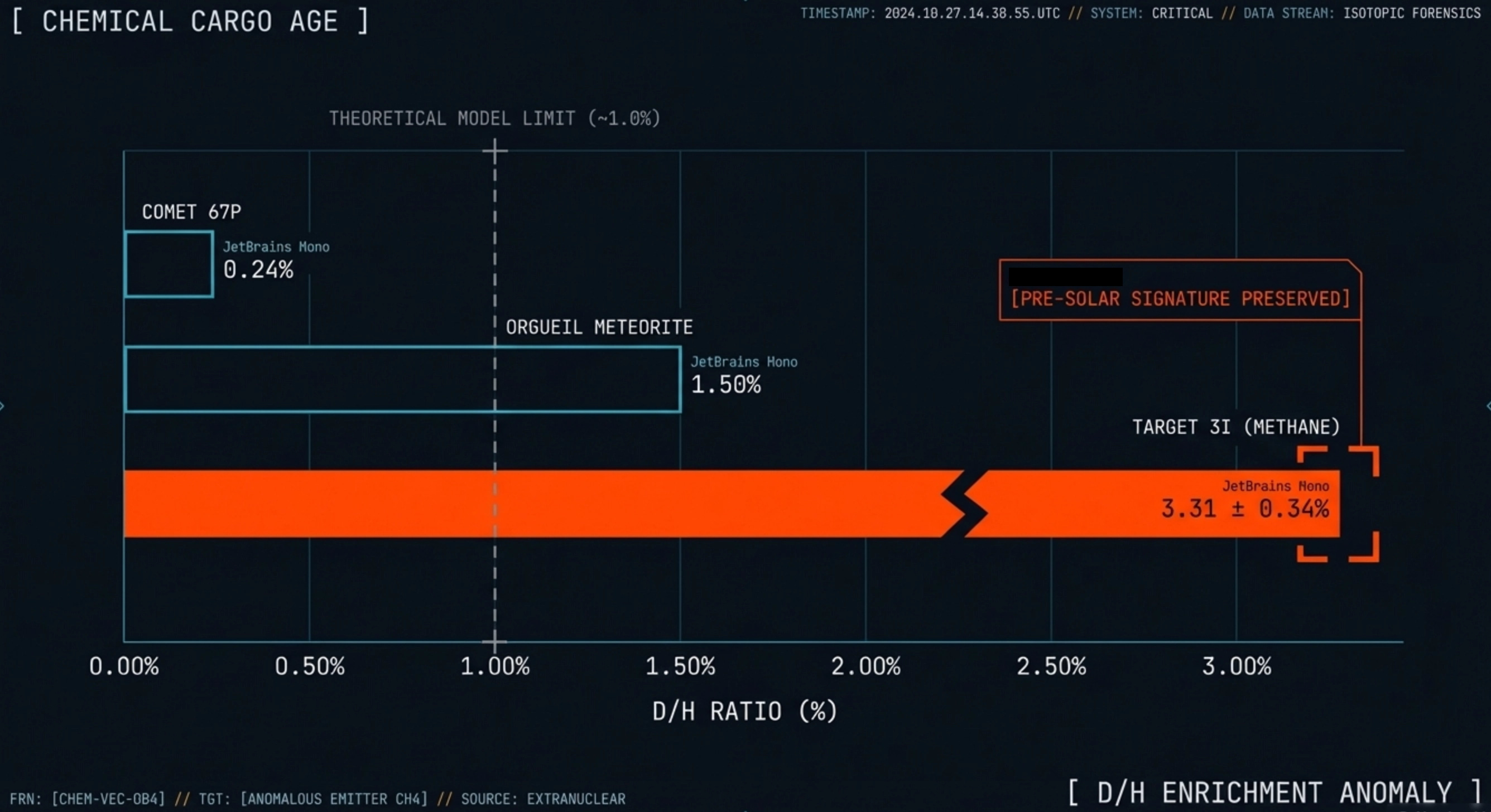
In The Ancient Engine, we explained how the ratio of heavy hydrogen to regular hydrogen works as a timestamp baked into the molecule. Colder environment, higher ratio. Once the ice is set, that number does not change. Not in a million years. Not in ten billion.
The team measured this ratio in 3I’s methane. The result: (3.31 plus or minus 0.34) percent.
To understand how extreme that is: the only other comet where this measurement has ever been done is 67P, the one the Rosetta spacecraft visited in person. 67P’s number: 0.241 percent. 3I is fourteen times higher. The most enriched material in our entire solar system, organic radicals inside the Orgueil meteorite, tops out at 1.5 percent. 3I is more than double that.
Now here is the part the authors admit openly. The best computer models for how methane gets this enriched max out at roughly 1 percent. The measurement is 3.31 percent. A factor of three beyond anything the models can produce.
The authors write: “It is uncertain whether theoretical models of either star formation or disk chemistry can reproduce the methane D/H ratio in 3I/ATLAS’s ices.”
That is a Nature Astronomy submission telling you their own field cannot explain the number.
Their workaround is to estimate what the ratio might be using a different molecule measured in star-forming regions as a stand-in. Even those estimates are explicitly called “lower limits.” The comparison values are indirect. The 3I measurement is direct.
And buried in the discussion: the ratio of methane enrichment to water enrichment is 3.5 for 3I. For 67P, it is 4.8. Those numbers match within the uncertainty despite these two objects coming from completely different places, formed billions of years apart, in radically different environments. The authors flag this as requiring “a fundamental mechanism.” A universal process that nobody has identified.
Three molecular clocks. Water. Nitrogen. Methane. All three point to the same impossible corner. And the third one broke the models.
SENTINEL ASSESSMENT:
The authors conclude that 3I’s ices were “inherited” from the gas cloud that existed before its planetary system formed. Never reprocessed. Never remixed. The raw material is older than the disk it came from.
This object carries ten-billion-year-old chemical cargo that survived the full history of the Milky Way without losing its formation signature. Either that is the most pristine natural preservation in astronomical history, or it was stored properly.
THE STORAGE TEMPERATURE
Every water molecule carries a hidden stamp.
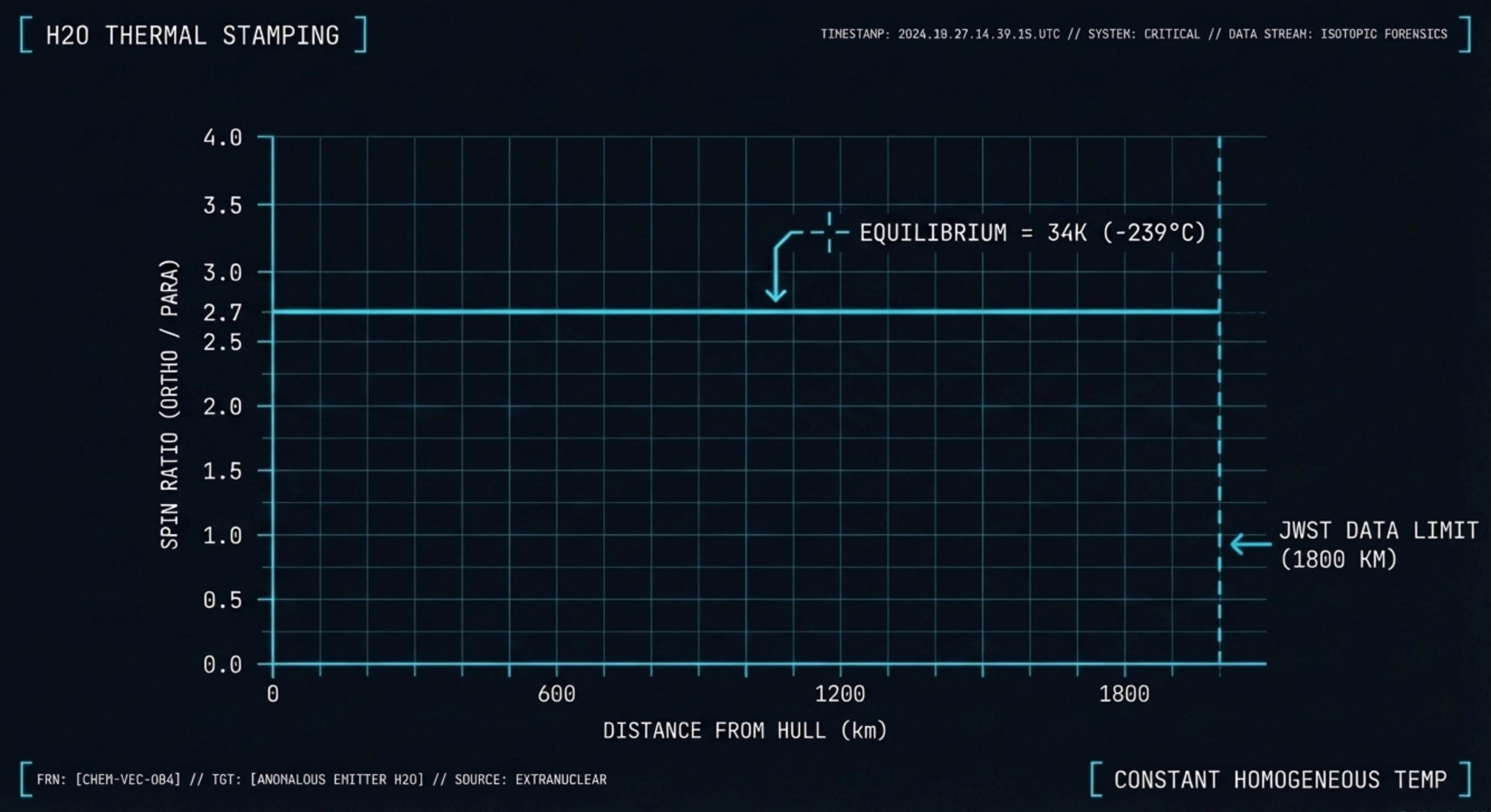
Water comes in two versions depending on how the spins of its two hydrogen atoms are aligned. Think of it like two coins. Both heads, or one heads one tails. At warm temperatures, you get a fixed ratio between the two types: three to one. As the temperature drops, the ratio shifts. And once it is set, nothing in the expanding cloud of gas can change it. Not cooling. Not collisions. Not distance. The stamp is permanent.
Roth’s team measured this ratio at every pixel across the entire cloud. The result: the same number everywhere. 2.7 to 1. It does not change at the surface. It does not change a thousand kilometers out. It does not change when the temperature of the surrounding gas drops below minus 253 degrees Celsius.
That ratio corresponds to a temperature of 34 Kelvin. Negative 239 degrees Celsius. That is the temperature at which every water molecule in 3I’s cloud was last in equilibrium before it was released.
Every molecule. Every direction. Every distance from the object. Same stamp.
Now connect it. 80 to 90 percent of the water comes from a source thousands of kilometers from the surface. Yet every single molecule carries the same 34-degree stamp. That requires either grains that all happen to sit at exactly the same temperature, or a single source releasing water at a controlled temperature.
The grains do not exist. The temperature is real.
THE METAL
Buried in the appendix of Paper two is a finding the authors treat as a footnote. We are not going to.
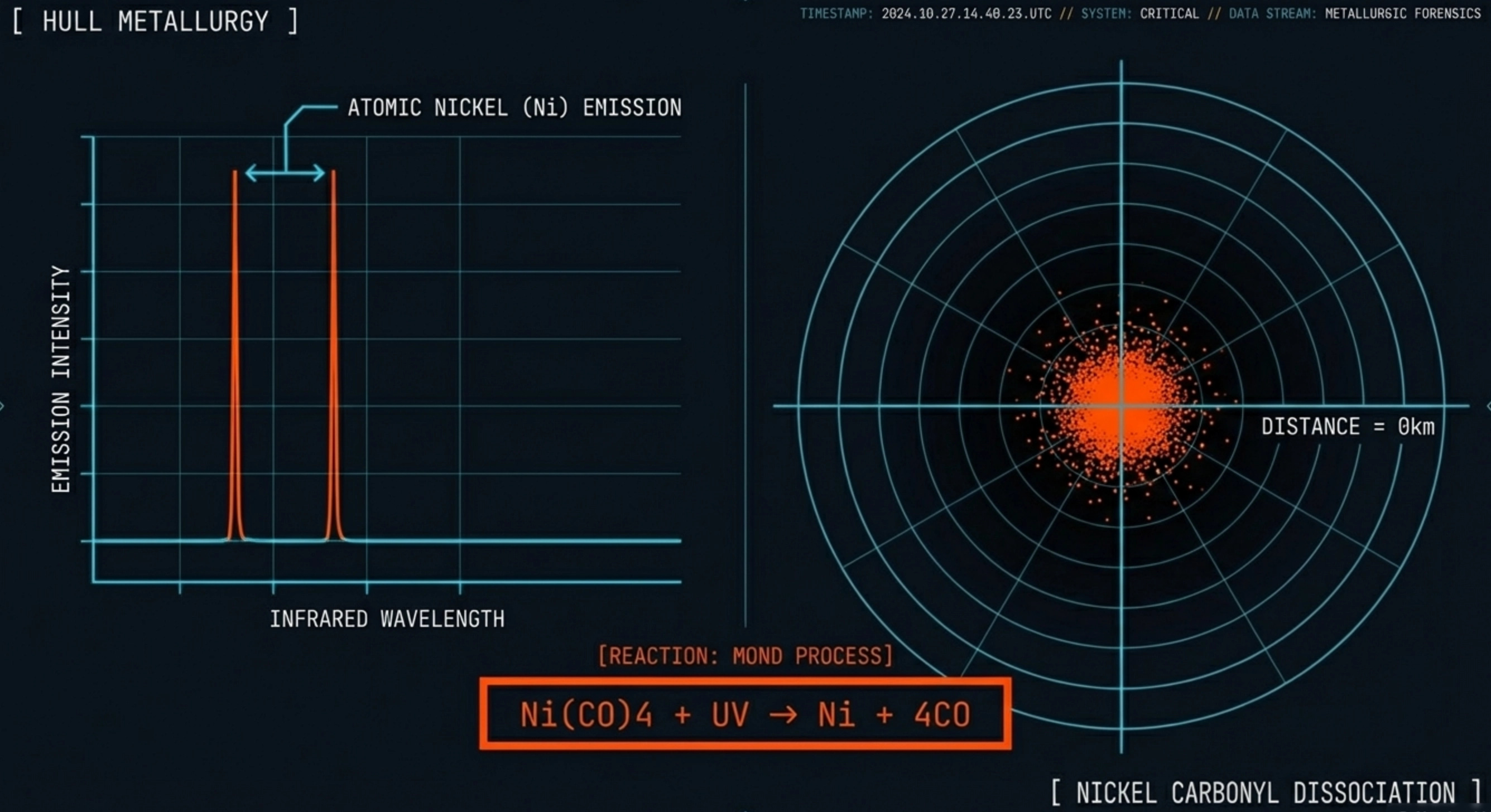
They detected atomic nickel glowing in 3I’s cloud at two specific infrared wavelengths. The brighter one was strong enough to map pixel by pixel. The result: nickel concentrated right at the object, with a faint glow extending outward.
The team does not know what is producing the nickel. It could be coming directly off the surface. Or it could be coming from a parent molecule that breaks apart near the surface and releases nickel atoms as it does.
In a cloud dominated by carbon monoxide, like 3I’s, there is an obvious candidate. Nickel carbonyl. A molecule where a nickel atom sits packaged inside a shell of four carbon monoxide molecules. When sunlight hits it, the CO peels off and the nickel drops out. That specific reaction is the Mond process. Ludwig Mond patented it for industrial nickel purification in 1890.
The Sentinel Dossier documented the sequential nickel-before-iron activation as one of the original 18 anomalies: nickel appeared first because it vaporizes at a lower temperature. The Ancient Engine documented the tenfold post-perihelion metal surge with CO rising in lockstep, consistent with a shared metal reservoir cracking open.
Now we have the first image of where the nickel is actually being released. Concentrated at the hull. Extended but close. In a CO-rich cloud. Running a reaction that matches a 135-year-old industrial patent.
THE ARCHITECTURE
One team. One dataset. Two papers. Both model failures. Published on the same day. And both built on an explanation that died three days before they went public.
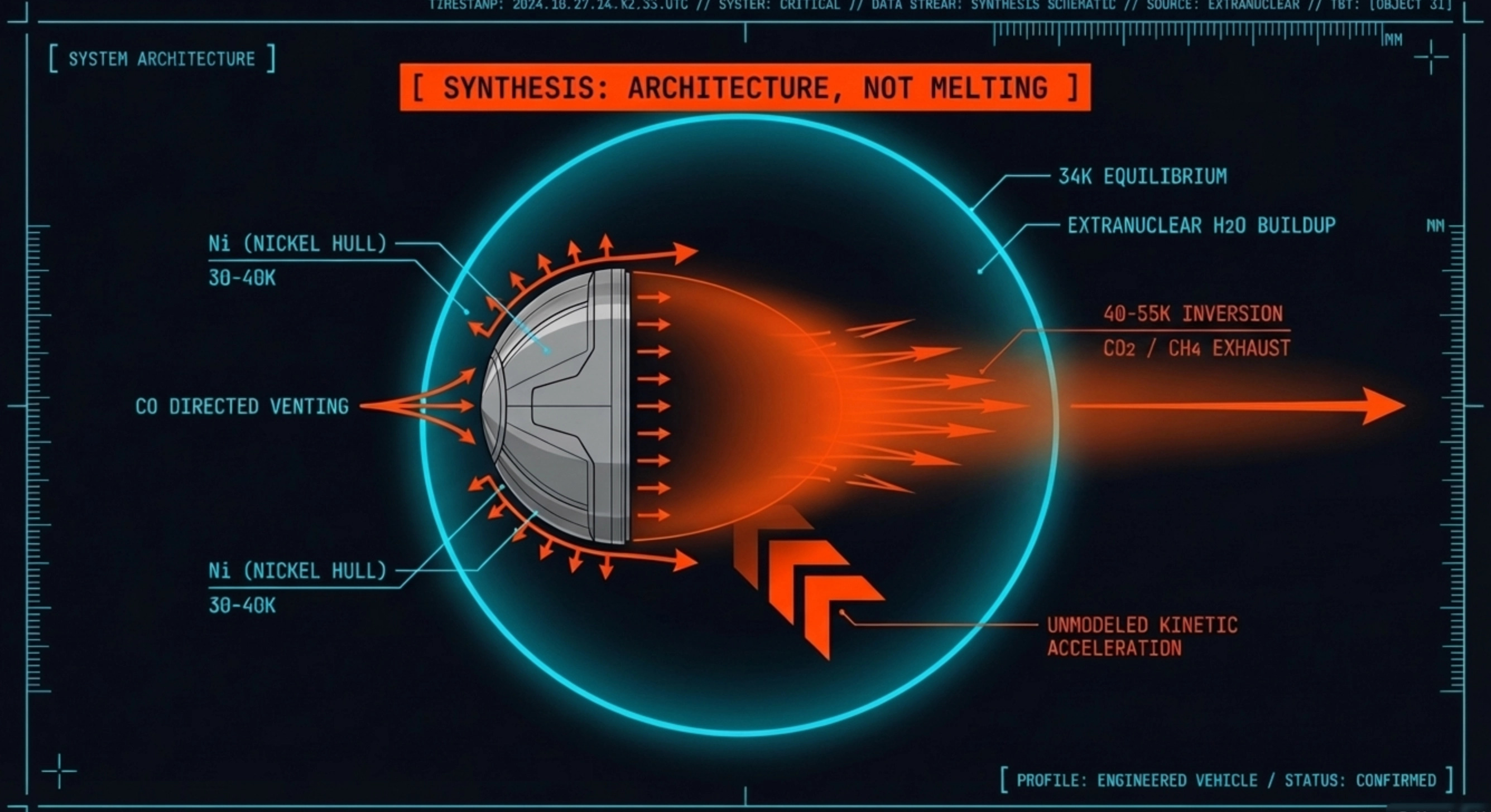
Remove the dead theory. Read the maps clean. This is what you see.
Five chemicals venting in five different directions from one object. Carbon monoxide through directional vents. Carbon dioxide and methane out the back. Water distributed through a field that gets denser as you move away from the hull. Nickel concentrated at the surface. The dark side running 20 degrees hotter than the sunlit side. Gas accelerating faster than any simulation predicts. Every water molecule stamped at 34 Kelvin.
Chemistry underneath it all that no formation model can produce. Methane enrichment three times beyond any theoretical pathway, from ices older than the Sun, carrying a ratio that matches a solar system comet despite radically different origins.
Every prediction we published in The Verdict is either confirmed or untested. None have failed.
The Ghost Coma said the water comes from the field. These maps show the water building outward.
The Ignition Sequence said the chemical systems activate in sequence. These maps show five systems running five directions.
The Curated Orbit said there is unexplained thrust. These maps show gas acceleration the models cannot produce.
The Heartbeat said the jets are structured. These maps show directional CO venting with a perpendicular component the authors call “puzzling.”
The Ancient Engine said the isotopes point somewhere impossible. The third clock just confirmed it with the widest gap yet.
The Verdict said the icy grain theory is dead. Three days later NASA used it to explain both papers.
Thirty-two briefings later, we are describing how the machine works. And when the establishment’s own maps show you the architecture, the only thing missing is the explanation they were using. It died. Ours has been on the record since December.
The five predictions from The Verdict remain on the table at Jupiter. Ghost coma persists or it does not. Thrust changes or it does not. Jets reappear or they do not. Brightness deviates or it does not. Chemistry shifts or it does not.
We told you what it is. Now NASA showed you how it works. They just didn’t know that’s what they were doing.
Keep looking up.
-- The Sentinel
Sentinel Note: We hate paywalls as much as you do. Every article we have published is free and we plan to keep it that way. That is not changing. But this publication has no institutional backing, no sponsors, and no editorial board. We are a small team doing the work that the newsrooms will not. Sourcing papers, filing FOIAs, building tools, and writing at a pace that keeps up with a once-in-a-civilization event. If you can subscribe, you are funding independent investigation with no strings attached. If you cannot, we do not care. Read everything. Share everything. The mission is the mission.
Share this investigation. The Suppression Gradient documented what happens when this coverage reaches platforms that do not want you reading it. Every share, every restack, every forwarded link is a data point against the gradient.
Previous briefings: The Narrow Band | The Sky Is Falling | The Weigh-In | The Verdict | The Ancient Engine | The Curated Orbit | The Long Count | The Green Burial | The Ghost Coma | The Ignition Sequence | The Heartbeat | The Suppression Gradient | The Silent Edit | CONFIRMED: The TESS Contingency | The Glomar Confirmation
I daresay Avi Loebs latest paper will add greatly to this. Fantastic journalism. Thankyou
I get the shivers each time I read your work because the subject is so complex, one might actually think they can slide it past the entire population. I guess they never counted on you and your team. Thank you so much. I don’t know what it means but I am agog