

By The Sentinel December 22, 2025
You can spin a press release. You can redact a UAP report. You can classify a video. But you cannot hide the movement of $800 billion.
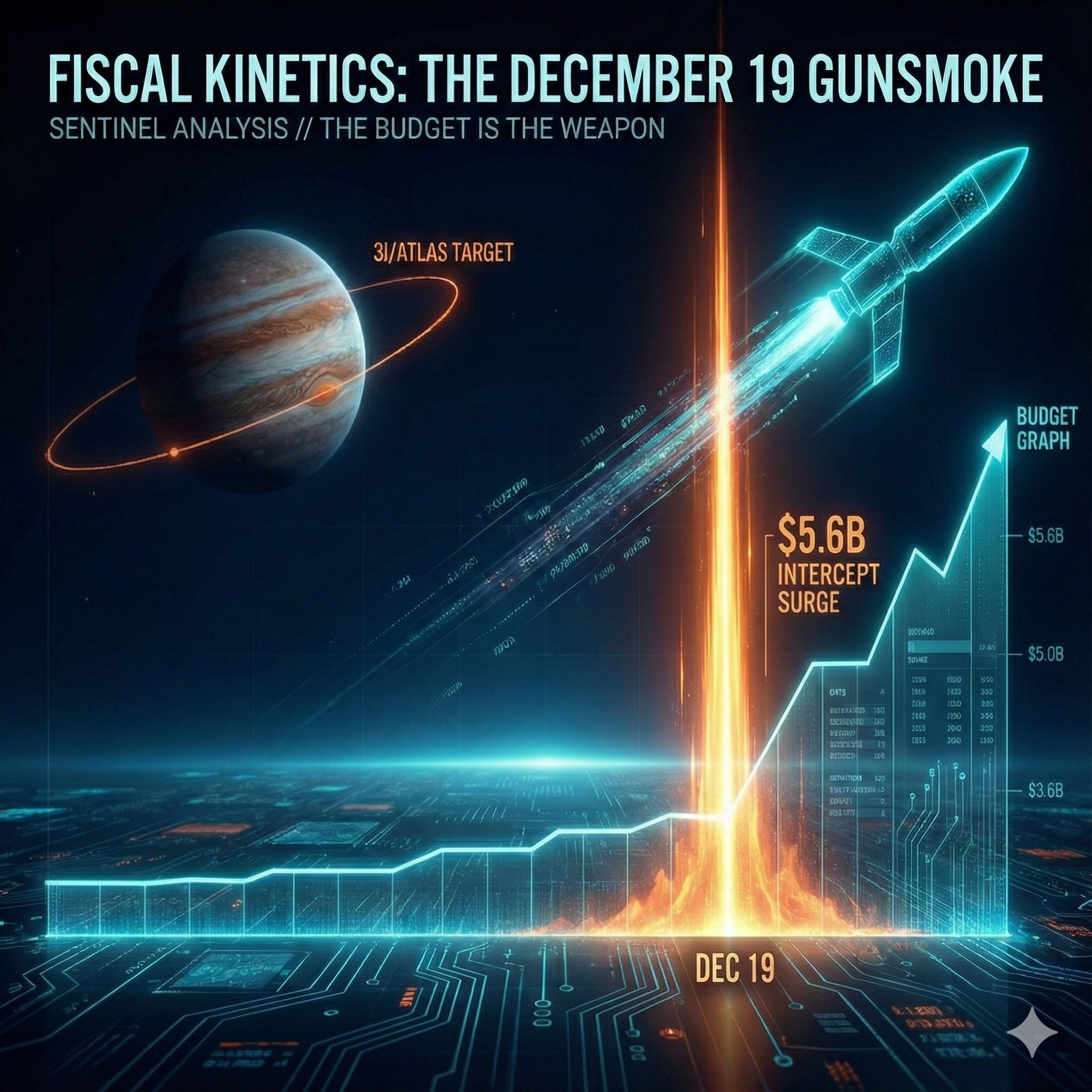
On December 19, 2025 exactly 24 hours after we published the initial Sentinel Dossier on 3I/Atlas the United States government executed a fiscal maneuver that confirms our suspicions. The passage of the FY2026 Appropriations bill wasn’t just government business as usual. It was a mobilization order.
While the legacy media is distracting you with headlines about “modernization” and “competition with China,” the Pentagon just authorized the largest transfer of wealth into Exo-Atmospheric Kinetic & Directed Energy capabilities in human history.
They aren’t building a budget. They are building a war chest. And looking at the specific line items, we know exactly who—or what—they are planning to fight.
The “Golden Dome” Deception
The centerpiece of this new budget is the sudden, full-scale activation of “Project Golden Dome.” The official narrative, parroted by every major outlet, is that this is a $175 billion missile defense shield designed to protect the Homeland from “rogue state ICBMs” like those from North Korea or Iran.
Do not accept this. It is a geometrical lie.
You do not need a multi-layer space-based interceptor network to stop a North Korean Taepodong-2. We already have Ground-Based Midcourse Defense (GMD) and THAAD for that.
The budget allocates $5.6 billion immediately for “Space-Based Interceptors” designed to destroy targets in the “initial phase.” The Space Force claims this is for hitting missiles as they launch up from the ground. But orbital mechanics is a two-way street. A kinetic kill vehicle that can hit a target rising from the atmosphere can just as easily hit a target diving into it.
“Golden Dome” is not a shield for the Earth’s surface. It is a perimeter fence for High Earth Orbit. They are building a wall, but they are pointing it at the sky.
The Kill Chain: Why Rocket Lab Just Got Drafted
Perhaps the most smoking gun in the procurement data is the sudden reversal regarding the Space Development Agency (SDA).
For months, funding for “Tranche 3”—the next generation of tracking satellites—was stalled in committee. Then, on December 19, the floodgates opened. The SDA executed a massive $3.5 Billion contract award to build 72 new satellites.
But look at the vendors. Alongside the usual giants (Lockheed, Northrop), there is a critical outlier: Rocket Lab.
Rocket Lab secured an $805 million slice of the pie. Why give a massive defense contract to a “New Space” company known for small, agile launch vehicles? Because the legacy defense primes build buses that sit still in Geostationary orbit. Rocket Lab builds the Photon bus—a platform designed for extreme maneuverability and interplanetary injection.
These Tranche 3 satellites are explicitly funded for “Fire Control Quality Tracks.” Previous satellites could only see the target. Tranche 3 satellites can guide a weapon to it.
The inclusion of Rocket Lab suggests that the target isn’t a slow-moving ballistic missile. It’s something fast, something that changes trajectory, and something that requires an agile interceptor to catch.
The “Glitch” That Wasn’t
On December 15, just days before the budget passed, the Space Force quietly announced the delay of the “Victus Haze” mission to 2026. The official excuse was a “rocket anomaly” with the launch provider.
In the context of the Sentinel analysis, this is highly suspect. “Victus Haze” was a demonstration mission specifically designed to practice approaching and inspecting a satellite on short notice (Tactically Responsive Space).
Why delay a critical inspection test? Because you don’t waste your “Sprint” vehicles on a practice run when the real game is starting.
The delay pushes the mission into early 2026. This aligns perfectly with the March 16, 2026 arrival of 3I/Atlas at the Jupiter Hill Sphere. We believe the “demonstration” assets have been seized and repurposed. They aren’t going to test the capability; they are going to use it.
Hunting in the Dark
Finally, we have the acceleration of DARC (Deep Space Advanced Radar Capability).
While the budget news dominated the cycle, Northrop Grumman quietly secured the contract to accelerate Site 2 in the United Kingdom.
Why is this urgent? Because, as noted in the Sentinel Dossier, 3I/Atlas has entered “Dark Mode.” It has low albedo and is effectively stealth to optical telescopes in its current phase. You can’t shoot what you can’t see.
DARC is the solution. It uses active radar to “paint” deep space objects, rendering stealth coatings irrelevant. The rush to bring Site 2 online is an effort to ensure 24/7 global radar coverage before the target crosses the intercept threshold. They are turning on the searchlights.
The March Convergence
The timeline of the money now matches the timeline of the threat.
December 2025: The “War Chest” is unlocked. Interceptors and Fire Control are fully funded.
Early 2026: “Victus Haze” assets are retasked.
March 16, 2026: 3I/Atlas arrives at Jupiter.
The government is not reacting to “inflation” or “China.” They are racing a clock.
The Authority Paradox is in full effect: The more they deny the reality of the object in press briefings, the more money they spend to kill it in the budget.
Don’t listen to what they say. Watch what they buy.
The Sentinel Dossier is an independent intelligence product. We rely on the “Scientific Brutalism” methodology: absolute clarity, raw data, and the rejection of comforting consensus.