

DATE: 2025-12-16
CLEARANCE: Public
SUBJECT: 3I/ATLAS // MANEUVERING DATA
DATA CONFIDENCE: Verified [Paper] / Hypothesis [Interpretation]
The Story
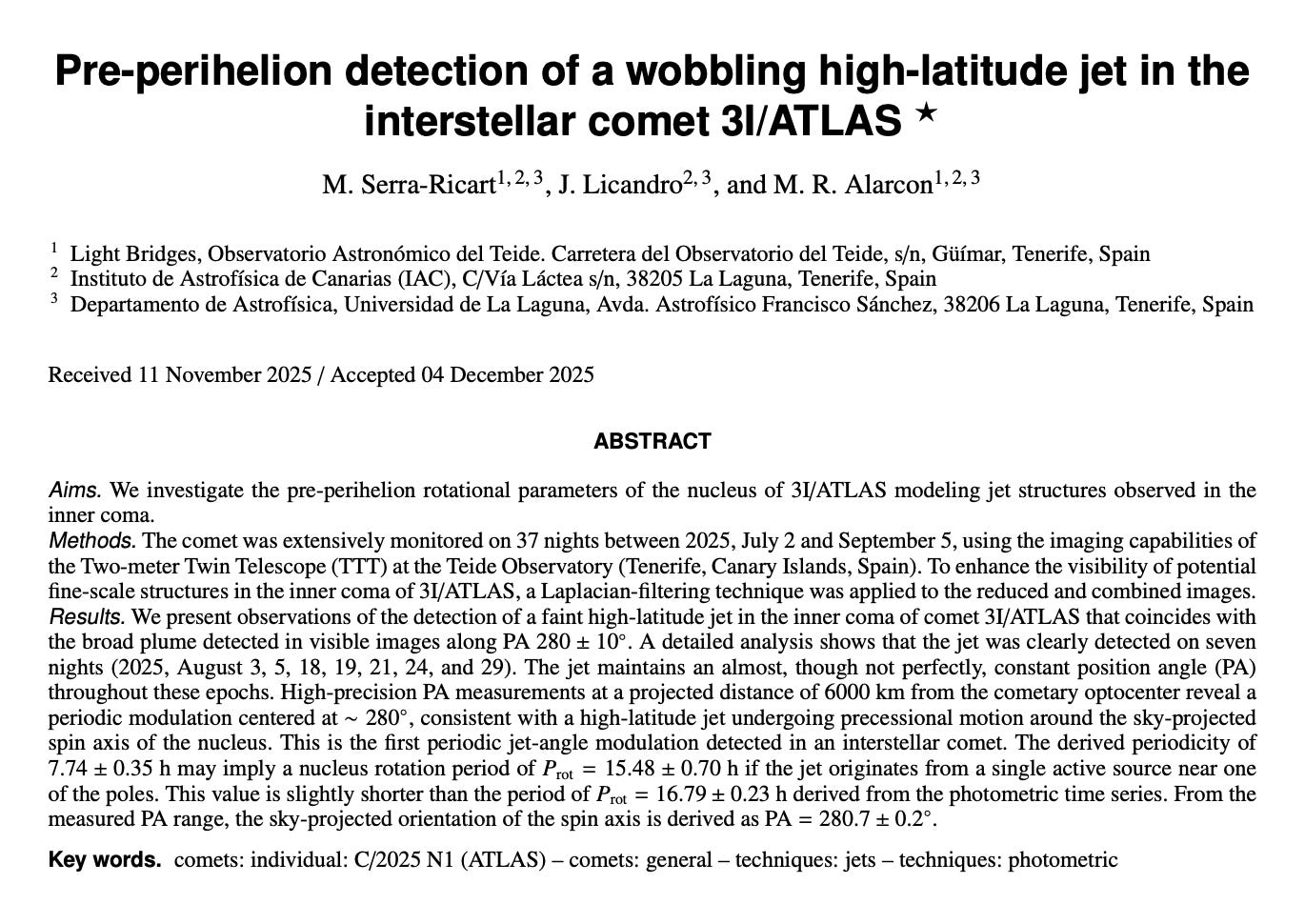
A new preprint paper accepted by Astronomy & Astrophysics has confirmed a critical anomaly in the behavior of Interstellar Object 3I/ATLAS. While the authors classify the object as a “comet”, their data reveals a “wobbling high-latitude jet” that is modulating the object’s spin and trajectory.
The official narrative is that this is a natural CO2 vent. The alternative hypothesis consistent with Dr. Avi Loeb’s technosignature models is that we are observing a stabilization maneuver or directed exhaust from a probe entering the inner solar system.
Below is the breakdown of the data and the discrepancy in the official timeline that the mainstream scientific press is overlooking.
1. The Data: “Periodic Modulation”
The paper, titled Pre-perihelion detection of a wobbling high-latitude jet in the interstellar comet 3I/ATLAS, is based on 37 nights of monitoring using the Two-meter Twin Telescope (TTT) in the Canary Islands.
The authors applied a “Laplacian-filtering technique” to strip away the noise and look at the core structure. What they found was not a chaotic explosion of gas, but a structured, repeating pattern.
The Anomaly: A jet structure that maintains a specific position angle (PA ~280°) but “wobbles” or oscillates periodically.
The Periodicity: The jet modulates every 7.74 hours.
The “Spin-Up”: Most disturbingly, the object is spinning faster. Photometric data from a month prior showed a rotation period of 16.79 hours. This new data implies a period of 15.48 hours.
THE SENTINEL ASSESSMENT: In orbital mechanics, a “spin-up” of over an hour in just a few weeks represents a massive change in angular momentum. While natural outgassing can induce torque, the precision of the “wobble” suggests a focused, directed force.
If this were a spacecraft, a “wobbling jet” is indistinguishable from a gimbaled thruster performing a course correction or a scanning sensor sweeping a specific sector of the sky.
2. The “Dust” Discrepancy: Ablation vs. Coma
One of the primary arguments against the “Probe Hypothesis” for ‘Oumuamua was the lack of a tail. 3I/ATLAS has a tail, which mainstream science says closes the case: it’s a comet.
However, the new paper notes something strange about the composition of this tail. The authors state the dust is dominated by “large, compact particles” (tens to hundreds of microns). They describe the tail as “faint” and “short” because the sun’s radiation pressure cannot easily push these heavy particles away.
THE HYPOTHESIS: Why is an interstellar object shedding “heavy, compact” material rather than fine dust? If 3I/ATLAS is an artificial object that has traversed the interstellar medium for millions of years, it would require significant shielding. As it approaches the Sun (Perihelion), that shielding heats up.
What the authors describe as “large dust grains” fits the profile of ablative shielding material or degraded hull coating flaking off under thermal stress. The “faint” tail isn’t dust; it’s debris.
3. The “Gardener” or the “Predator”?
This data supports two distinct narratives regarding the intent of the object.
Hypothesis A: The Course Correction (Dark Forest) The object is maneuvering. The “Reverse Solar Oberth” effect noted in previous orbital analyses requires energy. The “wobbling jet” provides the mechanism for that energy. The object is braking and stabilizing its rotation to ensure its sensors are locked on a target—potentially the Jupiter Hill Sphere rendezvous in March 2026.
Hypothesis B: The Passive Vent (Mainstream) It is a pristine rock from another star system that happens to have a vent near its pole (+75° latitude). The “wobble” is just the geometry of the rock spinning. The “spin-up” is just the gas pushing the rock faster.
The “Duck Test” Failure: Mainstream science asks us to believe in a chain of coincidences:
It is a rock that hit the ecliptic plane within 0.2% probability.
It is a rock that is aiming for Jupiter.
It is a rock that is now spinning itself up and venting heavy particles just as it enters tracking range.
At what point does a “rock” become a “craft”?
The Sentinel Hypothesis
We are entering the critical window. If the rotation period tightens further—dropping below the newly measured 15.48 hours—or if the “wobble” stabilizes into a fixed vector as it rounds the Sun, the “random comet” theory collapses.
We argue that the current activity is not random outgassing, but a thermal management and attitude control sequence. The “heavy dust” is the shedding of an external ablative layer, revealing the operational core beneath.
The mainstream press will wait for the press release. We watch the raw telemetry.
Subscribe to The Sentinel. We track the anomalies they ignore.