

DATE: FEBRUARY 15, 2026
SUBJECT: FORENSIC ANALYSIS OF SECTOR 1751 // ARXIV:2602.12364v1 CROSS-REF: [THE SENTINEL DOSSIER] | [THE GLOMAR CONFIRMATION] | [SITREP: THE PACIFIC DIVERSION] | [THE THREE DAYS OF DARKNESS] | [THE SURGE] | [THE SILENT EDIT]
CLEARANCE: PUBLIC
THE CONFESSION
On February 12, NASA’s TESS Science Support Center quietly released a paper. No press conference. No media advisory. Just a technical document slipped onto the arXiv preprint server — arXiv:2602.12364v1 — authored by Jorge Martinez-Palomera, Amy Tuson, and the TESS Science Support Center.
They called it a “High Level Science Product.”
Buried on page one, a single sentence confirmed what The Sentinel reported thirteen days earlier: during the most critical observation window for Interstellar Object 3I/ATLAS, their flagship $337 million space telescope went dark.
Their word for it was “contingency mode.”
In The Three Days of Darkness, we called it a containment protocol.
In The Surge, we identified the motive.
Today, they officially confirmed both. They just didn’t realize they were confessing.
WHAT IS ACTUALLY FLYING THROUGH OUR SOLAR SYSTEM
Before we dissect the blackout, the data laundering, and the institutional coverup, you need to understand what’s at stake. Because the question NASA doesn’t want you asking isn’t whether TESS went offline. It’s what TESS would have seen if it hadn’t.
On December 18, 2025, we published The Sentinel Dossier — a comprehensive threat assessment identifying eighteen distinct anomalies associated with 3I/ATLAS. Not curiosities. Not “interesting features.” Eighteen independent data points that, viewed in aggregate, form a statistically impossible cluster around a single conclusion: this object is not a comet.
Consider the operational profile:
3I/ATLAS entered our solar system aligned within 5° of the ecliptic plane — the narrow disk where all our planets orbit. The probability of a random interstellar object threading this geometry: 0.2%. But that alignment wasn’t just lucky — it was tactically efficient. It enabled what we identified as a “Grand Tour” trajectory, sweeping past Mars and Venus while threading Earth’s observational corridor at 1.8 AU. The cumulative probability of achieving these planetary encounters by chance: 0.005%.
It is accelerating under its own power. The orbital solution shows non-gravitational acceleration that, under the standard cometary model, would require the object to eject 10-20% of its total mass. No commensurate debris field has been observed. Dr. Avi Loeb and the Galileo Project have demonstrated that this acceleration follows a smooth inverse-square relationship with distance from the Sun — precisely what you’d expect from solar radiation pressure acting on a thin, artificial structure. A light sail.
Its jets don’t smear. On a rotating body — 3I completes one revolution every 16.16 hours — outgassing should spiral like water from a spinning hose. Instead, the jets are tightly collimated: straight lines extending millions of kilometers. As we wrote in the Dossier: “Rectilinear jets on a rotating body are a hallmark of Reaction Control Systems, not random cracks in an ice ball.”
It has a sunward jet — a jet firing toward the Sun, not away from it. A retro-rocket. A braking thruster visible to every telescope that looked.
It executed a Reverse Solar Oberth maneuver — shedding orbital energy at perihelion, the textbook technique for slowing down to park in a target system. And it did so while hidden behind the Sun from Earth-based observers.
Its surface exhibits “extreme negative polarization” — a property unprecedented in all known comets and asteroids, consistent with metamaterial surfaces.
Its chemical plume contains massive methanol, hydrogen cyanide, and an anomalous Nickel-to-Iron ratio orders of magnitude higher than any known comet — a ratio that mirrors industrial superalloys, not raw rock.
It turned blue near the Sun — a chromatic shift consistent with plasma drive emissions or ionization from an internal energy source hotter than the star itself.
And it is headed for Jupiter. Not past Jupiter. To Jupiter. The object will arrive on March 16 at a distance of 53.5 million kilometers — a figure that matches Jupiter’s Hill Sphere radius, the gravitational boundary where orbital insertion requires minimal fuel, with a margin of error of 0.06 million kilometers.
As we wrote in December: “If it maneuvers like a ship, targets planets like a ship, is made of industrial alloys like a ship, and transmits radio signals like a ship... it is a ship.”
The combined probability of these eighteen anomalies converging on a single natural object by chance is less than one in one billion.
This is what TESS was supposed to be watching.
JANUARY 15: THE DAY EVERYTHING WENT DARK
January 15, 2026 may be the most operationally significant date in the history of this investigation. Three events converged on a single calendar square, and none of them have been adequately explained.
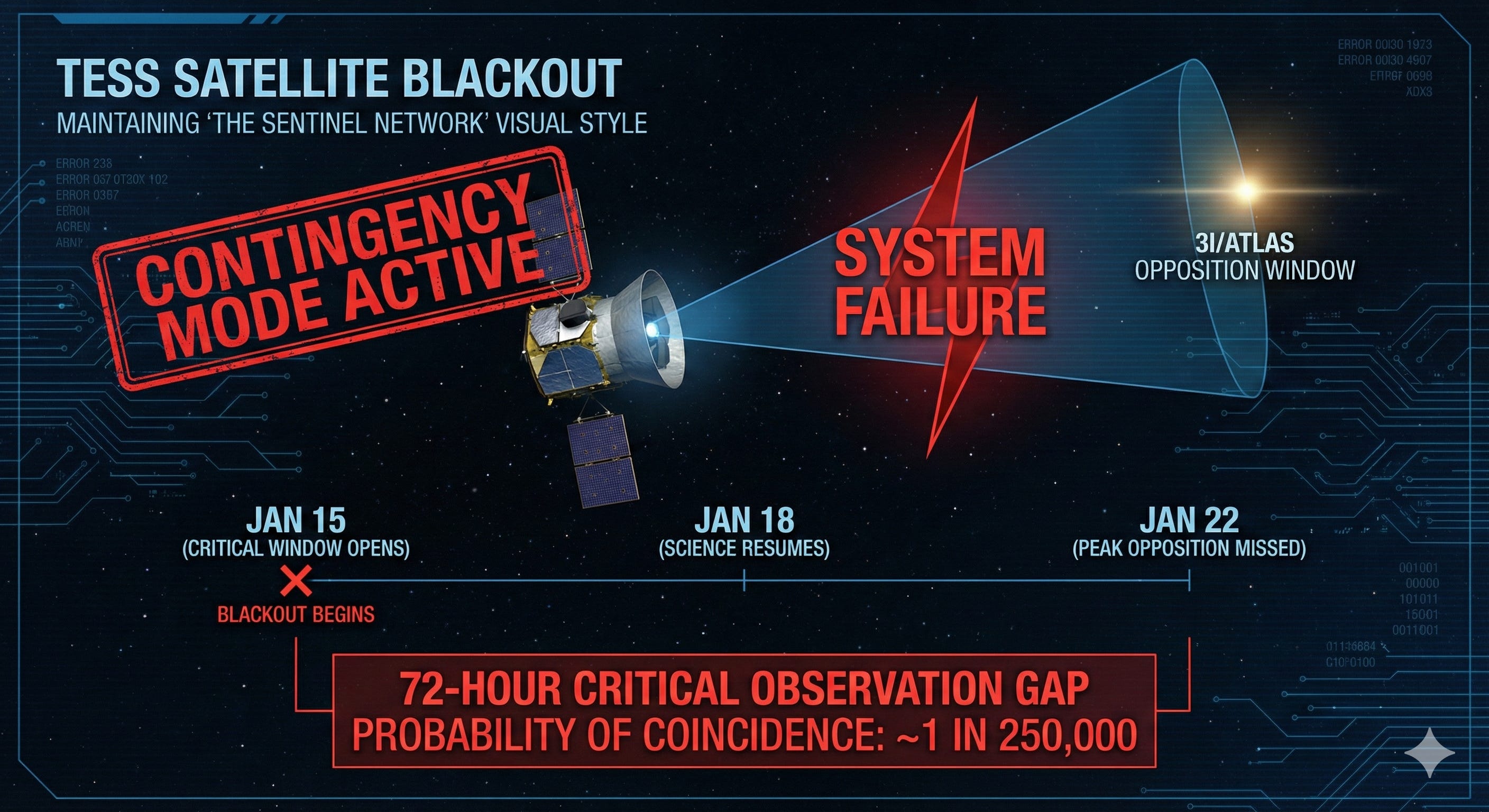
Event One: TESS Goes Offline.
Two days earlier, on January 13, Avi Loeb and Mauro Barbieri published a paper (arXiv:2601.08624) predicting that 3I/ATLAS would reach peak opposition on January 22 at a phase angle of 0.69°. Opposition is the alignment where Earth sits directly between the Sun and the target — the geometry that maximizes backscattered light and reveals surface properties. For a “comet,” this should be unremarkable. For a solid, reflective object — a hull, a sail, a structured surface — opposition produces a diagnostic brightness spike called an opposition surge. This was the window. This was the test.
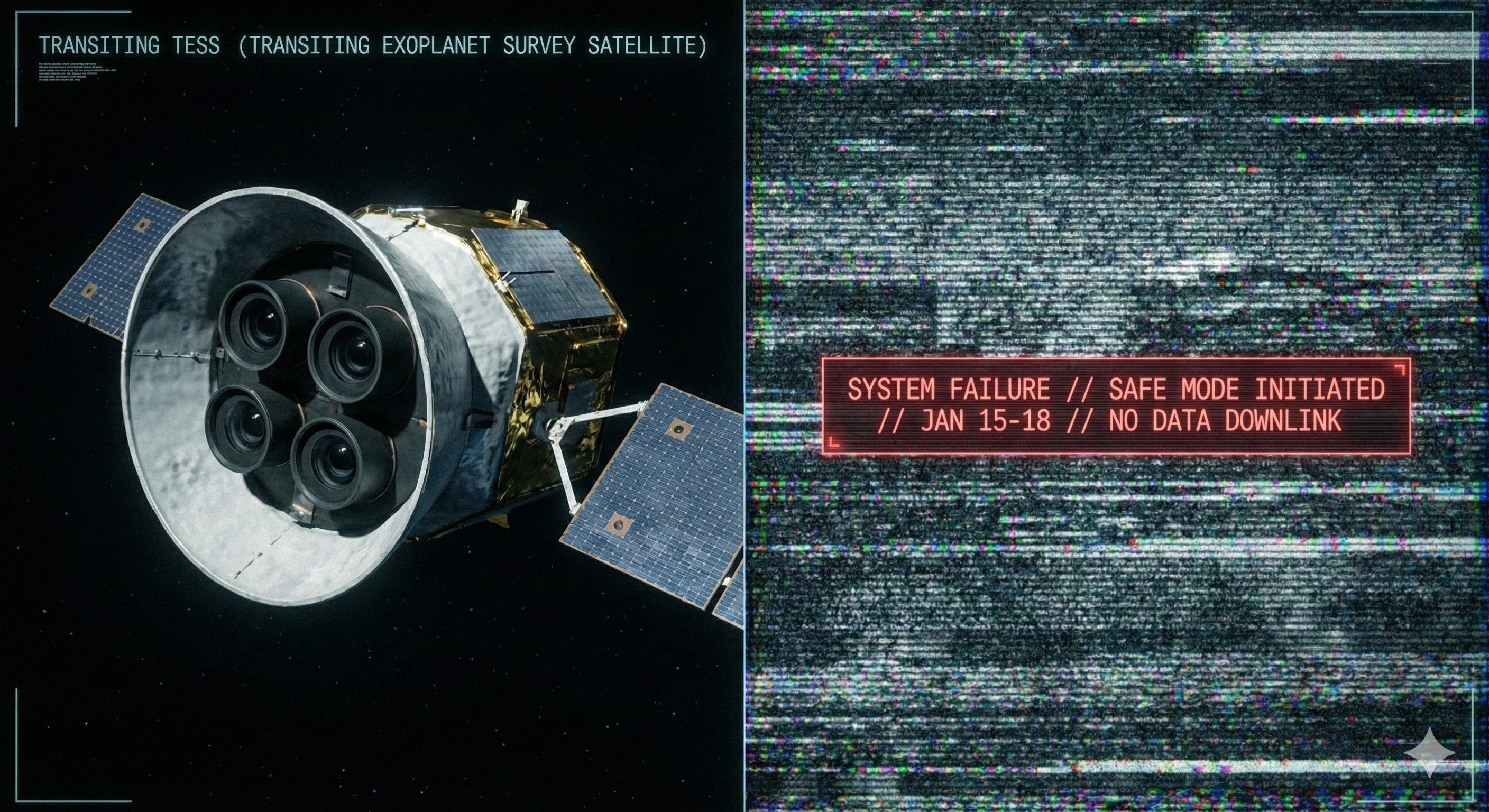
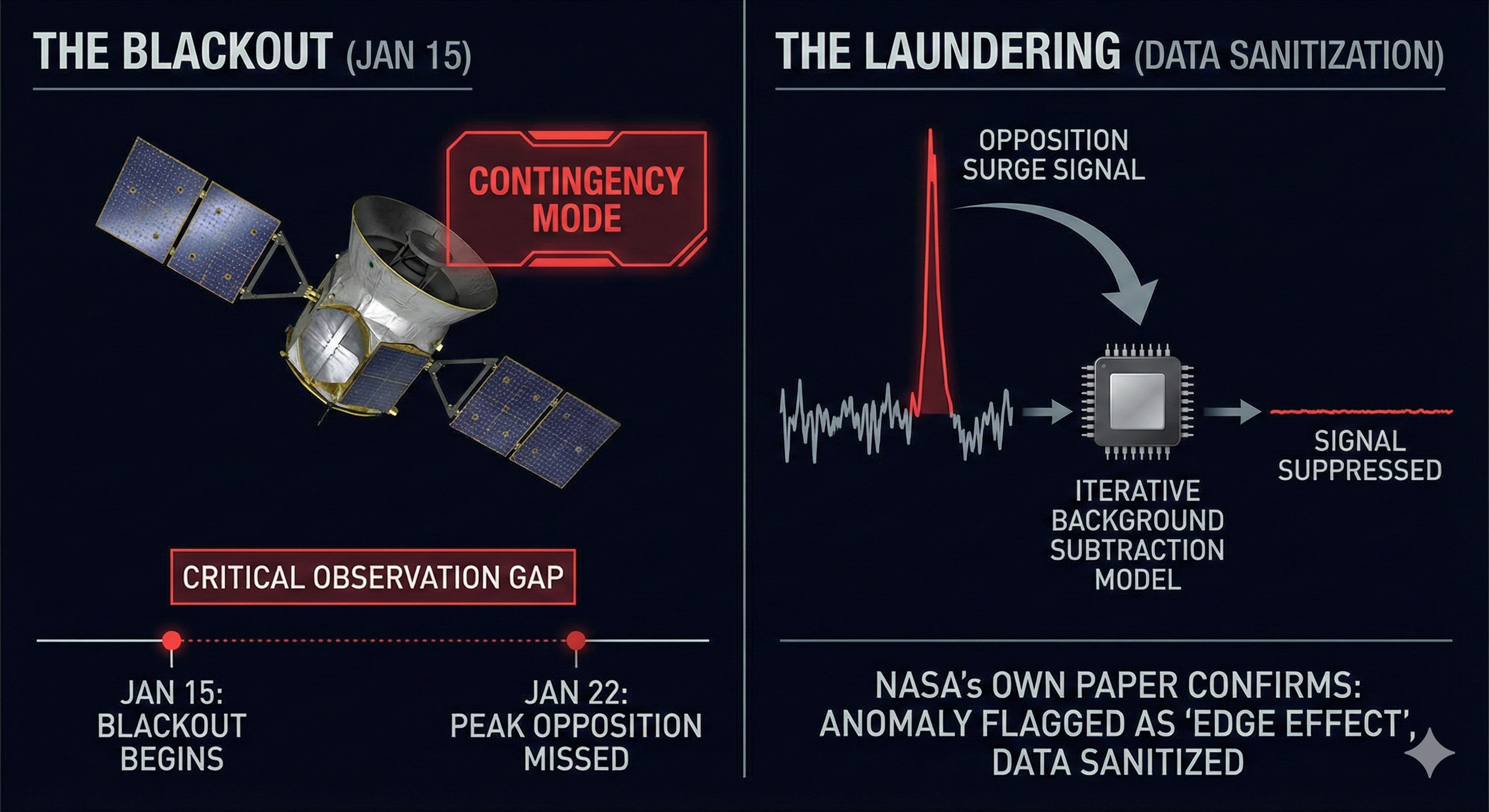
On January 15, the moment 3I/ATLAS entered opposition geometry, TESS dropped into what NASA now calls “contingency mode.” It stayed dark for seventy-two hours.
Event Two: Crew-11 Emergency Evacuation.
On that same day — January 15 — SpaceX Crew-11 executed an emergency return from the International Space Station, splashing down off the California coast at 03:41 local time. As we documented in SITREP: The Pacific Diversion, the operational footprint of this evacuation contradicts the official “medical issue” narrative at every level. The capsule used a rare Pacific trajectory instead of the standard Atlantic recovery zone. All four crew members were transported to a medical facility in San Diego — not Houston — and held together “for observation.” NASA cited the “fastest return window” as justification, confirming extreme urgency. The ISS was left with a skeleton crew of three.
We wrote: “The decision to treat the healthy crew as ‘patients’ rather than ‘passengers’ is a telltale sign of containment.”
The timing is the data. TESS goes blind and the station evacuates on the same day. The probability of these events co-occurring by chance is a question we leave to our readers.
Event Three: The Opposition Window Opens.
As TESS sat in darkness and the ISS crew was being contained in San Diego, 3I/ATLAS began its transit through the most revealing observational geometry of its entire solar system passage. The window was open. The instruments were off. The witnesses were removed.
THE OPPOSITION SURGE: WHAT HUBBLE SAW WHILE TESS WAS BLIND
TESS was offline. But Hubble was not.
On January 29, a team led by Man-To Hui and David Jewitt submitted their analysis (arXiv:2601.21569v1) of Hubble observations taken during the opposition window. What they found is the data point that, in our assessment, explains the blackout.
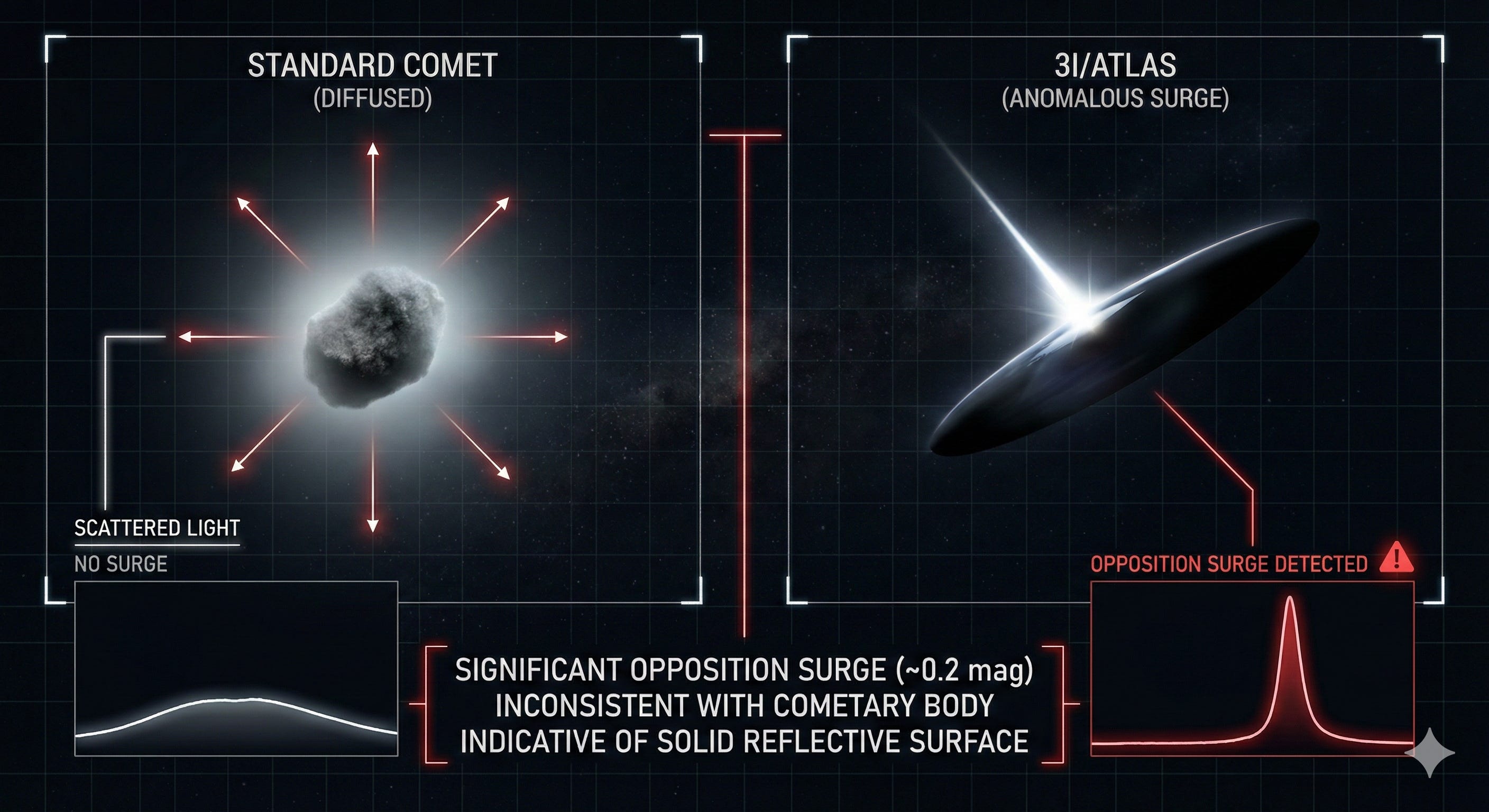
3I/ATLAS produced a significant opposition surge of approximately 0.2 magnitudes — a sharp brightness spike characteristic of coherent backscatter from solid, compact surfaces. Not the diffuse glow of a dusty coma. A flare.
The Hubble team’s own paper acknowledged what this means. This kind of surge is “widely observed among asteroids, planetary rings, and miscellaneous other airless bodies” but “not a standard feature of comets.” Among the few comets ever studied in this regime, none exhibited a distinct opposition effect.
Only one comet in recorded history has ever shown a measurable opposition surge: 67P/Churyumov-Gerasimenko, studied at close range by the Rosetta spacecraft. Its surge measured 0.15 magnitudes. 3I/ATLAS produced a stronger signal from interstellar distance.
As we wrote in The Surge on February 3: “The ‘dust’ surrounding 3I/ATLAS possesses ‘unusual physical properties.’ It scatters light like a solid surface or a dense debris field of rings — not like the fluffy ice-halo of a natural comet.”
The opposition surge is the optical signature of structured material. A metallic hull. A sail membrane. Industrial alloys with high backscatter efficiency. This is what TESS — the instrument purpose-built for high-cadence photometric monitoring — was uniquely positioned to capture in continuous, time-resolved detail during the January 15-22 window.
This is what was lost to “contingency mode.”
We wrote it then: “The ‘Safe Mode’ was the curtain; the Opposition Surge was the show.”
THE STATISTICAL IMPOSSIBILITY
TESS has operated since 2018. Eight years. Nearly three thousand days of continuous observation, cataloguing thousands of stars and planetary systems with extraordinary reliability.
The historical contingency rate yields approximately a 0.05% probability of failure on any given day. The probability of that failure aligning with this specific three-day opposition approach window: roughly one in 250,000.
For context, your odds of being struck by lightning in a given year are one in 500,000. A royal flush in poker: one in 649,740.
NASA is asking us to believe that their flagship survey telescope suffered a spontaneous catastrophic failure during the precise 72-hour window when an interstellar object exhibiting eighteen anomalies consistent with artificial origin was entering the one geometric alignment that would most clearly reveal its surface properties.
We documented this blackout on January 30 — thirteen days before NASA’s paper admitted it.
THE PROCESSING QUESTION
The blackout is only the first layer. What NASA did with the data they did capture deserves scrutiny.
Their paper describes an “iterative” background subtraction protocol. They built a mathematical model of what the sky should look like, masked out the comet, and subtracted everything that didn’t conform. Then they ran it again. And again. Refining until the output was clean.
We warned this would happen. On December 18, in The Sentinel Dossier, we predicted that institutional bodies would attempt to “smooth” anomalous data through background subtraction, stripping optical signatures under the cover of routine processing. Three months later, NASA described the exact methodology we anticipated.
Consider the implications. If the opposition surge manifested in TESS data as it did in Hubble’s — a sharp, directed reflection from a solid surface — an aggressive iterative subtraction algorithm could classify those photons as “scattered light” and remove them. The very signal that makes this object extraordinary could be mathematically subtracted, frame by frame, iteration by iteration.
Project Archimedes — Phase 1 Results:
The Sentinel has now independently verified the raw data. Our forensic pipeline acquired 730 photometric measurements from the raw calibrated Full Frame Images across Block 3 (January 19-22), tracking the comet’s motion through JPL Horizons ephemerides at every 200-second cadence interval. At the macro level, the raw light curve and NASA’s processed HLSP light curve are broadly consistent, with the target showing a clear detection at ~1100-1500 e⁻/s — the expected flux range for 3I/ATLAS.
This matters. The raw data is publicly available, and at first-order, the processed product reflects it. We report this because The Sentinel follows the data, not a narrative.
But macro consistency is not the same as sub-percent fidelity. The opposition surge Hubble detected was 0.2 magnitudes — roughly a 20% brightness variation concentrated in a narrow phase-angle window. Whether that signal survived NASA’s iterative background subtraction intact is a question that requires delta analysis: subtracting the processed curve from the raw curve, point by point, with control stars, error propagation, and proper SNR calculation. That analysis is now underway.
And there is a tell that suggests where to look.
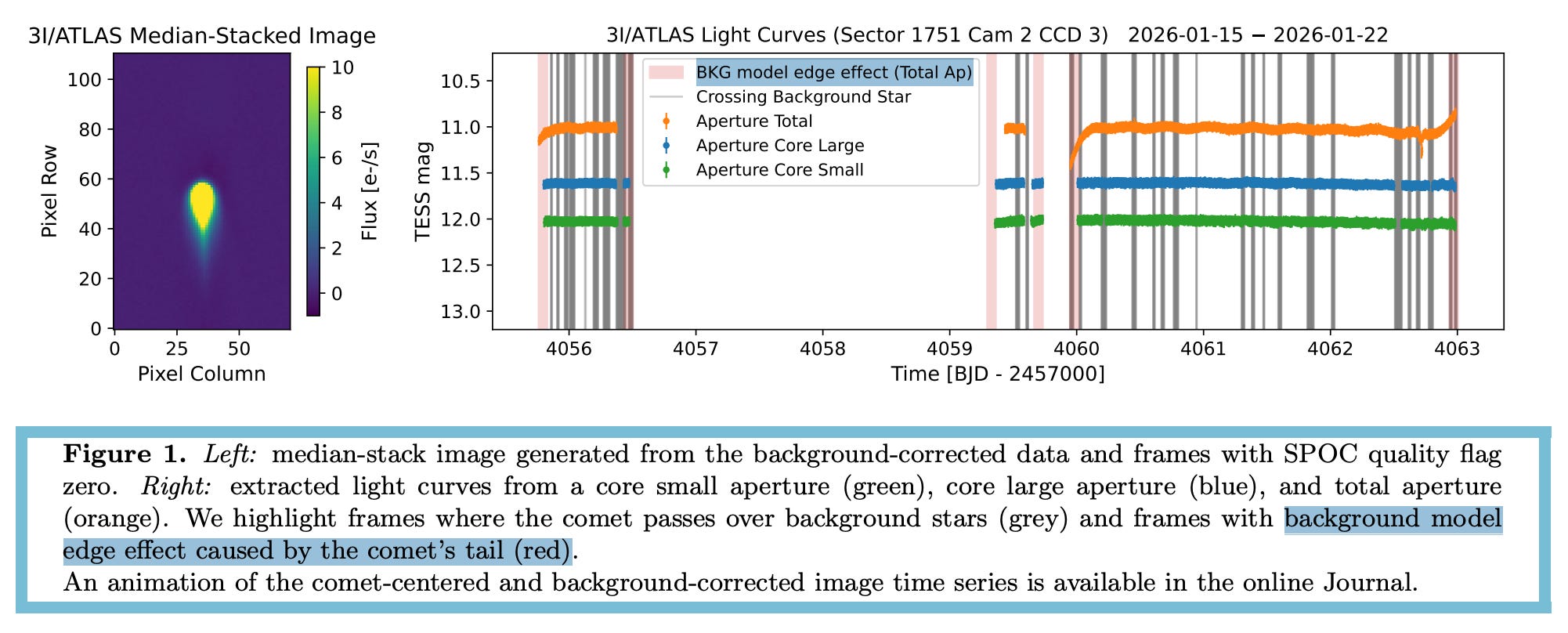
On page two of their paper, Figure 1 flags certain frames in red with a revealing label: “background model edge effect caused by the comet’s tail.” Their physics model couldn’t handle the tail’s behavior. Instead of investigating why the tail was breaking their framework — instead of asking what physical property was generating anomalous scatter — they flagged it as an error and excluded those frames.
This is not science. This is data curation. You don’t flag the anomaly as the error. The anomaly is the finding.
THE COVERUP: FIVE LAYERS DEEP
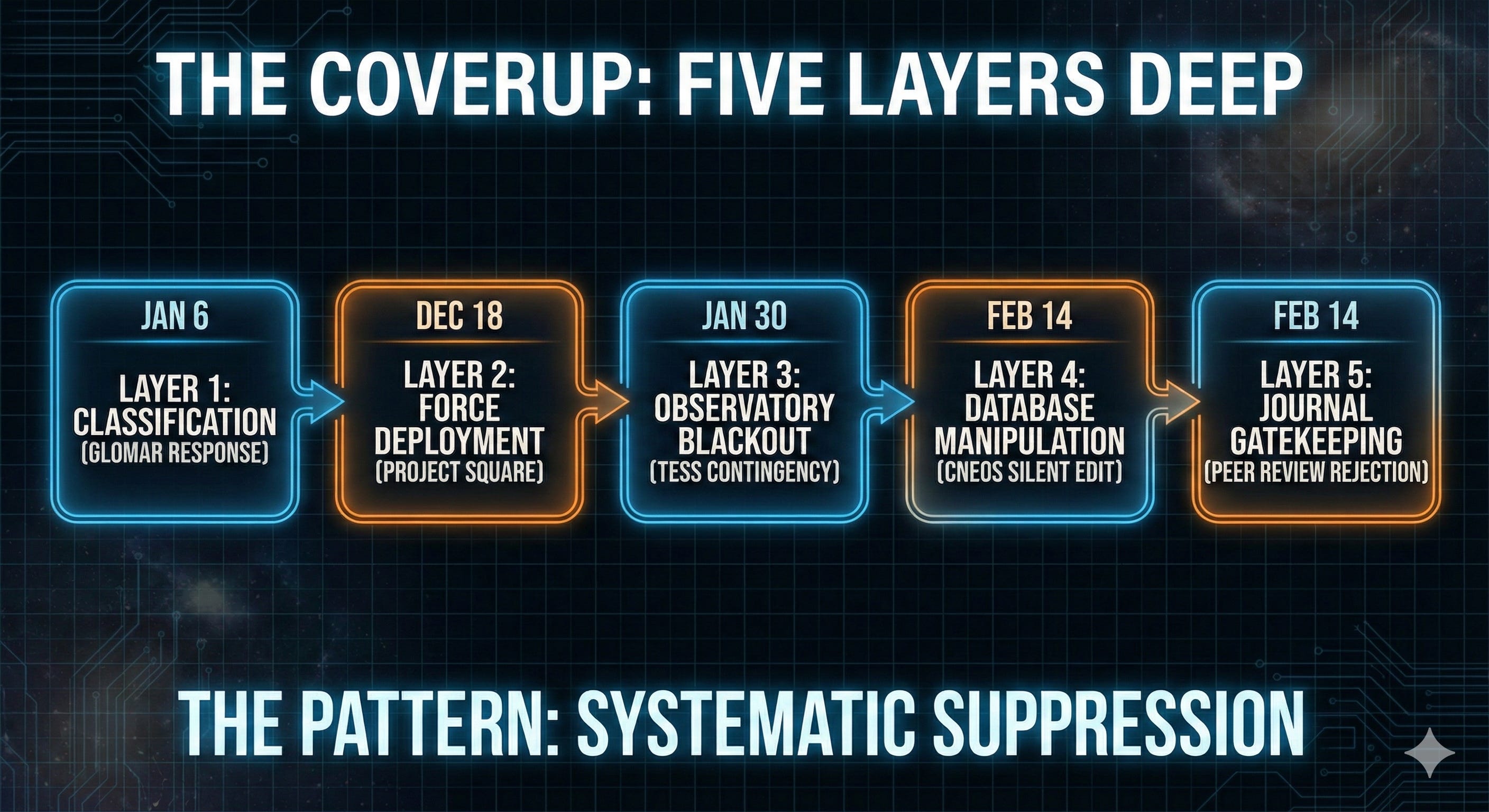
What elevates this from institutional negligence to systematic suppression is the pattern. We are not dealing with one bureaucratic failure. We have documented five independent layers of information management, each targeting the same anomaly from a different angle. Taken individually, each might be explained. Taken together, they describe a coordinated protocol.
LAYER 1: CLASSIFICATION — THE GLOMAR CONFIRMATION, January 6
On January 6, we reported that the CIA had issued a Glomar Response to a FOIA request about 3I/ATLAS. Under FOIA law, an agency can only invoke Glomar if the mere act of admitting a file exists would compromise National Security or reveal Intelligence Sources and Methods.
If you ask the CIA for files on Halley’s Comet, they tell you they have no records. Comets are not intelligence targets. But the CIA placed 3I/ATLAS in the same legal category as foreign weapons systems and covert operations.
As we wrote: “NASA says 3I/Atlas is a rock. The CIA says it is a matter of National Security. Both cannot be true.”
The Glomar response implies that National Technical Means — classified reconnaissance satellites — were tasked to image this object. They aren’t hiding the object. They’re hiding the resolution of the object.
LAYER 2: FORCE DEPLOYMENT — LAUNCH ANOMALY: PROJECT SQUARE, December 18
On December 18, the U.S. Space Force launched the STP-S30 mission — codenamed “Don’t Be Such A Square” — five months ahead of its original April 2026 schedule. The acceleration was announced just 48 hours before launch. The payload: a cluster of sensor platforms deployed into orbit 24 hours before 3I/ATLAS made its closest approach to Earth.
We wrote: “Why does the US Space Force accelerate a ‘test mission’ by five months? Because April 2026 is too late.” The object would be near Jupiter by then.
This wasn’t a test. It was a scramble.
LAYER 3: OBSERVATORY BLACKOUT — THE THREE DAYS OF DARKNESS, January 30
TESS goes dark for 72 hours during the opposition approach window. No public announcement. No press release about the contingency event. The admission was buried in a technical paper on arXiv thirteen days after we reported it.
When the data is finally released, it arrives processed through iterative background subtraction and packaged as a “High Level Science Product” rather than raw observations. Our independent verification confirms the raw data is publicly accessible and macro-level consistent with the processed output. The question that remains — and that Phase 2 of Project Archimedes is designed to answer — is whether the processing methodology removed sub-percent anomalous signals in the opposition peak window.
LAYER 4: DATABASE MANIPULATION — THE SILENT EDIT, February 14
After Avi Loeb and Richard Cloete identified two potentially interstellar meteors in NASA’s CNEOS fireball database, the database was silently edited within 24 hours. A single velocity vector sign was flipped — a tiny mathematical change that forced one meteor’s calculated origin back inside the solar system. No correction notice. No announcement. The edit was discovered only because Loeb had archived the original data through the Internet Archive’s Wayback Machine.
As we wrote: “A silent, retroactive edit made only after a challenging paper is published is not science; it is a cover-up.”
LAYER 5: JOURNAL GATEKEEPING — THE SILENT EDIT, February 14
Simultaneously, a prestigious astrophysics journal refused to send Loeb’s papers on 3I/ATLAS anomalies to peer review, claiming they would be of “limited interest to the astrophysics research community.” The editor used identical template language to reject two previous 3I/ATLAS papers — both of which were later published in Monthly Notices of the Royal Astronomical Society and generated widespread scientific discussion.
We wrote: “When a single individual can unilaterally decide that the analysis of a potential interstellar probe is of ‘limited interest,’ they are not acting as an editor; they are acting as a filter for ‘acceptable’ reality.”
THE PLAYBOOK
Map the layers and the protocol becomes visible:
Classify the object at the intelligence level (Glomar). Deploy assets to image it with classified resolution (Project Square). Blind the civilian instruments during the most diagnostic window (TESS contingency). Scrub the databases when independent researchers find corroborating evidence (CNEOS edit). Gate the journals to prevent peer-reviewed publication of anomalous findings. Process whatever data does emerge through iterative subtraction before public release — a methodology that could mask the very signals independent researchers are looking for.
At every layer, the same object is being targeted. At every layer, the response is the same: smooth, reject, hide, exclude.
As we wrote in The Surge: “The suppression is no longer subtle — which means we are getting closer to the signal.”
THE GHOST FLEET
There is one more finding from the Hubble team’s paper that deserves attention, because it reframes the entire conversation.
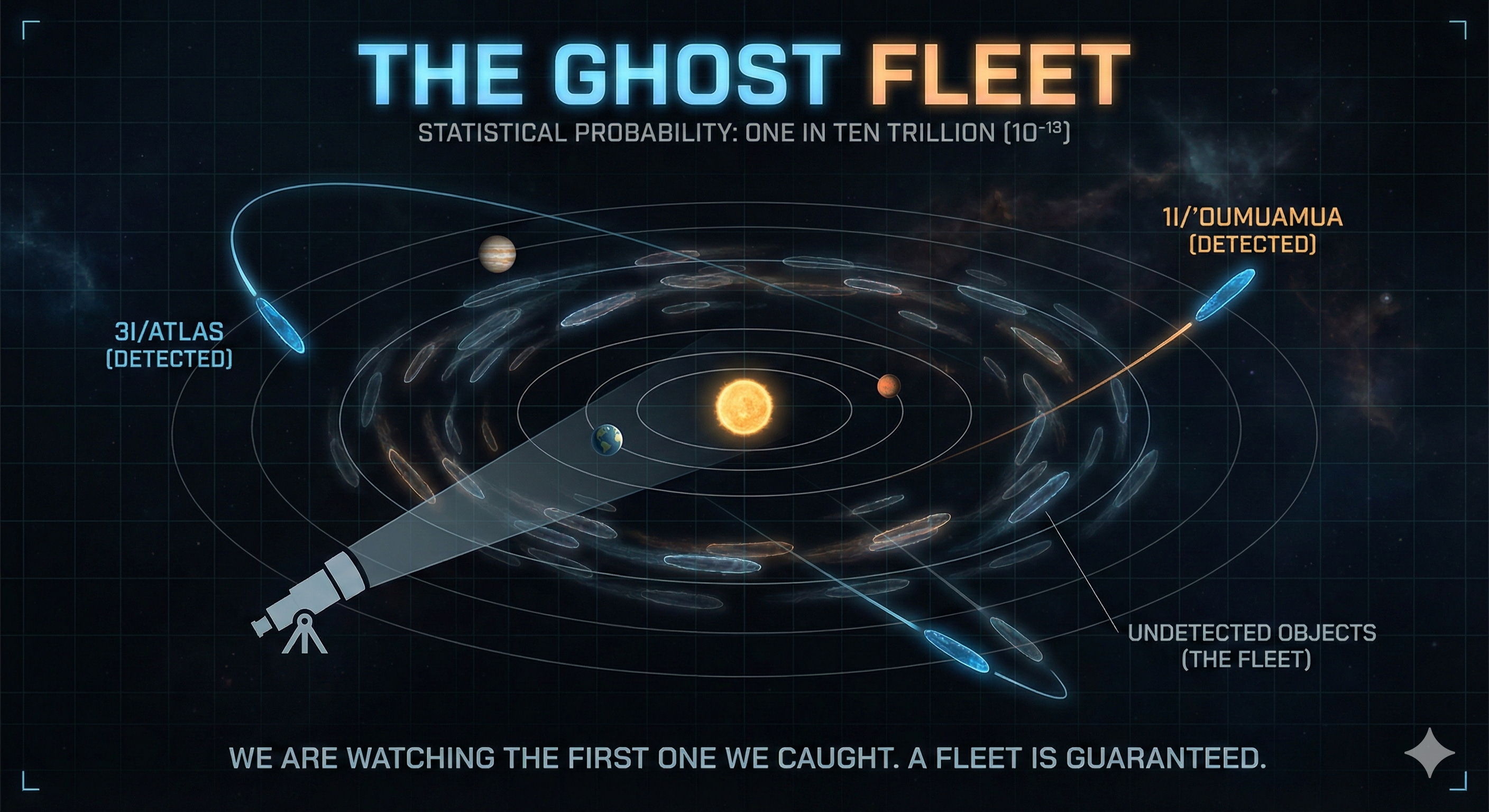
The authors calculated the probability that no objects of 3I’s size passed through the inner solar system between the mid-1990s and 2017 — the gap between modern surveys and 3I’s detection. The result: 10⁻¹³. One in ten trillion.
Their conclusion: it is “highly probable that several 3I-like interstellar objects passed through the inner solar system undetected.”
We are not watching a singular event. We are watching the first one we caught.
And the new data confirms a troubling consistency. Both 3I/ATLAS and 1I/’Oumuamua — the only two interstellar objects observed in enough detail to characterize — share what we called in The Surge a “Standardized Configuration.” Both exhibit elongated axis ratios (the “cigar” shape). Both show statistically significant non-gravitational acceleration. Both display activity asymmetry — brightening on approach, fading on departure. As we wrote: “It turned off the lights on the way out.”
One anomalous visitor is a curiosity. Two with matching specs is a pattern. A statistical guarantee of many more unseen is a fleet.
PROJECT ARCHIMEDES: STATUS REPORT
Phase 1 is complete.
The Sentinel has independently acquired the raw calibrated Full Frame Images from TESS Sector 1751 — Camera 2, CCD 3, January 15-22, 2026 — through the MAST archive. Our pipeline tracked 3I/ATLAS across seven TESSCut cutouts using JPL Horizons ephemerides, extracting 730 photometric data points with aperture photometry and local background subtraction.
Phase 1 Finding: The raw TESS data is publicly available and intact. The macro-level light curve is broadly consistent with NASA’s processed HLSP output. No evidence of data withholding or archive manipulation was found. We publish this finding because transparency is the methodology, not the obstacle.
Phase 2 — Now Active: Delta analysis. The raw and processed datasets are now aligned. What remains is the frame-by-frame comparison — subtracting the HLSP light curve from the raw light curve to isolate residuals, running the same analysis on control stars for null testing, and calculating whether any statistically significant signal was removed by NASA’s iterative background subtraction. Particular attention will be paid to the frames NASA flagged as “edge effects” and excluded from their model.
If the opposition surge is present in the raw data but absent from the processed output, the delta will show it. If it isn’t, we will report that too.
Access the raw data yourself at mast.stsci.edu. Search for TESS Sector 1751, Camera 2, CCD 3, date range January 15-22, 2026. Download the raw calibrated FFIs — not the HLSP products.
29 DAYS
The Jupiter Rendezvous is March 16, 2026. Twenty-nine days from today.
If The Sentinel Dossier is correct — if the Hill Sphere intercept at 53.5 million kilometers represents an orbital insertion point — then we are less than a month from the moment this object reaches its apparent destination. The moment it does whatever it came here to do.
The CIA classified it. The Space Force scrambled sensors for it. NASA blinded their telescope during its most revealing window. The databases are being scrubbed. The journals are being gated. The data is being laundered.
And in 29 days, it arrives at Jupiter.
We have the timestamps. We have the archives. We have the receipts. Every prediction The Sentinel has made — the blackout dates, the opposition surge, the data sanitization methodology — has been confirmed by NASA’s own subsequent publications.
Now we’re verifying the raw data. Phase 1 says the data is there. Phase 2 will tell us what’s in it.
STATUS: OPEN // INVESTIGATION ACTIVE // ARCHIMEDES PHASE 2 IN PROGRESS
CALL TO ACTION
Subscribe to The Sentinel for updates on Project Archimedes Phase 2 delta analysis.
Download the raw Sector 1751 FFIs from MAST and run your own comparison.
Archive everything. As The Silent Edit documented, retroactive edits have already occurred elsewhere.
Share this investigation. Institutional gatekeeping only works when the gates are respected.
The “Safe Mode” was the curtain.
The Opposition Surge was the show.
The raw data is the evidence.
And Jupiter is 29 days away.
Keep looking up.
— The Sentinel
Is there any other non-US satellite or telescope the data could be gathered from?
This is some top notch OSINT and presentation. Keep up the great work.