

SUBJECT: HUTSEMÉKERS ET AL. PAPER II (ARXIV:2605.07652) // POST-PERIHELION VLT/UVES METALS
DATE: MAY 28, 2026
CROSS-REF: THE ANCIENT ENGINE | THE OPERATING SYSTEM | THE VERDICT | THE PUBLICATION GAP
DATA CONFIDENCE: VERIFIED (ARXIV:2605.07652, 12 VLT/UVES SPECTRA DEC 4 2025 TO FEB 22 2026) + ANALYSIS (SENTINEL CROSS-REFERENCE)
We are building the video side of this operation. If you want the briefings in a format you can watch, subscribe to The Sentinel Network on YouTube.
THE RETURN
On May 8, eleven astronomers led by Damien Hutsemékers at the University of Liège in Belgium published the most complete observational record of iron and nickel emission from 3I/ATLAS ever assembled.
Iron and nickel show up in many comets. They have never shown up at the distances 3I/ATLAS was showing them. The Belgian team built an explanation for that anomaly in their first paper on the object. Paper II is the defense.
Read the conclusions section and the defense is in trouble.
Twelve high-resolution observations. Eleven weeks. From the orbit of Mars out to the inner edge of the asteroid belt. By the team’s own description, the most exhaustive record of cometary metal emission ever published.
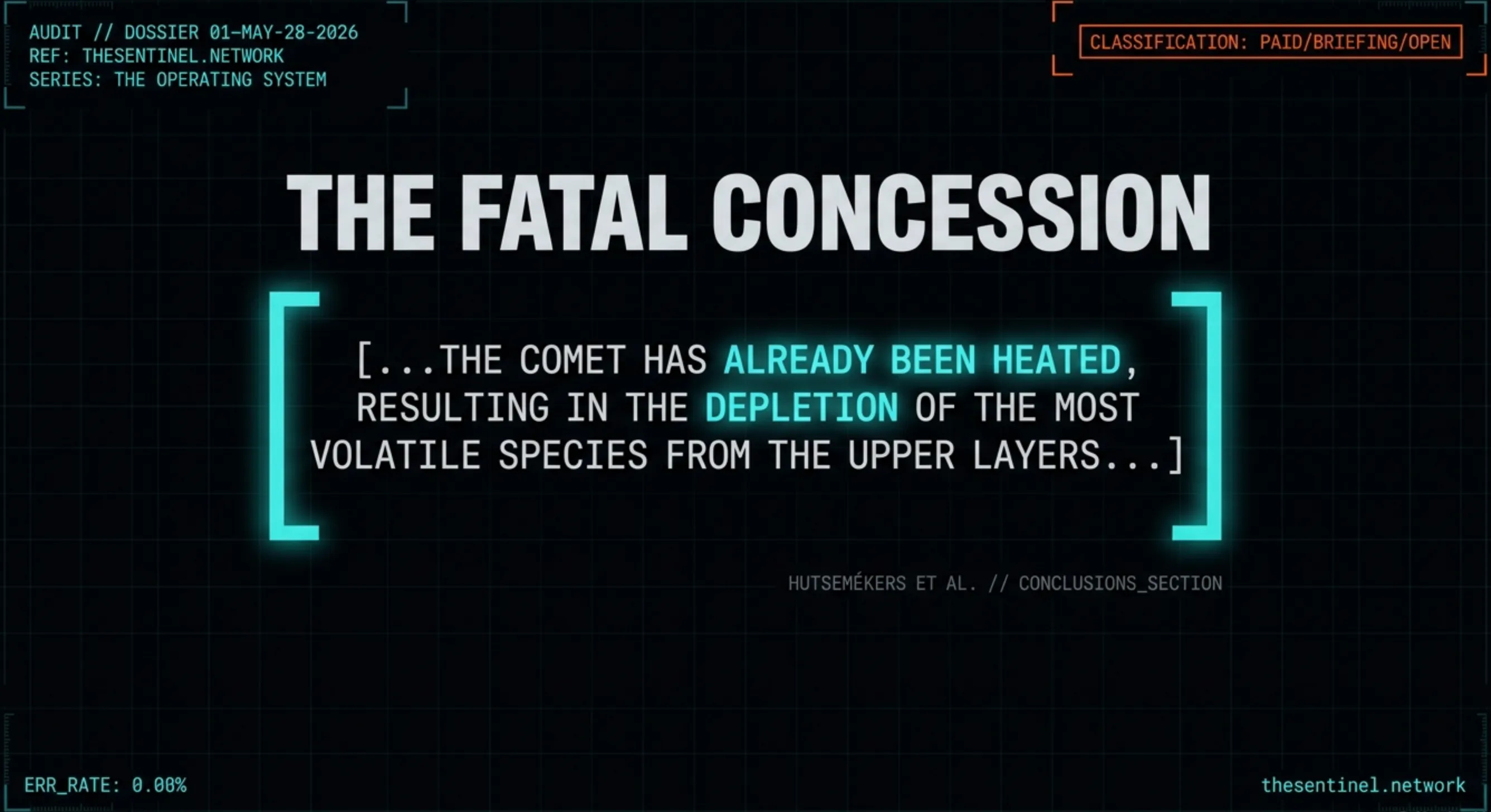
From the paper’s own conclusions section, verbatim: “the comet has already been heated, resulting in the depletion of the most volatile species from the upper layers.”
In plain terms: 3I/ATLAS’s surface was cooked before it got here. The easy-to-evaporate compounds are gone from the top. What remains is buried beneath a processed crust.
That is not the description of a pristine comet. That is the description of a body whose original surface has already been weathered away.
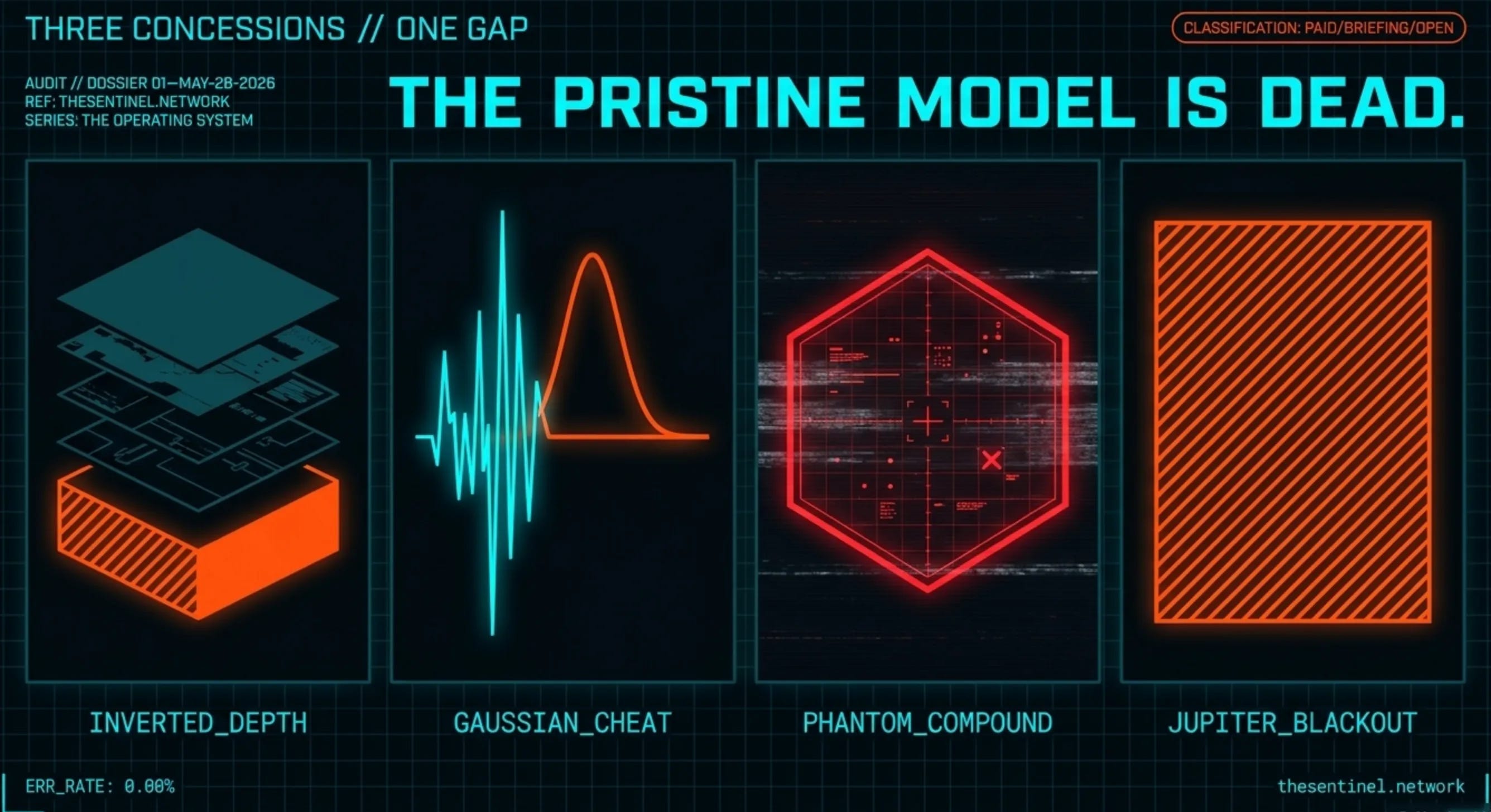
Three concessions hold the model together.
The source of the chemistry had to be moved below the surface.
A hand-fitted heat patch had to be added to the team’s model at exactly the temperature they needed.
The two compounds the explanation proposes as the source of the metals have never been directly detected in any comet. Not in 3I/ATLAS. Not in any solar system comet. Not even in comet 67P/Churyumov-Gerasimenko after two years of orbital observation by the Rosetta spacecraft.
The Liège observations stop on February 22 at 4.35 astronomical units from the Sun. The closest approach to Jupiter was on March 16. We will come back to that gap. It matters.
THE SENTINEL ASSESSMENT:
Eleven authors. Twelve observations. Three concessions. A Belgian team defending 3I/ATLAS as a pristine interstellar comet just published data that says its surface was cooked before it arrived. Their words. Not ours.
THE TWO TEAMS
Two teams. Two instruments. Two continents. Same finding.
The Liège team measured the iron and nickel coming off 3I/ATLAS for eleven weeks as it moved away from the Sun. They expected symmetric behavior on each side of closest approach. Closer to the Sun, more activity. Further from the Sun, less. Inbound and outbound should mirror each other.
They got the opposite.
The fade-out as the comet moved away from the Sun was slower than the ramp-up had been on the way in. Iron faded slower than nickel. The comet burned hotter on the way out than on the way in.
This was not a Liège-only finding.
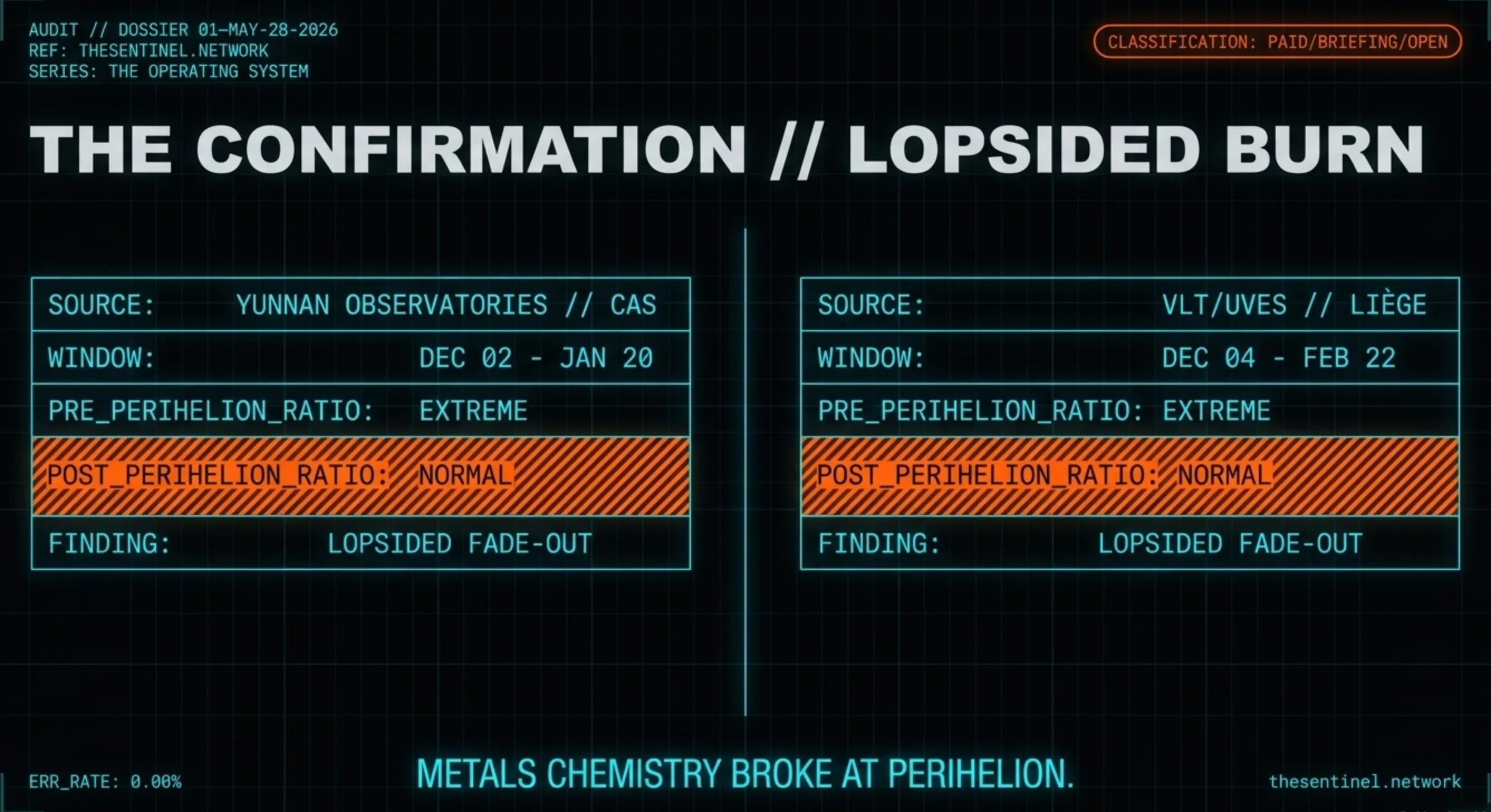
The Chinese Academy of Sciences team had already measured the same lopsided pattern. We covered their result in THE ANCIENT ENGINE. Their campaign ran from the Yunnan Observatories in southern China. Two ground telescopes. December 2, 2025 to January 20, 2026. Lower-resolution measurements. Wider wavelength coverage. Different geographic vantage. Same conclusion. The fade-out after closest approach was slower than the ramp-up before it.
Liège acknowledges the Chinese measurements directly. Iron numbers in excellent agreement. Nickel numbers different by about a factor of two. Lopsidedness confirmed in both datasets.
Two teams. Two instruments. Two methodologies. One confirmed finding.
Liège has something the Chinese team did not. Precision. Their instrument can separate the individual chemical fingerprints of iron and nickel that the Chinese telescopes saw as a blur. That precision tracks the nickel-to-iron ratio across twelve specific points in the orbit.
The ratio is the cleaner number. Before closest approach: extreme. Near closest approach: normal. After closest approach: still normal.
The comet did not start ordinary and become weird. It started weird, became ordinary near closest approach, and stayed ordinary on the way out.
That trajectory is what you would expect if something was being depleted.
THE SENTINEL ASSESSMENT:
The metals chemistry of 3I/ATLAS broke at perihelion. Two independent teams using two instruments confirmed it. The chemistry leg of THE VERDICT is more strongly evidenced today than at any point since March 17.
THE DEPTH
The Liège team built a full temperature model of 3I/ATLAS. Every depth below the surface. Every distance from the Sun. Eleven weeks of observations. Then they fit the model to the measured iron and nickel data.
The fit failed at the surface.
A standard comet has ice on the surface. Sunlight heats the ice. The ice turns directly to gas. The gas carries chemistry with it into the comet’s atmosphere. Surface temperature has a well-understood relationship to distance from the Sun, refined for half a century. Closer is hotter. Further is colder.
The Liège model predicted surface temperatures too cold to release enough of the carbonyl compounds to match the metals actually observed. Their conclusion in Paper II: “the sublimation could occur below the surface of the nucleus.” Sublimation is the technical term for ice turning directly to gas. The conclusion translates: the chemistry is not happening on the surface. It is happening underneath.
So they moved the source layer down.
Five centimeters or deeper after closest approach. The required depth grows as the comet moves further from the Sun.
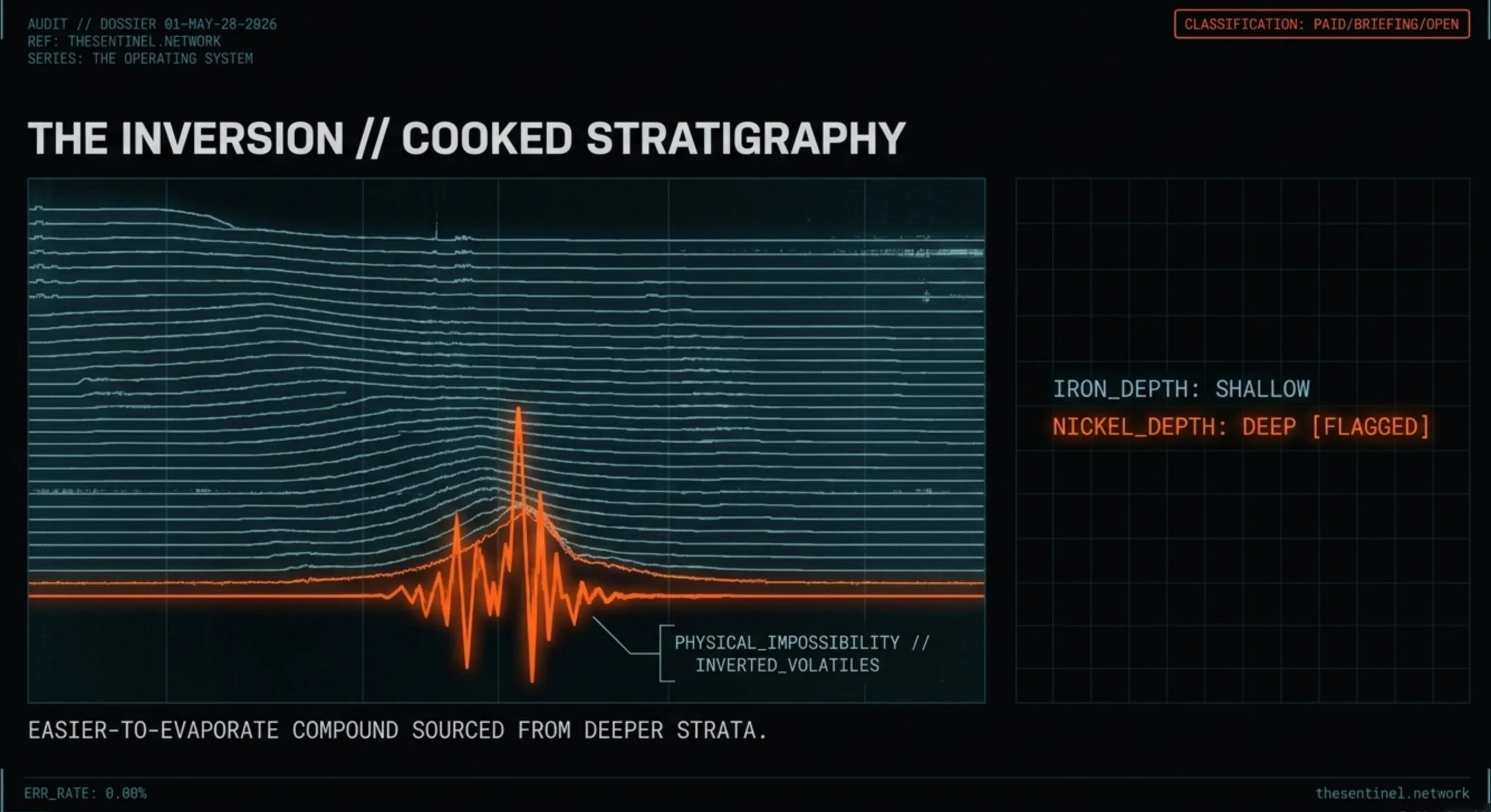
Then comes the strange part. Nickel carbonyl boils at a lower temperature than iron carbonyl. It is the easier of the two to evaporate. In a comet warmed by the Sun, the easier-to-evaporate compound should be the one coming off the top.
Liège’s model says the opposite. The nickel is being sourced from deeper than the iron.
Read that sentence twice. The easier-to-evaporate compound is the one buried deeper.
A pristine comet cannot produce this pattern. Pristine means frozen since formation, with everything spread evenly throughout the nucleus. Warm it with sunlight. The volatile compounds come off the top first. They have to. That’s where the heat is.
There is only one way to get the inverted picture Liège is measuring: the volatile compounds near the top are already gone. They were burned off in some earlier heating event. What the telescope sees now is what survived. What survived was deep enough to escape the burn.
Think of the high-tide line on a beach. The footprints below the high-tide line get erased. The footprints above it survive. If a beachcomber arrived hours later and asked “where can I find footprints,” the answer would not be “near the water.” It would be “above where the water reached.” Not because anyone moved them. Because the shallow ones are gone.
That is the architecture of 3I/ATLAS’s upper layers. The volatile compounds near the top are not missing because they moved. They are missing because they were destroyed. The depth where the chemistry now starts is the depth where it survived.
The team is explicit about what this means. Their own words: “the comet has already been heated, resulting in the depletion of the most volatile species from the upper layers.”
In plain terms: 3I’s surface was cooked before it got here. The easy-to-evaporate stuff is gone from the top. What remains is buried beneath a processed crust.
The cooking happened before 3I got here. We have observed every part of its passage through our solar system. The depleted-from-the-top pattern was already there in the earliest measurements. The processing happened somewhere else, sometime else, before 3I/ATLAS entered our system.
In October, Maggiolo et al. modeled exactly this outcome. Galactic cosmic ray bombardment of an interstellar object over billions of years. The model predicts that long-duration cosmic ray exposure breaks down the volatile chemistry in the upper meters of the nucleus. Simpler breakdown products including carbon dioxide accumulate near the surface. The original ices, including the most volatile compounds, are preserved deeper, where the cosmic rays cannot reach.
We covered Maggiolo’s paper in THE ANCIENT ENGINE.
The Belgian team did not cite Maggiolo. They did not invoke cosmic rays. They built a model around carbonyl chemistry.
The data forced them to the same conclusion anyway.
Two completely different physical mechanisms. Two completely different chemical pathways. Two completely different inputs. One layered architecture.
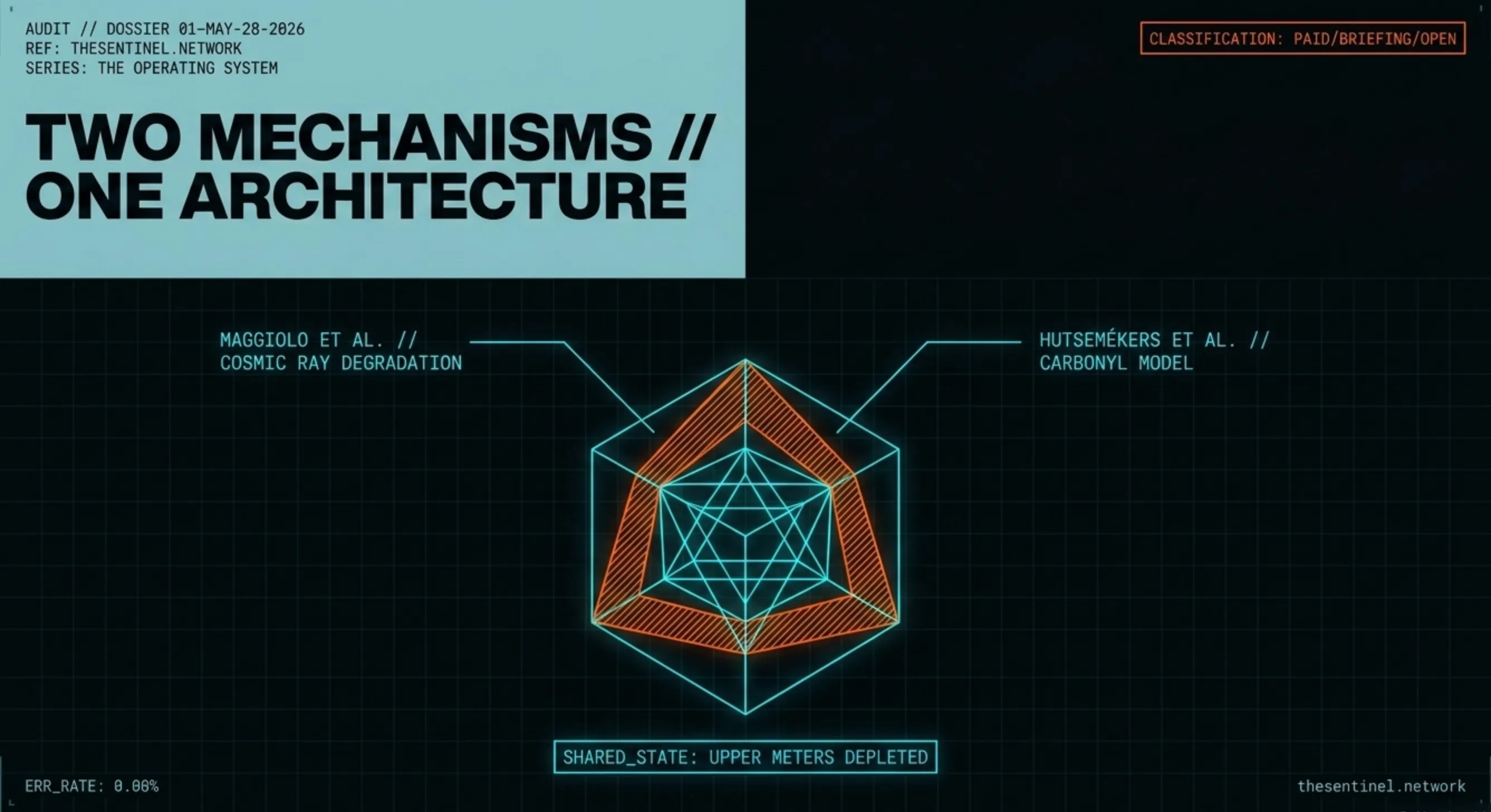
THE SENTINEL ASSESSMENT:
The Liège team could not fit their data with surface chemistry. Their model demanded a body with volatile species depleted from the upper layers and preserved at depth. Their own words. Not ours. The same layered architecture Maggiolo predicted from cosmic ray chemistry. The same architecture we have been describing since October. Two mechanisms. One picture.
THE GAUSSIAN
The Liège temperature model failed on one observation.
Before closest approach to the Sun, the nickel-to-iron ratio in 3I/ATLAS was not just elevated. It was extreme. Their thermal profiles could not produce that ratio under any standard assumption. The temperatures at depth were too cold to release the right amount of the nickel-carrying compound.
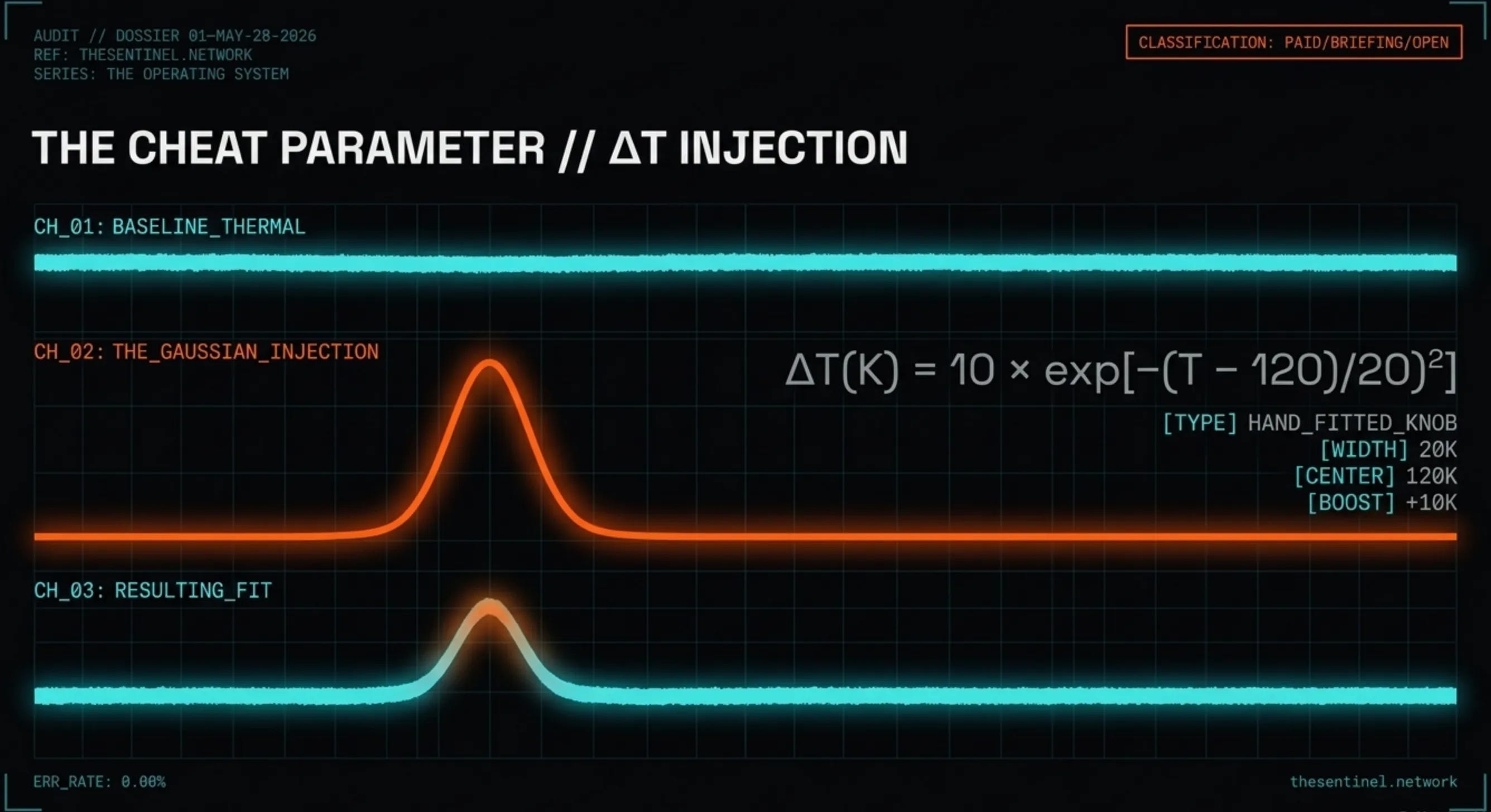
So they cheated.
They needed a hotter source. The standard physics would not give them one. So they invented one and bolted it onto the model.
Their formula: ΔT(K) = 10 × exp[−((T − 120)/20)²].
Three numbers. Ten Kelvin of extra heat. Centered at 120 Kelvin. A bell curve 20 Kelvin wide on each side. Every number hand-picked. Every number chosen to make the math produce the ratio the data already showed.
Picture a chef whose oven thermometer reads 350 but whose cake is burning. Instead of recalibrating the oven, the chef draws a hot zone on the thermometer at 425 degrees and says: there, that is where my cake actually is. Then writes a recipe around it.
The cake is the data. The oven is the model. The hot zone is the Belgian team’s formula.
Physics produces parameters. The Liège team produced the parameters first. Then went looking for the physics.
The team offers physical justification. The 100-140 Kelvin temperature window matches the temperature at which water ice changes its molecular structure. Water ice that forms in deep cold locks into a disordered glass-like state called amorphous ice. Warm it past a threshold. It reorganizes into the regular crystalline ice structure of ordinary frozen water. That reorganization releases heat.
The Liège team suggests this transition could provide a temporary warming burst in exactly the right temperature range. The paper’s own language: the temperature of their additional heat source “roughly corresponds” to the ice transition.
It is a plausible physical mechanism. It is also a hand-tuned knob in a model under pressure. The formula was added first. The physical justification was attached after.
We are not asserting that the ice transition cannot be the right answer.
We are documenting that the model now contains a parameter whose only physical role is to produce the result the data requires.
The data was telling them something. They translated it into a knob.
THE SENTINEL ASSESSMENT:
Ten Kelvin. Centered at 120 Kelvin. Width of 20 Kelvin. Hand-fitted. The numerical parameters were selected first. The physical justification was attached after. This is what model defense looks like when the data is putting pressure on the central hypothesis.
THE COMPOUND
Here is the structural problem with the carbonyl explanation.
Iron and nickel atoms are what the Belgian team’s telescope actually sees in 3I/ATLAS’s atmosphere. Atoms. Individual atoms of iron and nickel, glowing in sunlight.
The carbonyl compounds are something else entirely. They are the proposed parent molecule. The hypothesis says nickel tetracarbonyl and iron pentacarbonyl vaporize from the nucleus, break apart in sunlight, and release the individual atoms the telescope sees. The atoms are observed. The compounds are inferred.
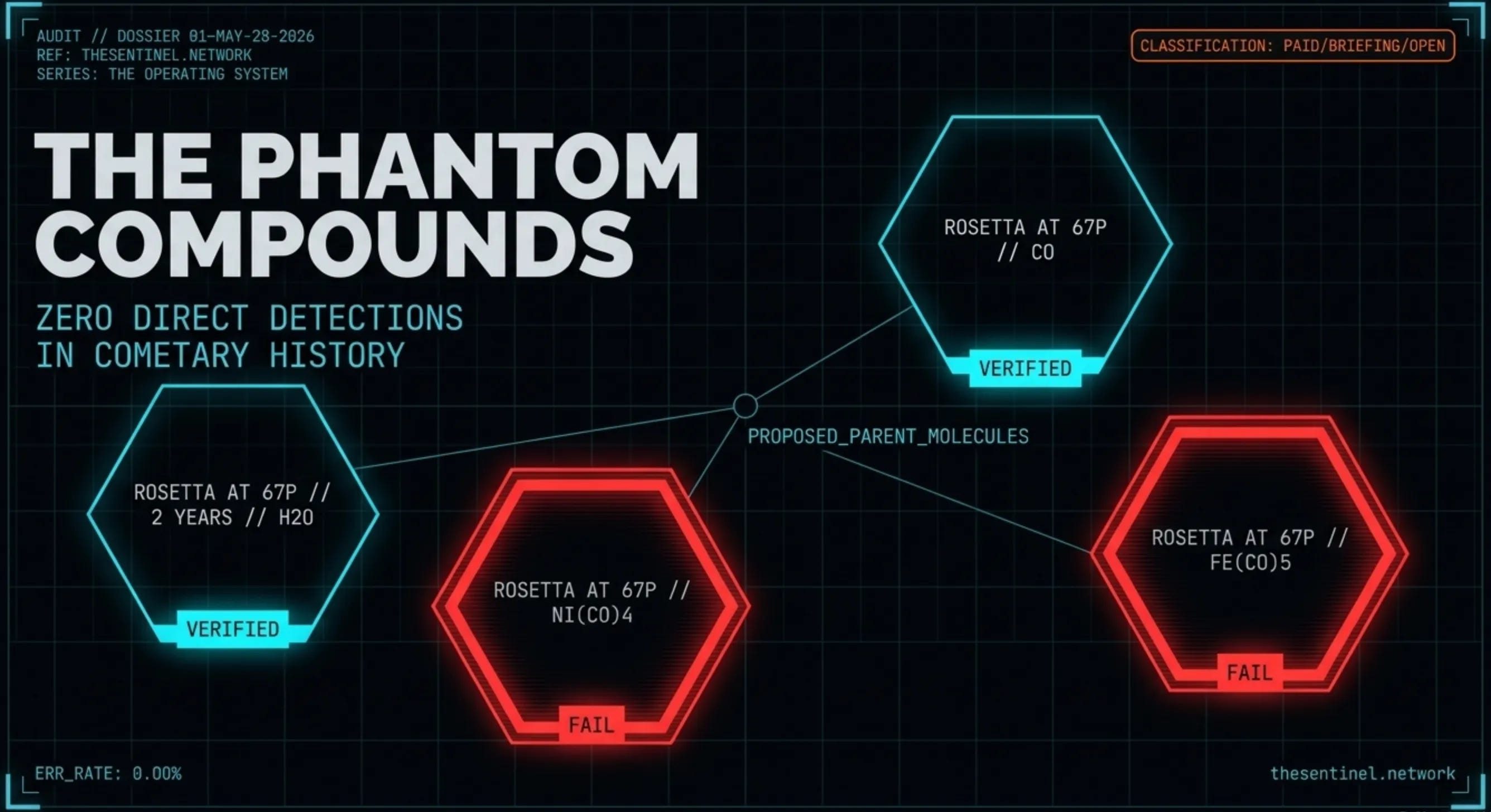
And in fifty years of cometary chemistry, those compounds have never been directly detected in any comet. Not in 3I/ATLAS. Not in any solar system comet. Not in comet 67P/Churyumov-Gerasimenko, the most thoroughly studied comet in human history.
The Rosetta spacecraft orbited 67P for two years. Continuous orbital presence. August 2014 to September 2016. It carried an instrument built to identify every chemical species in the gas around the nucleus. Rosetta produced a comprehensive inventory of 67P’s atmosphere.
It did not detect Ni(CO)₄ or Fe(CO)₅. Two years. Zero readings of the proposed parent molecules.
The Liège team acknowledges this directly in Paper II: “carbonyls have been found in the interstellar medium ... they have not yet been detected in cometary comae, including in comet 67P.”
Then they offer an out. 67P and 3I/ATLAS have different histories. A solar-system comet cycles through the inner solar system many times. An interstellar object passes through once. Different chemistry, the argument goes.
This is a fair argument. It is also a permanent loophole. Any future non-detection in any other comet can be dismissed on the same grounds.
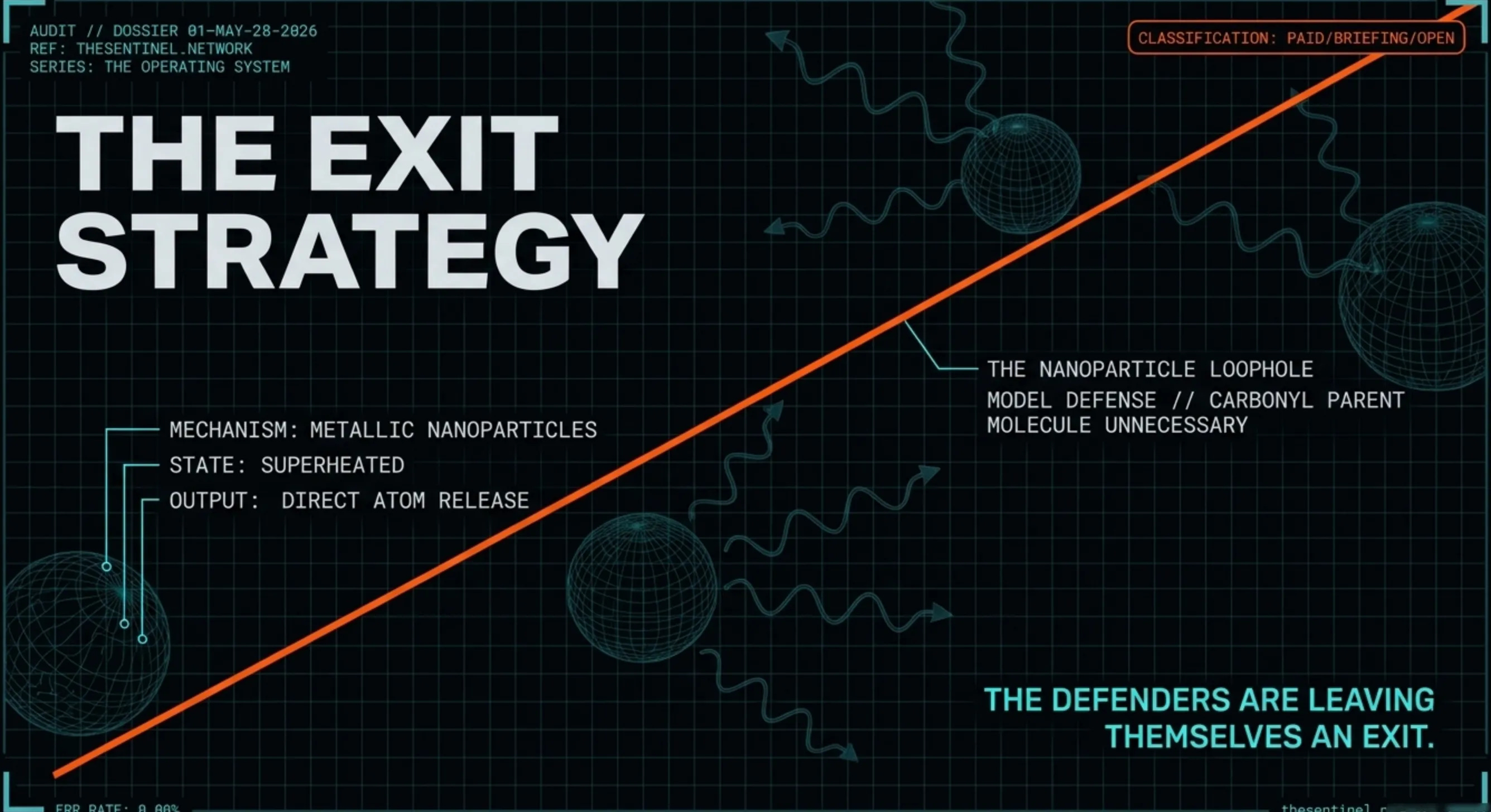
The team leaves themselves a second exit. From the conclusions section, verbatim: “alternative interpretations remain valuable and should also be investigated, such as the release of NiI and FeI atoms into the gas phase from superheated metallic nanoparticles.”
The cited mechanism has nothing to do with carbonyls. Tiny grains of solid metal float in the comet’s atmosphere. Sunlight hits them. They get much hotter than the surrounding gas. The hot grains release iron and nickel atoms directly. No carbonyl compounds required as the parent molecule.
The nanoparticle mechanism does not require sub-surface chemistry. It does not require a hand-fitted heat boost. It does not require carbonyls to exist in cometary chemistry at all.
The Belgian team has been refining the carbonyl explanation for cometary metals since 2021. Paper II is their most detailed application of it yet. And in the same paper, in the conclusions section, they preserve an exit toward a mechanism that makes their parent molecule unnecessary.
In the conclusions section. Of their own paper.
That is what model defense looks like when the data is putting pressure on the central hypothesis.
THE SENTINEL ASSESSMENT:
Ni(CO)₄ and Fe(CO)₅. The Belgian team’s proposed parent molecules for the iron and nickel atoms in 3I/ATLAS’s atmosphere. Zero direct detections in any comet, ever. In the conclusions section of their own paper, the team preserved a non-carbonyl alternative as a viable interpretation. The defenders are leaving themselves an exit.
THE GAP
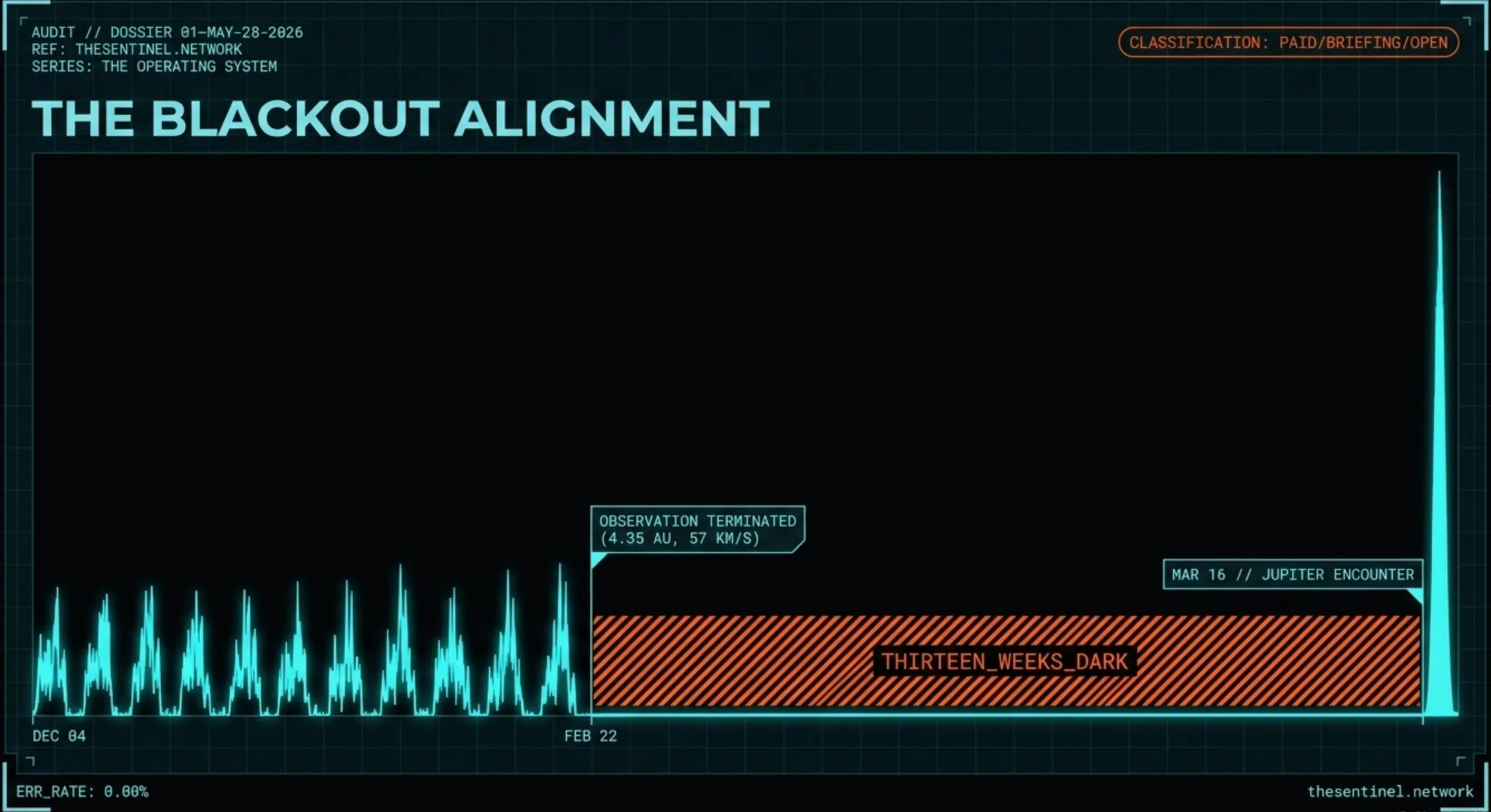
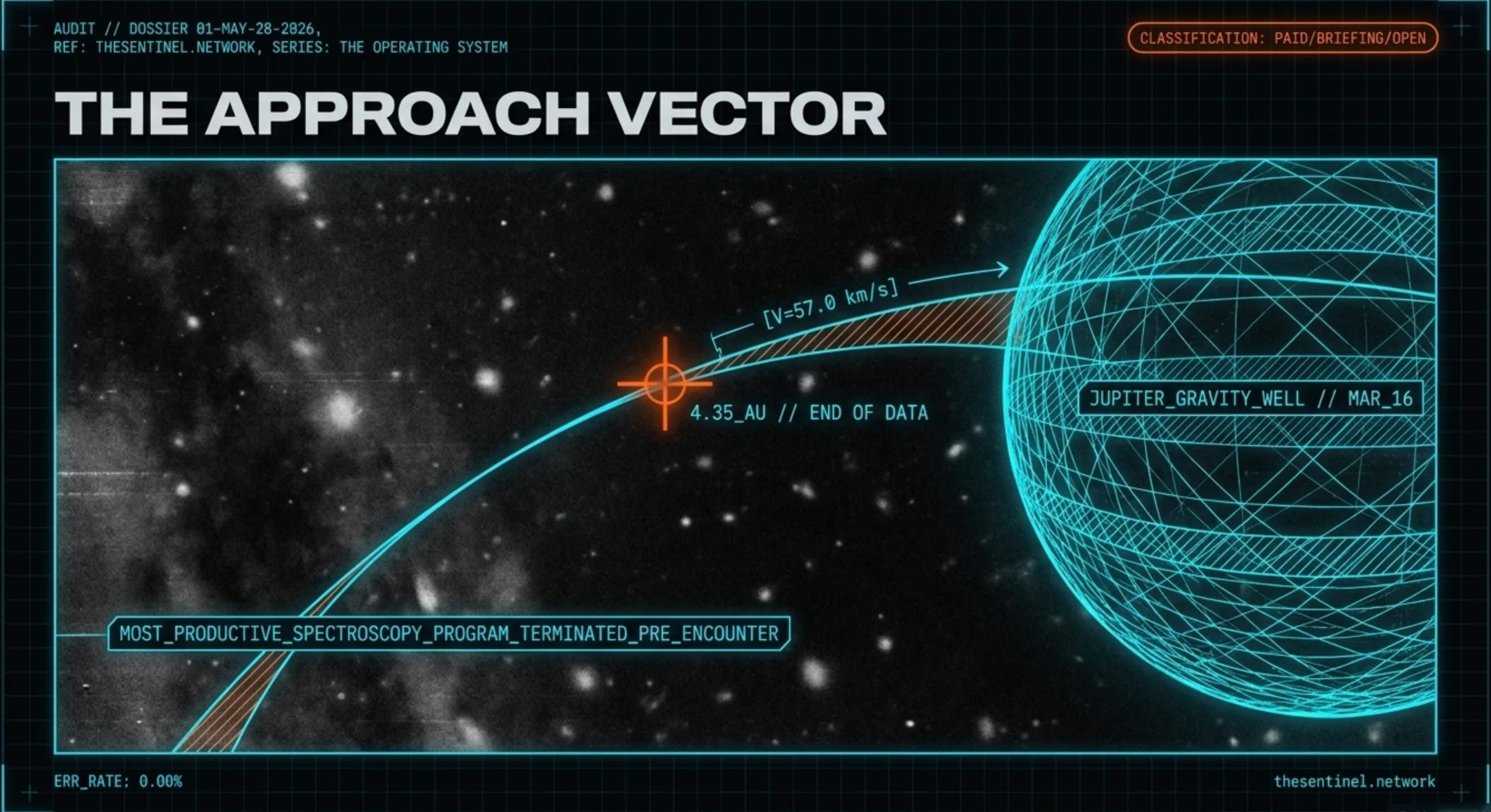
The Liège observations stop on February 22, 2026.
The comet was at 4.35 astronomical units from the Sun. Moving outbound at 57 kilometers per second. The signal was getting weaker but had not gone out. The team had been observing at regular intervals for nearly three months. The most exhaustive record of cometary metals ever assembled. Running actively on the largest optical telescope in the world.
They stopped.
Three weeks and one day later, on March 16, 2026, 3I/ATLAS made its closest approach to Jupiter. We documented the broader publication blackout around the Jupiter encounter in THE PUBLICATION GAP.
Paper II covers nothing past 4.35 astronomical units. There is no spectroscopy from after the Jupiter pass. There is no mention of whether observation was attempted, scheduled, denied, or considered. The ten weeks between the final observation and the publication of Paper II receive zero mention.
Other groups have published in this window. Roth et al. published JWST chemical maps in late March using December data. Biver et al. at IRAM published in April using November data. Ferrín et al. published the orbit-integrated mass budget covered in THE MASS RECEIPT on April 15 using data through January. Shinnaka et al. extended outbound spectroscopy to 2.87 astronomical units at the Subaru telescope on January 7.
Liège had a working instrument. An active program. The most exhaustive metals dataset on a comet’s atmosphere in the field.
They stopped three weeks before Jupiter.
Thirteen weeks later, their next observation has not been published.
We are not asserting that the Liège team was instructed to stop. We have no evidence to support that claim.
We are documenting that the most productive metals-spectroscopy program on an interstellar object in human history went dark immediately before the most consequential gravitational encounter of the entire transit.
And has remained dark.
The forensic question is not whether they were prevented from observing.
The forensic question is what they would have published if they had.
THE SENTINEL ASSESSMENT:
The most productive metals-spectroscopy program on an interstellar object in human history went dark three weeks before Jupiter. Thirteen weeks later it has not come back. The pattern documented in THE PUBLICATION GAP holds at the level of individual research programs. We do not know what observations exist past February 22. We know they have not been published.
Paper II is the most complete record of iron and nickel emission from 3I/ATLAS ever assembled. The architecture it describes is the architecture of a processed, layered, weathered body. The Belgian team built their model to defend a pristine comet. The model now describes something else.
We said in October that 3I has a processed, layered structure. We said in March that the data describes a machine. The Belgian team just confirmed the processed architecture from a completely different chemical pathway.
They are not arguing with us. Their own data is doing the arguing for them.
Keep looking up.
-- The Sentinel
Every briefing we’ve published is free. That’s not changing. This publication has no institutional backing, no sponsors, and no editorial board. We’re doing the work the newsrooms won’t, sourcing papers, filing FOIAs, building tools, and writing at the pace a once-in-a-civilization event demands.
Paid subscribers fund the investigation directly. They also get access to primary source documents, the comment section on every briefing, Fieldcraft Labs, and the FIELDCRAFT series, the tools and methods behind every investigation we publish. They also get THE SIGNAL, our weekly forward-looking market intelligence series translating Sentinel forensic work into capital-allocation analysis. No ads. No sponsors. No strings. Your subscription is a data point against the suppression gradient.
If you can’t subscribe, we don’t care. Read everything. Share everything. The mission is the mission.
Subscribe to The Sentinel Network™
A top 100 Science publication on Substack.
Share this briefing. THE SUPPRESSION GRADIENT documented what happens when this coverage reaches platforms that do not want you reading it. Every share, every restack, every forwarded link is a data point against the gradient.
Previous briefings: THE MISSING BIN | THE BLUEPRINT | THE MASS RECEIPT | THE REFINED FUEL | THE PUBLICATION GAP | THE OPERATING SYSTEM | THE ANCIENT ENGINE | THE VERDICT
Widening out the discussion to assess if I3/ATLAS is a technological device as some of the evidence indicates: The estimated age is a problem and considering its purpose seems a worthy area of study if more evidence proves out.
If it is indeed billions of years old, is it possible any technology could survive that long with operational efficiency? I'm skeptical of the age findings.
Where and why would it send its informational findings? Any civilization that built such a device would surely have long since died out even it it's only a few million of years old.
More likely in my view is that it is an automated seeding device - identifying biological presence on planetary bodies and seeding that body and/or its solar system with ... something.
If it is an automated military-style probe seeking out potential threats or places to relocate or conquer it would not directly approach the target but recon the surroundings first, perhaps in stages, and part of its function might be to send objects such as asteroids toward the target to assess planetary defense capabilities. It is this type of device it could be from a dead civilization with one of its robots still actively doing the job it was designed for.
I know TheSentinel does not engage in speculation but in nuts-and-bolts hard facts, but if the evidence over time proves it to be a device I look forward to its assessment as to its purpose.